


Stay Ahead With Linux Security Features
 security advisory attack
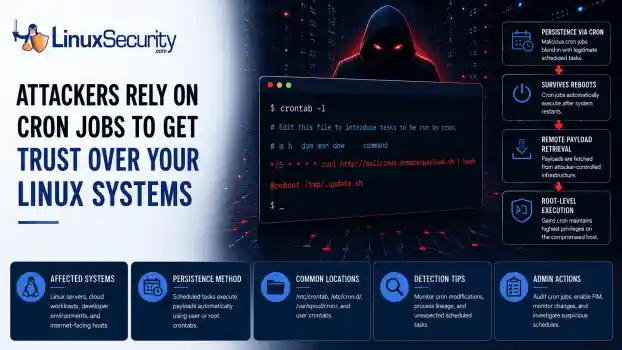
 A Linux server gets cleaned up after an intrusion. The suspicious process is terminated, credentials are rotated, and the system is rebooted during maintenance. Everything seems secure. A few hours later, the same outbound connection appears again. . Situations like that point to persistence . The attacker no longer needs the original exploit because something on the host continues restoring access behind the scenes. Finding that mechanism is often more important than understanding how the...
 Jun 08, 2026
 threat detection scalability
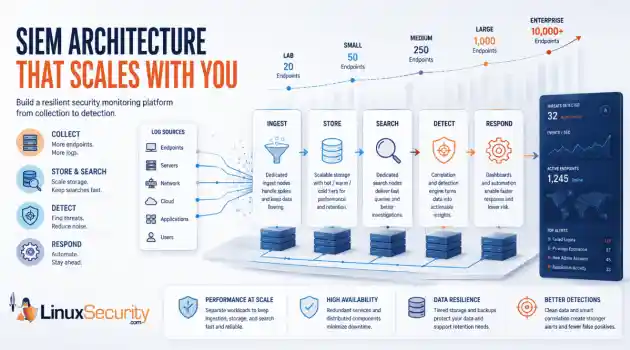
 Building a SIEM is easier than scaling one. Most open-source deployments start as a simple "all-in-one" server. It is easy to set up, but that design rarely survives the transition from a lab to a production workload. . A SIEM watching 20 endpoints is not doing the same job as one watching 500. More endpoints mean more logs; more logs require more storage; more storage makes search heavier. Eventually, the very architecture that made your lab easy to deploy becomes the reason your production...
Jun 04, 2026
 security advisory apache
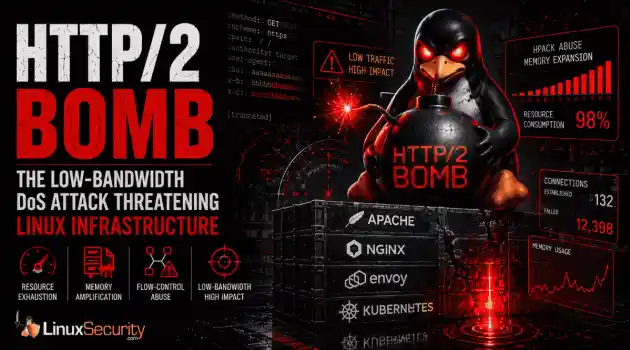
 A newly disclosed attack technique called HTTP/2 Bomb is drawing attention because it targets the software that sits at the front of much of the Linux internet. Apache HTTP Server, NGINX, Envoy, and the ingress layers that many Kubernetes environments depend on can be forced into consuming disproportionate amounts of memory using relatively small amounts of attacker traffic. . For Linux administrators, the concern is not the HTTP/2 protocol itself. It is the possibility that a single...
Jun 04, 2026
 security advisory important
 The compromise of Nx Console shows how much infrastructure now sits behind a single developer account. GitHub repositories, CI/CD pipelines, container build systems, Terraform projects, Kubernetes deployments. None of those systems was the initial target. The workstation was. . Attackers did not need a Linux privilege escalation bug or a remote code execution chain. They needed developers to trust a tool they were already using. For many organizations, that was enough. What Happened? Federal...
Jun 03, 2026
 security advisory open-source
 You remove the malware. You rotate the compromised credentials. You patch the original vulnerability and close the ticket. Two weeks later, the attacker is back. . What happened? You didn't lose the battle at the exploit; you lost it at the cleanup. In many modern Linux intrusions, the malware you found wasn't the main problem—it was the fallback mechanisms left behind. These hooks quietly restore attacker access the moment you look away. If you clean a host but miss these persistence layers,...
Jun 02, 2026
 Refine features
X Clear Filters
Get the latest News and Insights
Get the latest Linux and open source security news straight to your inbox.
Community Poll
What got you started with Linux?
Loading...
Explore Latest Linux Security features
We found -3 articles for you...
102
 patch managementSELinuxauthentication
Comprehensive Security Tactics for Linux System Administrators
As cyber threats rapidly advance, Linux administrators and InfoSec professionals are essential defenders against increasingly sophisticated threats. Protectors of critical infrastructure and sensitive data, these experts must implement a wide array of security practices designed specifically to their unique challenges. . Drawing upon knowledge shared at LinuxSecurity.com , this article discusses advanced Linux security practices designed to ward off today's most dangerous cyber risks. Why Is Staying Informed the Bedrock of Linux Security? Knowledge is power in cybersecurity; knowledge is protection. Linux professionals prioritize keeping abreast of threats, vulnerabilities, and security trends. For this reason, LinuxSecurity.com is an indispensable source of up-to-date information, offering insights to identify and address potential breaches preemptively. Senior administrators should go beyond passive news consumption; they should actively engage in security forums, subscribe to threat intelligence feeds, and connect with the broader cybersecurity community. Platforms such as CVE and NIST provide extensive databases of vulnerabilities and exposures paired with automated alert systems, providing real-time threat intelligence essential for early detection and response. Patch Management: Beyond the Basics Advanced Linux administrators understand that effective patch management requires a different approach than simply applying updates automatically; they consider their systems' individual needs and configurations when considering strategies. An effective patch management protocol begins with prioritization. Administrators can assess vulnerabilities using the Common Vulnerability Scoring System (CVSS) and then prioritize patches based on potential impact and severity. While automation tools may assist, human oversight is always required to ensure patches do not disrupt critical operations or introduce new vulnerabilities. How Is SELinux A Mighty Fortification for Linux Systems? Security-Enhanced Linux (SELinux) is a highly effective weapon in the Linux security arsenal, but its complexity often deters wider adoption. Yet SELinux offers unparalleled granularity regarding access controls for experienced professionals who need precise control over who has access to what on their systems. Crafting custom SELinux policies requires an in-depth knowledge of one's network architecture and threat model, but audit2allow can assist this process by analyzing log files to generate policy modules that reflect actual system usage while restricting any unauthorized actions. Why Is Authentication The First Line of Defense? Robust authentication mechanisms are integral to protecting Linux systems from unauthorized access, yet many organizations depend on password policies as their only protection. Advanced administrators should look beyond simple password policies by adopting SSH key-based authentication multi-factor authentication (MFA) and investigating Pluggable Authentication Modules (PAM) for enhanced control over accessing systems. MFA adds another level of protection by requiring two verification forms beyond just passwords or keys, such as hardware tokens or mobile app-generated codes in high-security environments. MFA can more easily distinguish between impenetrable and compromised systems than without additional layers of defense. Why Is Continuous Education and Training Essential? Human factors in cybersecurity can often be the source of instability. Offering regular training to users and administrators, regular and updated education on password hygiene and phishing awareness, and more advanced topics such as secure coding practices , social engineering tactics, and how to respond in case of a suspected breach can drastically decrease the risks of security breaches. Senior Linux administrators can lead by example and champion a culture of security vigilance while constantly honing their skills to stay ahead of emerging threats. What Is the Importance of ServiceHardening and Attack Surface Reduction? Service hardening refers to configuring system services and applications to reduce vulnerabilities while restricting unnecessary functionalities. For Linux administrators, this usually means running regular audits of running services, disabling or terminating unnecessary ones, and using tools like systemd-analyze security to analyze potential service vulnerabilities in depth. Reducing the attack surface requires implementing network segmentation, strict firewall policies, and least privilege models for system access. Each measure makes it harder for attackers to gain entry and move laterally across networks. How Does Data Encryption Protect Data at Rest and in Transit? Securing sensitive data at rest and transit is an essential security practice in an age when data breaches can have devastating repercussions. Tools like GnuPG can offer end-to-end file encryption, while Linux Unified Key Setup (LUKS) offers robust disk encryption solutions. Transport Layer Security (TLS) encrypts data in transit between servers and clients, thus protecting against eavesdropping and man-in-the-middle attacks. Linux administrators should use only robust, modern cryptographic protocols that have been reviewed regularly to ensure compliance. Why Is Automating Security and Compliance Beneficial? Manual security audits and compliance checks can be time-consuming and potentially inaccurate in complex environments. At the same time, automation tools like OpenSCAP offer a solution by continuously evaluating systems against established baselines and producing reports with remediation scripts to address any issues found. Integrating security testing tools into the CI/CD pipeline enables continuous security analysis, helping ensure new code deployments do not introduce vulnerabilities into production environments. Why Should Admins and Organizations Adopt a DevSecOps Culture? The DevSecOps movement advocates for integrating security practices throughout the software development lifecycle . For Linux administrators, this means working closely with development teams to ensure security considerations remain paramount from inception through deployment. Infrastructure as Code (IaC) tools like Ansible , Terraform, and Kubernetes are essential. They enable security policies and configurations to be codified within version control alongside application code for consistency, repeatability, and auditability of security configurations across environments. Our Final Thoughts on the Importance of Implementing Advanced Linux Security Practices Comprehending advanced Linux security requires an integrated approach that combines technical know-how, strategic planning, and constant monitoring. By adopting advanced practices like those found at LinuxSecurity.com and taking advantage of resources like these, Linux administrators and InfoSec professionals can drastically enhance their organization's cybersecurity posture. . Delve into cutting-edge Linux security measures provided by LinuxSecurity.com, enhancing your protection against the ever-changing landscape of cyberattacks.. Advanced Linux Security, Cyber Threat Protection, InfoSec Best Practices. . Dave Wreski
 Jul 20, 2024
•
Jul 20, 2024
•
102
 cyber threatsmalwareopen source
Why Open Source Email Security Solutions Are Essential for Your Safety
Is your solution doing enough to protect your users? This article helps you to decide. These days, the words “spam email” and “data breach” are commonplace. With an estimated 3.8 billion email users worldwide ( Radicati Group) , it is no surprise that scammers and cyber criminals frequently utilize email as a vector to carry out their attacks. Most email users are aware of this exploitation, and many have taken what they believe are the necessary measures to secure their email accounts. . It is a common belief that purchasing a spam filter or antivirus software eliminates the need for concern about email-related attacks. Sound familiar? Maybe you’ve taken additional measures and invested in a comprehensive email security gateway. If so, you have made a concerted effort to protect yourself from email-related harm and have likely reduced your chances of experiencing a successful attack. However, why stop there? There may be more you can do to mitigate your risk of being victimized by phishing, malware, BEC and other serious threats. From the software and technology that they are comprised of to the features they offer, email security solutions vary greatly in the protection they provide. Many email security gateways operate in a similar manner: identify and quarantine malicious email, thus preventing it from reaching the inbox. However, the technology used in this plays a significant role in determining accuracy and false-positives. These factors are critical when it comes to privacy and security. Open-source software is inherently more reliable and secure than proprietary alternatives due to the manner in which it is developed and reviewed. In regards to security, the accessibility of open source code enables developers and engineers around the world to view and critique open source projects. As a result, vulnerabilities and bugs are detected and fixed very rapidly. Email security solutions that are comprised of open-source software and that run on Linux are securefrom the ground up, as opposed to solutions that are made up of proprietary software and added security features, which often were not designed to work harmoniously. Thus, open-source email security solutions are innately secure by design . When evaluating an email security solution, it is imperative to consider the features it provides along with the technology it utilizes . Because email-related attacks have evolved to be highly advanced and difficult to detect, simply relying on a spam filter or an antivirus solution is not enough to keep you or your organization out of harm’s way. These features can be beneficial, but only if they are implemented as part of an advanced, comprehensive email security gateway. Many email security providers sell these features in an “a la carte” manner. While this does provide the customer with the freedom to select specific features and work within a budget, this approach fails to recognize the shortcomings of these features on their own. Furthermore, the products these companies offer often fall short of what open-source alternatives are able to provide in terms of security, efficacy and cost-effectiveness. Guardian Digital, the only open-source email security company, believes in a holistic, comprehensive approach toward securing email accounts. The EnGarde Email Security Gateway combines a myriad of advanced open-source features and technologies to provide complete, unrivaled protection in the midst of today’s scary and unpredictable digital threat landscape. EnGarde utilizes Big Data techniques, machine learning and advanced heuristics technologies, among many other state-of-the-art protective features, to identify both new and existing threats, including advanced persistent threats and zero-day exploits. The gateway rapidly and accurately identifies and quarantines malicious emails, ensuring that only safe and legitimate mail reaches the inbox. Moreover, the highest levels of encryption are used to prevent data loss. If you or yourbusiness prioritizes the safety of your information and, ultimately, your people, chances are you have taken measures to secure your email. The crucial question is: with both the prevalence and severity of email-related attacks on the rise, is your email really secure? . Open-source email security outshines traditional methods by offering flexibility, transparency, and cost-efficiency, empowering organizations to combat evolving threats effectively. Email Security, Open Source Solutions, Cyber Threats, Phishing Protection, Malware Prevention. . Brittany Day
Mar 05, 2019
•


Get the latest News and Insights
Get the latest Linux and open source security news straight to your inbox.
Community Poll
What got you started with Linux?
Search Topics
Powered By

Linux Security - Your source for Top Linux News, Advisories, HOWTOs and Feature Releases
QUICK LINKS
subscribe to newsletters!
Like staying secure? So do we.
Sign up for updates, tips, and alerts!
Discover faster search, smarter navigation, and deeper Linux security insights. Read More