


Stay Ahead With Linux Security Features
 security advisory attack
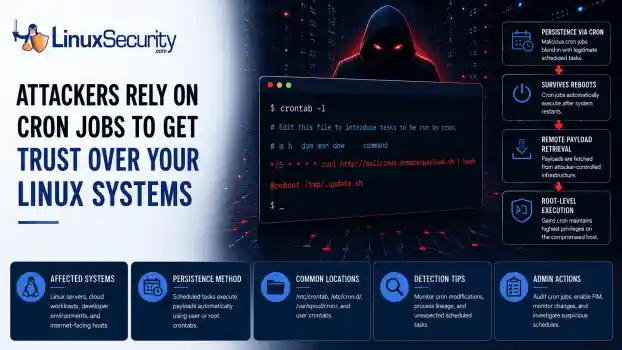
 A Linux server gets cleaned up after an intrusion. The suspicious process is terminated, credentials are rotated, and the system is rebooted during maintenance. Everything seems secure. A few hours later, the same outbound connection appears again. . Situations like that point to persistence . The attacker no longer needs the original exploit because something on the host continues restoring access behind the scenes. Finding that mechanism is often more important than understanding how the...
 Jun 08, 2026
 threat detection scalability
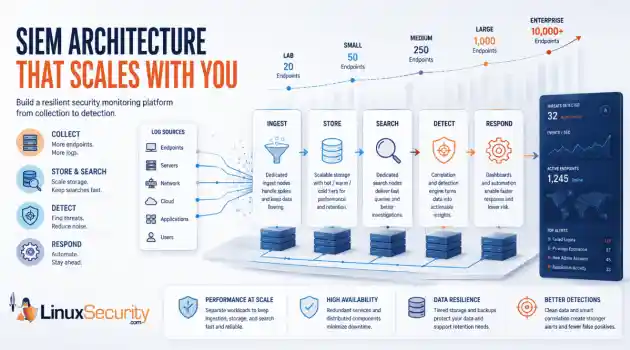
 Building a SIEM is easier than scaling one. Most open-source deployments start as a simple "all-in-one" server. It is easy to set up, but that design rarely survives the transition from a lab to a production workload. . A SIEM watching 20 endpoints is not doing the same job as one watching 500. More endpoints mean more logs; more logs require more storage; more storage makes search heavier. Eventually, the very architecture that made your lab easy to deploy becomes the reason your production...
Jun 04, 2026
 security advisory apache
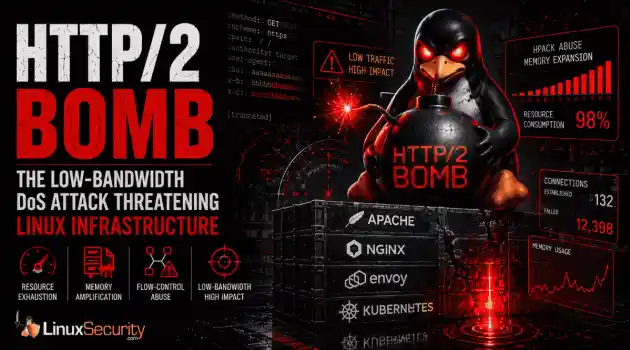
 A newly disclosed attack technique called HTTP/2 Bomb is drawing attention because it targets the software that sits at the front of much of the Linux internet. Apache HTTP Server, NGINX, Envoy, and the ingress layers that many Kubernetes environments depend on can be forced into consuming disproportionate amounts of memory using relatively small amounts of attacker traffic. . For Linux administrators, the concern is not the HTTP/2 protocol itself. It is the possibility that a single...
Jun 04, 2026
 security advisory important
 The compromise of Nx Console shows how much infrastructure now sits behind a single developer account. GitHub repositories, CI/CD pipelines, container build systems, Terraform projects, Kubernetes deployments. None of those systems was the initial target. The workstation was. . Attackers did not need a Linux privilege escalation bug or a remote code execution chain. They needed developers to trust a tool they were already using. For many organizations, that was enough. What Happened? Federal...
Jun 03, 2026
 security advisory open-source
 You remove the malware. You rotate the compromised credentials. You patch the original vulnerability and close the ticket. Two weeks later, the attacker is back. . What happened? You didn't lose the battle at the exploit; you lost it at the cleanup. In many modern Linux intrusions, the malware you found wasn't the main problem—it was the fallback mechanisms left behind. These hooks quietly restore attacker access the moment you look away. If you clean a host but miss these persistence layers,...
Jun 02, 2026
 Refine features
X Clear Filters
Get the latest News and Insights
Get the latest Linux and open source security news straight to your inbox.
Community Poll
What got you started with Linux?
Loading...
Explore Latest Linux Security features
We found -3 articles for you...
102
 Linux securityopen source toolsrisk mitigation
Enhancing Linux Security with Breach Simulation Techniques
Cybersecurity threats have reached a new level of prevalence and sophistication, and innovative methods and tools are urgently needed to protect sensitive information. Recent statistics are eye-opening: According to Statista, 2,365 recorded cybersecurity attacks in 2023, a surprising 72% growth compared to 2021. . As these attacks become increasingly advanced, traditional security measures must be more robust. Organizations must know the latest forensic Linux distro updates and adopt advanced security protocols that protect them from data breaches and operational disruptions. Breach and attack simulation, or BAS, is emerging in this domain as one of the best modern protection methods. In this article, we will discuss BAS, why it is so essential for Linux environments, and some of the most well-known open-source tools available. What is Breach and Attack Simulation? Breach and Attack Simulation , BAS, is a cybersecurity mechanism conducted to act much like real-world attackers. BAS permits an organization to identify the weak points of its security frameworks by simulating controlled cyberattacks. According to MarketsandMarkets, the BAS market is expected to grow at a CAGR of 22.1% during the forecast period, reaching $3.5 billion by 2032. BAS offers essential insight into an organization's security posture by emulating cybercriminal tactics. It provides a balance sheet of strengths and weaknesses, offering an overall perspective on the capability of security measures to withstand real cyberattacks. In this dynamic world of cyber threats, BAS is earmarked as one of the pivotal weapons in the cybersecurity armory. Why is BAS So Important in Linux and Open-Source Systems? Linux and open-source environments are a dream for an attacker, both because of widespread enterprise usage and due to some inherent vulnerabilities that might persist within the code contributions that occur in open-source. With BAS, organizations can stay one step ahead of cybercriminals by discovering what maygo wrong in the security framework before it happens. It is integral to proactive risk mitigation against data breaches , regulatory fines, and reputational damage. By emulating a range of attack vectors using comprehensive feeds of up-to-date data on emerging threats, organizations get to shore up the gaps in their defenses before those gaps can be leveraged. Most Famous Breach and Attack Simulation Open Source Tools for Linux BAS is a fundamental approach to cybersecurity improvement, and several open-source tools make implementing it possible. The following are some of the most well-known BAS tools for Linux: Metasploit Framework Metasploit Framework is generally regarded as among the most advanced open-source tools for penetration testing and security validation. It consists of tools intentionally developed to mimic actual attacks and assess a security posture. Its immense repository of publicly available exploits permits users to deliver various attack vectors against the exploited systems by crafting custom-made payloads. Critical capabilities of Metasploit include: Post-Exploitation Modules: Such modules provide post-exploitation information gathering, privilege escalation, and access maintenance. Automation Capabilities: It allows users to run scripts, increasing efficiency in security testing and information-gathering processes. Vulnerability Scanning: Metasploit is usually used to exploit any known vulnerability on a Linux system and to test the effectiveness of the available security controls. Start with Metasploit. Install it on any Linux system, open the framework, and use auxiliary modules for vulnerability scanning . Then, look for exploits, identify them, and launch them, using meterpreter to post-exploit. Infection Monkey Another well-known open-source BAS tool is Infection Monkey by Guardicore. This tool emulates various attack techniques to test the security of a data center or cloud environment from cyber threats. It identifies weakspots, misconfigurations, and gaps in an organization's security posture. Key Features of Infection Monkey: Lateral Movement Simulation: This feature exposes how an attacker can move inside a network after gaining initial access. Compliance Testing: Infection Monkey does compliance testing against CIS benchmarks , ensuring a system is securely configured. Customizable Attack Vectors: Users can define attack scenarios fitting for organizational needs. To deploy Infection Monkey, ensure your environment matches the system requirements. Then, clone the software from its GitHub repository , install the required dependencies, and open the user interface with a web browser, where you can create and configure attack scenarios. CALDERA CALDERA is an open-source, next-generation tool that provides automated adversary emulation, red teaming, and security assessment. It uses the MITRE ATT&CK framework to perform realistic attack scenarios and help organizations improve their security posture insights. Key Features of CALDERA include: Modularity: Caldera's modularity makes it extensible through plugins, allowing organizations to tailor simulations for threats specific to their concerns. Automation and Central Management: This is done by providing a server-side interface from which the administration of simulations is quickly done centrally. Realistic Attack Scenarios: Because its actions map to ATT&CK techniques, CALDERA helps an organization fix critical vulnerabilities in its defenses. For the use of CALDERA, target systems will need to have Python, Git, and Docker installed. A clone can be made from GitHub and placed in a virtual environment where one creates and installs the requirements to open a web interface to generate and execute attack scenarios. Understanding the Importance of Including BAS in Cybersecurity Strategies Organizations can no longer afford to implement only responsive cybersecurity measures. Proactive steps arecritical to protect digital assets. Some of the top benefits derived from integrating BAS into cybersecurity include: Enhanced Security Posture : BAS allows organizations to detect and fix vulnerabilities before attackers can leverage them. This proactive approach improves the security posture overall, lessening the chances of successful cyberattacks. Data-Driven Decision Making: BAS gives valuable insights to organizations through attack simulations, after which informed decisions can be made on investments and improvements in security. It facilitates resource optimization for them by prioritizing areas of enhancement. Improved Incident Response: BAS assists an organization in refining its incident response plan by emulating realistic attack scenarios. Teams will know where their response mechanisms are lacking and can incorporate improvements for swift and effective responses against live threats. Cost Savings: Proactively addressing vulnerabilities using BAS can save an organization millions of dollars in costs related to data breaches, regulatory fines, and damage to brand reputation. The investment made in tools and simulations can result in significant long-term savings. Our Final Thoughts on the Importance of BAS for Robust Linux Security With the increased Linux security threats, protecting digital assets requires advanced tools and techniques. For organizations to adapt to today’s evolving threats, Breach and attack simulation is necessary. BAS replicates real-world attacks to assess security postures and provide actionable insights. Tools like Metasploit Framework, Infection Monkey, and CALDERA will automatically help an organization identify weak links and thus improve security measures and incident response. Organizations must stay current on emerging threats and the tools required to mitigate them. Equipped with BAS at the forefront of their cybersecurity strategies, they are better set to navigate this complex world of cybersecurity successfullyand defend against an expanding array of attacks. In other words, adopting BAS is not an option but a necessity for organizations committed to robust security postures in this digital age. Are you using BAS to improve your cybersecurity strategy? We'd love to hear about it! Reach out to us on X @lnxsec, and let's discuss it. . As cyber threats grow sophisticated, organizations must adopt breach simulation techniques and tools to improve Linux security.. cybersecurity, threats, reached, level, prevalence, sophistication, innovative. . Dave Wreski
 Oct 31, 2024
•
Oct 31, 2024
•
102
 security toolslinux securityattack simulation
Advanced Breach And Attack Simulation Tools For Linux Security Strategies
Cybersecurity threats are becoming more imminent daily in today's fast-paced digital landscape. In 2023, there were 2365 cybersecurity attacks, an increase of 72% from 2021. These attacks are also becoming more sophisticated daily, making traditional security measures inadequate. . Companies must resort to more advanced security methods to prevent the loss of sensitive data and operational disruption due to security threats. In this article, we’ll explore how you can use Breach and Attack simulations (BAS), a cutting-edge cybersecurity technique, to protect your organization from cybersecurity threats. What Is Breach and Attack Simulation (BAS)? Breach and attack simulation, abbreviated as BAS, is a modern-day cybersecurity mechanism replicating real-world attackers' behavior. It's rapidly gaining popularity, with a market value projected to reach $3.5 million by 2032 with a CAGR of 22.1%. BAS technology allows you to simulate controlled cyberattacks to assess how ready your company’s security posture is against a real cyberattack. It copies real-world cybercriminals' tactics and helps point out your organization’s strengths, weaknesses, and areas for improvement when faced with cyberattacks. Why Is BAS Critical in Linux and Open-Source Ecosystems? BAS is critical for robust cybersecurity in Linux and open-source environments for the following reasons: Identifying Threats Proactively BAS allows you to stay one step ahead of cyber criminals by letting you identify potential vulnerabilities in your company’s security framework beforehand. These simulations are based on vast data on emerging threats and can implement various scenarios in your company. That way, your organization can mitigate the risk of costly data breaches, regulatory fines, and reputation damage before it even happens. It also facilitates a culture of constantly improving your security system, a need of the current dynamic cybersecurity world. Your security and IT team can conduct simulationsregularly and incorporate lessons learned in each iteration to identify repetitive issues in your system over time. With this iterative approach, you can build a strong security posture over time. Realistic Threat Scenarios Another significant advantage of BAS is that you can analyze your organization’s security posture. Unlike traditional tests of system vulnerability, which apply across the entire system, BAS has a more holistic approach to evaluating system security by launching a controlled attack on a specific aspect of your security infrastructure. You can use hacker TTPs, tactics, and procedures to identify blindspots you might not see unless an actual attack happens. Resource Allocation A holistic and iterative approach to improving your company’s security footprint means your budget is allocated more efficiently. With BAS, you can reallocate limited resources to address critical security issues. This will let you eliminate threats on a priority basis and significantly reduce the probability of an imminent damaging attack. What Are the Top Open-Source Breach and Attack Simulation Tools for Linux? BAS is a vital strategy in cybersecurity , and different tools facilitate BAS simulations. Here are some of our favorite open-source tools: Metasploit Framework The Metasploit framework is one of the most popular and powerful open-source tools for penetration testing and security validation. It provides a comprehensive suite of tools to stimulate real-world attacks and assess the security posture of systems and networks. In Metasploit, you have a vast repository of publicly available exploits for Linus and customizable payloads that can be delivered to exploited systems to perform various tasks, such as establishing remote access. It also has some auxiliary modules that perform scanning, fuzzing, and other types of testing without exploiting vulnerabilities. Post-exploitation modules are available for gathering information, escalating privileges, and maintainingaccess. Metasploit also allows for the automation of tasks using scripts. It is commonly used to scan for known vulnerabilities in Linux systems and stimulate attacks by exploiting known vulnerabilities to test the effectiveness of security controls. To stimulate attacks with Metasploit, install it on a Linux system and launch it. Use auxiliary modules to scan for vulnerabilities. After you search for, figure out, and launch exploits, use the meterpreter payload to perform post-exploitation tasks. Infection Monkey Infection Monkey is an open-source BAS tool developed by Guardicore. It stimulates various attack techniques to test the resiliency of data centers and cloud environments against cyber attacks. It also helps organizations identify vulnerabilities, misconfigurations, and weaknesses in their security posture. Its key features include attack simulation by lateral movement, which stimulates how an attacker can move within the network after gaining initial access. Similarly, it also tests the network’s susceptibility to credential theft attacks. Infection Monkey is also helpful in testing compliance with CIS benchmarks to ensure systems are configured securely. It identifies common misconfigurations that attackers could exploit. It allows customization of attack vectors to match specific threat models and organizational needs, and users can define custom payloads for more specific attack simulators. To deploy Infection Monkey in Linux, verify that your environment meets the system requirements for running Monkey Island and Monkey agents. You can clone the software from its repository on GitHub and install the necessary dependencies to set it up. You can access the interface through a web browser and follow the on-screen instructions to complete the initial setup and configuration. Then, you can define attack scenarios and start your simulation. CALDERA CALDERA is an open-source platform developed by MITRE to automate adversary emulation, red teaming, and securityassessment. It runs on the MITRE ATT&CK framework to simulate realistic attack scenarios, helping organizations understand their security posture and improve their defenses. Its key features include modularity through easily extendable plugins, flexibility, automation, and central management through its server interface. CALDERA utilizes the MITRE ATT&CK framework, a knowledge base of adversary tactics and techniques based on real-world observations. CALDERA maps its actions to ATT&CK techniques to create custom attack scenarios that reflect specific adversaries or threat models relevant to the organization. This allows you to gain insights into potential attack paths and vulnerabilities, focus on the most critical vulnerabilities and misconfigurations, and improve your defenses based on the simulation results. To run CALDERA, you will need Python, 3.6+, Git, and Docker on your system. Then, clone the CALDERA repository from GitHub and create and activate a virtual environment. Once you install the necessary dependencies, start the CALDERA server and access its web interface on a web browser. You can use the web interface to generate an agent for your target Linux machines, transfer it, and execute it. CALDERA can also create attack scenarios using ATT&CK techniques. How Can I Set Up and Run Simulations? Implementing breach and attack simulations in your company includes, but is not limited to, defining clear objectives, threat intelligence, and simulation tool selection, especially if your company has a Linux-based system. The first step to implementing BAS, or any advanced security framework in Linux, is to define the program's scope. This lets you determine whether your simulations will target Linux-specific attacks like malware or insider threats or run a comprehensive broad-spectrum attack scenario irrespective of the operating system. Once you’ve defined what purpose you want BAS to serve, you can select whether you want network-based, endpoint-based, or hybrid simulations. This choicewill also depend on your system requirements. Once you’ve chosen the appropriate BAS framework, you’ll have to test run several simulations and iterate to determine the more optimized testing for your system. You can use already-designed compatible simulation tools like Metasploit, OpenVAS , etc., to improve your system’s adaptability to BAS. Best Practices for Linux Security Validation Here are some practical tips for Linux Security Validation admins should implement: Frameworks and Methodologies for Structuring BAS Exercises BAS exercises continuously assess and improve an organization’s security by stimulating a real-world cyberattack scenario. One common BAS framework is the MITRE ATT&CK framework, which is helpful in mapping exercises to cover a wide range of tactics and identifying gaps in your current detection capabilities. Similarly, the NIST ( National Institute of Standards and Technology Cybersecurity Framework (CSF) is used for BAS exercises and has five primary functions: identifying crucial vulnerabilities, protecting assets by implementing controls, detecting cybersecurity events, responding to an incident, and recovering to ensure business continuity. Strategies for Effective Vulnerability Management Effective vulnerability management involves identifying, assessing, and systemically mitigating vulnerabilities. One common strategy is patch management, in which you must develop a comprehensive policy that prioritizes patches based on the severity of vulnerabilities. You can configure management tools like Ansible, Puppet, and Chef to automate this process and reduce human errors. You should also have a framework to prioritize vulnerabilities. One such framework leverages the Common Vulnerability Scoring System (CVSS) scores. When prioritizing remediation efforts, consider how critical your affected assets are. Continual Optimization for Threat Model Validation in Linux Systems You must regularly review and update your threat models for continuousoptimization. Ideally, you should update your models once every three months. Ensure the threat model contains all components and integrations and involves key stakeholders from development, operations, and security teams in the review process. You can use automated threat modeling tools like Pytm to automatically create and update threat models and integrate them into your DevSecOps pipeline. These tools help scale your threat modeling efforts in complex environments. Similarly, red team exercises where you stimulate sophisticated attacks are also crucial for threat model validation. Case Studies and Real-world Applications BAS can be successfully implemented on Linux platforms. Let’s take the case of a financial institution using Infection Monkey to improve the security of its Linux-based servers. It deployed Infection Monkey across the institution's data centers and stimulated lateral movement, credential theft, and privilege escalation scenarios. As a result, the institution identified several vulnerabilities, such as outdated software and weak passcodes. We can also take the example of a Tech Startup utilizing Metasploit for proactive security testing to analyze the improvement of security postures through open-source BAS tools. They used the Metasploit framework to test their Linux servers' security, including SQL injection, cross-site scripting (XSS), and remote code execution attacks. These simulations helped them discover critical vulnerabilities early in the development cycle, reducing the risk of exploitation in production. BAS can also mitigate ongoing security challenges. As cyber-]attacks evolve, attackers develop new techniques to bypass existing security measures. But BAS tools like CALDERA keep up with the latest attack techniques, ensuring simulations are relevant and up-to-date. They provide a realistic view of the current security measures. For example, a healthcare security provider that regularly updates CALDERA scenarios to include the latest ransomwaretechniques helps the provider stay ahead of emerging threats, significantly reducing the risk of successful attacks. Our Final Thoughts on the Importance of Comprehensive Security Validation & Attack Simulation Companies need to find ways to defend themselves from constantly changing dangers. Breach and attack simulations are one such tool. They allow you to evaluate and escalate cyber security measures by copying digital attack conditions similar to real-world hacks. Give some of these threat protection strategies and tools a try to secure your Linux systems and protect your critical data against Linux security vulnerabilities and attacks. . Investigate sophisticated breach and attack simulation methodologies to fortify defenses against changing vulnerabilities in Unix-based systems.. Breach And Attack Simulation, Linux Security Tools, Attack Simulation Techniques, Open Source Security, Cybersecurity Tools. . Brittany Day
Jul 27, 2024
•


Get the latest News and Insights
Get the latest Linux and open source security news straight to your inbox.
Community Poll
What got you started with Linux?
Search Topics
Powered By

Linux Security - Your source for Top Linux News, Advisories, HOWTOs and Feature Releases
QUICK LINKS
subscribe to newsletters!
Like staying secure? So do we.
Sign up for updates, tips, and alerts!
Discover faster search, smarter navigation, and deeper Linux security insights. Read More