


Stay Ahead With Linux Security Features
 security advisory attack
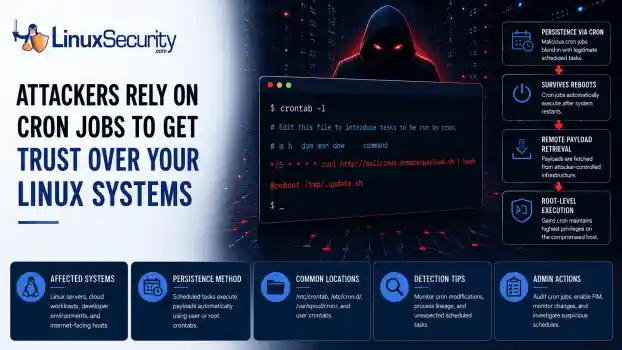
 A Linux server gets cleaned up after an intrusion. The suspicious process is terminated, credentials are rotated, and the system is rebooted during maintenance. Everything seems secure. A few hours later, the same outbound connection appears again. . Situations like that point to persistence . The attacker no longer needs the original exploit because something on the host continues restoring access behind the scenes. Finding that mechanism is often more important than understanding how the...
 Jun 08, 2026
 threat detection scalability
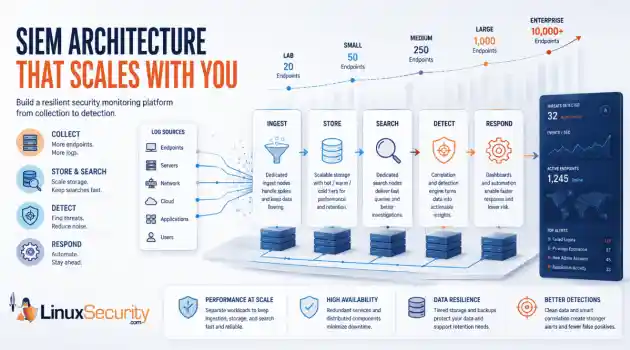
 Building a SIEM is easier than scaling one. Most open-source deployments start as a simple "all-in-one" server. It is easy to set up, but that design rarely survives the transition from a lab to a production workload. . A SIEM watching 20 endpoints is not doing the same job as one watching 500. More endpoints mean more logs; more logs require more storage; more storage makes search heavier. Eventually, the very architecture that made your lab easy to deploy becomes the reason your production...
Jun 04, 2026
 security advisory apache
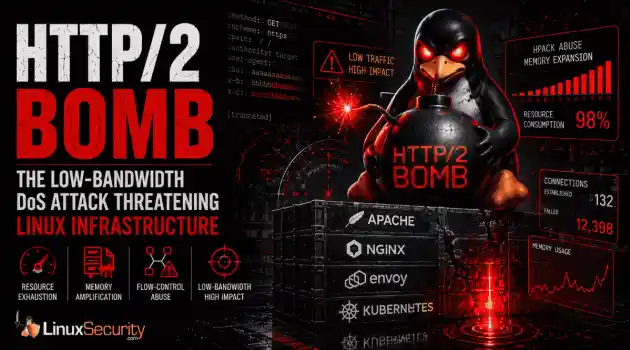
 A newly disclosed attack technique called HTTP/2 Bomb is drawing attention because it targets the software that sits at the front of much of the Linux internet. Apache HTTP Server, NGINX, Envoy, and the ingress layers that many Kubernetes environments depend on can be forced into consuming disproportionate amounts of memory using relatively small amounts of attacker traffic. . For Linux administrators, the concern is not the HTTP/2 protocol itself. It is the possibility that a single...
Jun 04, 2026
 security advisory important
 The compromise of Nx Console shows how much infrastructure now sits behind a single developer account. GitHub repositories, CI/CD pipelines, container build systems, Terraform projects, Kubernetes deployments. None of those systems was the initial target. The workstation was. . Attackers did not need a Linux privilege escalation bug or a remote code execution chain. They needed developers to trust a tool they were already using. For many organizations, that was enough. What Happened? Federal...
Jun 03, 2026
 security advisory open-source
 You remove the malware. You rotate the compromised credentials. You patch the original vulnerability and close the ticket. Two weeks later, the attacker is back. . What happened? You didn't lose the battle at the exploit; you lost it at the cleanup. In many modern Linux intrusions, the malware you found wasn't the main problem—it was the fallback mechanisms left behind. These hooks quietly restore attacker access the moment you look away. If you clean a host but miss these persistence layers,...
Jun 02, 2026
 Refine features
X Clear Filters
Get the latest News and Insights
Get the latest Linux and open source security news straight to your inbox.
Community Poll
What got you started with Linux?
Loading...
Explore Latest Linux Security features
We found -3 articles for you...
102
 security featuresopen-source solutionsautomation tools
Exploring Linux Cloud Solutions for Enhanced Business Efficiency
Cloud computing has significantly changed the business landscape as various organizations have benefited from the ability to harness scalable infrastructure, flexible storage, and high performance. . At the core of this change is Linux, an open-source operating system that is now the foundation of nearly every cloud computing platform. Due to its flexibility, security, and performance , Linux has gained significant popularity as an operating system in data centers. As businesses have slowly shifted to cloud computing, the demand for Linux will also rise. In this article, we’ll focus on using Linux in cloud computing, some of the powerful Linux cloud platforms today, and why Linux is advantageous for businesses in cloud computing. We will also discuss how solutions based on the Linux cloud can minimize software development costs and maximize business performance. The Rise of Linux in Cloud Computing Linux is, more or less, the foundation of cloud computing because of its open-source policy, flexibility, and scalability. When companies started moving towards cloud environments, Linux became optimal for operating large-scale distributed environments. A major driver of this growth has been the versatility of hardware on which Linux can operate, which is essential for virtualized environments that rely on cloud platforms. Furthermore, Linux's structure is quite simple, and its community is large, so the system is updated regularly, and new security patches are always available. This has placed Linux as the favored operating system for cloud platforms, thus fueling the expansion of cloud services. Currently, most of the cloud infrastructure, whether virtual machines or containers, runs on Linux, making the role of Linux in cloud computing clear. Why Is Linux Dominating Cloud Computing? The benefits of Linux in cloud computing cannot be overstated. Here are some key reasons why Linux has become integral to cloud computing. Open Source and Costs Since Linux is an open-sourceoperating system, businesses can implement cloud solutions while avoiding expensive license costs related to proprietary operating systems. This significantly lowers the cost of mobile app and software development, making cloud solutions affordable for startups and large enterprises. Open source also implies continuous development because developers worldwide update the Linux kernel and related software. Stability and Reliability Linux is well-known for its stability and reliability, especially for large-scale and business-critical applications. In cloud computing scenarios where availability and performance are crucial issues, Linux has a reliable and solid structure capable of providing very low downtimes and high performance, even when the loads are very high. Security Features Security is a significant issue in cloud computing, and Linux has integral firewalls, strong user authentication, and secure booting. Most cloud service providers in the United States also provide Linux distributions with a special focus on security, known as Red Hat Enterprise Linux and Ubuntu LTS. Scalability and Flexibility Small-scale and well-designed, Linux can smoothly be installed and run in any environment, from a virtual machine to a container. This is critical for organizations that need elastic cloud services to address dynamic business needs and application demands. Support for Containers and Microservices The use of containers and microservices is currently revolutionizing how applications are developed and hosted in the cloud. Linux has emerged as the leading platform for container applications primarily because of the compatibility of the operating systems with container technologies like Docker . It is particularly relevant for organizations considering cloud microservices adoption as one of their architectural styles. Automation and DevOps Tools Support Linux supports automation tools and DevOps, which allows businesses to apply continuous integration and deployment (CI/CD)processes . Most of the automated tools, such as Ansible , Puppet , and Chef , are compatible with Linux to enhance the automation of cloud infrastructures. This makes operations smooth, requires minimal human interaction for necessary changes, and shortens the development cycle, enabling businesses to quickly implement changes and new features. Four Popular Linux-based Cloud Platforms Several excellent cloud-based platforms are available to Linux users. Our four favorites are as follows: 1. Amazon Web Services (AWS) AWS continues to dominate the cloud services market, providing numerous services with Linux as the underlying technology. AWS was indeed one of the pioneer cloud platforms that realized the significance of Linux in the cloud for business and integrated Linux-based services as a primary service offering. Key Linux-based Services on AWS Amazon EC2 (Elastic Compute Cloud) is an AWS core service that enables the deployment of virtual servers. Customers can select from Amazon Linux, Ubuntu, CentOS, and Red Hat Enterprise. These virtual machines are quite manageable, as the organization can easily upgrade or downgrade them depending on its needs. Amazon ECS (Elastic Container Service): A container orchestration service that lets users schedule and manage Docker containers on a Linux platform. This service benefits organizations that want to grow and deploy their containerized applications. Amazon RDS (Relational Database Service): AWS provides Linux solutions for organizations to host MySQL, PostgreSQL, and other databases efficiently and securely. Benefits of AWS for Linux-based Cloud Solutions Scalability: AWS offers flexible capacity; this implies that any business can acquire, modify, or release resources based on its requirements. Global Reach: AWS has a vast infrastructure in various parts of the globe; thus, providing Linux services across different regions ensures low customer latency. Cost Management: When deployed in AWS,Linux costs nothing regarding software licensing since it is an open-source operating system, saving costs. 2. Microsoft Azure While Microsoft is mainly associated with Windows, Azure has gone all in for Linux in the past few years. Today, over 60% of Azure’s marketplace virtual machines run on Linux. Azure offers various Linux cloud computing services to help businesses leverage open-source flexibility. Key Linux-based Services on Azure Azure Virtual Machines (VMs): Azure has various Linux-based VMs, including Ubuntu, CentOS, Red Hat, and SUSE Linux distributions. These VMs are suited for large-scale applications, databases, and workloads in the cloud environment. Azure Kubernetes Service (AKS): AKS is Azure’s managed service for Kubernetes . It is based on the Linux environment and allows enterprises to manage and orchestrate containerized workloads. AKS fully supports the integration with Azure Active Directory to ensure security for cloud-native applications. Azure App Services: This is a platform-as-a-service (PaaS) mainly for the deployment of Linux-based applications. Developers can deploy code in languages like Node.js, Python, PHP, and Java on Linux-based infrastructure. Benefits of Azure for Linux-based Cloud Solutions Hybrid Cloud Support: Azure shines in hybrid cloud scenarios. Organizations can connect their on-premises Linux servers with Azure services seamlessly. Robust Security : Microsoft offers a comprehensive security layer for Linux applications on Azure, enabling enterprises to achieve compliance while adopting Linux's agility. Extensive Integration: Azure works cohesively with other Microsoft services, such as Microsoft 365, which could benefit business organizations that use Linux in their operations. 3. Google Cloud Platform (GCP) Google Cloud has supported open-source and Linux-based technologies since its early days. Linux remains GCP’s dominant platform, and the company offers diverse tools forLinux-based solutions, especially for containerized environments. Key Linux-based Services on GCP Google Compute Engine (GCE): Google’s IaaS provides an environment where Linux-based virtual machines can be run for business on a global platform. Debian, CentOS, Ubuntu, Red Hat, and SUSE are supported distributions. GCE provides flexibility in configuring a Linux environment while leveraging Google’s advanced infrastructure to meet business needs. Google Kubernetes Engine (GKE): GKE is a fully managed Kubernetes service offered by Google based on Linux containers. Kubernetes allows businesses to run and orchestrate extremely scalable and containerized applications with the support of the Google Cloud platform. Google Cloud Functions: Google Cloud’s serverless computing environment is Linux-centric, enabling developers to create and run event-based functions in languages like Python, Go, and Node.js. Benefits of GCP for Linux-based Cloud Solutions Performance and Speed: Google Cloud is known to provide performance-optimized infrastructure to run Linux-based workloads, especially for high-end services such as artificial intelligence, machine learning, and big data processing jobs. Cost Efficiency: Google Cloud has a reasonable pricing structure for its services, and combined with Linux, it makes software development costs easily manageable for businesses. AI and ML Integration: GCP’s Linux-based services are AI-optimized and fully compatible with Google’s AI and Machine Learning tools, making them ideal for businesses that want to build AI applications. 4. IBM Cloud IBM Cloud is another critical player that provides reliable Linux solutions for enterprises. Having actively contributed to the open-source community, IBM has been offering Linux-based cloud solutions for quite some time now. Their cloud offerings meet the needs of companies interested in a hybrid cloud model, artificial intelligence, and dynamic computing power. Key Linux-basedServices on IBM Cloud IBM Cloud Virtual Servers: These virtual servers offer flexible computing capacity derived from several Linux distributions, including Red Hat, Ubuntu, and SUSE. IBM Cloud is also closely connected to Red Hat OpenShift, which enables businesses to run Kubernetes workloads on Linux. IBM Cloud Kubernetes Service: Like AWS and GCP, IBM provides a KaaS service that runs on Linux. This service allows businesses to run containerized applications in a secure and highly flexible environment. IBM Watson: Watson, an AI developed by IBM, also uses Linux-based technologies. Through Watson, businesses can analyze data using machine learning and deep learning while still using the security and open-source flexibility of Linux. Benefits of IBM Cloud for Linux-based Cloud Solutions Enterprise-Grade Solutions : IBM Cloud was developed for enterprises emphasizing hybrid cloud plans, enabling organizations to simultaneously operate on-premises and cloud-based Linux environments. Security and Compliance : IBM Cloud has enhanced security features for Linux workloads, such as encryption, secure multi-tenancy, and comprehensive compliance. AI and Data Analytics : Combining IBM Watson with Linux-based cloud solutions gives enterprises an effective tool for implementing innovative AI solutions and gaining value from big data. Our Final Thoughts on the Benefits of Linux-based Cloud Computing Solutions Linux has become one of the primary pillars of cloud computing because of its stability, versatility, and expansibility for companies of any size. Whether you are a startup or a big corporation, using Linux-based solutions for your cloud environment will allow you to grow and protect your data while leveraging the modern technologies introduced by cloud services. The decision to adopt Linux for cloud computing is not only about technology but about making the right strategic decision to prepare your business for the future. . Linux leads in cloud computing withinnovations enhancing performance, cost efficiency, and security. Its open-source nature allows tailored solutions for businesses.. Linux Cloud Solutions, Open Source Computing, Cloud Infrastructure, DevOps Automation. . Anthony Pell
 Sep 14, 2024
•
Sep 14, 2024
•
102
 cybersecuritySELinuxsystem administration
Key Skills For Linux Administrators: Crafting A Standout Resume
If you’ve thought about becoming a professional Linux administrator but you’re not sure where to start, this article is for you. . In it, we’ll explore some of the most important skills expected of someone working in the role. Many of them you’ll already be familiar with, but some may surprise you. Much of our focus will be on cybersecurity and how to make sure you’re ready to deal with security issues from day one. We’ll also cover what sort of administrator skills you’ll need and look at what to include in your resume to give you the best chance of success. What Is a Linux Administrator? The typical Linux administrator’s business agreement contract won’t necessarily specify every aspect of the job description. That’s because the role involves being a jack-of-all-trades and every day is different. Broadly speaking, you’ll be responsible for overseeing every element of both hardware and software management, not only for the physical but also the virtual systems. On a day-to-day basis, that can mean sundry tasks like backup, building new systems, maintenance, configuring and installing new applications. On occasion, it will mean disaster recovery, which is not always the most fun day. One area that is absolutely crucial is network security. Any good Linux sysadmin worth the name will have a broad technical knowledge of the subject. What Linux Administrators Should Know about Security If you’re thinking about embarking on cybersecurity training for Linux systems, here are the fundamentals you should make sure are covered: Creating a good firewall policy Familiarity with Netfilter interpreters like ufw and firewalld is a good start. To have a full grounding in network-wide firewall implementation, though, you should be looking to acquire a solid understanding of both the iptables ruleset and nftables (which uses the nft command line tool). Even though nftables has superseded iptables to a certain extent, you’ll still come across manyiptables-protected networks in the real world, so it’s vital that you be able to work with them. Securing your Linux server Besides implementing an effective firewall, there are many other ways of securing your server, and you should be aware of all of them. Some of these are standard practice across the cybersecurity field e.g. good password hygiene, configuring 2FA, antivirus protection. But some are more Linux-specific. For instance, it’s important to disable the root login on a business server. That’s because the elevated administrative permissions can give cybercriminals a way in. Being able to use SELinux Security Enhanced Linux ( SELinux ) implements a Mandatory Access Control permission system in the Linux kernel. It was designed to protect against unauthorized use and is an integral part of every experienced Linux sysadmin’s toolkit. The SELinux status can be disabled, permissive, or enforcing (which you can think of as off/watching but not doing/watching and actively protecting respectively). Make sure you can use the getenforce command and the sestatus utility to find the system’s current status. Intrusion detection and prevention There are many Intrusion Prevention Systems (IPS) available whose primary function is to monitor network traffic and stop attacks. These have largely replaced the earlier Intrusion Detection Systems (IDS), which detected intrusions and sent an alert to the sysadmin but didn’t actually do anything else. Not very helpful. You’ll need a thorough knowledge of how to set up tools like OSSEC, Tripwire and fail2ban so that protection is set at the appropriate level. Configuring data encryption There are two approaches to data encryption with Linux: full-disk encryption, which encrypts the block device before it is mounted on the system, and file-based encryption, which encrypts a file or folder only using native filesystem features. For networks, you’ll usually be using full-disk encryption, so you should be aware of youroptions for implementing block device encryption. You can use LUKS (Linux Unified Key Setup) encryption in all modern installers. Using Pluggable Authentication Modules (PAM) It’s worth learning about PAM configuration files early on, so you land on your feet when dealing with advanced authentication and security considerations. Rather than having to write new authentication checks for each authentication method used by an app, PAM allows for a separate specialized authentication procedure to be used, whether the user is being authenticated via security certificate, biometric protocol like fingerprint identification and so on. Configuring Linux system auditing A vital weapon in the sysadmin’s security armory is the audit daemon (auditd). It generates log entries displaying information about what’s happening on the network. This helps you track potential violations of security. It’s important to know how to define audit rules, search the logs and create reports from the data provided. It helps you get to know your system much better and assists in the improvement of your security protocols. Knowing your vulnerability scanning tools Every system has its security flaws, and a crucial part of your role will be finding them before an attacker does. Luckily, there are many vulnerability scanning tools to choose from. At the very least, you should be familiar with OpenVAS, Archery and Lynis. Other excellent tools include Prowler (vuln), Safety, and salt-scanner. Being familiar with container security Because containers are so easy to implement, portable and simple to configure, you’re likely to use them often. They do share the host system’s kernel, though, which can become a potential attack vector. So it’s prudent to consider security on your Linux containers. Some angles of approach include employing user namespaces, SELinux MAC, restricting syscalls and setting resource limits. Conducting penetration testing The open-source nature of Linux means that thekinds of tools available for penetration testing are also often the same ones used by hackers themselves. So there’s really no excuse not to be prepared for a realistic attack scenario. Make sure you know all about the most common pentesting tools so you can use them fluently. These include Kali Linux, BackBox, Parrot Security OS, and BlackArch. Knowing your open-source SIEM tools SIEM (Security Information and Event Management) describes a security and auditing system that comprises a number of different analysis and monitoring elements. There are all-rounder solutions available (e.g. LogRhythm, QRadar, ArcSight) but they are expensive, so knowing what’s available in terms of open-source equivalents is a good idea. You’ll find you need to use several as they all tend to have different strengths and weaknesses. Upping your overall Linux cybersecurity skills To sum up, there are a few areas you should be focusing on when brushing up your cybersecurity skills. Broadly speaking, you can divide these into the following: System and network administration. Knowledge of regular expressions. Strong facility with SELinux and AppArmor. In-depth knowledge of open-source security tools. Bash scripting. Important Linux Administrator Skills that Should Be Included on Your Resume Feeling confident? Ready to fire up that online electronic signature software and sign your new contract? Hold on there just one minute; you haven’t got the job yet. Let’s take a look at the kinds of skills you’ll be expected to demonstrate to secure and shine at an interview. The most vital are: A clear understanding of OWASP: a good familiarity with the Open Web Application Security Project (OWASP) is fundamental to operating in this sector. Cloud computing skills: Cloud Ops are key in today’s workplace. Make sure you understand cloud architecture and migration, as well as how hybrid cloud environments work. Cyber security skills: these shouldinclude mitigation using Linux hacking software, as well as monitoring and prevention for possible DDoS attacks. Knowledge on APT (Advanced Package Tool) will also be useful. System monitoring and administration: VMware, MySQL, Python, and RHEL skills. Security Training and Certifications to Add to Your Linux Resume Knowing your stuff is one thing; being able to prove it quite another. Consider certification. The most commonly asked for certifications at the moment are: CISSP - Certified Information Systems Security Professional CISA - Cybersecurity and Infrastructure Security Agency CEH - Certified Ethical Hacker Why Making a Good Resume Can Help You Stand Out from the Rest as a Linux Administrator It’s a competitive industry and everyone needs an edge. Take the time to focus on sharpening up your resume so it really packs a punch. Remember the golden rule: tailor your resume to the role in question. Generic resumes tend to lack the kind of sparkle recruiters are looking for. It’s also vital to maximize your prospects by focusing on your strengths. If you’re relatively young, you may lack experience in the industry, so play up your qualifications and any hands-on projects you’ve succeeded with. On the other hand, more experienced candidates may need to focus on proving that they’re up to date with the latest developments in the sector. Ready, Set, Go! Being a Linux administrator is hugely rewarding. Sure, it’s a role full of challenges, and some days are harder than others. But you’ll never be bored, and if you have a true passion for Linux, there’s a job out there for you. So get yourself ready, make sure you’re all set, and yes – soon enough, you’ll be breaking out that contract generator software and hitting the ground running on your first day. Good luck! . As the need for skilled Linux admins grows, building a strong skill set is essential. Key skills include Linux OS knowledge, shell scripting, and system securityexpertise.. Linux Administrator Skills,Cybersecurity Skills,Firewall Management,Resume Building,Cloud Security. . Brittany Day
Oct 24, 2022
•


Get the latest News and Insights
Get the latest Linux and open source security news straight to your inbox.
Community Poll
What got you started with Linux?
Search Topics
Powered By

Linux Security - Your source for Top Linux News, Advisories, HOWTOs and Feature Releases
QUICK LINKS
subscribe to newsletters!
Like staying secure? So do we.
Sign up for updates, tips, and alerts!
Discover faster search, smarter navigation, and deeper Linux security insights. Read More