


Stay Ahead With Linux Security Features

 security advisory attack
 A Linux server gets cleaned up after an intrusion. The suspicious process is terminated, credentials are rotated, and the system is rebooted during maintenance. Everything seems secure. A few hours later, the same outbound connection appears again. . Situations like that point to persistence . The attacker no longer needs the original exploit because something on the host continues restoring access behind the scenes. Finding that mechanism is often more important than understanding how the...
 Jun 08, 2026
 threat detection scalability
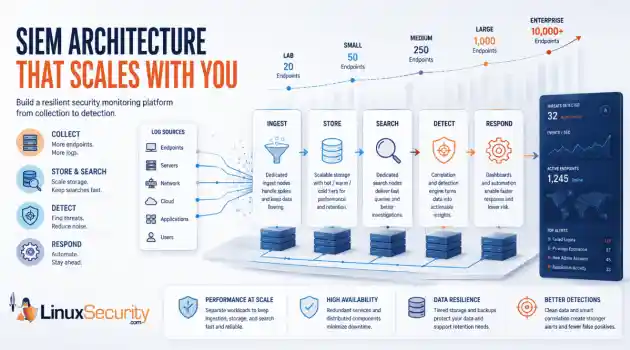
 Building a SIEM is easier than scaling one. Most open-source deployments start as a simple "all-in-one" server. It is easy to set up, but that design rarely survives the transition from a lab to a production workload. . A SIEM watching 20 endpoints is not doing the same job as one watching 500. More endpoints mean more logs; more logs require more storage; more storage makes search heavier. Eventually, the very architecture that made your lab easy to deploy becomes the reason your production...
Jun 04, 2026
 security advisory apache
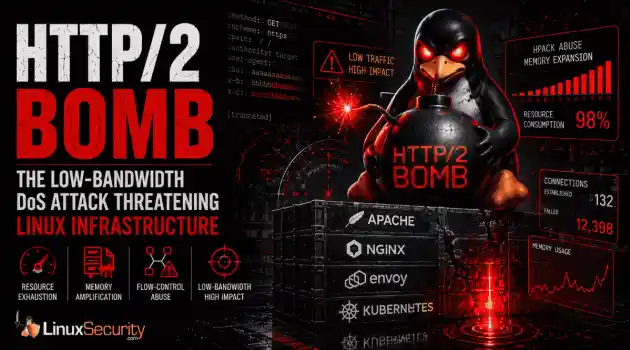
 A newly disclosed attack technique called HTTP/2 Bomb is drawing attention because it targets the software that sits at the front of much of the Linux internet. Apache HTTP Server, NGINX, Envoy, and the ingress layers that many Kubernetes environments depend on can be forced into consuming disproportionate amounts of memory using relatively small amounts of attacker traffic. . For Linux administrators, the concern is not the HTTP/2 protocol itself. It is the possibility that a single...
Jun 04, 2026
 security advisory important
 The compromise of Nx Console shows how much infrastructure now sits behind a single developer account. GitHub repositories, CI/CD pipelines, container build systems, Terraform projects, Kubernetes deployments. None of those systems was the initial target. The workstation was. . Attackers did not need a Linux privilege escalation bug or a remote code execution chain. They needed developers to trust a tool they were already using. For many organizations, that was enough. What Happened? Federal...
Jun 03, 2026
 security advisory open-source
 You remove the malware. You rotate the compromised credentials. You patch the original vulnerability and close the ticket. Two weeks later, the attacker is back. . What happened? You didn't lose the battle at the exploit; you lost it at the cleanup. In many modern Linux intrusions, the malware you found wasn't the main problem—it was the fallback mechanisms left behind. These hooks quietly restore attacker access the moment you look away. If you clean a host but miss these persistence layers,...
Jun 02, 2026
 Refine features
X Clear Filters
Get the latest News and Insights
Get the latest Linux and open source security news straight to your inbox.
Community Poll
What got you started with Linux?
Loading...
Explore Latest Linux Security features
We found -2 articles for you...
102
 network threatsemail securitycybersecurity practices
Interview With Guardian Digital CEO: Open-Source Email Security Insights
In this interview, Dave Wreski, Guardian Digital CEO and Founder discusses Guardian Digital's utilization of Open Source in the development of cutting-edge email security solutions and their advantages for your business email. . Security Spotlight: Interview with Dave Wreski, Founder and CEO of Guardian Digital Interviewed by Brittany Day Dave Wreski is the CEO and founder of Guardian Digital, a company that provides open-source email solutions to the many network security threats that impact individuals and businesses. Mr. Wreski started Guardian Digital as an Internet security enterprise offering open-source solutions to critical business problems in 1999 and has narrowed its focus on email security over time. Guardian Digital offers products that are highly effective in preventing phishing, spam, malware, and other attacks on network security. Dave Wreski is an expert in the field of email security, as well as an open-source advocate and active member of the Linux community. In this interview, he shares his knowledge of email security, email-related network security issues, and solutions Guardian Digital provides . Guardian Digital's email security solutions are unique in that they utilize open-source development and open-source software. What advantages does open-source email security provide over alternative proprietary email security solutions? There are multitudes of inherent advantages to using open-source development and open-source software that we provide to our customers so they can utilize them in their data and network security solutions. Compared to proprietary methods, open-source development often results in superior products because many developers are able to collaborate and improve upon ideas, leading to high levels of innovation in engineering. We believe open-source software is more secure over its lifecycle because of its transparency and accessibility. Open-source products with cybersecurity vulnerabilities are fixed rapidly upon detection. The specificopen-source programs we have chosen to use for our email security solutions have a long history of being highly secure, and any network security issues that existed prior to this were identified through peer review so they could be taken care of immediately. Open-source products are standards-based, making them freely accessible to everyone, unlike many proprietary alternatives. What are the shortcomings or downfalls of many email security solutions on the market today? In what ways is the email security that Guardian Digital provides superior? Guardian Digital’s email security solutions offer many advantages over our competitors’ solutions. We utilize a purpose-built operating system that is designed to be extremely secure. We stay updated on the latest cybersecurity trends so we can adhere to the latest standards in email security, which include implementing the highest level of encryption to protect information from unauthorized parties. Guardian Digital also provides the highest level of data and network security for email for no charge, unlike many companies that require customers to pay more for an upgrade. Can you talk a little bit about how being an active member of the Linux community has influenced your views on email security? How has Linux impacted Guardian Digital as an enterprise? We are very passionate about Linux and open source and have used it as the foundation of everything we do since our inception in 1999. Linux is an extremely reliable operating system with customizable software. As a result, we have always been an active member of the Linux community and give back as much as we can. One way we have done this is by sponsoring the development of LinuxSecurity.com, a website that Linux users can visit for the latest open-source updates and cybersecurity news. What do you feel are the biggest email-related threats that exist today? What do you recommend that companies do to protect themselves from these threats? How do the services that Guardian Digital offers protectorganizations from current email-related threats? Phishing is one of the most dangerous email-related network security threats because of the financial damage that can result from these types of scams. Phishing attacks in network security have become highly targeted and sophisticated, making them very difficult to detect. Spam is another significant problem because it has become so prevalent and negatively impacts all email users. Spam is difficult to detect and block and decreases worker productivity. Spam emails can convince people to share personal information or transfer money to criminals. Using a comprehensive, state-of-the-art email security solution like the ones that Guardian Digital provides is the most effective method of protection from any email-related network security issues. Guardian Digital's email security solutions are cloud-based. Can you discuss the various advantages of cloud services in regard to email security? Our open-source, cloud-based email security offers our customers various advantages. First, the server is built to be highly secure, adding yet another element of data and network security to our solutions. Emails must pass through an additional filter before they reach end users. We are able to store spam in the cloud, where we either eliminate it or quarantine it. We have developed highly secure cloud-based solutions to protect email accounts so that companies and individuals can focus on other aspects of business and life rather than whether or not they run the risk of facing cloud security breaches. Guardian Digital prioritizes top-notch customer service. In what ways is outstanding customer service a critical aspect of an effective email security solution? Offering our customers outstanding support and services is and always has been a priority for us. In many ways, the quality of the services we offer is just as important as the email security products we provide. Being an open-source email security company, we view the unrivaled service we offer our customersas the unique value that sets us apart from other enterprises. We realize email is a critical business function and have designed our services to ensure we’re there to help every step of the way with ensuring email is always secure. Guardian Digital is the first of its kind to take the best-of-breed network security toolkits in the Linux community and integrate them into enterprise email solutions with an intense focus on security and unrivaled customer support, designed to ease information technology overhead for its customers. It is this pioneering role we have played in engineering an unprecedented level of open-source security that has made Guardian Digital trusted by so many clients worldwide for almost twenty years. We don't just use existing programs but develop a whole infrastructure of services around them. We are continually at the forefront of the security field to ensure that our engineers preserve our leading-edge products and services as data and network security threats continue to evolve. . Discover insights from Guardian Digital's CEO, Dave Wreski, on how open-source solutions are transforming email security amid ongoing network threat challenges. Email Security, Open Source Solutions, Guardian Digital, Cybersecurity Practices, Cloud Services. . Brittany Day
 Mar 28, 2023
•
Mar 28, 2023
•
102
 information securityopen sourcedatabase
RavenDB 5.0: Security-Focused NoSQL Database Meets Open Source Innovation
RavenDB is at the forefront of data management innovation - leveraging open-source development and an intense focus on usability to offer efficient, versatile and highly secure database services to business application developers worldwide. The latest release of the open-source NoSQL document database, RavenDB 5.0, accommodates both local and hosted environments, and adds time series support and document compression to its robust feature set. . As open source security enthusiasts, we are particularly interested in RavenDB’s open-source approach to managing and securing data - and how this approach has enabled RavenDB to surpass competitors in areas including usability, integration and data security. To gain an in-depth understanding of the company’s latest release, we spoke with RavenDB Founder, CEO and Lead Developer Oren Eini about the defining features of RavenDB and RavenDB Cloud, some notable use cases, security considerations - and more. Secure, User-Friendly Data Management for Both On-Premise and Hosted Environments Through RavenDB 5.0 and RavenDB Cloud , the RavenDB 5.0 release brings efficient, integrated and highly secure data management supported by a robust feature set to both on-premise and database-as-a-service clients. All of the purpose-driven components that comprise RavenDB 5.0 were built from the ground up - resulting in a database that is fast, fully integrated and widely available. RavenDB also offers enhanced data security through usability - a defining characteristic that sets the database apart from its competitors. The company uniquely views support as a cost center as opposed to a revenue center. Insight gained through RavenDB support calls is used to modify the database to make such calls unnecessary in the future. Eini explains, “Viewing support as a revenue center disincentivizes vendors to create user-friendly products, which has drastic negative implications for data security. Usability and security are closely tied. Database breaches continuallydemonstrate that having complex security is equivalent to having no security at all.” Eini elaborates, “Our approach to security embodies operational simplicity and automation.” The Power of Community Another defining characteristic of RavenDB is the company’s transparent, open-source approach to development. Eini feels that RavenDB’s use of the open-source development model has both contributed to the popularity of the database and greatly enhanced its feature set. He explains, “Feedback provided by members of the open-source community has been pivotal in improving RavenDB. It is extremely beneficial to be able to engage in a proper discussion with a customer, and the fact that our entire codebase is open-source and available in our code repository has made it easy to get to the root cause of issues quickly.” Eini adds, “Being a part of the open-source community has also enhanced the features we offer. RavenDB’s automatic indexing support and transparent data encryption, for instance, were created by the open-source community and are now among the database’s central features.” The release of RavenDB 5.0 adds two key new features to a rapidly-expanding list: time series support, which enables users to track time serie s data, and document compression, a feature that analyzes documents to identify commonalities between them and efficiently compresses data between documents. The document compression feature cut cloud storage costs in version 5.0 by an impressive 50%. RavenDB vs. RavenDB Cloud: How Do The Two Compare? RavenDB 5.0 and RavenDB Cloud make the RavenDB 5.0 release ideal for developers looking to deploy an on-premise database, as well as those seeking a hosted platform. Eini explains the benefits of both scenarios, “For some users such as healthcare and financial institutions, having full control over the entire stack is important. Others need a database that can be deployed on the edge, where connectivity isn’t assured. For these users, the ability todeploy on location, without any external requirement, is very important.” He elaborates, “Running on cloud enables developers to push all the operations overhead to someone else, making it much easier to provision and make changes on the fly.” That being said, the on-premise and cloud versions of RavenDB are essentially identical, both running the same binaries and offering the same capabilities. In terms of security, both take similar measures to protect sensitive data, including X509 certificate authentication and encryption of all data over the wire, the ability to limit connections to specific IP addresses or ranges at the network level and full auditing support for all operations. RavenDB Cloud integrates a selection of additional awareness behaviors and automated security measures. Environmental information is incorporated into RavenDB instances to allow them to better calibrate themselves to environmental factors. For example, when using burstable instances, RavenDB Cloud reports the status of CPU credits to reduce background tasks when running low. In RavenDB Cloud, backups are encrypted by default, whereas the on-premise version of RavenDB requires users to select an encryption key if the database is not already encrypted. Despite these differences, Eini feels that the level of security that users can expect from RavenDB Cloud and RavenDB 5.0 is roughly comparable. He reflects, “The main difference is the additional steps that on-premise users have to go through. With RavenDB Cloud’s fully-managed services, virtually everything is done for the user.” He adds, “With both versions, we pay a lot of attention to the security of the system in general.” Although RavenDB Cloud offers a high level of convenience through increased automation and fully-managed services, the majority of RavenDB customers run on-premise or edge systems. Over 70% of these systems run on Linux, with the rest running on Windows servers. It is very common for RavenDB to be deployed on the edge. “RavenDBcan operate in a disconnected manner, but the data will be synced to a central location - usually on the cloud,” Eini explains. “We have a customer who has deployed RavenDB inside industrial robots running Raspberry Pi and another running RavenDB in a Point of Sale system.” RDI Software, a landmark RavenDB customer, has deployed the database on edge to over 36,000 restaurant locations, where the platform processes upward of 500,000 USD per minute. The company has a unique requirement for a database: robustness above all else. “The typical employee for a fast food restaurant is a teenager on minimum wage - not exactly your ideal IT worker. As such, we have to deal with very old hardware, used in often hazardous environments and operated by people with very little experience”, Eini explains. He elaborates, “RavenDB has been used in this capacity for over half a decade, because it is able to handle this situation and doesn’t require constant supervision. In particular, RavenDB’s zero admin capabilities mean that the database is able to adjust, independently, to each individual environment and behavior.” The Bottom Line RavenDB’s transparent open-source approach to data management and intense focus on operational simplicity make the database ideal for security-conscious users looking for a fast, user-friendly platform for business application development. Through RavenDB 5.0 and RavenDB Cloud, the RavenDB 5.0 release brings security, usability and efficiency to local and hosted environments alike. Visit ravendb.net to learn more about the database, and to download RavenDB 5.0 or RavenDB Cloud . Connect with RavenDB on social media: Twitter | Facebook | LinkedIn . RavenDB 5.0 is an advanced NoSQL database that enhances security, usability, and fosters open-source development, making it ideal for modern programmers. RavenDB, NoSQL Database, Data Management, Open Source Security. . Brittany Day
Oct 19, 2020
•

102
 email securityenterprise solutionsopen access
Exploring The Benefits of Linux-Based Cloud Solutions For Enterprises
Cloud technology and Linux-based cloud services are becoming increasingly popular due to the various benefits they offer in regard to security, efficiency, flexibility and convenience. . Cloud use offers enterprises a wide array of benefits ranging from higher levels of security to increased convenience. Cloud computing is an IT model that offers open access to shared resources and services that can be easily managed over the Internet. As opposed to relying on a direct connection to a server, an increasingly large number of businesses are choosing to utilize cloud technology because of the various advantages associated with this paradigm. In a survey of 1,000 IT executives conducted by the Uptime Institute, 50 percent of enterprise executives said that they expect the majority of IT workloads to shift to off-premise cloud sites in the future. Linux has played a critical role in the increasingly popular movement of services to the cloud. A myriad of cloud services including Apache CloudStack, OpenStack, Amazon Web Services and Google Cloud Platform run on Linux. As a result, Linux server application deployments have risen significantly. Guardian Digital has chosen to use Linux-based cloud services to provide customers with cloud-based comprehensive email security that protects against the latest and most sophisticated email-related threats. The company feels that cloud-based solutions offer inherent advantages in terms of security, efficiency, flexibility and convenience. Top 4 Advantages of Cloud Technology and Cloud-based Solutions According to Guardian Digital: 1. Security: In the cloud computing model, information is offloaded onto highly secure cloud servers. This minimizes the risk of data loss and interruptions in the case of an outage. Cloud-delivered security solutions are capable of using vast amounts of data in real time to provide adaptive protection against the latest threats. 2. Efficiency: Cloud services are extremely efficient. They require minimal initial investment and haverelatively low operating costs. This results in lower overall costs than on-premise alternatives. 3. Flexibility: Cloud technology offers flexible capacity that can be adjusted quickly and easily. The flexible capacity of Cloud services allows for flexible costs. Cloud security solutions can also handle very large amounts of data that could quickly overwhelm on-premise solutions. 4. Convenience: Cloud-based solutions are easy to manage and highly convenient for enterprises looking to prioritize other aspects of business. With Cloud technology, employees are able to work remotely without compromising security, thus minimizing risk and maximizing productivity for organizations. According to Forbes, cloud computing is projected to grow from $67 billion in 2015 to $162 billion in 2020. This trajectory reflects the value that cloud technology is providing to companies. Cloud services can benefit all businesses, and enterprises should invest in cloud-based solutions to effectively secure their email accounts from today’s complex email-related threats. . Utilizing cloud solutions provides businesses with numerous advantages, boosting safety, productivity, and accessibility.. Cloud Services, IT Efficiency, Security Solutions, Linux Technology, Cloud Computing. . Brittany Day
Jul 11, 2018
•

Get the latest News and Insights
Get the latest Linux and open source security news straight to your inbox.
Community Poll
What got you started with Linux?
Search Topics
Powered By

Linux Security - Your source for Top Linux News, Advisories, HOWTOs and Feature Releases
QUICK LINKS
subscribe to newsletters!
Like staying secure? So do we.
Sign up for updates, tips, and alerts!
Discover faster search, smarter navigation, and deeper Linux security insights. Read More