


Stay Ahead With Linux Security Features

 security advisory attack
 A Linux server gets cleaned up after an intrusion. The suspicious process is terminated, credentials are rotated, and the system is rebooted during maintenance. Everything seems secure. A few hours later, the same outbound connection appears again. . Situations like that point to persistence . The attacker no longer needs the original exploit because something on the host continues restoring access behind the scenes. Finding that mechanism is often more important than understanding how the...
 Jun 08, 2026
 threat detection scalability
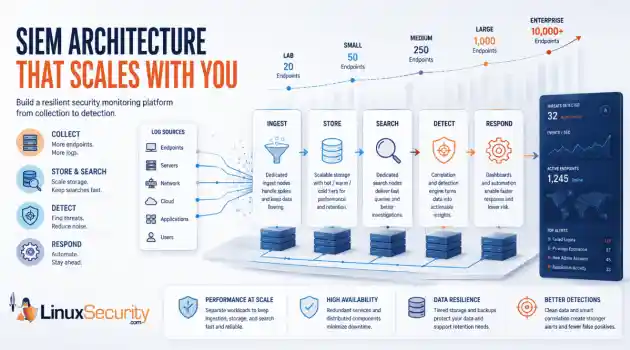
 Building a SIEM is easier than scaling one. Most open-source deployments start as a simple "all-in-one" server. It is easy to set up, but that design rarely survives the transition from a lab to a production workload. . A SIEM watching 20 endpoints is not doing the same job as one watching 500. More endpoints mean more logs; more logs require more storage; more storage makes search heavier. Eventually, the very architecture that made your lab easy to deploy becomes the reason your production...
Jun 04, 2026
 security advisory apache
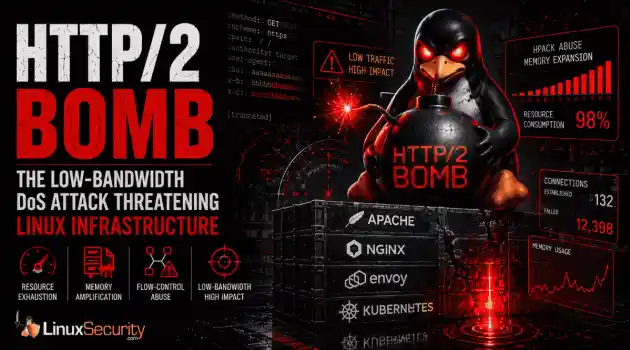
 A newly disclosed attack technique called HTTP/2 Bomb is drawing attention because it targets the software that sits at the front of much of the Linux internet. Apache HTTP Server, NGINX, Envoy, and the ingress layers that many Kubernetes environments depend on can be forced into consuming disproportionate amounts of memory using relatively small amounts of attacker traffic. . For Linux administrators, the concern is not the HTTP/2 protocol itself. It is the possibility that a single...
Jun 04, 2026
 security advisory important
 The compromise of Nx Console shows how much infrastructure now sits behind a single developer account. GitHub repositories, CI/CD pipelines, container build systems, Terraform projects, Kubernetes deployments. None of those systems was the initial target. The workstation was. . Attackers did not need a Linux privilege escalation bug or a remote code execution chain. They needed developers to trust a tool they were already using. For many organizations, that was enough. What Happened? Federal...
Jun 03, 2026
 security advisory open-source
 You remove the malware. You rotate the compromised credentials. You patch the original vulnerability and close the ticket. Two weeks later, the attacker is back. . What happened? You didn't lose the battle at the exploit; you lost it at the cleanup. In many modern Linux intrusions, the malware you found wasn't the main problem—it was the fallback mechanisms left behind. These hooks quietly restore attacker access the moment you look away. If you clean a host but miss these persistence layers,...
Jun 02, 2026
 Refine features
X Clear Filters
Get the latest News and Insights
Get the latest Linux and open source security news straight to your inbox.
Community Poll
What got you started with Linux?
Loading...
Explore Latest Linux Security features
We found -3 articles for you...
102
 security advisoryUbuntuimportant
CrackArmor AppArmor Flaws Put Linux Containers and Snap Sandboxes at Risk
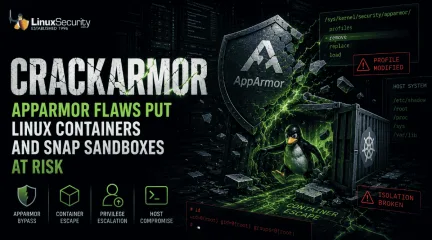
Linux administrators rely on AppArmor to contain compromised applications. If a browser, container, or Snap package is exploited, the profile is supposed to limit what that process can touch on the host. This mechanism is the backbone of Linux container isolation. . The newly disclosed “CrackArmor” vulnerabilities challenge that isolation model directly. Research from Qualys shows that attackers with local code execution may be able to manipulate or disable AppArmor protections entirely, turning a restricted process into a path toward host-level compromise. The Breakdown of Mandatory Access Control Traditional Linux permissions determine which users can access a system. AppArmor adds another layer by restricting what a process can do after execution begins through mandatory access control. Even a root process can still be blocked from accessing sensitive files, loading kernel interfaces, or initiating unauthorized actions if the profile denies it. CrackArmor matters because the AppArmor vulnerabilities target the framework itself rather than a single application or driver. The flaws affect the Linux Security Module (LSM) policy management interfaces and allow an unprivileged local attacker to abuse a confused-deputy condition to load, replace, or remove security profiles. By interacting with pseudo-files under /sys/kernel/security/apparmor/, an attacker may be able to alter enforcement behavior through privileged tooling that was never intended to expose direct profile control to lower-privileged users. This effectively bypasses the Linux sandboxing that administrators rely on for security. Why This Isn’t “Just” a Local Privilege Escalation CrackArmor is not a remote code execution worm by itself. The attacker still needs local code execution first. In practice, though, that initial foothold is often the easy part. A successful exploit of these flaws can result in a Linux privilege escalation. Common entry points include: Malicious scripts executed by users Browser exploit chains Vulnerable applications running inside containers Exposed development tooling or CI runners Once local execution exists, the AppArmor flaws can be chained with other weaknesses to bypass namespace restrictions or weaken Linux container isolation. In a multi-tenant infrastructure, that changes the impact significantly. There is currently no public evidence of widespread in-the-wild exploitation. Still, Linux privilege escalation and container escape paths remain high-value targets because they convert a limited foothold into persistent system access. Some of these flaws have reportedly existed since kernel v4.11, which was released in 2017, leaving a long exposure window across older deployments. Container Isolation Risks A realistic scenario involves a vulnerable web application running inside a Kubernetes security context, specifically a container protected by an AppArmor profile such as docker-default. An attacker exploits the application and gains shell access inside the container. From there, the attacker abuses the AppArmor policy handling flaw to trigger privileged profile operations indirectly, leading to a potential container escape. If the profile is removed or replaced successfully, the container may gain visibility into host resources depending on namespace configuration, mounted filesystems, and granted capabilities. At that point, the attack moves beyond the original container compromise and into host interaction, credential access, network inspection, or lateral movement activity. Effective Kubernetes security depends on these profiles remaining immutable to the processes they restrict. Ubuntu, Azure, and Snap Exposure Ubuntu security is heavily affected because AppArmor is enabled by default across much of the ecosystem. Snap Sandbox The Snap sandbox relies extensively on AppArmor profiles to isolate desktop and server applications from the host system. If these profiles can be manipulated, the core security promise of the Snap sandboxis broken. Azure Kernels Many Azure-focused Ubuntu kernels use AppArmor as part of the default workload isolation model for cloud deployments, making Ubuntu security a top priority for cloud architects. Kuberne tes Kubernetes security clusters frequently assume that AppArmorProfile enforcement inside Pod Security Contexts provides a stable isolation boundary between workloads and the host. AppArmor vulnerabilities that allow profile modification threaten this entire boundary. Remediation and Verification Canonical has released patched kernels under USN-8243-1. Applying updates alone is not enough. The patched kernel does not become active until the system reboots. Maintaining robust Linux sandboxing requires verified, active enforcement. Operational Actions Audit active kernels: uname -r Verify Kubernetes profile attachment: kubectl exec -- cat /proc/1/attr/current The output should show AppArmor profiles operating in (enforce) mode. Monitor for unexpected profile modifications through dmesg or journalctl -k, especially profile unload activity or denied operations involving the Linux Security Module filesystem. Apply updates and reboot affected systems: sudo apt update && sudo apt upgrade For organizations relying on mandatory access control, namespace isolation, or multi-tenant Linux infrastructure, delaying these updates leaves a path open for a container escape from local execution to broader system compromise. Stay Ahead of the Threat: Sign up for our newsletter for weekly deep-dives into Linux security, Kubernetes risks, and container escape threats. Kubernetes Container Security Misconfigurations Leading to Threats What Is a Container Escape Vulnerability? What Is AppArmor? A Practical Look for Linux Admins . The newly disclosed “CrackArmor” vulnerabilities challenge that isolation model directly for Linux containers.. AppArmor Security Flaws, Linux Container Security Risks, Ubuntu Kernel Updates, Local PrivilegeEscalation. . MaK Ulac
 May 07, 2026
•
May 07, 2026
•
102
 data breachsecurity techniquescontainer escape
Beyond the Sandbox: Container Escape Techniques Observed in Recent Research
Containers were sold on the promise of container isolation. Think of them like clean, separate rooms in a house where nothing leaks from one room to another. Most teams still operate on this assumption, believing that what happens inside a container stays there. . However, recent research from feeds like Packet Storm shows that these boundaries aren't as solid as we think. Often, a container "breaks" quietly. It isn't a loud crash; it’s just a single process stepping an inch outside its lane. When that happens, the "room" is no longer private. The cracks aren’t hypothetical. By looking at real-world activity rather than polished lab demos, we can see that attackers aren't usually doing anything revolutionary. They are simply finding small mistakes and chaining them together to walk right through the front door. The Reality of Container Escapes A container escape is exactly what it sounds like: a program running inside a container finds a way to reach out and grab control of the "host" (the main computer or server running the container). Once an attacker reaches the host, the game changes completely. The host can see everything: Other containers running on the same system. Secret passwords and keys (credentials). Network paths to other parts of the company. In real incidents, this "escape to host" step is often what turns a small, contained problem into a massive data breach that spreads across an entire network. How the Breakout Actually Happens There isn't one "magic" trick to escape a container. Instead, attackers use a series of small weaknesses. 1. Exploiting Container Runtime Security The runtime is the engine that starts and manages containers. When container runtime security is weak or the engine has a flaw, the container can "leak." A famous example is the Leaky Vessels set of vulnerabilities. Here, attackers used a simple trick involving "symlinks" (shortcuts to files) to fool the system into letting them touch files on the main host instead ofstaying inside their container. 2. Exploiting the Shared Kernel Containers are lightweight because they don't have their own "brain" or kernel; they share the host’s kernel. Think of it like the plumbing in an apartment building. Each unit is separate, but they all use the same pipes. If a pipe bursts in the basement, every unit is affected. The experts at Google Project Zero have documented how a single bug in this shared kernel can turn container access into full host access almost instantly. The Crypto Exchange Pivot In a real-world Unit 42 attack , attackers escaped a container, stole workload identities, and used them to move across the cloud. The container wasn’t the target, it was the entry point. Why These Attacks Still Work It is tempting to blame high-tech zero-day vulnerabilities, but the truth is more boring. Most escapes happen because of cloud misconfigurations. Common mistakes include: Privileged Containers : Giving a container "super-user" powers it doesn't need. Lazy Patching : Waiting too long to update software because "uptime" is more important than security. Excessive Permissions : Giving a container access to files or networks it will never actually use. The MITRE ATT&CK Containers Matrix maps out these exact techniques, showing that attackers simply use the doors we leave unlocked. What to Watch For You won't always see a warning light when an escape happens. Instead, look for these "smoke signals": Abnormal Mount Activity : If a container suddenly tries to access deep system files like /proc or /etc, it’s likely trying to find a way out. Suspicious System Calls : These show up early if you’re looking in the right place. A simple app doesn’t usually reach deep into the kernel, so when it starts asking for odd capabilities, that’s where things start to feel off. Network Behavior Shifts : A container that normally sticks to a database suddenly reaching out to an external IP is the kind ofdrift that lines up with compromise more often than misconfiguration. If you want to see how this gets weaponized, Exploit-DB is still one of the places people check for working code—the same payloads attackers lift and adapt to turn zero-day vulnerabilities into real access. A Pragmatic Way Forward This isn’t a panic situation. It’s cleanup, mostly, and a bit of discipline that tends to slip in fast-moving environments. Running privileged containers or using root access still shows up more than it should. It makes everything easier right up until it doesn't, handing over more control than most teams realize they've exposed. Patching runtimes quickly sounds obvious, but it’s where delays stack up. Updates sit and known issues stay reachable longer than they should, which is exactly the gap attackers look for. Keeping things simple does more than it sounds. If a container doesn’t need outbound access, cutting it off removes an entire class of problems. Conclusion: The Walls Are Not Solid Container isolation works well, but it isn't perfect. Container escapes are a real part of the modern tech landscape, not just a rare theory. Staying safe doesn't mean buying more expensive tools. It means changing how you think. If you assume the walls might leak, you’ll build better floors. Stay informed by tracking new threats and never assume the boundary will hold forever. . Recent insights reveal that container isolation boundaries are vulnerable, exposing systems to threats and breaches.. Container Security, Runtime Vulnerabilities, Cloud Misconfiguration, Cybersecurity Practices, Data Protection Strategies. . MaK Ulac
Apr 22, 2026
•


Get the latest News and Insights
Get the latest Linux and open source security news straight to your inbox.
Community Poll
What got you started with Linux?
Search Topics
Powered By

Linux Security - Your source for Top Linux News, Advisories, HOWTOs and Feature Releases
QUICK LINKS
subscribe to newsletters!
Like staying secure? So do we.
Sign up for updates, tips, and alerts!
Discover faster search, smarter navigation, and deeper Linux security insights. Read More