


Stay Ahead With Linux Security Features
 security advisory attack
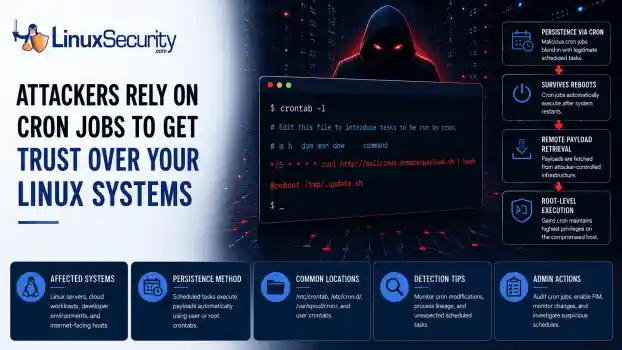
 A Linux server gets cleaned up after an intrusion. The suspicious process is terminated, credentials are rotated, and the system is rebooted during maintenance. Everything seems secure. A few hours later, the same outbound connection appears again. . Situations like that point to persistence . The attacker no longer needs the original exploit because something on the host continues restoring access behind the scenes. Finding that mechanism is often more important than understanding how the...
 Jun 08, 2026
 threat detection scalability
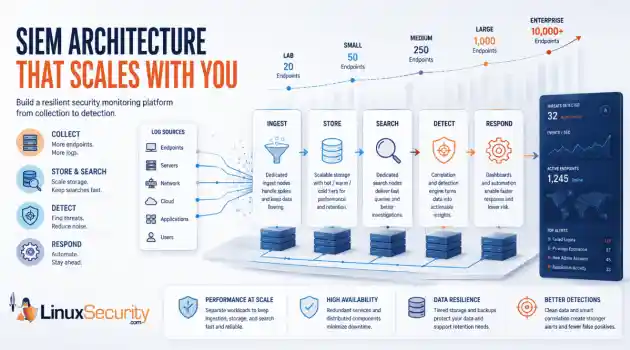
 Building a SIEM is easier than scaling one. Most open-source deployments start as a simple "all-in-one" server. It is easy to set up, but that design rarely survives the transition from a lab to a production workload. . A SIEM watching 20 endpoints is not doing the same job as one watching 500. More endpoints mean more logs; more logs require more storage; more storage makes search heavier. Eventually, the very architecture that made your lab easy to deploy becomes the reason your production...
Jun 04, 2026
 security advisory apache
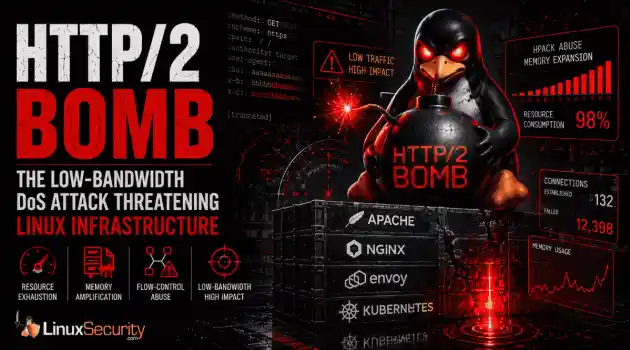
 A newly disclosed attack technique called HTTP/2 Bomb is drawing attention because it targets the software that sits at the front of much of the Linux internet. Apache HTTP Server, NGINX, Envoy, and the ingress layers that many Kubernetes environments depend on can be forced into consuming disproportionate amounts of memory using relatively small amounts of attacker traffic. . For Linux administrators, the concern is not the HTTP/2 protocol itself. It is the possibility that a single...
Jun 04, 2026
 security advisory important
 The compromise of Nx Console shows how much infrastructure now sits behind a single developer account. GitHub repositories, CI/CD pipelines, container build systems, Terraform projects, Kubernetes deployments. None of those systems was the initial target. The workstation was. . Attackers did not need a Linux privilege escalation bug or a remote code execution chain. They needed developers to trust a tool they were already using. For many organizations, that was enough. What Happened? Federal...
Jun 03, 2026
 security advisory open-source
 You remove the malware. You rotate the compromised credentials. You patch the original vulnerability and close the ticket. Two weeks later, the attacker is back. . What happened? You didn't lose the battle at the exploit; you lost it at the cleanup. In many modern Linux intrusions, the malware you found wasn't the main problem—it was the fallback mechanisms left behind. These hooks quietly restore attacker access the moment you look away. If you clean a host but miss these persistence layers,...
Jun 02, 2026
 Refine features
X Clear Filters
Get the latest News and Insights
Get the latest Linux and open source security news straight to your inbox.
Community Poll
What got you started with Linux?
Loading...
Explore Latest Linux Security features
We found 0 articles for you...
102
 data protectionencryption practicesdisk encryption
Disk Encryption: An Authoritative Guide for Linux Users
A lost Linux laptop or a recycled server drive can leak everything on it — from system files to sensitive data. Disk encryption changes that. It locks the entire drive, and nothing can be read until the right key is supplied. In this guide, we’ll look at what disk encryption does, how it works on Linux, where it helps most, and the options that are still worth using in 2025. . What Is Disk Encryption and Why Does It Matter Disk encryption turns the contents of a drive into unreadable code. Without the key, nothing on the disk can be accessed. Full disk encryption is the strongest form — see our sysadmin-focused guide for the deep dive. On Linux, the process is transparent once you log in. The operating system handles decryption automatically, so files open and save as they normally would. File encryption works differently. It lets you choose what to secure. Disk encryption takes the broader approach: it covers everything, including the operating system, swap space, and temporary files that users don’t usually see. Why does this matter? Because unprotected storage leaks data in ways people often overlook. A laptop left in an airport, a drive sent back for warranty service, or a retired server put into recycling can all expose sensitive information. With disk encryption, the hardware is locked. Without the key, it’s useless. Regulators recognize this. Frameworks like HIPAA and GDPR treat encryption as the standard for protecting data at rest, and fines often follow when it isn’t in place. How Disk Encryption Works in Linux Linux disk encryption protects everything written to the drive. Data is encrypted before storage and unlocked only after the correct passphrase is provided. To the user, the process is invisible. The system boots, the password is entered, and files open as if nothing special is happening. Underneath, everything on disk stays locked. Most modern distributions — Ubuntu, Fedora, Debian — rely on the same two components: Dm-crypt :handles encryption and decryption at the block level. LUKS2 : manages passphrases, recovery keys, and metadata to keep the setup consistent across systems. That pairing is now the baseline for linux disk encryption. It’s what makes the process seamless, whether you’re encrypting a laptop, a server, or even a removable drive. Performance used to be the trade-off. On older hardware, encryption could slow down disk operations noticeably. With today’s CPUs, AES instructions offload much of the work. In practice, the slowdown is small enough that most users never see it — but the protection it provides is significant. Disk Encryption Security Concerns Disk encryption keeps data safe on a powered-off or lost device, but it doesn’t block every type of attack. Once the system is unlocked, other risks come into play. Weak passphrases can be guessed or brute-forced. For example, a short password like “1234” can be cracked in seconds, even if the underlying encryption is strong. Standards bodies stress that a strong key matters as much as the cipher itself. Malware or keyloggers can steal the passphrase at the moment it’s typed in. Even with disk encryption in place, if malware is running on the system, it can capture the passphrase as you type. Phishing and supply chain exploits remain a real threat. Incidents like the supply chain attack targeting Telegram bots showed that attackers don’t need to break encryption if they can trick users or compromise the software supply chain. Unpatched operating systems open another door. Once the machine is running, exploits against an outdated kernel or library make the encryption irrelevant. Disk encryption stops data leaks from stolen hardware, but keeping a system secure also requires updates, monitoring, and careful handling of credentials. That’s why pairing disk encryption with strong passwords and regular updates is considered baseline security. Benefits of Disk Encryption for Linux Systems Thereal strengths of disk encryption show up in ordinary situations — the kind that don’t make headlines but still cause real damage when they go wrong. Lost or stolen devices . A laptop forgotten at airport security, or an external drive slipped into the wrong bag, won’t leak a thing without the passphrase. To whoever finds it, the hardware might as well be blank. Compliance . Regulators don’t care whether a breach happened by accident or through theft. Under HIPAA, GDPR, and CCPA, unencrypted data at rest is a violation. With disk encryption in place, the same lost laptop doesn’t trigger fines. End-of-life protection . Old servers and workstations often carry sensitive data long after they’re powered down. Destroying the encryption keys — a crypto-erase — wipes that data permanently. The drive can be resold or recycled without risk. Disk encryption doesn’t make a system bulletproof, but it takes some of the most common and costly risks off the table. Limitations of Disk Encryption While disk encryption is powerful, it’s not a cure-all. Users need to understand its trade-offs to use it effectively. Performance Impact of Disk Encryption on Linux : Disk encryption puts extra work on the system, and the impact shows up differently depending on the hardware. On an older desktop, copying a big folder can feel sluggish. On newer machines, the difference is usually small enough that most people won’t notice. Key Management Risks in Disk Encryption : If disk encryption keys are lost, the data is permanently inaccessible. Weak passphrases or missing backups create the biggest risks. Secure backups and multiple recovery keys are essential so one mistake doesn’t lock out an entire system. Why Disk Encryption Does Not Protect Data in Transit : Disk encryption protects data at rest but not in transit. Once the system is unlocked, files and memory are just as exposed as on an unencrypted machine. Malware and exploits can still steal information or move laterallythrough the network. Disk encryption won’t stop an attacker who steals data after you’ve logged in. Disk encryption does one job well: it protects the files on a drive if the hardware goes missing. Once the system is open and running, though, other risks take over. The risks and downsides of enabling full disk encryption It’s one of the strongest ways to keep data safe at rest — but it’s not without costs. Lose the keys, lose the data. A forgotten passphrase or a damaged LUKS header usually means the drive is gone. Backups are the only safety net. Performance isn’t free. Modern CPUs handle it well. On older hardware or in heavy I/O jobs, you’ll feel the drag. Recovery gets harder. Swapping disks, migrating, or fixing corruption takes more planning when everything is locked. Boot isn’t bulletproof. A misconfigured initramfs or an unsigned bootloader can give an attacker with hands on the machine a way in. Memory can leak. Cold-boot and side-channel attacks are still possible if a device is left sleeping instead of shut down. And once it’s open, it’s open. Malware, phishing, and remote exploits work the same on an encrypted system as they do on any other. Best practice: Back up keys and headers in safe places, use strong passphrases, lock down boot, and shut the machine off when you walk away. Encryption protects the drive itself — the rest still depends on you. Linux Disk Encryption Options in 2025 Linux offers a handful of disk encryption tools, but only a few are still worth using in practice. Tool/Method Best Use Case Pros Cons Status dm-crypt with LUKS2 Default on most distros Strong, well-maintained Some setup knowledge Recommended VeraCrypt Removable or cross-platform media Free, portable Not kernel-native Recommended Enterprise solutions Hybrid cloud / large fleets Centralized key management Cost, added complexity Recommended eCryptfs / loop-AES Legacy systems only Still found in old setups Weak defaults, outdated Avoid For most Linux users, disk encryption through dm-crypt and LUKS2 is the default. It’s built into Ubuntu, Fedora, and Debian installers and works reliably across laptops and servers. VeraCryp t still has a place when drives need to be moved between operating systems. Older tools like eCryptfs or loop-AES are mostly historical; they’re better replaced than deployed. Best Practices for Deploying Disk Encryption Getting the most out of disk encryption depends on how it’s set up and maintained. A few practical steps go a long way. Enable at OS install for a clean deployment. Back up recovery keys securely. Test recovery and crypto-erase before production. Use strong, unique passphrases. Don’t rely solely on FDE — combine with secure boot, patches, and backups. Handled this way, disk encryption stays reliable not just for lost devices, but across the full life of the system. FAQ: Disk Encryption on Linux Does disk encryption slow Linux? On a modern laptop, barely. Most CPUs have built-in instructions that take the load off, so you won’t notice it when browsing or editing documents. Copy a huge folder on older hardware, though, and the slowdown becomes obvious. Do I really need it on a personal machine? Yes. A laptop left in a coffee shop or an external drive forgotten at the office can expose everything on it. Disk encryption makes the device look like random noise until the right key is entered. How is file encryption different from disk encryption? File encryption is pick-and-choose. You decide which documents or folders to lock. Disk encryption covers the whole drive — even swap space and temporary files you never think about. That’s why it’s the standardchoice for Linux systems now. Conclusion: Why Disk Encryption Should Be Your Baseline The case for disk encryption is clear. It keeps stolen laptops from leaking data, meets compliance requirements under HIPAA and GDPR, and makes device retirement safe with crypto-erase. In 2025, linux full disk encryption is no longer optional — it’s expected. Most distributions include it by default, and it’s one of the simplest ways to keep your data safe. . What Is Disk Encryption and Why Does It Matter Disk encryption turns the contents of a drive into un. linux, laptop, recycled, server, drive, everything, system, files. . MaK Ulac
 Sep 23, 2025
•
Sep 23, 2025
•
102
 network securitydata protectionkey management
Enterprise Encryption for Linux: Best Practices and Key Strategies
As more organizations switch to remote or hybrid work environments, businesses have started to rely on cloud computing and mobility to secure their company. Therefore, endpoint encryption on Linux servers has become all the more valuable and necessary. However, companies must properly configure and manage their endpoint devices to prevent cybercriminals from breaching systems and stealing sensitive data. . We at LinuxSecurity spoke with WinMagic, a leading endpoint encryption provider, to discuss how companies can fortify their infosec architecture with effective endpoint security strategies. This article will discuss improving manageability and compliance in enterprise encryption using WinMagic SecureDoc for Linux, a comprehensive disk solution. FAQs: What is Enterprise Encryption? Enterprise encryption is a higher-ranked form of coding that protects the data in your files from cloud security breaches. While typical encryption focuses on device-related keys, enterprise encryption takes it to a different level by making everything in a server inaccessible without said key. Such a system ensures that you do not face attacks on network security that could harm your company, including data loss, significant downtime, and reputational damage. What is Enterprise-Level File Encryption? Enterprise-level file encryption expands full-disk encryption, preventing unauthorized access in an even larger cybersecurity landscape. Throughout a piece of data’s lifecycle, enterprise-level file encryption will keep the product safe so that you never have to concern yourself with the possible implications of a network security threat. Here are the ways an enterprise encryption strategy prevents issues during the data’s entire life: When data is At Rest , a company stores the information and does not actively pass it around devices and systems. When data is In Transit , a business transfers the information to another location, either in the server, across devices, or to storage. Whendata is In Use , an organization accesses the information regularly to update, view, and complete daily operations. Who Should Encrypt the Data in My Company? Typically, an administrator or employee of a higher ranking will be able to encrypt data. These workers know more about an organization's network security toolkits, so they can adequately implement and configure encryption keys in a business and keep data safe. What Enterprise Data Encryption Solutions Does Linux Offer? While Linux databases and endpoints are more secure than Windows cloud security frameworks, Linux is not entirely immune to malware attacks in network security and other threats. Malware incidents grew by over three hundred percent in 2020, and one in five Americans encountered ransomware. Linux endpoint encryption can only do so much to combat these threats. Cybercriminals started targeting Linux after realizing it was a secure network with a growing user base and powered various high-value systems worldwide. Therefore, organizations must protect their systems and information by utilizing robust security mechanisms on all Linux devices. What Capabilities Does Linux Disk Encryption Carry? Enterprises struggle with Linux’s built-in capabilities, as some employees might be confused about how to approach configuring the disk encryption options. Let’s review dm-crypt and LUKS and how users can implement their services on their Linux systems. dm-crypt is a transparent disk encryption subsystem within the Linux kernel. This block device-based abstraction is ideal for Full Disk Encryption (FDE). The encryption can work over other block devices and utilizes cryptographic routines from the kernel’s Crypto API to enforce and install the encryptions. Linux Unified Key Setup (LUKS) is a disk encryption specification that provides a cloud security framework for password management while being a platform-independent disk format that can use standard encryption headers to protectyour server. LUKS is an enhanced cryptsetup that operates on Linux as a disk encryption backend for dm-crypt. What Are The Best Business Key Management Strategies Companies Should Use? Meanwhile, dm-crypt and LUKS can formulate a strong password authentication FDE application. However, using these features is not an enterprise-grade solution. WinMagic highlights the additional needs you must implement into your data at rest protection on Linux. Strategy 1: IT Compliance and Centralized Management Be sure that your regulatory cloud security policies follow local and industrial cybersecurity standards so that your system monitoring prevents misconfigured compliance. Encrypt sensitive data and protect intellectual property, which can help in the long run to avoid leaving your employees and clients in a panic if your server encounters network security issues. The California Senate Bill 1386 was among the first of many U.S. and international security breach notification laws. The Bill required that organizations inform any victim of a breach of unencrypted personal information. Companies, however, do not need to notify the user of violations of encrypted information. Organizations must install a key management system to prove that all data is encrypted and does not require notification in the event of a breach. This centralized solution is crucial to ensuring compliance, protecting privacy, and creating a separation between higher and lower-level employees and their access to information. Implementing WinMagic SecureDoc for Linux can allow organizations to oversee all communications to guarantee your server encrypts all data. Therefore, the IT department has protection if devices or information goes missing. You must also formulate password recovery procedures, operations, and management on a central console so that you can back up all encrypted data. Strategy 2: Zero Trust on Linux with SecureDoc Zero Trust protects your server by automatically assuming all network trafficis suspicious. However, most companies do not implement the server to the highest degree, leaving organizations susceptible to network security threats that could be detrimental to a server. According to the US government, an effective encryption strategy values an encryption service combined with a memorandum guiding employees and businesses in the right direction. It can be challenging to follow Zero Trust recommendations, as it could lead to reduced productivity and increased costs associated with dedicating more time and energy to administering cybersecurity projects. Fortunately, comprehensive encryption solutions, like SecureDoc for Linux, can follow Zero Trust requirements without sacrificing your valuable resources. Here is a brief description of SecureDoc for Linux and the benefits it offers to users: Log in and work on disk machines during live encryption conversions. Enable a pre-boot network-based authentication system as an additional data and network security measure to protect your data during boot-ups. Remove keys on stolen devices to ensure cybercriminals cannot access information even with the correct credentials. Avoid reinstalling an operating system before commencing encryption. Monitor encryption status through readily available administrative portals. Allow AD and Azure AD users to log into encrypted devices. Reduce the necessity for pre-provisioned access on a device. Work on a central management system with the Enterprise Server that allows you to navigate Linux, Windows, and Mac endpoints. With these critical features of WinMagic SecureDoc for Linux, organizations can support an integrated Zero Trust strategy that fortifies their information security architecture. Strategy 3: Active Directory (AD) and Pre-Boot Authentication WinMagic SecureDoc for Linux allows organizations to use AD usernames and passwords to authenticate users during a pre-boot. Native Linux requires pre-boot passwords and can even demand a new passwordfor each volume on the system, preventing Linux from supporting AD solutions on its own. Strategy 4: Handling Compromised Devices with Crypto-Erasing Enterprises must protect their server by utilizing root volume encryption. However, native Linux FDE requires improved mechanisms to employ root volume services. Implement initial online encryption like SecureDoc for Linux to encrypt preinstalled Linux laptops by wiping the disk and reinstalling Linux with encryption enabled. Fortify cryptography cybersecurity to erase data from compromised devices and record such actions for compliance checks following an attack. What is WinMagic SecureDoc for Linux? SecureDoc for Linux offers scalable, enterprise-class, full-drive encryption for Linux endpoints. This defense-in-depth enterprise encryption for Linux has two main components: Encryption : Linux layers dm-crypt on native encryption to unify all enterprises and device platforms. Key Management : Smart Card has Multi-Factor Authentication at pre-boot that agency systems can implement to support phishing-resistant password policies. OMB Memorandum M-19-17 requires that organizations utilize PIV and Derived PIV10 as a primary security measure for entering Federal Information Systems. WinMagic VP of Technology and CISO Garry McCracken elaborates, "Linux has had built-in encryption for endpoints for several years. Yet, many enterprises struggle with encryption on Linux endpoints, such as reinstallation of the operating system before commencing on encryption, and some solutions only provide encryption for Windows devices. Our SecureDoc for Linux solution builds on the capabilities available in Linux (such as dm-crypt), providing an overarching layer of manageability, visibility, and automation that scales at an enterprise level and facilitates compliance." Our Final Thoughts on Enterprise Encryption Organizations must secure Linux endpoints in an information security architecture for their enterprise as dataand network security threats grow in severity and strength. Prioritize IT security compliance and management, Zero Trust, Active Directory, and crypto-erasing strategies to protect your server. SecureDoc for Linux can enhance built-in disk encryption capabilities with scalable, multi-layered endpoint encryption. Garry McCracken, WinMagic's CISSP, VP of Tech, and CISO, hosted an Enterprise Linux Encryption Management webinar with Dave Wreski, Guardian Digital's CEO and Linux Security expert, where they discussed how organizations can address Linux encryption management challenges with compliance and centralized key management issues. . Discover how WinMagic empowers Linux security through innovative encryption methods that ensure both compliance and ease of management.. Enterprise Encryption, Linux Security Strategies, Data Protection Methods, Endpoint Security Solutions. . Brittany Day
Oct 16, 2022
•
102
 system updateroot accessdisk encryption
Enhance Security On Ubuntu 22.04: Encrypt Drives, Update, And More
Thanks to the fact that Linux is open-source, it is one of the most secure operating systems available . However, it is not perfect—like any software, it is open to exploits and there is a lot that can be done to improve its security. Improving the operating system is not just for experienced users—there are some simple things that everyone can do to make Ubuntu Linux more secure. . Encrypt Your Hard Drive While a strong password is important for keeping your computer locked, it is not a foolproof way to keep your files secure—an experienced Linux user can access the files from a stolen laptop without a password. However, encrypting your hard drive makes it so that the password is not just a key to your computer but a code that is essential to accessing your files—without the password, any files that a hacker steals are impossible to read. Unlike the other tips in this article, full hard drive encryption must be done during Ubuntu’s installation—while it is possible to encrypt partitions after installation, it is not as straightforward—plus, it is not all-encompassing like full hard drive encryption. Below, we have a brand new image of Ubuntu 22.04. When you boot up your machine, whether it be on a physical device or a virtual machine, follow the set up as normal until you reach the screen shown below: After reaching this screen, make sure to click on the “advanced features” option under “Erase disk and install ubuntu”. Once you do so, you should be greeted with the following screen: Once the advanced features menu opens up, make sure to select the “Use LVM…” option as well as the Encryption option. Once you do so, hit OK and click the Install Now option. Afterwards, you should see a screen similar to the one below: Here, we want to establish a security key as well as a recovery key in case you forget the initial security key. For additional security, you can overwrite the empty disk space and being that this is all done at installation, your diskshould be empty. Once you have that all set up, you can continue with installation as normal and you should be all set, you now have disk encryption enabled! Update your Operating System Regularly While operating system updates are seen as a nuisance by many, keeping an operating system up to date is one of the most important measures that can be done to keep a system safe. A perfect example of the dangers of out-of-date software is the infamous WannaCry attack, in which a North Korean ransomware infected over 200,000 computers and caused hundreds of millions of dollars in damages in 2017. WannaCry only affected Windows computers that did not have the latest security update. While not all of the widely used versions of Windows had this update available, according to research from the Kaspersky Lab , 98% of users affected by WannaCry were using Windows 7, which did have the security update available. If these users simply updated their computers, they would not have been affected by one of the largest ransomware attacks. While Linux is generally more secure than Windows, it is just as important to regularly update Linux. Since Linux is open-source, anyone can search its code for bugs and help to fix them. This means that once an exploit in Linux is found, it will generally be fixed quickly, but it also means that it is important to update as soon as possible because the exploit will be known to the public. The easiest way to update Ubuntu is to run the software updater application. To update via the terminal, enter the command “sudo apt update && sudo apt upgrade -y.” Disable Root Access Linux is a command-heavy operating system—while an average user can use Linux and never see the terminal, it is still a powerful tool that can potentially give attackers full access to a computer. The unrestricted ability to run any command in Linux is known as “root access,” and can be safely disabled since it is not really needed most of the time. If root access isever needed, it can always be locked behind a password. To lock root access behind a password, open the terminal and enter “sudo -i.” When the next line, a # prompt, appears, enter “password.” This will give you the prompt for setting a root password. Disable unnecessary services Because Linux has been around for so long, it contains many leftover features that are outdated and no longer necessary. If allowed to run, these features can be a security flaw, especially if they provide access to ports. To list all services that are running in Linux, open the command line. See the below resources for more information on this: tldp How to List Services in Ubuntu Server / Desktop Safe Internet Browsing Nowadays, most browsers make a profit by selling their users’ data to advertisers. While this is usually unnoticeable by users, allowing websites to install data-collecting third-party cookies can make users open to attacks, phishing, and identity theft. Ubuntu comes with Firefox installed as the default browser. While Firefox is already a great browser for privacy, it is always good to disable third-party cookies. Additionally, browser extensions such as Adblock, HTTPS Everywhere, and NoScript can help make browsing the internet more secure. Adblock Adblock extensions disable advertisements on websites, making browsing the internet easier by hiding obstructing ads. They also prevent users from seeing malicious scam advertisements and disable third-party cookies. Popular adblock extensions include Adblock, AdBlock Plus, and uBlock Origin. HTTPS Everywhere Even though most people do not write “ before URLs anymore, the Hypertext Transfer Protocol is still used to connect to every website. Since 2008, websites have started to switch to the Hypertext Transfer Protocol Secure, or HTTPS, which encrypts traffic between the user and the site, and sites that only use HTTP are considered insecure. HTTPS Everywhere automatically switchesHTTP connections to HTTPS connections whenever it is available, helping keep internet traffic safer. NoScript While websites are still primarily built using HTML and CSS, they often have a lot of behind-the-scenes code written in languages such as JavaScript and Java. While there are many legitimate uses for these scripts, they are also one of the main tools used by malicious sites and hackers to run malware. NoScript disables scripts that are not from sites that users declare that they trust. Conclusion While Linux is a secure operating system by default, its ability to be customized allows for a multitude of ways to make it more secure. Making Linux more secure is something that anyone, not just cybersecurity experts, can and should do for the best and safest experience. . Fortify your Ubuntu system’s security by implementing drive encryption, ensuring regular updates, and managing root permissions meticulously.. Encrypt Hard Drive, Secure Ubuntu, Internet Browsing Tips, Linux Practices, OS Update Strategies. . Brian Gomez
Oct 10, 2022
•
102
data protectionfile encryptiondisk encryptionBest File & Disk Encryption Tools For Securing Your Data
As we rapidly transition to an increasingly digital society, data protection is a greater concern than ever before. Encryption is one of the most effective and widely used methods of securing sensitive information from unauthorized parties. In this article, we'll introduce you to some Linux file and disk encryption tools we love to help you safeguard critical data and protect your privacy online. . Linux File Encryption: A Foundation of Modern Data Security Attackers are becoming increasingly creative in the methods they are employing to gain access to sensitive information that can be monetized for personal gain. While almost 85% of malware attacks target Windows systems and Linux offers inherent security advantages over Windows or MacOS due to its transparent open-source code, strict user privelege model and architectural diversity, Linux is becoming an increasingly popular attack target due to its growing popularity and the high-value devices it powers worldwide. Linux Is Becoming an Increasingly Popular Attack Target While almost 85% of malware attacks target Windows systems, Linux is becoming an increasingly popular attack target due to its growing popularity and the high-value devices it powers worldwide. Now more than ever, Linux users should opt to add a layer of privacy in the form of file and disk encryption. Encryting files and folders ensures that data is unreadable and unusable - even in the event that your computer gets hacked. Luckily, there a number of great tools avialable to Linux users that make the process fast, easy and highly secure. Our Favorite File & Disk Encryption Software for Linux WinMagic SecureDoc for Linux SecureDoc for Linux is a Linux endpoint security solution that provides enterprise-class full drive encryption for Linux endpoints by separating encryption into two components - encryption and key management. The defense-in-depth solution works seamlessly with Linux native encryption, building on the capabilities available in Linux (such asdm-crypt) to provide an overarching layer of manageability, visibility, and automation that scales at an enterprise level and facilitates compliance. SecureDoc for Linux supports a Zero Trust strategy, tackling the challenges associated with implementing Zero Trust recommendations by allowing initial live conversion of disk permitting admins and users to log in and work on the machine while encryption occurs. SecureDoc also reduces IT management costs by enabling a pre-boot network-based authentication as an additional security measure to ensure data on drives is never left unprotected during boot-up. In addition, SecureDoc provides damage control for lost or stolen devices by removing keys to ensure data cannot be accessed even with the right credentials. Some of the core features of SecureDoc for Linux include: Live disk conversion allows admins and users to log in and work on the machine while encryption occurs. Removes the need to clear the disk and reinstall the operating system before commencing encryption Encryption statuses are monitored and available centrally in a single pane of glass admin portal. SecureDoc enables pre-boot network-based authentication as an additional security measure to ensure data on drives is never left unprotected during boot-up. Supports Smart Card based MFA at pre-boot (e.g., PIV cards) SD Linux makes it easy for AD and Azure AD users to log into encrypted devices. Login to encrypted devices without having to be pre-provisioned for access on the device. SecureDoc Enterprise Server provides a simple central management for all OS endpoints, including Linux, Windows, and Mac. CryFS CryFS is a free and open-source cloud-based tool that lets you encrypt your files and store them anywhere. Setting it up is a breeze and it is compatible with popular cloud services like Dropbox, iCloud, OneDrive, among many others. CryFS works in the background - so you won’t notice it when accessing your files. This tool doesn’t just encrypt your files- it alsoencrypts your file sizes, metadata, and directory structure. The base directory contains a configuration file with the information CryFS requires to decrypt it. This configuration file is encrypted twice: once with aes-256-gcm and once with your chosen password. This same password will also be used for integrity checks. Cryptmount Cryptmount is a user-friendly open-source disk encryption tool that lets beginners encrypt a specific filesystem without requiring superuser privileges. It uses the dev mapper mechanism, which offers several advantages such as improved functionality in the kernel, transparent support for filesystems stored on either raw disk partitions or loopback files, separate encryption of filesystem access keys which allows access passwords to be changed without re-encrypting the entire filesystem, as well as the ability to store multiple encrypted filesystems within a single disk partition using a designated subset of blocks for each. Cryptmount not only allows users to protect important filesystems, but also makes it possible to swap system space. Multiple encrypted filesystems can be “mounted”, or made active, or “unmounted”, or deactivated, depending on the users’ immediate needs. This is particularly useful when working in an encrypted environment, but not wanting to mess around with your system’s inbuilt partitions. You can learn how to install and configure Cryptmount on your Linux system in this Tecmint tutorial . Cryptsetup Cryptsetup is an open-source utility made to easily allow users to set up disk encryption basedon the DMCrypt kernel module. This module includes plain dm-crypt volumes, LUKS volumes, loop-AES, TrueCrypt (including VeraCrypt extension), and BitLocker formats. It uses the standard LUKS (Linux Unified Key Setup) design to protect against low entropy attacks and provide multiple keys support and effective passphrase revocation. The use of LUKS also allows compatibility among distributions as well as multiple password security. LUKSstores all necessary setup information in the partition header, allowing users to easily transport or migrate data. Dm-crypt Dm-crypt, which operates under the GNU General Public License (GPL) , is great for encrypting entire disks of information, including removable media such as USB sticks, internal OS partitions and individual files. Some Linux distributions even allow Dm-crypt to encrypt and secure root system files. Because Dm-crypt only deals with transparent encryption of block devices, it is much more flexible than other encryption tools. One particularly great feature of the dm-crypt system is that it doesn’t have to work directly with a disk driver. Instead, it can save all data to a single file as opposed to using LUKS and a whole disk partition. Thus, you can have dm-crypt create a single file within which you could create an entire filesystem. Then you can mount that single file as a separate drive, and then access it from any piece of software - just like you would any other drive. eCryptfs eCryptfs is a free, open-source, cryptographic filesystem for Linux. You can think of it as “GnuPG (introduced below) as a filesystem”. The filesystem stores cryptographic metadata in each file’s header, which allows for the copying of encrypted files between hosts. These encrypted files can then be decrypted with the corresponding key in the Linux kernel keyring. This tool has been part of the Linux kernel since version 2.6.19 and is used in Google Chrome, as the basis for Ubuntu's Encrypted Home Directory and in several network-attached storage (NAS) devices. GnuPG GnuPG (aka GPG or Gnu Privacy Guard) is a free and open-source implementation of the OpenPGP standard as defined by RFC4880 (also known as PGP). It was engineered to replace Symantec’s PGP cryptographic software suite. This tool supports several types of encryption algorithms including public-key cryptography (RSA EIGamal, DSA), symmetrical key algorithms (Blowfish, AES, IDEA, etc), cryptographic hashfunctions (RIPEMD, SHA) and compression (ZIP, ZLIB, BZIP2). GnuPG also lets you encrypt and decrypt files from the command line and comes with a collection of frontend applications and libraries. Additionally, it features a versatile key management system along with access modules for a wide range of public key directories. Gostcrypt Gostcrypt , a fork of the now discontinued Truecrypt project, is a free and open-source cryptographic tool for Linux, Windows and MacOS. It currently uses the GOST 28147-89 algorithm, but is planning to move to GOST Grasshopper since the release of version 1.3.1. The Grasshopper algorithm aims to supersede the current GOST 28147-89 algorithm (64-bit block and 256-bit key, Feistel structure). Unlike the GOST 28147-89 algorithm, GOST Grasshopper belongs to the SPN (Substitution Permutation Network) family. This features 128-bit blocks (plaintext, ciphertext) and a 256-bit master key from which 10 128-bit subkeys can be derived. TOMB TOMB is a free and open-source encryption and backup tool for GNU/Linux systems. It’s written in easy-to-review code, linking commonly-shared components, and is popular among Linux user-developers for this reason. TOMB is touted as one of the best file encryption software options available for Linux today. It creates encrypted storage folders that can be opened and closed with their respective key files (which are also password-protected). A “tomb” is a locked and safely-transportable folder hidden in a filesystem. These tombs can be separated, for instance, your tomb file can be kept on your hard disk and the key files in a USB stick. Unfortunately, Tomb does not have a graphical user interface (GUI), and relies on Command Line input in order to function. Protect Your Data Today Data privacy has always been a pressing concern, but never been more critical than in today’s work-from-home environment. While Linux systems enjoy built-in security and privacy due to the system’s open-source nature, architecturaldiversity and strict user privilege model, this doesn’t mean that your files are safe in the event that your system gets hacked. If you want to keep your private files private, try out one of the eight excellent file and disk encryption tools for Linux covered in this article. Edited by Brittany Day, LinuxSecurity.com Content Editor and Guardian Digital, Inc. Director of Communications. . Linux File Encryption: A Foundation of Modern Data Security Attackers are becoming increasingly crea. rapidly, transition, increasingly, digital, society, protection, greater, concern. . Brittany Day
May 26, 2022
•
102
security toolscryptographyfile encryptionBest Tools for Securing Files and Disks on Linux Operating Systems
Most of us are familiar with Microsoft Windows or macOS - these OSes dominate the personal computing space. But the OS that is taking over the world isn’t owned by Microsoft, Apple, or any tech company for that matter. . In fact, the most popular OS in the world today isn’t owned by anyone. It’s the completely open-source Linux operating system. While Linux-based systems are generally considered to be more resistant to cyberattacks and cybercrime , they are not completely invulnerable to a determined intruder. Encryption is one of the most effective and widely used methods of securing senstive information from unauthorized parties. This article will introduce five of our favorite file and disk encryption tools to keep your important enterprise information safe from prying cybercriminals. Why Is Linux A Great OS for the Enterprise? What makes Linux such an appealing OS for enterprise purposes is its open-source nature. Unlike proprietary software such as Microsoft’s server solutions which have high licensing fees, Linux is freely available to anyone. More importantly, Linux’s core components can be easily edited, swapped out, or totally replaced by a user with the appropriate skills. This makes Linux amazingly customizable and adaptable to different businesses' needs and requirements. The benefits of employing a Linux-based distribution include: Free Open-source Widespread and accessible availability of support resources Cloud computing & storage standard Easy scalability A high degree of reliability Supports multitasking and cooperative work Not hardware intensive Highly secure Linux & Cybersecurity Many IT and cybersecurity experts consider Linux to be the safest, most secure operating system available to the world today. Because Linux is open-source, anyone can review it and ensure that there are no bugs or exploitable backdoors built into the OS. The same cannot be said of proprietary operating systems such as Microsoft’s Windowsor Apple’s macOS platforms. While both Microsoft and Apple may have a large team of well-resourced, professional developers working on security issues, no team of coders can compare to the sheer number of Linux user-developers around the world. Linux-based systems also benefit from a more secure user privileges hierarchy that discourages social engineering attacks, such as malicious email attachments. Its incredible distribution diversity also makes Linux a relatively unattractive target for cyber thieves in comparison to proprietary OSes. Linux comes in various forms and packages from Ubuntu to Debian to Gentoo just to name a few. Because Linux comes in so many different flavors and segmented audiences, it is much more difficult for a cybercriminal to develop a single, effective virus or piece of malware that can affect many users. Proprietary competitors, on the other hand, come in just one or two flavors. Windows, for example, is a prime example of this “monoculture effect”. It is much more profitable, and therefore attractive, for hackers or criminal organizations to develop an attack against Windows, which has a comparably much, much larger user base running identical OSes. Top 5 Linux File & Disk Encryption Tools 7-Zip 7-Zip offers strong command line encryption on Linux. Many people are familiar with 7-Zip as an archiving and zipping utility. However, for Linux user-developers, 7-Zip also offers a suite of robust encryption tools intended to keep your data safe and secure. Find out more about how to encrypt files and data with 7-Zip on your Linux distribution . Tomb Tomb is an excellent, easy-to-use, and minimalist command line encryption tool popular among Linux user-developers. Like Linux itself, Tomb is also totally free and open-source. One of the primary features of Tomb is its ability to generate encrypted storage vaults to be opened and closed using a password chosen by the user. These so-called “tombs” are like a locked folder that can be safelytransported and hidden in a filesystem away from malicious users. Unfortunately, Tomb does not have a graphical user interface (GUI) and relies on command line input in order to function. Learn more about Tomb file encryption on Linux . Cryptmount Cryptmount allows users to not only protect important file systems information but also swap system space. Multiple encrypted file systems can be “mounted”, or made active, or “unmounted”, or deactivated, depending on the users’ immediate needs. This is particularly useful when you want to work in an encrypted environment without having to mess around with your system’s inbuilt partitions. Like the other disk encryption tools above, Cryptmount relies on passphrases to maintain operational security. A strong passphrase will go a long way towards rebuffing cyberattacks and hacking attempts. Learn more about how to protect filesystems with Cryptmount . Gnu Privacy Guard (GnuPG or GPG) GnuPG , also known as GPG, is a unique hybrid encryption tool that not only employs conventional symmetric-key cryptography but also uses public-key cryptography. This two-prong approach to encryption helps speed up the encryption process without compromising OS security. GnuPG is popular among journalists who use the tool to encrypt important documents and protect the identities of their sources. GnuPG operates under the GNU General Public License (GPL) . Download GnuPG - the GNU Privacy Guard - to encrypt and sign your data. Dm-crypt Dm-crypt is great for encrypting entire disks of information, including removable media such as USB sticks, internal OS partitions, as well as individual files. In fact, some Linux distributions even allow Dm-crypt to encrypt and secure root system files. Because Dm-crypt only deals with transparent encryption of block devices, it is much more flexible than other encryption tools. Dm-crypt operates under the GNU General Public License (GPL) . Learn more about how to encrypt a Linux file system with Dm-crypt. The Bottom Line While Linux users enjoy built-in security and privacy as a result of the OS’s open-source nature, architectural diversity and strict user privilege model, this doesn’t mean that your files are safe in the event that your Linux system gets hacked! If you want to keep your sensitive data private, try out one of the awesome file and disk encryption tools for Linux covered in this article and let us know what you think on Twitter . About the Author Stephen Wright Stephen Wright is the founder and CEO of Wright Business Technologies . He is responsible for the overall success of the company, clients, employees, and vendor partners who support the business. Stephen graduated from Texas Tech University with a degree in business management and established Wright Business Technologies in 1992. He later earned his MBA, also from Texas Tech University. . Secure your Linux data with top encryption tools like LUKS, GnuPG, and VeraCrypt, enhancing protection against unauthorized access and data breaches. Linux Encryption Tools, Disk Security Solutions, Open Source Encryption, File Protection Software. . Brittany Day
Sep 04, 2021
•

Get the latest News and Insights
Get the latest Linux and open source security news straight to your inbox.
Community Poll
What got you started with Linux?
Search Topics
Powered By

Linux Security - Your source for Top Linux News, Advisories, HOWTOs and Feature Releases
QUICK LINKS
subscribe to newsletters!
Like staying secure? So do we.
Sign up for updates, tips, and alerts!
Discover faster search, smarter navigation, and deeper Linux security insights. Read More