


Stay Ahead With Linux Security Features
 security advisory attack
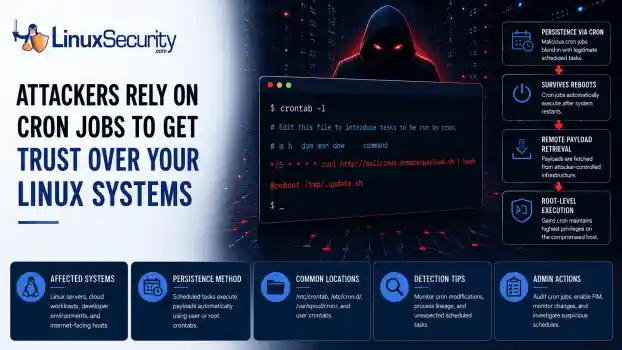
 A Linux server gets cleaned up after an intrusion. The suspicious process is terminated, credentials are rotated, and the system is rebooted during maintenance. Everything seems secure. A few hours later, the same outbound connection appears again. . Situations like that point to persistence . The attacker no longer needs the original exploit because something on the host continues restoring access behind the scenes. Finding that mechanism is often more important than understanding how the...
 Jun 08, 2026
 threat detection scalability
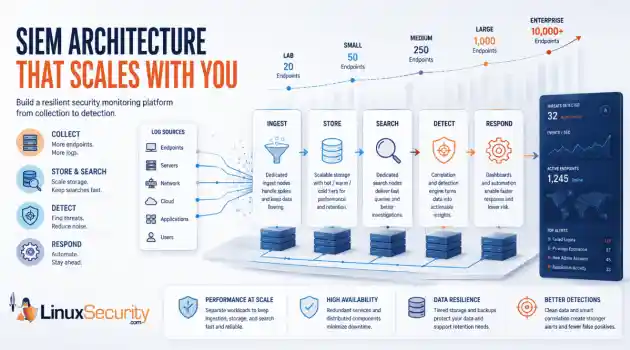
 Building a SIEM is easier than scaling one. Most open-source deployments start as a simple "all-in-one" server. It is easy to set up, but that design rarely survives the transition from a lab to a production workload. . A SIEM watching 20 endpoints is not doing the same job as one watching 500. More endpoints mean more logs; more logs require more storage; more storage makes search heavier. Eventually, the very architecture that made your lab easy to deploy becomes the reason your production...
Jun 04, 2026
 security advisory apache
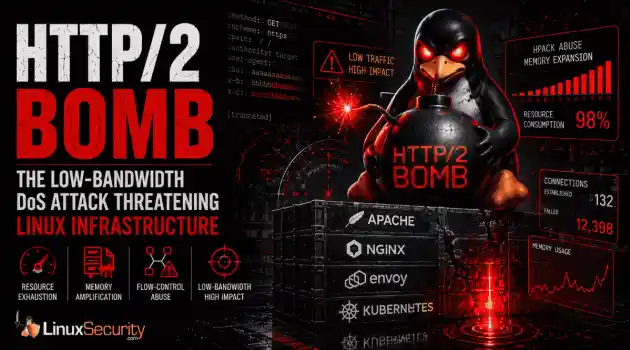
 A newly disclosed attack technique called HTTP/2 Bomb is drawing attention because it targets the software that sits at the front of much of the Linux internet. Apache HTTP Server, NGINX, Envoy, and the ingress layers that many Kubernetes environments depend on can be forced into consuming disproportionate amounts of memory using relatively small amounts of attacker traffic. . For Linux administrators, the concern is not the HTTP/2 protocol itself. It is the possibility that a single...
Jun 04, 2026
 security advisory important
 The compromise of Nx Console shows how much infrastructure now sits behind a single developer account. GitHub repositories, CI/CD pipelines, container build systems, Terraform projects, Kubernetes deployments. None of those systems was the initial target. The workstation was. . Attackers did not need a Linux privilege escalation bug or a remote code execution chain. They needed developers to trust a tool they were already using. For many organizations, that was enough. What Happened? Federal...
Jun 03, 2026
 security advisory open-source
 You remove the malware. You rotate the compromised credentials. You patch the original vulnerability and close the ticket. Two weeks later, the attacker is back. . What happened? You didn't lose the battle at the exploit; you lost it at the cleanup. In many modern Linux intrusions, the malware you found wasn't the main problem—it was the fallback mechanisms left behind. These hooks quietly restore attacker access the moment you look away. If you clean a host but miss these persistence layers,...
Jun 02, 2026
 Refine features
X Clear Filters
Get the latest News and Insights
Get the latest Linux and open source security news straight to your inbox.
Community Poll
What got you started with Linux?
Loading...
Explore Latest Linux Security features
We found -2 articles for you...
102
 security advisoryLinux securityincident response
What Is SELinux? A Practical Take for Linux Admins
Most of us meet SELinux when something breaks. A service won’t start, a port won’t bind, a perfectly reasonable file write gets blocked, and the quickest path back to green looks like turning it off. That first experience sticks, and it shapes how people talk about SELinux afterward. . The part that gets missed early on is that SELinux is not just another security toggle. It changes how failure looks on a Linux system. It changes what an exploit can do after it lands. It changes what mistakes cost you. Once you’ve watched the same class of incident play out with and without SELinux in place, the difference stops being theoretical. SELinux ships enabled or strongly encouraged on most mainstream distributions for a reason. In the context of Linux security, it sits below your applications and above the kernel in a way that’s hard to replicate with permissions alone. You don’t interact with it often when things are healthy. When something goes wrong, though, it tends to be very loud and very specific. This article is about what SELinux actually enforces, not what the documentation promises. We’ll look at where it fits in the Linux security model, what enforcing, permissive, and disabled modes really mean in day-to-day operations, and how SELinux shows up during incidents, audits, and postmortems. The goal is not to convince you to love it. The goal is to help you decide, deliberately, how much you want it involved in your environment and why. Where Does SELinux Fit in the Linux Security Model? Most Linux admins start with discretionary access control because that’s what you see first. Users, groups, mode bits, maybe an ACL when things get messy. If the permissions look right, access should work. If something breaks, you fix ownership or chmod and move on. SELinux sits alongside that model and refuses to trust it on its own. It adds mandatory access control on top of traditional permissions, which means the system checks two things every time a process touches something.First, do the Unix permissions allow this? Second, does SELinux policy allow this specific process, in this specific context, to do this specific action? Both have to agree. This is where behavior starts to change. Processes are not just running as users anymore. They run inside domains, and those domains are intentionally narrow. A web server process can read its content, write its logs, and bind to its ports. That’s it. If it suddenly tries to read SSH keys or write to arbitrary locations, SELinux steps in even if the file permissions say it’s allowed. You see this most clearly with root. Under classic Linux permissions, root is effectively omnipotent. Under SELinux, root is still constrained by policy. If a domain is not allowed to perform an action, running it as root does not magically fix that. This surprises people the first time they hit it, but it’s also the point. From a Linux security perspective, this matters less for preventing bugs and more for containing them. SELinux does not stop developers from writing vulnerable code. What it does is put hard boundaries around what that vulnerable process can touch once it’s compromised or misconfigured. When something goes wrong, it tends to go wrong in smaller ways. Here’s what you should take away. With SELinux in place, the failure mode shifts. One daemon compromise no longer automatically implies full system access. Escalation requires policy gaps, not just code execution. That change alone is why SELinux keeps showing up in serious security conversations, even when it’s inconvenient. What Does SELinux Actually Protect You From? SELinux is easiest to understand when you stop thinking in terms of features and start thinking in terms of damage control. It rarely prevents the first mistake. It often limits what that mistake can turn into. In real environments, that shows up in a few repeatable ways: A compromised web process can’t start poking around /home or /root, even if file permissions are sloppy. The domainsimply isn’t allowed to go there. A daemon that’s been hijacked can’t bind to a high port and start listening unless policy already permits it. You see the attempt, and it stops there. Unexpected file writes fail fast. Even world-writable directories don’t help if the context is wrong. Configuration drift hurts less. An accidentally over-permissive file doesn’t automatically become an attack path. Some zero-day exploits turn into noisy, contained failures instead of silent takeovers, because the payload behavior doesn’t match allowed actions. The pattern is consistent. SELinux forces an attacker or a broken process to behave like the role it was assigned. Code execution on its own is not enough. The exploit has to line up with policy, labeling, and allowed transitions, and that narrows the options considerably. You start to notice this during the incident review. Without SELinux, a service compromise often explodes outward until something else catches it. With SELinux enforcing, you see repeated denials clustered around one process, one context, one resource. The damage is smaller, the timeline is clearer, and containment is simpler. From an admin standpoint, this is where SELinux earns its keep. It becomes a compensating control you factor into severity and response. Not everything that gets blocked is an attack, but when something malicious does show up, the ceiling is lower. That changes how much you lose when things go wrong. Enforcing, Permissive, Disabled – What Those Modes Mean in Practice On paper, the three SELinux modes are straightforward. In practice, they lead to very different systems, even when everything else looks the same. Enforcing mode does exactly what the name suggests. If an action violates policy, it does not happen. The process gets denied, an AVC is logged, and the system moves on. This applies just as much to admin mistakes as it does to attacker behavior. You feel enforcing mode most when something is misconfigured, half-installed, orwhen you are making assumptions that the policy does not allow. Permissive mode is often misunderstood. It still evaluates policy and still logs denials, but it does not block the action. Nothing breaks. Everything works. That makes it useful for learning how a service behaves under SELinux or for debugging a rollout. It also makes it dangerous to leave in place, because you slowly stop noticing the difference between “allowed” and “would have been blocked.” Disabled mode removes SELinux from the equation entirely. There are no checks, no labels being enforced, and no denials to review. From a stability perspective, this is the quietest option. From a risk perspective, it puts you back in a world where Unix permissions and patch timing carry all the weight. What matters operationally is not which mode is “correct,” but what you are trading. SELinux enforcing mode raises the chance that a misconfiguration causes a visible failure. At the same time, it lowers the chance that a single flaw turns into a full-system compromise. Permissive mode keeps the lights on while you learn, but it does not reduce risk in any meaningful way. Disabled mode is simple, predictable, and completely reliant on everything else being right. This is the decision point. Mode choice directly affects outage risk versus compromise impact. There’s no universal answer, but once you understand what each mode actually does to system behavior, you can stop treating it as a superstition and start treating it as a deliberate control. Reading SELinux Denials Without Losing Your Mind Most of the frustration around SELinux comes from its logs. AVC denials show up, they look alarming, and there are often a lot of them. If you treat every denial as a crisis, you’ll burn out quickly. If you ignore them all, you lose most of the value SELinux provides. An AVC denial is specific by design. It tells you which process was blocked, what it tried to do, which object was involved, and which policy rule said no. Onceyou’ve read a few hundred of them, patterns emerge. The same source context hitting the same target over and over usually means a mislabelled file or a service that was never meant to do what it’s trying to do. Volume on its own is a poor signal. Time correlation is better. A spike in new denials right after a deployment almost always points to a configuration mismatch. A sudden cluster during an incident window is more interesting, especially if the process and access type don’t line up with normal behavior. Some denials are genuinely safe to ignore. Desktop services are probing hardware they don’t need. Background processes testing capabilities they’ll never use. Others point to real problems. A network-facing daemon is suddenly trying to read credential files. A process attempting to execute from a writable directory. Those are the ones worth slowing down for. Here’s the shift to make. Don’t disable SELinux to make the alerts stop. Use denials as a detection and diagnostic source. When you can tell the difference between noisy, expected failures and genuinely abnormal behavior, SELinux stops feeling opaque and starts acting like an extra set of guardrails you can actually reason about. Policy Decisions You’re Already Making (Whether You Realize It or Not) SELinux policy has a way of sneaking into your environment. You add an allow rule to fix a problem. You adjust a boolean to get a service unstuck. You carry a local tweak forward during a rebuild because it worked last time. None of it feels like a big decision in the moment. Over time, those decisions add up: Broad domains make life easier, but they widen what a compromised process can touch. Custom allow rules become part of your security baseline, whether they’re documented or not. Temporary workarounds tend to survive upgrades and migrations. Vendor policies reflect someone else’s assumptions about how the service should behave. Every rule you add is an access decision you now own. This isthe part people miss. SELinux policy is not just a technical artifact. It’s a record of risk acceptance. When something goes wrong, those rules explain why an action was possible or why it was blocked. From an admin perspective, the goal is not a perfect policy. It’s an intentional policy. Knowing why a rule exists, what breaks if you remove it, and what risk it introduces is more valuable than aggressively locking everything down. Once you treat SELinux policy as something you track and review, instead of something you quietly accumulate, it becomes manageable rather than intimidating. SELinux in Monitoring, Incident Response, and Compliance Workflows SELinux tends to show up in monitoring only after it causes pain. That’s backwards. Its logs are most useful when you already know how to read them and where they fit into your existing workflows. During an incident, AVC denials add context you don’t get from application logs alone. They help answer basic questions quickly. What was blocked? Which process was involved? Whether the system itself prevented an action or merely observed it. When you line denials up with auth logs, network events, and process starts, timelines get clearer. For incident response, SELinux can quietly reduce scope. A compromised service that keeps hitting denials is a service that’s contained. That doesn’t mean you ignore it, but it does affect urgency and response strategy. You’re dealing with a problem that’s fenced in, not one that’s already roaming the system. Compliance conversations are usually less subtle. Many frameworks assume some form of mandatory access control is in place, even if they don’t name SELinux directly. Running it and enforcing simplifies those discussions. Disabling it often means explaining what compensating controls you rely on instead and why they’re sufficient. That explanation tends to get revisited after every incident. The practical takeaway is simple. Treat SELinux as part of your Linux security controls, not astandalone feature. Tune alerts instead of silencing them. Keep denials accessible during investigations. When auditors or incident reviewers ask how access was restricted, SELinux gives you concrete answers instead of hand-waving. Our Final Thoughts: When SELinux Is Worth the Pain and When It Isn’t SELinux pays for itself unevenly. On some systems, it quietly reduces risk for years without much attention. On others, it becomes a constant source of friction with very little security return. The difference is usually the workload, not the skill of the admin. High-exposure servers benefit the most. Internet-facing services, shared environments, anything processing untrusted input all day long. In those cases, SELinux enforcing mode changes how incidents unfold in a measurable way. Compromises are louder. Movement is constrained. Recovery is more predictable. The return drops fast with brittle or poorly understood applications. Legacy software that assumes full filesystem access or odd execution paths can turn every update into a policy firefight. Small teams feel this more sharply. Time spent chasing edge-case denials is time not spent patching, reviewing access, or fixing backups, and that trade can go the wrong way. Containers complicate the picture, but they don’t remove SELinux from it. Used together, they can reinforce each other. Used carelessly, they can double the confusion. The same principle applies either way. Simple, repeatable patterns beat clever configurations that nobody wants to touch six months later. This is where judgment matters. SELinux does not replace patching, monitoring, or sane configuration management. It also doesn’t need to be everywhere to be useful. The wrong policy can be worse than no policy at all. Knowing where SELinux meaningfully reduces risk, and where it just adds operational drag, is the difference between running it out of obligation and running it with intent. . Explore how SELinux transforms Linux security, enabling better damage control andincident management for admins.. Linux SELinux security, SELinux mandatory access control, incident response Linux, SELinux policy management, Linux security best practices. . Brittany Day
 Feb 14, 2026
•
Feb 14, 2026
•
102
 mandatory access controlLinux administrationrisk mitigation
What Is AppArmor? A Practical Look for Linux Admins
Most of us don’t decide to deploy AppArmor. We inherit it. It’s already enabled on the system, already loaded at boot, and already assumed to be doing something useful. Over time, it fades into the background. That’s usually when it starts to matter. . AppArmor sits inside the kernel and quietly decides whether a process can touch a file, open a socket, or use a capability. It does this whether you are paying attention or not. In many environments, that means AppArmor is part of your Linux security posture by default, not by design. You may not know which services are confined, which profiles are permissive, or whether anything is actually being enforced. The problem is not that AppArmor exists. The problem is that it’s easy to trust it without verifying what it’s doing. Profiles can load cleanly and still fail to reflect how your services actually run. Denials can pile up in logs no one watches. Or nothing shows up at all, which feels reassuring until you realize you don’t know why. AppArmor is not a hardening switch you flip to make risk go away. It is a profile-driven control that narrows what a process can do after it has already started running. When it works, it limits how far a compromised service can reach. When it’s misunderstood, it either breaks workloads or provides a false sense of coverage. This article is about understanding what AppArmor really changes for you as an admin. How it fits into Linux security, where it meaningfully reduces risk, and where it does not. By the end, you should be able to look at AppArmor on your systems and decide whether it should be enforced, audited, tuned, or deliberately left alone. Where Does AppArmor Fit in Linux Security? When AppArmor shows up in conversations, it’s often treated as a feature instead of a control. That framing causes confusion. AppArmor is part of Linux security in the same way file permissions and sudo are. It limits behavior. It does not make decisions for you. At a basic level, AppArmor is amandatory access control system enforced by the kernel. Once a process starts, the kernel checks its AppArmor profile before allowing access to files, network resources, signals, or capabilities. Those checks happen after traditional Unix permissions are evaluated. If DAC says yes, but the AppArmor profile says no, the answer is still no. Here’s the important part to internalize early. AppArmor assumes the process is already running. It does not care how the process got there. If a service is exploited through a bug or misconfiguration, AppArmor does not stop that initial compromise. What it can do is limit what the attacker can touch next. That distinction matters when you’re reasoning about risk. Unlike label-based systems, AppArmor policies are path-based. The profile applies to a binary at a specific path and to the files it is allowed to access by path. That design choice makes AppArmor easier to reason about for many admins, especially early on, but it also introduces blind spots when paths change or when access happens in unexpected ways. Most admins first encounter AppArmor passively. It’s enabled by default on common distributions, profiles ship with packages, and nothing appears broken. Over time, you start to see it surface during incidents or upgrades, usually as a denial tied to a service that used to work. That’s often the moment people realize AppArmor has been part of their Linux security model all along. The practical shift here is how you think about damage, not intrusion. AppArmor is about constraining the blast area after something goes wrong. If you’re evaluating it as a preventive control, you’ll be disappointed. If you evaluate it as a way to keep a bad day from becoming a worse one, it starts to make more sense. What AppArmor Actually Controls (And What It Doesn’t) Once you accept where AppArmor sits, the next step is understanding its reach. This is where expectations tend to drift. People assume it covers more ground than it really does, or they dismissit entirely because it doesn’t solve the wrong problem. In practice, AppArmor focuses on a narrow but important slice of process behavior. It controls what a confined process is allowed to touch, not what logic it executes or what data it chooses to mishandle. AppArmor can restrict, per profile: Reading, writing, and executing files by path Access to specific directories or device files Network operations, depending on profile and kernel support Use of Linux capabilities, such as mounting or raw sockets ptrace and signal interactions with other processes This is effective when a service has a predictable footprint. A web server that should only read its config, write logs, and talk to the network is a good candidate. Once you’ve seen a compromised service try to read SSH keys or crawl through home directories, you start to see the value of narrowing those paths. There are clear limits. AppArmor does not understand application intent. It does not stop SQL injection , command injection, or logic flaws inside the process. If an application is allowed to read a file, AppArmor does not care why it’s reading it or how that data is used. Path-based enforcement also means that symlinks, bind mounts, and dynamic paths can complicate the picture in ways that are not always obvious. This is the point where assumptions usually break. AppArmor does not prevent lateral movement in the way people sometimes expect, and it does not compensate for weak authentication or exposed management interfaces. It reduces the set of things a process can reach, nothing more. Once you see those boundaries clearly, AppArmor becomes easier to reason about. You stop expecting it to solve application-layer problems, and you stop assuming it has visibility it simply doesn’t have. That shift alone prevents a lot of misplaced trust. Profiles, Modes, and Enforcement Reality On paper, AppArmor profiles look straightforward. A profile exists, it applies to a binary, and the kernel enforces it. Inproduction, it’s rarely that clean. Every profile runs in one of two modes. Enforce mode blocks actions that are not allowed by the policy. Complain mode allows the action but logs what would have been denied. Complain exists for a reason. Most real services do things you don’t fully understand until you watch them run under constraint. Skipping that learning phase is how profiles end up disabled instead of fixed. Profiles are loaded at boot or when the AppArmor service starts, and they’re matched by binary path. That detail shows up in incidents more often than people expect. If a package update moves or replaces a binary, or if a service is launched through a wrapper or symlink, the profile you think is active may not apply at all. The service still starts. Nothing crashes. Enforcement just quietly disappears. Includes and abstractions add another layer. Many shipped profiles rely on shared snippets for common permissions. That keeps policies manageable, but it also makes it harder to tell at a glance what a profile really allows. You start to see this when a denial doesn’t make sense until you trace it back through multiple includes. The most common mistake is assuming that a loaded profile is an effective profile. A profile can exist, be syntactically valid, and still fail to match how the service actually behaves. Over time, workloads change. Paths move. Features get added. Profiles do not update themselves. Once you’ve been bitten by this, your posture changes. You stop trusting the presence of profiles as evidence of enforcement. You start checking which mode they’re in, what paths they actually match, and whether the profile still describes the service you’re running today, not the one that shipped with the package years ago. What Breaks When AppArmor Is Turned On Most AppArmor problems don’t show up as clean failures. Services start, then behave oddly. Errors surface in places that don’t obviously point back to access control. That’s why AppArmor has a reputationfor being “random” when it isn’t. Common breakage patterns tend to repeat: Services failing with generic permission errors that don’t mention AppArmor Background tasks or helpers failing while the main process appears healthy Denials appearing only after package upgrades or configuration changes Custom install paths and non-standard directory layouts being blocked Containerized workloads hitting paths the profile never anticipated Teams disabling enforcement instead of adjusting the profile Test environments rarely expose this. They’re smaller, cleaner, and closer to defaults. Production systems accumulate history. Old paths linger. Debug flags get enabled. Temporary files move into places nobody documented. AppArmor enforces what the profile says, not what the service “usually” does. Developers often work around these failures by changing how the service runs rather than fixing the policy. That solves the immediate problem but leaves you with a control that’s technically enabled and functionally irrelevant. Over time, that’s how AppArmor becomes shelfware. The real cost here is time. If you don’t recognize AppArmor as the source, you chase file permissions, ownership, and SELinux flags that aren’t in play. Once you’ve seen a few of these incidents, you start checking AppArmor early. It saves hours. Operationally, this shifts how you plan changes. Turning AppArmor on, or moving profiles from complain to enforce, is not a toggle you flip casually. It’s something you stage, observe, and revisit, especially on systems that have grown organically over years. Logging, Alerts, and What “Good” Looks Like AppArmor’s visibility is uneven, and that’s part of why it’s easy to ignore. It logs denials, not intent. If nothing is being denied, you may see nothing at all. On most systems, AppArmor events end up in the audit stream or kernel logs, depending on how auditing is configured. A real denial is usually explicit once you know thepattern. You’ll see the profile name, the operation, the path that was blocked, and whether enforcement was active. Until you recognize that structure, it blends into the noise of other kernel messages. The harder part is interpretation. Some denials are expected and harmless. Others indicate that the profile no longer matches reality. The difference shows up over time. Repeated denials on the same path usually point to missing permissions. One-off denials tied to strange paths are often worth a closer look. Quiet systems are not automatically healthy. Sometimes it just means the profile is too permissive or not applied. Alerting is rarely out of the box. Most teams either forward AppArmor logs into existing Linux security monitoring or review them during incidents. That’s not ideal, but it’s common. The key is knowing what you would expect to see if enforcement were actually working. A system that never produces AppArmor logs at all deserves scrutiny, especially if profiles are supposedly enforced. Once you’ve watched AppArmor during a real failure, your expectations reset. You stop looking for dashboards and start looking for absence and repetition. That’s what “good” looks like here. Limited, explainable noise that tells you the control is alive and paying attention. AppArmor vs SELinux (The Non-Religious Version) This comparison comes up because admins are asked to justify choices, not because one system is universally better. Treating it like a debate usually misses the point. The operational difference that matters most is how policy is expressed and maintained. AppArmor ties rules to paths. SELinux ties rules to labels. In day-to-day work, that means AppArmor tends to be easier to read and adjust when you’re dealing with a small number of well-understood services. You can often look at a profile and understand, roughly, what it’s trying to allow. SELinux scales differently. Label-based enforcement holds up better in environments where paths change frequently, whereservices are heavily composed, or where isolation needs to be more uniform across the system. The tradeoff is complexity. When something breaks, understanding why can take longer unless the team already lives in that ecosystem. Defaults also matter. Some distributions lean heavily on SELinux and invest in keeping policies current. Others ship AppArmor profiles that cover common services and then largely leave them alone. That history affects how much work you inherit and what skills already exist on the team. The deciding factor is rarely theory. It’s who is going to maintain the policies, debug failures, and explain incidents at three in the morning. If no one on the team understands SELinux, AppArmor may be the only control that gets used at all. If SELinux is already part of your operational muscle memory, introducing AppArmor adds little. Once you see it this way, the question stops being which system is “stronger” and starts being which one you can actually operate. That’s the only comparison that tends to hold up over time. When AppArmor Is Worth It (And When It’s Not) AppArmor pays off when the behavior of a service is narrow and repeatable. You tend to see the benefits most clearly on internet-facing daemons that do one job, live in predictable paths, and rarely change how they access the system. In those cases, the profile stays stable, and the control quietly limits damage when something goes wrong. It’s also useful when you already have discipline around configuration and change management. Profiles age just like configs do. If nobody owns them, they drift. Teams that track changes, review logs, and revisit assumptions get more value out of AppArmor than teams that set it once and move on. There are environments where AppArmor adds friction without much return. Highly dynamic systems, custom-built applications with shifting paths, and workloads that constantly evolve tend to outgrow static profiles. In those cases, AppArmor often ends up permanently permissive ordisabled, which helps no one. Shelfware has a recognizable shape. Profiles exist, but stay in complain mode forever. Logs are never reviewed. Enforcement is disabled during incidents and never restored. At that point, AppArmor is consuming mental space without reducing risk. The decision doesn’t have to be permanent. Some teams enforce AppArmor only on a subset of services. Others revisit it after a major refactor or platform change. What matters is that the choice is intentional. In Linux security, an explicit decision is almost always safer than an inherited default you no longer remember agreeing to. How I Validate AppArmor Is Doing Its Job I don’t trust AppArmor because it’s enabled. I trust it when I can see it behave the way I expect. The first thing I check is whether profiles are actually loaded and in enforce mode . That sounds obvious, but it’s common to find services running under complain mode long after a rollout finished. From there, I confirm that the profile name matches the binary that’s running, not the one that used to exist. I like to generate a controlled failure. Nothing dramatic. A simple attempt to access a path that should be denied is enough. If AppArmor is enforcing, I expect to see a clear denial in the logs tied to the correct profile. If I don’t, something is wrong, even if the service appears healthy. After changes or upgrades, I review logs with a narrow time window. I’m looking for repetition. New denials clustered around a deployment usually mean the workload changed. Sporadic denials with odd paths are more concerning and worth digging into. Drift is the quiet enemy. Services accrete features. Paths move. Temporary workarounds become permanent. Periodically, I sanity-check profiles against how the service actually runs today. If a profile hasn’t been looked at in years, I assume it no longer describes reality. Before I trust AppArmor during an incident, I want to know two things. Is enforcement active, and have I seen it blocksomething before? If the answer to either is no, I treat it as unproven. In Linux security, controls earn trust through observation, not configuration state. Final Takeaways for Admins Running AppArmor AppArmor tends to fade into the background because it doesn’t announce itself. When it’s quiet, systems look fine. Services run. Nothing alerts. Over time, that quiet gets mistaken for coverage. What AppArmor actually gives you is constraint, not prevention. It limits how far a process can reach once it’s running. That’s valuable, but only if the profile still matches reality and enforcement is active. Defaults help you start, but they are not a finished control, and they rarely stay accurate on their own. A silent system still needs to be checked. Profiles drift. Workloads change. Logs stop being reviewed. None of that means AppArmor failed. It means ownership faded. That’s a normal pattern, but it’s one you need to recognize. Disabling AppArmor is not a mistake if it’s a conscious choice. Leaving it enabled without knowing what it enforces is. The difference is whether you can explain the decision when something goes wrong. If you take one thing away, it’s this. AppArmor is part of your Linux security posture, whether you like it or not. The only real question is whether you’re treating it as an active control, a monitored control, or an ignored one. Systems tend to reflect that choice sooner than you expect. . AppArmor sits inside the kernel and quietly decides whether a process can touch a file, open a socke. don’t, decide, deploy, apparmor, inherit, already, enabled, system. . Brittany Day
Feb 05, 2026
•

102
 security advisorykernel securitymandatory access control
Key Linux Features Boosting Security Measures for the Year 2026
Linux security comes from how the system is put together at the core. The layout of users, processes, and kernel space gives it a stable baseline that holds up across different environments. Most breaches still come from those basics drifting. That’s usually the story you see in real incidents. . Readers in ops or security feel this because the problems show up quietly. A permission slip, a package stops updating cleanly, or a service runs with more access than it should. Nothing dramatic. It just builds until someone notices the gap during a review or an outage. So the focus here is on the features of Linux that shape that stability and the Linux characteristics that keep daily operations predictable. Once you see how these fundamentals behave in real systems, the rest of the security model falls into place. What Makes Linux Secure? Understanding the Core Features of Linux Linux stays secure because the main pieces of the system reinforce each other. The openness of the platform makes problems visible early, and the privilege boundaries define how far a user or process can move. Kernel controls narrow that space even more, and the filesystems keep data in a state the system can trust. Update chains hold the rest together by keeping software predictable. None of it works alone, but it doesn’t need to. Operators start recognizing these categories after working with enough machines. Permissions form the first layer. SELinux and AppArmor shape what workloads can actually do at runtime. Namespaces , seccomp, and capabilities contain processes when something goes off script. Journaling and checksumming help the system recover cleanly. Update paths warns you when drift begins. These Linux characteristics show up before anything breaks, if you know where to look. All of this sets the stage for why transparency matters so much on Linux. Once you understand what the system exposes and why, the rest of the security model feels less like a collection of features of Linux and more like a designthat’s been steady for a long time. Open-Source Architecture: Why Transparency Improves Security Transparency is one of the Linux characteristics that proves its worth the moment you look under the hood. Anyone can inspect the code, report a flaw, or push a fix, which keeps vulnerability turnaround fast and visible. Issues rarely linger in isolation because the entire ecosystem notices when something looks off. You end up with a patching model that moves at the pace teams actually need. The openness also removes the guesswork that attackers rely on. There’s no hidden behavior for them to lean on, and any assumption they make has to survive public scrutiny. Defenders get the same advantage. They can verify what a component does instead of treating it like a sealed appliance, and that builds trust in the system’s long-term integrity and maintainability. Once that level of visibility becomes normal, the next step is understanding how Linux isolates users and workloads by default, since that separation is what keeps small mistakes from turning into larger incidents. Multiuser and Multitasking: Built-In Isolation for Safer Operations Linux separates users in a way that feels straightforward but carries real security value. Each account sits in its own space with limited reach, so a bad credential or misused session usually stays contained. Teams dealing with incidents see this often. The impact is smaller than expected because the boundary was held. The scheduler plays into that same pattern by keeping workloads from crowding each other. It divides CPU time and memory in a way that makes outliers stand out, even on a busy system. You get a clearer view of who’s doing what, and it helps catch issues before they spread into something larger. Once that separation is visible, the next step is understanding the permissions model that underpins it, since that’s where access control actually starts. Linux Permissions Model: The Foundation of Access Control The permissions layer iswhere Linux starts putting real boundaries around the system. It’s straightforward enough that you can read it quickly, but it still anchors who can touch what and how broad their reach is. On busy systems, that kind of consistency matters. It gives operators something steady to lean on when the rest of the environment is moving around it. Problems usually come from normal work, not from the model failing. A migration adjusts ownership, a quick fix loosens a directory, or a service account keeps access from a role it no longer serves. None of it looks dangerous at the moment. Give it a few months, though, and the pattern turns into system drift in Linux , where small permission gaps line up just wrong and expand the blast radius more than anyone expected. Once you’ve walked through enough of these checks, the value of keeping elevated tasks separate from regular user activity becomes clearer, which makes it clearer why Linux puts so much emphasis on separating elevated action from everyday access. Privilege Separation: How Linux Minimizes the Blast Radius Privilege separation is one of the Linux characteristics that makes incidents smaller than they could be. Linux draws a sharp line between having permissions and actually being root, and most systems never cross that line unless someone explicitly asks for it. You see the effect during investigations. A process might have read access somewhere, but it can’t reach across the system because it never gained true administrative authority. A few patterns define how Linux keeps that boundary intact: Normal permissions don’t equal full control: Most users can read or modify only what’s in their scope. The kernel treats real root access as a separate tier entirely, so a mistake in one area doesn’t spill over into the rest of the machine. sudo is narrow by design: Teams usually grant just enough access to run a command, not broad shells. The constraints in sudo policy matter more than people expect, because they decide whichpaths stay off-limits. Processes stay boxed in: Even elevated commands inherit restrictions, so they can’t wander far outside their intended task. It keeps lateral movement short and forces attackers to earn every step they take. After you’ve looked at how tightly Linux limits elevated work, it’s easier to see why another layer exists to contain what slips past it. Mandatory Access Controls: How SELinux and AppArmor Contain Zero-Days Mandatory access controls show their value when discretionary permissions aren’t enough. A process might have the right UNIX permissions, but MAC still decides what it can touch, which syscalls it can make, and how far it can move. It’s the layer that stops a zero-day from running freely just because DAC didn’t catch it. You see that control most clearly on systems that handle mixed workloads or untrusted input. MAC Concept What It Restricts in Practice Domains Keep a process locked to an expected behavior profile, limiting what it can interact with. Types Define which files or resources a domain can use, even when standard permissions would allow more. Contexts Label processes and objects so the system can evaluate every action against policy at runtime. Enforcement Blocks the action outright, creating AVC denials instead of letting questionable behavior run. In containerized or multi-service environments, these controls become part of the runtime shape of the system. SELinux and AppArmor policies determine which services can read logs, access the network, or write to specific paths, and prevent workloads from bleeding into each other even when the underlying filesystem allows it. That policy layer ends up acting like the backbone of container isolation on hardened hosts. AVC denials, mislabeled files, or a domain stepping outside its type are the signals operators notice first when MAC is doing itsjob. They show how tightly the system enforces its rules and where something doesn’t match the expected pattern. For deeper tuning and policy work, it helps to reference guides on configuring SELinux , since the details matter when tightening or adjusting behavior. Once you’ve seen how MAC handles what slips past permissions, the next stop is the kernel’s own security features, which fill in the rest of the boundary. Kernel Security Features: Namespaces, Seccomp, Capabilities, and Lockdown Kernel controls shape how much room an attacker has after the initial compromise. They’re tight, specific, and built to limit movement instead of trusting a process to behave. Here is a quick breakdown: Namespaces: Give processes their own PID, network, and mount views so they can’t see or touch other workloads. Seccomp: Filters syscalls and trims the attack surface to only what a process actually needs. Capabilities: Split root into small, controllable privileges so services don’t run with full authority. Lockdown: Blocks unsigned modules and restricts kernel access, especially on Secure Boot systems. Each control cuts off a different escape path, and together they reduce what post-exploitation looks like on a real system. From here, the filesystem layer becomes the next place where integrity and containment show their value. Filesystems and Journaling: Ext4, XFS, Btrfs, and Integrity Controls Filesystems end up influencing security more directly than people expect. Journaling keeps metadata consistent during crashes or forced reboots, which cuts down on corruption and gives the system a known state to recover from. That stability becomes one of the features of Linux that operators rely on quietly, especially on machines under steady write load. You also see real security impact in the small controls built into these filesystems. Immutable or append-only attributes stop critical files from being replaced, even by elevated processes. Btrfs adds its ownlayer with checksumming and self-healing, catching modifications that don’t match expected blocks. It all feeds into data integrity as a core Linux characteristic, not an add-on. Filesystem Feature What It Protects Journaling (Ext4/XFS) Limits corruption and gives consistent recovery after unexpected shutdowns Immutable / Append-only Prevents tampering with key system files, even with high privileges Btrfs Checksumming Detects and repairs silent data changes using known-good copies If the workflow needs stronger integrity checks, it’s worth looking into Linux integrity verification methods to see what fits the environment. Once storage integrity is solid, the update chain becomes the next layer that shapes how predictable the system stays. Package Management and Update Chains: How Linux Maintains Security Package systems stay predictable across distros, and that reliability matters more than people admit. The metadata, signatures, and repo chains tell you whether a host is following its expected path or drifting away from it. When mirrors go stale or keys expire, the system starts warning you in small ways, and those signals usually show up before anything breaks. You also see the impact in how distros separate routine updates from full upgrades. Each one handles patch cycles a little differently, but the pattern stays steady enough that operators know when a machine has fallen behind. Long-lived hosts make this more obvious because the gaps stand out once the workflow stops behaving cleanly. If you’re managing systems with long support windows, checking the Linux support lifecycle helps you understand how much runway each release actually has. Logging and Auditing: Journald, Auditd, and Kernel Event Tracking Journald and auditd tell you how close a system is to trouble, but they tell it in different ways. Journald shows service behavior as it happens. Auditd showswhat the kernel is actually permitting, blocking, or questioning. Together, they give you the earliest signal that a machine is drifting away from its baseline. Quick Signals Operators Look For Sudden bursts of warnings from a service that’s been stable AVC hits showing a process trying something outside its policy Syscalls that don’t match the workload’s usual pattern Gaps in logging that hint at tampering or disabled components Networking and Firewalling: Built-In Protections with Netfilter and nftables Linux’s network stack stays consistent even on hosts that run a mix of services, and that reliability is one of the features that Linux operators lean on. nftables handles filtering and NAT with a cleaner rule model than iptables ever had, and it’s easier to see when something in that flow changes. Network namespaces add another layer by giving each workload its own view of interfaces and routes, which cuts down on accidental overlap. A few patterns tend to show up when you work with this day after day: nftables rules reveal drift quickly because the structure is predictable Namespaces keep traffic separation tight without extra tooling SELinux and AppArmor override socket operations that don’t match policy The stack behaves the same way on routers, firewalls, and cloud hosts, which keeps troubleshooting grounded Once the network layer is behaving predictably, the next question is whether the system can keep its own configuration steady over time. Shell, Automation, and Scripting: Why Linux Enables Repeatable Security Automation is where Linux stays steady in the long run. Cron jobs and systemd timers run the same way every day, and small scripts fill in the gaps when teams need consistency without heavy orchestration. You start to notice the impact when a host stops following its schedule, and small pieces drift out of place. It’s one of those Linux characteristics that keeps environments stable without calling attention to itself. Operators usually rely on a simple mix of tools: Cron for recurring checks or cleanup work Systemd timers for jobs that need clearer visibility or tighter control Shell scripts to enforce configuration in ways that don’t depend on large frameworks Python or Zsh for tasks that need more structure but still need to be portable A system that keeps its routines in order tends to drift less in every other area. Final Summary: Why These Features Make Linux One of the Most Secure OSes Linux stays secure for the same reason it stays stable. The core pieces line up cleanly, and when they hold their shape, the system doesn’t drift far from its baseline. Most issues you see in real environments still start with something small — a permission that shifted, a repo key that aged out, or a service running with more reach than anyone intended. Quiet problems, but they grow if no one notices. Each layer supports the next. Filesystems keep data steady, kernel controls limit how far a compromised process can move, MAC rules stop behavior that doesn’t match policy, and package chains keep updates tied to trusted sources. None of these features of Linux solves everything alone, but together they keep the OS predictable under load. That predictability ends up being one of the Linux characteristics operators count on when environments get busy. If you want to dig further, it’s worth exploring how secure Linux is across different deployments, since the same patterns hold whether the system is running on a small appliance or a large cluster. . Explore essential Linux features that enhance security and prevent breaches in 2026, ensuring stable operations.. Linux security features, open source architecture, kernel security controls, mandatory access controls, Linux permissions model. . MaK Ulac
Nov 24, 2025
•

Get the latest News and Insights
Get the latest Linux and open source security news straight to your inbox.
Community Poll
What got you started with Linux?
Search Topics
Powered By

Linux Security - Your source for Top Linux News, Advisories, HOWTOs and Feature Releases
QUICK LINKS
subscribe to newsletters!
Like staying secure? So do we.
Sign up for updates, tips, and alerts!
Discover faster search, smarter navigation, and deeper Linux security insights. Read More