


Stay Ahead With Linux Security Features
 security advisory attack
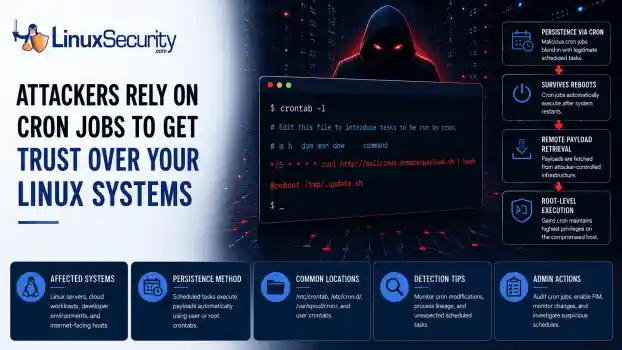
 A Linux server gets cleaned up after an intrusion. The suspicious process is terminated, credentials are rotated, and the system is rebooted during maintenance. Everything seems secure. A few hours later, the same outbound connection appears again. . Situations like that point to persistence . The attacker no longer needs the original exploit because something on the host continues restoring access behind the scenes. Finding that mechanism is often more important than understanding how the...
 Jun 08, 2026
 threat detection scalability
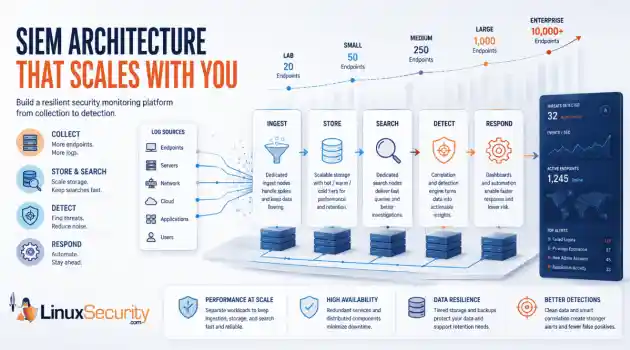
 Building a SIEM is easier than scaling one. Most open-source deployments start as a simple "all-in-one" server. It is easy to set up, but that design rarely survives the transition from a lab to a production workload. . A SIEM watching 20 endpoints is not doing the same job as one watching 500. More endpoints mean more logs; more logs require more storage; more storage makes search heavier. Eventually, the very architecture that made your lab easy to deploy becomes the reason your production...
Jun 04, 2026
 security advisory apache
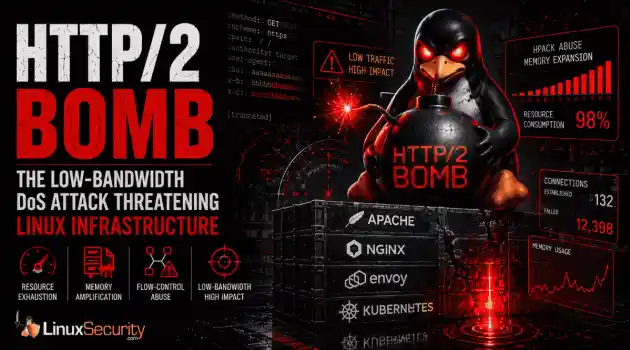
 A newly disclosed attack technique called HTTP/2 Bomb is drawing attention because it targets the software that sits at the front of much of the Linux internet. Apache HTTP Server, NGINX, Envoy, and the ingress layers that many Kubernetes environments depend on can be forced into consuming disproportionate amounts of memory using relatively small amounts of attacker traffic. . For Linux administrators, the concern is not the HTTP/2 protocol itself. It is the possibility that a single...
Jun 04, 2026
 security advisory important
 The compromise of Nx Console shows how much infrastructure now sits behind a single developer account. GitHub repositories, CI/CD pipelines, container build systems, Terraform projects, Kubernetes deployments. None of those systems was the initial target. The workstation was. . Attackers did not need a Linux privilege escalation bug or a remote code execution chain. They needed developers to trust a tool they were already using. For many organizations, that was enough. What Happened? Federal...
Jun 03, 2026
 security advisory open-source
 You remove the malware. You rotate the compromised credentials. You patch the original vulnerability and close the ticket. Two weeks later, the attacker is back. . What happened? You didn't lose the battle at the exploit; you lost it at the cleanup. In many modern Linux intrusions, the malware you found wasn't the main problem—it was the fallback mechanisms left behind. These hooks quietly restore attacker access the moment you look away. If you clean a host but miss these persistence layers,...
Jun 02, 2026
 Refine features
X Clear Filters
Get the latest News and Insights
Get the latest Linux and open source security news straight to your inbox.
Community Poll
What got you started with Linux?
Loading...
Explore Latest Linux Security features
We found -3 articles for you...
102
 data breachsecurity techniquescontainer escape
Beyond the Sandbox: Container Escape Techniques Observed in Recent Research
Containers were sold on the promise of container isolation. Think of them like clean, separate rooms in a house where nothing leaks from one room to another. Most teams still operate on this assumption, believing that what happens inside a container stays there. . However, recent research from feeds like Packet Storm shows that these boundaries aren't as solid as we think. Often, a container "breaks" quietly. It isn't a loud crash; it’s just a single process stepping an inch outside its lane. When that happens, the "room" is no longer private. The cracks aren’t hypothetical. By looking at real-world activity rather than polished lab demos, we can see that attackers aren't usually doing anything revolutionary. They are simply finding small mistakes and chaining them together to walk right through the front door. The Reality of Container Escapes A container escape is exactly what it sounds like: a program running inside a container finds a way to reach out and grab control of the "host" (the main computer or server running the container). Once an attacker reaches the host, the game changes completely. The host can see everything: Other containers running on the same system. Secret passwords and keys (credentials). Network paths to other parts of the company. In real incidents, this "escape to host" step is often what turns a small, contained problem into a massive data breach that spreads across an entire network. How the Breakout Actually Happens There isn't one "magic" trick to escape a container. Instead, attackers use a series of small weaknesses. 1. Exploiting Container Runtime Security The runtime is the engine that starts and manages containers. When container runtime security is weak or the engine has a flaw, the container can "leak." A famous example is the Leaky Vessels set of vulnerabilities. Here, attackers used a simple trick involving "symlinks" (shortcuts to files) to fool the system into letting them touch files on the main host instead ofstaying inside their container. 2. Exploiting the Shared Kernel Containers are lightweight because they don't have their own "brain" or kernel; they share the host’s kernel. Think of it like the plumbing in an apartment building. Each unit is separate, but they all use the same pipes. If a pipe bursts in the basement, every unit is affected. The experts at Google Project Zero have documented how a single bug in this shared kernel can turn container access into full host access almost instantly. The Crypto Exchange Pivot In a real-world Unit 42 attack , attackers escaped a container, stole workload identities, and used them to move across the cloud. The container wasn’t the target, it was the entry point. Why These Attacks Still Work It is tempting to blame high-tech zero-day vulnerabilities, but the truth is more boring. Most escapes happen because of cloud misconfigurations. Common mistakes include: Privileged Containers : Giving a container "super-user" powers it doesn't need. Lazy Patching : Waiting too long to update software because "uptime" is more important than security. Excessive Permissions : Giving a container access to files or networks it will never actually use. The MITRE ATT&CK Containers Matrix maps out these exact techniques, showing that attackers simply use the doors we leave unlocked. What to Watch For You won't always see a warning light when an escape happens. Instead, look for these "smoke signals": Abnormal Mount Activity : If a container suddenly tries to access deep system files like /proc or /etc, it’s likely trying to find a way out. Suspicious System Calls : These show up early if you’re looking in the right place. A simple app doesn’t usually reach deep into the kernel, so when it starts asking for odd capabilities, that’s where things start to feel off. Network Behavior Shifts : A container that normally sticks to a database suddenly reaching out to an external IP is the kind ofdrift that lines up with compromise more often than misconfiguration. If you want to see how this gets weaponized, Exploit-DB is still one of the places people check for working code—the same payloads attackers lift and adapt to turn zero-day vulnerabilities into real access. A Pragmatic Way Forward This isn’t a panic situation. It’s cleanup, mostly, and a bit of discipline that tends to slip in fast-moving environments. Running privileged containers or using root access still shows up more than it should. It makes everything easier right up until it doesn't, handing over more control than most teams realize they've exposed. Patching runtimes quickly sounds obvious, but it’s where delays stack up. Updates sit and known issues stay reachable longer than they should, which is exactly the gap attackers look for. Keeping things simple does more than it sounds. If a container doesn’t need outbound access, cutting it off removes an entire class of problems. Conclusion: The Walls Are Not Solid Container isolation works well, but it isn't perfect. Container escapes are a real part of the modern tech landscape, not just a rare theory. Staying safe doesn't mean buying more expensive tools. It means changing how you think. If you assume the walls might leak, you’ll build better floors. Stay informed by tracking new threats and never assume the boundary will hold forever. . Recent insights reveal that container isolation boundaries are vulnerable, exposing systems to threats and breaches.. Container Security, Runtime Vulnerabilities, Cloud Misconfiguration, Cybersecurity Practices, Data Protection Strategies. . MaK Ulac
 Apr 22, 2026
•
Apr 22, 2026
•
102
 cloud securityLinux adminprocess monitoring
eBPF for Runtime Threat Detection: What Linux Admins Are Actually Deploying
Runtime security has moved from “nice to have” to an operational baseline in Linux environments. Most teams learned the hard way that logs and post-event alerts don’t catch what actually runs on the system in real time. Attackers don’t wait for indexing pipelines or SIEM correlation. . Modern attackers no longer just break down your front door. Instead, they sneak in by hiding inside the trusted, legitimate software your company already uses every day. Because they mimic normal system behavior, they can move through your network undetected, turning a small security hole into a company-wide emergency. eBPF shows up here because it sits where the activity happens. Not a bolt-on, not another dashboard. Teams are wiring it into production because it gives them direct visibility into runtime behavior without dragging in heavy agents or rewriting workloads, and that shift is already visible across detection engineering, observability stacks, and security tooling. Why Runtime Security Has Become Critical for Linux Security Linux security has reached a point where visibility before and after an event is no longer enough, especially as modern attacks unfold in real time within the system itself. Limited endpoint security parity with Windows: Linux environments still lack consistent, mature endpoint controls. Coverage varies wildly across distros, and many deployments rely on minimal agents or none at all. Detection tied to logs, not behavior: Most Linux threat detection still leans on syslogs and audit trails. Useful after the fact, weak during execution when timing matters. Attacks happen during runtime: Process injection, privilege escalation, and lateral movement. All of it unfolds live in memory and kernel space, not in static artifacts. Static and perimeter defenses miss active threats: Firewalls and scanners don’t see what a process is doing once it’s running. They weren’t built for that layer. Put together, the gap is obvious. Linux security has goodvisibility before and after execution, but the middle, where attackers actually operate, stays thin unless you instrument runtime directly, a trend highlighted in the 2026 global cybersecurity outlook . Where Traditional Security Monitoring Falls Short Tool Type Strength Limitation Endpoint Security Known threat blocking Weak on Linux and limited runtime visibility Network Security Monitoring Traffic visibility No process-level insight Security Monitoring Tools Centralized alerts Reactive, delayed detection These tools still matter. But they operate on slices of the system, not the full execution path. As seen in current cloud-native security assessments , you see packets without knowing which process sent them, or alerts long after the command already ran, which makes triage slower and containment messy when attackers move laterally faster than your alerts fire. What eBPF Changes in Runtime Threat Detection Think of traditional security like a security guard watching the front gate. eBPF is like installing a high-definition security camera directly inside the engine of the car. Instead of guessing what went wrong after a crash by looking at tire tracks (logs), you can see exactly how the engine behaved in real-time as the incident was unfolding. Technical resources on kernel-level observation detail how this captures system calls, process execution, file access, and network activity in real time. No polling, no waiting for logs to flush. That visibility sits close to the source, which reduces blind spots that attackers rely on when they operate inside legitimate processes. What teams actually watch with eBPF tends to center around a few areas: Process execution chains and parent-child relationships System call patterns and anomalies Network connections tied back to processes File access and unexpected changes It’s not asecurity tool on its own. More like a telemetry layer that finally exposes runtime behavior cleanly enough for detection logic to work without guesswork. What Linux Admins Are Actually Deploying Today Most Linux admins aren’t relying on static defenses anymore. They’re shifting toward runtime visibility and kernel-level instrumentation to see what’s actually happening on their systems in real time. Runtime Threat Detection Platforms Recent technical analysis on eBPF security and observability shows teams are deploying platforms that sit on top of eBPF to track process behavior and system activity. The focus stays on identifying anomalies during execution, not matching signatures after the fact. Container and Cloud Workload Security Kubernetes environments lean heavily on eBPF for runtime protection. In modern cloud environments, applications are 'short-lived'—they might only exist for a few minutes before disappearing. Traditional security software is often too slow to keep up with these fast-moving targets. By building security directly into the 'brain' (the kernel) of the operating system, we ensure that every application is monitored from the moment it starts until the moment it closes. Network + Process Correlation Admins are linking network traffic back to the exact process generating it. This closes a long-standing gap where network monitoring showed activity but couldn’t explain the source inside the host. Open Source vs Commercial Tools Falco, Cilium, and Tetragon show up in a lot of deployments. Commercial platforms wrap similar capabilities with easier onboarding and support, but trade some control and transparency in the process. Key Use Cases Driving eBPF Adoption Detecting abnormal process behavior: Unusual execution chains or binaries spawning from unexpected parents tend to stand out quickly when you watch system calls directly. Identifying suspicious outbound connections: When a process suddenly starts beaconing or reaching unfamiliarendpoints, eBPF ties that traffic back to the source without guesswork. Monitoring file access and changes: Unexpected reads or writes to sensitive paths show up in real time, not hours later in audit logs. Detecting container drift and misuse: Containers running processes outside their intended scope get flagged fast, especially when images are supposed to stay immutable. Why eBPF Is Gaining Traction in Cloud Security Cloud environments don’t sit still. Instances spin up, containers die off, IPs rotate, and workloads shift constantly. Static agents struggle to keep up, especially when scaling across clusters where deploying and maintaining them becomes its own operational burden. eBPF works underneath that layer. It doesn’t require modifying workloads or baking security into every image, which fits how cloud teams actually operate. You get consistent visibility even as infrastructure changes shape every few minutes, and that consistency is what makes runtime security viable at scale rather than something that breaks under churn. Challenges Teams Run Into with eBPF-Based Security Kernel-level complexity: Custom eBPF work requires understanding kernel internals. That’s not common skill coverage across most teams. Tool maturity varies: Some platforms are stable, others still feel experimental. Behavior changes between kernel versions can introduce edge cases. Debugging and tuning overhead: False positives and noisy signals need tuning. Without it, detection pipelines get flooded, and analysts start ignoring alerts. Data volume and noise: Runtime telemetry is dense. Without filtering and context, it turns into another firehose instead of an actionable signal. Teams that stick with it tend to invest in tuning early. For those looking to keep up with these evolving challenges, regular security updates and newsletters are a critical resource. The ones that don’t usually drop it after getting buried in noise. Where Runtime Security and eBPF Fit in the Future ofCybersecurity Tools Security tooling is shifting toward behavior, whether vendors admit it or not. Static scanning and signature detection still play a role, but they don’t explain what a system is doing right now, and that gap keeps showing up in incident reports. Runtime visibility is becoming part of the baseline stack. Reflecting on 2026 hardening best practices , this is not a replacement for existing tools, but more like the layer that connects them, so alerts actually reflect real activity instead of fragments. eBPF fits into that shift because it provides the raw access needed to observe behavior without rewriting infrastructure, and that’s why it’s moving from niche deployments into something closer to standard practice across Linux environments. . Explore how eBPF facilitates runtime security for Linux, improving threat detection and monitoring in cloud environments.. Runtime Security, Linux Admin, eBPF, Cloud Security, Anomaly Detection. . Dave Wreski
Apr 17, 2026
•


Get the latest News and Insights
Get the latest Linux and open source security news straight to your inbox.
Community Poll
What got you started with Linux?
Search Topics
Powered By

Linux Security - Your source for Top Linux News, Advisories, HOWTOs and Feature Releases
QUICK LINKS
subscribe to newsletters!
Like staying secure? So do we.
Sign up for updates, tips, and alerts!
Discover faster search, smarter navigation, and deeper Linux security insights. Read More