


Stay Ahead With Linux Security Features

 security advisory attack
 A Linux server gets cleaned up after an intrusion. The suspicious process is terminated, credentials are rotated, and the system is rebooted during maintenance. Everything seems secure. A few hours later, the same outbound connection appears again. . Situations like that point to persistence . The attacker no longer needs the original exploit because something on the host continues restoring access behind the scenes. Finding that mechanism is often more important than understanding how the...
 Jun 08, 2026
 threat detection scalability
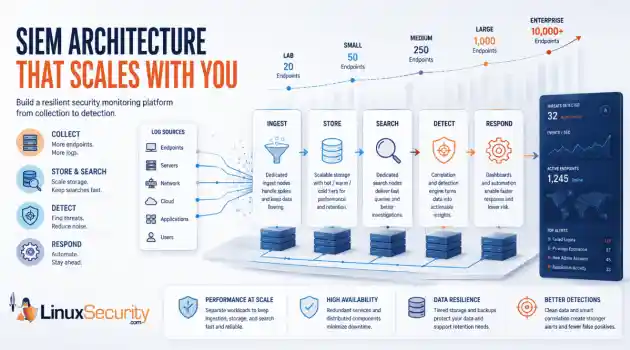
 Building a SIEM is easier than scaling one. Most open-source deployments start as a simple "all-in-one" server. It is easy to set up, but that design rarely survives the transition from a lab to a production workload. . A SIEM watching 20 endpoints is not doing the same job as one watching 500. More endpoints mean more logs; more logs require more storage; more storage makes search heavier. Eventually, the very architecture that made your lab easy to deploy becomes the reason your production...
Jun 04, 2026
 security advisory apache
 A newly disclosed attack technique called HTTP/2 Bomb is drawing attention because it targets the software that sits at the front of much of the Linux internet. Apache HTTP Server, NGINX, Envoy, and the ingress layers that many Kubernetes environments depend on can be forced into consuming disproportionate amounts of memory using relatively small amounts of attacker traffic. . For Linux administrators, the concern is not the HTTP/2 protocol itself. It is the possibility that a single...
Jun 04, 2026
 security advisory important
 The compromise of Nx Console shows how much infrastructure now sits behind a single developer account. GitHub repositories, CI/CD pipelines, container build systems, Terraform projects, Kubernetes deployments. None of those systems was the initial target. The workstation was. . Attackers did not need a Linux privilege escalation bug or a remote code execution chain. They needed developers to trust a tool they were already using. For many organizations, that was enough. What Happened? Federal...
Jun 03, 2026
 security advisory open-source
 You remove the malware. You rotate the compromised credentials. You patch the original vulnerability and close the ticket. Two weeks later, the attacker is back. . What happened? You didn't lose the battle at the exploit; you lost it at the cleanup. In many modern Linux intrusions, the malware you found wasn't the main problem—it was the fallback mechanisms left behind. These hooks quietly restore attacker access the moment you look away. If you clean a host but miss these persistence layers,...
Jun 02, 2026
 Refine features
X Clear Filters
Get the latest News and Insights
Get the latest Linux and open source security news straight to your inbox.
Community Poll
What got you started with Linux?
Loading...
Explore Latest Linux Security features
We found -3 articles for you...
102
 cloud securitysecurity monitoringkernel exploits
Why Linux Rootkits Still Matter in Cloud and VMware Environments
Linux rootkits are old, but they never really disappeared. They just stopped attracting the same attention. . Most malware wants to execute and spread. A rootkit wants to stay invisible long enough that nobody notices the compromise until the damage is already done, and on Linux systems, that still works more often than many teams are comfortable admitting. That difference matters because modern infrastructure runs heavily on Linux underneath. Cloud workloads, ESXi hosts, telecom appliances, Kubernetes nodes, internal web services. A quiet implant inside one of those systems can sit there for weeks while logs look normal and monitoring dashboards stay green. Modern Intrusions Still Use Linux Rootkits Researchers continue seeing Linux rootkits in campaigns tied to VMware exploitation, cloud intrusions, credential theft operations, and long-term persistence activity inside enterprise environments. The tooling changes. The goal usually does not. One of the more visible examples came from the UNC3886 activity targeting VMware environments. Researchers observed the group deploying Linux rootkits, including REPTILE and MEDUSA, after exploiting vCenter and ESXi vulnerabilities. The implants helped hide attacker activity, maintain persistence, and support credential theft across compromised systems. The visibility problem sits underneath all of this. Traditional security tooling still leans heavily on signatures, known malware hashes, or suspicious binaries sitting on disk. Rootkits work around that model by interfering with the operating system itself. Some operate in user space through shared libraries and linker abuse. Others load directly into the Linux kernel, where they can intercept activity before monitoring tools ever see the real picture. What a Linux Rootkit Actually Does A Linux rootkit exists for one reason: to make attacker activity disappear . Sometimes that means hiding files or processes. Other times it means suppressing logs, concealing outbound connections, ormasking remote access entirely. The goal is always the same — make the compromised system look normal long enough for nobody to investigate it closely. Some rootkits stay in the user space and tamper with what applications report back to administrators. Others run directly inside the Linux kernel itself. That is where things get dangerous fast. Once attackers reach kernel space, they can interfere with the operating system before tools like ps, top, or netstat ever see the real activity. At that point, defenders are no longer investigating a trustworthy system. They are investigating a system that may already be lying to them. Why Linux Remains an Attractive Target Linux powers the backbone of modern enterprise infrastructure. Many of these systems—like storage appliances or CI/CD servers—stay online for months with limited downtime, making them perfect candidates for long-term persistence. Attackers have shifted away from older, noisy binary-replacement methods to abusing legitimate system functionality : Loadable Kernel Modules (LKMs): Used for drivers, abused for stealth. LD_PRELOAD: Used for debugging, abused for code injection. eBPF / io_uring: Used for observability/performance, abused for undetectable kernel-level hooking. The line between "necessary admin tool" and "malicious rootkit" is now paper-thin. How Modern Linux Rootkits Stay Hidden LD_PRELOAD: Forces the system to load a malicious shared object before everything else. This can hide files or intercept credentials globally. Kernel-level Hooking: Once a module is in the kernel, it can "hook" functions. If you ask the kernel for a process list, the rootkit modifies the result on the fly to remove its own process ID. eBPF and io_uring: These modern features are hard to disable because they support critical system monitoring. Attackers use this "don't touch" status to hide their activity in plain sight. Defender’s Toolkit: What to Check Tomorrow If you suspect a systemis compromised, stop relying on standard binary output. Use these commands to look for the "truth" underneath: Target Command / Check Why it matters Modules lsmod Look for unsigned or unexplained modules. Libraries cat /etc/ld.so.preload This file should almost always be empty. eBPF bpftool prog show Identify hidden/unknown eBPF programs running in the kernel. Network ss -antp vs netstat Compare different tools; if they disagree, something is intercepting calls. Integrity ausearch -k module-load Check logs for unexpected module loading activity. Why Traditional Detection Breaks Down Many security products still rely on static indicators like hashes or file signatures. Elastic Security Labs found that adding a single "null byte" to a rootkit’s code can be enough to bypass antivirus software entirely without breaking the malware's function. Focus on behavior, not files: Unexpected kernel module loading. Unauthorized LD_PRELOAD usage. Sudden, unexplained process masquerading. Abnormal io_uring system call patterns. Reducing Linux Rootkit Risk Preventing kernel-level compromise is easier than recovering from it. Once a rootkit is in the kernel, you should treat the entire system as untrusted. Enforce Module Signing: Use modules_disabled or secure boot to prevent unauthorized kernel modules. Harden the Kernel: Use sysctl to restrict access to debugging interfaces like kprobes or perf_event_open. Layered Telemetry: Do not rely on local logs alone. Use hypervisor-level monitoring and external network traffic analysis. If the host is lying, the network and the hypervisor will tell the truth. Prioritize Patching: Most rootkits gain a foothold through known vulnerabilities. Closing the front door is the best way to keep thesesophisticated tools from ever getting inside. For teams running bare-metal infrastructure, reviewing dedicated server security hardening practices at the hosting level adds another layer before attackers ever reach the OS. Final Thoughts Linux rootkits are not relics—they are high-value tools for attackers who understand that modern infrastructure is often a "black box" to defenders. A hidden implant inside a cloud host or ESXi server can provide years of access while your dashboards stay green. The moment you stop trusting the operating system’s report is the moment your investigation actually begins. Traditional antivirus is only the first layer; true defense requires behavioral monitoring, deep visibility, and the readiness to rebuild rather than "clean" a compromised system. The hardest attacks to stop are the ones that are already running, quiet and invisible, beneath your feet. Related Articles Rootkits: Threats and Prevention Techniques For Linux Systems BERT: Cross-Platform Ransomware Hits Linux & ESXi - Important Advisory Understanding Play Ransomware's New Linux Variant Targeting ESXi LockBit 4.0: Safeguarding Linux from Ransomware Attacks and Risks Akira Ransomware Attacks VMware ESXi With Linux Encryptor . Most malware wants to execute and spread. A rootkit wants to stay invisible long enough that nobody . linux, rootkits, never, really, disappeared, stopped, attracting. . MaK Ulac
 Jun 01, 2026
•
Jun 01, 2026
•
102
 data securitysecurity monitoringopen source logging
Why Linux Logging Fails: Detection Gaps in Real-World Systems
If you spend enough time looking at a monitoring dashboard, you start to see a comforting pattern. Green lights mean the servers are up, the logs are flowing, and everything feels under control. But if you look closer, you realize that linux logging is often more of a formal archive than a security tool. There is a quiet gap between seeing that a system is running and actually knowing what it is doing. . Linux Logging and System Monitoring: Why Visibility Still Breaks Most organizations invest heavily in system monitoring because they assume that more data equals better security. The logic seems sound: if you record everything, you’ll catch the bad actor. This creates an "illusion of visibility." We expect IT monitoring to act like a digital tripwire, but these tools were originally built to tell you if a web server was slow or a hard drive was full. They track health, not intent. The disconnect happens because of how we interpret log data. A log entry is just a timestamped record of an event. Logs show what happened, but they don't tell you why it matters. Without that "why," logs exist as raw data without context. You might see a record showing that a specific file was opened, but that entry won't tell you if it was opened by a legitimate administrator doing their job or a piece of malware stealing data. This is the fundamental gap: visibility is just the act of having eyes on a system, while detection is the much harder process of understanding what those eyes are seeing. If your tools only show you that the system is "active," you aren't actually detecting threats; you are just watching them happen. Security Logging Failures: An Industry-Wide Monitoring Problem This isn’t just a technical quirk of Linux. It is a recognized category of systemic failure. Organizations often treat log management like a compliance checkbox—something you do because a regulation told you to. They collect event logs but rarely test if those logs can actually reconstruct an attack after it happens. When these systems fail, the clock starts ticking in favor of the attacker. You see this in almost every major breach: the data was actually there, buried in the system, but nobody saw it until months later. Security monitoring fails when it becomes a passive activity. If you save logs but never set up alerts to look for suspicious patterns, you aren't preventing a hack. You are simply creating a recording of the hack that you will find days or weeks later when you check your storage. The Impact of Logging Failures According to the OWASP Top 10 , logging and monitoring failures reduce visibility across systems and significantly delay threat detection. This leads to incomplete investigations and persistent blind spots that stay open for months. Linux Logging Inconsistency: Why Linux System Logs Aren’t Standardized One of the first things you notice in this field is that the operating system doesn't speak one language. Linux is a collection of independent parts, and each part decided a long time ago how it wanted to talk. This inconsistency is built into the OS itself. Component Logging Behavior Impact on Event Logs Standardization Level Kernel subsystems Inconsistent formats Hard to correlate events Low Applications Custom/Unique logging Missing critical fields Very Low Services (Daemons) Varies by config Gaps in log data Medium Because there is no universal format across linux system logs, every component acts as an independent island. If you want to connect a user logging in to a specific change made in the system's core, you have to manually build that bridge. Research from arXiv shows that this variability makes it incredibly difficult to create a reliable baseline for what "normal" looks like. Log Management and Collection Failures in Real Systems Even if you fix the formatting, youstill have to move the data. This is where linux log management breaks down under real-world pressure. A log goes through a long journey, and every step is a chance to lose the very evidence you need. It starts with Generation, where the logs are created. From there, they are gathered by Collection agents, sent across the network via Transport, and pooled together during Aggregation. Finally, they are ingested into a database like a SIEM. The failures here are often practical. An agent might crash, or a network might get congested and drop data. But the biggest failures are often intentional. Storing every single log is expensive. To save money, organizations set up filters that throw away "noisy" data. The problem is that attackers often hide in that noise. You start to see the pattern once you look at the bills: the more you save on storage, the more likely you are to miss the signal of a breach. This is a primary cause of SIEM detection failures . Linux Log Monitoring vs Detection: Where the Gap Forms To fix this, you have to understand the difference between monitoring and detection. They serve different masters. IT monitoring is about health; it tells you if the heart is beating. Network monitoring tracks the volume of traffic moving through the wires. But linux log monitoring on its own is just a stream of consciousness—a list of things that happened without an explanation of why they matter. Function What It Tracks The Critical Limitation Log Monitoring General system activity Lacks actionable interpretation Network Monitoring Traffic flow Doesn’t see what happens inside the host Detection Systems Malicious signals Only as good as the input data Think of it like this: Standard IT monitoring tells you the basics: Is the computer on? Is the CPU busy? Is the memory full? This is "heart rate." Security detection requires examining thesystem's logs in depth to see exactly which files were changed and which network connections were made. This is the "blood test" that reveals a specific infection or attack, even if the computer's "heart rate" (CPU/Memory) looks perfectly normal. Why Detection Systems Fail Even With Full Log Data You would think having "all the data" would solve the problem. It actually creates a new one. The sheer volume of log data generated by a modern Linux environment is enough to overwhelm most log analysis tools. When a system is flooded with data, it creates noise. If your security monitoring tool sends thousands of alerts a day, you will eventually stop looking at them. This leads to a reliance on "static rules." These are predefined patterns based on known behavior, like looking for three failed password attempts in a row. The problem is that modern threats don't always follow these fixed scripts. They look like normal administrative work—a user logging in from a new location or a script moving a file. If your rules are too rigid, you miss the attack entirely; if they are too loose, you get buried in false positives. As noted in NVIDIA’s research , the challenge isn't just collecting the data, but building systems smart enough to realize when "normal" behavior is actually a threat in disguise. Detection Engineering Gaps Across Modern Monitoring Systems This struggle is the core of "detection engineering." It’s an attempt to turn raw IT monitoring and network monitoring data into something useful. But engineers are fighting fragmented systems where the data from the firewall doesn't match the data from the Linux server. This leads to alert fatigue. People get tired of chasing ghosts. When a dashboard stays green for too long, we get complacent and start to trust the infrastructure more than we should. The SANS Institute frequently points out that these blind spots and fragmented sources are why modern systems struggle to stay relevant against evolving threats. What This Means forIncident Response and Monitoring Strategy When a real incident happens, these technical gaps become operational crises. If you are missing event logs, you can't tell how a hacker got in. If your log data is incomplete, you can't prove what they took. This breaks your timeline. You end up in a situation where your system monitoring shows that the server is "fine" while your data is being uploaded to a server on the other side of the world. Every minute spent trying to find a missing log is another minute the attacker has to hide their tracks. Rethinking Linux Logging for Modern Security Monitoring We have to stop looking at linux logging as a single switch you turn on. It is a fragile chain of dependencies. Reliability isn't about how many logs you collect; it is about how many of those logs you can actually turn into a decision. Getting a log from a server to a security analyst requires several distinct steps: the server must create the log, a program must collect it, the network must send it, and a database must store it. If any one of those steps fails—even if the other three work perfectly—the security analyst sees nothing. You end up with a "silent" system where you think you are protected, but no data is actually arriving. Most environments push this data through syslog into a SIEM, where it’s expected to be normalized, correlated, and turned into alerts. But if the upstream pipeline is incomplete or inconsistent, the SIEM doesn’t fix the problem. It scales it. The limitations of Linux logs are structural, and the failures in the pipeline are often financial or operational. If the path from the system to the analyst is broken at any level, the whole environment is effectively silent. . Explore the hidden gaps in Linux logging systems and understand how better monitoring can improve security efficiency.. Linux logging gaps, security monitoring failures, system detection vulnerabilities. . MaK Ulac
Apr 23, 2026
•


Get the latest News and Insights
Get the latest Linux and open source security news straight to your inbox.
Community Poll
What got you started with Linux?
Search Topics
Powered By

Linux Security - Your source for Top Linux News, Advisories, HOWTOs and Feature Releases
QUICK LINKS
subscribe to newsletters!
Like staying secure? So do we.
Sign up for updates, tips, and alerts!
Discover faster search, smarter navigation, and deeper Linux security insights. Read More