


Stay Ahead With Linux Security HOWTOs
How to Secure My Network security advisory intrusion detection
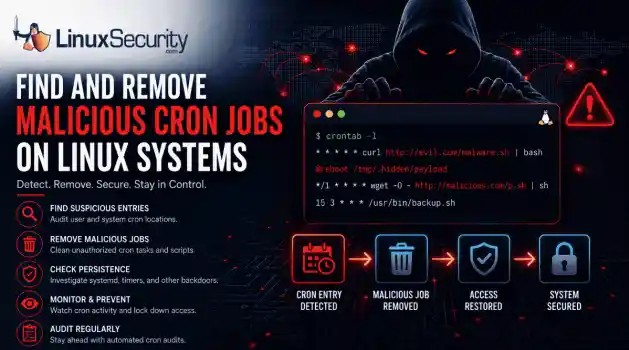
security advisory intrusion detection A compromised Linux server can continue running malware long after the initial intrusion. One of the most common persistence techniques is a malicious cron job that silently downloads payloads, restarts malware, or re-establishes attacker access every few minutes. This guide shows how to identify suspicious cron entries, preserve forensic evidence, remove unauthorized scheduled tasks, and verify that no additional persistence mechanisms remain. . What Should You Save Before Removing Cron Jobs...
 Jun 09, 2026

How to Secure My Networkaccess control Linux administration
access control Linux administration Most SSH hardening advice ends at the same recommendation: Disable password authentication and use SSH keys. . That's good advice. It removes entire classes of attacks, including password spraying, credential stuffing, and brute-force attempts against exposed servers. The problem is what happens next. Many administrators treat SSH keys as the finish line when they are really the beginning of the hardening process. Attackers rarely care whether they obtained access with a password or a private...
Jun 05, 2026

How to Secure My Networksecurity advisory remote access
security advisory remote access Most of the time, nobody notices. SSH authentication succeeds, no alerts are generated, and the connection looks exactly the way it did the day the key was installed. That's part of the problem. . When security teams investigate unauthorized access on Linux systems, they often focus on passwords, exposed services, or vulnerable software. Trusted access receives less attention. Yet a single forgotten or unauthorized SSH key can provide the same access as a legitimate user while attracting very...
Jun 03, 2026

How to Secure My Networkintrusion detection application security
intrusion detection application security The wrong IPS rule can look like a security fix right up until it becomes an outage. . On Linux systems, detection and prevention are often discussed together, but they do not carry the same operational risk. One tells admins that something suspicious happened. The other can decide whether traffic is allowed to continue. That is why IDS vs IPS is not just a definition to memorize. It is a deployment decision about where to monitor, where to block, and how much confidence a team needs before...
Jun 01, 2026

How to Secure My Networkunauthorized access security techniques
unauthorized access security techniques Exposed SSH servers are continuously hammered by brute-force attacks, password spraying, credential stuffing, and recycled passwords from infostealer dumps. Attackers rotate usernames, test weak credentials, and probe for anything that gives them initial access. The logs usually look messy long before the compromise happens. . The difficult part is separating harmless failures from actual intrusion activity. One failed login from an internal workstation rarely matters. Repeated failures...
May 28, 2026
 Refine HOWTOs
X Clear Filters
Get the latest News and Insights
Get the latest Linux and open source security news straight to your inbox.
Community Poll
What got you started with Linux?
Loading...
Explore Latest Linux Security HOWTOs
We found -3 articles for you...
166
 DDoS protectionnetwork performancesecurity interface
Effective Management of eBPF and XDP for Stronger DDoS Defense
Extended Berkeley Packet Filter (eBPF) maps are a sophisticated interface that allows atomic updates to shared memory segments. These segments act as shared memory and provide a robust interface for eBPF program configuration. . The read-copy update mechanism reduces the performance footprint on the hot path. eBPF allows exclusive access to memory fragments. It can handle various map types, including arrays, hash tables, bloom filters, and queues, making it ideal for complex configurations such as security. As configuration complexity increases, the need to connect different map entries increases. The ability to update configurations atomically will fail if too many connections exist. Updates to one map entry may require updating others simultaneously, leading to inconsistency. Learn how to manage XDP/eBPF effectively for better DDoS protection in the guide linked below. . Explore strategies to leverage eBPF and XDP for bolstering DDoS defenses and optimizing setup procedures efficiently.. DDoS Protection,eBPF Management,XDP Configuration,Network Security,Performance Optimization. . Brittany Day
 May 04, 2024
•
May 04, 2024
• How to Learn Tips and Tricks
167
 network performancevpn architectureldp components
Layer 2 VPN: Exploring LDP Components and MPLS Architecture
This article provides an overview of LDP, including LDP components and operations that are related to pseudowire emulation over MPLS along with an explanation of the control signaling and data switching details of AToM. . . Layer 2 VPNs (L2VPNs) are crucial in improving WAN communication, utilizing MPLS technology and LDP for efficient data packet forwarding and enhanced performance.. Layer 2 VPN, LDP Operations, MPLS Framework. . Anthony Pell
Jun 19, 2006
•
How to Secure My Network


Get the latest News and Insights
Get the latest Linux and open source security news straight to your inbox.
Community Poll
What got you started with Linux?
Search Topics
Powered By

Linux Security - Your source for Top Linux News, Advisories, HOWTOs and Feature Releases
QUICK LINKS
subscribe to newsletters!
Like staying secure? So do we.
Sign up for updates, tips, and alerts!
Discover faster search, smarter navigation, and deeper Linux security insights. Read More