


Security Vulnerabilities  malware linux
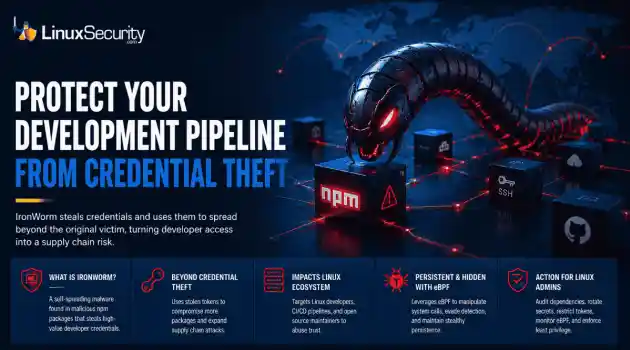
malware linux IronWorm steals credentials and uses them to spread beyond the original victim, turning developer access into a supply chain risk. . A new campaign targeting npm has evolved past simple credential theft. Researchers identified IronWorm, a self-spreading threat. It harvests high-value Linux development secrets—SSH keys, cloud tokens, package publishing credentials. One compromised workstation becomes a launchpad for downstream supply chain attacks. This is not a get-in-and-get-out operation....
 Jun 08, 2026

Network Securitysystem security Linux network
system security Linux network The romanticized image of the digital nomad – a laptop on a sun-drenched balcony – rarely accounts for the actual friction of maintaining a professional development environment on the move. . The friction is amplified with Linux. We are looking for a setup that respects our kernel configurations, handles volatile network handovers, and maintains a strict security posture without the hand-holding of a consumer-grade OS – so, put simply, more than just a laptop and a sunny deck. The hardware is...
May 26, 2026

Server Securityopen-source Linux administration
open-source Linux administration Cron has existed in Unix and Linux environments for decades, handling backups, cleanup scripts, patching jobs, log rotation, monitoring tasks, and other maintenance work that administrators do not want to run manually. Most Linux servers rely on it constantly, which is exactly why attackers continue abusing it for persistence after a system has already been compromised. . Persistence through cron is not complicated. Attackers do not need a rootkit or advanced malware framework to maintain...
May 25, 2026
Vendors/Productssecurity breach linux
security breach linux A major internal repository breach at GitHub has exposed a critical and overlooked blind spot in Linux supply chain security. Kernel exploits, exposed SSH services, weak firewall rules, and vulnerable daemons dominated the Linux threat model for years, and in many environments, they still matter. But recent supply-chain incidents involving GitHub ecosystems, npm packages, and malicious developer tooling point somewhere else entirely: the developer workstation. . The breach matters because...
May 21, 2026

Security Trends access control multi-tenant
access control multi-tenant Linux administrators often face an ugly choice in the cloud: prioritize convenience and cost-efficiency by sharing infrastructure, or sacrifice those benefits for the sake of total isolation. Most modern Linux workloads don't live on their own private servers anymore. They live in shared environments like Kubernetes clusters, where multiple teams and services run side-by-side. It sounds efficient, and it usually is. . But cloud isolation isn't as ironclad as it looks on the diagram. If you...
May 21, 2026
 Refine news
X Clear Filters
Get the latest News and Insights
Get the latest Linux and open source security news straight to your inbox.
Community Poll
What got you started with Linux?
Loading...

Explore Latest Linux Security news
We found -4 articles for you...
209
 data protectionLinux securitydisk encryption
Lennart Poettering Highlights Disk Encryption Issues in Linux
Most Linux distros are currently coming up short from offering adequate security around full disk encryption and authenticated boot. Prominent Linux developer Lennart Poettering even argues that your data is "probably more secure if stored on current ChromeOS, Android, Windows or macOS devices." . Lead systemd developer Lennart Poettering wrote a lengthy blog post today around the state of authenticated boot and disk encryption on Linux. While many Linux distributions offer full-disk encryption, offer UEFI SecureBoot, and begun embracing TPMs, many of the technologies aren't being used to their best potential yet especially now by default / out-of-the-box. Lennart's short summary of the situation is: Linux has been supporting Full Disk Encryption (FDE) and technologies such as UEFI SecureBoot and TPMs for a long time. However, the way they are set up by most distributions is not as secure as they should be, and in some ways quite frankly weird. In fact, right now, your data is probably more secure if stored on current ChromeOS, Android, Windows or MacOS devices, than it is on typical Linux distributions. The link for this article located at Phoronix is no longer available. . Lennart Poettering brings attention to vulnerabilities in Linux disk encryption and secure boot processes, urging for improvements.. Linux Disk Encryption, Authenticated Boot, Security Shortcomings, Data Protection, Lennart Poettering. . Brittany Day
 Sep 24, 2021
•
Sep 24, 2021
• Security Trends

Get the latest News and Insights
Get the latest Linux and open source security news straight to your inbox.
Community Poll
What got you started with Linux?
Search Topics
Powered By

Linux Security - Your source for Top Linux News, Advisories, HOWTOs and Feature Releases
QUICK LINKS
subscribe to newsletters!
Like staying secure? So do we.
Sign up for updates, tips, and alerts!
Discover faster search, smarter navigation, and deeper Linux security insights. Read More