


Network Security open-source python
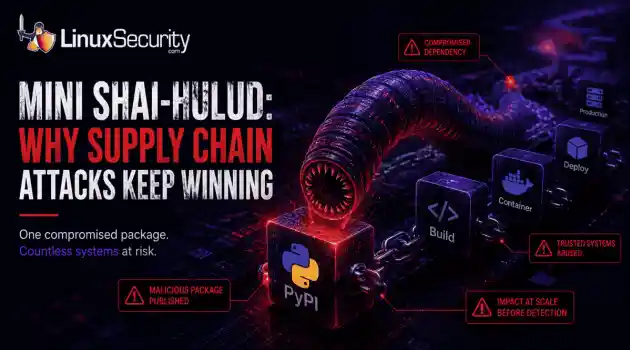
open-source python Researchers recently identified another wave of malicious packages on PyPI linked to the broader Mini Shai-Hulud campaign, a worm-like supply chain attack that spread through trusted software packages. On the surface, the packages looked no different from thousands of others published to the repository each week. . Instead of trying to break into a target network directly, the attackers hid malicious code inside software that developers were already using. A few downloads are all it takes....
 Jun 09, 2026
Security Vulnerabilities malware linux
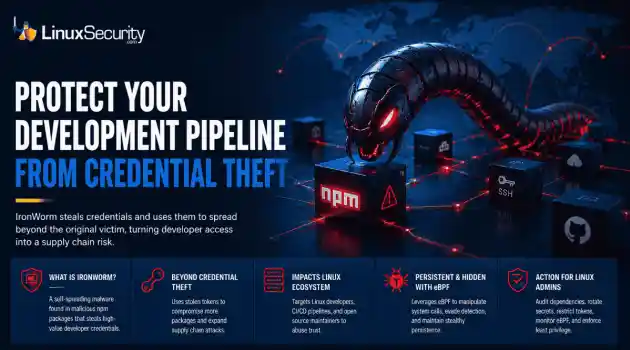
malware linux IronWorm steals credentials and uses them to spread beyond the original victim, turning developer access into a supply chain risk. . A new campaign targeting npm has evolved past simple credential theft. Researchers identified IronWorm, a self-spreading threat. It harvests high-value Linux development secrets—SSH keys, cloud tokens, package publishing credentials. One compromised workstation becomes a launchpad for downstream supply chain attacks. This is not a get-in-and-get-out operation....
Jun 08, 2026

Network Securitysystem security Linux network
system security Linux network The romanticized image of the digital nomad – a laptop on a sun-drenched balcony – rarely accounts for the actual friction of maintaining a professional development environment on the move. . The friction is amplified with Linux. We are looking for a setup that respects our kernel configurations, handles volatile network handovers, and maintains a strict security posture without the hand-holding of a consumer-grade OS – so, put simply, more than just a laptop and a sunny deck. The hardware is...
May 26, 2026

Server Securityopen-source Linux administration
open-source Linux administration Cron has existed in Unix and Linux environments for decades, handling backups, cleanup scripts, patching jobs, log rotation, monitoring tasks, and other maintenance work that administrators do not want to run manually. Most Linux servers rely on it constantly, which is exactly why attackers continue abusing it for persistence after a system has already been compromised. . Persistence through cron is not complicated. Attackers do not need a rootkit or advanced malware framework to maintain...
May 25, 2026

Vendors/Productssecurity breach linux
security breach linux A major internal repository breach at GitHub has exposed a critical and overlooked blind spot in Linux supply chain security. Kernel exploits, exposed SSH services, weak firewall rules, and vulnerable daemons dominated the Linux threat model for years, and in many environments, they still matter. But recent supply-chain incidents involving GitHub ecosystems, npm packages, and malicious developer tooling point somewhere else entirely: the developer workstation. . The breach matters because...
May 21, 2026
 Refine news
X Clear Filters
Get the latest News and Insights
Get the latest Linux and open source security news straight to your inbox.
Community Poll
What got you started with Linux?
Loading...
Explore Latest Linux Security news
We found -3 articles for you...
82
 data recoverysearch technologygovernment efficiency
Enhancing Government Efficiency Through Data Recovery and Search Tech
The government needs to stay focused on first rescuing data trapped in older systems and then establishing the basic framework for widespread search and communications functions. Exotic, automated intelligence forays would be gravy atop such basic achievements, which by themselves would . . . . The government needs to stay focused on first rescuing data trapped in older systems and then establishing the basic framework for widespread search and communications functions. Exotic, automated intelligence forays would be gravy atop such basic achievements, which by themselves would dramatically improve agencies' ability to work more efficiently -- on their own and together. In the wake of September 11, the federal government's technology infrastructure is not only backward but may also be downright dangerous. Any doubts about that were cleared up by with FBI Director Robert Mueller's recent testimony before the Senate. Mueller revealed that the bureau was unable to search through its electronic documents using anything but single terms. Searching for something as simple as, say, "flight schools" in agent files would confuse the computer -- even though such search capability has long been the available to anyone who staggers into an Internet cafe from Delhi to Des Moines. What's the problem? The FBI -- and much of the rest of the federal government -- has unwisely chosen to build its technology atop specialized software that's hard to use and expensive to maintain and update. Staying out of the commercial-software loop, where malicious hackers share information about programs' vulnerabilities on the Internet, was an effort to maintain security through obscurity. The link for this article located at BusinessWeek is no longer available. . The government needs to stay focused on first rescuing data trapped in older systems and then establ. government, needs, focused, first, rescuing, trapped, older, systems, establ. . Anthony Pell
 Jul 11, 2002
•
Jul 11, 2002
• Government
82
legislationcybercrimesecurity policyCyber Security Enhancement Act: Life Sentences Proposed for Cybercrime
Some forms of illegal hacking would be punished by life imprisonment under a proposal that Congress will debate on Tuesday. A House Judiciary subcommittee will consider the Cyber Security Enhancement Act (CSEA), which ups the penalties for computer intrusions, funds . . . . Some forms of illegal hacking would be punished by life imprisonment under a proposal that Congress will debate on Tuesday. A House Judiciary subcommittee will consider the Cyber Security Enhancement Act (CSEA), which ups the penalties for computer intrusions, funds surveillance research and encourages Internet providers to turn over more information to police. CSEA, sponsored by Crime Subcommittee chairman Lamar Smith (R-Texas), is one of Congress' more recent responses to the Sept. 11 terrorist attacks. Smith introduced the bill in December 2001, saying that it will "combat cybercrime and cyberterrorism and send the signal that if you engage in cybercrime or cyberterrorism, you will be punished." The link for this article located at Wired is no longer available. . Some forms of illegal hacking would be punished by life imprisonment under a proposal that Congress . forms, illegal, hacking, would, punished, imprisonment, under, proposal, congress. . Anthony Pell
Feb 12, 2002
•
Government


Get the latest News and Insights
Get the latest Linux and open source security news straight to your inbox.
Community Poll
What got you started with Linux?
Search Topics
Powered By

Linux Security - Your source for Top Linux News, Advisories, HOWTOs and Feature Releases
QUICK LINKS
subscribe to newsletters!
Like staying secure? So do we.
Sign up for updates, tips, and alerts!
Discover faster search, smarter navigation, and deeper Linux security insights. Read More