


Security Vulnerabilities  malware linux
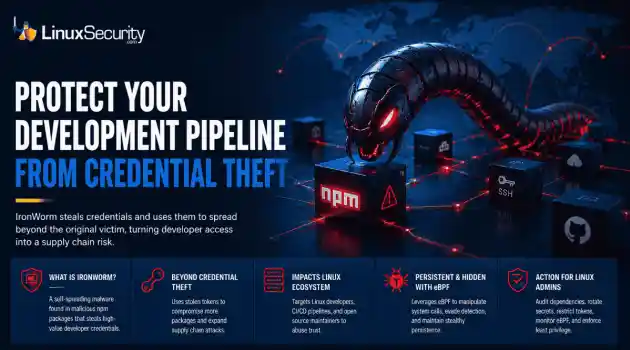
malware linux IronWorm steals credentials and uses them to spread beyond the original victim, turning developer access into a supply chain risk. . A new campaign targeting npm has evolved past simple credential theft. Researchers identified IronWorm, a self-spreading threat. It harvests high-value Linux development secrets—SSH keys, cloud tokens, package publishing credentials. One compromised workstation becomes a launchpad for downstream supply chain attacks. This is not a get-in-and-get-out operation....
 Jun 08, 2026

Network Securitysystem security Linux network
system security Linux network The romanticized image of the digital nomad – a laptop on a sun-drenched balcony – rarely accounts for the actual friction of maintaining a professional development environment on the move. . The friction is amplified with Linux. We are looking for a setup that respects our kernel configurations, handles volatile network handovers, and maintains a strict security posture without the hand-holding of a consumer-grade OS – so, put simply, more than just a laptop and a sunny deck. The hardware is...
May 26, 2026

Server Securityopen-source Linux administration
open-source Linux administration Cron has existed in Unix and Linux environments for decades, handling backups, cleanup scripts, patching jobs, log rotation, monitoring tasks, and other maintenance work that administrators do not want to run manually. Most Linux servers rely on it constantly, which is exactly why attackers continue abusing it for persistence after a system has already been compromised. . Persistence through cron is not complicated. Attackers do not need a rootkit or advanced malware framework to maintain...
May 25, 2026

Vendors/Productssecurity breach linux
security breach linux A major internal repository breach at GitHub has exposed a critical and overlooked blind spot in Linux supply chain security. Kernel exploits, exposed SSH services, weak firewall rules, and vulnerable daemons dominated the Linux threat model for years, and in many environments, they still matter. But recent supply-chain incidents involving GitHub ecosystems, npm packages, and malicious developer tooling point somewhere else entirely: the developer workstation. . The breach matters because...
May 21, 2026

Security Trends access control multi-tenant
access control multi-tenant Linux administrators often face an ugly choice in the cloud: prioritize convenience and cost-efficiency by sharing infrastructure, or sacrifice those benefits for the sake of total isolation. Most modern Linux workloads don't live on their own private servers anymore. They live in shared environments like Kubernetes clusters, where multiple teams and services run side-by-side. It sounds efficient, and it usually is. . But cloud isolation isn't as ironclad as it looks on the diagram. If you...
May 21, 2026
 Refine news
X Clear Filters
Get the latest News and Insights
Get the latest Linux and open source security news straight to your inbox.
Community Poll
What got you started with Linux?
Loading...
Explore Latest Linux Security news
We found -1 articles for you...
83
 malwarecybercrimesecurity incident
Investigation Links Russian Hackers To $530 Million Coincheck Heist
A new report of the investigation into the $530 million hack that ruined Japanese cryptocurrency exchange Coincheck in January 2018 states that Russian, not North Korean, actors may have been behind the attack. . The Asahi Shimbun, a Japanese newspaper, reported that viruses that were thought to have been used in the hack were found on employees’ computers. According to the Asahi Shimbun, the viruses were linked to Russian hacker groups and named “Mokes” and “Netwire.” These viruses were most likely transferred via email, and allowed the hackers to gain access to private keys. The link for this article located at Security Today is no longer available. . An analysis reveals that a cybercriminal group from Russia orchestrated the $530 million heist of Coincheck's cryptocurrency, utilizing sophisticated malware techniques.. Cryptocurrency Hack, Russian Hackers, Cybersecurity Investigation. . LinuxSecurity.com Team
 Jun 24, 2019
•
Jun 24, 2019
• Hacks/Cracks
83
 information leaksecurity breachcyber threat
RSA Security Breach: Government-Sponsored Hacker Groups Identified
Two separate hacker groups whose activities are already known to authorities were behind the serious breach of RSA Security earlier this year and were likely working at the behest of a government, according to new statements from the company. RSA President Tom Heiser, speaking at the RSA conference in London this week, said that the two unidentified hacker groups had not previously been known to work together and that they possessed inside information about the company The link for this article located at Wired is no longer available. . RSA President reveals that two cybercriminal factions responsible for a major security violation are likely operating under government sponsorship.. RSA Security Breach,Hacker Groups,Cyber Threats,Information Leak. . LinuxSecurity.com Team
Oct 12, 2011
•
Hacks/Cracks

76
cyber attacksdata thefthacktivismExploring Anonymous: Motivations and Actions of Hacker Groups
Hacker groups that attack or steal. When they're angry, they hack into business and government systems to steal confidential data in order to expose information about their targets, or they simply disrupt them with denial-of-service attacks. These are the hackers with a cause, the "hacktivists" like the shadowy but well-publicized Anonymous or the short-lived Lulz Security group (which claimed to have just six members and just joined forces with Anonymous). Over the years, Anonymous is believed to have hit targets that include the Church of Scientology, the Support Online Hip Hop website, the No Cussing Club website, and posted pornographic videos disguised as children's videos onto YouTube. It's said to have joined with Iranians protesting the results of the June 2009 Iranian presidential election. It's tied to taking down the Australian prime minister's website in 2009 because of the government's plans there to have ISPs censor porn on the Internet.. Hacker collectives like Anonymous rise from ideological beliefs and responses to injustices, driven by free speech, transparency, community, and personal thrill.. Hacker Groups,Cyber Attacks,Data Theft,Hacktivism,Anonymous. . Dave Wreski
Jul 08, 2011
•
Organizations/Events
83
security advisorycross-site scriptingcyber attacksHacker Groups Disrupt Websites Using Scripting Flaws on July 4th
Hacker groups hit several top websites on US Independence Day, but it remains unclear if the malicious efforts were co-ordinated or not, according to US reports.. Hackers took advantage of a cross-site scripting vulnerability that enabled them to insert code onto Google. Hackers took advantage of a cross-site scripting vulnerability that enabled them to insert code onto. hacker, groups, websites, independence, remains, unclear, malicio. . LinuxSecurity.com Team
Jul 05, 2010
•
Hacks/Cracks

Get the latest News and Insights
Get the latest Linux and open source security news straight to your inbox.
Community Poll
What got you started with Linux?
Search Topics
Powered By

Linux Security - Your source for Top Linux News, Advisories, HOWTOs and Feature Releases
QUICK LINKS
subscribe to newsletters!
Like staying secure? So do we.
Sign up for updates, tips, and alerts!
Discover faster search, smarter navigation, and deeper Linux security insights. Read More