



Network Security security advisory networking
security advisory networking For years, IPv4 was the only proxy type that really mattered for anyone running automation off a Linux box. IPv6 was the protocol everyone said they’d migrate to, but almost nobody actually did. In 2026, that’s finally starting to shift. . The problem is that most admins stick with IPv4 out of habit. They know it; it’s what their tooling defaults to, and they don’t see a reason to change. Some are overpaying for addresses they don’t need. Others would quietly break their scrapers, scripts, or...
 Jun 09, 2026

Network Securityopen-source python
open-source python Researchers recently identified another wave of malicious packages on PyPI linked to the broader Mini Shai-Hulud campaign, a worm-like supply chain attack that spread through trusted software packages. On the surface, the packages looked no different from thousands of others published to the repository each week. . Instead of trying to break into a target network directly, the attackers hid malicious code inside software that developers were already using. A few downloads are all it takes....
Jun 09, 2026
Security Vulnerabilities malware linux
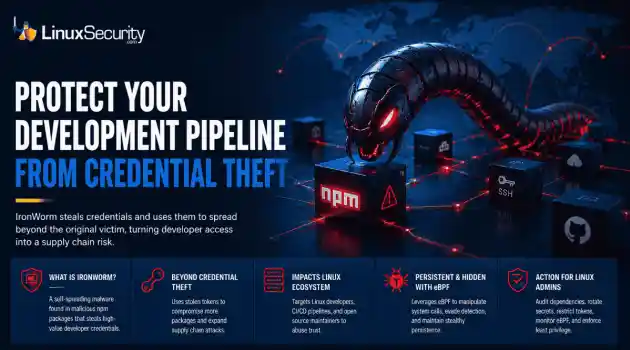
malware linux IronWorm steals credentials and uses them to spread beyond the original victim, turning developer access into a supply chain risk. . A new campaign targeting npm has evolved past simple credential theft. Researchers identified IronWorm, a self-spreading threat. It harvests high-value Linux development secrets—SSH keys, cloud tokens, package publishing credentials. One compromised workstation becomes a launchpad for downstream supply chain attacks. This is not a get-in-and-get-out operation....
Jun 08, 2026

Network Securitysystem security Linux network
system security Linux network The romanticized image of the digital nomad – a laptop on a sun-drenched balcony – rarely accounts for the actual friction of maintaining a professional development environment on the move. . The friction is amplified with Linux. We are looking for a setup that respects our kernel configurations, handles volatile network handovers, and maintains a strict security posture without the hand-holding of a consumer-grade OS – so, put simply, more than just a laptop and a sunny deck. The hardware is...
May 26, 2026

Server Securityopen-source Linux administration
open-source Linux administration Cron has existed in Unix and Linux environments for decades, handling backups, cleanup scripts, patching jobs, log rotation, monitoring tasks, and other maintenance work that administrators do not want to run manually. Most Linux servers rely on it constantly, which is exactly why attackers continue abusing it for persistence after a system has already been compromised. . Persistence through cron is not complicated. Attackers do not need a rootkit or advanced malware framework to maintain...
May 25, 2026
 Refine news
X Clear Filters
Get the latest News and Insights
Get the latest Linux and open source security news straight to your inbox.
Community Poll
What got you started with Linux?
Loading...
Explore Latest Linux Security news
We found -2 articles for you...
81
 internet regulationsnet neutralityentertainment industry
Analyzing FCC's Net Neutrality Challenges Regarding Online Piracy
I must confess, I thought FCC Chairman Julius Genachowski had found a clever way to keep his bid for Net neutrality regulations from getting mired in the debate over online piracy. When the FCC agreed to start the rulemaking process in October, Genachowski made it clear that the regulations wouldn't apply only to the transmission of unlawful content. That's code for bootlegged copies of "Avatar" and "The Hangover.". And yet (he says, channeling Al Pacino as Michael Corleone), Genachowski can't help being pulled back into the issue. In their comments on the FCC's notice of proposed rulemaking, entertainment-industry groups argued that the rules at the very least shouldn't discourage Internet service providers from trying to stop pirated content. The RIAA urged the commission to go further: ISPs are in a unique position to limit online theft. They control the facilities over which infringement takes place and are singularly positioned to address it at the source. Without ISP participation, it is extremely difficult to develop an effective prevention approach. We thus urge the Commission to adopt rules that not only allow ISPs to address online theft, but actively encourage their efforts to do so. In a statement accompanying their joint filing, four entertainment-industry unions struck a similar note: As Guilds and Unions representing more than 300,000 workers in the entertainment and media industries, we urge the FCC to ensure that any policies laid forth to preserve a free and open Internet also strengthen the distinction between the lawful and unlawful transmission of Internet content. We encourage the FCC to take all appropriate steps to keep the Internet from becoming a haven for the theft and illegal transmission of motion picture, audiovisual and sound recording works. The link for this article located at LA Times is no longer available. . Investigates the challenges the FCC faces in the complex dialogue of maintaining Net neutrality amidst efforts to combat digital piracy..Net Neutrality Debate, FCC Regulations, Online Theft Prevention. . LinuxSecurity.com Team
 Jan 16, 2010
•
Jan 16, 2010
• Privacy
82
file sharingonline regulationsinternet service providersMandelson's Internet Cuts Plan For Persistent File Sharers
Lord Mandelson has announced that he intends to pursue file sharers and cut off the connections of persistent offenders. Mandelson restated his controversial plans to adopt a tougher approach to online piracy in a speech today at the Cabinet Forum. . The proposals mean that internet service providers will play a part in identifying the worst offenders, and will send warning letters before cutting them off from the internet. Account suspension will be an option available as a last resort for the most serious infringers, according to Mandleson, who believes that a series of cajoling letters will be enough to dissuade many downloaders from reoffending. "It is clear that, whilst unlawful file-sharing excites a strong response from all sides, it is not a victimless act. It is a genuine threat to our creative industries," said Mandelson.. Mandelson reveals a strategy to tackle unyielding file sharers, engaging internet service providers in tracking violators.. File Sharing, Online Piracy, ISP Regulations. . Alex
Oct 28, 2009
•
Government

81
information securityprivacy concerndata retentionSwiss Surveillance Law: Email Logging Mandate Raises Privacy Risks
Swissinfo web site on 21 July; subheadings as published: A record of almost every email sent to and from Switzerland is to be logged and stored for at least six months, under a new Swiss surveillance law. Since the beginning of . . . . Swissinfo web site on 21 July; subheadings as published: A record of almost every email sent to and from Switzerland is to be logged and stored for at least six months, under a new Swiss surveillance law. Since the beginning of 2002, all Swiss Internet service providers (ISPs) have been legally obliged to record the time, date, sender ID and receiver ID of all emails. While the information to be recorded does not include the content of emails, legal experts have expressed concern that the law poses an unnecessary threat to people's privacy. "[Under] the new law, Internet providers in Switzerland are required to keep certain information about the mail that is exchanged," says Zurich-based information technology legal expert, David Rosenthal. "However, there are so many loopholes that the successful interception [of criminal emails] would be so low. I personally don't believe it justifies the immense effort and intrusion into privacy," he told swissinfo. The link for this article located at Hoovers.com is no longer available. . Swissinfo web site on 21 July; subheadings as published: A record of almost every email sent to and . swissinfo, subheadings, published, record, almost, every, email. . LinuxSecurity.com Team
Jul 22, 2002
•
Privacy

Get the latest News and Insights
Get the latest Linux and open source security news straight to your inbox.
Community Poll
What got you started with Linux?
Search Topics
Powered By

Linux Security - Your source for Top Linux News, Advisories, HOWTOs and Feature Releases
QUICK LINKS
subscribe to newsletters!
Like staying secure? So do we.
Sign up for updates, tips, and alerts!
Discover faster search, smarter navigation, and deeper Linux security insights. Read More