


Security Vulnerabilities  malware linux
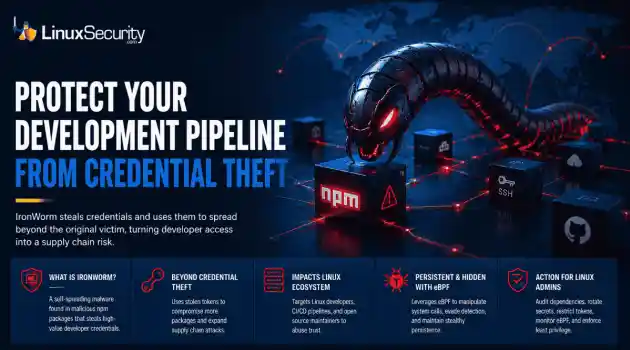
malware linux IronWorm steals credentials and uses them to spread beyond the original victim, turning developer access into a supply chain risk. . A new campaign targeting npm has evolved past simple credential theft. Researchers identified IronWorm, a self-spreading threat. It harvests high-value Linux development secrets—SSH keys, cloud tokens, package publishing credentials. One compromised workstation becomes a launchpad for downstream supply chain attacks. This is not a get-in-and-get-out operation....
 Jun 08, 2026

Network Securitysystem security Linux network
system security Linux network The romanticized image of the digital nomad – a laptop on a sun-drenched balcony – rarely accounts for the actual friction of maintaining a professional development environment on the move. . The friction is amplified with Linux. We are looking for a setup that respects our kernel configurations, handles volatile network handovers, and maintains a strict security posture without the hand-holding of a consumer-grade OS – so, put simply, more than just a laptop and a sunny deck. The hardware is...
May 26, 2026

Server Securityopen-source Linux administration
open-source Linux administration Cron has existed in Unix and Linux environments for decades, handling backups, cleanup scripts, patching jobs, log rotation, monitoring tasks, and other maintenance work that administrators do not want to run manually. Most Linux servers rely on it constantly, which is exactly why attackers continue abusing it for persistence after a system has already been compromised. . Persistence through cron is not complicated. Attackers do not need a rootkit or advanced malware framework to maintain...
May 25, 2026

Vendors/Productssecurity breach linux
security breach linux A major internal repository breach at GitHub has exposed a critical and overlooked blind spot in Linux supply chain security. Kernel exploits, exposed SSH services, weak firewall rules, and vulnerable daemons dominated the Linux threat model for years, and in many environments, they still matter. But recent supply-chain incidents involving GitHub ecosystems, npm packages, and malicious developer tooling point somewhere else entirely: the developer workstation. . The breach matters because...
May 21, 2026

Security Trends access control multi-tenant
access control multi-tenant Linux administrators often face an ugly choice in the cloud: prioritize convenience and cost-efficiency by sharing infrastructure, or sacrifice those benefits for the sake of total isolation. Most modern Linux workloads don't live on their own private servers anymore. They live in shared environments like Kubernetes clusters, where multiple teams and services run side-by-side. It sounds efficient, and it usually is. . But cloud isolation isn't as ironclad as it looks on the diagram. If you...
May 21, 2026
 Refine news
X Clear Filters
Get the latest News and Insights
Get the latest Linux and open source security news straight to your inbox.
Community Poll
What got you started with Linux?
Loading...
Explore Latest Linux Security news
We found -2 articles for you...
209
 IT infrastructuresecurity strategyvirtualization
Dual Boot or VM: Securely Transitioning to Linux Infrastructure
Given its potential security implications, switching from Windows to Linux can be intriguing and daunting for administrators . Instead of taking an abrupt leap and abandoning Windows altogether, creating an environment in which both operating systems coexist can make this transition process smoother and safer. . Taking this approach not only enhances testing capabilities but also provides protection from disruptive failures. Furthermore, this gradual migration approach enables critical services and workloads to be safely moved before a full switchover to Linux. Let's examine how dual booting or using virtualization software provides a balanced, secure route towards adding Linux into your IT infrastructure. Exploring the Dual Boot Advantage Establishing a dual boot system involves installing both Windows and Linux onto one machine, allowing users to boot into either system at startup. This provides organizations an effective means for testing security practices - acting as an ideal testing ground where Linux-specific security tools or patches may be trialed before expanding them across an entire network. Security administrators can use this setup to conduct vulnerability assessments without endangering their existing Windows setup. Testing updates or open-source security software in an isolated Linux environment provides peace of mind knowing any potential issues won't threaten critical Windows systems. Incorporating both operating systems simultaneously ensures greater operational continuity while mitigating risks associated with software compatibility issues. Virtual Machines: A Flexible Approach Virtual machines (VMs) offer administrators several benefits over dual booting methods. One such advantage is access to Linux as an application within Windows without needing to reboot their machine and use its security tools. Running a Linux virtual machine (VM) can greatly enhance security operations by providing real-time testing of security scenarios without impacting liveenvironments. Admins can test potential threats in virtualized Linux environments before exploiting vulnerabilities for real. This process enhances security measures and creates more robust response strategies. Virtual machines (VMs) enable admins to efficiently prioritize current tasks on Windows systems while exploring security frameworks or protocols in Linux on one machine, thus expanding their understanding and utilization of Linux's vast security features. Security: Mitigating Risks with a Dual Strategy One of the primary concerns when switching operating systems is security risks that might emerge. Using dual boot or virtualization technology can help minimize these risks significantly, especially since cyber threats have become far more sophisticated in recent years. Running two distinct OSes on one machine adds another layer of protection. Suppose one operating system becomes compromised due to malware or a security breach. In that case, its counterpart remains undamaged, providing admins a crucial advantage in responding to incidents without resorting to emergency restoring procedures. Admins can leverage Linux's robust security tools without completely cutting ties with all their Windows applications, maintaining operational flexibility and assurance that would otherwise be impossible with a single OS system. Gradual Learning Curve and Migration Transitioning from Windows to Linux can be a steep learning curve, particularly for those entrenched in a Windows-based environment. A phased approach via dual boot or VM allows IT professionals to acquaint themselves with Linux at their own pace, testing waters and developing competencies without immediate pressure. This comfort in learning fosters a deeper understanding of Linux’s capabilities, from superior security protocols to tweaking system configurations that enhance your security posture. Over time, as familiarity grows, critical services and workloads can be moved from Windows to Linux with confidence. Admins canensure that all security standards are rigorously tested and maintained during this gradual migration, reducing the potential for disruption and increasing the resilience of IT infrastructure. Enhancing Your Overall Security Strategy Both dual boot and VM solutions encourage a more comprehensive approach to strengthening an organization’s overall IT security strategy. By integrating Linux into their systems in a controlled and incremental fashion, security professionals can leverage the best aspects of each OS. Windows continues to provide familiarity and compatibility with established systems, while Linux offers unparalleled opportunities for innovation and enhanced security practices. Admins can monitor and adjust policies in real time, dynamically applying insights from the Linux environment into more extensive network-wide security plans. Switching effortlessly between systems facilitates continuous learning and adaptation, essential qualities for any security-conscious admin to develop. Our Final Thoughts on The Benefits of a Dual Boot or VM When Transitioning to Linux For IT security admins considering the leap to Linux, opting for a dual boot or VM offers a prudent, security-focused strategy. It promotes a balanced learning curve and encapsulates security benefits that aren't just theoretical but demonstrably practical in mitigating risks and maintaining business continuity. As organizations continue navigating the challenges of today's digital environment, such a transitional strategy ensures readiness and resilience, empowering security admins to deliver secure, reliable IT solutions. Ready to get started? Tom's Hardware offers an excellent guide on setting up a dual boot system . Canonical also offers a great guide on setting up a VM with VirtualBox. Have additional questions or concerns? Reach out to us on X @lnxsec - we're here to help! . Boost your testing potential and fortify security by transitioning to Linux via dual boot setups or virtual machines, whileexpertly minimizing associated risks.. Dual Boot, Virtualization, IT Security, Linux Transition. . Brittany Day
 Feb 28, 2025
•
Feb 28, 2025
• Security Trends
78
 security toolssecurity testingperformance tuning
Achieving Effective Security Testing Even with Limited Resources
Effective security testing of new IT products is constrained by staff shortages, inadequate equipment and crunched time--in short, by a scarcity of resources. But even with all these hurdles, security testing can--and should--be done and done well. . . .. Effective security testing of new IT products is constrained by staff shortages, inadequate equipment and crunched time--in short, by a scarcity of resources. But even with all these hurdles, security testing can--and should--be done and done well. eWEEK Labs has access to some of the most advanced test gear, expertise and vendor support available, but many of our test practices can be modified and implemented in resource-constrained IT organizations. In a manner of speaking, we've taken some of our security testing "recipes" and adapted them for use in a production IT department. The result is a soup-to-nuts collection of testing practices, as well as recommendations for useful security testing tools. The good news is that nearly every security test practice is in step with the process of tuning systems and applications for optimum performance. The reason for this is simple: IT staffers must become at least advanced administrators of any system if they are to run meaningful tests on it, and, along the way, they will learn about more advanced performance-tuning techniques. The link for this article located at eweek.com is no longer available. . The examination of digital solutions for vulnerabilities encounters obstacles such as lack of personnel and insufficient resources, yet it continues to be essential for protection.. security testing, resource constraints, testing strategies. . LinuxSecurity.com Team
Oct 11, 2004
•
Vendors/Products

79
security standardssecurity testinginternet securityStandardized Internet Security Testing: Developer Proposals for Standards
A group of security developers has called for an industry standard for internet security testing. The group, called Ideahamster, which includes a mixture of security experts and developers, has suggested that the introduction of such a standard would make it easier . . . . A group of security developers has called for an industry standard for internet security testing. The group, called Ideahamster, which includes a mixture of security experts and developers, has suggested that the introduction of such a standard would make it easier for users to judge security products. Security firms currently use a number of different methodologies for testing their products. Members of the group said the idea of the Open Source Security Testing Methodology Manual was spawned after they became "sick of reading bland testing methodology descriptions". Group member Pete Herzog said that the focus of the manual "is to set forth a standard for internet security testing. Regardless of firm size, finance capital and vendor backing, any network or security expert who meets the outline requirements in this manual is said to have completed a successful security snapshot and therefore, if nothing else, has been thorough." The link for this article located at vnunet is no longer available. . A group of security developers has called for an industry standard for internet security testing. Th. security, group, developers, called, industry, standard, internet, testing. . LinuxSecurity.com Team
Mar 22, 2001
•
Security Projects

Get the latest News and Insights
Get the latest Linux and open source security news straight to your inbox.
Community Poll
What got you started with Linux?
Search Topics
Powered By

Linux Security - Your source for Top Linux News, Advisories, HOWTOs and Feature Releases
QUICK LINKS
subscribe to newsletters!
Like staying secure? So do we.
Sign up for updates, tips, and alerts!
Discover faster search, smarter navigation, and deeper Linux security insights. Read More