


Security Vulnerabilities  malware linux
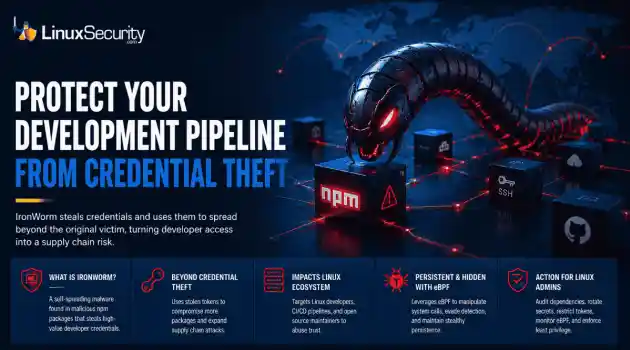
malware linux IronWorm steals credentials and uses them to spread beyond the original victim, turning developer access into a supply chain risk. . A new campaign targeting npm has evolved past simple credential theft. Researchers identified IronWorm, a self-spreading threat. It harvests high-value Linux development secrets—SSH keys, cloud tokens, package publishing credentials. One compromised workstation becomes a launchpad for downstream supply chain attacks. This is not a get-in-and-get-out operation....
 Jun 08, 2026

Network Securitysystem security Linux network
system security Linux network The romanticized image of the digital nomad – a laptop on a sun-drenched balcony – rarely accounts for the actual friction of maintaining a professional development environment on the move. . The friction is amplified with Linux. We are looking for a setup that respects our kernel configurations, handles volatile network handovers, and maintains a strict security posture without the hand-holding of a consumer-grade OS – so, put simply, more than just a laptop and a sunny deck. The hardware is...
May 26, 2026

Server Securityopen-source Linux administration
open-source Linux administration Cron has existed in Unix and Linux environments for decades, handling backups, cleanup scripts, patching jobs, log rotation, monitoring tasks, and other maintenance work that administrators do not want to run manually. Most Linux servers rely on it constantly, which is exactly why attackers continue abusing it for persistence after a system has already been compromised. . Persistence through cron is not complicated. Attackers do not need a rootkit or advanced malware framework to maintain...
May 25, 2026

Vendors/Productssecurity breach linux
security breach linux A major internal repository breach at GitHub has exposed a critical and overlooked blind spot in Linux supply chain security. Kernel exploits, exposed SSH services, weak firewall rules, and vulnerable daemons dominated the Linux threat model for years, and in many environments, they still matter. But recent supply-chain incidents involving GitHub ecosystems, npm packages, and malicious developer tooling point somewhere else entirely: the developer workstation. . The breach matters because...
May 21, 2026

Security Trends access control multi-tenant
access control multi-tenant Linux administrators often face an ugly choice in the cloud: prioritize convenience and cost-efficiency by sharing infrastructure, or sacrifice those benefits for the sake of total isolation. Most modern Linux workloads don't live on their own private servers anymore. They live in shared environments like Kubernetes clusters, where multiple teams and services run side-by-side. It sounds efficient, and it usually is. . But cloud isolation isn't as ironclad as it looks on the diagram. If you...
May 21, 2026
 Refine news
X Clear Filters
Get the latest News and Insights
Get the latest Linux and open source security news straight to your inbox.
Community Poll
What got you started with Linux?
Loading...
Explore Latest Linux Security news
We found -3 articles for you...
81
 data protectionvendor negotiationsecurity provision
Exploring Security Measures in IT Licensing Agreements and Negotiations
In the first article in this series, we looked at security concerns related to clickwrap and shrinkwrap agreements, used by vendors for mass-market licenses and service agreements. In these cases, no negotiations are involved. If you want what the vendor is . . . . In the first article in this series, we looked at security concerns related to clickwrap and shrinkwrap agreements, used by vendors for mass-market licenses and service agreements. In these cases, no negotiations are involved. If you want what the vendor is selling, you are required to agree to "a one size fits all" agreement, including whatever provisions it contains, if any, that pertain to information security. This type of agreement is typical of the licensing agreements that individual users and small organizations enter into. This article looks at a situation that is more typical for commercial users, one in which negotiations between vendors and service providers and their users concerning licensing and services agreements are commonplace and expected, and discusses why it is helpful, and usually essential, to have information security professionals participate in those negotiations. Information technology transactions involve two principal areas: the functionality one party is providing (i.e., the software or services) and what the other party must do or pay to obtain access to that functionality. The basic information technology, whether it is a license or an agreement for services brings together a party that needs to have data transformed with the party that will make that transformation possible for a price or other consideration. The link for this article located at SecurityFocus is no longer available. . In the dynamic world of IT transactions, negotiating security in licensing agreements is essential to protect against breaches and compliance risks, ensuring trust. Security Provisions, IT Transactions, Vendor Negotiation, Licensing Agreements. . LinuxSecurity.com Team
 Oct 22, 2002
•
Oct 22, 2002
• Privacy
78
business strategiesFortune 500cost savingsNetworking Equipment Savings: Fortune 500 Overpayment Analysis
Are you overpaying for networking equipment? Gartner Inc. reports that many Fortune 500 companies are overpaying an average of $500,000 per year by failing to take active steps to cut their costs. The key, Gartner says, is using negotiating best . . . . Are you overpaying for networking equipment? Gartner Inc. reports that many Fortune 500 companies are overpaying an average of $500,000 per year by failing to take active steps to cut their costs. The key, Gartner says, is using negotiating best practices for vendor selection. Namely, that means getting vendors to compete against each other for your business, opening the door to potential discounts. That practice is expected to save corporations that shop around 20-50% on network costs through 2005. Gartner found that a majority (exact numbers were not cited) of companies are staying with their current vendors (with whom, it was unsaid, they've likely had good track records and a working relationship). Also unsaid was this: It's up to the customer to put a price on this and decide whether it's worth shopping around. Mark Fabbi, vice president and research director for Gartner, says, "The number of companies that have made the easy decision of just awarding business to their current vendor instead of actively negotiating has soared since 1998, which essentially takes a large amount of money from their bottom lines." The link for this article located at EarthWeb is no longer available. . Explore the avenues through which top-tier corporations can reduce their expenditures on telecommunications hardware by utilizing efficient bargaining tactics.. Networking Equipment, Cost Savings, Vendor Negotiation, Fortune 500, Business Strategies. . LinuxSecurity.com Team
Jun 14, 2001
•
Vendors/Products


Get the latest News and Insights
Get the latest Linux and open source security news straight to your inbox.
Community Poll
What got you started with Linux?
Search Topics
Powered By

Linux Security - Your source for Top Linux News, Advisories, HOWTOs and Feature Releases
QUICK LINKS
subscribe to newsletters!
Like staying secure? So do we.
Sign up for updates, tips, and alerts!
Discover faster search, smarter navigation, and deeper Linux security insights. Read More