


Security Vulnerabilities  malware linux
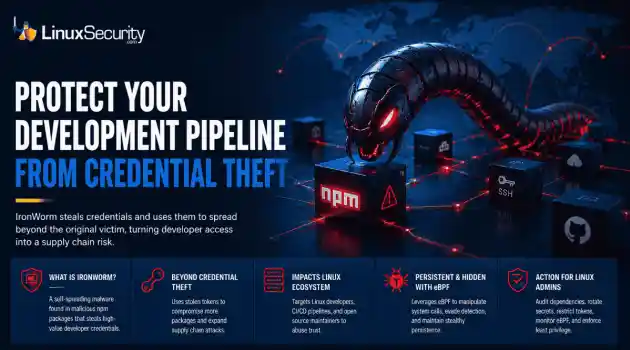
malware linux IronWorm steals credentials and uses them to spread beyond the original victim, turning developer access into a supply chain risk. . A new campaign targeting npm has evolved past simple credential theft. Researchers identified IronWorm, a self-spreading threat. It harvests high-value Linux development secrets—SSH keys, cloud tokens, package publishing credentials. One compromised workstation becomes a launchpad for downstream supply chain attacks. This is not a get-in-and-get-out operation....
 Jun 08, 2026

Network Securitysystem security Linux network
system security Linux network The romanticized image of the digital nomad – a laptop on a sun-drenched balcony – rarely accounts for the actual friction of maintaining a professional development environment on the move. . The friction is amplified with Linux. We are looking for a setup that respects our kernel configurations, handles volatile network handovers, and maintains a strict security posture without the hand-holding of a consumer-grade OS – so, put simply, more than just a laptop and a sunny deck. The hardware is...
May 26, 2026

Server Securityopen-source Linux administration
open-source Linux administration Cron has existed in Unix and Linux environments for decades, handling backups, cleanup scripts, patching jobs, log rotation, monitoring tasks, and other maintenance work that administrators do not want to run manually. Most Linux servers rely on it constantly, which is exactly why attackers continue abusing it for persistence after a system has already been compromised. . Persistence through cron is not complicated. Attackers do not need a rootkit or advanced malware framework to maintain...
May 25, 2026

Vendors/Productssecurity breach linux
security breach linux A major internal repository breach at GitHub has exposed a critical and overlooked blind spot in Linux supply chain security. Kernel exploits, exposed SSH services, weak firewall rules, and vulnerable daemons dominated the Linux threat model for years, and in many environments, they still matter. But recent supply-chain incidents involving GitHub ecosystems, npm packages, and malicious developer tooling point somewhere else entirely: the developer workstation. . The breach matters because...
May 21, 2026

Security Trends access control multi-tenant
access control multi-tenant Linux administrators often face an ugly choice in the cloud: prioritize convenience and cost-efficiency by sharing infrastructure, or sacrifice those benefits for the sake of total isolation. Most modern Linux workloads don't live on their own private servers anymore. They live in shared environments like Kubernetes clusters, where multiple teams and services run side-by-side. It sounds efficient, and it usually is. . But cloud isolation isn't as ironclad as it looks on the diagram. If you...
May 21, 2026
 Refine news
X Clear Filters
Get the latest News and Insights
Get the latest Linux and open source security news straight to your inbox.
Community Poll
What got you started with Linux?
Loading...

Explore Latest Linux Security news
We found -4 articles for you...
210
 security advisorymoderatevim
RHEL: Vim Moderate Code Execution Bug CVE-2025-53905 Advisory
Two new flaws in Vim could let attackers run code on Linux systems. Red Hat confirmed the issue in a recent advisory, describing it as a Linux code execution vulnerability with impact well beyond the editor itself. . Both RHEL 9 and Fedora are affected, along with other enterprise distributions built from the same package base. Red Hat’s RHEL security update notes that a crafted file or malicious macro could trigger arbitrary code execution with the user’s privileges — a serious risk in developer or production environments where Vim is routinely installed. These bugs, tracked as Vim CVE-2025-53905 and Vim CVE-2025-53906, raise an old concern: how easily a simple text editor can become an attack surface. We’ll examine the causes, identify who’s exposed, and determine what needs patching immediately. Technical Breakdown of the Vulnerabilities Both bugs trace back to the same problem: Vim is doing more than most users realize under the hood. It’s efficient and deeply tied into everyday workflows, which also makes it a quiet risk when something breaks at a low level. CVE-2025-53905 — Syntax Highlighting Buffer Overflow This issue lives in Vim’s syntax engine. The parser that handles color rules and syntax definitions doesn’t enforce strict bounds on certain buffers. A malformed .vim or syntax file can push data past what’s allocated, leading to memory corruption. Once control data is overwritten, arbitrary code can run with the same privileges as the user. Red Hat documented this in its RHEL security update , noting that Vim CVE-2025-53905 could be used for privilege escalation or remote code execution in certain setups. The flaw affects RHEL 9, Fedora, and related enterprise builds. Anyone who regularly loads custom syntax files or unverified plugins could be exposed without realizing it. CVE-2025-53906 — Path Traversal and File Access Vim CVE-2025-53906 affects how Vim manages temporary files. In some cases, the editor fails to stay confined to itsworking directory. A crafted file can manipulate the path used for temporary storage, allowing unintended reads or writes elsewhere on the system. The result can range from overwriting configuration files to exposing data in local directories. It’s a simple bug with practical impact, and most users wouldn’t notice it happening. Exploitation Scenario Malicious syntax files, plugins, or repository configs could all carry exploit payloads. A single file opened in Vim is enough to trigger the vulnerable code paths for Vim CVE-2025-53905 or Vim CVE-2025-53906. Both flaws have been patched upstream. Fixes are available in the Vim master branch and included in Red Hat’s latest release, but systems running older builds remain vulnerable until updates are applied. Why Developer Tools Pose Real Linux Security Risks Most Linux professionals trust their tooling. Editors like Vim sit at the center of daily workflows — handling configs, scripts, and production files — often under elevated privileges or as part of automated tasks. That’s what makes a text editor vulnerability different from a typical user-space bug. When the editor breaks, it can take the system with it. In the case of Vim CVE-2025-53905 and Vim CVE-2025-53906, the risk comes from where and how Vim operates. Developers open files across network shares, mount points, and build directories. If any of those paths include a crafted syntax or temporary file, what begins as a parsing error can become a Linux code execution vulnerability. We’ve seen this before. CVE-2019-12735 exposed Vim’s modeline feature to remote code execution, and CVE-2023-2420 followed with another buffer overflow in core editing functions. Each time, the same pattern repeats — trusted local tools turning into unintentional attack surfaces. The trend isn’t slowing down. Editor-based exploits are reappearing as lateral-movement footholds across Linux environments, particularly in shared development and CI pipelines. What used to be dismissedas isolated bugs is now part of a wider Linux developer security problem: everyday tools providing attackers with low-friction access to critical systems. For more on how these smaller user-space flaws connect to kernel-level risk, see our feature on Linux kernel security in 2025 . How These Fixes Are Moving Through Linux Distributions When Red Hat issues a fix, it usually starts with a push to its mainline packages. That’s what happened here. The RHEL security update introduced patched builds for both Vim CVE-2025-53905 and Vim CVE-2025-53906, and those updates are already live in RHEL 9 repositories. Fedora has the same patches queued for rollout. Upstream commits are verified in the Vim master branch , confirming the fixes have landed and will move downstream into other distributions soon. Ubuntu and Debian typically trail by a few days while their maintainers validate dependencies and push signed updates to stable channels. How to Check Coverage If you’re running RHEL or Fedora , you can confirm the patch with: dnf updateinfo list vim | grep RHSA-2025:17742 For Debian or Ubuntu : apt changelog vim | grep CVE-2025 Or simply check your installed version : vim --version | head -n 1 This isn’t just a distro update cycle. It’s part of how Linux code execution vulnerability management works — fixes need to propagate from upstream commits through downstream maintainers before systems are fully protected. Skipping verification leaves gaps, especially in mixed environments or when local mirrors lag behind. For admins tracking how vulnerabilities like these flow through the ecosystem, the coverage timeline is as important as the patch itself. See our feature on Connected Linux Kernel Vulnerabilities: Ubuntu Advisories 2025 for a deeper look at how those updates move across distributions and what to watch for next. Mitigation and Security Recommendations The patches are available, but security doesn’t end once the package updates. These stepsreduce exposure and close remaining gaps in real environments. Immediate Patch Action Verify your systems are running the patched build. Use your package manager to confirm update status, then cross-check the release information in the Red Hat CVE Portal . Both Vim CVE-2025-53905 and Vim CVE-2025-53906 should show as resolved in the latest versions. If you manage mixed distributions, confirm updates landed across mirrors and container images — not just on primary hosts. Interim Protections Where updates can’t be applied immediately, reduce the attack surface: Start Vim in restricted mode ( vim -Z ) to block unsafe commands. Disable modelines ( set nomodeline ) to prevent automatic code execution. Don’t open files pulled from unknown sources, shared repos, or external attachments. Integrate editor sandboxing or containerized workflows in CI environments so risky files can’t interact with host systems. These steps don’t replace patching, but they keep exposure low until patched builds are verified and deployed everywhere. Expert Analysis and Industry Commentary Red Hat classified these flaws as Moderate, but in our experience, that label can be misleading. It doesn’t mean the risk is low; it means the exploit requires the right conditions. Once those conditions exist, a Linux code execution vulnerability in a tool like Vim can escalate quickly. We’ve seen this pattern before. Local utilities that sit deep in everyday workflows — text editors, package managers, shell tools — often carry more real-world risk than their CVSS scores suggest. The difference comes down to how Linux professionals actually use them. Many run Vim with elevated privileges, inside scripts, or across shared build environments. That’s what makes this kind of bug more serious than the classification implies. Red Hat’s scoring is technically sound, but the context matters. From where we sit, any issue that allows code execution through routine editor behavior deserves fastattention, regardless of its numeric score. If these vulnerabilities eventually surface in the CISA Known Exploited Vulnerabilities Catalog , it’ll only confirm what many of us already recognize: that editor-based flaws are no longer edge cases. For readers tracking broader trends, we’ve compared this user-space patching cycle with the latest kernel developments in Security Fixes and Enhancements in Linux Kernel 6.14 . Together, they show how Linux security is tightening at every layer — from the editor to the kernel itself. Takeaway for the Linux Security Community The disclosure of Vim CVE-2025-53905 and Vim CVE-2025-53906 shows how easily everyday Linux tools can turn into attack paths. Editors and developer utilities run close to the system and often with elevated access. When one is compromised, the effect can spread through shared builds, repositories, or CI environments. Security teams should treat these tools as part of their core infrastructure. Keep them in the patch pipeline, confirm package versions, and verify updates the same way you would for kernel or network services. What looks like a simple editor bug can become an entry point if left unpatched. For broader insight into how Linux mitigations are evolving, see Linux Kernel Security Updates Close . . Two vulnerabilities in Vim could lead to code execution on Linux environments, impacting security; updates required for protection.. Vim vulnerabilities, Linux code execution risks, RHEL security updates, CVE-2025-53905, Vim security patch. . MaK Ulac
 Oct 14, 2025
•
Oct 14, 2025
• Security Vulnerabilities

Get the latest News and Insights
Get the latest Linux and open source security news straight to your inbox.
Community Poll
What got you started with Linux?
Search Topics
Powered By

Linux Security - Your source for Top Linux News, Advisories, HOWTOs and Feature Releases
QUICK LINKS
subscribe to newsletters!
Like staying secure? So do we.
Sign up for updates, tips, and alerts!
Discover faster search, smarter navigation, and deeper Linux security insights. Read More