Overly broad permissions can turn one compromised account into a much larger security problem. Learn how to reduce unnecessary access, review privileges, and apply least privilege across modern Linux systems. Review Linux Privileges×



Desktop Security security advisory vulnerability
security advisory vulnerability GNOME is officially shortening its standard vulnerability disclosure window from 90 days to 30 days, a change that impacts upstream maintainers, downstream Linux distributions, and system administrators in how they handle software vulnerabilities. The policy shift, announced by long-time security coordinator Michael Catanzaro , addresses modern software patching realities and a growing influx of automated submissions. . Because GNOME is the default desktop environment on several major Linux...
 Jul 21, 2026

Security Vulnerabilities security advisory moderate
security advisory moderate For organizations that run a self-hosted Git platform, it’s no longer just about hosting static code repositories. Today, Git servers are responsible for deployment pipelines, API tokens, SSH keys, package repositories, and the automation scripts that push code directly. Confirm that the upgrade addresses known vulnerabilities but also provides production environments. . That makes them trusted systems within the development environment and attractive targets for attackers looking to move...
Jul 20, 2026

Server Securitydata privacy automation
data privacy automation Every system admin has lived through the same Monday morning ritual. A queue of forty tickets, half of them password resets, permission errors, or disk space warnings that any experienced technician could resolve in under two minutes. The other half require actual judgment. For years, automation promised that software would eventually sort the two apart on its own. That promise is now being tested in production Linux environments. . Early results are reshaping how IT teams think about tier-1...
Jul 17, 2026

Privacydata collection automation
data collection automation You're running a web scraping project to collect pricing data from e-commerce sites. You set up a pool of datacenter proxies, launch your scripts, and within minutes — banned . CAPTCHAs everywhere. Your data pipeline stops before it really begins. . It's a frustrating scenario that plays out daily in ad verification, market research, and multi-account management. The website doesn't know you're doing legitimate research or monitoring. It just sees traffic coming from IP ranges it recognizes as...
Jul 17, 2026

Security Trends security advisory social engineering
security advisory social engineering Business Email Compromise used to be a numbers game — mass-blasted emails, broken English, an obvious "URGENT WIRE TRANSFER" subject line. That era is over. Generative AI has turned BEC into a tailored, low-noise operation that mimics writing style, voice, and even video presence. This piece looks at what's actually changed under the hood, what defenders are testing in response, and why so many organizations are still structurally unprepared for it. . The Infrastructure Problem Nobody Wants to...
Jul 17, 2026
 Refine news
X Clear Filters
Get the latest News and Insights
Get the latest Linux and open source security news straight to your inbox.
Community Poll
Should Linux servers automatically install security updates?
Trending News
Loading...
Explore Latest Linux Security news
We found 9,995 articles for you...
209
 cybersecurityLinux documentationsecurity icons
Enhancing Linux Documentation with Security Icons for Clarity
Linux operating systems have gained prominence due to their stability, adaptability, and excellent security options. In the case of developing documentation, designing cybersecurity dashboards, or educational material, visuals are of vital importance when it comes to making things clear. The use of icons allows one to understand the message regarding alerts, authorization, encryption, authentication, or the state of the system just by looking at the visual cue without having to read long descriptions. Their universally similar design helps improve the quality of communication while adding a professional touch to documentation. . Why Do Security Icons Matter in Linux Documentation? The technical documentation should be easy to understand by both novices and experienced professionals. Good icons will help readers distinguish the significant parts of the document, such as security warnings, firewalls, encryption, authentication , and other necessary elements. Thus, instead of using words only, meaningful icons make the technical documentation more attractive and easier to perceive. They will increase the readability and consistency of installation, administration, and troubleshooting documentation. If an organization uses several different Linux distributions, such icons may help to establish a unified style of documentation. Improving Technical Communication Using Linux security icons is a good way to communicate security-related information faster than using lengthy descriptions. Usually, developers use them to emphasize privileged commands, root permissions, Secure Shell access, and encrypted directories. Therefore, using icons will decrease the time spent learning Linux security principles and will help to perceive complex documentation in a better way. Moreover, the usage of icons will make the collaboration of team members easier since everybody knows what icons mean regardless of their background knowledge. According to research from the UX Design Institute , effectiveiconography is a cornerstone of intuitive UI, as it significantly lowers the cognitive load for users processing complex technical information. Common Types of Security Icons Used in Linux Projects The range of subjects covered in Linux documentation is diverse. Thus, a number of different icon categories become very important. Lock icons usually stand for encrypted documents, while shield images denote the overall security or antivirus functions of the system. Icons depicting authentication usually involve user profiles along with passwords or key images. To find a versatile library for your projects, you can explore various security icons to help symbolize firewall protection, vulnerability alerts, or encrypted status. Correctly chosen icons will provide information about the topic and help users avoid distractions from work. Authentication and Access Control Icons Authentication is probably the most critical part of any Linux security. The set of commonly used icons includes symbols for passwords, biometrics, SSH, and MFA authentication, as well as icons for user permissions. Such visuals make explanations of logging in much clearer. Administrators can distinguish between normal and privileged accounts easily. Useful authentication icons will make it easy for users to understand how to log into the system securely. Using Security Icons in Cybersecurity Projects Cybersecurity solutions make use of visualizations since many experts have to work with vast volumes of information in a very short period of time. The dashboards that are used to visualize information regarding threats, vulnerabilities, and security operations can be easily read when icons are applied appropriately. Colored graphics can make it easier for professionals to spot dangerous incidents and ensure efficient system monitoring and alert handling. Irrespective of whether the task is to create an intrusion detection solution or a network monitoring tool, icons will add clarity to the interface. Visualizing ThreatDetection When it comes to working with threat detection systems, analysts can see various types of information such as malware alerts, malicious activity, firewall activities, and network incidents. With the help of clearly defined security symbols, developers provide analysts with an opportunity to differentiate between various kinds of events in a matter of seconds. Best Practices for Choosing Security Icons Designing good icons entails much more than choosing pretty graphics. In addition to being clear and scalable, icons need to be consistent in all documentation and applications. They have to be clearly distinguishable at various sizes while retaining enough contrast. The use of a consistent style is one of the factors that help achieve professionalism, especially in enterprise Linux, where several teams are involved in documenting their systems. Well-designed icons should work in tandem with documentation and not distract from it. Maintaining Consistency Across Documentation Consistency is crucial in terms of trust and usability. Use of similar icon sets in installation guides, configuration instructions, security policies, and training material makes life easier for the reader. Besides, using a standardized library of icons facilitates further development as it adheres to a certain design language. Future Trends in Linux Security Documentation Since Linux is penetrating into the sphere of cloud computing, DevOps, and enterprise infrastructure, it means that documentation standards will keep on evolving. Interactive manuals, artificial intelligence-based documentation, and adaptive digital knowledge bases create the need for new icons that can be viewed successfully from any device or screen. We should expect an increased use of animated icons, scalable vector graphics, and icon designs focused on accessibility. This will help professionals explain complex cybersecurity notions and improve the user experience. Conclusion Quality Linux documentation requires a proper balancebetween technical correctness and visual presentation. Well-chosen security icons will make it easier for users to understand complicated notions, navigate through the information, and receive cybersecurity education in an effective manner. Thus, using icons in such documents as administrator manuals, cybersecurity dashboards, educational resources, and enterprise knowledge bases will significantly boost their usability and professional appearance. . Explore the importance of security icons in Linux documentation and their role in enhancing clarity in cybersecurity projects.. Security Icons, Linux Documentation, Cybersecurity, Visual Communication, Iconography. . Anthony Pell
 Jul 17, 2026
•
Jul 17, 2026
• Security Trends
210
 security advisorylinux distributionuntrusted code
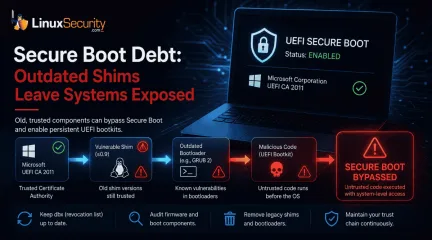
Linux UEFI Shim Vulnerability Severe Exploitation of Obsolete Bootloaders
ESET researchers identified 11 old and forgotten Linux UEFI shim bootloaders at versions 0.9 and below that can be used to bypass UEFI Secure Boot on any UEFI-based machine that trusts Microsoft’s Microsoft Corporation UEFI CA 2011 third-party certificate authority, regardless of the installed operating system (OS). Reported shims can be exploited to execute untrusted code during system boot, enabling attackers to deploy malicious UEFI bootkits even on systems with UEFI Secure Boot enabled. . While two CVE IDs were assigned to this case, CVE-2026-8863 and CVE-2026-10797 , exploitation of each reported shim is not just about a single bug that can be found in these old shims directly. In fact, the attack surface is extended by the shims’ trusted, second-stage bootloaders—most notably GRUB 2—which, like the shims themselves, often include outdated versions with known vulnerabilities. The discovered shims come from various software packages, including PC-diagnostics utilities and older Linux distributions. Importantly, exploitation is not limited to systems with the affected software installed, as attackers can bring their own copy of these vulnerable, Microsoft-signed shims to any UEFI system with the Microsoft third-party certificate enrolled. The Problem of "Secure Boot Debt" This is not merely a collection of 11 vulnerable binaries; it is a textbook case of "Secure Boot debt"—the accumulation of old, trusted code that creates a persistent attack surface. To allow Linux distributions to boot on Secure Boot-enabled systems without Microsoft signing every distribution-specific bootloader, the open-source shim project provides a small first-stage bootloader that Microsoft signs once. This shim acts as a secondary anchor, verifying and launching the rest of the boot stack. The breakdown occurs here: these shims do not have an expiration date. In the eyes of the firmware, a shim signed in 2013 is often just as "valid" as one signed in 2026. Because these legacy shims predatesecurity features like Secure Boot Advanced Targeting (SBAT) , which embeds generation metadata into boot components to allow entire vulnerable generations to be revoked, they simply ignore current revocation policies. Risk and Persistence It is vital to note that this is primarily a persistence mechanism rather than a remote, "one-click" initial access vector. Exploitation generally requires an attacker to already possess significant privileges or control over the boot process, such as administrative access, physical access to the machine, or a successful compromise of the host OS. Once a vulnerable shim is utilized, however, the malicious code operates from a position of authority, establishing persistence that survives OS reinstalls and disk wipes. Since this exploit occurs before the OS loads, many OS-level security controls, including EDR agents, cannot observe the initial compromise. Strengthening the Chain The primary obstacle to revocation is the scale of ecosystem coordination. While newer mechanisms like SBAT are critical for scalability, systems running bootloaders from a decade ago do not know how to verify those policies. To protect systems, administrators should prioritize the following: Prioritize the dbx Update: Ensure all systems have applied the latest Secure Boot revocation list updates. This is the primary defense against the execution of these specific binaries. Audit Firmware Lifecycle: Firmware-level auditing must be incorporated into standard vulnerability management. Treat bootloader inventory with the same scrutiny applied to OS-level package managers. Retire Legacy Components: Periodically inventory the boot chain and remove obsolete shim and GRUB binaries from deployment images. Old, signed components should not remain available simply because they still boot successfully. The BootHole disclosure demonstrated that Secure Boot depends on every trusted component in the boot chain. Secure Boot Is Only as Strong as Its Trust Chain Secure Boot isn't a security feature that you can "set it and forget it"; it's a trust model that needs to be maintained all the time. Updating the operating system is only half the battle if old boot components are still trusted below it. Linux administrators can lower Secure Boot debt and protect the boot chain's integrity by regularly applying Secure Boot revocation updates, getting rid of old shim and GRUB binaries, and including firmware in regular security maintenance. . Obsolete Linux UEFI shims introduce security risks, enabling attackers to exploit vulnerabilities during boot.. Linux UEFI, Trust Chain, Secure Boot, Bootloader Vulnerabilities, GRUB Security. . MaK Ulac
Jul 16, 2026
•
Security Vulnerabilities

77
security measuressysadmin practicescredential managementRunning Proxies Safely on Linux: A Hardening Guide for System Administrators
Proxies are a standard component of a Linux administrator's toolbox. You can use them to see how services respond in various locations, to run route monitoring checks, and to retrieve public data for internal tooling. However, a proxy is an outbound tunnel with credentials attached, and on a multi-user server, it is a security risk that should be treated with the same caution as SSH or sudo. This post explains the practical measures that prevent a proxy setup from becoming a weak point in an otherwise hardened host. . Keep credentials clear of places where they frequently leak. Don't put your credentials where they can be seen by anyone. Most of the time, something simple goes wrong: proxy credentials get hardcoded into a script, a systemd unit, or a cron job . This means that every user on the box can read them, and they will always be there in shell history and backups. As if they were any other secret. Keep them in a secrets manager or, at the very least, a file that is owned by root and has tight permissions. Add them to the program at runtime using environment variables that are set to the service user's scope, and never commit them to a repository. For fixed servers, IP allowlisting is better if your service supports it because it removes the password from the connection and only lets requests come from addresses that you have registered. Choose a provider whose sourcing you can defend On Linux, you are used to knowing exactly what your software does. Extend that instinct to your proxy vendor. Residential proxy networks route traffic through real consumer connections, and the reputable ones source those exits from consenting participants and document where their pools operate. Reputable providers are transparent about how their residential IP pools are sourced, where they operate, and the options they offer. They should also provide clear documentation and guidance on secure residential proxy use , so you understand how to deploy the service responsibly Isolate the proxypath from everything else Do not let one credential and one route serve every purpose. Give each job its own scoped account so a leak or a runaway is contained. Where possible, run proxy-using tools under a dedicated unprivileged service user with no login shell, so a compromise of the tool does not hand an attacker a general foothold. If a job only needs HTTPS, do not provision a SOCKS credential that can tunnel arbitrary TCP out of your network, because that is precisely the capability an intruder would love to find lying around. Watch DNS and prevent leaks A classic mistake is routing HTTP through the proxy while DNS still resolves locally, which leaks your lookups and can defeat the geo-targeting you set up the proxy for in the first place. Confirm that name resolution follows the proxy path when it should, test it explicitly rather than assuming, and log egress at the host so you can see where traffic actually goes. A quick check comparing the exit address the provider reports against public geolocation confirms the route is behaving before you trust it in production. Log, alert, and assume the credential will eventually leak Instrument the proxy layer like any other service. Record request volume per credential and alert on spikes that signal a runaway job, and on traffic to countries you never target, which is the fingerprint of a stolen credential in someone else's hands. A proxy credential seen coming from an unfamiliar host at an odd hour deserves the same response as a leaked API key, because functionally that is what it is. Rotate on a schedule so that even an undetected leak has a limited lifespan. Maintain compliance with the regulations. Technical hardening does not excuse misuse. Maintain automatic fetching on public pages, follow robots directions, keep request rates low enough so that no target is burdened, and keep personal data out of everything you collect. An arrangement that is both technically tight and operationally restricted may be performed forever withoutcausing problems and explained to a security reviewer without hesitation. Anyone who administers Linux professionally is familiar with the through-line: least privilege , explicit configuration, true logging, and no secrets in the open. Apply similar practices to the proxy layer, and it will become just another well-managed component of the system, rather than the silent exception that undoes the rest of your hardening. . Learn effective strategies to manage proxies safely on Linux, ensuring secure configurations and better credential practices.. Linux Proxies Hardening Guide, Secure Proxy Management, System Administrator Practices, Credential Security, Outbound Traffic Best Practices. . Anthony Pell
Jul 16, 2026
•
Server Security
210
 security advisoryRed Hatcritical
Mak’s Weekly Security Roundup: Linux Updates You Shouldn't Ignore This Week
Before the week gets away from you, take a look at what's landed across the Linux ecosystem. The volume of security advisories hasn't slowed, and while not every update demands an emergency maintenance window, several deserve to move to the top of your patch queue. This week's updates span the kernel, remote desktop infrastructure, VPNs, containers, browsers, and the utilities Linux systems quietly depend on every day. Individually, these look routine. Together they show how quickly attackers can take advantage of organizations that let routine patches pile up. . Why This Week Matters One thing stood out as I worked through this week's advisories: nearly every layer of a modern Linux deployment received security attention. The operating system, remote administration tools, browsers, VPN software, container platforms, and the utilities Linux systems quietly depend on all received meaningful security updates. None of these vulnerabilities dominate the headlines on their own, but together they reinforce an important lesson: small, delayed patches have a habit of becoming much bigger security problems. Kernel Updates: Priority Kernel maintenance remains the most critical—and often most postponed—task. Ubuntu and Red Hat published multiple advisories covering networking, filesystems, and drivers. With several fixes addressing privilege escalation and container-escape scenarios—including several affecting privilege escalation and container-related components —these updates are essential. If you only have one reboot window this week, use it for the kernel. Hardening Remote Access and Orchestration FreeRDP 3.29 : This release addresses 22 vulnerabilities while introducing significant runtime hardening. Given its prevalence in enterprise environments, this update is a priority. OpenShift: Red Hat released security updates for 4.20 , 4.21 , and 4.22 . As the control plane for your infrastructure, securing the orchestration layer is paramount. VPNs: OpenVPN addressed multiple issues, including proxy and metadata handling. As internet-facing gateways, these should be prioritized. Browsers and Foundational Plumbing Browsers remain high-value targets. Firefox and Thunderbird updates are vital, particularly for administrator workstations. Additionally, ensure you address updates to Python Pillow and cifs-utils to maintain the integrity of your environment's "plumbing." Patching Priority Category Recommended Priority Linux Kernel Critical (Highest priority) Internet-Facing Services (OpenVPN) High Remote Access & Orchestration (FreeRDP, OpenShift) High Foundational Utilities (Wget, Python, GnuTLS) Medium/Ongoing End-User Apps (Firefox, Thunderbird) Medium/Ongoing Linux security isn't just about responding to the latest critical CVE; it’s about consistently reducing the attack surface. Consistent, disciplined patching remains your most effective defense against the cumulative risk of the modern threat landscape. . This week's roundup highlights crucial Linux security updates for your systems, emphasizing the urgency of timely patching.. Linux updates, security advisories, patch management, system vulnerabilities, open source software. . MaK Ulac
Jul 15, 2026
•
Security Vulnerabilities
210
 security researchopen-sourcekernel
GhostLock Exposes an Uncomfortable Truth About Open Source Security
When researchers announced GhostLock, many people focused on the exploit. What stood out to me wasn't just what the vulnerability could do, but how long it had remained hidden. The flaw had lived in the Linux kernel for roughly 15 years before it was publicly identified by researchers. That means the flaw survived hundreds of kernel releases and years of upstream development before it was publicly documented. It raises an uncomfortable question about one of open source's oldest assumptions. One of the enduring arguments in favor of open source is that transparency improves security. If anyone can inspect the code, vulnerabilities should be easier to discover and fix. GhostLock doesn't disprove that idea, but it does force us to ask how well it scales when the Linux kernel contains tens of millions of lines of code. . Why the GhostLock Linux Kernel Vulnerability Is Different The Linux kernel vulnerability CVE-2026-43499 , or "GhostLock," was identified by Nebula Security Research in their ionstack analysis . Because the flaw originated in upstream code, it potentially affected numerous Linux distributions that incorporated the vulnerable kernel code until it was patched in the upstream Linux kernel in April 2026 . GhostLock stood out for several reasons: Legacy Impact: The bug existed since kernel 2.6.39, illustrating that even mature, stable code can harbor deep-seated flaws for years. High-Stakes Exploitation: Researchers demonstrated local privilege escalation to root and a container escape, making the vulnerability particularly significant for cloud and containerized environments. Professional Interest: The vulnerability was identified through Google’s kernelCTF program, earning a $92,337 bounty. The payout also reflects how difficult kernel memory-safety bugs have become to identify, even for experienced researchers. The real question isn't whether Linux is secure. It is whether the traditional "many eyes" argument still reflects how securityactually works in a codebase of this magnitude. When "Many Eyes" Meets Modern Reality One of the best-known ideas in open source security is the "many eyes" principle , often associated with Eric S. Raymond's Linus's Law : "Given enough eyeballs, all bugs are shallow." The idea is straightforward. Because the source code is publicly available, developers, researchers, and users can inspect it, increasing the likelihood that vulnerabilities will be identified and fixed more quickly than they might be in closed-source software. In practice, however, transparency makes review possible; it does not guarantee that every line of code will actually be examined by someone with the time, expertise, or reason to look at it. That distinction becomes increasingly important in a project as large and complex as the Linux kernel, where millions of lines of code are maintained by thousands of contributors across hundreds of subsystems. Several practical realities shape how security review works today: The Scale Problem: The Linux kernel receives thousands of changes during every development cycle. No single human can review the entire codebase. Subsystem Silos: Most reviewers specialize in one subsystem. If a vulnerability exists in an obscure or legacy corner of the kernel, it may sit outside the field of view of those most qualified to audit it. The "Old Code" Reality: Legacy code often changes less frequently than actively developed subsystems. That stability is valuable, but it can also mean certain execution paths receive less ongoing scrutiny than newer code undergoing active development. How Linux Kernel Security Research Has Changed GhostLock wasn't discovered because someone finally decided to manually audit that specific line of code. It was discovered because the methodology of Linux security research has fundamentally changed. Historically, kernel security depended largely on expert review and targeted testing. Today, that work is increasingly complemented bycoverage-guided fuzzing, sanitizers, and large-scale automated testing. Tools like syzkaller/syzbot and KASAN act as force multipliers, systematically probing kernel state transitions that would be impossible for a human to track mentally. Automated testing now routinely finds combinations of events that humans would never naturally think to test. Programs like kernelCTF have further professionalized this research, bringing top-tier talent to bear on the kernel’s deepest subsystems. GhostLock is a testament to the fact that modern security is no longer just about "eyes"—it’s about the sophistication of the tooling and the bounty programs that reward deep, specialized research. The Reboot Gap For administrators, GhostLock is a stark reminder of the "reboot gap." Most organizations have well-defined maintenance windows for web servers, databases, and application software. Kernel updates are different because they frequently require reboots, coordinated maintenance windows, or live-patching infrastructure that many organizations simply don't have. It's not uncommon for organizations to schedule kernel updates quarterly while patching user-space software weekly. GhostLock shows why that gap deserves another look. In a containerized world, many assume the host is "just plumbing." A container escape vulnerability proves that the host kernel is the single point of failure for everything running on top of it. Local privilege escalation vulnerabilities become especially important in these environments because the kernel remains the shared trust boundary. When a vulnerability allows for container escape, the kernel is effectively an application-level concern and must be treated with the same urgency as a critical web server flaw. Security Priorities Have Changed GhostLock also highlights how Linux kernel security priorities have shifted over the last decade. Memory safety is now one of the community's primary areas of investment. Maintainers continue to strengthen the kernel through hardeningfeatures, sanitizers, memory-safety improvements, Rust for new kernel components, and continuous automated testing. Rather than suggesting the ecosystem is stagnant, GhostLock illustrates why those investments have become increasingly important as the kernel continues to grow in size and complexity. GhostLock also demonstrates one of open source's greatest strengths. Once the vulnerability was publicly identified, researchers could independently analyze the root cause, distributions could verify the fix, and administrators had complete visibility into the patch itself. That level of transparency is difficult to match in proprietary software, where the source code and development process are generally not available for independent review. What GhostLock Says About the Future of Open Source Security If GhostLock could stay under the radar for 15 years, it makes you wonder: how many other bugs are still waiting to be found? We don't know for sure. But GhostLock also proves that the ecosystem for finding those bugs is much tougher today than it was ten years ago. Between continuous fuzzing, memory sanitizers, coordinated disclosure, and mature bug bounty programs, we are finding whole classes of vulnerabilities that would have been totally invisible in the past. GhostLock doesn't prove that open source security has failed; it proves that transparency alone isn't enough. The Linux kernel has outgrown the point where it can rely solely on volunteer code review to find every critical flaw. Today's security depends just as much on dedicated security teams, automated testing, and bounty programs that reward that deep, specialized research. This reminds us that those strengths still matter, but the scale of modern projects requires more than just visibility. Today's Linux kernel is secured not only by developers reviewing code, but also by continuous automated testing, specialized security researchers, and organizations willing to invest in uncovering vulnerabilities that traditional review alone maynever find. . GhostLock reveals the limitations of open source security, emphasizing the need for advanced tools and methodologies in Linux kernel maintenance.. Linux Kernel GhostLock, Open Source Security Flaws, Automated Security Testing. . MaK Ulac
Jul 14, 2026
•
Security Vulnerabilities
74
 network protectionsystem hardeningsecurity best practices
Securing SSH in Production: Keys, Hardening, and Real Attack Patterns
Spin up a fresh Linux VPS with default settings and check /var/log/auth.log ninety seconds later. There will already be failed login attempts — not dozens, hundreds, sometimes before the deployment script has even finished running. . Automated bots scan the entire IPv4 address space non-stop, and port 22 with password authentication open is exactly what they're looking for. Most cloud providers have seen enough of this that a new instance gets its first probe within a minute of going live. Security research tracking exposed Linux endpoints found that 89% of Linux endpoint attack behaviors in 2025 involved brute force or credential stuffing against SSH. Eighty-nine percent. In early 2026, the SSHStalker botnet — discovered by Flare Systems via SSH honeypot — had already racked up nearly 7,000 compromised systems by the end of January, mostly cloud servers, not through any sophisticated exploit but through weak or default credentials. Once inside, the malware dropped an SSH key, then immediately started scanning for more victims on port 22. A DShield sensor from around the same period documented the full cycle at under four seconds: first connection to complete botnet enrollment. The attacks aren't sophisticated. Default configurations keep making sophistication unnecessary. Start With Keys — Everything Else Comes After Disabling password authentication is the change with the most immediate impact. Do it first, before touching anything else. Once it's in place, the entire brute-force and credential-stuffing attack surface disappears — bots can hammer port 22 as long as they want, and without the private key they're simply not getting in. For new key pairs, Ed25519 is the right choice. Faster than RSA, smaller, stronger at comparable performance: ssh-keygen -t ed25519 -C "production-server" -f ~/.ssh/id_ed25519 Copy the public key to the server, then — and this step matters more than it sounds — open a second terminal and confirm the key-based login works from thatsecond session before touching anything in the config. Don't close the existing session until you've confirmed a fresh connection succeeds. Locking yourself out of a remote server mid-hardening is the most common way this process goes sideways, and it's entirely avoidable: # /etc/ssh/sshd_config PasswordAuthentication no KbdInteractiveAuthentication no PubkeyAuthentication yes In environments where key management is taken seriously — and it should be — rotating keys every six months is worth the friction. It sounds excessive until a former employee still has valid credentials six months after leaving, or a key gets exfiltrated as part of a broader compromise nobody caught at the time. The sshd_config Settings That Actually Move the Needle A handful of changes, none of them complicated, collectively close off real attack surface. None should require debate. Disable direct root login. There's no legitimate operational need for it — log in as a regular user and escalate with sudo when needed. And it adds a layer: an attacker who gets a key still needs to figure out which account has elevated access: PermitRootLogin no Explicit allowlists for SSH access so that any system accounts created after this point don't automatically inherit login capability: AllowUsers deploy monitoring-user Default values for authentication attempts and connection grace periods are far too generous for anything internet-facing: MaxAuthTries 3 LoginGraceTime 20 MaxStartups 10:30:60 LoginGraceTime 20 drops connections that haven't authenticated in 20 seconds flat. MaxStartups 10:30:60 starts throttling unauthenticated connections at 10 pending and drops them aggressively past 60 — this directly limits parallel brute-force attempts trying to flood the authentication pipeline. Add idle session timeouts too, since forgotten open sessions are their own category of risk: ClientAliveInterval 300 ClientAliveCountMax 0 On the port change. Moving SSH off port 22 won't stop a targetedattacker — a basic port scan finds it immediately. But it does eliminate the overwhelming majority of automated scanning traffic, since most botnets only ever target port 22. Logs get dramatically cleaner, and on production systems where log analysis is part of the daily workflow, that reduction in noise has genuine operational value. Worth doing, as long as nobody confuses it with a security control: Port 2222 SSH Certificates for Larger Deployments Key pairs are fine when you've got five servers. At fifty, the model breaks. You're distributing public keys to every host, rotating them manually, and inevitably inheriting authorized_keys files full of entries from people who left six months ago — nobody owns the cleanup, and stale access just sits there. The fix is treating SSH like PKI: a central Certificate Authority signs user keys, and every server trusts the CA instead of tracking individual keys. One revocation point. No per-host cleanup: # Generate the CA key pair — store this offline or in a hardware security module ssh-keygen -t ed25519 -f ~/.ssh/ssh_ca -C "production-ca" # Sign a user's public key with a 24-hour validity window ssh-keygen -s ~/.ssh/ssh_ca -I " username@prod " -n deploy -V +24h ~/.ssh/id_ed25519.pub On each server, trust the CA — not individual keys: # /etc/ssh/sshd_config TrustedUserCAKeys /etc/ssh/ssh_ca.pub Issue certificates with short lifetimes — 24 hours works well — and a stolen key becomes useless overnight without touching a single host. The stale access problem that haunts larger fleets mostly disappears on its own. Bastion Hosts Exposing SSH directly on every server multiplies attack surface with every machine you add. The cleaner model: a single hardened bastion host — the only machine with port 22 reachable externally — with all other servers restricted to accepting connections only from the bastion's IP at the firewall level. All hardening effort concentrates on one machine. Internal servers can dropeverything that doesn't come from the bastion. And SSH's ProxyJump makes the setup seamless: # ~/.ssh/config Host internal-server HostName 10.0.1.50 User deploy ProxyJump bastion.example.com SSH internal-server tunnels through the bastion automatically. Every lateral connection gets logged there. Combined with SSH certificates, you get one enforcement point for the entire fleet. Fail2Ban Key-only authentication largely kills the brute-force problem. Fail2ban still earns its place — misconfigured clients, edge cases, environments where password auth genuinely can't be fully disabled for one reason or another. A baseline configuration that bans IPs for 24 hours after three failed attempts: # /etc/fail2ban/jail.local [DEFAULT] bantime = 86400 findtime = 600 maxretry = 3 [sshd] enabled = true port = 2222 logpath = /var/log/auth.log maxretry = 3 Adjust the port value to match whatever is set in sshd_config. After any configuration changes, restart and verify: sudo systemctl restart fail2ban sudo fail2ban-client status sshd For privileged access workstations or jump servers where a stolen key alone would be an unacceptable outcome, stack TOTP on top. Twenty minutes of setup, and a compromised private key by itself stops working: # /etc/ssh/sshd_config AuthenticationMethods publickey,keyboard-interactive Reading the Logs Getting the configuration right is one half of this. Actually reading the logs is the other — and it gets underestimated consistently. SSH authentication logs are genuinely informative when you read them with intent rather than just watching for volume spikes. Repeated failures from a single source followed by a success: credential stuffing, worth investigating regardless of the account. Authentication from an IP that's never appeared before on an account with established connection history: worth a second look. More telling than either: a privileged account suddenly connecting from somewhere it never hasbefore. Or a service account that's never had an interactive session showing up with one. Audits extend monitoring past what SSH logs capture: auditctl -a always,exit -F arch=b64 -S execve -F euid=0 -k root_commands Every root command gets logged with a tag for easy filtering. Cross-reference with SSH auth events and you get a full timeline from initial login through command execution — which matters a lot during incident response when reconstruction is what you need. SSHStalker reinforced something worth keeping in mind: compromised hosts don't just become victims, they become attack infrastructure. A server generating high outbound connection volumes to port 22 on non-private IP ranges is almost certainly already part of a scanning relay. Behavioral monitoring that flags that specific pattern catches it faster than manual log review ever will. The DShield sensor data from early 2026: four seconds from first connection to fully enrolled botnet node on a default-credential system. Not a theoretical estimate — an actual observed result from a real internet-exposed VPS. The full hardening process here takes under an hour on a fresh server. Disable passwords, deploy a key, tighten the config, install fail2ban. The gap between a default SSH setup and a properly hardened one isn't a project. It's an afternoon. For the offensive perspective on SSH — how attackers enumerate configurations, harvest private keys from the filesystem, hijack agent sockets to move laterally without ever touching a key file, and use SSH tunneling to reach internal services, this SSH attack surface guide breaks down the techniques defenders need to understand. . Implement essential SSH security measures to prevent automated attacks through key management and system hardening strategies.. SSH Security, Hardening Practices, Key Management, Automated Attacks, Network Protection. . Andrew Kowal
Jul 13, 2026
•
Network Security
210
 security advisorycriticalauthentication
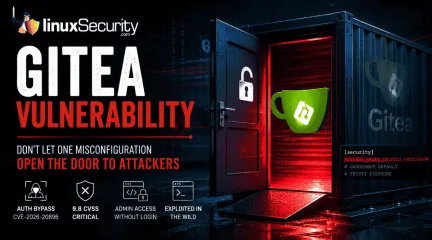
Critical Gitea Docker Authentication Bypass: An Open Door to Your Infrastructure
If you’re running Gitea in a container, stop what you’re doing and check your versioning right now. We’re looking at a critical vulnerability— CVE-2026-20896 —shipped directly in Gitea’s official Docker images. It’s a 9.8 CVSS-rated "open door" that lets any unauthenticated attacker stroll in and impersonate any user on your system, admin account included, without needing a password or a token. The reality? This isn't some complex, low-level kernel exploit. It’s a classic "secure-by-default" failure where one bad configuration template is quietly gutting your entire authentication model. . One Wildcard Default Broke the Trust Model Gitea has this reverse-proxy authentication feature built for enterprise setups where a front-end server—say, Nginx or Traefik —does the heavy lifting of verifying who you are. Once it knows you’re legit, it passes your username to Gitea via an X-WEBAUTH-USER header. It’s a standard, reliable pattern, provided you actually lock Gitea down to only accept that header from a proxy you trust. The security hole in the official Docker images is just one line in the app.ini template: REVERSE_PROXY_TRUSTED_PROXIES = * That wildcard tells Gitea: "I don't care where the request came from, I trust the identity header." By tossing out the safe default—which should’ve restricted trust to the local loopback interface ( 127.0.0.0/8 )—the Docker image leaves the door wide open. Any attacker who can hit your container’s HTTP port can just send a forged header and tell Gitea they’re the admin. No exploit chain, no credential theft, no memory corruption. Just one header, and they’re in. Why Git Platforms Are the New "Crown Jewels" It’s easy to think of a Git server as just a place to store code, but that’s a dangerous simplification. In today’s DevSecOps workflows, Gitea is the nervous system of your entire operation. Administrator access gives an attacker: The Full Repository Set: Public, private, and internalcode. Persistent Secrets: API keys, database credentials, and deploy tokens that developers accidentally committed and never scrubbed. Pipeline Control: The ability to alter CI/CD configurations to inject malicious code into your production builds before they’re even signed. Infrastructure Keys: SSH deploy keys and webhooks that connect your Git server directly to your live production systems. When an attacker gains admin access, they aren't just reading your repo—they’re using your own automation to move laterally into your CI/CD security stack. Which Gitea Deployments Are at Risk? The risk is concentrated in official Docker images through version 1.26.2 . If you are running these versions and have ENABLE_REVERSE_PROXY_AUTHENTICATION = true set, you are potentially exposed. If your container is reachable from the public internet—or even from an untrusted segment of your internal network—you are a high-priority target. Attackers are already using automated scanners to hunt for these ports. Take a minute to audit your Linux firewall rules; the only thing that should be talking to your Gitea container is your internal proxy. Staying Secure: Practical Defensive Steps Patching is the baseline here, but don't stop there. You need to verify your actual deployment state: Upgrade Immediately: Move to version 1.26.4 as soon as possible. Kill the Wildcard: Never leave REVERSE_PROXY_TRUSTED_PROXIES set to * in production. Hardcode the specific IP address of your authorized reverse proxy. Audit Container Exposure: Use Docker security best practices to ensure your management ports aren't just wide open to the world. Verify Your Network: If you’re managing Gitea in a larger environment, audit your Linux container security to ensure the service is isolated at the host level. The Bottom Line The Gitea Docker Authentication Bypass isn't exploiting a flaw in the Gitea source code; it’s exploiting the assumption that"default" settings are safe for production. The 13-day gap between public disclosure and the first in-the-wild scanning attempts from ProtonVPN exit nodes is a stark reminder of the speed at which today's attackers move. For those of us managing self-hosted infrastructure, this is a wake-up call. Verifying the configuration of your container templates is just as vital as keeping your kernel up to date. Before the next CVE hits, take the time to look under the hood—because if you haven't checked that wildcard, you’re currently hosting a free-for-all. As you tighten your Gitea deployment, how do you balance the need for ease-of-use in your internal configuration templates against the security risk of "convenient" defaults? . A critical Gitea Docker vulnerability could enable unauthenticated users to impersonate anyone without a password.. Gitea Vulnerability, Docker Security, Authentication Bypass. . MaK Ulac
Jul 13, 2026
•
Security Vulnerabilities
215
 network securitysystem hardeningbrowser security
Defending the Open Source Desktop: Advanced Cybersecurity Strategies for Linux
There was a time when Linux meant server rooms and hobbyist forums. These days it's on regular laptops, and a big part of that is people getting fed up with commercial operating systems scraping their data, shipping telemetry nobody asked for, and boxing them into hardware ecosystems they can't opt out of. . None of that makes Linux immune to trouble though. Yes, it dodges most of the mainstream malware that everyone else deals with. But the software running on top, and honestly the person sitting at the keyboard, are still very exploitable. Actual security isn't a box you check once during setup. It's ongoing and includes hardening the system, keeping an eye on the network, patching the apps you rely on every day, all of it. The Browser Is Where Most Trouble Starts Most of a person's screen time occurs in a browser. It's the door between your machine and everything else, and it's also carrying your bank sessions, your login tokens, and your personal DMs. That combination makes it the obvious target. People use extensions for one-off tasks and then just leave them there. Forgotten, still running, still able to touch things in the background. It’s worth building the habit of going through what's installed every so often and figuring out how to remove browser extensions that aren't earning their keep anymore. Fewer extensions means less surface area, and it means a single compromised update can't plant something on your machine. A lean browser is faster too, sure, but the real payoff is that there's less room for something to sit there unnoticed, shipping your data out the back door. What's Actually Driving People to Switch? The move to open source isn't a trend. It's people wanting their machine back. There are plenty of pieces out there on quitting Windows and trying Linux , and they all circle the same complaint, which includes forced updates and data terms nobody agreed to. Once you're on Linux, you're the one deciding what runs and what phones home, so to speak. Thatcontrol is the whole foundation of everything else you do to lock the system down. It's not free though. No one's patching behind your back or babysitting your firewall. That's on you now and includes permissions, updates, all the calls that used to be automatic. Keeping Tabs on Your Own Network Securing one machine only gets you halfway. You need some visibility into what's moving across the network too, because that's usually where things actually go wrong. Attackers don't usually go after the hardened box first. They'll find whatever's weakest, some IoT gadget or an old phone nobody's updated in ages, and use that as a stepping stone toward something worth taking. That's the argument for internal visibility tools. Running something like Suricata east-west traffic monitoring means you can actually watch what's passing between devices you'd otherwise just assume are fine. Catch the traffic that looks wrong early, and you can quarantine the problem before it spreads to anything that matters. Locking Down Remote Access Opening SSH to the outside world raises the stakes quite a bit. That port gets hammered by bots around the clock, all of them just guessing passwords and hoping for better outcomes. A good password isn't nothing, but it's not enough on its own either. Get in the habit of pulling your logs, and once you know how to understand failed authentication patterns in Linux logs , you can tell a typo from a script chewing through a password list. From there you can set up rules that ban the bad actors automatically, before they get anywhere close to getting in. The Job Never Really Finishes Honestly, there's no final state here. Threats change, the tricks that work now won't work forever, and Linux being what it is only gets you so far without the habits behind it. Staying on top of your extensions, watching the network, actually reading the logs- that's what turns a fine setup into a hard one to crack. It takes effort, but what you get back is real ownership ofthe machine and a lot less to lose sleep over. That's really the whole point of open source anyway. Not just a different way of doing things, but one where you're actually the one in charge. . Explore advanced strategies for enhancing security on Linux desktops, including browser management, network visibility, and SSH hardening.. Linux security strategies, open source desktop, browser extension management, network visibility tools, SSH access security. . Anthony Pell
Jul 13, 2026
•
Desktop Security

Get the latest News and Insights
Get the latest Linux and open source security news straight to your inbox.
Community Poll
Should Linux servers automatically install security updates?
Trending News
Search Topics
Powered By

Linux Security - Your source for Top Linux News, Advisories, HOWTOs and Feature Releases
QUICK LINKS
subscribe to newsletters!
Like staying secure? So do we.
Sign up for updates, tips, and alerts!