Explore top 10 tips to secure your open-source projects now. Read More
×


GhostLock Exposes an Uncomfortable Truth About Open Source Security
 Jul 14, 2026
•
Jul 14, 2026
•
 MaK Ulac
4 - 7 min read

Topics Covered
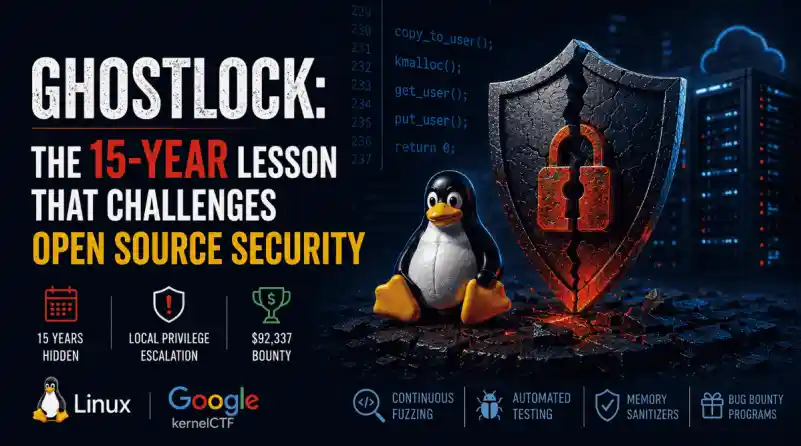
When researchers announced GhostLock, many people focused on the exploit. What stood out to me wasn't just what the vulnerability could do, but how long it had remained hidden. The flaw had lived in the Linux kernel for roughly 15 years before it was publicly identified by researchers. That means the flaw survived hundreds of kernel releases and years of upstream development before it was publicly documented.
It raises an uncomfortable question about one of open source's oldest assumptions. One of the enduring arguments in favor of open source is that transparency improves security. If anyone can inspect the code, vulnerabilities should be easier to discover and fix. GhostLock doesn't disprove that idea, but it does force us to ask how well it scales when the Linux kernel contains tens of millions of lines of code.
Why the GhostLock Linux Kernel Vulnerability Is Different
The Linux kernel vulnerability CVE-2026-43499, or "GhostLock," was identified by Nebula Security Research in their ionstack analysis. Because the flaw originated in upstream code, it potentially affected numerous Linux distributions that incorporated the vulnerable kernel code until it was patched in the upstream Linux kernel in April 2026.
GhostLock stood out for several reasons:
- Legacy Impact: The bug existed since kernel 2.6.39, illustrating that even mature, stable code can harbor deep-seated flaws for years.
- High-Stakes Exploitation: Researchers demonstrated local privilege escalation to root and a container escape, making the vulnerability particularly significant for cloud and containerized environments.
- Professional Interest: The vulnerability was identified through Google’s kernelCTF program, earning a $92,337 bounty. The payout also reflects how difficult kernel memory-safety bugs have become to identify, even for experienced researchers.
The real question isn't whether Linux is secure. It is whether the traditional "many eyes" argument still reflects how security actually works in a codebase of this magnitude.
When "Many Eyes" Meets Modern Reality
One of the best-known ideas in open source security is the "many eyes" principle, often associated with Eric S. Raymond's Linus's Law: "Given enough eyeballs, all bugs are shallow." The idea is straightforward. Because the source code is publicly available, developers, researchers, and users can inspect it, increasing the likelihood that vulnerabilities will be identified and fixed more quickly than they might be in closed-source software.

In practice, however, transparency makes review possible; it does not guarantee that every line of code will actually be examined by someone with the time, expertise, or reason to look at it. That distinction becomes increasingly important in a project as large and complex as the Linux kernel, where millions of lines of code are maintained by thousands of contributors across hundreds of subsystems.
Several practical realities shape how security review works today:
- The Scale Problem: The Linux kernel receives thousands of changes during every development cycle. No single human can review the entire codebase.
- Subsystem Silos: Most reviewers specialize in one subsystem. If a vulnerability exists in an obscure or legacy corner of the kernel, it may sit outside the field of view of those most qualified to audit it.
- The "Old Code" Reality: Legacy code often changes less frequently than actively developed subsystems. That stability is valuable, but it can also mean certain execution paths receive less ongoing scrutiny than newer code undergoing active development.
How Linux Kernel Security Research Has Changed
GhostLock wasn't discovered because someone finally decided to manually audit that specific line of code. It was discovered because the methodology of Linux security research has fundamentally changed.
Historically, kernel security depended largely on expert review and targeted testing. Today, that work is increasingly complemented by coverage-guided fuzzing, sanitizers, and large-scale automated testing. Tools like syzkaller/syzbot and KASAN act as force multipliers, systematically probing kernel state transitions that would be impossible for a human to track mentally. Automated testing now routinely finds combinations of events that humans would never naturally think to test.
Programs like kernelCTF have further professionalized this research, bringing top-tier talent to bear on the kernel’s deepest subsystems. GhostLock is a testament to the fact that modern security is no longer just about "eyes"—it’s about the sophistication of the tooling and the bounty programs that reward deep, specialized research.
The Reboot Gap
For administrators, GhostLock is a stark reminder of the "reboot gap." Most organizations have well-defined maintenance windows for web servers, databases, and application software. Kernel updates are different because they frequently require reboots, coordinated maintenance windows, or live-patching infrastructure that many organizations simply don't have. It's not uncommon for organizations to schedule kernel updates quarterly while patching user-space software weekly. GhostLock shows why that gap deserves another look.
In a containerized world, many assume the host is "just plumbing." A container escape vulnerability proves that the host kernel is the single point of failure for everything running on top of it. Local privilege escalation vulnerabilities become especially important in these environments because the kernel remains the shared trust boundary. When a vulnerability allows for container escape, the kernel is effectively an application-level concern and must be treated with the same urgency as a critical web server flaw.
Security Priorities Have Changed
GhostLock also highlights how Linux kernel security priorities have shifted over the last decade. Memory safety is now one of the community's primary areas of investment. Maintainers continue to strengthen the kernel through hardening features, sanitizers, memory-safety improvements, Rust for new kernel components, and continuous automated testing. Rather than suggesting the ecosystem is stagnant, GhostLock illustrates why those investments have become increasingly important as the kernel continues to grow in size and complexity.

GhostLock also demonstrates one of open source's greatest strengths. Once the vulnerability was publicly identified, researchers could independently analyze the root cause, distributions could verify the fix, and administrators had complete visibility into the patch itself. That level of transparency is difficult to match in proprietary software, where the source code and development process are generally not available for independent review.
What GhostLock Says About the Future of Open Source Security
If GhostLock could stay under the radar for 15 years, it makes you wonder: how many other bugs are still waiting to be found?
We don't know for sure. But GhostLock also proves that the ecosystem for finding those bugs is much tougher today than it was ten years ago. Between continuous fuzzing, memory sanitizers, coordinated disclosure, and mature bug bounty programs, we are finding whole classes of vulnerabilities that would have been totally invisible in the past.
GhostLock doesn't prove that open source security has failed; it proves that transparency alone isn't enough. The Linux kernel has outgrown the point where it can rely solely on volunteer code review to find every critical flaw. Today's security depends just as much on dedicated security teams, automated testing, and bounty programs that reward that deep, specialized research.
This reminds us that those strengths still matter, but the scale of modern projects requires more than just visibility. Today's Linux kernel is secured not only by developers reviewing code, but also by continuous automated testing, specialized security researchers, and organizations willing to invest in uncovering vulnerabilities that traditional review alone may never find.
 PREVIOUS
 NEXT
NEXT

Powered By

Linux Security - Your source for Top Linux News, Advisories, HOWTOs and Feature Releases
QUICK LINKS
subscribe to newsletters!
Like staying secure? So do we.
Sign up for updates, tips, and alerts!