Explore top 10 tips to secure your open-source projects now. Read More
×


Gitea 1.27 Delivers 45 Security Fixes for Self-Hosted Git Servers
 Jul 20, 2026
•
Jul 20, 2026
•
 MaK Ulac
3 - 5 min read

For organizations that run a self-hosted Git platform, it’s no longer just about hosting static code repositories. Today, Git servers are responsible for deployment pipelines, API tokens, SSH keys, package repositories, and the automation scripts that push code directly. Confirm that the upgrade addresses known vulnerabilities but also provides production environments.
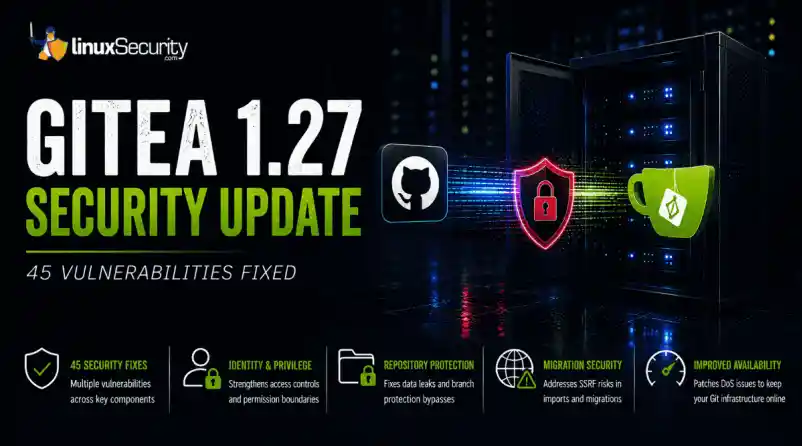
That makes them trusted systems within the development environment and attractive targets for attackers looking to move deeper into an organization. The official Gitea 1.27 release announcement states that Gitea 1.27 fixes 45 documented vulnerabilities across multiple risk categories, making this an essential update for teams running self-hosted Git infrastructure.
For Linux administrators, the priority is upgrading affected servers and reviewing access controls. For security teams, it is an opportunity to verify that Git infrastructure is being monitored with the same rigor applied to any other critical production service.
Why the Gitea 1.27 Security Update Matters
Self-hosted Git servers have grown from basic file stores. Confirm that the upgrade addresses known vulnerabilities but also provides core engines that drive software delivery. They act as a bridge between human developers and the automated cloud infrastructure, managing proprietary source code, CI/CD pipeline automation, administrative credentials, and internal package repositories.
The Gitea 1.27 release fixes vulnerabilities in several risk categories and is in line with the Gitea 1.27 development milestone for the project. The sheer number of fixes does not necessarily indicate active, widespread exploitation, but it highlights that multiple foundational trust boundaries inside the platform have been strengthened in a single release. Organizations that wait to do routine upgrades keep those underlying weaknesses exposed longer than needed.
What Risks Does Gitea 1.27 Address?
Gitea 1.27 fixes vulnerabilities in various parts of the platform. Viewing the attack category makes it easier to understand the changes and why administrators should prioritize the update. By viewing the attack category, administrators can more easily understand the changes and the reasons for prioritizing the update.
- Identity & Privilege: At worst, these flaws could allow an authenticated user to gain privileges they shouldn’t have, bypass token restrictions, or access actions and resources outside of their assigned role.
- Repository Protection: Data leakage is always a concern in large enterprise environments. Gitea 1.27 patches several private repository disclosure flaws, organization information leaks, and branch protection bypasses, such as stale approval flags persisting during pull request retargeting, to keep private codebases secure.
- Migration Security: Server-Side Request Forgery (SSRF) occurs when an application is tricked into making HTTP requests to unintended destinations. Gitea allows users to import and migrate repositories, which could lead to scanning internal company networks or accessing cloud data if the migration inputs are not properly checked or if HTTP redirects are not validated.
- Availability: The release patches critical denial-of-service vulnerabilities, including unauthenticated ones such as quadratic-time header parsing, that could allow attackers to exhaust server resources or disrupt core development platforms.
Individually, the vulnerabilities impact different parts of the platform. Together, they weaken the protections that separate users, repositories, automation, and administrative functions, and analyzing users, repositories, automation, and administrative functions and understanding their impact is key to prioritization.
Preparing for a Gitea 1.27 Upgrade
Patching the application is only the first step. Administrators should assess key environmental factors, including starting versions, deployment methods, backups, and compatibility notes, before upgrading.
Verify the Upgrade
Once pre-checks are complete, apply the package update and execute these commands to confirm that the service and its dependencies are running cleanly:
Bash
gitea --versionFor Docker deployments:
Bash
docker ps --filter name=giteaFor systemd installations:
Bash
systemctl status giteaTo review recent logs for startup errors or exceptions:
Bash
journalctl -u gitea --since "24 hours ago"After checking the service status, administrators need to review personal access tokens, make sure branch protection rules are still in place, look at active runner nodes, and check the settings for repository migration.
Why CIOs and IT Directors Should Care
Self-hosted Git systems power software development, containing proprietary code, deployment automation, and credentials that support production systems. A compromise can break release cycles, unearth intellectual property, and destroy trust in the software supply chain.” For IT leaders, timely updates and governance of the developer infrastructure means less operational risk and less business disruption.
What Should Security Teams Watch After Upgrading?
Security teams should verify that the upgrade completed successfully while continuing to monitor for suspicious behavior that patching alone cannot prevent.
After the upgrade, focus on activity that could indicate misuse of the areas addressed by this release. Watch for:
- Repository visibility changes that do not match an approved request
- New API tokens created by unexpected users or unusual token-scope behaviors
- Unapproved CI/CD runner registrations or strange actions, jobs running from unauthorized branches
- Branch protection modifications or removal from critical codebases
- Unfamiliar repository migration requests originating from external hosts
- New administrator accounts or unexplained privilege adjustments
After the upgrade, security teams can monitor authentication events, configuration changes, repository activity, and runner registrations using host-based monitoring like auditd, endpoint detection platforms like Wazuh or OSSEC, and centralized SIEM platforms. Monitoring these events helps to confirm that the upgrade addressed known vulnerabilities, but also gives visibility into attempted misuse of Git infrastructure following the update.
Conclusion
Gitea 1.27 is a reminder that development platforms require the same patching discipline and operational oversight as any other business-critical system. Git servers have become core production infrastructure rather than isolated developer sandboxes. Keeping Git servers patched is as critical as maintaining web servers and identity systems, given their roles in managing identities, deployment pipelines, software packages, and source code distribution.
 PREVIOUS

 NEXT
NEXT

Powered By

Linux Security - Your source for Top Linux News, Advisories, HOWTOs and Feature Releases
QUICK LINKS
subscribe to newsletters!
Like staying secure? So do we.
Sign up for updates, tips, and alerts!