Explore top 10 tips to secure your open-source projects now. Read More
×


How Linux Security Teams Spot Vulnerabilities Before CVEs Are Published
 Jul 14, 2026
•
Jul 14, 2026
•
 Dave Wreski
3 - 6 min read
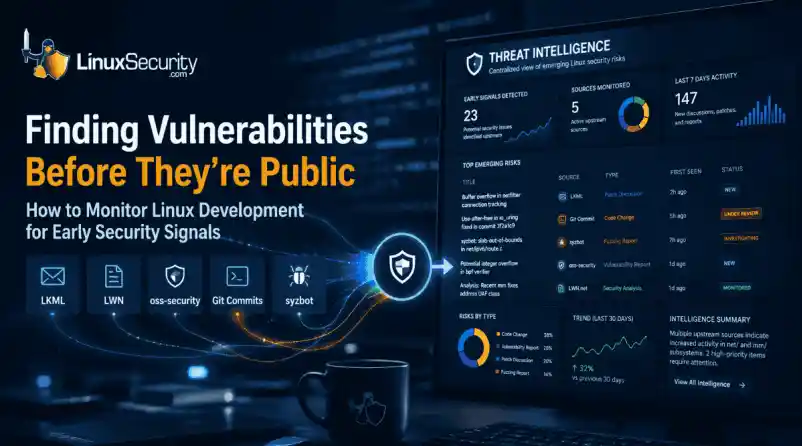

Most of us don't hear about a kernel vulnerability until a CVE lands in our inbox or the vulnerability scanner starts complaining. By then, the patch isn't new anymore. Kernel developers may have been passing it around for review, arguing over the implementation, or revising it for days before anyone outside that community noticed it.
None of those discussions are secret. They're sitting in mailing list archives, Git commits, and patch reviews where they've been the whole time. The strange part isn't that the information is hard to find. It's that most of us never think to look there.
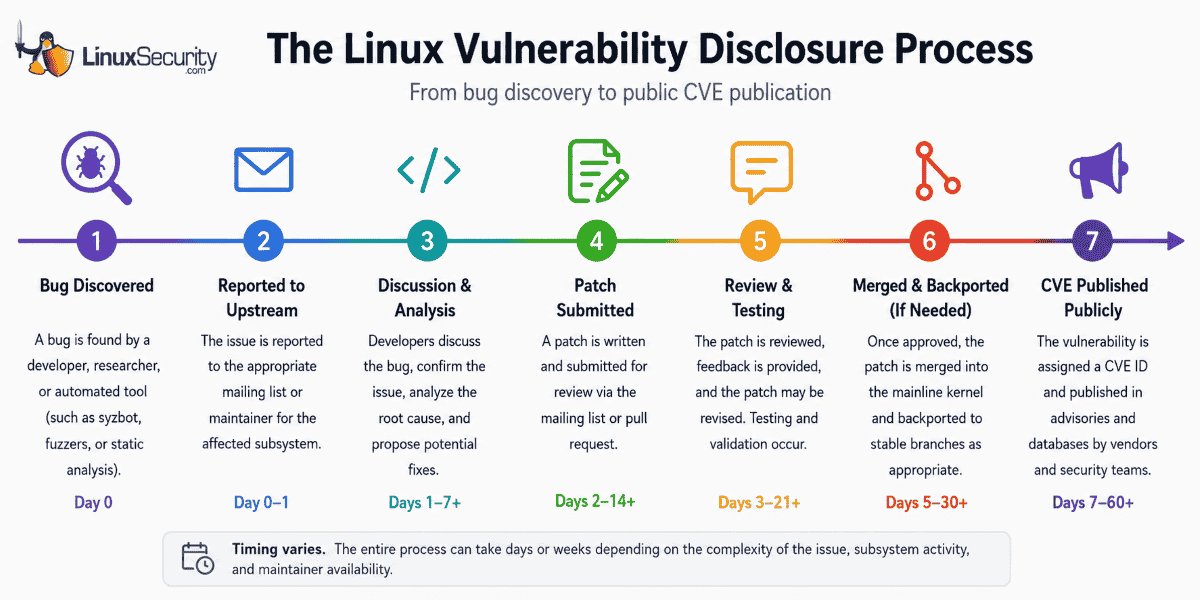
The Linux Vulnerability Lifecycle
To understand how to spot vulnerabilities early, it helps to visualize the typical path from discovery to disclosure:
Where Early Security Signals Actually Appear
Security fixes rarely appear in just one place. A patch might start as a mailing list discussion, move through several revisions, show up in the stable tree, and only later receive a CVE. Following that entire path isn't realistic for most teams, but knowing where those conversations happen makes it much easier to understand why some fixes deserve closer attention than others.
LKML is where most of that story begins. It's also noisy. Hundreds of patches move across the mailing list every day, so the interesting part usually isn't the existence of a patch. It's the discussion around it. Long review threads, repeated revisions, or several maintainers debating the same change are often more revealing than the patch itself.
oss-security feels different. Instead of watching development unfold, you're watching researchers, vendors, and Linux distributions compare notes as a disclosure moves toward becoming public. If something significant is about to land in multiple distributions, there's a good chance the discussion shows up there first.

Most people aren't going to spend their mornings reading LKML archives, and that's where LWN.net becomes useful. Rather than reproducing every discussion, it explains why a particular thread mattered and what changed before the patch reached users.
When a fix is merged, kernel.org becomes the reference point. Stable releases and Git history make it possible to follow how quickly a change moved from development into supported kernels.
Then there's syzbot. It never gets tired, never stops fuzzing, and produces far more crash reports than anyone could read. Most don't turn into vulnerabilities. The interesting part is when the same area of the kernel keeps showing up. That's usually a sign that developers haven't reached the end of the story yet.
Reading Between the Lines of a Kernel Patch
Most kernel commit titles aren't especially descriptive. A subject line like "net: validate skb length before parsing" could be anything from routine maintenance to the first step in fixing a serious security problem. The title rarely provides enough information on its own.
The commit footer is often more revealing than the first line.
net: validate skb length before parsing
Fixes: a34be7...
Cc: <
Reported-by: syzbot
A Fixes: tag points back to the commit that introduced the bug. Cc: stable tells stable kernel maintainers that the patch should be considered for backporting to supported releases. Reported-by: syzbot means the issue was uncovered during automated fuzz testing.
None of those details say "security vulnerability," and many commits with those tags never receive a CVE. Even so, seeing them together is usually enough to slow down and read the patch more carefully. The commit title might be ordinary, but the surrounding metadata often isn't.
Common Security Clues Hidden in Commit Metadata
Some clues appear over and over again in kernel development, although none of them should be treated as proof that a security issue exists.
Take syzbot reports. Most never become serious vulnerabilities, but recurring reports against the same subsystem can indicate that developers are chasing a difficult bug. The report itself isn't the story. The pattern is.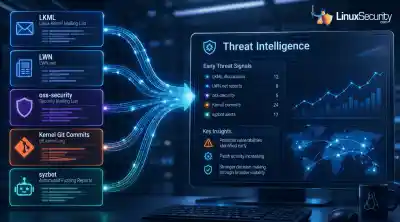
KASAN and UBSAN findings deserve similar attention. Developers use these sanitizers to expose memory corruption and undefined behavior, so seeing them referenced in commit messages usually means someone found a genuine defect rather than a cosmetic bug.
It's also worth paying attention to how maintainers react. A patch that attracts multiple revisions, lengthy review threads, or several subsystem maintainers often involves code that's difficult to change safely. The same goes for fixes that are rapidly backported to stable kernels or unexpectedly reverted after merging. Neither guarantees a vulnerability, but both suggest there's more happening beneath the surface than the commit title alone reveals.
Building a Layered Intelligence Workflow
Mature security teams treat upstream intelligence as a tiered model. Most organizations stop at the first two layers; high-maturity teams integrate the rest to gain an edge.
- Vendor Advisories: Your baseline for compliance.
- NVD/CVEs: The historical record for tracking exposure.
- Openwall (oss-security): The best source for identifying when a public disclosure is imminent.
- LWN.net: The bridge between raw discussions and finished advisories.
- Kernel Mailing List (LKML): The raw stream for monitoring specific subsystems.
- Git Commits: The authoritative record of what actually changed.
By framing your process this way, you realize that upstream monitoring isn't about replacing traditional vulnerability management; it’s about contextualizing it. You aren't reading the mailing list to panic; you're reading it to know which servers to prioritize the moment the stable kernel release lands.
Improving Patch Prioritization Through Context
When you understand the upstream flow, your patch management changes. Instead of treating every kernel change as a generic update, you can assess the risk yourself:
- Assess the Subsystem: Is the affected code even used in your environment?
- Evaluate the Bug Class: Does the fix address memory corruption (high risk) or a rare race condition (lower risk)?
- Review Discussion: Extensive review cycles, multiple revisions, or involvement from several maintainers can indicate that a change affects complex or security-sensitive code paths.
- Check the "Stable" Signal: If a patch is being pushed to all stable branches, consider increasing its priority for testing and deployment.
Conclusion
It's easy to see a CVE as the starting point because that's when most security teams first encounter it. In reality, it's usually the point where everyone else has caught up. The debugging, code review, disagreements, testing, and patch revisions have often already happened in public, leaving behind a trail that anyone can follow.
That doesn't mean every administrator needs to spend the day reading LKML threads or reviewing kernel commits. Most organizations won't, and they don't need to. But understanding where those discussions happen and knowing what they're telling you changes the way you look at a security update. A kernel patch stops being just another package to install and becomes the final result of a much longer investigation.
The Linux development process has always favored openness. For security teams willing to look upstream, that transparency offers something no CVE score can provide: the opportunity to understand how a vulnerability evolved before it became another entry in a database.
Organizations looking to strengthen this process should also review best practices around Linux security patches, Linux kernel security, and staying current with Linux security news.
 PREVIOUS

Powered By

Linux Security - Your source for Top Linux News, Advisories, HOWTOs and Feature Releases
QUICK LINKS
subscribe to newsletters!
Like staying secure? So do we.
Sign up for updates, tips, and alerts!