Explore top 10 tips to secure your open-source projects now. Read More
×


Control Panel Authentication Failures Expose Entire Linux Servers
 May 04, 2026
•
May 04, 2026
•
 MaK Ulac
5 - 10 min read


Linux security usually comes down to access controls and permissions, but those controls only work if the platform enforcing them holds up. What happens when the control layer most Linux environments depend on fails?
CVE-2026-41940 is an authentication bypass in cPanel/WHM that turns a single entry point into full server access, exposing hosted sites and mailboxes rather than just one account.
Once that control layer is compromised, isolation between users doesn’t hold. What should be separated becomes accessible, and that’s where exposure starts to spread.
At the time of disclosure, the issue affects cPanel/WHM on Linux systems where the authentication process fails to properly validate session or request state. This isn’t a misconfiguration. It’s a breakdown in how the platform enforces identity at the control level.
This blog breaks down how that failure happens, what it exposes in real environments, and what teams should be looking for when a control layer becomes the weakest point in the system.
What Actually Happened (Authentication Bypass Explained)
The bypass occurs before credential validation completes, allowing unauthorized requests to be treated as authenticated admin sessions. This vulnerability stems directly from an authentication failure in the control panel's access mechanism:
- Authentication bypass allows access past the login layer
- No credentials required at any stage
- Immediate admin access on entry
Because cPanel/WHM runs natively on Linux, the access granted by CVE-2026-41940 extends directly into system configurations, user accounts, service accounts, and all hosted domains. It creates severe cybersecurity threats before the incident even registers in the logs.
As of now, there is no confirmed attribution tied to active exploitation. The risk comes from how easily a flaw like this can be weaponized once disclosed, especially in widely deployed hosting environments.
How the Exploit Path Typically Unfolds
In practical terms, exploitation doesn’t require a complex chain. It follows a short path: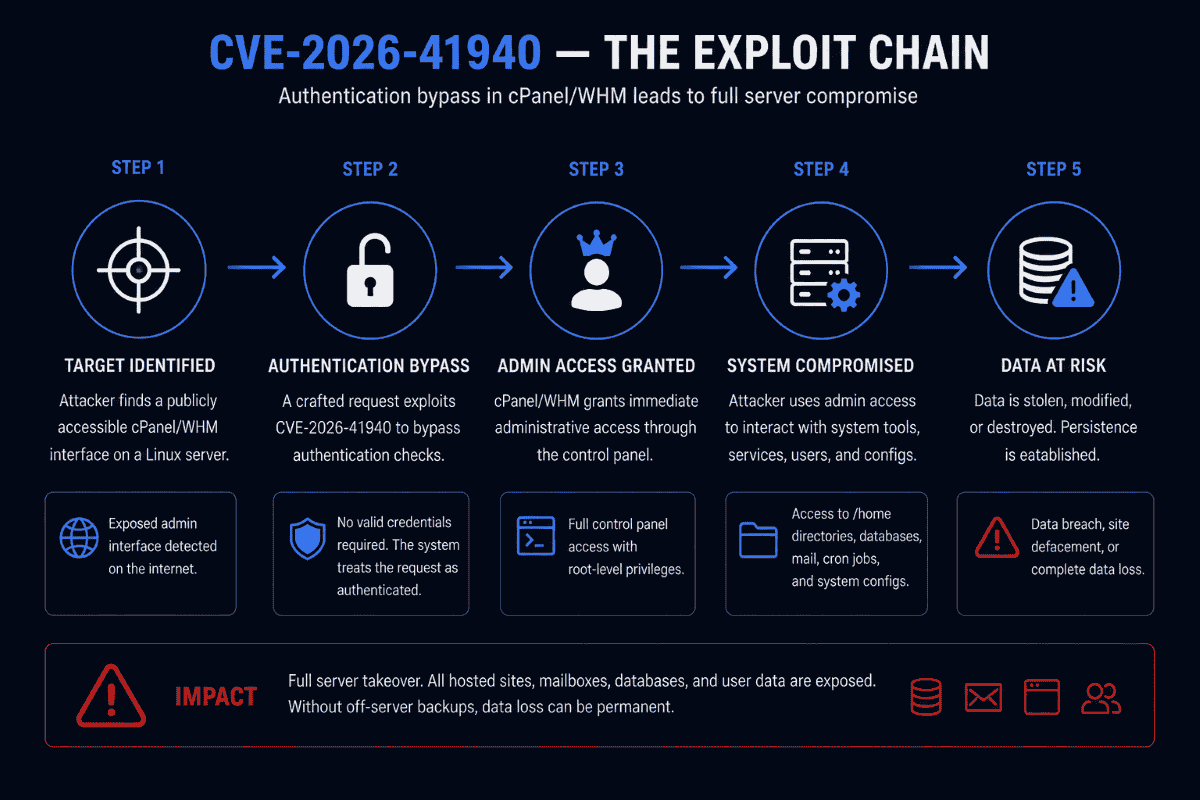
- The attacker identifies an exposed cPanel or WHM interface on a public-facing server
- A crafted request is sent that bypasses authentication checks tied to session handling or request validation
- The system incorrectly treats the request as authenticated
- Administrative access is granted immediately through the control panel interface
- From there, the attacker interacts with system-level tools, services, and user environments as a trusted admin
No credential theft, no brute force, no lateral movement. The control layer simply accepts the request.
Why This Leads to a Data Breach So Quickly
When a control panel breaks, it doesn’t degrade gracefully. It just hands over control, and the gap between initial access and a full data breach disappears almost immediately because the system is built to centralize authority over the host.
Most cyber attack paths have friction. An attacker lands somewhere low, works laterally, then tries to escalate privileges to reach something useful.
That doesn’t apply here. With administrative access through the panel, they drop straight into the highest privilege context on the system, no pivoting, no chaining exploits, just direct control over the environment that server security assumes is trusted.
Everything hangs off that identity. The web interface, database layer, and system tools all operate under the same control plane, so once the authentication layer fails the attacker isn’t moving through the network at all, they’re already sitting at the core with access to services, configs, and data paths that normally require multiple steps to reach, which is why this kind of security breach turns into immediate data exfiltration and full system exposure without the usual noise or delay.
Authentication Bypass at the Control Panel Level Changes the Impact
Control panels like cPanel/WHM are often the single point of access for entire hosting environments. When authentication fails there, it’s not isolated. It can expose every site and mailbox on the server at once.
What Happens After a Server Is Compromised
Once the attacker controls the Linux host, things don’t explode all at once. It spreads through normal system paths, the same ones admins use every day, which is why it blends in longer than it should.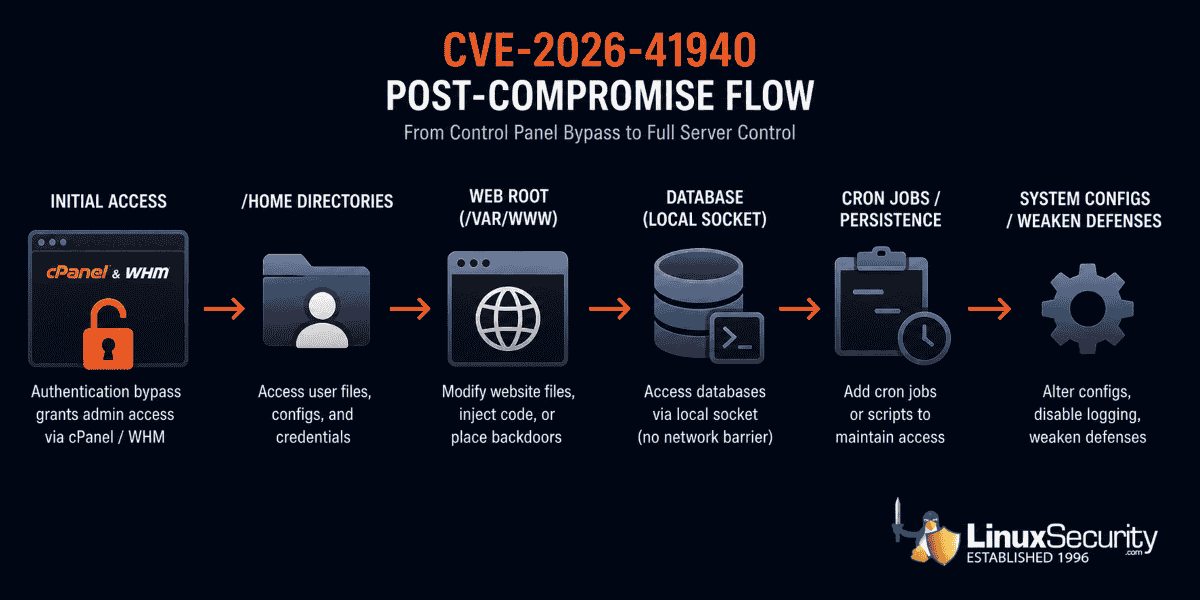
- Access to /home directories exposes user data, configs, and credentials across tenants
- Modification of web root files allows code injection or silent backdoors inside active sites
- Database access via local services gives direct reads over sockets with no network barrier
- Cron jobs or scripts added to maintain persistence across reboots
- System configs altered to weaken controls or suppress logging
None of this is exotic. It’s standard interaction with the OS.
This is where data loss starts becoming irreversible, because once those layers are touched, the attacker isn’t just passing through. They’re reshaping how the system behaves over time, and that’s what keeps these cybersecurity threats active even after initial access is noticed, while server security controls are still technically “running” but no longer trustworthy.
Real-World Impact: When Data Loss Is Permanent
The true cost of a cyber attack only becomes clear when the recovery phase begins. Consider a shared hosting server running Linux where the administrative panel is breached. If the attacker wipes the server—deleting user directories, databases, and configuration files—and there are no off-server backups, the impact is absolute.
In a Linux shared hosting environment, one compromised server does not mean one lost site. It means tens or hundreds of virtual hosts are wiped out instantly. The data loss is not just about a single company's files; it is a multi-tenant disaster where recovery is impossible if the backups are stored on the same underlying infrastructure. The resulting data breach strips the organization of its digital presence, its intellectual property, and its ability to recover, leaving the environment crippled.
Why This Is Especially Dangerous in Linux Hosting Environments
In Linux web hosting security, the issue isn’t just exposure. It’s how much sits behind that one layer.
Shared Infrastructure
A single host carries multiple tenants. Different users, different sites, same underlying system and services, which works fine until the control layer breaks and isolation stops being enforced in any meaningful way. Once inside, the attacker isn’t moving between sites. They’re operating underneath them, with visibility and access that cuts across everything at once, and that’s where website security assumptions start to fall apart quietly.
Root-Level Access
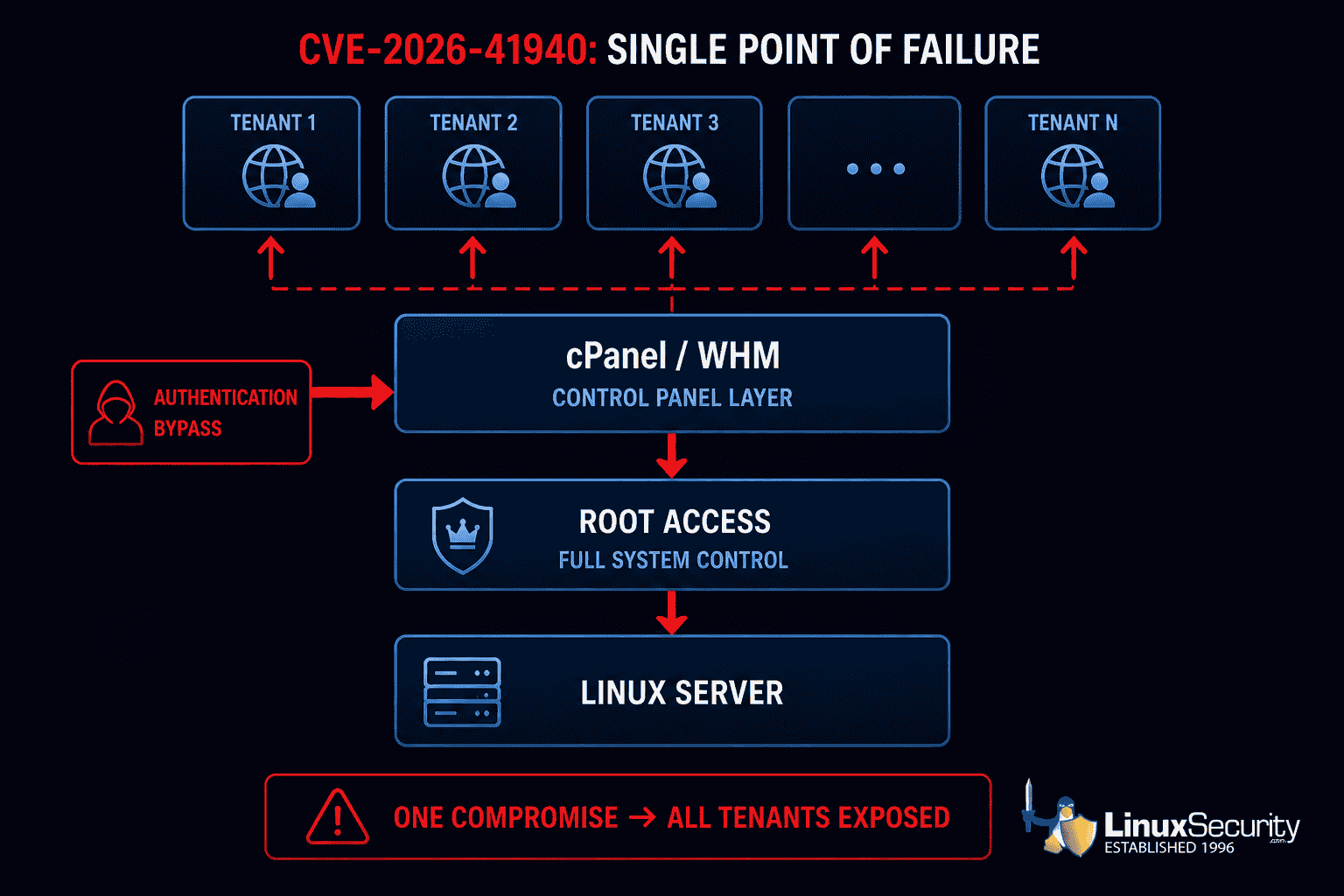
Control panels don’t operate with a limited scope. They execute as root because they’re expected to manage the entire system.
When that access is exposed, every filesystem boundary becomes optional. Permissions, ownership, separation between users, all of it can be overridden directly, which turns what looks like a contained entry point into full server control without resistance and shifts the situation from a localized issue into a broader server security failure tied to how privilege is handled.
Service Integration
Modern panels tie services together tightly. Web servers, mail systems, and databases don’t sit in isolation. They share configs, credentials, and execution paths.
That integration simplifies management. It also widens impact.
An attacker controlling one layer can reach into others without needing separate access paths, so instead of targeting individual services, they inherit the relationships between them, which is why these cybersecurity risks scale quickly and turn a single compromise into a platform-wide problem rather than a contained event.
Why These Cyber Security Threats Keep Happening
This pattern repeats. Different bugs, same structure.
- Admin panels exposed to the internet
- Single authentication layer protecting everything
- Lack of segmentation between services
- Delayed patching cycles
- Exposed management ports common in Linux setups
When you rely on a single, internet-facing system for all administrative actions, any flaw in the authentication mechanism translates directly to a massive increase in cybersecurity risks and related cybersecurity threats.
How to Reduce Risk Without Overcomplicating Security
You don’t need a full redesign. Just fewer assumptions.
- Restrict WHM and cPanel access via firewall rules like iptables or cloud security groups
- Limit admin access to trusted IP ranges or VPN endpoints
- Remove public exposure of admin interfaces entirely where possible
- Maintain off-server backups that can’t be altered from the host
- Monitor authentication logs and unusual activity patterns
- Validate and apply patches quickly, especially for control panels
This isn’t about adding layers. It’s about tightening the ones that already exist.
Most cyber attack prevention failures come from leaving high-privilege systems exposed longer than intended, and basic website protection and server protection steps still do most of the heavy lifting when applied consistently.
Closing Insight
The system doesn’t need to fail everywhere. Just once in the right place.
A single gap in server security at the control layer turns into a full compromise because everything else trusts that layer to hold, and when it doesn’t, the line between access and ownership disappears quickly across the entire environment, which is why most data breach scenarios tied to control panels aren’t about complex exploits but about one boundary that never got tested under real conditions.
Stay ahead of these patterns. Subscribe to the LinuxSecurity newsletter for direct updates on real-world cybersecurity threats, data breach trends, and practical server security insights.
Data Breach and Cyber Attack FAQs
What is a data breach?
A data breach is unauthorized access to sensitive information. In a Linux hosting environment, this often happens when an attacker gains control over system-level access and reads or extracts data from user directories, databases, or configuration files. The impact depends on how much data is exposed and whether it can be recovered, but in shared hosting setups, a single breach can affect multiple sites at once.
What happens in a cyber attack?
A cyber attack is an attempt to access or control systems without permission. In cases like control panel bypasses, the attacker skips traditional entry methods and uses a flaw in the system itself to gain administrative access, allowing them to modify services, extract data, or disrupt operations without needing additional exploits.
What is a security breach?
A security breach is the moment protections fail, and unauthorized access occurs. It doesn’t always mean data is stolen immediately, but it creates the condition for it. In server environments, an authentication bypass is a clear example because it removes the primary control layer that protects the system.
How do cyber attacks cause data loss?
Data loss happens when attackers delete, overwrite, or extract information. With full administrative access, they can remove databases, alter files, or wipe entire systems, and if backups are not isolated, the attacker can remove those too, turning a temporary incident into permanent loss.
How to prevent a cyber attack?
Prevention focuses on reducing exposure. Restrict access to administrative systems, apply patches quickly, and avoid leaving control panels open to the internet. Strong cybersecurity best practices center around limiting who can reach critical services and verifying those controls regularly.
Why are Linux servers often targeted in cyber attacks?
Linux servers host a large amount of shared infrastructure. One system can support many websites and services, making it a high-value target, and when misconfigurations or exposed management layers exist, attackers can affect multiple tenants at once without needing to break the operating system itself.
 PREVIOUS

 NEXT
NEXT
Powered By

Linux Security - Your source for Top Linux News, Advisories, HOWTOs and Feature Releases
QUICK LINKS
subscribe to newsletters!
Like staying secure? So do we.
Sign up for updates, tips, and alerts!