Explore top 10 tips to secure your open-source projects now. Read More
×


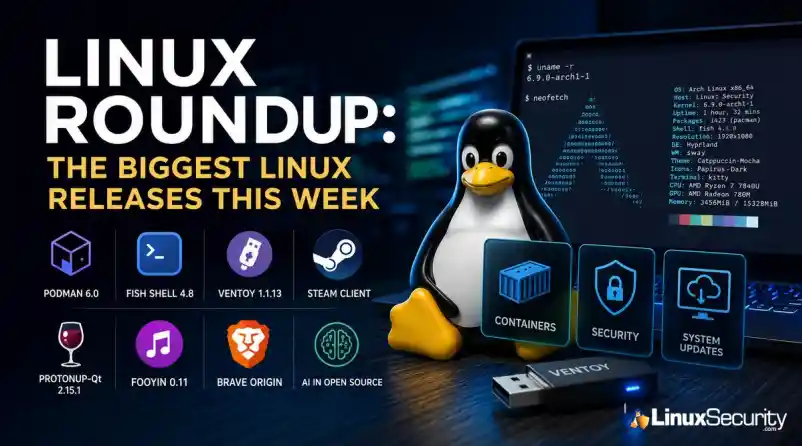
Linux Roundup: The Biggest Linux Releases This Week
 Jun 25, 2026
•
Jun 25, 2026
•
 MaK Ulac
3 - 6 min read

Topics Covered
Most weeks in Linux are about new features. This one is about avoiding problems before they happen.
Several projects shipped updates that quietly change how systems behave behind the scenes. None of them are particularly flashy, but if you're responsible for containers, workstations, gaming systems, or recovery media, these releases are worth paying attention to.
Here's what stood out this week.
Podman 6.0 Is a Major Upgrade, Not a Routine Package Update
If your infrastructure depends on Podman, this is the update that deserves your full attention. Podman 6 removes three technologies that have been living on borrowed time:
- cgroups v1
- slirp4netns
- BoltDB
These aren't deprecated anymore; they are gone. For anyone running modern Fedora or recent enterprise distributions, the transition may be almost invisible because most systems have already migrated to SQLite, Pasta networking, and cgroups v2 over the past couple of releases.
Older deployments are a different story. Teams that built automation around slirp4netns, never completed the BoltDB migration, or still depend on legacy cgroup layouts, can discover that containers simply "disappear" after upgrading. The data isn't gone, but Podman may no longer recognize the old database format until the migration is completed.
The Pro-Tip: Check your database backend before touching anything:
podman info --format '{{.Host.DatabaseBackend}}'
If the result isn't sqlite, stop there. Run podman system migrate before installing Podman 6, and verify your hosts are already using cgroups v2. This is one of those upgrades that's painless if you prepare for it and a headache if you don't.
Read more: Podman 6 Migration Guide & Breaking Changes
Fish Shell 4.8 Keeps Improving the Everyday Experience
Fish continues doing something few shells manage well: making power-user workflows simpler without hiding complexity. Version 4.8 focuses on quality-of-life improvements:
Tracing: Custom key bindings are now easier to debug; Fish tells you exactly which configuration file created them, removing a common source of frustration.
Navigation: Improvements to logical and physical path handling make moving through symbolic-link-heavy development environments considerably less confusing.
None of these are "headline" features, but they collectively remove dozens of tiny annoyances Linux users encounter every day.
Learn more: Fish Shell Releases
Ventoy 1.1.13 Fixes a Growing Secure Boot Problem
Ventoy has become the go-to rescue USB for administrators. Unfortunately, recent UEFI firmware updates and Microsoft's newer Secure Boot certificates have caused more systems to reject healthy Ventoy drives with cryptic "Verification Failed" errors.
Version 1.1.13 updates its Secure Boot shim to work with the newer certificate chain while introducing additional policy controls (VTOY_SECURE_BOOT_POLICY) for systems with unusual firmware. If your recovery media stopped booting on newer enterprise hardware, this update is likely the fix you need.
Steam Makes Linux Streaming More Reliable
Valve’s latest Steam client update isn't about new games—it's about making your desktop Linux/Steam Deck experience more robust.
PipeWire: The session handling has been hardened to recover more gracefully from dropped streams and audio interruptions.
Remote Play: You now have access to significantly higher bitrates (up to 250 Mbit/s). On wired local networks, this delivers substantially cleaner image quality, effectively minimizing compression artifacts.
These are the kind of "invisible" fixes you appreciate only after realizing your gaming sessions stopped breaking.
Read more: Steam Client Update for Linux & Steam Deck
ProtonUp-Qt 2.15.1 Makes Life Easier for ARM Gamers
ARM-based handhelds are growing in popularity, and ProtonUp-Qt now properly detects these architectures instead of force-feeding them incompatible compatibility layers. The project has also formally prioritized Proton-CachyOS, providing a more performant alternative for those using Lutris or Heroic. This update quietly cleans up the manual workarounds that many Linux gamers have been juggling.
Read more: ProtonUp-Qt 2.15.1 Release
Fooyin 0.11: Minimalism with More Power

Fooyin is quietly becoming one of the most polished lightweight music players on Linux. Version 0.11 adds an integrated internet radio browser, improves indexing for massive libraries (50,000+ tracks), and includes a new real-time spectrum visualizer. It manages to feel "native" and responsive, where other Electron-based players feel sluggish.
Learn more: Fooyin Releases
Brave Origin: A Minimalist Browser for Linux
Brave has launched "Brave Origin," a stripped-down, lightweight edition of their browser that removes "feature creep" like AI, crypto wallets, and VPN tools.
The Linux Advantage: While this is a $59.99 premium product on Windows and macOS, it is free for Linux users.
The Takeaway: It’s essentially the pure, secure Chromium engine without the extra services. If you’ve wanted the privacy protections of Brave without the baggage, this is the cleanest implementation available.
Learn more: Brave Origin
Software Freedom Conservancy: Formalizing AI Usage
In a move that will likely influence project standards, the Software Freedom Conservancy (SFC) released new guidance for AI-assisted contributions. They are encouraging projects to use "Assisted-By" or "Generated-By" tags in commit metadata.
The Goal: It’s not a ban; it’s a transparency requirement. For maintainers, this creates a clear audit trail and reinforces the expectation that human contributors must review, understand, and take responsibility for any code an LLM produces.
Read more: Software Freedom Conservancy's AI Guidance
Final Thoughts
This week’s releases share a common theme: Maturation. Instead of chasing flashy, headline-grabbing features, developers are cleaning up technical debt, retiring legacy infrastructure, and hardening the software we rely on daily.
If you're an admin, the Podman 6.0 migration is your highest priority. If you're a desktop user, Ventoy and Brave Origin are the items you'll want to check out this weekend. Sometimes the best Linux news isn't what gets added; it's what finally gets cleaned up.
Want more Linux security news, vulnerability analysis, and software supply chain updates? Subscribe to the LinuxSecurity Newsletter and get the latest threats, advisories, and expert insights delivered directly to your inbox.
Related Reading
Continue exploring the latest Linux administration, container security, and open source trends with these articles from LinuxSecurity.com:
- Understanding Container Security Best Practices for Linux Admins
- Installing Podman on Rocky Linux for Security and Admin Efficiency
- How To Bind Rootless Containers To Privileged Ports In Docker And Podman
- Emerging Trends and Tools in Container Security
- Docker Security Management: Techniques and Best Practices
 PREVIOUS

 NEXT
NEXT


Powered By

Linux Security - Your source for Top Linux News, Advisories, HOWTOs and Feature Releases
QUICK LINKS
subscribe to newsletters!
Like staying secure? So do we.
Sign up for updates, tips, and alerts!