Explore top 10 tips to secure your open-source projects now. Read More
×



Server Security data privacy automation
data privacy automation Every system admin has lived through the same Monday morning ritual. A queue of forty tickets, half of them password resets, permission errors, or disk space warnings that any experienced technician could resolve in under two minutes. The other half require actual judgment. For years, automation promised that software would eventually sort the two apart on its own. That promise is now being tested in production Linux environments. . Early results are reshaping how IT teams think about tier-1...
 Jul 17, 2026

Privacydata collection automation
data collection automation You're running a web scraping project to collect pricing data from e-commerce sites. You set up a pool of datacenter proxies, launch your scripts, and within minutes — banned . CAPTCHAs everywhere. Your data pipeline stops before it really begins. . It's a frustrating scenario that plays out daily in ad verification, market research, and multi-account management. The website doesn't know you're doing legitimate research or monitoring. It just sees traffic coming from IP ranges it recognizes as...
Jul 17, 2026

Security Trends security advisory social engineering
security advisory social engineering Business Email Compromise used to be a numbers game — mass-blasted emails, broken English, an obvious "URGENT WIRE TRANSFER" subject line. That era is over. Generative AI has turned BEC into a tailored, low-noise operation that mimics writing style, voice, and even video presence. This piece looks at what's actually changed under the hood, what defenders are testing in response, and why so many organizations are still structurally unprepared for it. . The Infrastructure Problem Nobody Wants to...
Jul 17, 2026
Security Trends cybersecurity Linux documentation
cybersecurity Linux documentation Linux operating systems have gained prominence due to their stability, adaptability, and excellent security options. In the case of developing documentation, designing cybersecurity dashboards, or educational material, visuals are of vital importance when it comes to making things clear. The use of icons allows one to understand the message regarding alerts, authorization, encryption, authentication, or the state of the system just by looking at the visual cue without having to read long...
Jul 17, 2026
Security Vulnerabilities security advisory linux distribution
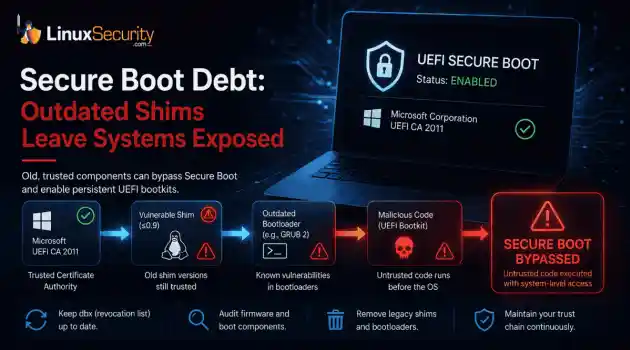
security advisory linux distribution ESET researchers identified 11 old and forgotten Linux UEFI shim bootloaders at versions 0.9 and below that can be used to bypass UEFI Secure Boot on any UEFI-based machine that trusts Microsoft’s Microsoft Corporation UEFI CA 2011 third-party certificate authority, regardless of the installed operating system (OS). Reported shims can be exploited to execute untrusted code during system boot, enabling attackers to deploy malicious UEFI bootkits even on systems with UEFI Secure Boot enabled.....
Jul 16, 2026
 Refine news
X Clear Filters
Get the latest News and Insights
Get the latest Linux and open source security news straight to your inbox.
Community Poll
Is continuous patching actually viable?
Loading...
Explore Latest Linux Security news
We found 537 articles for you...
76
 security advisoryrisk managementimportant
CISSP: Bridging Linux Security and Organizational Compliance Needs
Linux security professionals spend most of their time on concrete problems. Hardening SSH. Configuring SELinux or AppArmor. Building secure CI/CD pipelines. Managing patches across server fleets. The work is technical, hands-on, and measurable. . Then someone from finance asks for a security budget increase. Or compliance announces the organization needs SOC 2 certification. Or leadership wants to know how the security program aligns with business risk. Suddenly, the technical work doesn't matter as much as the ability to translate it. Executives don't care about iptables rules. Auditors don't care how elegant container security implementations are. They want to see frameworks, documentation, and risk assessments. Most Linux admins hit this wall eventually. The technical skills that make them valuable don't help them communicate that value to people who make budget and compliance decisions. The Certified Information Systems Security Professional (CISSP) certification fills that translation gap. Not by teaching Linux professionals how to secure systems—they already know that—but by teaching them how to frame security work in terms that organizations actually understand and require. Where Technical Work Meets Organizational Reality Open source security professionals operate in environments driven by tools and implementation. Fix vulnerabilities. Automate security checks. Lock down access. The feedback loop is immediate and technical. Organizational security operates differently. It requires documented procedures, formal risk assessments, compliance evidence, and governance structures. Without that layer, day-to-day security work can be solid and still fall apart the moment someone asks you to prove it. This creates friction. A Linux admin might have excellent vulnerability management practices. But when SOC 2 auditors show up, they don’t just want to hear “we patch fast.” They want policies, evidence, and a trail that shows it happens the same way every time. The workwas done. The documentation just isn’t there in a form that auditors recognize. CISSP helps security professionals put structure around that work and explain it in the language that audits and leadership expect. Not as busywork. As evidence that security exists as a managed program, not just ad-hoc technical fixes. Where CISSP Provides Practical Value The certification becomes useful in specific situations that Linux security professionals encounter regularly. Budget justification: Organizations allocate security budget based on risk reduction and compliance requirements, not technical elegance. CISSP teaches professionals to frame infrastructure hardening in terms of quantifiable business risk. It connects Linux fleet security directly to regulatory requirements and insurance coverage. Compliance requirements: ISO 27001, SOC 2, and PCI DSS all require specific security controls with proper documentation. Open source tools like OpenVAS / Greenbone and Wazuh (OSSEC) can help support compliance efforts. But organizations still need security professionals who understand which controls these tools actually satisfy and how to document them appropriately. CISSP covers the governance structures and control frameworks that compliance audits expect to see. Cross-functional communication: When organizations outsource security operations and need to interface with SOC providers, internal teams need a common vocabulary. CISSP provides a shared language between technical staff, vendors, auditors, and leadership. How Linux Experience Maps to CISSP Domains Linux security professionals already perform work that aligns with CISSP domains. The certification formalizes existing knowledge into recognized frameworks. Security Operations: Daily work with log analysis tools like Elastic or Graylog, incident playbooks, and vulnerability scanning directly maps to CISSP security operations concepts. The certification adds formal structure around incident classification, response coordination, anddisaster recovery that organizations expect to see documented. Asset Security: Managing server inventories, enforcing encryption, and handling sensitive data are standard Linux admin tasks. CISSP connects these activities to data lifecycle management and retention policies that auditors look for during compliance reviews. Software Development Security: Linux professionals securing CI/CD pipelines are already implementing DevSecOps principles. Modern DevSecOps embeds controls like role-based access, signed artifacts, and SBOM generation directly into code delivery pipelines. CISSP formalizes how these practices fit into secure software development lifecycle frameworks that organizations use to demonstrate security maturity. Risk Management: Every decision about vulnerability prioritization or patch scheduling represents risk management. CISSP gives professionals a more formal way to document those decisions using standard risk methods. That kind of documentation matters when auditors or executives need evidence that security decisions aren’t being made on gut instinct. When CISSP Doesn't Make Sense The CISSP certification takes real time. Eight domains of study. Five years of paid experience across at least two domains, with a one-year waiver possible if you have a degree or an approved credential. For professionals managing production systems full-time, this represents months of preparation. CISSP may not provide value when: Security roles focus exclusively on technical implementation with no governance responsibilities Organizations maintain dedicated governance, risk, and compliance teams that handle all framework alignment Career paths prioritize deep technical specialization over breadth Work environments don't require compliance certifications or formal security program documentation CISSP provides measurable value when: Security professionals need to justify investments or headcount to non-technical leadership Organizations pursue ormaintain compliance certifications like SOC 2, ISO 27001, or PCI DSS Career progression leads toward positions managing both technical teams and organizational security programs Roles require interfacing with auditors, insurance providers, or executives who expect industry-standard security frameworks Organizations operate in environments where compliance frameworks like SOC 2, HIPAA , and ISO require consistent, traceable evidence The Real Value Proposition Linux expertise makes security professionals technically capable. Governance knowledge makes them organizationally effective. Kubernetes and cloud-native practices require integrating security into every layer, working closely with developers from the outset. This integration demands both technical implementation skills and the ability to communicate security requirements across organizational boundaries. CISSP provides the frameworks and vocabulary for that cross-functional communication. It doesn't replace technical knowledge. It extends the impact of that knowledge into contexts where technical details matter less than documented security programs. Most Linux security professionals eventually face situations where their technical competence is assumed, but their ability to frame that competence organizationally determines outcomes. Budget approvals. Compliance audits. Leadership discussions. Insurance reviews. CISSP addresses those situations by teaching security professionals how to translate technical work into organizational language. The certification demonstrates that technical competence exists within a managed security program framework, not as isolated technical wins. . CISSP training enhances Linux security professionals' ability to translate technical work into organizational language effectively.. Linux Security, CISSP, Risk Management, Compliance, Open Source. . MaK Ulac
 Dec 24, 2025
•
Dec 24, 2025
• Organizations/Events
76
Red Hat Linux Hacked at Pwn2Own Berlin
Red Hat Enterprise Linux got hacked during the Pwn2Own Berlin 2025 competition . Let that sink in for a moment. This is one of the go-to systems for businesses that demand stability and security, yet two exploits cracked it wide open. If you’ve ever caught yourself thinking, “Oh, it’s Red Hat; I’m good,” this is your reminder that no system is untouchable, no matter how respected. Vulnerabilities exist, and real-world attackers or researchers are always looking for ways to exploit them. It happened here, and if you’re running Red Hat, it could happen in your environment, too. . So, the big question is: what went wrong, and how can you guard against it in your own setup? We’re not here to panic or theorize—this is about staying proactive and practical. Let’s walk through what these exploits targeted, where weaknesses showed up, and what steps you need to take to shore up your defenses. Whether you’re managing a single workstation or an entire fleet of Red Hat systems, understanding this breakdown isn’t optional—it’s critical. Let’s dive in. Inside the Exploits: What Happened at Pwn2Own? On the first day of the competition , security researchers showcased two vulnerabilities in Red Hat Linux that allowed them to breach the system and gain elevated privileges. These weren't surface-level attacks; they dug deep into the system's workings, finding cracks in the foundation. The first exploit was based on an integer overflow vulnerability, a flaw often lurking within software that mishandles mathematical operations. Exploiting this type of vulnerability allowed attackers to escalate their privileges, jumping from standard user permissions to full administrator control. That’s not a trivial leap—it’s like finding the keys to the entire building hidden under the welcome mat. Such privilege escalation exploits are among the most damaging because the system is entirely in their hands once attackers gain root access. The second exploit was more complex. It chainedtogether a use-after-free vulnerability—where attackers use memory incorrectly after it’s been released—and an information leak revealing sensitive data about how the system operates. This attack put researchers in full control of the system, proving just how devastating a well-chained exploit can be. Interestingly, part of this chain involved what’s known as an N-day vulnerability, meaning that certain aspects of the exploit had already been disclosed and fixes were theoretically available but hadn’t been fully applied. The point here isn’t just how clever the researchers were—it’s about what such vulnerabilities reveal. They show us where systems are most fragile, and while these exploits may seem technical, the lessons they teach couldn’t be more practical. The Critical Importance of Patch Management If there’s one thing that every Red Hat admin should be doing religiously, it’s keeping their system updated. Failures in patch management are tragically common, and the N-day aspect of the second exploit sends a pointed message. No matter how sophisticated your defenses seem, letting known vulnerabilities linger compromises everything. The reality is, patches aren’t exciting. They’re interruptions. They require admins to rearrange priorities, test updates in staging environments, and deal with unexpected compatibility issues. It’s work no one particularly enjoys. But skipping an update because it feels like a hassle creates openings for attackers. In this case, an already-known flaw contributed to the success of the exploit. That’s the price of delay in the patching process. Like many enterprise Linux distributions, Red Hat offers robust tools and notifications to help admins stay updated. Use them. Monitor advisories , plan for updates, and automate where possible, but don’t let known issues go unaddressed. The security landscape changes daily, and vulnerabilities don’t fix themselves—even ones that were disclosed weeks or months earlier. Fixing what’sbroken is among the clearest steps you can take to avoid exploitation. Security Audits: Seeing Problems Before They Become Breaches Hackers and security researchers have one thing in common: they’re excellent at finding problems before anyone else notices them. That’s not magic; it’s methodical. They dig into code logic, poke at system configurations, and experiment over and over. Admins need to adopt this mindset. Vulnerability audits aren’t optional anymore—they should be routine. Think of your infrastructure as a puzzle handed to an attacker. Your job as an admin isn’t just to build the puzzle but to inspect it for weak spots before someone else does. Security audits provide the lens necessary to take that closer look. Are outdated libraries lurking in your repositories? Have system permissions been set too broadly? Have applications forgotten their boundaries and started leaking sensitive information? These are things audits uncover. Use well-regarded tools for penetration testing —there’s no shortage of software designed for precisely this purpose. Better yet, consider hiring external professionals to test your defenses. Sometimes fresh eyes—the same kind that researchers bring—are what you need to see cracks that you’ve walked past countless times. Consider it an investment in keeping doors shut where they should stay shut. Cutting the Attack Surface: Why Simplicity Matters One of the simplest but most effective ways to defend Red Hat systems—or any Linux environment—is to cut down the attack surface. Attackers thrive on complexity. The more services, applications, and tools running on your systems, the more entry points you’re offering. And yes, some of those services will never be used for malicious purposes, but do you really need to take that gamble? Take a moment to look at what’s running on your systems. Are there background processes or applications that aren’t strictly necessary? Trim them. Are there permissions set for users who don’tactively use your system? Revoke them. Every unnecessary piece of software or open port is an unanswered question that an attacker will try to answer. Some admins hesitate to disable or limit services that aren’t actively in use, fearing inconvenience or disrupting workflows. That’s a fair concern, but compare it to the cost of exposing critical infrastructure. Simplicity isn’t just about organizational preference—it’s a security imperative. The fewer moving parts, the harder it is for someone to exploit you. The Crucial Role of Awareness and Training No security tool or preventive measure can match human awareness as an effective security strategy. Administrators must be aware of emerging threats, vulnerabilities, and best practices. Nobody has the luxury of working without being informed —the stakes are just too high! Security awareness involves more than attending lectures; it involves reading Red Hat security advisories, studying reports like that from Pwn2Own Berlin, and taking vulnerabilities—even hypothetical ones—seriously when identified. Security awareness promotes an environment of curiosity and defense by constantly asking, "What could go wrong here?" before any incidents take place. Training should go beyond procedural learning and cover concepts like memory management, exploit chaining, and privilege escalation that attackers use against us. Understanding their mechanics allows administrators to fix weak configurations faster, deploy mitigations proactively, and respond swiftly when an incident arises. Looking Ahead: Lessons from Pwn2Own What can we take away from the Red Hat Linux exploits demonstrated at Pwn2Own Berlin 2025? If anything, defenders need to stay ahead of attackers, and doing so requires more than technical fixes. It demands practical, engaged effort every single day. Knowing about integer overflow vulnerabilities or use-after-free exploits isn’t enough—you have to translate that knowledge into meaningful defenses. Patch systemsregularly, audit them habitually, and run only what’s necessary. Train consistently. Test your readiness for breaches. These aren’t glamorous tasks but pay dividends in creating an environment less likely to crack under pressure. Red Hat Linux, like any system, is only as strong as the admins behind it. If you’re sitting in that position, take the lessons from Berlin to heart and make today the day you strengthen your defenses! . Red Hat Enterprise Linux was hacked at Pwn2Own Berlin; learn how to strengthen your system against such exploits.. enterprise, linux, hacked, during, pwn2own, berlin, competition. . Brittany Day
May 16, 2025
•
Organizations/Events

76
Key Trends & Takeaways from VulnCon 2025
VulnCon 2025 , recently held in Raleigh, NC, created a dynamic stage for security professionals and open-source advocates to connect, share, and collaborate on tackling some of today's most pressing challenges in vulnerability management and open-source software security. The conference buzzed with energy as industry experts, developers, and Linux admins unpacked the latest advancements, explored emerging trends, and exchanged actionable strategies to strengthen their security practices. . From groundbreaking solutions to practical methodologies, VulnCon 2025 provided attendees with the tools and insights needed to better protect the ecosystems they oversee. Let’s dive into the key moments and powerful takeaways from this year’s event. Key Trends in Vulnerability Management and Open-Source Security from VulnCon 2025 As cyber threats evolve and advance, organizations are prioritizing smarter, collaborative ways of combatting vulnerabilities and safeguarding open-source ecosystems. At VulnCon 2025, attendees discussed everything from the critical role of metadata in vulnerability tracking to safeguarding software supply chains, whether through compliance with regulations like the EU Cyber Resilience Act , setting security baselines, or adopting compliance protocols from new regulations like OSRA/SOSA. Here is an overview of some key trends identified at VulnCon 2025 that are shaping the future of vulnerability management and open-source software security. The Growing Importance of Vulnerability Metadata OpenSSF and other participants at VulnCon emphasized the central role of metadata in vulnerability management. Discussions around tools like the Open Source Vulnerability (OSV) database highlighted how improving metadata helps organizations better understand the context of vulnerabilities. Talks also explored integration with SBOMs (Software Bill of Materials), VEX (Vulnerability Exploitability eXchange), CVE identifiers, and evolving frameworks such as PURL (Package URLs) and CPE(Common Platform Enumeration). These developments demonstrate the need to implement systems that can ingest and use high-quality metadata for faster and more accurate vulnerability assessments. Open Source Supply Chain Security A major trend this year focused on understanding and securing the open-source software supply chain . Case studies—such as those presented by Apache Airflow and Alpha-Omega —demonstrated how critical it is to monitor and proactively maintain dependencies. Downstream users of OSS were reminded that contributing upstream not only strengthens security but also ensures the longevity of the projects they rely on. Impacts of the EU Cyber Resilience Act (CRA) The CRA featured prominently at VulnCon, particularly in discussions about how vendors will need to adapt to its stringent requirements by the 2027 deadline. This law has profound implications for anyone managing software supply chains, including open-source software (OSS). Organizations like the Linux Foundation are working with industry leaders and policymakers to help the community meet compliance requirements. Admins managing systems with European ties must pay attention to this legislation and prepare to meet its requirements for transparency and security. Security Baselines Driving Conformance OpenSSF’s Security Baseline initiative was at the forefront during this year's event. This framework aligns with global standards and emphasizes structured security requirements for open-source software (OSS) projects. Adopting this baseline in your projects or selecting software that complies with it can significantly improve your overall security posture. Practical Insights for Linux Administrators So, how can we use the information shared at VulnCon 2025 to improve the security of our Linux environments? Here are some actionable recommendations gleaned from VulnCon 2025 and the OpenSSF community’s efforts that we can implement to improve our vulnerability management and open-source security strategies: Use Advanced Vulnerability Management Tools Incorporate vulnerability management solutions that harmonize with evolving frameworks like OSV, SBOMs, and VEX. Ensure your systems are compatible with modern metadata standards to quickly identify and address vulnerabilities in dependencies. Set up automated tools that parse and update vulnerability databases, integrate Software Bill of Materials (SBOMs) into your Continuous Integration/Continuous Deployment (CI/CD) pipelines, and correlate findings with Common Vulnerability and Exposure (CVE) identifiers for better prioritization. Engage with the Open Source Ecosystem Actively participate in the OSS projects you depend on. This includes helping upstream developers fix issues, auditing your dependencies, and budgeting time to implement due diligence processes for open-source packages. Perform regular dependency reviews using tools like Dependabot or oss-review-toolkit to map and mitigate risks in your supply chain. Prepare for Regulatory Compliance (CRA and Beyond) Start aligning your operations with the requirements of the EU Cyber Resilience Act and related regulations. This will ensure smooth compliance and position your organization as a leader in secure practices. Conduct an assessment of your software supply chain and evaluate how your organization collects, stores, and verifies vulnerability and software lifecycle data. Adopt Security Baselines and Standards OpenSSF’s Security Baseline ensures an actionable roadmap for OSS projects, and the same principles can be extended to Linux environments. Adopting structured security practices makes it easier to align with global best practices. We, Linux administrators, should apply benchmarks like CIS (Center for Internet Security) guidelines or OpenSSF’s recommendations to our Linux systems and implement regular audits to ensure good practices are followed over time. Collaborate Across Industries VulnCon 2025 highlighted the importance of cross-industry collaboration inaddressing systemic issues in vulnerability management. Linux administrators managing diverse systems should tap into community-driven resources, attend security forums, and share the insights they have learned. Join organizations like OpenSSF to stay informed, engage in working groups, and access their tools, such as the Security Baseline initiative, for practical security enhancements. What’s Next? Continuing the Momentum As discussions around open-source vulnerability management become more complex, Linux admins play a crucial role in proactively controlling risk and mitigating threats. Staying up to date with changing standards and adopting tools like Software Bills of Materials (SBOMs) or security baselines are all effective approaches for safeguarding our Linux environments and ensuring that open-source software remains a lasting, resilient part of the digital ecosystem. Did you attend VulnCon 2025? What were your most significant takeaways? Let us know @lnxsec! . From groundbreaking solutions to practical methodologies, VulnCon 2025 provided attendees with the t. vulncon, recently, raleigh, created, dynamic, stage, security, professionals. . Brittany Day
Apr 28, 2025
•
Organizations/Events
76
 security enhancementsystem administrationlong-term support
SUSE 15 Support Extended and AI Improvements Highlighted at SUSECON25
SUSECON25 recently took place in Orlando, showcasing SUSE's significant strides toward integrating Artificial Intelligence (AI) throughout its product line. With enhanced workflows and observability tools designed to streamline operations and increase efficiency, SUSE promises more intelligent system administration platforms that facilitate quicker detection and resolution of potential security issues. . SUSE has also pledged extended support for their current offerings, with Service Pack 7 for SLES 15 receiving updates until 2037 and SLES 16 planned to be released later this year. This ensures administrators can plan long-term without feeling pressure to upgrade frequently. Combined with enhanced Multi-Linux Support and its upgraded Multi-Linux Manager 5.1 offering Role Based Access Control (RBAC) capabilities and seamless migration features, these upgrades make managing diverse Linux environments securely and efficiently a snap! These changes go beyond incremental enhancements; they will become essential tools in helping strengthen security and management practices across various Linux distributions. In this article, I'll explore three key developments from this event: improved AI integration, extended support for long-term stability, and enhanced multi-Linux support. Embracing AI for Smarter System Management We Linux security administrators benefit greatly from AI integration. Traditional manual processes can now be automated using AI-powered observability tools that identify anomalies or potential security threats and enable quicker responses and mitigation efforts. By harnessing this intelligence, admins can focus on strategic tasks rather than routine monitoring and troubleshooting - thus increasing productivity while strengthening overall security posture. SUSE's expanded AI Library provides invaluable resources for customizing and optimizing AI features according to individual security needs. From automating patch management and threat detection to compliance monitoringand more, SUSE's toolkit offers ample foundation to build. Long-Term Support for Peace of Mind SUSE's announcements at SUSECON25 showcase their dedication to innovation and long-term support. Its AI integration efforts, extended support for SLES 15, the upcoming release of SLES 16, and improvements to multi-Linux management all indicate a significant effort to make Linux security administration simpler, safer, and more manageable. Admins will benefit from these developments both immediately and over the long term. AI capabilities promise to transform how systems are monitored and managed, and extended support and releases guarantee stability and reliability. Additionally, multi-Linux support with better RBAC features and seamless migrations helps address some practical difficulties of managing diverse environments. As 2025 unfolds, SUSE is positioning itself to lead in providing the tools and support necessary for successfully managing change. SUSECON25 underscored the importance of staying aware and taking advantage of innovations, which are vital to maintaining secure systems now and in the future. Smoother Management with Improved Multi-Linux Support Maintaining uniform security and performance across various Linux distributions can be an arduous and time-consuming endeavor. SUSECON25's expanded Multi-Linux Support sought to address this by simplifying this task and offering an uncomplicated management experience for those overseeing them. Multi-Linux Manager 5.1 features several upgrades designed to simplify life for Linux security administrators, particularly regarding Role-Based Access Control (RBAC). RBAC gives administrators more granular control of user permissions and access rights so only authorized personnel can make system modifications without risk of unauthorized access or security breaches. Notable upgrades also include migration capabilities for major and minor versions of Linux, offering administrators tools that make transitioning between versions as seamless aspossible without disrupting workflow or jeopardizing security. This is especially useful in organizations using multiple distributions that must comply with strict security standards. Integrating Third-Party Tools for Enhanced Security SUSE recognizes the value of interoperability and flexibility, so Multi-Linux Manager 5.1 now includes greater integration with third-party tools. This allows admins to seamlessly integrate their preferred tools or applications into SUSE environments without altering them significantly. This flexibility goes beyond mere convenience; it also promotes stronger security infrastructures. Administrators can use various tools to conduct in-depth vulnerability assessments , monitor network traffic for suspicious activity, or enforce policies across systems. By consolidating all these resources into one management platform like SUSE Linux Enterprise Server 11, security admins have all the resources they need when conducting assessments or enforcing policies across systems. The Road Ahead SUSE's announcements at SUSECON25 showcase their dedication to innovation and long-term support. SUSE's AI integration, extended support for SLES 15, the upcoming release of SLES 16, and improvements to multi-Linux management all indicate its commitment to making Linux security administration simpler, safer, and manageable in the future. Administrators will benefit from these developments both immediately and over the long term. AI capabilities promise to transform how systems are monitored and managed; extended support and releases guarantee stability and reliability; and multi-Linux support with better RBAC features and seamless migrations helps address some of the practical difficulties of managing diverse environments. SUSE is positioning itself to lead in providing the tools and support necessary for successfully managing change. Staying informed and taking advantage of these innovations are vital to maintaining secure systems in the future. Did you attend SUSECON25? We'd loveto hear about your experience @lnxsec ! . SUSECON25 showcased significant advancements in Linux admin tools, leveraging AI for optimized management, support, and streamlined operations for enterprises. SUSECON25, AI Solutions, Linux Management, Security Tools, Multi-Linux Support. . Brittany Day
Mar 18, 2025
•
Organizations/Events
76
 security practicesoperational efficiencysecurity integration
OpenInfra Foundation Joins Linux Foundation: Enhancing Open-source Security
Exciting news has just reached the open-source community: OpenStack , now known as OpenInfra Foundation , is joining forces with the Linux Foundation . This significant move promises greater collaboration and operational efficiency throughout the community. . Linux security admins now have new opportunities to leverage advanced security practices supported by the extensive resources of the Linux Foundation, with improved integration and compliance with global security standards. In addition, this partnership underscores the significance of secure infrastructure in supporting cutting-edge technologies like AI . By aligning these two powerful organizations, their combined expertise and governance should strengthen security protocols further, making collaborative efforts more robust and streamlined. Let's examine the significance of this partnership and its potential benefits for open-source security/ Strengthening Open-source Collaboration The open-source community thrives on cooperation, as evidenced by the recent merger between OpenInfra Foundation (formerly OpenStack) and the Linux Foundation. By joining forces, these two powerhouses aim to amp up their impact in areas critical for modern infrastructure; not simply pooling resources but creating synergies that strengthen robustness, security, scalability, and longevity of open-source projects. This is particularly beneficial for Linux security administrators hoping this alliance will bring new methodologies and tools to make their tasks more efficient and effective. OpenInfra's decision to collaborate with the Linux Foundation is wise. Although its governance will remain unchanged, collaboration unlocks unrivaled expertise and resources within both organizations. Thanks to their long history of nurturing innovative projects, this relationship provides fertile ground for OpenInfra to expand and improve initiatives, providing security admins access to improved tools and practices without disrupting current governance structures. Enhancing Security Practices One of the main benefits of this merger is its potential to strengthen security practices across both organizations' projects. The Linux Foundation has an impressive record of creating and enforcing security standards that should now extend into OpenInfra's tools and frameworks. This cross-pollination should lead to more resilient and secure open-source infrastructures. As Linux security administrators, integration means having more structured and well-maintained security protocols. The Linux Foundation's Core Infrastructure Initiative and Open Source Security Foundation aim to identify and mitigate vulnerabilities early. With more deeply embedded OpenInfra projects providing a stronger basis on which to build secure environments, fewer vulnerabilities will slip through cracks. Operational Efficiency and Governance Aligning with the Linux Foundation offers another great advantage in terms of operational efficiency. The organization boasts a well-tested governance model, which helps projects run smoothly and scale. OpenInfra's adherence to this model will mean adopting best practices in project management that streamline development cycles and lead to faster implementation of security features. We security administrators will benefit from this governance model in two ways. Integration of new features and updates should become simpler within your systems. More predictable release cycles and documentation will reduce the overhead of keeping systems secure and up-to-date , potentially decreasing the patching frenzy that typically follows less structured release cycles. Supporting Cutting-edge Technologies Ensuring a secure foundational infrastructure is necessary at the forefront of cutting-edge technologies. With their complex computational demands, Artificial Intelligence (AI) and Machine Learning (ML) necessitate a secure yet scalable infrastructure. OpenInfra and the Linux Foundation's partnership strives to support this by making sure open-source toolsused for AI/ML are not only robust but also safe. AI applications often involve sensitive data that requires stringent security measures to safeguard against breaches. As OpenInfra projects align closer with Linux Foundation's standards, these security measures for such applications will strengthen AI/ML solutions providers' confidence that their infrastructure's security can meet these requirements head-on. Better Integration with Global Security Standards The Linux Foundation's dedication to upholding global security standards is another hallmark of its collaboration. Projects under its umbrella are known for complying with these standards, making regulatory requirements easier for organizations to meet. With OpenInfra now part of this ecosystem, organizations can expect improved alignment with international security regulations such as GDPR and HIPAA. Linux security administrators working in regulated industries know firsthand that assuring compliance is often time-consuming. Thanks to increased adherence to security protocols and standards introduced by this merger, this process will become streamlined, reducing administrative burden and mitigating risk from noncompliance penalties. Leveraging Expertise and Resources One key advantage of joining forces is access to available expertise and resources. The Linux Foundation houses numerous projects and working groups specializing in technology and security, which OpenInfra projects can now leverage by joining forces. For us admins, this means having access to an expansive community of security experts who can offer insights and assistance with specific security challenges. Leveraging collective knowledge through forums, working groups, or direct collaboration can significantly boost your capabilities and security strategies, creating an ecosystem designed for continuous learning and improvement that keeps you at the forefront of security practices. Final Thoughts & Looking Ahead OpenInfra's integration into the Linux Foundationmarks an exciting step forward for open-source projects, especially those focused on security. Collaboration, robust security practices, operational efficiency, and compliance with global standards will likely all improve over time, setting new benchmarks for creating and maintaining these projects. This merger marks an exciting time in our community as the OpenInfra Foundation and Linux Foundation join forces to advance infrastructure security and efficiency. Stay engaged, stay secure, and embrace what this game-changing collaboration will offer! . Linux cybersecurity professionals can now benefit from improved protective strategies, resulting from a partnership with the Linux Foundation.. OpenInfra, Linux Foundation, Open Source Security, Security Practices, Compliance Standards. . Brittany Day
Mar 13, 2025
•
Organizations/Events
76
risk managementsecurity practicessecurity measuresOpenSSF: Security Baseline Initiative Enhances Open-Source Protection
Open Source Security Foundation (OpenSSF) recently unveiled its Security Baseline initiative to assist Linux security admins and developers in incorporating essential security measures into open-source projects. This set of guidelines, available on February 25, offers three tiers of practices explicitly tailored for project maturity levels, ensuring open-source software provides consistent and dependable protection from day one. . Understanding and following these guidelines means taking proactive measures against vulnerabilities while strengthening user trust in projects. Operating at version 20250225, the OSPS Baseline outlines basic security for open-source projects, serving as a practical guide for developers and project maintainers. This initiative encourages security awareness within communities so everyone can collaborate to refine and improve practices. Adding this guideline into your workflow can make the open-source ecosystem safer while aligning yourself with broader community efforts to remain vigilant against security threats. Let's take a closer look at this initiative, its significance, and practical measures you can take to adhere to these guidelines while overcoming implementation challenges. Understanding the Security Baseline Initiative On February 25, OpenSSF introduced its Security Baseline initiative, providing an organized framework for securing open-source projects according to their level of maturity. Since open-source software development involves collaborative efforts without central oversight, maintaining consistent standards can be challenging. Thankfully, the Security Baseline offers three guidelines that ensure basic security fundamentals are always met. This design makes this initiative particularly advantageous for diverse projects ranging from fledgling developments to mature software offerings. Why Tiered Guidelines Matter Security in software development cannot be addressed with one-size-fits-all solutions. Projects vary significantly incomplexity, size, and sensitivity - therefore, security frameworks and solutions must reflect this diversity. The Security Baseline's tiered guidelines were specifically tailored to this reality to enable projects at various stages of maturity to adopt appropriate security practices at different points during their journeys. This scalability ensures burgeoning projects start with manageable security goals while adding more sophisticated measures as they expand. As a result, it supports projects as they develop, facilitating sustained security improvement over their lifecycles. Building Trust in Open-Source Software One of the main objectives of the Security Baseline is to build trust in open-source software by assuring its security is comparable with proprietary solutions. Security breaches and vulnerabilities can erode trust in an open-source project and prompt users to seek alternatives. By adhering to OpenSSF guidelines, developers can demonstrate their dedication to user and stakeholder security and position projects favorably in trust-driven ecosystems. Engaging the Linux Security Community in This Initiative Linux security admins will play an instrumental role in adopting and implementing the OpenSSF Security Baseline. As security leaders within their projects, these individuals are in an ideal position to advocate for and integrate this set of guidelines into existing workflows, thus leading initiatives prioritizing security from their inception and creating an atmosphere that values proactive risk management practices. The Security Baseline allows Linux admins to interact with and engage with the broader security community. With its active maintenance and open-source nature, there is room for collaboration and contribution - and community members are encouraged to provide feedback, suggest improvements, and refine the guidelines in response to emerging security threats or advancements in technology. A Practical Guide to Implementation Implementing the Security Baseline within aproject begins with understanding the project's security needs and maturity level. This includes a current security posture assessment, gap analysis, and selecting appropriate tier levels from guidelines to address those gaps. Newer projects might focus on security measures like secure coding practices or vulnerability scanning . In contrast, more mature ones could focus more heavily on advanced threat modeling and incident response plans. Open-source initiatives provide greater flexibility when applying these guidelines, enabling administrative teams to tailor practices according to their operational environment. By carefully considering each tier, projects can create an adaptive security strategy that scales with their growth while responding quickly to changing risks. Overcoming Common Challenges Adopting new security guidelines can be challenging for projects with limited resources or stretched teams. One key solution lies in education and awareness: ensuring all contributors understand why security is necessary and how it can be incorporated into their work without disrupting the workflow. Collaboration is another vital asset. Networking with other projects and developers who have successfully applied the guidelines can provide invaluable practical insight and experiences to guide your efforts. This community-centric approach to open-source development fosters increased collective security through shared knowledge. Our Final Thoughts: Understanding The Path Forward As the open-source community expands, its security challenges will also grow. To meet this need, the OpenSSF Security Baseline initiative was formed. By adopting its guidelines, we Linux security admins and developers can increase our projects' security while protecting ourselves from emerging threats and building trust between ourselves and users. The journey towards comprehensive open-source security is complex yet rewarding. Initiatives like Security Baseline are helping the open-source community meet challengeshead-on while making sure open-source software remains an enduring platform for innovation now and in the future. Have you adopted the OpenSSF Security Baseline guidelines in your open-source development workflow? Let us know on X @lnxsec ! . Bolster the resilience of open-source applications by implementing multi-level protocols from the OpenSSF framework, aimed at reducing vulnerabilities and fostering confidence.. OpenSSF, security practices, open-source guidelines, risk management, Linux admin. . Brittany Day
Feb 27, 2025
•
Organizations/Events
76
security advisorysoftware designopen sourceLinux Foundation and OpenSSF: CRA Compliance Impact on Security
As Linux security admins, staying abreast of evolving regulations is vital to ensuring the resilience and compliance of our systems. A recent initiative by the Linux Foundation Europe and OpenSSF to support implementation of the European Union Cyber Resilience Act (CRA) promises to transform how we manage security and compliance within the open-source software ecosystem by formalizing guidelines and tools that meet the stringent requirements set out by the CRA. . By mandating measures like secure software design, robust vulnerability reporting, and transparent Software Bills of Materials (SBOMs), our day-to-day operations will experience a noticeable shift towards more disciplined security practices. Let's examine this initiative and its implications for your Linux security administration and your systems' compliance with CRA's standards and regulations. Understanding the Cyber Resilience Act To fully appreciate this initiative, it is necessary to understand the Cyber Resilience Act (CRA) . Enforced since December 2024, this comprehensive regulation seeks to increase digital product and service security within Europe. CRA mandates that security must be integrated into software design processes from their inception, and developers must be held responsible for vulnerability reporting and management services within their products. Also, transparent software dependency lists with SBOMs are an integral element. As a Linux security admin, your job extends far beyond protecting the infrastructure within which your systems reside. It involves ensuring all software running on them also complies with these new standards. This requires reassessing how software is sourced, developed, and maintained while emphasizing proactive security measures and thorough documentation. Enhancing Security Practices The requirements set out by CRA have fundamentally transformed how we approach system security. One key implication of their requirements is to incorporate security from the onset of software design -known as "security by design." This concept ensures that security considerations do not become an afterthought but are integrated into every stage of software creation. Linux security admins must work closely with development teams to ensure security protocols are strictly followed from the outset, including regular code reviews, threat modeling, and testing of security features as part of the development process. Taking an early detection and mitigation approach to vulnerabilities reduces risks associated with potential exploits. As soon as the CRA was implemented, its significance became even clearer. The upkeep of systems cannot be underestimated. Regular software patches and updates to address known vulnerabilities are imperative to creating resilient infrastructure. Tools and guidelines developed under the Linux Foundation Europe/OpenSSF initiative will also play a significant role in supporting enhanced security practices. Management of Software Bills of Materials (SBOMs) A core requirement of the CRA is transparency in software dependencies through SBOMs . An SBOM provides a detailed listing of components and dependencies within the software, making tracking vulnerabilities easier and ensuring compliance with regulations such as the CRA. Linux security administrators responsible for managing SBOMs must implement tools that automatically generate and maintain these inventories, track open-source components, evaluate their security posture, and promptly respond to vulnerabilities in software supply chains. Becoming proficient at managing SBOMs assists compliance and strengthens overall software supply chains. Compliance Tracking and Management Ensuring compliance with CRA standards requires constant oversight of all software and devices in your infrastructure, which makes compliance tracking essential. Compliance tracking involves keeping detailed records of security measures, software updates, vulnerability management activities, etc., demonstrating adherence to thesestandards. Administrators must establish efficient methods for documenting compliance activities and being ready for audits, including clear records of patch management, vulnerability assessments, and security testing results. Tools and guidelines created through Linux Foundation Europe and the OpenSSF initiative provide invaluable resources to aid administrators in streamlining these compliance tracking processes. Collaboration and Community Involvement Collaboration is at the core of open-source communities, and this initiative puts that strength to use to its maximum. The Linux Foundation Europe and OpenSSF are working with numerous stakeholders, including companies like ARM, Ericsson, GitHub, Kusari, OpenJS Foundation, and Red Hat Rust Foundation. Through such close cooperation, tools and guidelines that are comprehensive yet broadly applicable can be created. Engaging actively with the Linux security community is vital. Subscribing to industry newsletters and tracking updates on social channels will keep you abreast of recent events and developments. Contributing open source projects supporting this initiative also offers an invaluable opportunity to collectively share knowledge and enhance security practices. Education and Adaption With cybersecurity becoming ever-more dynamic, ongoing education and adaptation are critical. The initiative by Linux Foundation Europe and OpenSSF brings new tools, frameworks, or best practices that administrators must adopt. Keeping current with these resources and learning about emerging security threats is paramount to success. Furthermore, the advent of the CRA marks a growing global trend toward tightening security regulations by adapting proactively to this shift in policies and adapting their systems as necessary to comply with current requirements while being prepared for potential security threats in the future. Our Final Thoughts on This Security & Compliance Initiative The partnership between Linux Foundation Europe and OpenSource Security Foundation to implement the Cyber Resilience Act marks a historic moment in Linux security administration. This initiative emphasizes the necessity of enhanced security practices, rigorous compliance tracking, and effective management of SBOMs, fundamentally altering how we approach system security. Linux security administrators can benefit by accepting these changes, actively engaging with the open source community's efforts, and accepting tools and guidelines being developed to meet CRA requirements - ultimately increasing supply chain security. As the cybersecurity landscape transforms, staying informed, gaining new knowledge, and adapting to evolving regulations will become increasingly critical. This initiative offers an ideal way of strengthening security practices on Linux systems in response to emerging threats - providing increased resilience against them. . Adhering to GAAP regulations is essential for system administrators to safeguard data integrity and respond to changing legislation.. Cyber Resilience Act, compliance tracking, open source security, software dependencies, secure software design. . Brittany Day
Feb 10, 2025
•
Organizations/Events
76
browser securitysecurity strategycommunity engagementLinux Foundation: Transforming Chromium Development for Enhanced Security
As Linux security admins, staying ahead of the curve is paramount, especially regarding the browsers you use and manage. On January 9, 2025, The Linux Foundation is unveiling "Supporters of Chromium-Based Browsers," an initiative supported by tech titans including Google, Meta, Microsoft, and Opera. This project is expected to transform the open development ecosystem surrounding Chromium (the foundation behind popular browsers such as Google Chrome and Microsoft Edge) through an open governance model and industry collaboration that promises greater transparency, security, and customization for Chromium-based browsers while aligning perfectly with open-source community's security needs. . This is a golden opportunity for us Linux security admins to engage with a community-driven project prioritizing security and innovation. We’ll have more control over updates and browser features, minimizing unnecessary integrations and tightening security measures where it counts. The collaborative nature of the initiative ensures continuous scrutiny and improvement of security features, fostering an environment where potential vulnerabilities are swiftly addressed. With its open-source approach, you can trust that compliance and security standards are met with thorough community verification. Let's examine this initiative in more depth and explore how it will enhance your browser security strategies, keeping your systems safe and efficient. Strengthening Open Development One of the most exciting aspects of the "Supporters of Chromium-Based Browsers" initiative is its dedication to open development. By providing a neutral space where developers and the open-source community can come together, this initiative seeks to support existing Chromium projects and any that emerge - encouraging innovation while freeing various stakeholders from restrictions associated with proprietary solutions. We can expect a steady flow of features and updates developed collaboratively by the community to addressusers' needs and concerns. Open development also means increased transparency. Since the code and development processes are open, it's easier to understand the security measures being implemented. This transparency builds trust and allows for better-informed decision-making when configuring and deploying these browsers in your environment. Governance and Industry Support A key distinguishing feature of this initiative is its open governance model, with a technical advisory committee overseeing development to ensure it meets community needs rather than solely serving single entities' interests. This governance model seeks to promote balanced decision-making processes where voices from various sectors - security experts, developers, and end-users can all have their say and be considered in decision-making processes. Major tech companies such as Google, Meta, Microsoft, and Opera provide financial backing and invaluable expertise and resources. These companies are committing to funding and development, which means that the project will have the resources needed to tackle significant challenges, including those related to security. This industry support translates to a more robust and reliable browser that benefits from the combined experience and resources of some of the biggest names in tech. Impact on Chromium vs. Chrome Understanding the differences between Chromium and Google Chrome is vital to fully grasp the impact this initiative will have on users. Although Chromium serves as the basis of Chrome, certain features and integrations specific to Google services (like Chrome Sync) or licensed codecs for H.264 and AAC are missing from it. It also excludes DRM modules such as Google’s Widevine. Though these differences seem like limitations, they present an opportunity from a security perspective. By avoiding deep integration with Google services, Chromium has a smaller attack surface, reducing potential vectors for exploitation. This is particularly beneficial for environments whereminimalism and security are paramount. Linux security admins can configure Chromium-based browsers to fit their specific security needs without the additional bloat and potential vulnerabilities associated with proprietary features. Security Through Community Collaboration One of the most significant advantages of the "Supporters of Chromium-Based Browsers" initiative is the potential for enhanced security through community collaboration. With more developers and organizations contributing to the project, there will be increased scrutiny of the code . This collaborative effort ensures that security vulnerabilities are identified and resolved quickly, benefiting from the diverse expertise within the community. Moreover, the transparent development process means that security measures are visibly, openly debated and implemented. This transparency lets administrators understand the security considerations behind each feature or update, making it easier to trust the browser’s security posture. This level of openness is invaluable in an era where trust is a critical security component. Control Over Updates and Features One of the primary challenges with proprietary browsers is the reliance on the vendor for updates and features. With Chromium, you have more control over these aspects, which is crucial for maintaining a secure environment. The initiative's open development model means that updates can be reviewed and customized to meet specific security requirements before deployment. For us Linux admins, this control is a significant advantage. It means we can apply updates that align with our organization's security policies and timelines rather than being at the mercy of a vendor's update cycle. We can also disable or enable features based on our security needs, ensuring the browser is as secure as possible for our specific environment. Enhanced Compliance and Auditing Compliance with security standards and the ability to conduct thorough audits are critical for any organization. Theopen-source nature of the "Supporters of Chromium-Based Browsers" initiative means that compliance and auditing processes can be more robust and community-verified. With the code openly available, verifying that the browser meets specific security standards and conducting comprehensive audits is easier. This means added assurance that your browsers comply with industry standards and that you can prove this compliance through thorough, transparent audits. The community-driven nature of the project ensures that compliance is not just about meeting the minimum standards but continuously evolving to address new security threats and challenges. Community and Industry Backing Major industry players' support of this initiative cannot be understated. Google, Meta, Microsoft, and Opera are providing financial backing and bringing their extensive expertise. This level of support ensures that the project will have the resources it needs to tackle significant security challenges and push the envelope regarding innovation. This backing means that the initiative is not a fringe project but a well-supported, mainstream effort with a higher probability of long-term success. These major players' combined resources and expertise ensure the project will benefit from the latest security research and development advancements. This is crucial for staying ahead of emerging threats and ensuring that the browsers you deploy are at the cutting edge of security technology. Our Final Thoughts on This Promising Chromium Browser Development Initiative The "Supporters of Chromium-Based Browsers" initiative by the Linux Foundation marks an exciting development for open-source communities and Linux security admins. By prioritizing open development, transparency, and community collaboration, this initiative promises browsers that are feature-rich but also secure and customizable. We have an incredible opportunity with this initiative to engage in an endeavor that brings together Open Source and security principles. Byplaying an active role, we can help shape the future of Chromium-based browsers so they meet the highest security standards tailored specifically for our environment. Seize this chance to enhance your browser security strategies and keep your systems safe in 2025 and beyond! . Participate in a collaborative effort aimed at bolstering web safety for Linux system operators while simplifying enhancements and upgrades.. Chromium browsers, open development, security collaboration, Linux admins, community driven. . Brittany Day
Jan 13, 2025
•
Organizations/Events

Get the latest News and Insights
Get the latest Linux and open source security news straight to your inbox.
Community Poll
Is continuous patching actually viable?
Search Topics
Powered By

Linux Security - Your source for Top Linux News, Advisories, HOWTOs and Feature Releases
QUICK LINKS
subscribe to newsletters!
Like staying secure? So do we.
Sign up for updates, tips, and alerts!