Explore top 10 tips to secure your open-source projects now. Read More
×



Server Security data privacy automation
data privacy automation Every system admin has lived through the same Monday morning ritual. A queue of forty tickets, half of them password resets, permission errors, or disk space warnings that any experienced technician could resolve in under two minutes. The other half require actual judgment. For years, automation promised that software would eventually sort the two apart on its own. That promise is now being tested in production Linux environments. . Early results are reshaping how IT teams think about tier-1...
 Jul 17, 2026

Privacydata collection automation
data collection automation You're running a web scraping project to collect pricing data from e-commerce sites. You set up a pool of datacenter proxies, launch your scripts, and within minutes — banned . CAPTCHAs everywhere. Your data pipeline stops before it really begins. . It's a frustrating scenario that plays out daily in ad verification, market research, and multi-account management. The website doesn't know you're doing legitimate research or monitoring. It just sees traffic coming from IP ranges it recognizes as...
Jul 17, 2026

Security Trends security advisory social engineering
security advisory social engineering Business Email Compromise used to be a numbers game — mass-blasted emails, broken English, an obvious "URGENT WIRE TRANSFER" subject line. That era is over. Generative AI has turned BEC into a tailored, low-noise operation that mimics writing style, voice, and even video presence. This piece looks at what's actually changed under the hood, what defenders are testing in response, and why so many organizations are still structurally unprepared for it. . The Infrastructure Problem Nobody Wants to...
Jul 17, 2026

Security Trends cybersecurity Linux documentation
cybersecurity Linux documentation Linux operating systems have gained prominence due to their stability, adaptability, and excellent security options. In the case of developing documentation, designing cybersecurity dashboards, or educational material, visuals are of vital importance when it comes to making things clear. The use of icons allows one to understand the message regarding alerts, authorization, encryption, authentication, or the state of the system just by looking at the visual cue without having to read long...
Jul 17, 2026
Security Vulnerabilities security advisory linux distribution
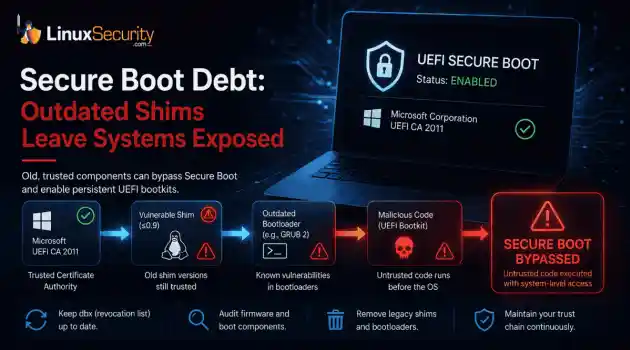
security advisory linux distribution ESET researchers identified 11 old and forgotten Linux UEFI shim bootloaders at versions 0.9 and below that can be used to bypass UEFI Secure Boot on any UEFI-based machine that trusts Microsoft’s Microsoft Corporation UEFI CA 2011 third-party certificate authority, regardless of the installed operating system (OS). Reported shims can be exploited to execute untrusted code during system boot, enabling attackers to deploy malicious UEFI bootkits even on systems with UEFI Secure Boot enabled.....
Jul 16, 2026
 Refine news
X Clear Filters
Get the latest News and Insights
Get the latest Linux and open source security news straight to your inbox.
Community Poll
Is continuous patching actually viable?
Trending News
Loading...
Explore Latest Linux Security news
We found 0 articles for you...
209
 cybersecurityadvanced threatstrust building
Cybersecurity and Digital Authority: Building Trust in the Digital Era
Cybersecurity is no longer just a technical concern. It has become a business survival priority. A single data breach doesn’t only expose data, it can erase years of hard-earned trust. Studies show that 75% of consumers won’t engage with companies that have experienced a security incident. That means reputation is now on the line just as much as revenue. . What makes this more challenging is the rapid evolution of digital standards. Customers, partners, and even search engines are constantly assessing whether your brand can be trusted. They pay attention to your security practices, your transparency, and how consistently you demonstrate authority. This blog explains how digital authority and cybersecurity work together to build trust, how reputation strengthens security, and the practical steps you can take to protect both your systems and your brand. Understanding Digital Authority as a Cybersecurity Force Multiplier Think about it this way: your reputation isn't just marketing fluff anymore, it's your secret weapon against cyber threats. Modern cybersecurity has evolved way beyond those clunky firewalls your IT guy installed five years ago. It's about how customers perceive your trustworthiness when they're deciding whether to click that link or enter their credit card info. Reputation-Based Security Models and Trust Scoring Search engines are getting scary smart about this stuff. They're constantly evaluating your security certificates, scanning for breach histories, and factoring all of that into where you show up in results. Organizations with solid digital authority get a visibility boost that becomes its own security feature. Why? Because when customers can easily find your legitimate channels, they're way less likely to fall for those sneaky impersonation scams targeting your brand. Smart companies expanding their online footprint often partner with the best link-building service to establish credible web connections. These authentic relationships create trustnetworks that make fraudulent sites stick out like sore thumbs, making them easier to spot and report. The Psychology of Trust in Digital Environments You've got maybe three seconds to earn someone's trust online. That's it. Users make lightning-fast decisions based on what they see and what they remember from past experiences. A website radiating strong security signals paired with an established digital authority creates instant confidence. This psychological edge reduces user hesitation, boosts engagement, and, here's the kicker, makes your customer base much harder to fool with social engineering attacks. Modern Cybersecurity Best Practices for Trust Building Your threat detection and response capabilities are the bedrock supporting all those trust indicators customers see. You simply cannot build lasting digital authority without a security infrastructure that can back up your reputation claims. AI-Powered Threat Detection and Response Machine learning has revolutionized how we catch bad actors. These algorithms spot behavioral weirdness that traditional systems would completely miss. They're analyzing user patterns, network traffic, and system behaviors to flag potential threats before they wreak havoc. Automated response systems can lock down threats in minutes instead of hours, protecting both your security and your hard-earned reputation. Beyond Zero Trust: Adaptive Trust Architecture Cybersecurity best practices have moved past simple yes-or-no access decisions. Instead of binary controls, adaptive systems continuously score risk levels based on context, behavior, and real-time threat intelligence. This approach maintains tight security without creating friction that ruins user experience, a delicate balance that's crucial for preserving online trust. Quantum-Resistant Cryptography Implementation Forward-thinking leaders are already preparing for the quantum computing revolution. Hybrid cryptographic strategies provide protection during this transition while ensuringyour systems stay viable long-term. The quantum-safe migration timeline varies by industry, but preparation needs to start now if you want to maintain your digital authority as quantum capabilities advance. Building Digital Trust Through Proactive Cybersecurity Governance Transparent governance transforms your security investments into visible trust assets that customers and partners can actually evaluate and appreciate. Transparency-First Security Policies Public security certifications and audit results prove your commitment to protection. Real-time security dashboards give stakeholders confidence in your systems' current health. When incidents happen, and they will, clear disclosure protocols actually strengthen trust by demonstrating accountability and your commitment to improvement. Stakeholder Cybersecurity Communication Technical security measures are worthless if stakeholders can't understand their value. Customer education programs help users protect themselves while using your services. Partnership security requirements ensure vendor relationships enhance rather than compromise your security posture. Advanced Threats and Protecting Digital Authority Modern attackers aim not only at your systems but also at your brand’s credibility. This demands specialized defense strategies protecting both digital assets and public perception. Get this: supply chain attacks have exploded over 2600% since 2018, victimizing more than 54 million people in 2023 alone. Emerging AI-Driven Threats Deepfake technology enables attacks that directly assault your digital authority through fake executive communications or fraudulent brand content. AI-powered phishing campaigns adapt to individual targets with terrifying personalization. Detecting synthetic media requires specialized tools and training to identify and counter these evolving threats. Supply Chain Cybersecurity and Trust Networks Third-party risk assessment must account for cascading vulnerabilities that can devastatemultiple organizations simultaneously. Blockchain-based verification systems provide tamper-proof records of vendor security compliance. Collaborative threat intelligence sharing helps identify risks before they impact your specific environment. Measuring and Optimizing Online Trust Performance Quantifying trust impact requires sophisticated measurement approaches that transform cybersecurity investments into measurable business outcomes. Trust Metrics and KPIs Customer trust index development tracks how security measures influence confidence over time. Security perception surveys reveal gaps between actual protection and customer understanding. Conversion rate optimization through trust signals demonstrates the direct business impact of building digital trust initiatives. Digital Reputation Monitoring and Management Brand mention monitoring for security-related discussions helps identify reputation threats before they explode. Crisis communication protocols ensure consistent messaging during security events. Recovery strategies focus on demonstrating improved capabilities rather than simply apologizing for past failures. Technology Integration for Unified Trust Architecture Seamless integration ensures security measures support rather than hinder business operations while maintaining customer confidence at scale. Identity and Access Management Evolution Passwordless authentication reduces friction while improving security. Biometric integration presents implementation challenges but offers a superior user experience when properly deployed. Identity federation across multi-cloud environments maintains security consistency regardless of platform complexity. Security-by-Design in Digital Transformation DevSecOps methodologies embed security considerations throughout development cycles. API security protocols protect microservices architectures powering modern applications. Cloud-native security patterns adapt traditional cybersecurity best practices to distributedenvironments. Crisis Management and Trust Recovery Protocols Even the most robust security systems can't prevent every incident. Crisis response capabilities become the ultimate test of your trust infrastructure. Incident Response Planning for Trust Preservation Stakeholder communication hierarchies ensure accurate information reaches the right audiences quickly. Media relations strategies focus on demonstrating competence and commitment rather than deflecting blame. Legal and regulatory notifications maintain compliance while supporting broader trust-building efforts. Post-Incident Trust Rebuilding Strategies Transparency initiatives following breaches often strengthen long-term relationships by demonstrating organizational character. Compensation programs show commitment to making victims whole. Long-term reputation recovery requires consistent demonstration of improved capabilities over time. Common Questions About Cybersecurity and Digital Authority 1) What are the three main pillars of cybersecurity? They are technology, processes, and people. Technology protects systems, processes guide how security is managed, and people follow safe practices. Together, they create a strong security framework. 2) What are the five pillars of CISA? They are identity, device, network/environment, application workload, and data. Each pillar focuses on securing a specific area of access and use. Combined, they build a complete defense strategy. 3) How does digital authority impact cybersecurity effectiveness? Strong digital authority creates trust networks that make fraudulent impersonation more difficult while giving customers confidence to engage with legitimate channels, reducing successful social engineering attacks . The Future of Trust in Cybersecurity Cybersecurity and digital authority are no longer separate priorities. They’ve fused into the foundation of modern trust. The next wave of threats will target both your defenses and your credibility, making reputation ascritical as resilience. Organizations that act now, aligning strong protection with visible transparency, won’t just withstand attacks; they will also thrive. . Explore the convergence of online credibility and cyber defense to bolster reliability and safeguard your reputation in the modern digital landscape.. digital authority cybersecurity, online trust management, brand reputation building. MaKenna Hensley. MaK Ulac
 Sep 03, 2025
•
Sep 03, 2025
• Security Trends
74
 infrastructure protectioncyber riskscloud security
Emerging Challenges in Cloud Security Due to Sophisticated Threats
A second area of focus must be in the way we understand and address threats. The threat landscape has evolved dramatically in the past three years: Starting in 2008 with the growing ability of viruses and malware to evade anti-virus signature technologies; to the pandemic scale of attacks launched by criminals in 2009 for profit; to more sophisticated attacks organised by nation states in 2010.. In 2011 we must also defend against the potentially catastrophic danger of Advanced Persistent Threats perpetrated by non-state actors and terrorists. By manipulating control systems in critical infrastructure facilities, Stuxnet was the first Trojan to cross the chasm from the digital realm into the physical world. Stuxnet foreshadows what the future of cyber warfare or terrorism might hold and is the reason that next generation infrastructure initiatives like smart grid must have security embedded. According to researchers from IEEE SmartGrid Comm2010, the smart grid will offer up to 440 million potential points to be hacked. Stuxnet is a wake-up call to a very real and present danger and a stark reminder of the need for collaboration not only among businesses but between nations in an increasingly interdependent world.. Guarding against sophisticated ongoing threats is essential for the protection of cloud infrastructure today.. Cloud Security, Advanced Threats, Cybersecurity Risks, Infrastructure Protection. . Alex
Feb 17, 2011
•
Network Security

83
cyber threatsecurity strategyadvanced threatsDefcon: Uniting Forces Against Evolving Queen Bot Threats
Imagine for a moment that our central defense against bank robbers was a technology that recognized criminals based largely upon their physical appearance. Now imagine that the bad guys had figured out a way to rapidly and automatically change not only their facial structure, but their height, weight, clothing and method of attack. The net result those attacks would ultimately be more successful and profitable bank robberies, encouraging the bad guys to step up the frequency and brazenness of their attacks. . . Imagine for a moment that our central defense against bank robbers was a technology that recognized . imagine, moment, central, defense, against, robbers, technology, recognized. . LinuxSecurity.com Team
Aug 11, 2006
•
Hacks/Cracks
67
malicious cryptographyadvanced threatsarmored virusUnderstanding Malicious Cryptography In Advanced Threats And Detection
This two-part article series looks at how cryptography is a double-edged sword: it is used to make us safer, but it is also being used for malicious purposes within sophisticated viruses. Part two continues the discussion of armored viruses and then looks at a Bradley worm - a worm that uses cryptography in such a way that it cannot be analyzed. Then it is shown how Skype can be used for malicious purposes, with a crypto-virus that is very difficult to detect. . The link for this article located at SecurityFocus is no longer available. . The link for this article located at SecurityFocus is no longer available.. two-part, article, series, looks, cryptography, double-edged, sword. . LinuxSecurity.com Team
May 17, 2006
•
Cryptography
77
information securitythreat mitigationemail securityEmail Security: Addressing Advanced Threats and New Security Strategies
With the increasing threat of far more sophisticated attacks than just spam and viruses, email security is taking a leap forward. But in implementing new solutions, organisations open up the risk to additional vulnerabilities, because the products they have chosen may not provide an adequate level of security. . Email has always been a non-conformer, the maverick of the information security world. Don’t talk to strangers is a concept your email server doesn’t understand. It breaks the standard security model by allowing unauthenticated and unidentified connections from an untrusted source to a trusted destination. Furthermore your firewall doesn’t lift a finger to help secure it. To operate email needs both inbound and outbound access. The very fact that companies want to receive email from strangers – potential customers – means that asking for authentication, the standard way to verify a connection passing through a firewall to a protected network, simply does not work. So the firewall just passes the responsibility to the mail server. Putting the mail server on the DMZ is not an answer either, this just moves the problem rather than addressing the insecurities of email, and makes it more difficult for internal users to read their email. The link for this article located at Net-Security.org is no longer available. . Email protection requires contemporary approaches to counteract advanced dangers and fundamental vulnerabilities in conventional configurations.. Email Security Strategies, Sophisticated Cyber Threats, Security Approaches. . LinuxSecurity.com Team
Jan 26, 2005
•
Server Security

Get the latest News and Insights
Get the latest Linux and open source security news straight to your inbox.
Community Poll
Is continuous patching actually viable?
Trending News
Search Topics
Powered By

Linux Security - Your source for Top Linux News, Advisories, HOWTOs and Feature Releases
QUICK LINKS
subscribe to newsletters!
Like staying secure? So do we.
Sign up for updates, tips, and alerts!