Explore top 10 tips to secure your open-source projects now. Read More
×



Server Security data privacy automation
data privacy automation Every system admin has lived through the same Monday morning ritual. A queue of forty tickets, half of them password resets, permission errors, or disk space warnings that any experienced technician could resolve in under two minutes. The other half require actual judgment. For years, automation promised that software would eventually sort the two apart on its own. That promise is now being tested in production Linux environments. . Early results are reshaping how IT teams think about tier-1...
 Jul 17, 2026

Privacydata collection automation
data collection automation You're running a web scraping project to collect pricing data from e-commerce sites. You set up a pool of datacenter proxies, launch your scripts, and within minutes — banned . CAPTCHAs everywhere. Your data pipeline stops before it really begins. . It's a frustrating scenario that plays out daily in ad verification, market research, and multi-account management. The website doesn't know you're doing legitimate research or monitoring. It just sees traffic coming from IP ranges it recognizes as...
Jul 17, 2026

Security Trends security advisory social engineering
security advisory social engineering Business Email Compromise used to be a numbers game — mass-blasted emails, broken English, an obvious "URGENT WIRE TRANSFER" subject line. That era is over. Generative AI has turned BEC into a tailored, low-noise operation that mimics writing style, voice, and even video presence. This piece looks at what's actually changed under the hood, what defenders are testing in response, and why so many organizations are still structurally unprepared for it. . The Infrastructure Problem Nobody Wants to...
Jul 17, 2026

Security Trends cybersecurity Linux documentation
cybersecurity Linux documentation Linux operating systems have gained prominence due to their stability, adaptability, and excellent security options. In the case of developing documentation, designing cybersecurity dashboards, or educational material, visuals are of vital importance when it comes to making things clear. The use of icons allows one to understand the message regarding alerts, authorization, encryption, authentication, or the state of the system just by looking at the visual cue without having to read long...
Jul 17, 2026
Security Vulnerabilities security advisory linux distribution
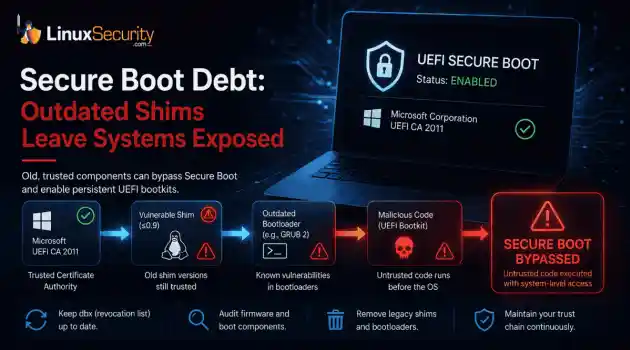
security advisory linux distribution ESET researchers identified 11 old and forgotten Linux UEFI shim bootloaders at versions 0.9 and below that can be used to bypass UEFI Secure Boot on any UEFI-based machine that trusts Microsoft’s Microsoft Corporation UEFI CA 2011 third-party certificate authority, regardless of the installed operating system (OS). Reported shims can be exploited to execute untrusted code during system boot, enabling attackers to deploy malicious UEFI bootkits even on systems with UEFI Secure Boot enabled.....
Jul 16, 2026
 Refine news
X Clear Filters
Get the latest News and Insights
Get the latest Linux and open source security news straight to your inbox.
Community Poll
Is continuous patching actually viable?
Loading...
Explore Latest Linux Security news
We found 112 articles for you...
212
 application securityincident responselinux
What Is Kubernetes Security? A Linux Admin’s Practical Guide
You locked down SSH, hardened systemd services, tuned auditd, and felt reasonably confident about your Linux security posture. Then a Kubernetes cluster shows up, and suddenly workloads are being scheduled, rescheduled, and destroyed without ever touching the patterns you’re used to watching. Kubernetes security is where that shift becomes real. . At a glance, it still runs on Linux. Processes, cgroups, namespaces, network interfaces. Nothing magical. But Kubernetes changes how those pieces are orchestrated, who is allowed to create them, and how identity is assigned. What used to be a local user with sudo is now a service account with a token. What used to be a static service in systemd is now a pod that might live for six minutes. That abstraction layer is where people get comfortable too quickly. In traditional Linux security, you think in terms of hosts. Who has shell access. Which services are exposed. Whether the firewall is tight and the file permissions make sense. Container security adds isolation between workloads, but Kubernetes sits above that and decides what runs, where it runs, and with what permissions. If you do not control that layer, your node hardening only gets you so far. This is where the line between Linux security and Kubernetes security starts to matter. Kubernetes security is not a separate discipline you hand off to someone else. It is an extension of the same responsibility, just moved up the stack. Control points shift from hosts to APIs. Risk shifts from direct root compromise to API misuse and over-permissioned service accounts. Monitoring shifts from mostly syslog and auth logs to audit logs, RBAC changes, and unusual exec activity inside pods. Once you start looking at it that way, the pattern becomes clearer. In this guide, we’ll walk through what Kubernetes security actually includes, where your existing Linux controls still matter, where they stop being enough, and how your risk model changes when orchestration is in play. We’ll also lookat what to monitor differently and how to approach triage when something feels off, especially in environments where cloud security controls and container security tooling overlap with cluster configuration. The goal is simple. By the end, you should know which decisions are now yours, which controls you need to enforce at the API level, and where your old mental model needs an update. Kubernetes Security Starts Where Linux Security Stops Being Enough If you strip the terminology away, Kubernetes security is about controlling who can ask the cluster to do something, what they can ask it to do, and what actually happens on the nodes as a result. It builds directly on Linux security, but it moves the primary control surface away from the host and toward the control plane. In traditional Linux security, we focus on the machine. SSH access. Sudoers. Listening services. File permissions. Firewall rules. If a system is compromised, we assume someone gained shell or exploited a daemon, and we trace it from there. Kubernetes changes that assumption. Now the cluster itself becomes the system you are defending. Kubernetes security spans three areas that you have to think about together: The control plane, which includes the API server, scheduler, controller manager, and etcd. The worker nodes, where kubelet and the container runtime actually start processes. The workloads, meaning pods, containers, and the service accounts attached to them. You can harden every node to your usual baseline and still lose control of the environment if the API server is wide open or RBAC is sloppy. That is the shift. The API server becomes the front door. Every deployment, every scaling event, every secret read, every exec into a pod flows through it. If someone can call that API with enough permissions, they do not need SSH. They can create a privileged pod, mount the host filesystem, and read what they want indirectly. Identity also changes shape. Instead of local users and groups, you now haveservice accounts and tokens. By default, pods often receive a mounted token that allows them to talk back to the API. If that token is over-permissioned, lateral movement is not theoretical. It is just another API call. Networking shifts as well. In Linux security, you think in terms of interfaces and iptables rules. In Kubernetes, network paths are created dynamically by the CNI plugin, and isolation is enforced through network policies, not static firewall entries. If you never define those policies, the cluster is often wide open internally. Containers add another wrinkle. They are short-lived. A pod can spin up, process data, and terminate before your traditional host-based monitoring even correlates it properly. Root inside a container is not automatically root on the host, but if you allow privileged pods or hostPath mounts without restriction, that boundary can blur quickly. This is the part people underestimate. You move from asking who has shell on this box to asking who can call the API and deploy a privileged pod. That one change reframes almost every security decision in a Kubernetes environment. The Real Risk Model Shift in Kubernetes Once orchestration enters the picture, the risk model stops being host-centric. You start protecting decision points instead of just machines. That takes some adjustment. The API server becomes your crown jewel. Every meaningful action in the cluster runs through it. Create a pod. Read a secret. Patch a role. Exec into a container. If an attacker can authenticate and has enough RBAC permissions, they do not need to exploit the kernel. They can just ask the cluster to give them what they want. etcd is part of that picture. It stores cluster state, including secrets, as structured data. If etcd is exposed or unencrypted at rest, you are not dealing with abstract risk. You are dealing with readable credentials and configuration. In several public incident write-ups over the past few years, exposed etcd instances led directly to data theft andcluster takeover. It is not common in well-run environments, but when it happens, it is complete. Service account tokens are another quiet pivot point. A compromised web application running in a pod often has a mounted token by default. If that token allows list or get access across namespaces, an attacker can enumerate resources with something as simple as: kubectl get pods --all-namespaces Or the API equivalent through curl. No exploit chain. Just permissions doing exactly what they were configured to do. This is where Kubernetes security overlaps with cloud security. In managed clusters, the control plane is often operated by the provider, but access to the API is still yours to govern. If you expose the API endpoint publicly and rely only on weak authentication or broad roles, you have effectively published your orchestration layer to the internet. The cloud provider did not create that exposure. The configuration did. Network segmentation changes as well. Instead of VLANs and static firewall rules , isolation depends on network policies. Without explicit policies, many clusters allow unrestricted east west traffic by default. That means a compromised pod in one namespace can talk to services in another unless you say otherwise. Misconfigured RBAC is far more common than kernel-level container escapes . Most real-world Kubernetes incidents start at the application layer. A vulnerable service, an exposed dashboard, a leaked credential. From there, attackers move through the API using legitimate mechanisms. You start to see the pattern once you look at a few clusters side by side. The risk is less about breaking isolation at the kernel boundary and more about abusing the control plane as designed. That means your threat model has to include API abuse, token misuse, and overly broad roles as first-class risks, not edge cases. If you are still thinking only in terms of host compromise, you are missing the layer where most decisions are actually made. Control Plane Security – WhatI Lock Down First When I walk into a new cluster, I look at the control plane before I worry about workload tuning. If the API layer is loose, everything else is just decoration. This is where Kubernetes security either holds together or quietly falls apart. Start with the API server. Confirm anonymous authentication is disabled. Check how authentication is handled, especially in managed environments where OIDC or IAM integration is in play. Then look hard at RBAC. I want to know who can create ClusterRoleBindings, who can patch roles, and who can create pods with elevated privileges. If too many identities can grant permissions to others, you do not really have boundaries. Audit logs matter here more than people expect. Enable them if they are not already on, and ship them off the cluster. I look for patterns like sudden spikes in create or patch operations on roles, unexpected exec calls into production namespaces, or tokens being used from IP ranges that do not match your normal admin networks. These are not noisy events if you scope them correctly. They are usually meaningful. etcd is next. Even in managed clusters, understand whether secrets are encrypted at rest and who can reach the etcd endpoint. In self-managed clusters, restrict network access tightly. If someone can talk directly to etcd and it is not protected, they can bypass much of the higher-level control logic. That is not theoretical. There are documented cases where exposed etcd endpoints led directly to credential exposure. Admission controllers are the guardrails people forget. Enforce Pod Security Standards or an equivalent policy so privileged containers, hostPath mounts, and dangerous capabilities are blocked by default. Do not rely on convention. Make the cluster reject unsafe configurations automatically. This is one of the most practical layers of Kubernetes security because it stops risky decisions at creation time. Managed control planes do not remove this responsibility. The provider may patch and operate the APIserver, but RBAC design, namespace structure, and admission policy are still yours. I have seen teams assume that because the control plane is “managed,” it is also “secure.” It is only as secure as the permissions you define. The shift here is concrete. Instead of tightening firewall rules on individual hosts, you are defining and enforcing policy at the API layer. If that layer is tight, most accidental privilege escalation paths disappear before they ever hit a node. If it is loose, node hardening will not save you. Node and Container Runtime Security – Where Linux Still Matters It is easy to swing too far toward the control plane and forget that everything still runs on a Linux kernel. Kubernetes security builds on Linux security. It does not replace it. The base OS on each worker node should still be minimal and intentionally configured. Disable unused services. Keep packages tight. Enforce your normal hardening baseline. If you would not allow a service to run on a traditional production server, it should not be sitting on a Kubernetes node either. Kubelet deserves specific attention. It is the agent that talks to the control plane and manages containers locally. Confirm the read-only port is disabled. Require authentication and authorization on its API. I have seen environments where port 10250 was reachable internally without proper controls, which allowed remote command execution through the kubelet API. No SSH involved. Just an exposed management interface doing what it was told. Container runtime access is another quiet risk. If someone can reach the container runtime socket on the host, they can often start containers directly or inspect running ones. Restrict access tightly and monitor for unexpected interactions with that socket. This is basic container security, but in a cluster, it becomes a pivot point between host and workload. SELinux or AppArmor profiles still have value. They add friction to container escapes and limit what a compromised process can do onthe node. Kernel escapes are not the most common path in real incidents, but they are not fictional either. Keeping the kernel patched and enforcing mandatory access controls is still part of responsible Linux security. Monitoring also needs to include the node layer. I watch for unusual process execution inside containers, especially binaries that are not part of the image baseline. I look at mounts that map host directories into pods, particularly sensitive paths like /var/run or /etc. A pod that suddenly mounts the host filesystem is rarely doing something benign. The key is not to treat nodes as irrelevant just because Kubernetes orchestrates them. Your Linux hardening baseline still applies. You just validate it against container escape paths, kubelet exposure, and runtime access patterns that did not exist in traditional single-service hosts. Workload and Namespace-Level Controls Once the control plane and nodes are reasonably tight, policy starts to move closer to the workload itself. This is where Kubernetes security becomes less about infrastructure and more about boundaries between teams, services, and environments. Namespaces are often treated as organizational folders. In practice, they need to function as security boundaries. RBAC should be scoped so that users and service accounts only have access within their namespace unless there is a clear reason to go broader. If a developer can list secrets or pods across all namespaces by default, the isolation is cosmetic. Service accounts deserve the same scrutiny you used to apply to local system users. Each workload should run with the least privilege it actually needs. If a pod only needs to read from a specific ConfigMap, it should not have permissions to list or watch resources cluster-wide. Over time, these permissions tend to accumulate. Someone grants broad access for debugging, and it never gets revisited. You start to see this pattern once teams scale. Network policies are another area where intent and reality diverge.Many clusters allow unrestricted east west traffic unless policies are explicitly defined. That means a compromised pod in a low-risk namespace can still reach internal services elsewhere. Define network policies that reflect real trust boundaries, not just convenience. Otherwise, lateral movement is a default feature. Pod Security Standards or equivalent admission policies should enforce baseline expectations. No privileged containers unless approved. No hostPath mounts into sensitive directories. No unnecessary capabilities. If you rely on code review alone to enforce this, you will eventually miss something. Secrets management is part of this layer, too. Avoid scattering sensitive data across namespaces without clear ownership. Confirm how secrets are created, who can read them, and whether they are rotated. In audits, this is often where compliance questions land first. In practice, what breaks is predictable. Developers ask for cluster-admin to “just test something.” Shared namespaces accumulate overly broad RoleBindings. Network policies are postponed because “we trust our internal traffic.” These decisions feel small in isolation, but together they weaken the boundary model. The shift for you is straightforward. You formalize namespace boundaries as actual security boundaries. That means reviewing RoleBindings the way you once reviewed sudoers files, and treating service account permissions as production credentials, not background noise. Monitoring and Incident Response in a Kubernetes Environment Monitoring in Kubernetes feels familiar at first. Logs, metrics, alerts. Then you realize the most important activity never touches SSH and barely shows up in traditional syslog. That is where the adjustment happens. Start with API audit logs. If they are not enabled, you are operating with a blind spot. Every create, patch, delete, exec, and role change flows through the API server. When I investigate suspicious activity, I look for unusual patterns in those events first. Asudden create of a ClusterRoleBinding. An unexpected exec into a production pod at 2 a.m. A service account accessing resources outside its normal namespace. These are strong signals when you baseline normal behavior. Container runtime logs and kubelet logs still matter. Use journalctl -u kubelet on the nodes when something looks off. Look for repeated container restarts, unauthorized image pulls, or errors around admission failures. High pod churn can be normal in autoscaled environments, but it can also mask crash loops caused by tampering or misconfiguration. Centralized logging is not optional here. Pods are ephemeral. A compromised container can run for five minutes, exfiltrate data, and disappear. If logs stay local to the node, you may never reconstruct what happened. This is where Kubernetes security intersects again with cloud security in managed environments, since many teams rely on provider logging integrations. Verify what is actually being collected and how long it is retained. Do not assume. There are a few commands I run almost reflexively during triage: kubectl get clusterrolebindings kubectl describe pod journalctl -u kubelet They are simple, but they quickly show whether permissions have shifted, whether a pod is running with unexpected settings, and whether the node reported anything unusual. Alerting also needs to evolve. Instead of focusing only on CPU spikes or node failures, add alerts for RBAC changes, privileged pod creation, and abnormal token usage patterns. Timeline reconstruction in Kubernetes depends heavily on API logs. If those are incomplete or rotated too aggressively, incident response becomes guesswork. The core shift is this. Monitoring moves from being primarily host-level and service-level to being API-centric. You are watching decisions being made inside the cluster, not just processes running on a machine. Once you internalize that, investigations start to make more sense. How Kubernetes Security Changes Your Policies and Decision-Making At some point, this stops being a technical tuning exercise and starts affecting governance. Kubernetes security changes what your policies need to reference and who is allowed to make certain decisions. In a traditional Linux environment, policies revolve around server ownership, sudo access, firewall changes, and patch cycles. In a Kubernetes environment, those are still relevant, but they are no longer the primary levers. The cluster becomes the shared control plane, and permissions inside it define the real boundaries. You need clear answers to a few questions. Who can create namespaces? Who can create or modify ClusterRoleBindings? Who can change admission policies? These are not routine tasks. They shape what everyone else in the cluster is allowed to do. If too many identities can adjust these objects, enforcement becomes inconsistent. Privileged workloads deserve formal review. A pod requesting hostPath mounts or elevated capabilities should trigger scrutiny similar to granting root on a production server. This is not about slowing teams down. It is about recognizing that these settings directly impact the underlying Linux security model. Image scanning before deployment is another policy-level control. It ties container security back to supply chain risk . If you are not defining when and how images are scanned, and what happens when critical vulnerabilities are found, enforcement becomes optional. Over time, optional controls fade. Separation of duties becomes more precise in Kubernetes. The cluster administrator role is not the same as an application deployer. Conflating them makes audits harder and increases risk during incidents. When you review access, think in terms of cluster roles and namespace-scoped roles, not just generic admin labels. Incident response runbooks should explicitly reference Kubernetes objects. How do you revoke a compromised service account? How do you audit recent RBAC changes? How do you isolate a namespace quickly? If your runbooks only talk aboutisolating servers or blocking IP addresses, they are incomplete. The practical shift is subtle but important. Policies must reference pods, namespaces, service accounts, and roles alongside servers and subnets. Once that language becomes standard in your documentation and reviews, Kubernetes security stops feeling like an add-on and starts looking like a natural extension of your existing governance model. Our Final Thoughts: What Does Kubernetes Security Mean for You as a Linux Admin? Kubernetes security does not replace Linux security. It shifts where enforcement actually lives. If you approach it as a separate discipline, you end up with gaps between the host and the control plane, and that is usually where problems surface. The API server becomes as critical as SSH once was. RBAC and admission controls start to matter as much as iptables rules did in older environments. Service accounts function like system users, except they can operate at cluster scale if you let them. Audit logs from the control plane become first-class evidence during investigations, not secondary context. Hardening the node still matters. You still patch the kernel. You still restrict services. But that baseline is no longer sufficient on its own. If someone can create a privileged pod with a single API call, the state of SSH on the host is not the deciding factor. In practical terms, the questions change. You stop asking who has sudo on this box and start asking who can create a privileged pod. You review ClusterRoleBindings the way you once reviewed /etc/sudoers. You treat unexpected kubectl exec activity as seriously as unexplained SSH sessions. You verify that etcd encryption at rest is enabled before assuming secrets are safe. You require justification for hostPath mounts because they are effectively direct disk access. Over time, I watch for small signs of drift. Temporary RBAC permissions that never get removed. Namespaces that operate for months without any network policies. Service accounts thataccumulate broad access because it is easier than refining roles. Control plane audit logs that are rotated too quickly to support real investigations. A common failure pattern is easy to describe. A team hardens the nodes, enables image scanning, and feels covered. Meanwhile, a compromised pod uses an over-permissioned service account to enumerate secrets across namespaces. There is no kernel exploit. No dramatic break-in. Just API access used exactly as configured. That is usually the part that catches people off guard. For you as a Linux admin, the adjustment is not about abandoning what you know. It is about expanding your baseline. API governance, RBAC review, and admission enforcement become routine operational practices, not specialized tasks. Once you treat them with the same seriousness as host hardening, Kubernetes security starts to look less like a new problem and more like the next layer of the same responsibility. . Master Kubernetes security for Linux admins, transforming policies for API access, namespace controls, and incident response strategies.. Kubernetes security management, API governance best practices, incident response strategies. . Brittany Day
 Feb 26, 2026
•
Feb 26, 2026
• Cloud Security
210
 security advisorysoftware updateapplication security
Chrome 134 Update: Critical Fixes for Linux Users' Security
Google recently took an important step toward increasing web browsing security by unveiling Chrome 134 to patch several severe vulnerabilities. As a Linux administrator, staying informed on such updates to protect systems against potential threats is paramount. This release addresses critical issues like an out-of-bounds read in V8 and defects across DevTools Profiles and PDFium. . Keeping your Chrome browser updated, as cyber threats become increasingly sophisticated, can significantly lower security risks and ensure an enhanced browsing experience. Let's take a look at the bugs fixed in Chrome 134, their potential impact, and ways we can best protect ourselves as Chrome users. Understanding the Chrome 134 Security Update Chrome 134 marks an exceptional leap forward in browser security, patching multiple critical and high-severity vulnerabilities reported by Zhenghang Xiao and Nan Wang as CVE-2025-1914 . These vulnerabilities could result in crashes, data corruption, or remote attacks to exploit and execute code - this finding is especially noteworthy given that V8 serves as Chrome's JavaScript engine that renders webpages and runs scripts. DevTools vulnerabilities such as CVE-2025-1915 were also addressed, which are essential for debugging and optimizing web applications. It was discovered that improperly restricting pathnames to restricted directories posed a risk of unauthorized access. Other medium-severity issues include use-after-free vulnerabilities in Profiles ( CVE-2025-1916 ) and inappropriate implementations in Browser UI ( CVE-2025-1917 ), both of which enable attackers to compromise browser stability and security. Low-severity issues were also addressed, including improper implementations in Selection and Permission Prompts ( CVE-2025-1922 and CVE-2025-1923 ). Examining The Impact of These Fixes The fixes introduced in Chrome 134 are critical for all impacted Chrome users. If left unpatched, these vulnerabilities could allow attackers to execute arbitrary code,steal sensitive information, or crash the browser, causing significant disruptions. High-severity vulnerabilities, such as out-of-bounds reads and use-after-free bugs, can cause serious harm. Attackers might exploit these flaws to bypass security measures built into your OS or browser. By addressing these flaws, Chrome 134 helps block potential exploit paths, further strengthening your systems' security posture. Medium and low severity issues may seem less immediately concerning; however, they still play an essential part in increasing browser robustness and resilience. Security only stands up when all weak links are properly addressed. Minor problems can often become part of larger attack strategies, so every fix contributes to creating a safer browsing environment overall. Ensuring Your Chrome Browser Is Protected Staying up-to-date is critical to protecting against potential vulnerabilities in Chrome browsers. While updating on Linux can be relatively painless, updating all systems across an organization requires time and attention. Start by opening Chrome and entering its settings menu (represented by three vertical dots in the upper right corner). From here, navigate to Help > About Google Chrome for help. If an update is available, it will automatically download. Once this process has finished, it's important to relaunch the browser to complete its installation. Although updates on individual machines can be managed manually, automating updates across an enterprise can be simplified using various system management tools such as Puppet , Chef , or even simple cron jobs. These tools streamline this process and ensure all users within a network receive critical security patches without manual intervention. This automation saves time and ensures all critical patches are applied promptly. Debian , Mageia and openSUSE have released important security advisory updates regarding fixes for these flaws. It is crucial that all impacted users apply the updates released by theirdistro(s) promptly to mitigate risk. Reporting Issues and Contributing to Security Once you detect issues or vulnerabilities, you must report them promptly. Google offers bug bounties for serious security vulnerabilities to encourage researchers and professionals to discover and fix flaws quickly. You can report problems by filing an entry in Chrome Bug Tracker with as much detail as possible so developers can address them efficiently. Participating actively in Chrome's reporting process improves its security while providing a safer internet for all. Your participation helps foster collaboration within the broader cybersecurity community, strengthening security and creating greater resilience. Our Final Thoughts on the Significance of the Chrome 134 Update Chrome 134 marks an important advancement toward safeguarding browsing experiences for all users, particularly enterprise environments where security cannot be compromised. As a Linux security admin, it is critical to ensure your browser remains updated against newly discovered vulnerabilities. Understanding their impact and maintaining timely updates will significantly lower risk. Staying informed via official channels such as Chrome Releases and actively engaging in the security community are great ways to build and sustain an effective security posture for your organization. Reporting issues also helps strengthen Chrome's security infrastructure, creating a safer internet. By taking these steps you are both protecting yourself and contributing to efforts by individuals worldwide to strengthen web security. . The latest Chrome 134 patch resolves severe vulnerabilities, boosting the browser's protection for users on macOS.. Chrome Update, Linux Browser Security, Software Patching, Cyber Threats, V8 Security. . Brittany Day
Mar 13, 2025
•
Security Vulnerabilities

77
 application securitymalwareLinux administration
Defending Oracle WebLogic from Hadooken Malware Threats
Cybercriminals have been relentlessly attacking the digital landscape, aiming to exploit vulnerabilities in well-known systems. One such exploit is the recently discovered Hadooken malware, which targets Oracle WebLogic applications. . To help you secure your server against this emerging threat, we will explore the intricacies of the Hadooken malware, understand its operational mechanics, and pinpoint the targets it aims to compromise. We'll then offer practical detection and mitigation advice for Linux administrators and organizations. An Introduction to Oracle WebLogic Server Oracle WebLogic Server is a leading enterprise-level Java EE application server widely utilized for building, deploying, and managing large-scale, distributed applications. Developed by Oracle, it boasts strong support for Java technologies, transaction management, and scalability. Due to its prevalence in critical sectors such as banking, e-commerce, and various business-critical systems, WebLogic is often a prime target for cyberattacks. Despite its robust architecture, WebLogic has been susceptible to attacks due to vulnerabilities such as deserialization flaws and improper access controls. Misconfigurations, like weak credentials or exposed admin consoles, can lead to severe consequences, including remote code execution (RCE), privilege escalation, and data breaches if not properly secured or patched. How Does Hadooken Malware Operate? Hadooken malware is a complex threat that targets WebLogic servers by exploiting weak credentials and other vulnerabilities. When executed, the malware introduces additional threats, including the Tsunami malware and a crypto-miner. Here's a breakdown of the Hadooken malware's operation: Source: AquaSec Blog Initial Access and Execution The attackers gain initial access by exploiting weak credentials on WebLogic servers. Once inside, they achieve remote code execution. The malicious script downloads two scripts, a shell script named ‘c’ and a Python scriptnamed ‘y’, which serve as secondary payload mechanisms. Payload Delivery The primary payload, Hadooken malware, gets downloaded into non-persistent temporary directories. The Python script iterates over several paths to secure the download and execution while subsequently deleting the original file to avoid detection. The shell script similarly downloads the Hadooken malware into the /tmp directory, executing and then deleting it to remain stealthy. Secondary Malware Hadooken executes to deploy both a crypto-miner and Tsunami malware. Once packed and unpacked, the crypto-miner is dropped into several paths: /usr/bin/crondr, /usr/bin/bprofr, and `/mnt/-java. The Tsunami malware is also deployed, randomly named, into the /tmp/ directory, although indications show it isn't immediately used in the attack. Persistence and Evasion Hadooken creates multiple cron jobs to maintain persistence, using random names and varying frequencies for execution scripts under different cron directories. The malware employs tactics to evade detection by renaming its crypto miner to familiar names like -bash and deleting logs after execution. Lateral Movement and Impact Hadooken attempts to iteratively access SSH keys, allowing it to move laterally across connected servers within an organization. The malware's impact is evident in its resource hijacking for crypto-mining and its potential to introduce ransomware such as RHOMBUS and NoEscape in prolonged campaigns. Detection and Mitigation: Best Practices for Linux Admins and Organizations Given the sophisticated nature of Hadooken malware and the severity of its impact, Linux administrators and organizations must adopt a comprehensive approach to detect, mitigate, and prevent such threats. Here are some actionable strategies to secure your server and your Linux environment against Hadooken malware: Infrastructure as Code (IaC) Scanning: Scan IaC templates such as Terraform, CloudFormation, or Kubernetes YAML files for potentialmisconfigurations before deployment. Cloud Security Posture Management (CSPM): Continuously scan cloud configurations for misconfigurations, compliance violations, and security risks across services like AWS, Azure, and GCP. Kubernetes Security and Configuration: Regularly scan Kubernetes clusters for compliance with security best practices. Ensure alignment with CIS Kubernetes benchmarks . Container Security: Perform thorough vulnerability scanning of container images and Docker files to identify and rectify misconfigurations and vulnerabilities. Runtime Security Monitoring: Implement runtime security tools to monitor cloud-native applications for anomalies and suspicious behaviors in real time. Our Final Thoughts on Protecting Against Hadooken Malware The Hadooken malware illustrates the evolving nature of cyber threats targeting enterprise-level applications like Oracle WebLogic. Linux administrators and organizations can significantly mitigate risk and safeguard critical systems by understanding its operation and adopting proactive and reactive security measures. Continuous vigilance, regular updates , strong authentication practices, and comprehensive security tools are paramount in maintaining a secure digital environment amidst these growing threats. . Fortify your system from Hadooken threats through effective detection, mitigation techniques, and essential guidelines for Linux administrators.. WebLogic Security, Malware Detection, Cyber Threats, Application Security, Linux Administration. . Brittany Day
Sep 16, 2024
•
Server Security
83
 cyber threatsapplication securitymalware
Snowblind Malware: Understanding Seccomp Threats in Financial Apps
Cybersecurity threats continue to emerge regularly, and Promon's security team recently identified one such novel threat, Snowblind. This malware targets Android apps used for banking apps in Southeast Asia using an unconventional exploit method involving seccomp, a Linux kernel feature. Snowblind first surfaced through Promon partner i-Sprint's discovery and represents a significant shift in attack vectors in that region. . Let's examine this novel threat, how it works, and practical measures you can implement to mitigate risk. Understanding seccomp and Its Misuse To appreciate Snowblind fully, it is necessary first to understand seccomp . Short for "secure computing mode," this Linux kernel security facility restricts what system calls applications can execute - significantly reducing its attack surface by placing applications within a secure sandbox where only approved system calls may be executed. Introduced in 2005 and expanded further in 2012 with seccomp-bpf to enable more complex filtering rules through Berkeley Packet Filters (BPF) , seccomp has proven its worth as an application-level security feature since Android version 8 (Oreo). Seccomp now prevents apps from making particular off-limit system calls, thus protecting against potential exploits. Snowblind is the first recorded seccomp instance deployed as an attack vector. Instead of serving as an effective protection measure, seccomp is being leveraged as a weapon by clever malware that subverts established anti-tampering mechanisms like repackage detection, integrity checks, and obfuscation by exploiting seccomp's robust control over system calls. Snowblind's Operational Mechanics Snowblind works by infiltrating applications with malicious payloads and then repackaging them for distribution to users and security measures alike. Unlike other malware that directly modifies app code or works within virtualized environments, Snowblind uses seccomp to bypass defenses unnoticed. It alters host application filters to allowmalicious system calls while maintaining normal operations in terms of users and security measures. The risk in taking this approach lies in its subtlety and effectiveness: malware does not need to perform complex hacks on an app's functionality. Instead, it modifies runtime environment rules, making detection particularly challenging. Snowblind's primary targets are banking applications in Southeast Asia and their users. While its effect may seem limited in scope, using seccomp as an attack tool could inspire similar tactics globally and pose an existential threat to Android users worldwide. How Can I Combat Seccomp-based Threats? Understanding and countering this new threat requires several strategic and technical measures: Regular App Audits and Updates: It is vital to ensure that applications are regularly scanned for anomalies and updated to incorporate security patches. Enhance Application Behavior Monitoring: Implement tools that track and log runtime application behaviors, with particular attention paid to system call manipulation. Robust seccomp Profile Management: When setting up seccomp profiles, ensure they are as restrictive as possible regarding system calls allowed and that once set, they are inviolate. Educate Developers and Users: Raise awareness about this newly discovered exploit by teaching developers to employ safe coding practices while encouraging users to install apps from trusted sources. Our Final Thoughts on the Significance of Snowblind Malware Snowblind has transformed the cyber threat landscape by exploiting an integral security feature to launch system-level attacks. As attackers become more sophisticated in exploiting system components for breaches, cybersecurity must keep pace by being proactive and informed about implementing security measures. Adopting advanced technologies and strategies that anticipate and counteract emerging threats is vital against such innovative attacks. . The rise of Snowblind malware unveilssignificant security issues within the digital world, exploiting vulnerabilities via stealthy tactics to remain undetected. Snowblind Malware, Android Security, Seccomp Exploitation. . Anthony Pell
Jun 27, 2024
•
Hacks/Cracks
67
 encryptionapplication securityOpenSSL
Exploring Encryption Techniques With Kuba Tyszko on Linux
[Kuba Tyszko] like many of us, has been hacking things from a young age. An early attempt at hacking around with grandpa’s tractor might have been swiftly quashed by his father, but likely this was not the last such incident. . With a more recent interest in cracking encrypted applications, [Kuba] gives us some insights into some of the tools at your disposal for reading out the encrypted secrets of applications that have something worth hiding. There may be all sorts of reasons for such applications to have an encrypted portion, and that’s not really the focus. One such application that [Kuba] describes was a pre-trained machine-learning model written in the R scripting language. If you’re not familiar with R, it is commonly used for ‘data science’ type tasks and has a big fan base. It’s worth checking out. Anyway, the application binary took two command line arguments, one was the encrypted blob of the model, and the second was the path to the test data set for model verification. The first thing [Kuba] suggests is to disable network access, just in case the application wants to ‘dial home.’ We don’t want that. The application was intended for Linux, so the first port of call was to see what libraries it was linked against using the ldd command. This indicated that it was linked against OpenSSL , so that was a likely candidate for encryption support. Next up, running objdump gave some clues as to the various components of the binary. It was determined that it was doing something with 256-bit AES encryption. Now after applying a little experience (or educated guesswork, if you prefer), the likely scenario is that the binary yanks the private key from somewhere within itself reads the encrypted blob file, and passes this over to libssl . Then the plaintext R script is passed off to the R runtime, the model executes against the test data, and results are collated. . Liam Carter discusses strategies for decrypting secure software and mitigating potentialvulnerabilities.. encryption tools,hacking insights,linux applications,data science. . LinuxSecurity.com Team
Feb 22, 2023
•
Cryptography
209
risk managementsecurity practicesapplication securityEffective Security Management With The OWASP Top 10 Framework
What is the OWASP Top 10, and – just as important – what is it not? In this review, we look at how you can make this critical risk report work for you and your organization. . OWASP is the Open Web Application Security Project, an international non-profit organization dedicated to improving web application security. It operates on the core principle that all of its materials are freely available and easily accessible online, so that anyone anywhere can improve their own web app security. It offers a number of tools, videos, and forums to help you do this – but their best-known project is the OWASP Top 10. The link for this article located at The Hacker News is no longer available. . The OWASP stands for the Open Web Application Security Project, a vital entity dedicated to improving the security of web applications through essential guidelines and frameworks.. owasp top ten, application risks, security practices. . Brittany Day
Oct 14, 2022
•
Security Trends
209
 risk managementapplication securitysoftware safety
Enhancing Application Security Through Open Source Policies
Only about half of firms have an open source software security policy in place to guide developers in the use of components and frameworks, but those that do exhibit better security. . Companies that have an open source software (OSS) security policy in place tend to perform much better in self-assessed measures of readiness. They also tend to have dedicated teams in charge of driving software security, according to a survey published on June 21. The survey — published by software-security firm Snyk and the Linux Foundation on Tuesday — found that seven out of 10 companies that have an OSS security policy in place consider their application development to be highly or somewhat secure . Comparatively, just 45% of companies that failed to institute such a policy consider themselves at least somewhat secure. The link for this article located at Dark Reading is no longer available. . Organizations utilizing an open-source software security framework tend to excel in protecting their development methodologies and systems.. Open Source Software, Security Policies, Application Development, Risk Management, Software Safety. . Brittany Day
Jun 21, 2022
•
Security Trends
214
application securitytrust managementcybersecurity best practicesEstablishing a Root of Trust in Embedded Linux and IoT Security
With IoT, 5G and embedded devices becoming a larger part of everyone’s daily lives, security—and more importantly, trust in our technology—is on everyone’s minds. Embedded devices don’t have a good security track record; the last several years saw a significant number of high-profile hacks that could prevent people from widely accepting IoT into their homes. . The proliferation of hacks and the threat to basic infrastructure resulted in a move toward regulating the security of critical software. Specifically, Executive Order 14082, issued by United States, drew up a list of security practices, including the inclusion of a software bill of materials (SBOM), with every application run by the U.S. federal government. The National Institute of Standards and Technology (NIST) is also creating reference architectures and templates for application security as a result of the Executive Order. Regulation is coming to software security that will likely impact every company that produces code or sells products running on code. Check out these six tips on protecting your IoT devices from hackers. . Surge in cyber attacks drives regulatory changes in safeguarding embedded systems and IoT device security initiatives.. Embedded Security, IoT Trust, Application Regulation, Cybersecurity Best Practices. . Brittany Day
May 18, 2022
•
IoT Security

Get the latest News and Insights
Get the latest Linux and open source security news straight to your inbox.
Community Poll
Is continuous patching actually viable?
Search Topics
Powered By

Linux Security - Your source for Top Linux News, Advisories, HOWTOs and Feature Releases
QUICK LINKS
subscribe to newsletters!
Like staying secure? So do we.
Sign up for updates, tips, and alerts!