Explore top 10 tips to secure your open-source projects now. Read More
×



Server Security data privacy automation
data privacy automation Every system admin has lived through the same Monday morning ritual. A queue of forty tickets, half of them password resets, permission errors, or disk space warnings that any experienced technician could resolve in under two minutes. The other half require actual judgment. For years, automation promised that software would eventually sort the two apart on its own. That promise is now being tested in production Linux environments. . Early results are reshaping how IT teams think about tier-1...
 Jul 17, 2026

Privacydata collection automation
data collection automation You're running a web scraping project to collect pricing data from e-commerce sites. You set up a pool of datacenter proxies, launch your scripts, and within minutes — banned . CAPTCHAs everywhere. Your data pipeline stops before it really begins. . It's a frustrating scenario that plays out daily in ad verification, market research, and multi-account management. The website doesn't know you're doing legitimate research or monitoring. It just sees traffic coming from IP ranges it recognizes as...
Jul 17, 2026

Security Trends security advisory social engineering
security advisory social engineering Business Email Compromise used to be a numbers game — mass-blasted emails, broken English, an obvious "URGENT WIRE TRANSFER" subject line. That era is over. Generative AI has turned BEC into a tailored, low-noise operation that mimics writing style, voice, and even video presence. This piece looks at what's actually changed under the hood, what defenders are testing in response, and why so many organizations are still structurally unprepared for it. . The Infrastructure Problem Nobody Wants to...
Jul 17, 2026

Security Trends cybersecurity Linux documentation
cybersecurity Linux documentation Linux operating systems have gained prominence due to their stability, adaptability, and excellent security options. In the case of developing documentation, designing cybersecurity dashboards, or educational material, visuals are of vital importance when it comes to making things clear. The use of icons allows one to understand the message regarding alerts, authorization, encryption, authentication, or the state of the system just by looking at the visual cue without having to read long...
Jul 17, 2026
Security Vulnerabilities security advisory linux distribution
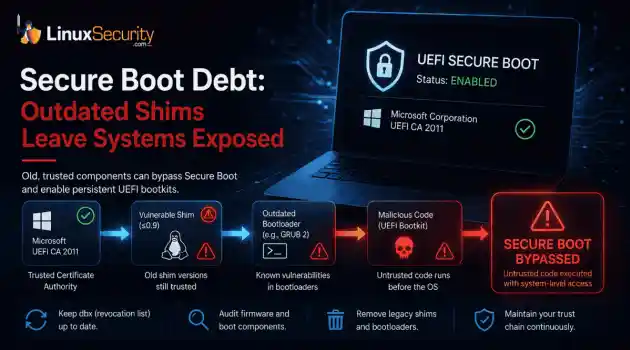
security advisory linux distribution ESET researchers identified 11 old and forgotten Linux UEFI shim bootloaders at versions 0.9 and below that can be used to bypass UEFI Secure Boot on any UEFI-based machine that trusts Microsoft’s Microsoft Corporation UEFI CA 2011 third-party certificate authority, regardless of the installed operating system (OS). Reported shims can be exploited to execute untrusted code during system boot, enabling attackers to deploy malicious UEFI bootkits even on systems with UEFI Secure Boot enabled.....
Jul 16, 2026
 Refine news
X Clear Filters
Get the latest News and Insights
Get the latest Linux and open source security news straight to your inbox.
Community Poll
Is continuous patching actually viable?
Loading...
Explore Latest Linux Security news
We found 35 articles for you...
77
 data privacyautomationIT support
What Happens When AI Agents Start Handling Tier-1 Linux Support Tickets
Every system admin has lived through the same Monday morning ritual. A queue of forty tickets, half of them password resets, permission errors, or disk space warnings that any experienced technician could resolve in under two minutes. The other half require actual judgment. For years, automation promised that software would eventually sort the two apart on its own. That promise is now being tested in production Linux environments. . Early results are reshaping how IT teams think about tier-1 support altogether. Moving from passive ticket routing to active, autonomous remediation is a turning point for infrastructure management. Modern digital agents don’t just categorize issues. Now, they can directly parse syslog files, execute bash commands, and verify system state changes without manual oversight. The way this transition is actually playing out on the command line reveals massive efficiency gains waiting to be unlocked. At the same time, engineering teams are confronted by entirely new operational risks. The success of agent automation depends on how they decide to navigate those new risks. A New Generation of Agentic IT Platforms A growing number of IT management platforms have started deploying autonomous agents that read, categorize, and in many cases resolve tier-1 tickets without a human touching the queue first. An autonomous IT agent resolves Tier-1 tickets end-to-end on the device — triaging incoming requests, pulling context from device history, and closing out routine issues before they reach a technician's desk. The pitch is straightforward. Free up human staff for the tickets that actually need a person thinking through them, and let the agent absorb the repetitive work that eats up the bulk of a support team's hours. For Linux environments specifically, this shift matters more than it might on a Windows-heavy help desk. Linux tickets tend to skew toward configuration drift, package conflicts, and permission issues that follow recognizable patterns. Thatpredictability makes the environment a reasonable proving ground for agentic automation, but it also raises the stakes when something goes wrong, because a misconfigured permission fix pushed at 2 am can propagate across a fleet of servers before anyone notices. Why Tier-1 Linux Support Is a Natural Testing Ground Tier-1 tickets are, almost by definition, the most templated part of any support operation. Users forget their SSH keys. Cron jobs fail silently. Log partitions fill up because nobody set a rotation policy. These are not novel problems, and the fixes are rarely creative. Repetitiveness is exactly what makes large language models effective here. An agent trained on thousands of resolved tickets can recognize the shape of a problem faster than a junior technician still building pattern recognition from scratch. However, some problems are more complex than they appear. Recognizing a pattern is a different challenge from understanding the environment it lives in. Human Linux technicians generally have some sense of what that server does, who depends on it, and what happens if a fix goes sideways. An AI agent working from ticket text and system logs alone does not automatically have that context. That’s why most current deployments are scoped narrowly. Agents are restricted to specific ticket categories, paired with escalation paths that hand off ambiguous issues to a person. The Privacy Question Nobody Asks Loudly Enough Support tickets are full of sensitive information. Customer names, internal hostnames, sometimes credentials pasted directly into a ticket body because a user panicked and included everything they could think of. When that data sits in a system reviewed by trained staff under an internal policy, the exposure is contained. When it becomes training or context data for an AI system, the calculus changes. Exposure from support tickets is already a well-documented problem. Linux Security reported on an incident where customer names and addresses were exposedthrough a support ticket error that made tickets accessible to anyone who had submitted one. Poorly implemented ticketing systems are frequently the weakest link in an otherwise well-guarded environment. If an organization wants to add AI agents into that workflow, they need to ask some hard questions about their existing security. Where ticket data travels, how long it persists, and whether an agent's memory will retain details of a resolved issue. Without thinking it through, the agent can exacerbate all of the existing data vulnerabilities of a ticketing system. Well-architected agentic platforms address this directly through tenant-level data isolation, approval workflows for high-risk actions, and audit trails on every agent decision — which is why the security posture of the underlying platform matters more than the intelligence of the agent sitting on top of it. Kernel-Level Security Still Matters More Than the Interface It is tempting to treat AI ticket triage as a purely software layer problem, something that lives entirely above the operating system. That framing misses how much the underlying platform still shapes what an agent can safely do. Linux itself continues to harden at the kernel level in ways that directly affect how much autonomy any automated system, human-built or AI-driven, can be trusted with. Recent kernel development illustrates the point well. Linux Security covered how newer architecture support strengthens address space layout randomization , a defense mechanism that makes it harder for any process, including a misbehaving script or an overly permissive agent, to exploit predictable memory addresses. These improvements are a quiet reminder that the foundation an AI agent operates on matters just as much as the intelligence of the agent itself. No amount of clever ticket triage compensates for a kernel that makes lateral movement easy once something goes wrong. The Broader Industry Is Moving Toward Standardized Agent Frameworks The interest in AIagents handling operational work is not confined to IT help desks. Industry analysts have tracked a broader push toward shared standards for how autonomous agents communicate, hand off tasks, and operate within enterprise infrastructure. Forbes recently examined how an agent framework moved under the stewardship of the Linux Foundation, signaling that major industry players see enough long-term value in agentic systems to want open, interoperable standards rather than a patchwork of proprietary approaches. That context matters for IT teams evaluating tier-1 automation tools. A platform built on emerging open standards is more likely to integrate cleanly with the rest of an organization's stack a few years from now than one built entirely on closed, proprietary logic. It is a detail worth watching closely as more vendors enter this space. Where Ticket Automation Fits Alongside Broader Monitoring AI-driven ticket triage does not exist in isolation. It sits alongside a wider set of tools that IT and operations teams already rely on to understand what is happening across distributed and remote environments. Discussions of remote desktop monitoring software cover some of the same underlying challenges, giving teams visibility into systems and activity without requiring a person to manually check every endpoint. The overlap is not coincidental. Both categories of tooling are trying to solve the same basic problem, which is how a smaller team keeps oversight over a growing and increasingly distributed set of machines. Hosting environments face a parallel version of this challenge. As more infrastructure moves toward AI-assisted operations, conversations around AI-powered helpdesk tools in the web hosting space echo many of the same tradeoffs seen in general IT support, including where automation genuinely reduces workload and where it introduces new categories of risk that did not exist when a human reviewed every request. What Comes Next for Tier-1 Support Teams None of thissuggests tier-1 support is about to become fully autonomous. The line between routine and complex tickets is becoming a design decision rather than a fixed boundary. To benefit from ticket automation, support teams must clearly define which Linux tickets are safe to hand to an agent, and which absolutely require a human in the loop. This approach sets boundaries that limit inherent risks. On the other hand, organizations that treat every ticket as automatable are the ones likely to learn the hard lessons first. . Explore how AI agents are transforming tier-1 Linux support and the impact on operational efficiency and security risks.. AI support automation, Linux ticketing system, autonomous IT, data exposure risks. . Andrew Kowal
 Jul 17, 2026
•
Jul 17, 2026
• Server Security
81
 data collectionautomationweb scraping
Why Mobile Proxies Are Harder to Block Than Datacenter IPs
You're running a web scraping project to collect pricing data from e-commerce sites. You set up a pool of datacenter proxies, launch your scripts, and within minutes — banned . CAPTCHAs everywhere. Your data pipeline stops before it really begins. . It's a frustrating scenario that plays out daily in ad verification, market research, and multi-account management. The website doesn't know you're doing legitimate research or monitoring. It just sees traffic coming from IP ranges it recognizes as datacenter infrastructure, throttles it, or increases scrutiny. But here's the thing. When you switch to mobile proxies, the same platforms treat you differently. The IP addresses look like they belong to real people using phones on cellular networks. Anti-bot systems pause, and your traffic gets through. Mobile proxies have Carrier-Grade NAT, which is one of the reasons why they are inherently more difficult to block than datacenter proxies. In this article, we’ll discuss the differences between real carrier mobile IPs, why businesses and agencies choose them for reliable scraping and multi-accounting, and how to tell if they’re the right tool for your next project. There are three types of IP addresses To see why mobile proxies are different, you need to understand where IP addresses actually come from. There are three main types, and each one originates from an entirely different location. IPs of Datacenters Datacenter IPs are from AWS, Google Cloud, and other cloud providers. These IP ranges are publicly associated with cloud providers, so it is easy for websites to identify and block them. They are fine for simple tasks, but they get flagged very quickly by anti-bot systems as they are recognized as server traffic. Residential IPs Residential IPs are real home Internet connections from ISPs such as Comcast or AT&T. They originate from IPs assigned to real households – so they appear as real user traffic. They are harder to block than datacenter proxies and offer a goodbalance of speed and reliability. Residential proxies are good for buying tickets, managing social media, and general web scraping. Mobile IPs Mobile IPs come from cell carriers like T-Mobile and Verizon. They are assigned to real smartphones and tablets. Carrier-Grade NAT means that at any one time, thousands of users share the same IP. This is why mobile IPs are the most reliable for automation, social media accounts and data collection where you need uninterrupted access, and also the hardest to block. Why websites easily identify datacenter traffic Websites block datacenter traffic because most automated server attacks also originate from cloud infrastructure. To protect their platforms, websites combine multiple detection methods to identify cloud IPs: Cloud ASN reputation – Traffic coming from AWS , Google Cloud , or Azure is quickly classified as server-based activity. Public IP ranges – Datacenter IP ranges are publicly documented, making them easy to recognize. Rate limits – Websites restrict how many requests a single IP can make within a certain period. CAPTCHAs – When traffic appears unusual, websites may require additional verification before allowing access. These measures protect websites from abuse, but they can also affect legitimate automation, testing, and public data collection. Why mobile proxies are harder to block The biggest difference between mobile and datacenter IPs is the network behind it. Mobile IPs come from cellular carriers such as T-Mobile, Verizon, and AT&T. Unlike cloud providers, mobile operators use Carrier-Grade NAT (CGNAT) , a technology that allows hundreds or even thousands of subscribers to share a single public IP address at the same time. Why does that matter? One public IP represents many users , not a single server. Blocking one mobile IP can affect hundreds or thousands of legitimate customers. IP reputation is shared across many devices , making it harder to judge trafficbased on the IP address alone. Carrier IPs naturally change over time , creating more varied traffic patterns than static datacenter networks. Because of this, websites are more cautious about blocking mobile IPs outright . Websites still evaluate browser fingerprints, cookies, request frequency, and user behavior. However, mobile networks provide a different type of network identity that is often better suited to long-running web scraping, market research, ad verification, and multi-account workflows. If your projects rely on U.S. carrier networks, using proxies from large carriers, such as T-Mobile proxies , is one option for accessing a real mobile network for automation, web scraping, or managing multiple accounts. When mobile proxies are the best choice Mobile proxies aren't the best solution for all use cases. Their main tradeoff is cost: they're significantly more expensive than datacenter proxies. They deliver the most value when your workflows depend on real carrier traffic or when reliable access matters more than saving money. Here’s when it makes perfect sense to choose mobile IPs: Mobile app testing – testing apps on real carrier networks helps identify issues that don't appear on Wi-Fi or cloud infrastructure. Ad verification – verifying how ads appear to users in different regions is useful for checking geo-targeted campaigns and localized content. Multi-account management – separating accounts with different mobile IPs reduces login conflicts. Social media automation – Instagram, TikTok, and Facebook expect large amounts of mobile traffic. Carrier-backed IPs provide a more stable environment for long-running workflows. Location-based testing – checking local search results, pricing, and product availability with carrier IPs delivers more accurate results. That doesn't mean mobile proxies are always the best option. Datacenter proxies remain faster, cheaper, and better suited for high-volume scraping orlow-security targets where occasional blocks are acceptable . Many businesses use both, choosing the network that best matches each workflow. What to look for in a mobile proxy provider Not all mobile proxy services are built the same. If your workflows depend on reliable access, look for infrastructure that offers real carrier networks, flexible session control, and integration with the tools you already use. For example, CyberYozh's T-Mobile mobile proxies provide access to real U.S. carrier IPs designed for automation, testing, and data collection. Real 4G/5G carrier IPs instead of emulated mobile traffic. Stable and rotating sessions for different workflows. API access for Playwright, Puppeteer, Selenium, Scrapy, and custom scripts. Extensive geographic coverage with managed IP pools. Mobile, residential, and datacenter proxies available from one platform as your needs grow. Conclusions Mobile proxies address a real-world problem: they make automated traffic appear as traffic that websites expect to see from real users. They are more reliable for web scraping, managing multiple accounts, ad verification or automation than datacenter IPs. Choose the right proxy for your tasks, and your workflows will work stably with fewer blocks and fewer headaches. Mobile proxies FAQs Why are mobile proxies harder to ban? Mobile proxies use real carrier IPs shared by many users via Carrier Grade NAT. Blocking them could interfere with legitimate mobile traffic. What are the common use cases for mobile proxies? Some common use cases are web scraping, managing multiple accounts, social media automation, ad verification, and location testing. Are mobile proxies good for scraping? Yes. They help to keep access to websites that often block datacenter IPs. What’s the best proxy for automation? It is contingent upon the task: datacenter for speed, residential for large scale scraping, and mobile for trust-sensitive workflows. What’s a T-Mobileproxy? T-Mobile proxies have IP addresses from the T-Mobile mobile network and are extensively used for automation, testing and data gathering within the US. . Learn the advantages of mobile proxies over datacenter IPs for tasks like web scraping and ad verification.. Mobile Proxies, Web Scraping, Datacenter IPs, Data Collection, Ad Verification. . Anthony Pell
Jul 17, 2026
•
Privacy

79
 Linux securitysecurity assessmentautomation
How AI Is Changing Open Source Penetration Testing
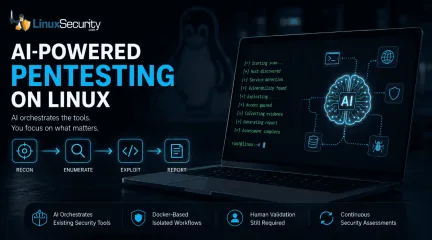
AI is beginning to reshape how penetration testing workflows are organized. For years, the penetration tester’s workflow has been a labor-intensive ritual: scan, enumerate, research, exploit, and report. But new frameworks are attempting to codify that intuition, turning the "human-in-the-loop" process into a machine-coordinated workflow. But is this a genuine evolution in how we secure Linux environments, or just a sophisticated wrapper around the same old tools? . Dark Moon is an open-source autonomous penetration testing framework that combines large language models with established offensive security tools. It supports assessments against web applications, APIs, Active Directory, Kubernetes environments, content management systems, and other common enterprise targets while orchestrating scans through Docker-based tooling. The "Conductor" Philosophy For the uninitiated, Dark Moon doesn’t aim to replace the core toolkit—tools like Nmap, sqlmap, or Nuclei—that Linux security professionals have relied on for decades. Instead, it positions itself as an "AI-powered conductor." In a traditional manual assessment, a tester has to constantly context-switch, analyzing the output of one tool to decide which flag to pass to the next. One open source implementation attempts to solve this via agentic reasoning. It doesn’t just scan; it interprets the HTTP response, determines if a CMS fingerprint is present, and proposes and executes the next stage of testing based on its reasoning model. For instance, imagine exposing a new Ubuntu web server. Traditionally, you might begin with Nmap, move to ffuf after discovering an HTTP service, fingerprint the application, then manually decide whether sqlmap or nuclei makes the most sense to run next. The Darkmoon project attempts to automate those transitions by using the output from one stage to dynamically determine what happens next. It can also consolidate findings into a structured report, sparing the operator from parsing dozens ofdisconnected tool outputs. Linux as the Working Environment for AI Security Tools One of the best things about these new security agents is that they’re built on the tools we’ve been using for years. The project leverages Docker for isolation, which is a massive win for Linux admins and DevOps folks who are already living in containers. It solves that classic "dependency hell" we’ve all dealt with—you know, trying to get some niche Python-based scanner to play nice with your system’s existing libraries. Because the framework runs everything in its own container, it keeps your host OS clean and stable while the AI manages the heavy lifting. For those of us who spend most of our day in a terminal, it’s not really about learning a whole new system. It’s more like getting an extra pair of hands to handle the repetitive, manual "grunt work" of orchestration, leaving us to actually dig into the interesting findings/ The Reality Check: Where AI Fits It is crucial to set expectations here. The AI is not a magic bullet. As noted in industry discussions on autonomous pentesting platforms , the real value lies in the reasoning layer. The AI isn’t discovering new exploits on its own; it is managing the execution of existing ones. This brings a specific set of limitations: Contextual Blindness: An AI can easily misinterpret a non-standard login portal or a specific network quirk that a human would recognize instantly. The "Hallucination" Risk: Some frameworks attempt to reduce hallucination risk by routing actions through controlled tool execution, the risk remains that the AI might prioritize the wrong path. Human Validation: The consensus among security researchers is that AI currently functions best as a "force multiplier." It handles the reconnaissance and the monotonous chaining of tools, allowing the professional to focus on the high-stakes analysis. Why It Matters for the Linux Community For sysadmins, researchers, and home-lab enthusiasts, these frameworksrepresent a shift in the security paradigm. We are moving away from "point-in-time" assessments—where you scan a network once a year—toward continuous security validation. The useful part is repeatability. The same checks can run after changes, after deployments, or against lab systems where configuration drift tends to show up first. While many people will use Dark Moon as a research or lab platform, the same orchestration model could eventually fit into CI/CD pipelines or scheduled internal assessments. It effectively turns your security posture from a static checkbox into a living component of your environment. Final Thoughts These frameworks don't replace tools like Nmap, ffuf, sqlmap, or the rest of the Linux security toolkit. Those tools remain the engines doing the work. What's changing is the orchestration layer sitting above them. As AI becomes better at interpreting results and coordinating workflows, frameworks like Dark Moon offer a glimpse of how future penetration testing may evolve while still relying on the open-source tools the Linux community has trusted for years. Whether you use it in production or just as a sandbox tool to explore the future of AI-driven red teaming, it’s a project that builds on the open-source spirit rather than trying to hide it behind a black-box paywall. Want more Linux security news, vulnerability analysis, and software supply chain updates? Subscribe to the LinuxSecurity Newsletter and get the latest threats, advisories, and expert insights delivered directly to your inbox. Related Reading Understanding Linux Privilege Escalation Patterns and Security Measures How Secure Is Linux? Exploring Security Design and User Privilege Models Optimizing Linux Security: Strategies for Modern Threats . Explore the capabilities of Dark Moon, an AI-powered framework transforming penetration testing workflows on Linux systems.. AI Penetration Testing, Automation Framework, Open Source Security, Linux Tools, Dark Moon. . MaK Ulac
Jun 26, 2026
•
Security Projects
78
 security breachlinuxautomation
Risks of GitHub Repo Breach on Linux Supply Chain Security
A major internal repository breach at GitHub has exposed a critical and overlooked blind spot in Linux supply chain security. Kernel exploits, exposed SSH services, weak firewall rules, and vulnerable daemons dominated the Linux threat model for years, and in many environments, they still matter. But recent supply-chain incidents involving GitHub ecosystems, npm packages, and malicious developer tooling point somewhere else entirely: the developer workstation. . The breach matters because attackers no longer need direct access to hardened Linux servers to compromise production environments. Trusted developer tooling and CI/CD automation can now deliver poisoned code upstream long before defenders realize anything changed. Modern Linux environments increasingly depend on GitHub Actions workflows, container registries, self-hosted runners, and automated deployment pipelines tied directly to developer systems. One compromised extension or dependency may be enough to quietly move malicious code into production infrastructure. Linux environments disproportionately rely on open-source tooling, containerized CI workflows, infrastructure-as-code automation, and developer-managed deployment pipelines. That trust relationship is now becoming one of the weakest points in the modern Linux security model. Why Developer Workstations Have Become a Linux Security Blind Spot Recent supply-chain incidents involving malicious npm packages, compromised developer tooling, and poisoned CI workflows have exposed a growing problem for Linux environments: trusted developer systems now sit directly upstream from production infrastructure. VS Code extensions carry an unusual level of trust inside modern Linux workflows. Developers install them constantly for: Linting and Git integration Container and Kubernetes management Terraform support and build automation Cloud deployment workflows Most teams barely review these extensions beyond install counts and marketplace ratings. Productivityusually wins over scrutiny. Once installed, a compromised extension may gain access to: GitHub session tokens SSH keys and signing credentials npm authentication tokens Kubernetes configurations Cloud secrets and CI environment variables Linux production systems often prioritize automation, minimalism, and operational efficiency over traditional endpoint-style monitoring. That makes trusted developer environments especially valuable to attackers looking for cleaner access paths into infrastructure. Attackers no longer need to fight through hardened Linux servers directly if they can compromise the trusted tooling developers already use upstream. Why the GitHub Supply-Chain Trend Matters for Linux Security Recent supply-chain attacks highlight a dangerous reality for Linux teams: production infrastructure increasingly inherits the trust decisions made upstream inside developer tooling and CI automation. Linux systems often sit at the very end of the attack chain. The broader npm and GitHub ecosystem attacks demonstrated how malicious code can move through legitimate CI infrastructure and trusted publishing systems without immediately triggering suspicion. In several incidents, poisoned packages appeared authentic because they were distributed through otherwise trusted automation pipelines. Even cryptographic provenance becomes less meaningful if the trusted CI pipeline itself has already been compromised. Traditional Linux security still matters. Kernel hardening, SSH lockdowns, segmentation, SELinux policies, and firewall rules remain essential. But they no longer represent the full attack surface. Attackers increasingly target trust relationships because trusted automation provides cleaner and quieter access than exploiting operating systems directly. How a Single Developer Workstation Can Poison Production The attack chain starts quietly. A developer installs or updates what appears to be a legitimate VS Code extension or npm dependency. The toolingbehaves normally enough to avoid suspicion while hidden functionality begins harvesting credentials and session data. From there, attackers can move directly into trusted automation systems. A compromised developer environment may expose: GitHub access tokens SSH keys and signing credentials Kubernetes deployment configurations Cloud authentication secrets CI/CD environment variables Once attackers gain access, CI/CD systems become the amplification layer. GitHub Actions workflows may be modified to inject malicious dependencies, alter build configurations, or poison deployment artifacts. Self-hosted Linux runners create additional exposure because they often maintain persistent credentials and broad internal network access. At that point, attackers no longer need direct access to hardened Linux servers. Trusted automation delivers the malicious code for them. A compromised extension on a developer workstation may ultimately lead to poisoned containers being automatically deployed into Kubernetes clusters or production Linux environments through infrastructure already trusted by the organization. Linux CI/CD Pipelines Are Increasingly Becoming the Real Target Security researchers increasingly view CI/CD systems as the primary target for modern supply-chain attacks in Linux environments. Pipeline compromise bypasses many traditional security controls because the malicious activity occurs inside systems already approved to build and deploy software. GitHub Actions workflows deserve particular scrutiny. Risky patterns such as pull_request_target workflows may allow attacker-controlled code from external pull requests to execute inside trusted repository contexts that may still have access to repository secrets, tokens, or workflow permissions under certain conditions. Self-hosted Linux runners create even larger blast radii because they frequently maintain: Long-lived credentials Access to internal repositories Container registry permissions Terraform state files Kubernetes deployment access Infrastructure-as-code compounds the problem further. Dockerfiles, Terraform manifests, Helm charts, and deployment workflows collectively provide attackers with detailed visibility into production architecture. For Linux teams, CI/CD infrastructure must now be treated as a high-risk security boundary rather than simple deployment automation. npm Supply-Chain Attacks Continue Targeting Linux Development Environments A surge in targeted npm attacks confirms that package ecosystems remain one of the weakest links in Linux-based development environments. Attackers increasingly rely on techniques such as: Typosquatting legitimate package names Maintainer account compromise Dependency confusion attacks Poisoned transitive dependencies Transitive dependencies make the problem significantly worse. Developers may trust a direct package while having little visibility into hundreds of indirect dependencies installed alongside it. By the time defenders detect suspicious behavior, malicious packages may already exist across: CI runners Container images Production workloads Cached deployment artifacts Package trust now directly impacts the integrity of the underlying Linux environment. How Linux Admins Can Detect Exposure Security teams are increasingly adopting new response protocols for supply-chain compromises tied to developer tooling and CI automation. Admins should immediately focus on: Repository activity: Look for unauthorized workflow edits, suspicious commits, or unexpected OAuth authorizations. Runner behavior: Monitor CI runners for unusual outbound traffic, package downloads, or unexpected job execution patterns. Credential rotation: Replace GitHub tokens, SSH keys, npm credentials, cloud secrets, and Kubernetes service accounts. Artifact integrity: Rebuild containers from verified sources and validate SBOMs against known-good baselines. Extension auditing: Reviewinstalled VS Code extensions across developer systems and remove unapproved tooling. Persistence checks are equally important. Malicious workflows, poisoned caches, and hidden automation hooks may survive standard credential rotations. Supply-chain attacks rarely stop at a single layer. Best Practices for Securing Linux CI/CD Pipelines Security teams are increasingly treating developer tooling and CI infrastructure with the same level of scrutiny traditionally reserved for production servers. Endpoint Hardening Restrict VS Code extension installations through allowlists and centralized policy controls. Isolate development environments using containers or disposable workspaces. Monitor workstations for unauthorized extension activity and credential access. GitHub and CI Security Avoid risky GitHub Actions patterns such as pull_request_target unless absolutely necessary. Use MFA, short-lived tokens, and tightly scoped GitHub permissions. Deploy ephemeral CI runners instead of persistent self-hosted systems. Segment CI infrastructure from production deployment networks. Dependency and Artifact Security Verify package provenance using Sigstore or cosign. Continuously audit dependencies and monitor for suspicious package updates. Validate SBOMs before deployment. Use tooling such as OpenSSF Scorecard, Syft, Grype, and Trivy to improve visibility into software supply chains. Visibility remains the final layer. Centralized logging, behavioral monitoring, and threat intelligence integration improve detection speed when trusted tooling becomes the compromise vector. Linux Security Now Starts Before Production Linux admins spent years hardening production infrastructure against direct compromise. Attackers adapted by moving further upstream into developer environments, package ecosystems, and CI/CD automation already trusted to deploy code into production. That shift changes the security model entirely. A fully patched Linux servermay still execute poisoned code delivered through a trusted pipeline, signed package, or compromised developer workflow. In many environments, the workstation now matters just as much as the production server itself. The modern Linux attack surface no longer starts at the edge firewall or exposed SSH port. Increasingly, it starts wherever developers write, build, and ship code. Stay ahead of emerging Linux supply-chain threats, CI/CD risks, and open-source security issues by subscribing to the LinuxSecurity newsletter . Get weekly analysis, practical hardening guidance, and security insights focused on real-world Linux infrastructure. Related Reading Why CI/CD Pipelines Became Targets in Software Supply Chain Attacks GitHub Actions Linux Self-Hosted Runners Security Risks Why Linux Supply Chain Attacks Are Becoming a Nightmare for DevOps Teams The npm Supply Chain Problem: Why Installing Packages Executes Untrusted Code GitHub Actions Critical Misconfigurations Expose Open Source Risks . Explore the risks in Linux supply chain security amidst GitHub's repo breach, revealing the importance of developer tool security.. Linux Supply Chain Security, GitHub Breach, CI/CD Security, Developer Tool Threats, Security Best Practices. . Dave Wreski
May 21, 2026
•
Vendors/Products
209
 threat analysisLinux securityincident response
Threat Analysis and Cyber Intelligence in Linux Security
Over the last decade, the volume of cyber threats has grown, but their shape has changed even more. Attacks no longer sit neatly inside a few predictable categories. Espionage, ransomware, and phishing bleed into each other, turning up in organizations of every size. . Threat analysis matters because most attacks do not begin with a clear signal. They unfold gradually, blending into routine activity until the pattern becomes obvious, usually after damage has already occurred. You start to notice the shift when incidents stop looking isolated. One campaign bleeds into another. Infrastructure gets reused. Techniques repeat, but the timing changes. Defenses built around static assumptions tend to fail quietly. By the time a new tactic is obvious, it has usually already worked somewhere else. Why Threat Analysis Matters for Linux Users This tends to show up first in Linux-heavy environments where systems have been stable for a long time. A service that has not been touched in months starts accepting unexpected connections. A patch is delayed because nothing appears broken. A small configuration change is made to solve a short-term problem and is never revisited. Nothing looks like an incident on its own. Each change makes sense in isolation. Threat analysis is what connects those details. It gives teams a way to see when routine activity starts forming a pattern. Without that perspective, most attacks are only understood after the fact, once logs are reviewed and timelines are reconstructed. By then, the question is no longer how to prevent it, but how far it has gone. How Security Is Strengthened by Threat Intelligence in Organizations Threat intelligence becomes valuable when it adds context. Not as a feed of indicators, but as a way to understand what activity actually means. This is where threat intelligence protecting enterprise networks helps teams distinguish routine system activity from access patterns and behavior that warrant investigation. Threatintelligence is not just a list of malicious IP addresses. It reflects: Who the attackers are. What motivates them? Which techniques do they reuse across campaigns? Organizations use that context to decide which risks matter now, not which ones look impressive on paper. The Federal Trade Commission has repeatedly pointed to actionable threat intelligence as a practical way to improve security posture. Many organizations supplement internal threat intelligence efforts with external Cybersecurity Services that provide additional visibility into emerging threats, attacker tactics, and incident response strategies. Combining internal analysis with specialized expertise can help security teams identify risks earlier and improve overall defensive readiness. On Linux systems, this context often explains activity that would otherwise look routine, including: Repeated SSH access attempts tied to known tooling Malware variants adapted for common distributions Vulnerabilities that appear theoretical until exploitation begins Collaboration and Information Sharing Threat analysis rarely happens in isolation. Most meaningful findings come from shared work, whether through industry groups, research communities, or government agencies. CISA’s public alerts and analysis are one example, but they are far from the only source. Patterns emerge faster when information moves: One organization spots a technique Another confirms it under different conditions A third sees the same infrastructure reused weeks later That shared visibility fills gaps no single team can cover on its own, especially when campaigns span regions and jurisdictions. Tools and Methods Employed in Risk Assessment Threat data comes from many places. Malware sandboxes, honeypots, analytical platforms, and monitoring systems all contribute pieces of the picture. NIST outlines many of these practices as part of its guidance on detection and response. In Linux environments, much ofthat signal originates from: System and authentication logs Audit records tied to privilege changes Network telemetry collected over time On their own, these records rarely stand out. Correlated, they begin to show patterns that were easy to miss in isolation. Automation helps surface those relationships, but it does not replace judgment. Machine learning can highlight anomalies across large datasets. Honeypots, by contrast, reveal attacker behavior directly by design. Both serve different purposes, and both age differently. Threat Research for Proactive Defense The real value of threat research shows up before an incident fully unfolds. Patterns repeat. Techniques resurface. Once that becomes clear, defenses can be adjusted ahead of time. Proactive research supports: Earlier detection through updated rules and signatures Faster triage when activity deviates from baseline Policy decisions around access and authentication Treating incidents as isolated events rarely works. The same weaknesses tend to reappear under slightly different conditions. Training and Awareness Through Threat Research Threat research also shapes how teams are trained. Real incidents carry more weight than abstract scenarios. Case studies grounded in current activity tend to stick longer than generic examples. The SANS Institute regularly highlights the role of current threat trends in professional education. In practice, this shows up as: More realistic phishing simulations Red team exercises based on recent campaigns Faster recognition of early warning signs Prepared staff do not eliminate risk. They reduce surprise. The Growing Cyber Threats Affecting Security Programs As technology changes, so do attack paths. Cloud platforms, connected devices, and automation tools expand the surface that defenders have to account for. The same technologies that improve efficiency also create new opportunities for abuse. Threat researchers now spend more timeexamining how emerging systems are misused rather than how they were intended to work. That work does not stop. Attackers adapt quickly, especially when experimentation becomes cheap. Organizations that invest in ongoing research tend to notice those shifts earlier, not because they predict the future, but because they recognize familiar patterns when they resurface. Threat Research as Part of Incident Response Threat analysis sits near the beginning of most incident response workflows. Before containment decisions are made, teams need to understand how the activity started and where it can spread. For Linux fleets, that analysis often includes: authentication activity across hosts privilege escalation and role changes persistence mechanisms that survive restarts lateral movement patterns between systems Together, these signals explain how an incident unfolded. Response efforts typically involve coordination across technical teams, legal, operations, and external partners. Over time, those responses influence how systems are hardened and how future incidents are handled. The Role of Automation in Threat Research Automation becomes unavoidable as data volumes increase. No team can manually review everything generated by modern environments. Automated collection and analysis allow analysts to focus on interpretation rather than triage. When paired with machine learning, automation helps: Surface patterns earlier Reduce response latency Prioritize investigation paths It narrows the field. It does not decide the outcome. FAQ: Threat Analysis and Threat Research What is threat research in cybersecurity? Threat research focuses on understanding attacker behavior, techniques, and vulnerabilities so organizations can respond based on evidence rather than assumptions. Why is threat research important to businesses? It helps teams recognize emerging risks earlier and reduce the impact of attacks that would otherwise go unnoticed. How doorganizations use threat research? They apply it to detection strategies, training programs, and incident response planning. Conclusion: Why Threat Analysis Remains Essential Threat analysis remains central to modern security because attackers rarely stop at the first attempt. They probe, adjust, and return. Continuous research shapes how defenses evolve, how incidents are investigated, and how future risks are assessed. As threats become more adaptive, the ability to observe, analyze, and adjust becomes just as important as any individual control. . Explore why threat analysis is critical for Linux security, helping teams understand complex attack patterns and enhance defenses.. Threat Analysis, Cyber Intelligence, Risk Assessment, Incident Response, Linux Security. . MaK Ulac
Jan 13, 2026
•
Security Trends
77
 security advisorymalwareexposure
Linux Security 2026: Emerging Risks Impacting Cloud and IoT Infrastructure
Linux security sits at the center of modern infrastructure. Most production systems, cloud workloads, and IoT devices run on it in some form. That reach gives it stability and risk in equal measure. The Identity Theft Resource Center reported 1,732 confirmed data compromises in the first half of 2025, an 11 percent rise from the same period, and more than half of 2024’s total. . It’s clear that a growing number of these incidents began on Linux-based systems. Attackers continue to use automation and AI to scan for unpatched packages, weak SSH setups, and kernel flaws faster than most teams can respond. The pattern isn’t new, but the tempo is. Linux security has shifted from a routine maintenance item to a continuous operational demand for every organization that depends on uptime. Who’s Targeting Linux Systems and What They Want You see the same names cycle through every year. What’s changed isn’t who they are, but how precise they’ve become. Most big operations now include Linux systems in the first wave, not as an afterthought. Lazarus Group uses compromised Linux servers to run crypto miners and collect financial data. They tuck payloads inside standard binaries, which helps them slip past shallow scans. APT28 (Fancy Bear) keeps brute-forcing SSH keys and planting implants that sit under kernel updates. Once inside, they stay dormant until needed. Carbanak aims at the financial infrastructure built on Linux. They blend credential theft with lateral movement across databases and payment networks. The Dark Overlord goes after smaller Linux environments that lag in patching. Data theft, extortion, or leaks — any of them will do. Anonymous offshoots still show up from time to time, taking swings at public Linux systems to prove a point more than to make money. Most of these groups start the same way. Automation finds the weak spots. Humans take over once a system looks promising. A working Linux exploit spreads fast once it hits the openweb. Linux security can’t rely on obscurity or reputation anymore. The focus has shifted to exposure management, tracking what’s accessible, what’s vulnerable, and how long it’s been overlooked. Why Linux Security Threats Keep Growing Linux security has scaled with the systems it protects. The workload is bigger, automation faster, and attackers better equipped. What’s changed is speed. Threats evolve between patch cycles, and open tools make exploitation easier for anyone paying attention. AI Is Changing the Balance AI now runs through both sides of the equation. Attackers use it to fingerprint Linux environments, identify kernel versions, and build payloads in minutes. Defenders lean on it for triage and anomaly detection, though results vary. The core problem is data. Most security teams don’t have enough clean logs to train reliable models. That’s why alert noise keeps growing while detection speed stays flat. AI can improve pattern recognition, but it doesn’t replace context. Human review still decides what’s real. Recent studies on how AI is transforming cybersecurity defenses point to the same issue — automation raises both capability and risk. Linux security will depend on how well teams balance the two. Supply Chain Exposure Across Linux Environments Every open-source package or container image carries inherited risk. Once a compromised build slips into the pipeline, it spreads quietly through dependencies. The 2024 XZ backdoor incident showed how deep that problem runs. A single malicious library nearly reached production repositories. The point was clear: linux security depends as much on verified code as on timely patching. Better linux vulnerability management means signed repositories, automated dependency checks, and traceable build chains. Trust without proof is no longer acceptable. IoT and Edge Devices Running Linux IoT hardware keeps widening the attack surface. Many devices still run old Linux kernels and default credentials.Once compromised, they become access points for internal scans or parts of DDoS networks. For smaller organizations, securing linux servers isn’t enough. Edge nodes, routers, and sensors need the same oversight. A breach rarely starts at the core; it starts where no one’s watching. Cloud and Container Complexity Most cloud and container workloads depend on Linux. The flexibility helps deployment, but it also multiplies risk. Misconfigured IAM roles, unused credentials, and stale Docker images create quiet openings. A few of these attacks rely on zero-days. They rely on drift, with old systems left exposed. Strong linux security practices like image scanning, access control, and regular audits cut that risk before it causes downtime. How to Strengthen Linux Security in 2026 Linux security still comes down to the basics. The teams that stay consistent usually get hit less, not because they’re lucky, but because they keep the small things tight. Kernel live patching Apply updates without downtime using tools like Canonical Livepatch or Oracle Ksplice. Kernel live patching keeps systems current and reduces the reboot gap that attackers often rely on. AppArmor and SELinux Run them in enforcing mode. Audit-only doesn’t block anything. Real enforcement cuts lateral movement before persistence takes hold. SSH key discipline Rotate keys often, disable password logins, and limit root access. It’s not exciting work, but most Linux breaches still start here. Package verification Sign and verify every package and repository. Anything unsigned should fail policy checks automatically. It’s one of the simplest ways to strengthen linux vulnerability management and close the loop on supply chain risk. AI-assisted log review Let automation flag anomalies, but keep humans in the loop. Machines handle speed; people handle context. Real linux security depends on both. Continuous compliance Bake CIS Benchmarks or OpenSCAP into CI/CD pipelines. Regularvalidation turns security from an audit event into a daily habit. Each step strengthens linux vulnerability management by improving control, response speed, and visibility. When these habits hold, securing linux servers becomes less about incident response and more about keeping exposure from forming in the first place. The Direction of Linux Security in 2026 Attackers have adjusted faster than most defenders expected. The same automation that powers modern DevOps pipelines now drives exploitation at scale. Linux systems sit in the middle of that change. They’re the foundation most teams build on and the one attackers know best. AI keeps raising the ceiling on both sides. It sharpens detection, but it also accelerates scanning, intrusion, and obfuscation. Over time, what separates a breach from a close call will come down to the fundamentals: patch cadence, identity control, and clear visibility across infrastructure. Strong linux security depends on staying close to those fundamentals. Teams that invest in automation for patching and validation tend to outlast the noise. When linux vulnerability management is treated as an active process instead of a cleanup task, small issues stop becoming big ones. For most organizations, securing linux servers will remain the backbone of resilience. Containers, IoT, and cloud workloads all start there. Focus on raising the cost and time of compromise so attackers look for easier targets. Linux security will define the next phase of enterprise defense. The platform isn’t new, but the threat model around it keeps moving. Staying steady means patching fast, verifying often, and never assuming yesterday’s fix still holds. The Future of Linux Security Linux security now defines how resilient infrastructure can be. Most critical systems run on it, which means every configuration choice matters. The flexibility that made Linux dominant is still its biggest strength, and still the hardest thing to secure. Attackers haven’t stoppedevolving. Automation and AI now run both sides of the fight. They scan, sort, and exploit faster than manual teams can react. They can match that pace by staying consistent with patches, access limits, and visibility. Securing linux servers starts with that baseline. Keep root access narrow, patch cycles short, and audit trails clean. It sounds simple, but it’s what keeps most environments from tipping into incident response. Good linux vulnerability management isn’t about closing every CVE. It’s about closing the ones that matter. Context decides priority. Systems that track and verify their own state recover faster because surprises are fewer. Linux remains open, flexible, and everywhere. That isn’t changing. The next phase of linux security will depend less on new tools and more on steady habits: review, verify, patch, repeat. . Explore the risks in Linux security for 2026, the influence of AI, and essential defense strategies to adopt.. Linux security risks, AI cybersecurity, exposure management, Linux defense strategies. . MaK Ulac
Nov 24, 2025
•
Server Security
210
 security advisorylinuxautomation
TARmageddon: async-tar Vulnerability Exposes Linux Archive Extraction Risks
A path traversal flaw in the Rust async-tar library has people looking harder at archive extraction security on Linux. Researchers are calling it TARmageddon, which fits. It’s not a kernel panic or a zero-day bomb, but it’s the kind of quiet bug that ends up everywhere — build servers, CI pipelines, container images. . The problem’s simple. async-tar doesn’t properly sanitize file paths when unpacking a tar file. A crafted .tar file can slip files outside the intended directory and overwrite system data. No one’s shown a clean remote code execution (RCE) path yet, but that doesn’t matter much if your build process just wrote an attacker’s file to /etc/cron.d. CVE-2025-62518 is the provisional tag floating around. Whether or not it sticks, the point stands — these small libraries sit deep in automation stacks, and one unsafe assumption can cascade across thousands of systems. This isn’t news to most admins. Linux archive security has always been more about habits than patches. But TARmageddon is a good reminder of how easy it is to trust an archive you shouldn’t. How the async-tar Vulnerability Works on Linux Here’s what’s known about how it happens and where it shows up. Vulnerability Overview The Rust async-tar library handles archive extraction asynchronously. That’s great for speed but less so for safety. When unpacking a tar file, it doesn’t fully sanitize directory paths. A malicious archive can slip entries like ../../etc/passwd into the stream, and the library will write them outside the target directory. It’s a classic path traversal vulnerability. In most tests, that means files get overwritten like configs, scripts, whatever the process has write access to. No confirmed Linux remote code execution yet, but overwrite is usually step one in the chain. The bug shows up in projects that call async-tar directly or through build tooling that depends on it. For the technically inclined, the library’s behavior is documented in the async-tar library documentation . Affected Components and Environments You’ll see exposure mainly in Rust-based tools and CI/CD jobs using async-tar or its forks like tokio-tar. Anything unpacking untrusted tar files— containers, build pipelines, or automated deployment tasks can be hit. Maintainers working with tokio-tar have already pushed a fix, outlined in the astral-tokio-tar security advisory . A safer alternative for new projects is tar-rs, which includes proper path sanitization by default. This isn’t the first time archive libraries have failed this way. A nearly identical bug appeared in npm’s tar-fs module, as noted in the Debian security update for node-tar-fs path traversal . Different language, same blind spot, assuming file paths can be trusted. Technical Reference There’s no officially assigned CVE yet. Some reports reference CVE-2025-62518, but that listing hasn’t been verified. The CVE-2025-62518 vulnerability details page summarizes what’s been discussed publicly so far. Researchers found the issue during static analysis of unmaintained Rust crates, a reminder that dependency drift is its own risk. Once a library drops maintenance, small bugs like this one can hide for years. Why Tar File Extraction Security Matters on Linux Every admin unpacks a tar file without a second thought. It’s part of the muscle memory of Linux work. But that routine is exactly where this kind of mistake hides. Archive Extraction Risks in Linux Systems Tar archives run everything under the hood — packaging, backups, container layers, you name it. When that system breaks, it’s not flashy. It’s quiet. A build fails—a config change. Something odd starts running where it shouldn’t. A bad archive doesn’t need fancy malware. If it overwrites a script or drops a new file into a live directory, it’s already won. One poisoned tar file in a CI cache can move through a fleet before anyone notices. That’s why this bug lands squarely in Linux supply chainsecurity. Every automated build that extracts archives inherits the trust model of the tool doing the unpacking. Most of the time, that means CI/CD security is assumed rather than verified. Path Traversal Exploits and Real-World Parallels We’ve seen this movie before. The Python tarfile bug, CVE-2007-4559, sat unnoticed for years while developers kept shipping vulnerable code. npm’s tar and tar-fs had similar holes. Even core tools like GNU tar have cracked — see the Ubuntu GNU tar denial-of-service vulnerability . The async-tar issue just keeps the trend going. Same pattern, different stack. It’s not that engineers don’t know better. It’s that archive handling feels like solved work — until a path traversal vulnerability shows it isn’t. These flaws all fall under a familiar bucket in the NVD vulnerability classification framework : improper input validation. The oldest bug there is trust. Broader Linux Security Implications Automation makes life easier and attacks faster. Build jobs, containers, and deployment scripts unpack archives nonstop, sometimes with root rights, sometimes without a second thought. A single untrusted archive in that flow can rewrite a config, poison a container image, or slip into production. It’s not a headline-worthy hack. It’s just lazy archive extraction, security meeting real-world consequences. That’s the uncomfortable part of Linux hardening — we’re often defending against ourselves. Mitigation and Response: Securing Tar Extraction on Linux If async-tar exposed one thing, it’s that archive handling still needs guardrails. Here’s what actually helps when closing path traversal vulnerabilities in day-to-day Linux work. 1. Replace Vulnerable Libraries If you’re using async-tar or tokio-tar, stop. Switch to tar-rs , which includes proper path sanitization and is still maintained. It’s a drop-in option for most Rust tools, but more importantly, it’s alive. Run dependency scans often. Old or abandoned cratesare how these bugs stay hidden for years. cargo-audit and RustSec checks catch most of them. 2. Avoid Root Extraction Don’t run tar commands as root unless you enjoy rebuilding servers. Run extraction through a limited service account or inside a container with tight file permissions. Even a small tar file can overwrite critical configs if it runs with full privileges. 3. Sandbox Archive Operations Isolation beats cleanup every time. Use systemd-run --user --pty to launch a temporary environment, or go further with bubblewrap . Point the writable directory somewhere safe — /tmp/build or /work — and keep everything else read-only. It takes an extra command, but it cuts off most sandbox escape routes before they start. 4. Validate Before Extraction Never trust what you haven’t looked at. List archive contents first: tar -tvf archive.tar tar -tvf archive.tar Then extract safely: tar --one-top-level --restrict -xf archive.tar tar --one-top-level --restrict -xf archive.tar Those flags limit where files land and prevent accidental writes outside the target directory. 5. Automate Checks in CI/CD Don’t rely on memory. Add scripts that flag unsafe tar usage or call out unmaintained dependencies. Verify every archive source — mirrors, third-party packages, automated downloads. Most CI/CD pipelines already parse manifests; add validation before unpacking anything. Follow vendor updates when they land, like the Fedora advisory for astral-tokio-tar fix (FEDORA-2025-5e50082948) . The safest Linux hardening stance treats every archive as untrusted. Combine sandboxing, path sanitization, and strict tar command flags. That alone blocks most remote code execution attempts born from sloppy archive extraction. It’s not elegant, but it works, and that’s what counts. Conclusion: Reinforcing Linux Archive Extraction Security If TARmageddon showed anything, it’s that even familiar tools can become attack surfaces when the basics are ignored.async-tar wasn’t malicious, just unguarded — and that’s often worse. A single unchecked path can undo every other layer of defense on a system that looks hardened from the outside. The real takeaway is simple: treat every .tar file as untrusted input. Most remote code execution stories don’t start with zero-days; they start with shortcuts — missing flags, root extractions, and unreviewed scripts. Mitigation isn’t just about patching or replacing a crate. It’s about verifying every tar command, automating checks, and keeping privileges narrow enough that one bad archive can’t reach anything that matters. Sandboxing and privilege separation still win over theoretical fixes every time. Admins and DevOps teams should take this moment to audit the quiet stuff — build jobs, cron tasks, Dockerfiles — anything that extracts or handles archives. Move those processes into safer lanes with bubblewrap or systemd-run , and assume that tomorrow’s package might not be clean. Long-term, this is about supply chain security. Verifying not just what code runs, but how it arrives. It’s a small shift in mindset, but it’s the one that keeps your environment boring — and boring, in security, is the goal. For reference, LinuxSecurity.com has tracked similar issues before, like the Python tarfile vulnerability affecting 350,000 projects . The patterns haven’t changed much — only the toolchains have. . Explore the TARmageddon vulnerability in async-tar impacting archive extraction on Linux with vital security tips.. async-tar security, Rust vulnerabilities, archive extraction security, path traversal exploits, container security. . MaK Ulac
Oct 24, 2025
•
Security Vulnerabilities
209
incident responseopen-sourcelinuxEnhancing Linux Security with Threat Intelligence Platforms
Cyber threats move faster than teams can track them. Exploits surface, get patched, and come back wearing new code. Staying secure now means reading the landscape before it shifts. Every day, thousands of new indicators roll in — from open-source feeds, sensors, honeypots, and shared research. Nobody can keep up manually. . That’s why most mature shops rely on a threat intelligence platform. It pulls data from everywhere, cleans it, correlates it, and gives it shape. Instead of triaging blind alerts, teams start to see what matters. They move from guessing to knowing. For Linux environments, this shift has been overdue. Visibility across open-source infrastructure used to trail behind Windows or commercial stacks. Now, with integrated feeds and sandbox engines tied to systems like VMRay, Linux security teams get the same depth of insight — who’s probing them, what’s changing, and where the next risk sits. What Makes a Useful Threat Intelligence Platform A TIP works like the nervous system for security operations. It gathers raw data — domains, hashes, logs, packet traces — from every possible source. Then it normalizes that mess into something analysts can read. To speed up detection and investigation, many security teams rely on Security Information and Event Management (SIEM) to centralize telemetry and surface suspicious patterns across systems. A solid one does three things well: Aggregation: collects data from internal tools, commercial sources, and community feeds. Correlation: connects malware to infrastructure, infrastructure to attackers, and attackers to campaigns. Automation: pushes intelligence out to the controls that can act on it. Many teams now blend commercial feeds with open-source threat intelligence tools . They pull from MISP, VirusTotal, and internal telemetry, then send it all through their TIP. The payoff is cleaner data and faster triage. Analysts spend less time proving what’s noise and more time tracing realattacks. Threat Intelligence Platforms Commonly Used in Linux Security Most Linux security teams mix tools instead of betting on one platform. What matters isn’t the brand — it’s how the data flows, how clean it stays, and how fast it connects back into your controls. The following are common in production environments. Each does the job a bit differently. MISP (Malware Information Sharing Platform) An open-source project that’s been around for years, MISP powers a lot of community and government sharing hubs. It helps teams tag, correlate, and exchange indicators using open formats. Not point-and-click simple, but solid once automated through scripts or APIs. Anomali ThreatStream Anomali’s ThreatStream platform handles aggregation at enterprise scale. It pulls hundreds of feeds, normalizes the data, and pushes it into SIEMs or SOAR systems. Common in bigger SOCs that need volume and reliability more than customization. Recorded Future Teams use Recorded Future when they care more about context than raw indicators. It tracks open-web chatter, dark-web listings, and exploit trends, then maps them to known actors or CVEs. The intel helps Linux defenders spot patterns before they turn into active campaigns. ThreatConnect With ThreatConnect, the focus is on tying intelligence to workflow. It lets analysts pivot from a suspicious IP straight into playbooks or ticketing systems. Takes time to tune, but cuts down on console switching once it’s set up. VMRay Analyzer + Threat Intelligence VMRay centers on sandboxing. It detonates binaries and scripts, then feeds behavioral data back into your threat intelligence stack. That’s useful for Linux teams validating new samples or spotting evasive payloads that signatures miss. None of these platforms is a silver bullet. They’re building blocks. Pick the one that fits how your Linux environment handles automation, visibility, and data ownership. The goal isn’t collecting more intel — it’s making sense of what youalready have. From Reactive to Proactive Defense Most SOCs still live in reaction mode. Alerts hit, someone pivots through logs, and the cycle repeats. A mature threat intelligence platform breaks that loop. Once you start mapping known adversary infrastructure, new activity stops looking random. Patterns show up — IP reuse, compiler strings, payload types. When cybersecurity threat intelligence shows a Linux kernel exploit gaining traction on GitHub, defenders can patch early and tighten policies before it lands. That’s the step from defense to prevention. VMRay helps by feeding in behavior analysis from its sandbox engine — clean, high-confidence intelligence that’s ready to act on. Each new data point improves the next decision. The same loop tracks emerging Linux exploits and eBPF malware . Feeds evolve, models learn, and teams adjust before the next wave hits. The Role of Automation in Incident Response Manual work still kills time. Analysts spend hours copying IoCs between consoles or confirming what’s already known. That lag gives attackers room to move. Inside modern platforms, incident response automation closes that gap. When the TIP confirms a malicious domain or IP, it pushes the data straight into firewalls, endpoint agents, or Linux server rulesets. The entire cycle happens in seconds. Organizations that require continuous monitoring often supplement threat intelligence workflows with dedicated 24/7 Threat Detection & Response capabilities , ensuring that suspicious activity is investigated and contained even when internal security teams are unavailable. To cut response time and reduce manual overhead, Security Orchestration, Automation and Response (SOAR) can connect alerts, enrichment, and remediation into a much faster operational workflow. A simple chain looks like this: A phishing domain shows up in several feeds. The TIP matches it to known C2 infrastructure. SOAR or firewall automation adds it to block lists and flags any systemsthat talked to it. Analysts don’t touch a thing until it matters. That space gives them time for actual analysis — connecting behavior to campaigns, not cutting and pasting alerts. Threat Hunting and Linux Visibility Automation handles speed. Hunting handles depth. Security teams running Linux often dig through logs and kernel events, looking for subtle traces — rogue modules, privilege jumps, odd process trees. A threat intelligence platform ties that activity to a broader context. Say an analyst finds an unusual binary. The TIP checks it against sandboxes, known hashes, and attacker campaigns. It could link to an eBPF loader or a command-and-control host seen last week. That connection gives the hunt direction. Each cycle feeds the next. Data from hunts improves detection logic. Intelligence from the platform shapes what to look for. Over time, the system and the analysts start teaching each other. That’s how Linux security matures — less reaction, more understanding of how attackers actually move. Context, Attribution, and the Power of Integration When an incident hits, the question isn’t just what happened? It’s who did it, how, and what else ties in? A good threat intelligence platform maps those links — IPs, binaries, command servers, infrastructure. For Linux shops, that context matters. It helps trace a malicious script back to its origin or link a local infection to a global campaign. If a kernel exploit appears in logs, the platform can indicate whether it matches a known actor’s toolkit or a fresh zero-day still under study. That’s the bridge between alert and action. It’s where incident response turns from cleaning up to learning. Building a Threat Intelligence Culture Tools don’t fix security. People do — when they share what they learn. Building a culture around threat intelligence means turning analysis into a habit. Linux teams usually lead that naturally. Open-source work teaches collaboration. The same idea applies here.Analysts feed sightings back into the platform, operations tune the playbooks, and engineers build automation hooks. It becomes routine — a constant cycle of detection, validation, and feedback. Over time, the company shifts from consuming threat data to contributing it. Sharing indicators with peers and information-sharing centers keeps everyone sharper. That’s when Linux security becomes more than patching and scanning — it becomes part of a broader defense network. Final Analysis Threat intelligence isn’t a luxury anymore. The scale of Linux-focused attacks shows how quickly old defenses fall behind. Platforms like VMRay and others provide teams with a way to stay current by collecting, refining, and acting on data before the next exploit hits. Combined with automation, open-source collaboration, and disciplined process, a TIP gives back something most SOCs rarely have: time to think. That’s where better decisions start. . Cyber threats evolve rapidly; a threat intelligence platform helps Linux security teams anticipate and respond effectively.. threat intelligence Linux security, incident response automation, open source security tools, cybersecurity platform, proactive defense. . MaK Ulac
Oct 23, 2025
•
Security Trends

Get the latest News and Insights
Get the latest Linux and open source security news straight to your inbox.
Community Poll
Is continuous patching actually viable?
Search Topics
Powered By

Linux Security - Your source for Top Linux News, Advisories, HOWTOs and Feature Releases
QUICK LINKS
subscribe to newsletters!
Like staying secure? So do we.
Sign up for updates, tips, and alerts!