Explore top 10 tips to secure your open-source projects now. Read More
×



Server Security data privacy automation
data privacy automation Every system admin has lived through the same Monday morning ritual. A queue of forty tickets, half of them password resets, permission errors, or disk space warnings that any experienced technician could resolve in under two minutes. The other half require actual judgment. For years, automation promised that software would eventually sort the two apart on its own. That promise is now being tested in production Linux environments. . Early results are reshaping how IT teams think about tier-1...
 Jul 17, 2026

Privacydata collection automation
data collection automation You're running a web scraping project to collect pricing data from e-commerce sites. You set up a pool of datacenter proxies, launch your scripts, and within minutes — banned . CAPTCHAs everywhere. Your data pipeline stops before it really begins. . It's a frustrating scenario that plays out daily in ad verification, market research, and multi-account management. The website doesn't know you're doing legitimate research or monitoring. It just sees traffic coming from IP ranges it recognizes as...
Jul 17, 2026

Security Trends security advisory social engineering
security advisory social engineering Business Email Compromise used to be a numbers game — mass-blasted emails, broken English, an obvious "URGENT WIRE TRANSFER" subject line. That era is over. Generative AI has turned BEC into a tailored, low-noise operation that mimics writing style, voice, and even video presence. This piece looks at what's actually changed under the hood, what defenders are testing in response, and why so many organizations are still structurally unprepared for it. . The Infrastructure Problem Nobody Wants to...
Jul 17, 2026

Security Trends cybersecurity Linux documentation
cybersecurity Linux documentation Linux operating systems have gained prominence due to their stability, adaptability, and excellent security options. In the case of developing documentation, designing cybersecurity dashboards, or educational material, visuals are of vital importance when it comes to making things clear. The use of icons allows one to understand the message regarding alerts, authorization, encryption, authentication, or the state of the system just by looking at the visual cue without having to read long...
Jul 17, 2026
Security Vulnerabilities security advisory linux distribution
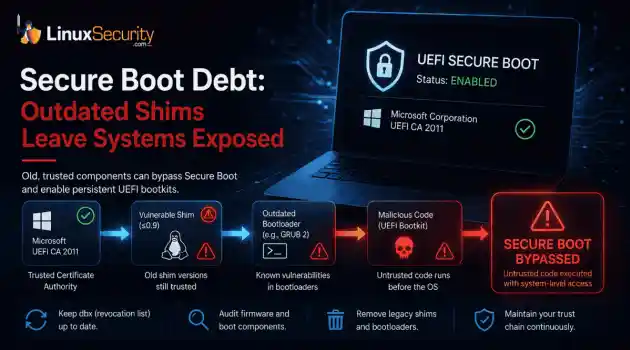
security advisory linux distribution ESET researchers identified 11 old and forgotten Linux UEFI shim bootloaders at versions 0.9 and below that can be used to bypass UEFI Secure Boot on any UEFI-based machine that trusts Microsoft’s Microsoft Corporation UEFI CA 2011 third-party certificate authority, regardless of the installed operating system (OS). Reported shims can be exploited to execute untrusted code during system boot, enabling attackers to deploy malicious UEFI bootkits even on systems with UEFI Secure Boot enabled.....
Jul 16, 2026
 Refine news
X Clear Filters
Get the latest News and Insights
Get the latest Linux and open source security news straight to your inbox.
Community Poll
Is continuous patching actually viable?
Loading...
Explore Latest Linux Security news
We found 60 articles for you...
210
 security advisorydenial of servicecritical
Linux Vulnerability Could Let Attackers Take Control of Systems and Disrupt Services
There’s a Linux vulnerability in systemd affecting several Ubuntu LTS releases. . It comes down to two separate issues. One can crash systemd outright, which means a denial of service. The other is more serious. It allows code execution as root through the udev component, depending on how input from a device is handled. This is not a direct DDoS attack vector or a malicious device. Still, that’s not a rare scenario in practice. Shared systems, test environments, and anything with physical access all come into play here. Systemd sits at the center of how the system starts and manages services. When something breaks at that level, it doesn’t stay isolated. What Is the systemd Vulnerability and How Does It Work? It starts with how systemd handles certain cgroup paths. Under the wrong conditions, handling breaks and systemd can crash outright. When that happens, services don’t recover cleanly, which turns into a denial of service. This is tracked as CVE-2026-29111 . The second issue sits in the udev component. It doesn’t handle certain fields coming from the kernel the way it should. If a malicious device is introduced, that input can be used to trigger code execution as root. They’re not the same class of problem. One disrupts the system. The other crosses into full control under the right conditions. Which Ubuntu Systems Are Affected by This Linux Vulnerability? The fixes cover a wide range of Ubuntu releases, including 14.04, 16.04, 18.04, and 20.04, along with newer versions addressed in the initial advisory. These aren’t edge cases. You still see these versions in production, especially in long-term deployments where systems don’t get rebuilt often. Older LTS releases tend to stick around in internal tools, backend services, or anything tied to stability over change. The second notice extends the fix to those older releases, which is usually a sign that the issue isn’t isolated to one version. It’s the same underlying behavior showing up acrossdifferent builds. Code Execution and Denial of Service Risks The more serious issue here is the path to code execution as root through the udev flaw. If that condition is met, the attacker isn’t just disrupting a service; they’re operating at the highest level on the system. The systemd crash is still relevant, but it’s a different kind of problem. It leads to a denial of service, which can take systems offline or interrupt workloads, especially if systemd fails to recover cleanly. Neither of these is remote by default. They rely on local access or physical interaction with the system. That narrows the entry point, but it doesn’t eliminate risk. In environments where users share systems or devices are regularly connected, those conditions show up more often than people expect. Can the systemd Vulnerability Be Used in a DDoS Attack? This is not a direct DDoS attack vector. It doesn’t expose a remote service or create a way to flood systems over the network. That said, if the denial of service issue is triggered across enough systems at once, it can still contribute to broader service disruption, especially in environments where many machines are managed in the same way. Who Is Most at Risk for the systemd Vulnerability? This shows up more in environments where access isn’t tightly controlled. Multi-user systems are the obvious case. If unprivileged users can log in, that local access is already there. The same goes for lab machines, shared servers, or internal tools where multiple people touch the same system over time. Physical access changes things, too. Any setup where devices can be connected, even briefly, opens the door for the udev issue to come into play. You tend to see that in testing environments, on-prem infrastructure, or older hardware that hasn’t been locked down. Legacy Ubuntu deployments are another factor. These versions stick around longer than expected, especially in systems that were built to run and left alone. That’s where these kinds ofvulnerabilities tend to linger. How to Patch the systemd Vulnerability The fix is already available through standard Ubuntu updates. Run: sudo apt update && sudo apt upgrade Once the update is applied, a reboot is required for the changes to take effect. Without that, systemd and related components may still be running the vulnerable versions. For full details on affected packages and versions, see the initial security notice and the extended update for older Ubuntu releases. Why This Linux Vulnerability Matters Systemd sits underneath everything. It handles how services start, stop, and recover. When something breaks at that level, it rarely stays contained to one process. This one doesn’t rely on remote access, but that doesn’t make it minor. Local paths still matter, especially on systems where access is shared or hardware isn’t tightly controlled. You start to see how those conditions show up more often than expected. Patching here isn’t just routine maintenance. It’s making sure a core part of the system isn’t left in a state where a small input turns into something bigger. . Linux systemd vulnerability can lead to root access and denial of service; crucial updates available for multiple Ubuntu versions.. Linux security updates, systemd vulnerabilities, Ubuntu patch management, code execution risks. . MaK Ulac
 Mar 24, 2026
•
Mar 24, 2026
• Security Vulnerabilities
78
 security advisorydenial of servicesecurity issue
Nvidia: Critical Security Advisory on Driver Flaws: DoS, Data Tampering
Nvidia's recent announcement regarding multiple significant vulnerabilities in their GPU display drivers and VGPU software has presented admins relying on these drivers with significant security challenges. Mid-January updates revealed seven distinct security flaws that may compromise system security and stability for those using this hardware. . Two high-severity issues pose extreme threats ranging from data tampering, denial of service attacks, information disclosure, or code execution if left unaddressed. To help you understand and mitigate these flaws, we'll explore these bugs in more depth and share proactive strategies for securing your Linux environment. Understanding These Nvidia GPU Driver Vulnerabilities Nvidia's January updates addressed seven vulnerabilities in their GPU display driver and VGPU software, with two being critical vulnerabilities affecting access to filesystem resources and memory leakage. While some vulnerabilities pose less risk than others, leading to scenarios like unauthorized file access or memory leaks, more serious ones present the opportunity for denial of service attacks, data tampering, or complete system compromise through code execution. CVE-2024-0149 and CVE-2024-0146 are of particular concern to Linux administrators. CVE-2024-0149 allows unauthorized file access on Linux drivers, potentially leading to leakage of sensitive information. In contrast, CVE-2024-0146 can lead to denial of service attacks, data tampering, information disclosure, and code execution attacks against VGPU software. Given their ability to severely disrupt operations while jeopardizing data integrity, these vulnerabilities must be considered top priorities by admins. Updating Your Drivers: The First Line of Defense One key way for us Linux admins to protect against vulnerabilities is to update all Nvidia drivers to the most recent versions. Nvidia has released new versions, including 553.62 and 539.19, that contain patches for these security flaws. Running outdateddrivers exposes your systems to potential exploits. To check your current driver version, use the nvidia-smi command. This utility provides all necessary details about your Nvidia drivers - including their version. Once identified, compare this version against Nvidia's recommended safe versions. If your version is outdated, download and install the latest drivers from their official site. Maintaining system security demands that regular updates be enabled wherever possible or even automatically updated where applicable. By adhering to a set schedule or activating automatic updates where feasible, you can ensure your drivers remain up-to-date and shield against newly discovered vulnerabilities as soon as patches become available. Monitoring and Incident Response At the same time as proactive updates, regularly monitoring your systems is vital. Implementing reliable monitoring tools can detect unusual activity that may indicate an exploitation attempt, such as unexpected spikes in resource consumption, attempts at unauthorized entry, or unusual system behavior. By recognizing anomalies early, you can either prevent potential breaches from happening altogether or minimize their impact. It is also vital to have an effective incident response plan. This should outline what steps should be taken in case of an actual or suspected security breach, so review and practice it regularly with your team so it remains ready. Quick response time can significantly mitigate damage caused by exploits while helping you quickly return to normal operations. The Importance of Backups Never underestimate the importance of regular backups in maintaining a robust security posture. Backups provide you with a safety net in case an attack succeeds and data integrity is compromised, so ensure all critical data is regularly backed up securely in multiple locations. Additionally, test these backups periodically so they can be fully restored when required. Maintaining an extensive backup schedule mightseem like an additional task, but in a severe security breach, having reliable backups can be the difference between a total loss and a swift recovery. Educating Your Team Security isn't only about tools and software updates; it's about people. Ensuring your team understands potential threats and the value of regular updates can make a real difference in incorporating security practices into their daily tasks. Conduct training sessions on recognizing signs of a breach, understanding the importance of prompt patching, and following security best practices diligently. An informed team is more likely to recognize irregularities, adhere to protocols thoroughly, and respond swiftly and appropriately when receiving security alerts. Fostering security awareness within your team will boost your overall defenses against vulnerabilities. Our Final Thoughts on Mitigating These Recent Nvidia Bugs Nvidia's recent alert highlights the importance of maintaining system security through careful vigilance. By staying informed about driver updates, implementing regular monitoring, creating robust incident response plans, and cultivating security awareness within their systems, Linux administrators can safeguard against newly identified vulnerabilities like these. Upgrading to the most up-to-date driver versions, checking Nvidia security bulletins regularly, and following these best practices can reduce risks posed by vulnerabilities in your systems and ensure a secure environment for you and your team. . A couple of critical vulnerabilities present significant risks including unauthorized data alteration, service disruption attacks, and potential remote code execution.. Nvidia Driver Security, GPU Vulnerabilities, System Security, Linux Admin, Update Best Practices. . Brittany Day
Jan 21, 2025
•
Vendors/Products

79
 security advisorycode executiondebian
Debian 12.9 Security Advisory: Critical Updates on Ansible, OpenSSH, Kernel
Debian 12.9 has just been released, offering numerous security enhancements and bug fixes vital for Linux security admins managing Debian systems. This point release for the "Bookworm" series addresses critical vulnerabilities in widely-used packages such as Ansible , OpenSSH , and the Linux kernel , ensuring your systems remain secure against recent threats. With security patches already rolling out via security.debian.org , this update is essential for maintaining a fortified, up-to-date Debian environment. . As new installation media becomes available, Debian users are strongly urged to upgrade and take advantage of its improvements. New packages mitigate risks like denial-of-service vulnerabilities in Avahi and arbitrary code execution issues in Ansible-core. Adopting Debian 12.9 significantly strengthens your security posture against potential exploits - an indispensable way to keep your infrastructure secure against possible threats. Let's examine some of the notable changes and improvements introduced in this release and how they will benefit the security and stability of your Linux systems. Strengthening Core Components Source: 9 to 5 Linux Debian 12.9's focus on fortifying core components sets this release apart. Key packages like Ansible, OpenSSH, and the Linux kernel received crucial security updates that address vulnerabilities that could otherwise lead to system breaches, data leakage, or even full system compromise. Debian 12.9 updates address key flaws in Ansible that allowed for unauthorized code execution so scripts run safely and as intended. OpenSSH updates close security loopholes that attackers could have exploited to gain unauthorized access. Moreover, improvements to the Linux kernel simultaneously address security vulnerabilities and performance issues. Mitigating Critical Vulnerabilities Debian 12.9 goes beyond simply updating core packages; it also addresses various vulnerabilities that have come to light recently. We Debian users can now rest easyknowing that potential denial-of-service attacks in Avahi have been mitigated. These attacks could render services unavailable and reduce productivity if left unpatched. This latest release also addresses Ansible-core's arbitrary code execution vulnerabilities to ensure malicious scripts cannot be used to gain control of systems. These updates go beyond minor fixes; they provide essential protection from known and emerging threats. Enhanced Stability and Bug Fixes While security is paramount, stability is equally crucial in production environments. Debian 12.9 delivers various bug fixes that enhance system reliability on this front. Updating to this latest release means we admins can sidestep many issues that could cause unexpected downtime or erratic behavior. These bug fixes cover many scenarios, from minor annoyances to critical problems. By ironing out these quirks, Debian 12.9 ensures that systems run more smoothly, reducing the administrative overhead caused by troubleshooting and resolving unexpected issues. Simplified Upgrades with New Installation Media Debian 12.9 offers new installation media that makes it easier for admins to deploy new installations or upgrade existing systems. These images contain the most up-to-date patches and improvements to ensure installations begin on a secure footing. Administrators overseeing multiple systems will find this new release more efficient in terms of setting up servers or workstations more quickly and more efficiently than before, thanks to an improved installation process that reduces the time and effort required to bring new systems online, freeing administrators up to focus on optimizing and protecting their environments. Ongoing Security Maintenance Even with all of Debian 12.9's updates, keeping security at the forefront of one's mind is essential. Administrators who regularly sync their systems with security.debian.org will find that many fixes are rolled out regularly. Taking such an active stance ensures systems always runthe latest, most secure versions of software packages. Staying abreast of these updates is of utmost importance, so automating tools and regular maintenance routines are vital in keeping systems updated against threats. By combining Debian 12.9's immediate benefits with ongoing security practices, administrators can secure their systems against potential attacks. How to Upgrade & Best Practices for Upgrading Debian 12.9 images can be downloaded here. These images support 64-bit architectures (amd64), as well as 32-bit architectures (i386) and PowerPC 64-bit Little Endians (ppc64el), IBM System z 390x, MIPS 64-bit Little Endians (mips64el), MIPS 16-bit Little Endians (mipsel), MIPS 32 bit Little Endians (mipsel), and MIPS. Debian 12.9 Live images can also be downloaded from this page, but only on 64-bit systems, preinstalled with KDE Plasma 5.27.5 LTS (Long Term Support), GNOME 43.10, Xfce 4,18, Cinnamon 5.6.8, LXQt 1.26.0, MATE 1.26.0 and LXDE 0.10.0 desktop environments. Download a "Standard" live ISO image without a graphical interface. Debian GNU/Linux 12 "Bookworm" users should update their installation using the sudo update && sudo full-upgrade commands in a terminal emulator. Alternatively, you can update your installation using a graphical package management tool like Synaptic Package Manager. Administrators planning an upgrade to Debian 12.9 should follow several best practices. First and foremost, testing in a staging environment before rolling it out to production systems allows any potential issues with the upgrade to be identified and addressed before impacting live operations. Before initiating an upgrade process, always create backup copies of data and system configurations to avoid risk and disruption during this transition period. Confirm that all dependencies have been fulfilled to prevent interruptions to the upgrade path. Once your upgrade is complete, conduct a post-upgrade review to ensure all services are running as intended and that noconfigurations have changed unexpectedly. This helps ensure that the system performs as anticipated and that all benefits from its new release are fully realized. Our Final Thoughts on the Significance of the Debian 12.9 Release Source: Phoronix Debian 12.9 is a necessary release that offers significant security and stability improvements to Debian systems. Addressing vulnerabilities in key packages like Ansible, OpenSSH, and the Linux kernel fortifies systems against potential threats. At the same time, improved stability and comprehensive bug fixes provide smoother operations with decreased administrative overhead costs. Debian 12.9 offers administrators a more effortless and safer system deployment and upgrade experience with its simplified installation media, making it easier to keep systems secure and up-to-date. With ongoing security maintenance via security.debian.org , Debian 12.9 equips us to safeguard our infrastructures better. Linux admins can unleash the full potential of Debian 12.9 by following best practices for upgrading and proactively managing system security to ensure their systems remain resilient in the face of emerging cybersecurity challenges. . Ubuntu 22.04 introduces vital patches and boosts efficiency, safeguarding users and maintaining robustness across the platform.. Debian 12.9, security updates, stable system, Linux administration. . Brittany Day
Jan 13, 2025
•
Security Projects
210
 security advisorycode executionarbitrary code execution
7-Zip 24.07 Update: Critical Security Flaw - Code Execution Threat
Compression utilities like 7-Zip have become essential tools for managing and storing data efficiently. Renowned for its high compression ratio and versatility, 7-Zip has earned millions of fans, from individual consumers to IT professionals around the globe. However, even trusted software can contain vulnerabilities. Recently, a security flaw was discovered within 7-Zip that may allow remote attackers to execute code through specially crafted archives containing malicious codes. . In this article, I'll examine this vulnerability and its impacts and guide you through updating to protect yourself by upgrading to the latest 7-Zip version to secure your systems. What Is 7-Zip? 7-Zip is an open-source file archiver widely recognized and utilized for its high compression ratio and support of various file formats such as ZIP, RAR, and ISO. Notably, its proprietary.7z format offers enhanced compression capabilities. 7-Zip has become indispensable to individuals worldwide, administrators, and software developers, who integrate it into various workflows and applications. Analyzing This Recent 7-Zip Vulnerability 7-Zip contains a critical security vulnerability, CVE-2024-11477 , that allows remote attackers to exploit Zstandard (Zstd) decompression implementation via specially crafted archives to execute arbitrary code remotely. The issue earned enough significance that CVSS gave it a score of 7.8, signaling its severity. At its core, 7-Zip's vulnerability lies in how it handles Zstandard decompression. More specifically, improper validation of user data may lead to an integer underflow before writing into memory - exploited by convincing users to open maliciously crafted archives. Attackers can exploit this weakness to execute arbitrary code within the context of their current processes. Vulnerable 7-Zip versions are susceptible to integer underflow when data provided to its decompression function isn't properly validated. This leads to an integer underflow and overwriting criticalmemory, allowing attackers to insert and execute code at will. Risk is compounded by exploiting this vulnerability, which requires relatively minimal technical knowledge. An attacker could easily create and distribute malicious archives via popular delivery like email attachments or file-sharing platforms. When someone interacts with someone using an exploited version of 7-Zip, the attacker could execute code with all access rights as the current user. Understanding the Impact of This Vulnerability CVE-2024-11477 can severely impact impacted systems, enabling attackers to run arbitrary code that could lead to further malicious activities. By exploiting this vulnerability, attackers could gain user access rights that allow them to operate with similar privileges as the currently logged-in user and access sensitive data or execute system commands. This includes accessing sensitive files and system commands in cases where an administrator-privileged user exists, resulting in complete system compromise. It affects all versions of 7-Zip before 24.07, so users running outdated versions are at risk. Steps should be taken immediately to secure systems by updating to the 24.07 version of 7-Zip for maximum system protection. Mitigation and Fixes Available to 7-Zip Users The 7-Zip development team has addressed this security flaw with version 24.07. As 7-Zip does not feature an automated update mechanism, users must download and install the latest version to stay protected. To update 7-Zip, download its latest version from its official website - version 24.07 or later is required - and follow its installation instructions to update your current installation. Finally, verify whether or not it has been installed by opening 7-Zip, checking its 'Help' menu, and verifying its version number. IT administrators and software developers should also monitor for suspicious activity within their networks and educate users about the risks of opening files from untrusted sources. Likewise, organizations shouldimplement policies limiting code execution from external sources to reduce potential vulnerabilities while conducting regular security audits on systems to identify and rectify vulnerabilities promptly. Security experts emphasize the significance of prompt patching as exploiting this vulnerability does not require complex technical knowledge. Though no known malware campaigns have targeted it yet, the risk remains significant, and mitigation measures should be prioritized. Both organizations and individuals should update systems regularly to stay protected against exploits that may impact their Linux environments. Our Final Thought on Addressing This Severe 7-Zip Flaw CVE-2024-11477 is an alarming reminder of the frequent vulnerabilities in widely used software such as 7-Zip. Improper validation within the Zstandard decompression algorithm underscores the vital need for rigorous testing and continuous monitoring for security flaws in software, making upgrading to version 24.07 of 7-Zip an absolute requirement to prevent potential arbitrary code execution attacks on systems. Users and organizations alike can lessen risks associated with cybersecurity vulnerabilities by following these steps and adopting a proactive approach to cyber safety. Keeping software updated, educating users on safe practices, and employing rigorous security measures combine to create a safer computing environment. Are you impacted by this flaw? Have you updated? Let us know on X @lnxsec ! . 7-Zip, a popular compression tool, has faced a serious vulnerability that could allow code execution, risking data breaches and system integrity. 7-Zip Vulnerabilities, Code Execution Risk, Software Updates, Cybersecurity Patches, Integer Underrun Exploit. . Brittany Day
Nov 25, 2024
•
Security Vulnerabilities
210
 security advisorycode executionservice disruption
X.Org: Security Advisory on Severe Memory Flaws and Code Execution Risks
After recent heap overflow, out-of-bounds write, and privilege escalation flaws brought X.Org into the spotlight, more severe memory safety, use-after-free, heap buffer overread, and code execution vulnerabilities have been identified in the popular X server. These issues affect the X.Org X11 server. . To help you secure your systems against exploits leading to service disruption, data compromise, and other damaging repercussions, we'll explore the vulnerabilities found, their impact, and how to mitigate them. What Vulnerabilities Have Been Found in the X.Org X11 Server? What Is the Impact of These Flaws? Vulnerabilities discovered in X.Org X11 include: The X.Org X Server incorrectly handled memory when processing the RRChangeOutputProperty and RRChangeProviderProperty APIs. An attacker could use this issue to cause the X Server to crash or obtain sensitive information. ( CVE-2023-6478 ) The X.Org X Server incorrectly handled memory when processing the DeviceFocusEvent and ProcXIQueryPointer APIs. An attacker could use this issue to cause the X Server to crash, obtain sensitive information, or execute arbitrary code. ( CVE-2023-6816 ) The X.Org X Server incorrectly handled reattaching to a different master device. An attacker could use this issue to cause the X Server to crash, leading to a denial of service, or possibly execute arbitrary code. ( CVE-2024-0229 ) The X.Org X Server incorrectly labeled GLX PBuffers when used with SELinux. An attacker could use this issue to cause the X Server to crash, leading to a denial of service. ( CVE-2024-0408 ) The X.Org X Server incorrectly handled the curser code when used with SELinux. An attacker could use this issue to cause the X Server to crash, leading to a denial of service. ( CVE-2024-0409 ) The X.Org X Server incorrectly handled memory when processing the XISendDeviceHierarchyEvent API. An attacker could use this issue to cause the X Server to crash or execute arbitrary code. ( CVE-2024-21885 ) The X.Org X Serverincorrectly handled devices being disabled. An attacker could use this issue to cause the X Server to crash or execute arbitrary code. ( CVE-2024-21886 ) Heap buffer overread/data leakage in ProcXIGetSelectedEvents. ( CVE-2024-31080 ) Heap buffer overread/data leakage in ProcXIPassiveGrabDevice. ( CVE-2024-31081 ) User-after-free in ProcRenderAddGlyphs. ( CVE-2024-31083 ) These vulnerabilities could have severe repercussions on impacted systems, enabling attackers to disrupt services and steal sensitive information, potentially resulting in the complete compromise of your critical Linux systems. How Can I Secure My Systems Against These X.Org Bugs? An essential X.Org update that fixes these issues has been released. We urge all impacted users to update to the latest version of X.Org as soon as possible. Applying the patches released by your distro(s) will protect your systems against attacks leading to downtime and compromise. To stay informed of essential updates released by the open-source programs and applications you use, register as a LinuxSecurity user , subscribe to our Linux Advisory Watch newsletter , and customize your advisories for your distro(s). This will enable you to stay up-to-date on the latest, most significant issues impacting the security of your systems. Follow @LS_Advisories on X for real-time updates on advisories for your distro(s) . . With new vulnerabilities in X.Org, adopting a multi-layered security approach is crucial. Steps like patching, access controls, and user education are essential. X.Org security, Memory safety fixes, Linux code execution, Open source update. . Anthony Pell
Apr 15, 2024
•
Security Vulnerabilities
210
 security advisorycode executionDebian
Debian Critical Security Advisory: Firefox And Thunderbird Threats
Multiple severe security issues have been found in the popular Mozilla Firefox web browser and Thunderbird email client that significantly threaten the confidentiality, integrity, and availability of impacted systems. . CVE-2023-5730 can be best described as a potential gateway for unwanted actions. If an attacker is successful in exploiting this vulnerability, they could cause unexpected behavior within the browser. Essentially, it lets them run harmful scripts without your knowledge or consent, which could result in unauthorized access to your personal information, alteration of your data, or even control of your machine. CVE-2023-5721 , which also impacts the Thunderbird email client, involves the improper handling of certain email content. More specifically, if an attacker sends a specially crafted email to a Thunderbird user, and the user interacts with the email (for example, opening an attachment), the attacker could execute harmful code. This can lead to data theft, unauthorized use of your system, or worse – a complete system takeover. CVE-2023-6212 is a memory safety bug that could be exploited to run arbitrary code, while CVE-2023-6207 is a use-after-free in ReadableByteStreams due to ownership mismanagement. How Do These Vulnerabilities Affect Linux Systems? The security of Linux systems would also be significantly compromised if these vulnerabilities were exploited. Firefox and Thunderbird applications run on Linux, and vulnerabilities in these applications could be used as entry points to gain unauthorized access to your system or extract sensitive information. What Can You Do to Stay Safe? Critical Firefox and Thunderbird security updates have been released to mitigate the vulnerabilities recently discovered. Given these bugs’ significant threat to impacted systems, if left unpatched, we strongly recommend that all affected users apply the updates released by Debian , Debian LTS , Fedora , Oracle , SciLinux , Slackware , and Ubuntu now toprotect against attacks threatening the security, integrity, and availability of their systems and the confidentiality of their sensitive data. To stay on top of essential updates released by the open-source programs and applications you use, register as a LinuxSecurity user , subscribe to our Linux Advisory Watch newsletter, and customize your advisories for your distro(s). This will enable you to stay up-to-date on the latest, most significant issues impacting the security of your systems. Follow @LS_Advisories on Twitter for real-time updates on advisories for your distro(s) . . Critical vulnerabilities discovered in Mozilla Firefox and Thunderbird endanger system security. Urgent measures should be taken.. Mozilla Firefox Bugs, Thunderbird Security Update, System Takeover Risk, Critical Security Advisory. . Brittany Day
Mar 03, 2024
•
Security Vulnerabilities
210
 security advisorycode executioncritical flaw
Ubuntu Security Advisory: Node.js Vulnerabilities Resolved for Exploitation
Several significant security issues were fixed in Node.js, including two critical vulnerabilities that have received a National Vulnerability Database base score of 9.8 out of 10. CVE-2019-15605 is an HTTP request smuggling bug in Node.js 10, 12, and 13 that causes malicious payload delivery when transfer-encoding is malformed, and CVE-2019-15606 is an authorization bypass issue in Nodejs 10, 12, and 13. . A remote attacker could possibly use these issues to obtain sensitive information or execute arbitrary code. Essential Node.js security updates have been released to fix these severe flaws. We urge all impacted users to apply the updates released by Ubuntu immediately to protect their critical systems and sensitive data against attacks leading to compromise. To stay on top of essential updates released by the open-source programs and applications you use, register as a LinuxSecurity user , subscribe to our Linux Advisory Watch newsletter, and customize your advisories for your distro(s). This will enable you to stay up-to-date on the latest, most significant issues impacting the security of your systems. Follow @LS_Advisories on Twitter for real-time updates on advisories for your distro(s) . . Crucial patches rolled out for Node.js addressing severe vulnerabilities. Safeguard your infrastructure and information from threats immediately.. Node.js Critical Issues, Ubuntu Security Fixes, Code Execution Vulnerabilities. . Brittany Day
Oct 05, 2023
•
Security Vulnerabilities
210
security advisorybuffer overflowcode executionDebian: Critical Update DLA-3567-1 severe: c-ares Code Execution Risk
A critical buffer overflow vulnerability has been found in c-ares before 1_16_1 thru 1_17_0 via the function ares_parse_soa_reply in ares_parse_soa_reply.c ( CVE-2020-22217 ). Due to how simple this bug is to exploit and its significant threat to the confidentiality, integrity, and availability of impacted systems, it has received a National Vulnerability Database base score of 9.8 out of 10 (“Critical” severity). . Exploitation of this flaw could allow an attacker to execute arbitrary code or cause a denial of service (DoS) condition. A crucial c-ares security update has been released to fix this severe flaw. We urge all impacted users to apply the updates issued by Debian LTS as soon as possible to prevent attacks potentially resulting in inconvenient, costly downtime and system compromise. To stay on top of essential updates released by the open-source programs and applications you use, register as a LinuxSecurity user , subscribe to our Linux Advisory Watch newsletter, and customize your advisories for your distro(s). This will enable you to stay up-to-date on the latest, most significant issues impacting the security of your systems. Follow @LS_Advisories on Twitter for real-time updates on advisories for your distro(s) . . Important c-ares patch: Remediations for buffer overflow vulnerability addressing potential DoS and execution threats.. c-ares Security, Buffer Overflow Fix, DoS Vulnerability, Code Execution Patch, Debian Update. . Brittany Day
Sep 29, 2023
•
Security Vulnerabilities

Get the latest News and Insights
Get the latest Linux and open source security news straight to your inbox.
Community Poll
Is continuous patching actually viable?
Search Topics
Powered By

Linux Security - Your source for Top Linux News, Advisories, HOWTOs and Feature Releases
QUICK LINKS
subscribe to newsletters!
Like staying secure? So do we.
Sign up for updates, tips, and alerts!