Explore top 10 tips to secure your open-source projects now. Read More
×



Server Security data privacy automation
data privacy automation Every system admin has lived through the same Monday morning ritual. A queue of forty tickets, half of them password resets, permission errors, or disk space warnings that any experienced technician could resolve in under two minutes. The other half require actual judgment. For years, automation promised that software would eventually sort the two apart on its own. That promise is now being tested in production Linux environments. . Early results are reshaping how IT teams think about tier-1...
 Jul 17, 2026

Privacydata collection automation
data collection automation You're running a web scraping project to collect pricing data from e-commerce sites. You set up a pool of datacenter proxies, launch your scripts, and within minutes — banned . CAPTCHAs everywhere. Your data pipeline stops before it really begins. . It's a frustrating scenario that plays out daily in ad verification, market research, and multi-account management. The website doesn't know you're doing legitimate research or monitoring. It just sees traffic coming from IP ranges it recognizes as...
Jul 17, 2026

Security Trends security advisory social engineering
security advisory social engineering Business Email Compromise used to be a numbers game — mass-blasted emails, broken English, an obvious "URGENT WIRE TRANSFER" subject line. That era is over. Generative AI has turned BEC into a tailored, low-noise operation that mimics writing style, voice, and even video presence. This piece looks at what's actually changed under the hood, what defenders are testing in response, and why so many organizations are still structurally unprepared for it. . The Infrastructure Problem Nobody Wants to...
Jul 17, 2026
Security Trends cybersecurity Linux documentation
cybersecurity Linux documentation Linux operating systems have gained prominence due to their stability, adaptability, and excellent security options. In the case of developing documentation, designing cybersecurity dashboards, or educational material, visuals are of vital importance when it comes to making things clear. The use of icons allows one to understand the message regarding alerts, authorization, encryption, authentication, or the state of the system just by looking at the visual cue without having to read long...
Jul 17, 2026
Security Vulnerabilities security advisory linux distribution
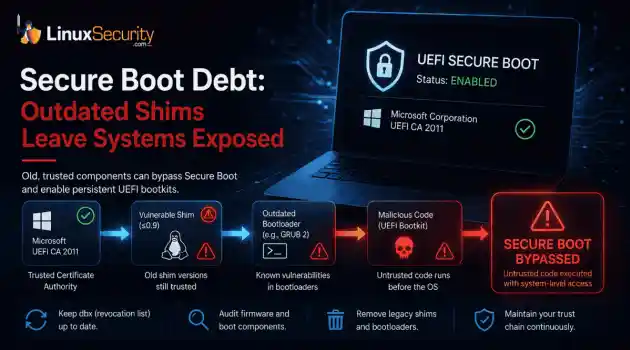
security advisory linux distribution ESET researchers identified 11 old and forgotten Linux UEFI shim bootloaders at versions 0.9 and below that can be used to bypass UEFI Secure Boot on any UEFI-based machine that trusts Microsoft’s Microsoft Corporation UEFI CA 2011 third-party certificate authority, regardless of the installed operating system (OS). Reported shims can be exploited to execute untrusted code during system boot, enabling attackers to deploy malicious UEFI bootkits even on systems with UEFI Secure Boot enabled.....
Jul 16, 2026
 Refine news
X Clear Filters
Get the latest News and Insights
Get the latest Linux and open source security news straight to your inbox.
Community Poll
Is continuous patching actually viable?
Loading...
Explore Latest Linux Security news
We found 65 articles for you...
79
 security advisoryDebiancritical infrastructure
SEAPATH 1.0 Debian: Security Advisory for Real-Time Hypervisor Deployment
The Linux Foundation has recently unveiled SEAPATH 1.0 , a security-hardened real-time hypervisor designed to revolutionize Linux administration in critical infrastructure environments. This release is particularly compelling due to its robust security features and real-time performance capabilities. . SEAPATH 1.0, supporting popular distributions like Debian and Yocto, provides the reliability and rapid response times necessary for complex applications, notably within the power grid industry. What makes SEAPATH stand out is its specialized focus on Digital Substation Automation Systems, which have already seen successful deployments by major industry players like GE Vernova and ABB. This production-ready hypervisor, a result of collaborative efforts from leading organizations, showcases a validated, trustworthy solution ready for immediate impact in enhancing secure and efficient operations. With SEAPATH 1.0, security-conscious Linux admins are not only looking at an advanced tool tailored to their needs but one that has been rigorously tested and adopted in real-world scenarios. This makes SEAPATH an invaluable addition to any secure Linux administration toolkit, promising improved security measures, real-time processing, and robust performance in critical infrastructure environments. As you explore SEAPATH, you'll appreciate its specialized capabilities and the collaborative expertise that went into its development, ensuring you have a reliable and secure foundation for your vital operations. Let's explore this exciting release and its security implications in greater depth. Introducing SEAPATH 1.0 Source: Phoronix Linux administration within critical infrastructure has reached an exciting new chapter with the Linux Foundation's release of SEAPATH 1.0. This security-hardened real-time hypervisor is set to be a game-changer for Linux security administrators who are always looking for robust tools that promise enhanced security and seamless performance. Tailored particularly fordigital substation automation, SEAPATH is a cornerstone for secure and efficient operations, especially in power grid industries that demand reliability and precision. With support for widely used distributions like Debian and Yocto Linux, SEAPATH 1.0 is more than just another hypervisor; it's a solution specifically designed to meet the high stakes and stringent demands of critical infrastructure environments. Given its strategic focus and deployment in real-world scenarios by industry giants such as GE Vernova and ABB , SEAPATH is theoretically sound and operationally proven. This focus on security and real-time performance sets a new standard for administrators tasked with maintaining the highest levels of system integrity. A Paradigm Shift in Security Security is often the cornerstone of any IT administration strategy, but it becomes even more vital in critical infrastructure sectors. SEAPATH 1.0 sets itself apart by offering a hypervisor richly fortified against potential threats. This makes it a formidable ally for admins needing a defense mechanism beyond conventional. The security hardening embedded in SEAPATH is crafted to address specific vulnerabilities, providing Linux administrators with a robust force field that shields vital systems. One of the most compelling aspects of SEAPATH's security model is its integration within a tailored context, focusing mainly on Digital Substation Automation Systems. This specialization assures that general threats are mitigated and sector-specific risks are tackled head-on. As cyberattacks become increasingly sophisticated, adopting a hypervisor that anticipates and defends against such risks is nothing short of a necessity. Real-Time Performance for Real-world Challenges Alongside security, performance is another pillar of SEAPATH 1.0, where its real-time capabilities become a significant highlight. In environments where timing can be everything—such as managing the flow of power across an intricate grid—real-time processing ensures thatlatency is kept to a bare minimum. This results in swift and incredibly reliable operations, fulfilling industrial demands without compromising efficiency. The hypervisor's ability to provide deterministic performance aligns perfectly with critical infrastructure needs where every millisecond counts. Having SEAPATH in action means Linux admins can rest assured knowing they have a tool engineered to handle time-sensitive tasks with precision. This real-time advantage ensures business continuity and optimizes operational efficiency. Deployment and Industry Validation One of the most reassuring aspects of SEAPATH 1.0 is its deployment track record. It has already been validated and deployed in production environments by key players in the industry, including GE Vernova, Alliander, and ABB. This real-world validation not only highlights SEAPATH's readiness but also its adaptability across different operational landscapes. Such widespread use underlines a trust in SEAPATH’s reliability and efficacy, reassuring any security-conscious Linux admin considering its implementation. This broad industry adoption also hints at a collaborative approach toward its development and deployment, showcasing shared expertise and unified problem-solving. With operational evidence from established players leading the charge, new adopters can confidently transition, knowing that the road has been tested and proven. Specialized Focus with Broad Implications Though initially focused on Digital Substation Automation Systems, SEAPATH 1.0’s capabilities have broader implications. Many Linux security administrators may be surprised by its potential to spill over into other areas requiring security and real-time performance. While this specialization addresses immediate needs in the power grid sector, the underlying technology can be extended and adapted to support other critical infrastructure sectors. Understanding SEAPATH’s specialized focus helps administrators appreciate the depth of tailored solutionscrafted for real-world challenges. Given the foundational technological elements, Linux admins can explore how similar innovations may benefit different industrial facets, potentially revolutionizing how different sectors handle security and performance demands. Unlocking the Potential of Collaborative Development SEAPATH 1.0 is the epitome of what collaborative development can achieve. Backed by a consortium of stakeholders that include leaders like Red Hat, Enedis, and Savoir-faire Linux, this project is powered by a collective brain trust dedicated to solving industry-specific issues with integrity and innovation. This shared vision and pooled expertise have been instrumental in crafting a robust solution that’s as reliable as it is, ensuring that SEAPATH is equipped to meet and exceed the high demands of critical operations. Linux administrators assessing SEAPATH 1.0 will likely value the diversity of insights and the presence of multiple perspectives in its creation. This collaborative ethos addresses current industry needs and anticipates future challenges, making it a forward-thinking choice for sustainable, long-term security and performance strategies. Our Final Thoughts: A Strategic Addition to Your Linux Security Toolbelt As Linux security administrators continually seek solutions that offer reliability and innovation, SEAPATH 1.0 emerges as a strategic addition to our toolbelt. Emphasizing security hardening, real-time performance, and validated deployments in production environments, SEAPATH stands ready to serve the needs of security-conscious environments. Its niche focus on Digital Substation Automation Systems, while specialized, hints at broader applications that could enhance security measures beyond the power grid industry. In embracing SEAPATH 1.0, we administrators don’t just adopt another piece of technology; we opt into a paradigm where security and performance align seamlessly with industry needs. Backed by real-world deployments and a strong collaborativefoundation, SEAPATH 1.0 is poised to redefine standards and shape the future of secure Linux administration. . SKYNET 2.5 introduces an innovative cloud framework for mission-critical systems featuring advanced protection and validated corporate implementation.. secure hypervisor, critical infrastructure tools, Linux administration, SEAPATH features, real-time performance. . Brittany Day
 Feb 06, 2025
•
Feb 06, 2025
• Security Projects
83
 security measuresthreat detectioncritical infrastructure
WolfsBane: Gelsemium APT Targets Linux Systems with Advanced Backdoor
WolfsBane, the latest Linux variant of the Gelsevirine backdoor, marks a historic turning point in cybersecurity. Attributed to the Gelsemium advanced persistent threat (APT) group, this Linux-based threat broadened their focus from being exclusively Windows-centric since 2014. With sophisticated cyber espionage campaigns by this APT group dating back to 2014, this recent shift to targeting Linux systems is an alarming move considering Linux's widespread deployment across critical infrastructure environments and enterprises. . WolfsBane's discovery illustrates Gelsemium's evolving tactics and indicates a trend of threat actors expanding their operational capabilities to exploit various operating systems. As organizations increasingly rely on Linux servers for robustness and stability, this presents cybersecurity defenses with an overwhelming challenge—they must now adapt by improving detection and mitigation strategies against multi-platform APTs. In this article, I'll explore this emerging threat, compare WolfsBane to its Windows-focused counterpart, and offer practical advice for securing your systems against these evolving attacks. Understanding the Significance of This Discovery WolfsBane, a new Linux backdoor associated with the Gelsemium APT group, marks a significant new development in cybersecurity threats. Gelsemium was previously best known for its Windows malware, including the Gelsevirine backdoor, which has been active since 2014. WolfsBane represents an evident shift by China-affiliated threat actors towards targeting Linux environments, highlighting several key points. WolfsBane indicates that, as endpoint protection and detection tools improve on Windows systems, threat actors have increasingly focused on exploiting vulnerabilities on Linux systems. This change broadens the attack surface, necessitating organizations with multi-platform environments to strengthen security measures across different operating systems. Furthermore, WolfsBane's sophisticated mimicry of Windowsfunctions and persistence mechanisms shows the commitment of threat actors to maintaining access to compromised systems over an extended period. Gelsemium's Tactics and Tools for Success WolfsBane employs a multi-stage infection chain composed of a dropper, launcher, and backdoor. The dropper, disguised as a "cron" file, impersonates legitimate command scheduling tools to facilitate the injection of malicious components into the target system. Once executed as root, it places its launcher and backdoor in the hidden directory $HOME/.Xl1, establishes persistence by configuring systemd services or changing SELinux configuration files, and ensures backdoor execution upon system startup via manipulating system service files while communicating with command-and-control (C&C) servers. This, in turn, facilitates remote command execution and system manipulation via communication channels with its C&C servers. Researchers also identified FireWood, another Linux backdoor not directly associated with Gelsemium tools; its connection may not be established, yet its presence indicates potential cross-APT group collaboration or "digital quartermastering." Web shells found during analysis provide attackers with remote control over compromised web servers, allowing initial access and further exploitation of web shells compromised during an attack. Comparative Analysis: WolfsBane vs. Gelsevirine Despite being tailored for distinct operating systems, Gelsevirine, WolfsBane's Windows counterpart, shares many similarities in structure and functionality. Both variants employ embedded custom libraries for network communication specific to each protocol. Command execution mechanisms in both versions employ hashed command names linked to handler functions for execution. Configuration structures remain consistent across both versions, with some fields being specific to either operating system. At the same time, domains previously flagged as indicators of compromise (IoC) tie WolfsBane back into this infrastructure asused by Gelsevirine. While the core functionalities remain similar, differences arise primarily based on which operating systems they target. Persistence management techniques vary due to differences between Linux and Windows systems regarding how services and security features operate. Furthermore, specifics regarding payload delivery and execution depend on specific system directories or execution contexts for Linux versus Windows systems. Who Is at Risk? WolfsBane targets East and Southeast Asian entities, particularly those operating critical infrastructure or possessing valuable information. Any organization running Linux servers exposed to the Internet—government institutions and agencies, financial services sectors, healthcare providers, educational institutions, and technology/telecommunications firms could all be at risk of WolfsBane attacks. Practical Mitigation Advice for Administrators WolfsBane poses a severe threat to Linux system security, so administrators should take various measures to mitigate its risks and fortify their defenses against it. Admins seeking to strengthen endpoint security must implement comprehensive Endpoint Detection and Response (EDR) solutions capable of detecting abnormal activities on Linux-based systems and alerting them of suspicious or anomalous behaviors. Conducting periodic security audits and continuous monitoring are effective ways of quickly detecting unauthorized changes or any suspicious activity that might threaten security. As part of a secure system configuration, hardening Linux servers by following best practices like disabling unnecessary services and restricting root access is crucial. Furthermore, regularly reviewing and securing systemd service configurations helps protect them against being used maliciously by attackers, guaranteeing only legitimate services start up automatically at boot-up time. One effective network security measure is implementing network segmentation to protect critical systems against potentialcompromise. Moreover, network- and host-based intrusion detection systems (IDSs) are essential to monitoring network traffic for malicious activity, and tracking lists of known malicious domains with network security appliances for proactive blocking is another crucial measure. Regularly revising incident response plans is essential to minimizing damage should an attack occur. This should involve training staff members on responding effectively in case of potential breaches and conducting regular backups to allow system recovery should a compromise occur. Advanced authentication practices, such as mandating multi-factor authentication for all remote access points and administrative accounts, further strengthen security by adding another layer of protection. Implement strong SSH key management practices, including regular key rotation and restricting SSH access only to authorized users. Applying the latest security patches is crucial for vulnerability management. Conducting periodic vulnerability scans is also critical, as doing so helps identify and address security vulnerabilities within a Linux infrastructure. Our Final Thoughts on the WolfsBane Backdoor & Its Implications for Linux Security WolfsBane highlights the ever-evolving tactics employed by advanced persistent threat actors like Gelsemium, which continually adapt to an ever-evolving security landscape. Organizations must remain vigilant and proactive with their security practices across all operating systems to prevent the risks posed by these sophisticated attacks and protect critical infrastructure against possible compromise. Implementing the practical measures we've discussed will go a long way in securing your Linux systems against WolfsBane attacks. . ShadowsLyre's emergence underscores the dynamic tactics of Belladonna, revealing a shift in focus toward Windows platforms.. WolfsBane Backdoor, Gelsemium APT, Linux Malware, Cyber Threats, System Security. . Anthony Pell
Nov 25, 2024
•
Hacks/Cracks

79
 critical infrastructureopen source projectIT services
GNU Toolchain Infrastructure Migrates To Linux Foundation Services
The GCC compiler and related GNU toolchain infrastructure has long been hosted by Sourceware.org that has been sponsored by Red Hat the past two decades. But now the GNU Toolchain Infrastructure (GTI) project is being established as it works to leverage the Linux Foundation's IT services to provide more robust and secure infrastructure for these critical open-source projects. . With the Linux Foundation IT services doing a stellar job hosting Kernel.org and related web server infrastructure for the Linux kernel, the various parties involved in the GNU toolchain have been sorting out a similar setup. The link for this article located at Phoronix is no longer available. . The Python Software Foundation announces a partnership with the Open Source Initiative, pledging improved accessibility and enhanced features.. Gnu Toolchain, Linux Foundation, Infrastructure Services, GCC Compiler, Open Source. . LinuxSecurity.com Team
Sep 30, 2022
•
Security Projects
209
cybersecurity threatsmalwarecritical infrastructureEmerging Linux Malware Threats: 6 Types and Their Impacts
Linux is a coveted target. It is the host operating system for numerous application backends and servers and powers a wide variety of internet of things (IoT) devices. Still, not enough is done to protect the machines running it. . "Linux malware has been massively overlooked," says Giovanni Vigna, senior director of threat intelligence at VMware. "Since most of the cloud hosts run Linux, being able to compromise Linux-based platforms allows the attacker to access an enormous amount of resources or to inflict substantial damage through ransomware and wipers." In recent years, cybercriminals and nation-state actors have targeted Linux-based systems. The goal was often to infiltrate corporate and government networks or gain access to critical infrastructure, according to a recent VMware report . They leverage weak authentication, unpatched vulnerabilities, and server misconfigurations, among others. . There is an increasing trend in Linux malware, with often ignored dangers focusing on essential infrastructures and Internet of Things (IoT) gadgets. Discover further insights on this topic.. Linux Malware, Cybersecurity Threats, IoT Vulnerabilities, Cloud Security Risks. . Brittany Day
May 30, 2022
•
Security Trends
76
 critical infrastructurecybersecurity awarenesselection security
Collaboration Essential For Election Security At DEFCON 26
Speaking at DEFCON 26 in Las Vegas on the subject of “Securing our Nation's Election Infrastructure”, Jeanette Manfra, assistant secretary, Office of Cybersecurity and Communications from the Department of Homeland Security stressed the need for public and private sector collaboration. . She said that “instead of thinking of individual risk and your own part, try to think about enterprise and government as a whole.” In terms of critical infrastructure, Manfra said that this is “purely voluntary in the private sector” and includes “everyone working for yourself or your company, and this includes academic institutions and the broader private and public partnership to work together to figure our critical infrastructure.” The link for this article located at InfoSecurity is no longer available. . At DEFCON, Jeanette Manfra emphasizes the importance of uniting efforts to strengthen vital infrastructure and ensure the integrity of electoral systems.. Election Security,Cybersecurity Solutions,Public Private Partnership. . Brittany Day
Aug 12, 2018
•
Organizations/Events
82
cyber threatscritical infrastructureinfrastructure protectionDHS Cyber Risk Management Center Announcement For Critical Infrastructure
The Department of Homeland Security (DHS) has announced the creation of a new cyber-risk management center intended to protect the nation’s banks, energy companies and other industries from potentially crippling cyber-attacks on critical infrastructure, according to agency officials who spoke at the 31 July cybersecurity summit hosted by DHS. . DHS Secretary Kirstjen Neilsen led a panel discussion comprised of Department of Energy Secretary Rick Perry, Cyber Command and National Security Agency leader Gen. Paul Nakasone, FBI director Christopher Wray, Mastercard CEO Ajay Banga, AT&T CEO John Donovan and Southern Company CEO Tom Fanning. Hoping to launch the center in 90 days, the DHS has also established a task force that will focus on threats to the industrial supply chain. The link for this article located at InfoSecurity is no longer available. . The Department of Homeland Security introduces a new hub dedicated to cyber-risk oversight aimed at safeguarding essential systems from digital attacks.. Cyber Risk Management, Infrastructure Security, Cyber Threat Protection. . Brittany Day
Aug 02, 2018
•
Government
83
information theftcyber attackcritical infrastructureRussian Hackers Target US Utilities Using Vendor Networks
By penetrating the networks of downline vendors, Russian hackers gained access to a reportedly secure, isolated network, allowing them to eventually reach the control rooms of US utilities, according to the Wall Street Journal.. The state-sponsored hacking group, which poses a serious threat to critical infrastructure, has been on the watch list of the Department of Homeland Security (DHS) since 2014. Using stolen credentials gained through spear-phishing emails and watering-hole attacks, the hackers's activity long went undetected, which allowed them to steal confidential information and “familiarize themselves with how the facilities were supposed to work,” WSJ reported. The link for this article located at InfoSecurity is no longer available. . Cybercriminals from Russia breach American power grid via third-party suppliers, endangering essential infrastructure functionality.. Russian Hacking, Critical Infrastructure, Spear-Phishing, Cybersecurity Threats. . LinuxSecurity.com Team
Jul 29, 2018
•
Hacks/Cracks
83
cyber attackcritical infrastructureenergy sectorUS Department of Homeland Security: Russian Cyber Attacks on Utilities
The US Department of Homeland Security, which earlier this year warned of Russian nation-state hacking teams targeting energy and other critical infrastructure organizations, in a briefing this week provided more details on the attack campaign.. The Wall Street Journal reported that DHS officials said there were hundreds of victims: an increase from their original count of a few dozen targets who had been hacked by Dragonfly, aka Energetic Bear, via supply-chain attacks. The link for this article located at DarkReading is no longer available. . The US Department of Homeland Security discloses that numerous energy companies have fallen victim to coordinated cyber assaults attributed to Russian cybercriminals.. US Utilities Cyber Threats,Russian Hackers Dangers,Energy Sector Security. . LinuxSecurity.com Team
Jul 25, 2018
•
Hacks/Cracks

Get the latest News and Insights
Get the latest Linux and open source security news straight to your inbox.
Community Poll
Is continuous patching actually viable?
Search Topics
Powered By

Linux Security - Your source for Top Linux News, Advisories, HOWTOs and Feature Releases
QUICK LINKS
subscribe to newsletters!
Like staying secure? So do we.
Sign up for updates, tips, and alerts!