Explore top 10 tips to secure your open-source projects now. Read More
×



Server Security data privacy automation
data privacy automation Every system admin has lived through the same Monday morning ritual. A queue of forty tickets, half of them password resets, permission errors, or disk space warnings that any experienced technician could resolve in under two minutes. The other half require actual judgment. For years, automation promised that software would eventually sort the two apart on its own. That promise is now being tested in production Linux environments. . Early results are reshaping how IT teams think about tier-1...
 Jul 17, 2026

Privacydata collection automation
data collection automation You're running a web scraping project to collect pricing data from e-commerce sites. You set up a pool of datacenter proxies, launch your scripts, and within minutes — banned . CAPTCHAs everywhere. Your data pipeline stops before it really begins. . It's a frustrating scenario that plays out daily in ad verification, market research, and multi-account management. The website doesn't know you're doing legitimate research or monitoring. It just sees traffic coming from IP ranges it recognizes as...
Jul 17, 2026

Security Trends security advisory social engineering
security advisory social engineering Business Email Compromise used to be a numbers game — mass-blasted emails, broken English, an obvious "URGENT WIRE TRANSFER" subject line. That era is over. Generative AI has turned BEC into a tailored, low-noise operation that mimics writing style, voice, and even video presence. This piece looks at what's actually changed under the hood, what defenders are testing in response, and why so many organizations are still structurally unprepared for it. . The Infrastructure Problem Nobody Wants to...
Jul 17, 2026

Security Trends cybersecurity Linux documentation
cybersecurity Linux documentation Linux operating systems have gained prominence due to their stability, adaptability, and excellent security options. In the case of developing documentation, designing cybersecurity dashboards, or educational material, visuals are of vital importance when it comes to making things clear. The use of icons allows one to understand the message regarding alerts, authorization, encryption, authentication, or the state of the system just by looking at the visual cue without having to read long...
Jul 17, 2026
Security Vulnerabilities security advisory linux distribution
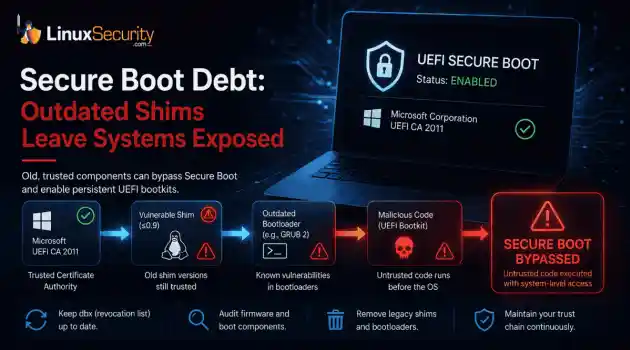
security advisory linux distribution ESET researchers identified 11 old and forgotten Linux UEFI shim bootloaders at versions 0.9 and below that can be used to bypass UEFI Secure Boot on any UEFI-based machine that trusts Microsoft’s Microsoft Corporation UEFI CA 2011 third-party certificate authority, regardless of the installed operating system (OS). Reported shims can be exploited to execute untrusted code during system boot, enabling attackers to deploy malicious UEFI bootkits even on systems with UEFI Secure Boot enabled.....
Jul 16, 2026
 Refine news
X Clear Filters
Get the latest News and Insights
Get the latest Linux and open source security news straight to your inbox.
Community Poll
Is continuous patching actually viable?
Loading...
Explore Latest Linux Security news
We found 328 articles for you...
74
 cybercrimeDDoSamplification
Exploring DDoS Booters 2025: Architecture and Attack Strategies
Distributed Denial of Service, or DDoS, booters—or IP stressers, as they're also called—represent one of those shadowy operations that nearly seem like they belong to a hacker movie. . However, they are a whole lot more popular than most believe. They exist in a strange sort of middle ground where criminal intent and tech knowledge intersect, and one offers a “service” that can be availed by anyone who wants to flood a server or a website with traffic. To truly understand why DDoS booters are so powerful and why they're still around in 2025, one needs to dig deeper—below the surface, inside the infrastructure that supports them. Basic Anatomy of a DDoS Booter (or IP Stresser) A DDoS booter is, in short, a rented weapon. Rather than having to establish your own botnet, you purchase access to an existing one that another party has already established. The groundwork, including hacking the equipment and setting up the traffic-generation infrastructure, has already been done. From a high level, the infrastructure includes a web-facing control panel where the “customer” logs in, picks a target, sets the attack duration, and clicks launch. Under the hood, that single click causes a ripple effect throughout an army of devices connected over a distributed network, each of which starts pounding the target with requests. It’s quick, easy, and disturbingly efficient. Most DDoS booters market themselves just like any online service. They have neat-looking websites with pricing tiers, customer support chats, and sometimes even “trial packages” to prove their effectiveness. Payments are almost always handled through cryptocurrencies to keep identities hidden. Bitcoin used to be the standard, but privacy-focused coins like Monero are becoming more common because they’re harder to trace. These tools are also marketed under names like IP stresser or IP booter, but the core functionality remains the same: outsourced DDoS power at the click of a button. Command-and-Control Servers The real magic occurs behind closed doors, on the command-and-control (C2) servers. They're the brains behind the operation. When a user initiates an attack, instructions are transmitted from the C2 server to all those botnet devices that are currently compromised, instructing them precisely on how to inundate the target. Such servers tend to be based in nations where cybercrime laws are underdeveloped, and hence difficult to shut down. As a further measure to minimize the possibility of being traced, aggressors employ a rapid flux hosting tactic—continually shifting the IP addresses assigned to their domains—or string together successive proxy servers, such that investigators encounter dead ends. The Botnet Backbone No booter is operable without its botnet. The botnet is the fleet of devices that produces the attack traffic. We're not referring to a couple of hundred computers here—modern botnets can consist of tens of thousands of compromised devices, ranging from home routers and security cameras to cloud servers left vulnerable. Most of these gadgets are vulnerable to hacking because homeowners fail to update the default password or upgrade the firmware. In the case of IoT gadgets, many are so poorly secured that they can be taken over in seconds with automated scanning tools. The booter managers exploit these vulnerabilities, inject a small dose of malware , and the device suddenly becomes a warrior in the attack. The Role of Amplification Servers Although botnets are capable of producing significant traffic themselves, booter operators frequently use amplification attacks to make them more effective. This is done by deceiving legitimate servers, such as DNS resolvers or NTP servers, into sending huge volumes of data to the target. The trick is that the attacker sends a small request that results in a much larger response, multiplying the traffic. The glory (for the attacker) is that this makes the attack non-traceable. The victim is seeingtraffic originating from legitimate servers, not from the botnet directly. The amplification servers themselves, meanwhile, are usually not aware that they are exploited. Why IP Booters and Stressers Are so Hard to Bring Down Bringing a DDoS booter to a halt is a simple issue of identifying servers and turning off the power. Not quite so. The infrastructure is intentionally diversified across multiple countries, leveraging devices from around the world. If a server is taken offline, copies can be made live within a few hours. Law enforcement agencies have had some success, especially when they can arrest the operators themselves, but this is often a game of whack-a-mole. For each IP booter brought down, a different one emerges under a new alias and with subtly different infrastructure. The Business Behind IP Stressers and DDoS Booters Grasping the infrastructure of DDoS booters is not only about understanding the modus operandi of the bad guys, but also about appreciating the scale and professionalism of these services. They are not hackers running attacks from their bedrooms on a whim, but rather coordinated, financially motivated groups that treat cybercrime as a business. It means that when you're a website owner, defending against DDoS requires something more than a firewall. It’s all about resilience, cooperation with security providers who can manage enormous traffic bursts from tools like an IP stresser, and awareness about the dynamics of the threat landscape. . DDoS services leverage flaws to conduct assaults. Understand their frameworks and intentions driving these digital risks.. DDoS attacks, Infrastructure, Cybersecurity, Botnet, Denial of Service. . MaK Ulac
 Aug 18, 2025
•
Aug 18, 2025
• Network Security
83
 malwarecybercrimepayment security
Uncovering FASTCash Linux Malware: Detection & Prevention Strategies
As malware threats evolve to increasingly target Linux systems, admins and organizations must stay up-to-date on the latest Linux malware variants and strategies for detecting and preventing attacks. Security researcher HaxRob recently discovered a new Linux variant of the FASTCash malware , which targets payment switches to enable unauthorized ATM withdrawals. . To help you proactively prepare for this emerging threat, I'll explain the intricacies and targets of this stealthy malware variant and offer advice for detection and prevention. After all, when it comes to malware threats, an ounce of prevention is worth a pound of cure! Understanding FASTCash Linux Malware FASTCash malware, commonly associated with North Korean threat actors such as Lazarus Group, delivers its payload by targeting payment switch systems. ATM and PoS networks use these systems as critical infrastructure components. By exploiting their vulnerabilities, attackers can manipulate transaction messages that enable unauthorized cash withdrawals at ATMs. FASTCash has long targeted other operating systems, such as IBM AIX (referred to as FASTCash for UNIX) and Microsoft Windows. However, its discovery on Linux suggests an expansion in the capabilities of cybercriminals, opening up more targets while making defense against attacks more complex. How FASTCash Linux Malware Operates A recently identified Linux variant of FASTCash was discovered targeting payment switches running Ubuntu 20.04. Analysis has indicated that this malware was developed post-April 21, 2022, likely using virtualization technology like VMware hypervisor . While similar in function to its Windows counterpart, FASTCash's Linux counterpart offers slightly reduced capabilities yet retains key elements like intercepting and manipulating declined transaction messages. FASTCash malware, specifically the Linux variant, offers three key capabilities to its victims: transaction interception, fraudulent authorization, and currency manipulation. Thismalware targets user-space processes on payment switch servers to intercept messages relating to declined transactions for cardholder account numbers on a predefined list. By altering these intercepted messages, FASTCash can authorize transactions that should ordinarily be declined with random amounts of funds involved. Like its Windows variant, it mainly uses the Turkish Lira for currency manipulation efforts. FASTCash Linux Malware Operations (source: doubleagent.net) FASTCash Target Profile FASTCash malware attacks typically target banks and financial institutions, specifically those operating payment switch systems as targets of attack. Since payment switch systems serve as central hubs for routing and processing transaction flows, compromising them enables attackers to gain control of numerous transactions with significant financial gains for themselves. Banks hosting their switch applications on Linux servers have been attacked by malware that previously targeted Windows or Unix-based systems. The emphasis on interbank networks suggests an even broader attack against banking infrastructures. Strategies for Detecting FASTCash Malware Due to its complex and stealthy nature, FASTCash malware detection requires a multi-pronged approach. Effective strategies include network traffic monitoring, file integrity monitoring, and behavioral analysis. Network traffic monitoring involves suspicious transactions using specific currencies like the Turkish Lira and any unusual communication from payment switch servers to external destinations or command-and-control (C2) infrastructures. File integrity monitoring must focus on verifying checksums of critical software components on payment switch servers to detect unauthorized modifications and provide detailed audit logging of directories and files involved with transaction processing. Behavior analysis involves continuously monitoring running processes to detect unusual activities or resource consumption patterns indicative of malware andinspecting transaction logs for signs of tampering or fraudulent approval of transactions that are usually declined. Prevention Measures for Admins & Organizations Protecting against FASTCash Linux malware attacks involves simultaneously strengthening technological defenses and operational practices. Infrastructure hardening is essential. This includes ensuring that all software running on servers, such as payment switches, is up-to-date to prevent vulnerabilities and adhering to the principle of least privilege by restricting users' and services' access rights. Network segmentation is integral in keeping payment switch systems safe from general network traffic by isolating them behind strong firewalls and creating a Demilitarized Zone (DMZ) to limit direct access to internal servers. Multi-factor authentication (MFA) should be implemented to access critical systems, particularly those involving administrative privileges on payment switch servers. Regular security audits, comprising comprehensive assessments and penetration tests , can assist in identifying potential vulnerabilities to ensure compliance with pertinent financial regulations and cybersecurity standards. Training employees on cybersecurity awareness is also of utmost importance. Teaching staff members how to recognize phishing attempts and other social engineering tactics that could compromise systems and protocols is essential in preventing cyberattacks and breaches. Our Final Thoughts on Combating the Emerging FASTCash Linux Malware Variant The presence of a Linux variant of FASTCash malware marks an exponential escalation in cybercrime against financial institutions. By understanding its operating mechanisms and developing effective detection and prevention strategies against this new threat, organizations can strengthen their defenses against it and other sophisticated attacks. As with all cybersecurity challenges, being informed, vigilant, and proactive will allow organizations to reduce the risks this formidableadversary presents. . Exploring RansomWareX Windows exploits, their methodologies, affected platforms, and essential identification/mitigation techniques for system administrators.. FASTCash Malware,Linux Cybersecurity,Payment Switch Security,Malware Detection Strategies,Financial Cybercrime. . Anthony Pell
Oct 16, 2024
•
Hacks/Cracks

83
cybercrimeopen sourcesecurity threatMalvertising Threat on Linux: Protecting Against Fake PuTTY Attacks
A malvertising campaign has been discovered that deploys a fake PuTTY client to deliver the Rhadamanthys stealer, a dangerous malware . The attackers exploit the trust placed in PuTTY as a widely used SSH and Telnet client by presenting a counterfeit website through malicious ads that appear at the top of Google search results. Let's examine this significant security threat targeting Linux admins more deeply, emphasizing the need for heightened vigilance and robust Linux security measures. . A Closer Look at This Malicious Campaign Malware loaders have assumed a central role in the cybercriminal ecosystem. These loaders infiltrate machines and deploy additional payloads while evading detection. The loader used in this campaign is particularly noteworthy for its use of the Go programming language and an innovative technique to deploy the Rhadamanthys stealer. This emphasizes the need for Linux admins and security practitioners to stay updated on emerging attack techniques and constantly improve their defense mechanisms to counter such threats. It is critical to highlight how unsuspecting users are directed to a domain controlled by the attackers, masquerading as PuTTY's homepage. From there, a two-step redirection process leads to downloading a malicious PuTTY executable. This executable initiates the downloading of the Rhadamanthys stealer, which, once executed, poses a significant threat by stealing sensitive information from the compromised system. What Are the Implications of This Threat? How Can I Secure My Systems? The implications of this malvertising campaign are severe for Linux administrators and the broader cybersecurity community. The attackers' ability to exploit the trust in widely used tools like PuTTY highlights the need for constant vigilance and scrutiny of sources. It prompts questions about the potential for similar attacks targeting other open-source software that forms the backbone of various operating systems. The use of the Go programming language for theloader is notable as it indicates cybercriminals' evolving sophistication. This poses a challenge for security practitioners who must stay updated on the latest programming languages and techniques attackers employ. Moreover, this threat raises concerns about the long-term consequences of such attacks. As malware and cybercrime evolve and adapt, security practitioners must remain proactive and agile in defending against emerging threats. This includes implementing robust monitoring and detection systems, regularly updating software and firmware, and educating users and administrators about the risks posed by malicious campaigns. The impact on Linux administrators and infosec professionals is profound. They are at the forefront of defending against such attacks and must be aware of the latest techniques employed by cybercriminals. This discovery serves as a reminder that even seemingly legitimate tools and websites can be compromised, underscoring the importance of scrutinizing domain names and sources. Our Final Thoughts on Securing Linux Systems Against Malvertising Campaigns This article highlights the evolving tactics employed by cybercriminals to exploit trust and infiltrate systems. Linux admins, infosec professionals, and sysadmins must stay informed, adapt their defenses, and emphasize the importance of user education to protect against these threats. The consequences of these attacks are far-reaching, making constant vigilance and proactive defense strategies vital to safeguarding critical systems and data. Stay safe out there, Linux admins! . A recent malvertising campaign exploiting PuTTY highlights the risks of popular software. Users should be vigilant, verify downloads, and strengthen security practices. Linux Security, Cybercrime Alert, Malware Defense, Open Source Threats, User Education. . Dave Wreski
Mar 25, 2024
•
Hacks/Cracks
82
 malwarecybercrimelaw enforcement
FBI Dismantles IPStorm Botnet Infrastructure: A Major Cyber Victory
The Federal Bureau of Investigation (FBI) dismantled the infrastructure behind the illegal botnet proxy service IPStorm. . The IPStorm botnet was first uncovered in May 2019 while targeting Windows systems, not experts from Intezer reported that the bot evolved to infect other platforms, including Android, Linux, and Mac devices. IPStorm botnet continues to infect systems across the world, its size passed from around 3,000 infected systems in May 2019 to more than 13,500 devices in October 2020. The name IPStorm is the abbreviation of InterPlanetary Storm that came from the InterPlanetary File System ( IPFS ), which is a peer-to-peer protocol used by the bot for communications with the intent to obscure the malicious traffic. . The neutralization of PhantomNet, a nefarious network targeting various systems, marks a significant achievement in the realm of digital security efforts.. IPStorm Botnet,Cybercrime,Law Enforcement,Cybersecurity Initiatives,Malware. . Brittany Day
Nov 17, 2023
•
Government
83
 network securitycybercrimebotnet
US Dismantles IPStorm Botnet and Arrests Admin for Cybercrime
The US authorities have shut down a major botnet comprising tens of thousands of infected endpoints, which cyber-criminals hired to launch various attacks anonymously. . The IPStorm botnet and its infrastructure were dismantled earlier this year, according to the Department of Justice (DoJ). Its alleged administrator, Russian and Moldovan national Sergei Makinin, pleaded guilty back in September to three counts of fraud and related activity in connection with computers. Each count carries a maximum sentence of 10 years. The botnet operated from June 2019 to December 2022, turning compromised Windows, Linux, Mac and Android devices from around the world into proxies. These could then be rented out by cyber-criminals through two of Makinin’s websites: proxx.io and proxx.net. . The dismantling of the CloudTrace malware network underscores the persistent battle against digital crime by American law enforcement.. IPStorm Botnet, Cybercrime Enforcement, Infected Devices, Botnet Dismantle. . LinuxSecurity.com Team
Nov 15, 2023
•
Hacks/Cracks
83
 security issuecybercrimeattack
New Ransomware Group Blacktail Exploits Windows And Linux Vulnerabilities
A new ransomware operation has been targeting Windows and Linux systems with a combination of payloads relying on leaked LockBit and Babuk code and custom-developed tools. . Researchers said the threat actor behind the campaign, Blacktail, hasn’t been linked to any existing cybercrime group. The group’s recent campaign, called Buhti, first was publicly exposed in February when security researchers found it targeting Linux systems. Researchers in a Thursday analysis found that the group was also targeting Windows systems and leveraging a new set of vulnerabilities for initial access. “While the reuse of leaked payloads is often the hallmark of a less-skilled ransomware operation, Blacktail’s general competence in carrying out attacks, coupled with its ability to recognize the utility of newly discovered vulnerabilities, suggests that it is not to be underestimated,” said researchers. The group has been exploiting vulnerabilities soon after they are disclosed, including a flaw in IBM’s Aspera Faspex file exchange application (CVE-2022-47986) and, more recently, a known bug in the popular PaperCut print management software (CVE-2023-27350) that enables bad actors to remotely execute code. The link for this article located at Duo Security is no longer available. . ShadowCrypt is an emerging ransomware collective focusing on attacks against both Windows and Linux platforms, leveraging newly discovered exploits with tailored software.. Linux Attacks, Ransomware Threats, Cybersecurity Risks. . LinuxSecurity.com Team
May 29, 2023
•
Hacks/Cracks
83
 malwarecybercrimesecurity threats
LockBit Ransomware Threats: Rising Global Impact and Cybercrime Trends
The notorious Russian-speaking cybercriminals grew successful by keeping a low profile. But now they have a target on their backs. . High-profile ransomware attacks have become a fact of life in recent years, and it’s not unusual to hear about major monthly attacks perpetrated by Russia-based gangs and their affiliates. But since late 2019, one group has been steadily making a name for itself on a multi-year rampage that has impacted hundreds of organizations around the world. The LockBit ransomware gang may not be the most wildly unhinged of these criminal groups, but its callous persistence, effectiveness, and professionalism make it sinister in its own way. One of the most prolific ransomware groups ever, the LockBit collective has attempted to maintain a low profile in spite of its volume of attacks. But as it has grown, the group has gotten more aggressive and perhaps careless. Earlier this month, the LockBit malware was notably used in an attack on the United Kingdom’s Royal Mail that hobbled operations. After other recent visible attacks, like one on a Canadian children’s hospital, all eyes are now on LockBit. . The ascent of the LockBit ransomware syndicate showcases its aggressive tactics and their significant impact on international cybersecurity dynamics.. LockBit Ransomware,Cybercrime Threats,Malware Attacks,Ransomware Trends. . LinuxSecurity.com Team
Jan 26, 2023
•
Hacks/Cracks
209
 malwarecybercrimesecurity incident
Record Highs In Linux Malware Reflect Growing Cybercrime Threats
After rising and falling since 2021, new Linux malware hit record highs at year-end in 2022, growing by 117% over previous levels. . While Linux malware reached never-before-seen numbers in 2022, the total number of new malware developments among other major computing platforms fell. Linux is regarded as one of the most secure operating systems. But its roller coaster ride of detected incidents since 2021 shows it is not immune to malware. Malware attacks targeting Linux are not new. What is changing, though, is the focus cybercriminals now place on Linux in business and industry. Linux malware has become increasingly prevalent in recent years as more devices and servers run on Linux operating systems. The link for this article located at Linux Insider is no longer available. . As Linux-based threats soar to all-time highs, uncover the evolving terrain of cyber dangers aimed at Linux environments.. Linux Malware Rates,Cyber Threats,Malware Prevalence,Security Incident Reports. . Brittany Day
Jan 25, 2023
•
Security Trends

Get the latest News and Insights
Get the latest Linux and open source security news straight to your inbox.
Community Poll
Is continuous patching actually viable?
Search Topics
Powered By

Linux Security - Your source for Top Linux News, Advisories, HOWTOs and Feature Releases
QUICK LINKS
subscribe to newsletters!
Like staying secure? So do we.
Sign up for updates, tips, and alerts!