Explore top 10 tips to secure your open-source projects now. Read More
×



Server Security data privacy automation
data privacy automation Every system admin has lived through the same Monday morning ritual. A queue of forty tickets, half of them password resets, permission errors, or disk space warnings that any experienced technician could resolve in under two minutes. The other half require actual judgment. For years, automation promised that software would eventually sort the two apart on its own. That promise is now being tested in production Linux environments. . Early results are reshaping how IT teams think about tier-1...
 Jul 17, 2026

Privacydata collection automation
data collection automation You're running a web scraping project to collect pricing data from e-commerce sites. You set up a pool of datacenter proxies, launch your scripts, and within minutes — banned . CAPTCHAs everywhere. Your data pipeline stops before it really begins. . It's a frustrating scenario that plays out daily in ad verification, market research, and multi-account management. The website doesn't know you're doing legitimate research or monitoring. It just sees traffic coming from IP ranges it recognizes as...
Jul 17, 2026

Security Trends security advisory social engineering
security advisory social engineering Business Email Compromise used to be a numbers game — mass-blasted emails, broken English, an obvious "URGENT WIRE TRANSFER" subject line. That era is over. Generative AI has turned BEC into a tailored, low-noise operation that mimics writing style, voice, and even video presence. This piece looks at what's actually changed under the hood, what defenders are testing in response, and why so many organizations are still structurally unprepared for it. . The Infrastructure Problem Nobody Wants to...
Jul 17, 2026

Security Trends cybersecurity Linux documentation
cybersecurity Linux documentation Linux operating systems have gained prominence due to their stability, adaptability, and excellent security options. In the case of developing documentation, designing cybersecurity dashboards, or educational material, visuals are of vital importance when it comes to making things clear. The use of icons allows one to understand the message regarding alerts, authorization, encryption, authentication, or the state of the system just by looking at the visual cue without having to read long...
Jul 17, 2026
Security Vulnerabilities security advisory linux distribution
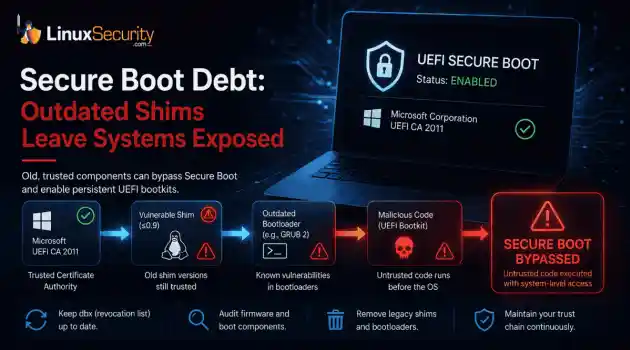
security advisory linux distribution ESET researchers identified 11 old and forgotten Linux UEFI shim bootloaders at versions 0.9 and below that can be used to bypass UEFI Secure Boot on any UEFI-based machine that trusts Microsoft’s Microsoft Corporation UEFI CA 2011 third-party certificate authority, regardless of the installed operating system (OS). Reported shims can be exploited to execute untrusted code during system boot, enabling attackers to deploy malicious UEFI bootkits even on systems with UEFI Secure Boot enabled.....
Jul 16, 2026
 Refine news
X Clear Filters
Get the latest News and Insights
Get the latest Linux and open source security news straight to your inbox.
Community Poll
Is continuous patching actually viable?
Trending News
Loading...
Explore Latest Linux Security news
We found 6 articles for you...
81
 storage securityauthentication flawinternet exposure
Exposed iSCSI Storage Clusters Present Major Data Breach Threats
Over 13,000 iSCSI storage clusters are currently accessible via the internet after their respective owners forgot to enable authentication. . This misconfiguration has the risk of causing serious harm to devices' owners, as cyber-criminal groups could access these internet-accessible hard drives (storage disk arrays and NAS devices) to replace legitimate files with malware, insert backdoors inside backups, or steal company information stored on the unprotected devices. The link for this article located at ZDNet is no longer available. . More than 12,000 open SMB file shares can be found on the internet, posing a threat of unapproved access and possible information leaks.. iSCSI Access Risk, Storage Cluster Security, Internet Vulnerability. . LinuxSecurity.com Team
 Apr 02, 2019
•
Apr 02, 2019
• Privacy
81
 data protectioncorporate securitycompliance
Understanding GDPR Compliance Impact on Global Companies
For many companies, GDPR has become a four-letter acronym. The European Union's new General Data Protection Rule – which applies to virtually any kind of data that can be used to identify a person – goes into effect May 25. And companies around the world are rushing to make sure they're in compliance, or at least can demonstrate that they're hard at work trying to meet the EU demands. . GDPR is designed to protect personal privacy, (hopefully) make companies more secure from data breaches and force them to get their collective hands around all the data they collect, use and distribute.. Firms around the globe strive to adhere to CCPA guidelines, aiming to protect individual privacy and bolster data defenses against unauthorized access.. GDPR Compliance, Data Privacy Regulation, Corporate Security. . LinuxSecurity.com Team
May 20, 2018
•
Privacy

74
data backupdisaster recoverycloud securityCloud Security Concerns Delay Firms From Using Cloud For Backup
BLACK BOX CLOUD DEPLOYMENTS are being shunned by firms looking to backup data due to security concerns. Cloud deployments, which have gained popularity in the past five years through the promise of accessing seemingly unlimited resources conjured up out of thin air, are being shunned for use as redundant storage due to fears about data security. . Talking to The INQUIRER, Bob Roudebush, VP of marketing at Neverfail, said that "worries of having data in other datacentres is why cloud adoption is not higher, even for disaster recovery". In recent months there have been several data breaches on cloud deployed services and Neverfail, which works with firms to harden operations against failure, said that customers are still wary of clouds. Roudebush said "the cloud sounds ideal for disaster recovery" but that one of the big issues with backing up data is to "ensure the security of data in more than one location". The link for this article located at The Inquirer is no longer available. . Worries about the security of data kept in cloud platforms discourage organizations from leveraging cloud solutions for backup and business continuity.. Cloud Security Solutions, Data Backup Strategies, Disaster Recovery Planning, Cloud Data Breaches. . Anthony Pell
Jul 20, 2011
•
Network Security
83
threat analysiscybercrimecybersecurityMan-in-the-Browser Threats: Risks to Corporate Networks and Data Security
Cybercriminals are increasingly targeting the information assets of some of the world's most well-known organizations, according to the findings of a recent global study by McAfee and Science Applications International Corp. (SAIC) entitled "Underground Economies: Intellectual Capital and Sensitive Corporate Data Now the Latest Cybercrime Currency.". With firewalls, antivirus and other security mechanisms protecting corporate networks, how do attackers manage to penetrate enterprise computer systems? Simply by exploiting the weakest link in the security chain. One of the newest methods is tunneling in via employees' browsers using an attack known as "Man-in-the-Browser" (MitB). The link for this article located at Network World is no longer available. . Explore the ways in which Man-in-the-Middle threats breach business environments and compromise confidential information.. Man-in-the-Browser, cybersecurity threats, corporate data security, employee risk, enterprise protection. . LinuxSecurity.com Team
Mar 31, 2011
•
Hacks/Cracks
77
security practicesdatabase securitysecurity challengesTop Five Database Security Risks Identified by IOUG Survey
Though database security best practices have circulated the conference circuit for years now and existing database security tools are now mature, today's typical enterprise is still far behind in shoring up its most sensitive stores of data. . In fact, the Independent Oracle Users Group's (IOUG) recently released data security survey findings are enough to open the eyes of anyone who has ever read news reports about embarrassing data breaches and wondered if his company could be breached next time. Taking a look at the results, it's clear that most organizations today are still running database security by the seats of their pants. The vast majority of organizations do not monitor their databases at all, or do so in an ad hoc fashion. Even more troubling, most enterprises don't even know where their sensitive data resides -- with many administrators admitting in the survey that they are not sure of all of the databases that contain sensitive information. The link for this article located at Dark Reading is no longer available. . The IOUG survey reveals critical insights on why database security issues persist in enterprises, primarily due to insufficient employee training and awareness. Database Protection, Enterprise Risks, Security Monitoring. . LinuxSecurity.com Team
Sep 27, 2010
•
Server Security
83
data protectionsecurity researchattack techniquesExploring Full-Disk Encryption Risks with the Evil Maid Attack
Full-disk encryption is often heralded as a panacea to the huge problems of data breaches and laptop thefts, and with good reason. Making the data on a laptop or other device unreadable makes the machine far less attractive or valuable to a thief. However, researchers are showing that this solution has its share of weaknesses, too.. Joanna Rutkowska, a well-known security researcher known mostly for her work on low-level rootkits and virtualization, has published a tool that enables an attacker to boot a protected laptop from a USB drive, record the encryption tool's passphrase and then decrypt its contents without trouble. Known as Evil Maid, Rutkowska said the attack is simple enough to be pulled off by a hotel housekeeper and is effective against TrueCrypt. The attack works like this: A laptop user, even one who is paranoid enough to power down his encrypted machine, leaves it alone for a few minutes. An attacker inserts the USB drive containing Evil Maid into the laptop and boots the machine from the USB drive. The tool installs a sniffer on the laptop, which will then log the encryption passphrase the next time the user enters it. The passphrase can be stored on the disk and then recovered by the attacker later. The link for this article located at Threat Post is no longer available. . Joanna Rutkowska, a well-known security researcher known mostly for her work on low-level rootkits a. full-disk, encryption, often, heralded, panacea, problems, breaches, laptop. . LinuxSecurity.com Team
Oct 20, 2009
•
Hacks/Cracks
82
data securitylegislationsecurity risksNew Data Security Legislation Aims to Protect Consumer Privacy
It has been a bad year for data security. The Privacy Rights Clearinghouse, a consumer advocacy group in San Diego, has counted 80 data breaches since February, involving the personal information of more than 50 million people. The sensitive data--names, Social Security and credit card numbers, dates of birth, home addresses and the like--have either been lost by or stolen from companies and institutions that compile such data. . In response, more than a dozen bills have been introduced in Congress this year. Companies that compile, trade and store consumer data, while largely resigned to the idea that new legislation will hold them to a higher standard for security, want to minimize the impact of any new law, maximize their discretion when it comes to notifying consumers of breaches and limit their liability when they do spring leaks. A bill introduced by Sen. Jeff Sessions, Republican of Alabama, for instance, simply requires businesses to improve security on the data they carry and to notify consumers only if there is a "significant risk of identity theft." But proving a "risk of identity theft" is nearly impossible, said Chris Jay Hoofnagle, senior counsel with the Electronic Privacy Information Center in Washington, a public interest research center.. With over 80 data breaches this year, new legislation in Congress aims to address consumer privacy risks and enhance security standards.. Data Security, Consumer Privacy, Data Breaches, Privacy Legislation, Security Standards. . Brittany Day
Nov 01, 2005
•
Government
81
consumer protectionidentity theftfraud9.9 Million Identity Theft Victims in America: $48 Billion Impact
A staggering 27.3 million Americans have been victims of identity theft in the last five years, according to Federal Trade Commission survey out this week. In the last year alone, 9.9 million people have had their identity purloined. Identity theft . . . . A staggering 27.3 million Americans have been victims of identity theft in the last five years, according to Federal Trade Commission survey out this week. In the last year alone, 9.9 million people have had their identity purloined. Identity theft cost businesses and financial institutions nearly $48 billion and consumer victims reported $5 billion in out-of-pocket expenses last year, according to the FTC. "Identity theft is affecting millions of consumers and costing billions of dollars," said Howard Beales, Director of the FTC's Bureau of Consumer Protection. "This information can serve to galvanize federal, state, and local law enforcers, the business community, and consumers to work together to combat this menace." The survey was released in the wake of the formation of an industry coalition to fight online identity theft (involving leading financial services, IT and e-commerce companies) earlier this week. Microsoft Corp, eBay, Amazon.com and Visa are among founder members of the Coalition on Online Identity Theft. . Over the last half-decade, approximately 30.2 million individuals in the U.S. experienced compromises of their personal data, significantly impacting the nation.. Identity Theft, Consumer Protection, Cyber Safety, Fraud Issues, Online Security. . LinuxSecurity.com Team
Sep 09, 2003
•
Privacy

Get the latest News and Insights
Get the latest Linux and open source security news straight to your inbox.
Community Poll
Is continuous patching actually viable?
Trending News
Search Topics
Powered By

Linux Security - Your source for Top Linux News, Advisories, HOWTOs and Feature Releases
QUICK LINKS
subscribe to newsletters!
Like staying secure? So do we.
Sign up for updates, tips, and alerts!