Explore top 10 tips to secure your open-source projects now. Read More
×



Server Security data privacy automation
data privacy automation Every system admin has lived through the same Monday morning ritual. A queue of forty tickets, half of them password resets, permission errors, or disk space warnings that any experienced technician could resolve in under two minutes. The other half require actual judgment. For years, automation promised that software would eventually sort the two apart on its own. That promise is now being tested in production Linux environments. . Early results are reshaping how IT teams think about tier-1...
 Jul 17, 2026

Privacydata collection automation
data collection automation You're running a web scraping project to collect pricing data from e-commerce sites. You set up a pool of datacenter proxies, launch your scripts, and within minutes — banned . CAPTCHAs everywhere. Your data pipeline stops before it really begins. . It's a frustrating scenario that plays out daily in ad verification, market research, and multi-account management. The website doesn't know you're doing legitimate research or monitoring. It just sees traffic coming from IP ranges it recognizes as...
Jul 17, 2026

Security Trends security advisory social engineering
security advisory social engineering Business Email Compromise used to be a numbers game — mass-blasted emails, broken English, an obvious "URGENT WIRE TRANSFER" subject line. That era is over. Generative AI has turned BEC into a tailored, low-noise operation that mimics writing style, voice, and even video presence. This piece looks at what's actually changed under the hood, what defenders are testing in response, and why so many organizations are still structurally unprepared for it. . The Infrastructure Problem Nobody Wants to...
Jul 17, 2026

Security Trends cybersecurity Linux documentation
cybersecurity Linux documentation Linux operating systems have gained prominence due to their stability, adaptability, and excellent security options. In the case of developing documentation, designing cybersecurity dashboards, or educational material, visuals are of vital importance when it comes to making things clear. The use of icons allows one to understand the message regarding alerts, authorization, encryption, authentication, or the state of the system just by looking at the visual cue without having to read long...
Jul 17, 2026
Security Vulnerabilities security advisory linux distribution
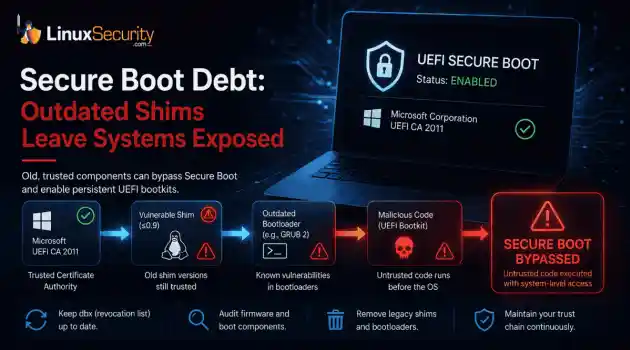
security advisory linux distribution ESET researchers identified 11 old and forgotten Linux UEFI shim bootloaders at versions 0.9 and below that can be used to bypass UEFI Secure Boot on any UEFI-based machine that trusts Microsoft’s Microsoft Corporation UEFI CA 2011 third-party certificate authority, regardless of the installed operating system (OS). Reported shims can be exploited to execute untrusted code during system boot, enabling attackers to deploy malicious UEFI bootkits even on systems with UEFI Secure Boot enabled.....
Jul 16, 2026
 Refine news
X Clear Filters
Get the latest News and Insights
Get the latest Linux and open source security news straight to your inbox.
Community Poll
Is continuous patching actually viable?
Loading...
Explore Latest Linux Security news
We found 61 articles for you...
210
 security advisorydata integrityexploitation risk
Microsoft: Critical GRUB2 Issues: Exploitation Risks and Boot Security
Microsoft recently shared the discovery of several critical vulnerabilities in open-source bootloaders, notably GRUB2 . These findings are particularly significant for us Linux security admins, who must now address these newly identified risks to ensure robust boot security on their systems. . GRUB2, a cornerstone for many Linux distributions, enables users to select and boot their desired operating systems. However, its complex codebase and vital role mean that any vulnerabilities within it can have far-reaching consequences, jeopardizing system security and data integrity. To help you better understand and prepare for this emerging threat, I'll examine the risks these vulnerabilities pose to impacted systems, the silent dangers of using GRUB2, and share practical measures for enhancing boot security on Linux. The Exploitation Risks of Vulnerable Bootloaders One of the greatest risks of these recent bootloader vulnerabilities is their potential use by malicious actors. Attackers could exploit such flaws to gain unwarranted entry to systems, bypass security features, and gain control during the boot-up process, leading to data theft, tampering, or persistent backdoor installations if the bootloader is compromised. If the bootloader is compromised, attackers can exploit the boot sequence to load malicious kernels or bypass security checks, posing a serious threat to the overall security posture of affected systems. Data Integrity and Firmware Infection The implications of these vulnerabilities extend beyond immediate exploitation risks. A compromised bootloader can lead to corruption or manipulation of data integrity during the boot process. Attackers exploiting these vulnerabilities have the potential to alter boot parameters, falsify configurations, and introduce malicious code at a foundational level. This can result in severe system compromises, where attackers gain elevated privileges and can conduct subsequent attacks undetected. Moreover, vulnerabilities in bootloaders can beutilized to infect the system firmware. This is particularly insidious because firmware infections are notoriously difficult to remove. Unlike traditional malware , which resides on the operating system, firmware infections persist across reboots and reinstalls. This means that even after reformatting and reinstalling the operating system, the compromised firmware can continue to pose a threat, making it a persistent menace to system security. Hidden Dangers of Using GRUB2 Linux administrators may be unaware of several unexpected and perilous aspects of using the GRUB2 bootloader . For one thing, its complex codebase can hide bugs that would be difficult to spot under normal usage conditions. Given its comprehensive functionality and flexibility, it includes significant amounts of code, which increases the chance that hidden issues might exist that attackers could exploit. Although GRUB2 supports UEFI Secure Boot , which helps prevent malicious code from running during bootup, improper configuration may still leave systems vulnerable. Misconfigurations with Secure Boot settings could allow attackers skilled at exploiting misconfigurations to gain unauthorized entry and bypass its protections completely - jeopardizing boot process integrity instantly! One of the more troubling aspects of GRUB2 vulnerabilities is their potential to enable attackers to launch persistent threats. Because GRUB2 is integral to booting systems, any breach could allow an attacker to establish deep, long-lasting footholds despite common mitigation strategies. These threats would continue even through system upgrades or reinstallations. Practical Strategies for Enhancing Boot Security on Linux Systems Linux administrators can employ various technical strategies and configuration changes to strengthen boot security on Linux systems, with Secure Boot being one of the primary strategies and changes. By configuring Secure Boot on systems equipped with UEFI firmware, administrators can ensure only signedbootloaders, kernels, drivers, and boot loader packages execute at boot time. They can enroll their own keys or use trustworthy ones from verified sources to ensure the integrity of these components and prevent execution of unauthorized or malicious code during this process. Another effective strategy is to set your bootloader (such as GRUB) with a password to prevent unauthorized users from making changes or booting into single-user mode, which could present potential security breaches. Administrators can modify /etc/grub.d/40_custom or create a similar file, add password protection, and enforce modification restrictions. You should update it using the command grub-mkconfig—o /boot/grub/grub.cfg. Additionally, encrypting disks using Linux Unified Key Setup (LUKS) helps protect data at rest. Full Disk Encryption (FDE) ensures that contents can only be accessed with an authorized passphrase or key, securing the system against access from unknown parties during installation or after manually configuring partitions and bootloaders. These measures together form part of an effective Linux security strategy to make boot time faster and safer than ever! Combined with Secure Boot and rigorous access control measures , these strategies substantially strengthen security on Linux systems' boot processes. Our Final Thoughts on Mitigating Bootloader Flaws The discovery of critical vulnerabilities in GRUB2 and other open-source bootloaders is a stark reminder that even core components of Linux systems may contain hidden dangers that pose severe threats, from exploitability and data integrity issues to persistent threats that compromise system security. For security administrators, staying vigilant, proactive, and well informed is key to maintaining system safety. Admins can effectively reduce risks to their systems by regularly updating software , configuring UEFI Secure Boot correctly, using advanced vulnerability scanning tools , and keeping education and awareness high on their agendas. Assecurity threats evolve, proactive bootloader security solutions will become even more essential in maintaining system integrity and safeguarding Linux environments. . Significant vulnerabilities identified in GRUB2 bootloaders pose threats to Linux system integrity. Discover methods to improve boot security.. Open Source Bootloaders, GRUB2 Vulnerabilities, Boot Security Strategies. . Brittany Day
 Apr 07, 2025
•
Apr 07, 2025
• Security Vulnerabilities
77
 access controlhigh availabilitybackup strategies
Effective Disaster Recovery Planning for Secure Linux Environments
What happens when your Linux server goes down? Is your organization prepared to recover quickly and securely, or will critical data and operations be left vulnerable? . Whether caused by hardware malfunctions, cyberattacks , or human error, downtime can have severe consequences for businesses and organizations relying on Linux infrastructure. Security specialists, in particular, must ensure that disaster recovery strategies do more than just restore functionality—they must also safeguard data integrity , prevent unauthorized access , and maintain compliance with industry standards. A well-crafted disaster recovery plan minimizes the risk of data loss or extended outages by considering recovery time objectives, redundancy measures, and security best practices unlike most general backup solutions. Key is proactive planning since reacting to a disaster without a clear recovery strategy might cause permanent damage, financial loss, and security breaches . Linux experts can make sure their systems stay robust in the face of disruptions by putting safe and effective disaster recovery plans into action. Understanding the Threats That Impact Linux Server Availability Linux servers power critical infrastructure across industries, from cloud computing and enterprise applications to cybersecurity and financial systems. Though they have a reputation for security and stability, they are not free from hazards that could disturb business activities. Hardware failures, power outages, and misconfigurations are still common causes of downtime, but cyber threats are becoming increasingly important. Ransomware attacks targeting Linux environments have grown more sophisticated, with attackers seeking to encrypt not just live data but also backup files. When backups are compromised, organizations may have no choice but to pay ransom demands or face extended downtime. Similarly, insider threats, whether through malicious intent or accidental misconfigurations, can lead tosignificant data loss if proper access controls are not in place. Even system updates or kernel patches , when not tested properly, can trigger failures that require rapid recovery. A reactive approach to disaster recovery is no longer sufficient. Security teams must anticipate these threats and implement strategies that ensure a seamless, secure recovery process when an incident occurs. Building a Resilient and Secure Linux Disaster Recovery Framework A strong disaster recovery framework ensures that Linux environments can recover from failures quickly and securely. This section explores key components of an effective strategy, including backup methodologies, storage options, and security best practices. Backup Strategies A secure disaster recovery plan for Linux environments must go beyond traditional backup strategies. Frequent, automated backups are essential, but they must be stored securely and protected against tampering. A combination of full, incremental, and differential backups helps strike a balance between data redundancy and storage efficiency. Offsite and Distributed Storage By guaranteeing that localized events, such fires or natural disasters, do not affect all copies of important data, storing backups in geographically dispersed data centers increases disaster resilience. Many companies use managed IT services for small businesses that offer highly safe, redundant disaster recovery solutions since many lack the means to keep their own offsite backup infrastructure. These services sometimes include immutable storage options, so guaranteeing that backup files cannot be changed or deleted—even by managers. Self-Managed vs. Managed IT Services Security specialists managing Linux environments must also weigh the benefits of self-managed disaster recovery versus outsourcing to a managed IT provider. While DIY approaches allow for full control over the infrastructure, they come with significant challenges, including the need for continuous monitoring, manual securityhardening, and routine testing to ensure backups remain reliable. Maintaining an in-house disaster recovery setup also requires dedicated personnel, expertise in secure storage configurations, and the ability to respond to failures in real time. Businesses evaluating their IT management strategy often find that balancing in-house control with expert-driven solutions provides the best mix of security and efficiency. By contrast, managed IT service providers can offer fully automated, continuously monitored disaster recovery solutions that reduce operational burdens while enforcing strict security policies. Many businesses turn to managed providers not just for backup storage but also for automated failover capabilities, compliance-driven security policies, and dedicated disaster recovery support. This approach helps mitigate risks while freeing up internal IT and security teams to focus on proactive defense measures rather than infrastructure maintenance. Security and Compliance Considerations Encryption is another crucial factor. Backups must be encrypted both in transit and at rest to prevent unauthorized access, particularly when stored in remote locations. A strong disaster recovery plan also defines clear recovery point objectives (RPO) and recovery time objectives (RTO), ensuring that critical systems can be restored within an acceptable timeframe without excessive data loss . Comparison Table: Self-Managed vs. Managed IT Services Factor Self-Managed DR Managed IT DR Control Level Full control Limited control Security Responsibility IT team-managed Provider-enforced Maintenance Effort High (constant monitoring) Low (automated monitoring) Compliance Handling Must be manually configured Often included in service Strengthening High-Availability and Redundancy in Linux Disaster Recovery A robustdisaster recovery plan must prioritize high-availability solutions to ensure business continuity. The following strategies help mitigate downtime and maintain operational stability. Failover Clustering and Load Balancing Minimizing downtime is a priority for any organization, and implementing high-availability solutions plays a key role in disaster recovery planning. Failover clustering ensures that if one server fails, another takes over seamlessly, reducing service interruptions. This is particularly useful for database-driven applications and web services, where even short outages can have significant consequences. Load balancing across multiple servers enhances resilience by distributing traffic and preventing a single point of failure. Combined with database replication , it allows Linux environments to continue operating even if a primary system goes offline. RAID and Filesystem Resilience At the hardware level, RAID configurations help prevent data loss by providing redundancy across multiple drives. However, RAID alone is not a substitute for a full disaster recovery strategy. Failures affecting an entire array still require backup restoration. Key Insight : While RAID improves data redundancy, proper disaster recovery planning must include comprehensive backup and restoration processes. Filesystem journaling in Linux filesystems such as ext4, XFS, and Btrfs also enhances data integrity, allowing recovery from unexpected crashes with minimal corruption. Containerization for Disaster Recovery Containerization has further revolutionized disaster recovery by enabling rapid deployment of applications across different environments. Security teams can use tools like Docker , Kubernetes , and infrastructure-as-code (IaC) frameworks to maintain identical configurations across multiple servers, simplifying disaster recovery and minimizing inconsistencies between live and backup environments. Testing and Validating Disaster Recovery Plans Only as successful asits last successful test is a disaster recovery plan. Frequent validation guarantees that backups stay whole and that recovery plans perform as expected. Linux managers should run full-system recovery drills and bare-metal restores, so simulating actual failure situations. This helps teams to find flaws in the recovery strategy and make required changes before a real disaster strikes. Tracking recovery activities and preserving security policy compliance depend on loggers and auditors. Recording results of recovery tests helps companies to improve their plans and guarantee responsibility. By always verifying backup data and alerting managers to possible problems before they become more serious, automated recovery validation helps to strengthen disaster readiness. Security-Focused Disaster Recovery Strategies Protecting backups from ransomware attacks: Use immutable storage options and write-once-read-many (WORM) technology to ensure that backups remain untouched even if an attacker gains access to the system. Access control measures: Backup and recovery processes should follow least privilege principles, restricting access to only those who need it. Implementing multi-factor authentication (MFA) for recovery operations adds an additional layer of security, preventing unauthorized modifications to critical recovery systems. Forensic analysis and logging: Security teams should ensure that logs, security events, and forensic data are preserved across backups. This allows for post-incident analysis in the event of a breach, helping to identify attack vectors and improve overall system defenses. Compliance and security benchmarks: Standards such as ISO 27001 , NIST , and CIS benchmarks influence disaster recovery planning by setting security requirements for backup storage, encryption, and access controls. Meeting these standards ensures regulatory compliance and best-in-class security practices. Linux Disaster Recovery: Security and Business Continuity Strategies Having a well-organized disaster recovery plan is essential to ensuring that Linux systems continue to function normally while also preserving their security. Traditional backup plans are not sufficient on their own to mitigate the cyber risks and system failures that are prevalent in today's computer world. Using automated recovery validation, high-availability systems, and safe storage methods are all things that businesses need to implement in order to ensure that their responses to disasters are flawless. Linux security experts can lower downtime, protect private data, and keep industry compliance by aggressively addressing security risks and implementing tested disaster recovery techniques. Regular testing, encryption, and safe access restrictions all help to create a strong recovery plan protecting Linux systems from both inside and outside threats. Whether depending on managed IT services for offsite redundancy or self-managed solutions, the secret to effective disaster recovery is readiness, automation, and ongoing security improvement. . Reduce operational interruptions; explore efficient Linux data recovery techniques to safeguard your information and processes.. Linux Disaster Recovery, Secure Backup Solutions, High-Availability Strategies, Data Integrity Planning, Managed IT Services. . MaK Ulac
Mar 03, 2025
•
Server Security

79
 data integrityLinux distributionsstorage management
OpenZFS 2.3: Improved RAID, Deduplication, and Stability for Linux
Maintaining robust storage management and ensuring data integrity are critical responsibilities for sysadmins. With the launch of OpenZFS 2.3, security admins are equipped with advanced tools designed to elevate storage practices. . This release introduces notable enhancements in RAID expansion and data deduplication, which promise to streamline operations and boost resource efficiency. In this article, I'll delve into the specifics of these new capabilities and explore how they can be leveraged to fortify your Linux systems. What Is OpenZFS? OpenZFS is an open-source file system and logical volume manager originally developed by Sun Microsystems for their Solaris operating system. It has since been adopted across various platforms, including Linux, FreeBSD, and macOS. OpenZFS offers traditional file system functionality combined with advanced features like snapshots, data integrity verification, and built-in compression technology - creating an easier, more reliable way of managing large amounts of data due to its ability to detect corruption more rapidly, support higher storage capacities with ease, and offer an intuitive administration platform. OpenZFS stands out with its copy-on-write technology, which ensures data is never overwritten until changes have been fully secured, significantly improving data integrity. Another key aspect is its capacity for quick and space-efficient snapshot creation - enabling users to capture the current states of their data so they can restore it easily in case backup and recovery operations become necessary. OpenZFS's advanced features make it an attractive choice for businesses and individuals seeking an efficient storage solution with high-performance capabilities. RAID Expansion: Seamless Scalability One of the standout features of OpenZFS 2.3 is its seamless RAID expansion functionality. Expanding a RAID array in previous iterations could be a complex, risky process, often requiring downtime, data migration, or even completereconfiguration. OpenZFS 2.3 simplifies this task, allowing administrators to add new drives to existing arrays without any data loss or interruption to ongoing operations. This capability is particularly beneficial for environments where storage needs are dynamically increasing. Expanding storage arrays without offloading data or reformating volumes means less time spent managing hardware and optimizing performance. Additionally, by reducing the downtime typically associated with RAID expansion, systems maintain higher availability, which is critical for operations that cannot afford interruptions. Faster Data Deduplication: Efficiency and Optimization Another significant improvement in OpenZFS 2.3 is its enhanced deduplication performance. Deduplication is a method that deletes duplicate copies of repetitious data to optimize storage utilization. With faster deduplication algorithms introduced in this update, admins can achieve more efficient storage management by significantly decreasing redundant data, freeing up valuable disk space. Faster deduplication increases performance and can immediately affect your system's security posture. By optimizing storage usage and decreasing the load on the storage subsystem, system overload risks such as denial-of-service attacks are reduced, and resource usage is efficiently optimized to allow faster retrieval time and improved overall system responsiveness. Improved Stability and Bug Fixes Stability and reliability are key pillars of any robust storage solution. The OpenZFS 2.3 release includes notable improvements in these areas, addressing critical bugs from previous versions. These fixes mean fewer unexpected failures and a lower likelihood of data corruption. Stability improvements ensure data is consistently accessible and secure , even under heavy loads or during complex operations like RAID expansion and deduplication. Compatibility with Major Linux Distributions Another critical aspect of OpenZFS 2.3 is its compatibility with allmajor Linux distributions and the latest kernel versions. This cross-compatibility ensures that regardless of the specific Linux environment in use, OpenZFS can be integrated seamlessly. For security admins, this means less time spent worrying about compatibility issues and more time focusing on utilizing the features of OpenZFS to enhance the storage infrastructure. Ensuring compatibility also aids in maintaining a consistent security posture across different systems. By standardizing with a robust and well-supported filesystem like OpenZFS, administrators can simplify their security protocols, streamline monitoring and management processes, and reduce the risk of inconsistencies or vulnerabilities arising from multiple heterogeneous storage solutions. Best Practices for Deploying OpenZFS 2.3 While OpenZFS 2.3 introduces powerful new features, the success of its deployment hinges on following best practices. Testing and vigilant monitoring are crucial steps that should not be overlooked. Thorough Testing Before Production Deployment Conducting thorough testing in a controlled setting is vital before rolling out OpenZFS 2.3 in a production environment. Testing helps identify any potential issues with hardware compatibility, performance bottlenecks, or unanticipated behaviors in specific use-case scenarios. Simulating your production environment as closely as possible during testing can ensure a smoother transition and reduce the likelihood of disruptions during the actual deployment. Implementing Comprehensive Monitoring Tools Post-deployment, vigilant monitoring is essential to maintaining the health and performance of your OpenZFS setup. Use monitoring tools that provide real-time insights into storage utilization, performance metrics, and potential errors or warnings. Proactive monitoring enables admins to address issues before they escalate into critical problems, ensuring continuous availability and reliability. Regular Updates and Maintenance Keeping your OpenZFS installationand the underlying Linux system updated with the latest patches is a fundamental practice. Regular updates deliver new features and improvements and address security vulnerabilities and stability issues. Establishing a routine update schedule helps maintain the integrity and security of your storage infrastructure. Our Final Thoughts on the OpenZFS 2.3 Release OpenZFS 2.3 brings critical advancements for Linux security admins, addressing some of the perennial challenges in storage management with innovative solutions. The seamless RAID expansion and faster data deduplication features enhance operational efficiency and contribute to a stronger security posture by ensuring better allocation and management of resources. Stability improvements and broad compatibility further cement OpenZFS 2.3 as a robust choice for diverse Linux environments. Administrators can leverage these enhancements by following best practices for testing, monitoring, and maintaining the new features to build more reliable, scalable, and secure storage systems. Whether deployed in enterprise data centers, research institutions, or cloud services, the practical benefits of OpenZFS 2.3 are poised to significantly impact how data storage is managed and secured in the Linux world. . This enhancement introduces noteworthy advancements in RAID scalability and data compression, focused on streamlining processes.. OpenZFS, Linux storage, data management, sysadmin tools, RAID enhancements. . MaK Ulac
Jan 24, 2025
•
Security Projects
79
security advisorydata integrityexception handlingArch Linux: Archinstall 3.0.2 Critical Update: Better Btrfs and Security
Archinstall 3.0.2 has just been released, and it brings a host of updates and improvements that Linux security admins will want to note. This latest version of Arch Linux's text-based installer includes Wayfire support and many enhancements that boost usability and reliability. Key changes include improvements to btrfs partition management, better handling of mirror lists, and replacing deprecated functions to ensure robust, up-to-date code. . The refactoring efforts in Archinstall 3.0.2 make the installer more secure by addressing critical bugs and cleaning up unspecified exception handling. These updates reduce potential vulnerabilities and ensure the installer operates predictably and securely. Security-conscious admins will also appreciate the focus on improving data integrity and enhancing package verification processes, making this release a significant step forward in maintaining a safe and efficient Arch Linux environment. Let’s dive into what Archinstall 3.0.2 offers and why it’s a noteworthy upgrade. Enhanced Wayfire Support Source: Phoronix One of the standout features of Archinstall 3.0.2 is its improved support for Wayfire , a Wayland compositor. Wayfire offers a modern and flexible environment, leveraging the latest graphical technologies. For security admins overseeing graphical environments, Wayfire’s enhanced integration means smoother, more reliable performance and fewer vulnerabilities associated with older, outdated graphical stacks. This improvement isn't just about making things look prettier; it's about ensuring your graphical interface is as secure and efficient as possible. Improved Btrfs Partition Management Archinstall 3.0.2 also significantly enhances btrfs partition management, a key feature for those employing this advanced filesystem. Btrfs is known for its powerful features, such as snapshots, subvolumes, and built-in RAID capabilities, which offer extensive flexibility and control. These enhancements mean a more reliable and efficientmethod to manage filesystem integrity, backup , and recovery tasks. The latest improvements in Archinstall ensure that btrfs performance is optimized, reducing the risk of data corruption and improving overall filesystem robustness. Refined Handling of Mirror Lists An essential aspect of maintaining an Arch Linux installation is ensuring package mirrors are managed correctly. Mirror lists are vital for keeping systems up-to-date with the latest packages without downloading issues or delays. Archinstall 3.0.2 includes refined handling of these mirror lists, making the update process smoother and more reliable. By ensuring that mirror lists are handled more efficiently, Archinstall reduces the risk of encountering outdated or compromised packages, strengthening your system’s security posture. Security Through Code Hygiene Security administrators will find the refactoring efforts in Archinstall 3.0.2 particularly impactful. The developers have focused on cleaning up the codebase, removing deprecated features, and addressing critical bugs. This thorough overhaul enhances performance and reduces potential vulnerabilities associated with legacy code and unspecified exceptions. Better-structured code is more straightforward to audit and less prone to errors, making it more secure by design. This update reflects a proactive approach to security, demonstrating how ongoing maintenance and refinement can prevent vulnerabilities from creeping into the system. Improved Exception Handling Exception handling is a critical component in any software, particularly for installers, which must handle a wide array of potential issues gracefully. Archinstall 3.0.2 includes substantial improvements in this area, ensuring exceptions are managed more predictably and securely. This means fewer unexpected crashes and better overall stability. This reliability is crucial when installing and configuring systems, as it ensures that the process can be completed without interruption, even in unexpected conditions. Intense Focus on Data Integrity Data integrity is paramount in any secure computing environment. Archinstall 3.0.2 strongly emphasizes this by improving how it handles filesystem operations and package verification. These enhancements ensure the data written to disk is accurate and reliable, reducing the risk of corruption or data loss. Archinstall ensures that only authentic and verified packages are installed on your system by improving package verification processes. This step is crucial in preventing the introduction of malicious software and maintaining a secure environment. Regular verification and checks are now more streamlined, providing additional security for your installations. Enhanced User Experience While the primary focus of Archinstall 3.0.2 is on security and reliability, user experience hasn’t been neglected. The installer’s interface and overall user experience have been polished to make it more intuitive and user-friendly. For new users and seasoned admins alike, a smoother installation process means fewer troubleshooting issues and more time focusing on configuring and securing your system. These enhancements support a more efficient workflow, from initial installation to regular system updates and maintenance. A more intuitive interface also lowers the barrier to entry, making it easier for new admins to adopt and configure Arch Linux securely. Reduced Risk of Vulnerabilities By replacing deprecated functions and providing critical bug fixes, Archinstall 3.0.2 reduces the risk of vulnerabilities that malicious actors can exploit. This proactive approach to maintaining and updating the codebase helps close security gaps before they can be exploited. This offers peace of mind in knowing that the installer you rely on is built with security as a foundational principle. Regular updates and vigilance in maintaining the codebase ensure that potential threats are mitigated effectively, safeguarding your systems from possible exploits. Our Final Thoughts onthe Archinstall 3.0.2 Release Archinstall 3.0.2 is a significant update that should not be overlooked. With enhanced support for Wayfire, improved btrfs partition management, refined handling of mirror lists, and an overall focus on code hygiene and security, this release underscores the importance of maintaining a secure and efficient Linux environment. By addressing critical bugs, refining exception handling, and enhancing data integrity and package verification processes, Archinstall 3.0.2 ensures that your Arch Linux deployments are updated and secure. These improvements enhance the installer’s performance and provide a robust foundation for maintaining system security in the face of evolving and emerging threats. For admins looking to streamline their Arch Linux installations and updates while maintaining the highest security standards, Archinstall 3.0.2 is a worthy upgrade. As you continue to oversee and protect your systems, this latest version of Archinstall offers the tools and improvements needed to stay ahead in security, efficiency, and performance. . Archinstall 3.0.2 bolsters stability through essential patching, optimized btrfs utilities, and upgraded error management.. Archinstall updates, Linux installation security, btrfs improvements. . Brittany Day
Jan 23, 2025
•
Security Projects
210
 security advisorycritical issuedata integrity
Google Chrome 132 Security Advisory: 13 Critical Flaws Impacting Integrity
Google's widely used Chrome web browser is back in the security spotlight, as yet another 13 critical security flaws need to be urgently addressed. Google quickly released Chrome 132 to patch these severe bugs. With vulnerabilities ranging from out-of-bounds memory access to a stack buffer overflow , these issues impact data integrity and the overall security posture of affected systems. . Luckily, Chrome updates are quick and painless to install, ensuring minimal disruption while providing maximum security benefits. Maintaining browser updates will decrease the risk that vulnerabilities exploited within your network can pose. Let's dive deeper into these flaws and effective mitigations, as prompt action against potential exploits is necessary! What Makes the Recent Chrome 132 Update So Urgent? Google Chrome is more than just a web browser - it plays a vital role in many workplaces, including Linux server environment. Due to its widespread adoption and usage, malicious actors frequently target Chrome to exploit vulnerabilities with high to low severity levels. Recently discovered flaws mitigated in Chrome 132, including out-of-bounds memory access, improper implementations, and stack buffer overflows that may allow attackers to access sensitive information without authorization or compromise system data. These vulnerabilities could enable malicious actors to access system data or gain unauthorized entry via compromised accounts or login credentials. Google's release of Chrome 132 represents an aggressive effort to address these vulnerabilities quickly. We security administrators must act fast or risk leaving our Linux environments exposed and at risk! Ignoring updates of this nature leaves our data susceptible and undermines our overall security posture. Examining the Impact of Vulnerabilities on Affected Systems To truly understand the significance of this update, we need to appreciate the dangers vulnerabilities pose in a networked environment. Out-of-bounds memory access,for instance, occurs when a program reads (or writes) data outside the bounds of allocated memory. This flaw can crash systems, corrupt data, or allow attackers to execute arbitrary code. Vulnerabilities in navigation or rendering engines, like those related to the V8 JavaScript engine in Chrome, could be exploited to redirect users to malicious sites or execute pernicious scripts. Such breaches can result in data theft, identity theft, or even localized denial of service. The update to Chrome 132 not only patches these individual vulnerabilities but also strengthens the browser's overall security architecture, providing a sturdy shield against potential exploits. The Critical Importance of Updating Chrome on Linux Protecting your environment is a multi-faceted endeavor, requiring everything from robust firewalls to impeccable patch management. Updating Chrome on Linux systems is straightforward and should be done immediately to ensure protection against newly identified vulnerabilities. Start by launching the Chrome browser. From there, click on the menu symbolized by three vertical dots at the top right corner. Select 'Help' and then 'About Google Chrome.' This action triggers the browser's automatic update check. If Chrome 132 is available, it will download automatically. After downloading the browser, restarting it is crucial to apply the new configurations effectively. Continuously ensuring that software is up-to-date is a fundamental practice that minimizes risk and boosts system integrity. As admins often juggle numerous tasks, implementing automated update checks could be a time-saving strategy to ensure security policies stay rigorous. Debian anf Fedora have issued important security advisories urging impacted users to update to Chrome 132 promptly. Mitigating Future Risks with Proactive Security Measures Understanding and acting upon vulnerabilities is only part of a broader security strategy. Looking forward, Linux security admins should adopt a proactivestance. This should include routine security audits, where networks and applications are scanned for vulnerabilities regularly, even before official patches become available. Security training for teams can ensure that everyone understands the importance of updates and the risks posed by vulnerabilities. This communal vigilance adds another layer of security, as even accidental errors or oversights can be promptly reported and addressed. Implementing robust monitoring tools can also provide admins real-time alerts about unusual activities or potential vulnerabilities and help flag necessary updates. This proactive approach helps manage risk and prepares admins and organizations to address new threats swiftly. Beyond Updates: Building a Culture of Robust Security While implementing software updates like Chrome 132 is vital, Linux admins should encourage a broader security culture within their organizations. Each member is critical to maintaining the integrity of your organization's security posture. This culture begins with education — ensuring that users understand the value of the data they interact with and the potential ramifications of security breaches . Promoting best practices for password management, such as using random password generators and secure password managers, can significantly reduce vulnerabilities. Furthermore, ensuring secure browsing practices, like avoiding suspicious sites or downloads and using VPNs when accessing public networks, can limit the risk of encountering malicious software. In environments where Chrome is a gateway to numerous web applications and services, a strong security culture can act as a human firewall that complements technical measures. Our Final Thoughts on the Significance of the Chrome 132 Update The release of Chrome 132 serves as a reminder of the ever-present need for vigilance within the IT landscape. For Linux security administrators, the update represents an actionable step towards maintaining control over the safety ofyour environment. Identifying vulnerabilities is essential; however, responding effectively through updates and fostering a security-minded culture is pivotal. Linux security admins must continuously learn and adapt to new cyber threats. Software updates like Chrome 132 are just part of a much larger, ongoing effort to protect systems and enhance organizational security postures. Ultimately, the swift application of updates like Chrome 132 protects information within an organization and fortifies trust in the systems underpinning our technological world. Taking decisive actions now, informed by an understanding of potential risks, positions admins and their organizations to face whatever challenges the future holds! . Rapid deployment of Firefox 102 addresses severe vulnerabilities, enhancing comprehensive information protection in Unix systems.. Chrome Update, Security Flaws, Linux Browser Security, Critical Update, System Integrity. . Brittany Day
Jan 22, 2025
•
Security Vulnerabilities
78
 security advisorydata integrityautomation
Red Hat Enterprise Linux 9.5: Improving Security and Automation for IT
Red Hat Enterprise Linux (RHEL) continues to develop with its latest release, version 9.5 . This update offers many new features and enhancements designed to meet the growing demands of modern IT environments. It emphasizes enhancing security, automating operations, and providing robust support for contemporary workloads. . Whether managing an enterprise data center, developing innovative applications, or ensuring compliance across complex infrastructures, RHEL 9.5 provides tools and capabilities that increase productivity while protecting data integrity for seamless operations. In this article, we'll highlight some significant updates and modifications in RHEL 9.5, such as improved security features, increased automation capabilities, and comprehensive workload support, making this release an essential advance for administrators and developers. From confidential computing and new system roles to Podman 5.0 support and updated developer tools, RHEL 9.5 stands up well to today's fast-moving IT landscape. Introduction to Red Hat Enterprise Linux Red Hat Enterprise Linux (RHEL) , developed by Red Hat Inc., is an innovative enterprise operating system with proven scalability and security explicitly tailored for enterprise environments. Over time, RHEL has become the go-to platform for deployment across data centers, virtualized environments, and hybrid clouds—an accolade testament to Red Hat's rich history as the leading open-source solutions provider. RHEL first debuted in 2000 and has steadily evolved to meet the ever-changing needs of modern IT environments. Today, RHEL is a cornerstone for organizations looking for a secure yet efficient platform that supports cutting-edge technologies like Artificial Intelligence (AI), Machine Learning (ML), and edge computing. Overview of Red Hat Enterprise Linux 9.5 Red Hat Enterprise Linux 9.5 marks a significant milestone, offering features to improve security, automate processes, and simplify hybrid cloud deployments. This latest version of RHELunderscores Red Hat Inc.'s dedication to providing secure yet efficient platforms to meet rapidly shifting enterprise IT requirements. Modern organizations face an ongoing challenge maintaining Linux environments while managing workloads they support despite limited time and resources. Furthermore, cloud services are expanding quickly, and AI/ML workloads are becoming an increasing part of today's IT environments, causing further complications in striking this balance. Fundamental Changes and Updates in RHEL 9.5 Red Hat Enterprise Linux (RHEL) 9.5 introduces several vital updates and modifications, strengthening its reputation for increased security, efficient operations, and supporting modern workloads. Security remains at the core of RHEL, and version 9.5 builds upon this legacy with several notable enhancements. Among these updates is improved confidential computing support to safeguard sensitive data during AI/ML computations - protecting it even in complex multi-tenant cloud environments while mitigating potential threats and maintaining data integrity. In addition, new system roles have been implemented to simplify administrative tasks while improving security. For instance, the Sudo role allows secure configuration of command line utilities across environments while significantly decreasing complexity for users with elevated privileges. RHEL 9.5 helps organizations achieve greater efficiency by offering several automation features. Improved file management capabilities have now been integrated into the web console, enabling administrators to perform file uploads and permission changes directly without command-line access, increasing efficiency and decreasing errors. Red Hat Satellite 6.16 extends this system management solution's functionality further, enabling administrators to automate and simplify RHEL environments more efficiently. Its improved content synchronization and compliance management also improve operational efficiencies. RHEL 9.5 was built to support modern workloads,helping organizations deploy applications in diverse environments. This release includes full support for Podman 5.0 —an open-source container engine that facilitates application deployment across platforms—while empowering developers with integrated developer tools and up-to-date programming languages like JDK 17 to meet modern Java app development. JDK 11 remains supported alongside this additional capability for robust application creation. Understanding the Impact of RHEL 9.5 on Linux Security and System Administration RHEL 9.5 places an unparalleled emphasis on security. Through confidential computing support, this platform ensures sensitive AI/ML workload data is protected against unwarranted access and potential breaches—which is in keeping with growing concerns surrounding data privacy in an age of big data and sophisticated cyber threats. Likewise, new system roles, particularly the Sudo role, simplify user privilege administration to lower misconfiguration risks and prevent unauthorized access. Collectively, these measures suit enterprises deploying RHEL 9.5 as an ideal option for organizations that require stringent security standards. Automation remains an essential element in IT operations. Recent enhancements to file management capabilities within the web console help system administrators complete routine tasks quickly and accurately. Red Hat Satellite 6.16 saves time and minimizes human error for more predictable system management, as it automates compliance and content synchronization tasks for RHEL environments. Automating these processes is critical when dealing with large-scale deployments where maintaining consistency and compliance among numerous systems can be challenging. By automating them, administrators can ensure all systems comply with organizational policies while relieving themselves of administrative tasks and increasing overall system reliability. Tackling IT Complexities As organizations increasingly adopt hybrid cloud strategies, ensuring they have adependable, secure operating system is critical. RHEL 9.5's improvements to security and automation help address the complex task of managing workloads across different cloud environments. At the same time, its support for Podman 5.0 allows seamless application deployment and management in cloud-native environments to ensure apps perform consistently, no matter the underlying infrastructure - an indispensable feature as businesses strive for efficiency and reliability in IT operations. AI and ML workloads present unique challenges regarding data processing, security, and system performance. RHEL 9.5's enhanced support for confidential computing ensures that sensitive data remains protected during AI and ML computations, alleviating one of the chief concerns associated with these technologies. Integration of cutting-edge developer tools and programming languages enables developers to efficiently construct and deploy AI/ML applications while taking advantage of cutting-edge technological advancements. Gunnar Hellekson, Vice President and General Manager of Red Hat Enterprise Linux, underscored the increasing complexity of enterprise IT environments due to emerging technologies like AI, stating, "We are committed to making Red Hat Enterprise Linux the most secure, zero trust platform on the market," emphasizing their company's desire to address such modern complexities. Our Final Thoughts on the RHEL 9.5 Release Red Hat Enterprise Linux 9.5 marks a significant step forward in meeting the evolving demands of enterprise IT environments. RHEL 9.5 gives organizations a secure yet flexible platform to deploy applications quickly while managing workloads efficiently by improving security, streamlining operations, and supporting modern workloads. Red Hat's commitment to innovation ensures RHEL remains an optimal and secure choice in today's complex IT landscape. As enterprises embrace hybrid cloud strategies and next-gen technologies like AI/ML, RHEL 9.5 features and enhancements will be essential instreamlining management, reducing complexity, strengthening security, and ultimately leading to greater efficiency and reliability within IT operations. . Explore the innovations of RHEL 9.5, emphasizing its enhanced security features, efficient automation capabilities, and strong management of AI workloads, reshaping enterprise IT solutions. RHEL 9.5, enterprise security, automation solutions, AI workloads, cloud deployment. . Brittany Day
Nov 14, 2024
•
Vendors/Products
210
 security advisorymoderatecross-site scripting
Joomla: 5.0.3/4.4.3 Moderate: RCE Risk from Critical XSS Bug
A critical security vulnerability has been found in the popular Joomla open-source content management system that has left millions of websites open to the risk of remote code execution (RCE) due to multiple cross-site scripting (XSS) bugs. The vulnerability is linked to a fundamental flaw in Joomla's core filter component and is tracked as CVE-2024-21726 . . What Is the Impact of This Bug? How Can I Mitigate My Risk? Joomla's advisory labels the vulnerability as "moderate" but emphasizes the potential impact attackers can have by exploiting XSS bugs to inject malicious scripts into legitimate websites. These scripts can then be used to steal sensitive data, redirect visitors to malicious sites, or distribute malware . With Joomla powering around 2% of all websites and many deployments accessible to the public, this vulnerability poses a significant risk to website owners and users. This issue highlights the importance of prompt patching and updates . The issue has been addressed in Joomla versions 5.0.3/4.4.3, released immediately after the discovery of the vulnerability. We emphasize the urgency for Joomla users to update their systems to the patched versions to protect their websites from potential attacks. We also urge security practitioners, Linux admins, infosec professionals, and sysadmins to stay vigilant and proactive in monitoring and addressing vulnerabilities in widely used platforms like Joomla. This vulnerability prompts admins and users to question the effectiveness of Joomla's content filtering mechanisms and raises concerns about how attackers can leverage XSS bugs to compromise websites and data integrity. Security practitioners can better safeguard their networks and data from potential cyber threats by keeping abreast of such vulnerabilities and hardening their systems through timely updates and patches. As the threat landscape evolves, security practitioners must adapt their strategies to combat emerging threats and protect their systems from exploitation. OurFinal Thoughts on the Implications of This Flaw This issue serves as a timely reminder of the ever-present security risks in the digital landscape and the importance of proactive security measures to mitigate these risks. By staying informed, vigilant, and proactive, security practitioners can enhance their organization's security posture and safeguard against potential threats and vulnerabilities. . Joomla's severe XSS vulnerability jeopardizes countless users to RCE threats; please update promptly to safeguard infrastructures and avert breaches.. Joomla Security Update, RCE Threat, XSS Vulnerability, Cybersecurity Awareness, Website Security. . Brittany Day
Feb 22, 2024
•
Security Vulnerabilities
67
 security advisorycriticaldata integrity
Linux Security Advisory: Critical DoS Threat with Encrypted Loop Devices
The following text describes a security hole in the encrypted loop device for linux. Because of it, an attacker is able to modify the content of the encrypted device without being detected. This text proposes to fix the hole by authenticating the device.. . . . The following text describes a security hole in the encrypted loop device for linux. Because of it, an attacker is able to modify the content of the encrypted device without being detected. This text proposes to fix the hole by authenticating the device. Vulnerability in encrypted loop device for Linux Jerome Etienne
Nov 02, 2023
•
Cryptography

Get the latest News and Insights
Get the latest Linux and open source security news straight to your inbox.
Community Poll
Is continuous patching actually viable?
Search Topics
Powered By

Linux Security - Your source for Top Linux News, Advisories, HOWTOs and Feature Releases
QUICK LINKS
subscribe to newsletters!
Like staying secure? So do we.
Sign up for updates, tips, and alerts!