Explore top 10 tips to secure your open-source projects now. Read More
×



Server Security data privacy automation
data privacy automation Every system admin has lived through the same Monday morning ritual. A queue of forty tickets, half of them password resets, permission errors, or disk space warnings that any experienced technician could resolve in under two minutes. The other half require actual judgment. For years, automation promised that software would eventually sort the two apart on its own. That promise is now being tested in production Linux environments. . Early results are reshaping how IT teams think about tier-1...
 Jul 17, 2026

Privacydata collection automation
data collection automation You're running a web scraping project to collect pricing data from e-commerce sites. You set up a pool of datacenter proxies, launch your scripts, and within minutes — banned . CAPTCHAs everywhere. Your data pipeline stops before it really begins. . It's a frustrating scenario that plays out daily in ad verification, market research, and multi-account management. The website doesn't know you're doing legitimate research or monitoring. It just sees traffic coming from IP ranges it recognizes as...
Jul 17, 2026

Security Trends security advisory social engineering
security advisory social engineering Business Email Compromise used to be a numbers game — mass-blasted emails, broken English, an obvious "URGENT WIRE TRANSFER" subject line. That era is over. Generative AI has turned BEC into a tailored, low-noise operation that mimics writing style, voice, and even video presence. This piece looks at what's actually changed under the hood, what defenders are testing in response, and why so many organizations are still structurally unprepared for it. . The Infrastructure Problem Nobody Wants to...
Jul 17, 2026

Security Trends cybersecurity Linux documentation
cybersecurity Linux documentation Linux operating systems have gained prominence due to their stability, adaptability, and excellent security options. In the case of developing documentation, designing cybersecurity dashboards, or educational material, visuals are of vital importance when it comes to making things clear. The use of icons allows one to understand the message regarding alerts, authorization, encryption, authentication, or the state of the system just by looking at the visual cue without having to read long...
Jul 17, 2026
Security Vulnerabilities security advisory linux distribution
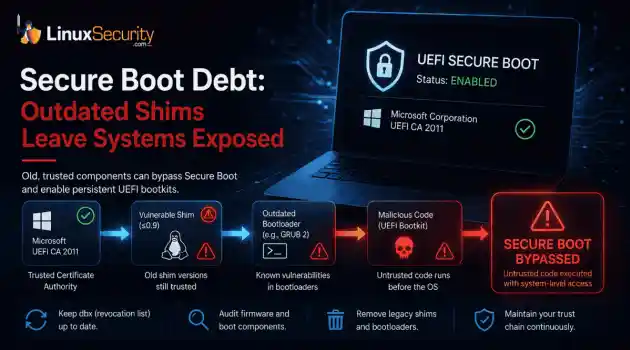
security advisory linux distribution ESET researchers identified 11 old and forgotten Linux UEFI shim bootloaders at versions 0.9 and below that can be used to bypass UEFI Secure Boot on any UEFI-based machine that trusts Microsoft’s Microsoft Corporation UEFI CA 2011 third-party certificate authority, regardless of the installed operating system (OS). Reported shims can be exploited to execute untrusted code during system boot, enabling attackers to deploy malicious UEFI bootkits even on systems with UEFI Secure Boot enabled.....
Jul 16, 2026
 Refine news
X Clear Filters
Get the latest News and Insights
Get the latest Linux and open source security news straight to your inbox.
Community Poll
Is continuous patching actually viable?
Loading...
Explore Latest Linux Security news
We found 172 articles for you...
77
 data privacyautomationIT support
What Happens When AI Agents Start Handling Tier-1 Linux Support Tickets
Every system admin has lived through the same Monday morning ritual. A queue of forty tickets, half of them password resets, permission errors, or disk space warnings that any experienced technician could resolve in under two minutes. The other half require actual judgment. For years, automation promised that software would eventually sort the two apart on its own. That promise is now being tested in production Linux environments. . Early results are reshaping how IT teams think about tier-1 support altogether. Moving from passive ticket routing to active, autonomous remediation is a turning point for infrastructure management. Modern digital agents don’t just categorize issues. Now, they can directly parse syslog files, execute bash commands, and verify system state changes without manual oversight. The way this transition is actually playing out on the command line reveals massive efficiency gains waiting to be unlocked. At the same time, engineering teams are confronted by entirely new operational risks. The success of agent automation depends on how they decide to navigate those new risks. A New Generation of Agentic IT Platforms A growing number of IT management platforms have started deploying autonomous agents that read, categorize, and in many cases resolve tier-1 tickets without a human touching the queue first. An autonomous IT agent resolves Tier-1 tickets end-to-end on the device — triaging incoming requests, pulling context from device history, and closing out routine issues before they reach a technician's desk. The pitch is straightforward. Free up human staff for the tickets that actually need a person thinking through them, and let the agent absorb the repetitive work that eats up the bulk of a support team's hours. For Linux environments specifically, this shift matters more than it might on a Windows-heavy help desk. Linux tickets tend to skew toward configuration drift, package conflicts, and permission issues that follow recognizable patterns. Thatpredictability makes the environment a reasonable proving ground for agentic automation, but it also raises the stakes when something goes wrong, because a misconfigured permission fix pushed at 2 am can propagate across a fleet of servers before anyone notices. Why Tier-1 Linux Support Is a Natural Testing Ground Tier-1 tickets are, almost by definition, the most templated part of any support operation. Users forget their SSH keys. Cron jobs fail silently. Log partitions fill up because nobody set a rotation policy. These are not novel problems, and the fixes are rarely creative. Repetitiveness is exactly what makes large language models effective here. An agent trained on thousands of resolved tickets can recognize the shape of a problem faster than a junior technician still building pattern recognition from scratch. However, some problems are more complex than they appear. Recognizing a pattern is a different challenge from understanding the environment it lives in. Human Linux technicians generally have some sense of what that server does, who depends on it, and what happens if a fix goes sideways. An AI agent working from ticket text and system logs alone does not automatically have that context. That’s why most current deployments are scoped narrowly. Agents are restricted to specific ticket categories, paired with escalation paths that hand off ambiguous issues to a person. The Privacy Question Nobody Asks Loudly Enough Support tickets are full of sensitive information. Customer names, internal hostnames, sometimes credentials pasted directly into a ticket body because a user panicked and included everything they could think of. When that data sits in a system reviewed by trained staff under an internal policy, the exposure is contained. When it becomes training or context data for an AI system, the calculus changes. Exposure from support tickets is already a well-documented problem. Linux Security reported on an incident where customer names and addresses were exposedthrough a support ticket error that made tickets accessible to anyone who had submitted one. Poorly implemented ticketing systems are frequently the weakest link in an otherwise well-guarded environment. If an organization wants to add AI agents into that workflow, they need to ask some hard questions about their existing security. Where ticket data travels, how long it persists, and whether an agent's memory will retain details of a resolved issue. Without thinking it through, the agent can exacerbate all of the existing data vulnerabilities of a ticketing system. Well-architected agentic platforms address this directly through tenant-level data isolation, approval workflows for high-risk actions, and audit trails on every agent decision — which is why the security posture of the underlying platform matters more than the intelligence of the agent sitting on top of it. Kernel-Level Security Still Matters More Than the Interface It is tempting to treat AI ticket triage as a purely software layer problem, something that lives entirely above the operating system. That framing misses how much the underlying platform still shapes what an agent can safely do. Linux itself continues to harden at the kernel level in ways that directly affect how much autonomy any automated system, human-built or AI-driven, can be trusted with. Recent kernel development illustrates the point well. Linux Security covered how newer architecture support strengthens address space layout randomization , a defense mechanism that makes it harder for any process, including a misbehaving script or an overly permissive agent, to exploit predictable memory addresses. These improvements are a quiet reminder that the foundation an AI agent operates on matters just as much as the intelligence of the agent itself. No amount of clever ticket triage compensates for a kernel that makes lateral movement easy once something goes wrong. The Broader Industry Is Moving Toward Standardized Agent Frameworks The interest in AIagents handling operational work is not confined to IT help desks. Industry analysts have tracked a broader push toward shared standards for how autonomous agents communicate, hand off tasks, and operate within enterprise infrastructure. Forbes recently examined how an agent framework moved under the stewardship of the Linux Foundation, signaling that major industry players see enough long-term value in agentic systems to want open, interoperable standards rather than a patchwork of proprietary approaches. That context matters for IT teams evaluating tier-1 automation tools. A platform built on emerging open standards is more likely to integrate cleanly with the rest of an organization's stack a few years from now than one built entirely on closed, proprietary logic. It is a detail worth watching closely as more vendors enter this space. Where Ticket Automation Fits Alongside Broader Monitoring AI-driven ticket triage does not exist in isolation. It sits alongside a wider set of tools that IT and operations teams already rely on to understand what is happening across distributed and remote environments. Discussions of remote desktop monitoring software cover some of the same underlying challenges, giving teams visibility into systems and activity without requiring a person to manually check every endpoint. The overlap is not coincidental. Both categories of tooling are trying to solve the same basic problem, which is how a smaller team keeps oversight over a growing and increasingly distributed set of machines. Hosting environments face a parallel version of this challenge. As more infrastructure moves toward AI-assisted operations, conversations around AI-powered helpdesk tools in the web hosting space echo many of the same tradeoffs seen in general IT support, including where automation genuinely reduces workload and where it introduces new categories of risk that did not exist when a human reviewed every request. What Comes Next for Tier-1 Support Teams None of thissuggests tier-1 support is about to become fully autonomous. The line between routine and complex tickets is becoming a design decision rather than a fixed boundary. To benefit from ticket automation, support teams must clearly define which Linux tickets are safe to hand to an agent, and which absolutely require a human in the loop. This approach sets boundaries that limit inherent risks. On the other hand, organizations that treat every ticket as automatable are the ones likely to learn the hard lessons first. . Explore how AI agents are transforming tier-1 Linux support and the impact on operational efficiency and security risks.. AI support automation, Linux ticketing system, autonomous IT, data exposure risks. . Andrew Kowal
 Jul 17, 2026
•
Jul 17, 2026
• Server Security
209
 open-sourcedata privacymachine learning
Top Synthetic Data Generation Tools for AI and Testing in 2025
If your organization needs realistic data for training, testing, AI modeling, or analytics while staying compliant with privacy laws, synthetic data platforms can help. These tools create datasets that reflect real patterns without exposing sensitive information and can speed up development cycles. . How does synthetic data generation work? Most platforms estimate the distribution of real data, sample new records that follow the learned distribution, then apply post-processing to meet constraints or business rules. Techniques include statistical modeling, machine learning, and deep learning. Key advantages Protects sensitive data and strengthens privacy programs Helps teams meet regulatory obligations Shortens development and testing timelines Lowers the cost of data provisioning and sharing Improves collaboration by sharing safe-to-use datasets Can help reduce unwanted bias when fairness controls are applied Gives developers and testers more control over dataset shape and quality Top synthetic data generation options in 2025 1. K2view — best for all-in-one enterprise testing and data privacy Recognized as a “Visionary” in Gartner’s 2024 Magic Quadrant for Data Integration Tools, K2view combines synthetic data generation with test data management and data masking to support secure testing at scale. It offers no-code workflows so testers can parameterize datasets for specific scenarios. 2. Gretel — best for AI and machine-learning workflows Gretel provides APIs and models for generating privacy-preserving synthetic data across tabular data, text, JSON, events, and more. It is well-suited to developer pipelines and research workflows. 3. Synthesis AI — best for computer-vision datasets Synthesis AI focuses on high-fidelity, labeled visual datasets for training perception models. It supports complex, human-centric, and in-vehicle scenarios to accelerate CV development where real data collection is slow or costly. 4. Sogeti —best for enterprise services across multiple domains Sogeti (part of Capgemini) offers consulting and tooling for synthetic and test data, with guidance tailored to regulated industries and large enterprise landscapes. 5. MOSTLY AI — best for compliant data sharing and fairness controls MOSTLY AI generates privacy-safe synthetic datasets that preserve statistical properties of source data. It includes fairness tooling to target parity on sensitive attributes, which can help reduce disparate outcomes in downstream models. 6. Synthea — best open source option for healthcare Synthea is an open source synthetic patient generator used for research, validation, and testing without exposing real patient data. It produces rich, labeled health records, making it a strong fit for clinical and health IT use cases. 7. Hazy — best for financial services datasets Hazy specializes in high-quality synthetic data for financial services and other regulated sectors, delivered as an enterprise platform. Open Source Options for Linux Teams If you’re running workloads on Linux or working in highly regulated environments, open source tools can be especially valuable. Synthea remains the best-known choice for healthcare, producing detailed synthetic patient records for research and testing without exposing real PHI. Another strong option is the Synthetic Data Vault (SDV) ecosystem, a set of Python libraries designed for generating tabular, relational, and time-series synthetic data. SDV is widely used in academic and enterprise projects and benefits from a growing open source community. Open source solutions give teams full control over the software stack, greater transparency for audits, and the flexibility to extend or adapt tools for custom test cases — advantages that align closely with the priorities of Linux security practitioners. Bottom line for 2025 Choose a platform that matches your compliance needs, data types, and delivery model. For enterprises consolidating testdata, K2view and Hazy are strong fits. For AI-heavy teams, Gretel and Synthesis AI accelerate training. If you prefer open source, start with Synthea for healthcare or other community-driven options for tabular and time-series data. . How does synthetic data generation work? Most platforms estimate the distribution of real data, samp. organization, needs, realistic, training, testing, modeling, analytics, while. . MaK Ulac
Sep 19, 2025
•
Security Trends

79
 network managementdata privacysecurity initiatives
Enhancing Network Security with AI: LF Networking Insights
As network security advances, we Linux security administrators must stay abreast of the latest tools, technologies, and trends to keep our systems resilient against emerging threats. Recent announcements from Linux Foundation Networking (LF Networking) reveal groundbreaking AI-driven projects and milestone releases that promise to reshape the network security domain. . Key initiatives like Project Salus and the Essedum Framework are introducing sophisticated tools to enhance data privacy , enforce ethical AI practices, and drive intelligent network management. With network automation, predictive maintenance, and robust security identified as top AI applications, these developments are set to streamline threat detection and response, making the lives of security admins like you and me safer and easier. Integrating the open-source technologies and strategic AI applications highlighted in LF Networking's global survey is indispensable for those managing cloud-native deployments. LF Networking is addressing critical security concerns and skill gaps, offering frameworks like Nephio and CNTi to ensure secure and compliant cloud operations. As the community drives these innovations forward, Linux security admins must hone their skills to leverage intent-based automation and other advanced security measures. Let's examine how embracing these developments fortifies network security and transforms security teams' operations in an increasingly AI-enhanced technological landscape. AI-Driven Security Innovations Of all the innovative initiatives announced so far, Project Salus stands out as an AI toolkit with responsible practices at heart. Dubbed after the Roman goddess of safety and wellbeing, Salus promises to implement stringent AI guardrails that protect data privacy, maintain traceability, and avoid biased decision making when deployed by AI systems. This assures us, security administrators, that AI deployments respect data privacy while offering reliable data aggregation tools that buildsecure network infrastructures with compliance at heart. Project Salus' Essedum Framework addresses AI's unique challenges for network operations. By centralizing and customizing data models for specific network use cases, Essedum improves how networks handle, manage, and secure data across heterogeneous environments while emphasizing cataloging, assurance, and access control—essential aspects for security admins who aim to maintain an enduring security posture within a complex network security threat landscape. Embracing Cloud-Native Technologies According to LF Networking’s recent global survey , 73% of organizations are moving towards integrating cloud-native networking into their operations. This shift brings with it a new set of security priorities and challenges. Cloud-native technologies, which often rely on containers , microservices, and dynamic orchestration, require a novel approach to security. LF Networking’s initiatives provide the necessary frameworks and best practices to secure these modern deployments. Projects like Nephio and the Cloud-Native Telecom Initiative (CNTi) are at the forefront of this movement. Nephio aims to simplify and automate the deployment and operation of Kubernetes across multiple clouds, ensuring that security policies are consistently applied across all environments. Meanwhile, CNTi focuses on creating standardized architecture models that enhance security and performance for cloud-native networks. For Linux security admins, staying updated with these projects' latest resources and guidelines will be crucial in effectively managing the transition to secure cloud-native environments. Bridging the Skill Gap One of the most revealing aspects of LF Networking’s survey is its spotlight on the barriers to open-source adoption. Notably, 38% of organizations cite skill gaps, while 37% point to security concerns as primary hurdles. These statistics are a call to action for security administrators to prioritize continuous learning and skillenhancement. As the landscape shifts towards AI-driven network security, having the right skills will be essential to mastering new tools and technologies. Strategic AI Applications in Network Security Perhaps one of the most surprising and fascinating insights from LF Networking’s survey is identifying AI applications that are pivotal to network security. Security ranks alongside network automation and predictive maintenance as one of the top AI applications, with 50% of respondents recognizing its significance. This provides a clear message to security admins: AI is not a future vision but a present reality that must be integrated into current security strategies. AI-driven security applications are set to revolutionize the identification of vulnerabilities and threats and the orchestration of responses. Initiatives like Salus and Essedum have tailored these applications to fit specific security needs within network environments. By adopting these AI tools, security admins can automate the often labor-intensive threat detection process, allowing quicker and more effective responses to potential security breaches. Security in Intent-Based Networking Intent-based networking represents a significant leap forward in network management, translating human intent into automated network configurations. This approach enhances operational efficiency and boosts security by minimizing the risk of configuration errors. AI is crucial in enabling these configurations, driving networks to operate seamlessly and securely based on predefined intents. For Linux security admins, the move towards intent-based automation signifies a transformational change. By clearly defining security policies and intents, admins can ensure that networks are configured correctly and consistently. This proactive approach to network management reduces the likelihood of human error and enhances the overall security framework. Our Final Thoughts: Navigating the Transition to AI-Driven Security The integration of AI intonetwork security, as showcased by LF Networking, marks a turning point for Linux security administrators. These advancements are not merely incremental improvements but foundational shifts that change how security is managed in network environments. The practical applications of AI, from enhanced data privacy to automated threat detection, offer a powerful toolkit for modern security challenges. However, navigating this transition requires more than just awareness. Security admins must actively engage with the new tools and frameworks provided, continuously enhance their skills, and participate in the global community driving these innovations. By doing so, they can ensure that their networks remain secure and thrive in the face of advancing technological threats. . Explore innovative AI-enhanced solutions such as SecureGuard and ShieldPro Framework that revolutionize cybersecurity management for Linux professionals.. AI Security Advances, Linux Network Management, Cloud-Native Technologies, Data Privacy Tools. . Brittany Day
Apr 03, 2025
•
Security Projects
78
 security advisorydata privacyupdate management
Security Considerations for Deepin 25 Linux Transition from Windows
For Linux admins and Windows users looking to broaden their horizons and explore new distributions, the allure of Deepin 25 Linux —with its Windows 11-like interface—cannot be overlooked. Deepin’s polished aesthetics and familiar user experience present an attractive option, especially for those transitioning from Windows 10. . However, when venturing into Deepin’s ecosystem, weighing the visual appeal against potential security and privacy concerns is crucial. With Deepin's controversial origins in China, administrators must meticulously evaluate the distribution's data privacy practices and update management nuances. In this article, I'll delve into these pivotal considerations, providing a clear-eyed view of Deepin 25's strengths and potential pitfalls to help you make informed decisions in securing your systems. Exploring The Allure of Deepin 25 Source: ZDNet Deepin 25 Linux, currently in Preview , was designed to be user-friendly and visually appealing, closely replicating Windows 11's user experience. This makes it particularly appealing for enterprises and users attempting to transition away from Windows to Linux but are uncertain how their interface or experience will differ. The familiarity can help reduce learning curves considerably, assisting users to quickly adapt to a different environment. One of the standout features of Deepin 25 is its built-in AI assistant and modernized system framework. The system includes read-only core system files, modular extensions, automatic rollbacks, incremental updates, and fast backup and restore features. This attention to design and functionality creates an OS that feels contemporary and robust, ensuring users can perform their tasks efficiently without feeling alienated. Deepin 25 provides users with a user-friendly control center and extensive customization options, giving them complete control over their environment to meet personal and organizational requirements. This level of customization is greatly appreciated byexperienced administrators and newcomers - making Deepin visually attractive but also practical and user-friendly. Considering Security and Privacy Concerns Deepin hasn't always had it easy. One of the primary concerns regarding Deepin stems from its Chinese origins. Debate and skepticism among the Linux community have arisen over whether user data may be monitored or mishandled by default. Deepin uses the Baidu search engine as its default search provider, while app stores require Deepin ID sign-in - two practices that raise legitimate concerns regarding privacy and data tracking. Trust is of paramount importance for security administrators. While there's no concrete proof that Deepin engages in illegal data collection practices, potential risks cannot be dismissed outright. These concerns have not only been voiced about Deepin; similar fears have also been expressed regarding other Chinese technology products and their relationship with government surveillance programs. To manage these risks, administrators should conduct extensive vetting of an operating system before fully deploying it in their production environment. This could involve testing Deepin 25 in a controlled sandbox or virtual machine. Such a cautious approach allows administrators to evaluate the OS regarding functionality and security without exposing critical systems to potential vulnerabilities. Update Management and System Reliability Another area where Deepin 25 demands scrutiny is its updated management system. Deepin uses its Ubuntu base's standard apt package manager and its proprietary Deepin Package Manager . This dual approach can sometimes lead to confusion and inconsistency. For example, there have been instances where the number of updates available via the apt-get tool did not match the updates shown by Deepin's graphical System Update interface. This discrepancy leads to questions about the reliability and thoroughness of system updates , which are critical for maintaining security and stability. Administrators should ensure that all system updates are applied consistently and timely. They can achieve this by supplementing the GUI-based updates with command-line verification and regular checks. This practice helps to catch any missed updates, ensuring the system remains secure and current. The Broader Context of International Relations Geopolitics also influences how organizations perceive Deepin 25, especially within the US and other Western nations. With growing concerns over Chinese technology and its implications for data security and national security, enterprises should carefully assess potential risks before adopting such technology. US government actions have previously raised red flags about Chinese hardware and software use, warning to be cautious with purchases and sometimes banning imports entirely. Such decisions can influence organizational policies and decision-making processes, making it necessary for security administrators to stay abreast of ongoing developments and regulatory issues. Admins must keep an open dialogue with their organizational leadership about the implications of Deepin or any software with potential international security risks and work toward understanding and mitigating them proactively to help organizations navigate today's complex global technological landscape. Practical Steps for Evaluating Deepin 25 With all these considerations in mind, security administrators should approach Deepin 25 with a structured evaluation plan. Here's a practical way to get started: First, test Deepin 25 in a virtual machine or a sandbox environment. This isolated setup allows you to explore the OS without compromising the integrity of your primary systems. It provides a safe space to assess the OS's functionality, responsiveness, and overall user experience. Next, scrutinize the default settings and configurations. Paying attention to the connectivity settings, data-sharing preferences, and system permissions can reveal potential privacy risks.Administrators should adjust settings to enhance privacy and security, disabling unnecessary features or services. It’s also critical to review Deepin’s update management process. Implement consistent checks using the Deepin Package Manager and apt-get to promptly apply all necessary patches and updates. This practice will help maintain your system’s security posture. Consider running Deepin within a controlled network environment to monitor its traffic and identify suspicious activity. Network monitoring and forensic tools can help detect unusual patterns that may indicate privacy concerns or security issues, giving admins a clearer picture of the OS's behavior. Lastly, explore alternative Linux distributions that offer the Deepin Desktop Environment (DDE), such as UbuntuDDE. These distributions might provide a similar user experience with potentially lower security risks. They allow you to enjoy the aesthetic and functional benefits of Deepin’s design without fully committing to its proprietary elements. Our Final Thoughts on Deepin 25 Linux Deepin 25 Linux stands out for its user-friendly, visually pleasing interface that closely resembles Windows 11, making it an attractive option for administrators transitioning from Windows to Linux . However, given its Chinese roots and geopolitical context, its allure must be balanced against potential security and privacy risks. Security admins should take an analytical and deliberate approach when deploying Deepin 25. By testing it in controlled environments, reviewing its update management practices, and exploring alternative distributions, you can navigate any challenges related to Deepin while making informed decisions to secure your systems. Staying abreast of technology developments is paramount to protecting our security and privacy. Deepin 25 offers many benefits; however, it must be approached carefully with an understanding of all potential implications to avoid any unforeseen dangers that could undermine these advantages. . However, when venturing into Deepin’s ecosystem, weighing the visual appeal against potential secu. linux, admins, windows, users, looking, broaden, their, horizons, explore, distributions. . Brittany Day
Jan 29, 2025
•
Vendors/Products
81
 cyber threatsencryptiondata privacy
Linux Data Privacy: Essential Tools and Security Features Against Threats
Data privacy might sound like a technical issue best left to the IT department, but let me put it into perspective: One day, all your personal messages, sensitive financial information, or even your company's trade secrets could be leaked to unauthorized parties. Unfortunately, this is not a hypothetical scenario; cyber threats are multiplying exponentially, affecting everything from individual devices to enterprise networks. With the threats to the security of systems on all sides, how can we possibly trust them with our data? Well, here comes Linux: powerful, open-source, and with a solid emphasis on security. For those looking to fortify their digital environments, Linux can offer an invaluable solution, thanks to preventing unauthorized access and data breaches. In this article, we will talk about some of the unique security features of Linux and its mechanism for keeping your data safe. We also provide actionable insights to keep you safe from trending cyber threats. The Security Advantage of Linux Linux is designed with security in mind. It’s open-source, meaning that developers and users worldwide can inspect the code, find vulnerabilities, and fix them before they become exploitable. The Linux community is very fast at developing and pushing patches once a risk has been identified; thus, the system remains secure and stable. Additionally, Linux supports removing your online digital data as an extra layer of security, allowing users to minimize their exposure to potential threats. Linux also gives users unparalleled control over their systems. Such flexibility in design allows tailoring an operating system's setup to match specific needs, increasing functionality and security. While many operating systems exist, Linux has quite a few distributions tailored for use cases ranging from personal computing to enterprise solutions. The adaptability combined with the proactive approach toward security makes Linux strong in data protection. Essential Data Privacy Tools on Linux Forthose concerned about data privacy, Linux offers different tools designed to keep data secured through encryption and security protocols. Here are some of the options to consider: Wireshark is a program that analyzes network traffic for any suspicious activity by analyzing various network protocols. It's often used to monitor and evaluate networks, which is vital in spotting possible data breaches or questionable activity. ClamAV is an open-source program that detects worms, trojans, viruses, and phishing programs. When installed on Linux, it scans emails and files for malware that might harm the system. This might block viruses that could result in data loss or breaches. Firejail is an application sandboxing utility. It minimizes the possibility of hacking a system just by tossing its untrusted applications into an isolated environment. Thus, it is a straightforward solution for privacy and protection. If you want to implement robust data encryption, then LUKS is the first choice. It is a type of disc encryption that provides full-block device encryption to lock any sensitive partition or even external drives. Data is kept using a very strong encryption technique so that no one can access it, even if they get physical access to the disc. Linux Success Stories in Data Sharing Over the past few years, Linux has become one of the primary options when it comes to data security and sharing for different sectors: Financial sector Uses Linux to overcome challenges in sharing data with privacy. Sensitive financial information is always under cyber threat, but strong and reliable security features make Linux again a weapon of choice. Organizations protect or avoid breaching critical financial data with the help of Linux. Healthcare Organizations depend on Linux for security regarding patient data transmission while setting high standards, such as HIPAA. Linux actually provides safe storage, access, and sharing of health information. Using a Linux-based solutionreduces the risk of a patient information breach and ensures conformance to existing privacy laws. Government Sector Many governments use Linux to secure sensitive data, anything from public records to national defense data; the list goes on and on. Linux provides the security for it all. Many government agencies have either stopped a breach or two by aiding through Linux or by making sure critical data remains private. Future Data Privacy Trends Data privacy increases as technology evolves, positioning Linux as one of the best options for securing data. As technology and the internet grow, so do possible cyber threats, which means that there will always be a need for secure operating systems like Linux. Based on the current situation, here are some of the trends that might catch wind soon: The first trend is no surprise— artificial Intelligence in Security . As technology progresses, we will see a lot of AI presence. Integrating AI with Linux could add additional layers of security by predicting and preventing possible threats in real-time. More organizations are focusing on open-source security . This is because open-source systems allow for better transparency and security. Even though privacy-enhancing technologies have been around for a while, they are becoming more popular every passing moment. The idea behind these technologies is to reduce a system’s access to personal data without affecting its function. These trends are proof of a shift towards a more user-controlled approach, securing Linux a place among the relevant choices for privacy security. To Sum Up: Linux as a Champion of Data Privacy Linux is open source, community-driven worldwide, at the forefront of data security and privacy, thereby assuring users and developers in their cooperation to patch vulnerabilities while keeping the system secure and reliable. Its openness lets you provide the enhanced assurance that such decisions are sound for all those concerned with eventual databreaches. Whether it’s protecting financial records, healthcare information, or sensitive government data, Linux proves its worth every day. As cyber threats grow, Linux keeps evolving to stay ahead. If you’re serious about keeping your data safe, Linux isn’t just a wise choice—it’s the right one. . . Explore the ways Linux enhances information security and privacy through powerful utilities and techniques for safe internet interactions.. Data Privacy, Online Security, Linux Tools, Encryption, Open-Source Security. . MaK Ulac
Nov 15, 2024
•
Privacy
81
security advisorydata privacysecurity fixesTails 6.8 Security Update: New Features, Fixes, and Upgrade Paths
As digital privacy and security concerns increase, operating systems that safeguard user anonymity and data privacy have gained greater prominence. One such operating system is Tails (The Amnesic Incognito Live System). . Tails has become renowned for its commitment to anonymity by employing the Tor network for secure online activities. The recent Tails 6.8 release introduces numerous features, updates, and critical fixes that further augment its mission as an invaluable privacy-focused tool. In this article, I'll delve deeper into these changes and their impact on security and privacy. Additionally, I'll explain how you can install or upgrade to this latest Tails 6.8 release. Significant Changes & New Features Introduced in Tails 6.8 Notable changes and new features added in Tails 6.8 include: File System Repair Feature Tails 6.8 introduces an essential feature for Persistent Storage with file system repair capabilities. In previous releases, errors in file systems could pose significant challenges and compromise data integrity. The current release addresses this concern by providing repair options directly from the Welcome Screen when unlocking Persistent Storage. While not every error can be safely rectified this way, Tails has prepared comprehensive documentation to assist users in recovering valuable files using alternative techniques, thus improving user experience while recovering any valuable assets that might have been lost through such errors. Updates to Existing Applications Tails 6.8 brings significant updates to bundled applications, most notably the Tor Browser update to version 13.5.6 . By staying current on their security patches and performance upgrades, keeping Tor updated enables users to enjoy enhanced online anonymity. Problems Addressed & Fixed in Tails 6.8 Several problems have been fixed in Tails 6.8 to offer improved security and a better user experience. They include: Waiting Time Extension for Persistent Storage Unlock: Acritical fix in Tails 6.8 involves extending the maximum waiting time when unlocking Persistent Storage to eight minutes. This extension prevents premature errors by accommodating variations in device performance and complex encryption processes, offering a smoother and more reliable unlocking experience. Enhanced Security for Password Visibility: Tails 6.8 implements a feature to hide the password shown while accessing the Persistent Storage to improve security during unlocking. This minor yet impactful change guards against shoulder surfing and boosts the confidentiality of sensitive data, aligning with Tails’ ethos of uncompromising security. WhisperBack Error Message Improvements: WhisperBack, Tails’ tool for reporting errors, has been refined to handle failures more robustly. Previously, failures in this tool posed significant hurdles, especially when Tails was not connected to Tor. These enhancements facilitate a more user-friendly error reporting process, aligning with the overarching goal of seamless user engagement. Accessibility Enhancements: Input fields are now more accessible with screen readers, addressing inclusivity and usability concerns.Installation and Upgrade Paths for Tails 6.8 Multiple options exist for upgrading to or installing Tails 6.8. These options include: Upgrading from an Existing Tails Installation For users with Tails 6.0 or later, upgrading to Tails 6.8 is straightforward through automatic upgrades, offering a seamless transition. However, a manual upgrade is recommended to circumvent potential issues if automatic upgrades fail to initiate or complete. Fresh Installation on New USB Sticks For budding users or those necessitating a fresh installation, comprehensive installation instructions are available for various platforms, including: Windows macOS Linux Debian or Ubuntu (via command line and GnuPG) It’s crucial to note that conducting a fresh installation on a USB stick will erase any existing PersistentStorage, so users should back up important data before proceeding. Direct Download Options For those preferring to manage their installation independently without detailed instructions, Tails 6.8 offers direct download links for: USB Image: Suitable for creating bootable USB devices. ISO Image: Ideal for use with DVDs and virtual machines. These options ensure users can choose the most compatible format tailored to their needs and preferences. Our Final Thoughts on the Significance of This Release Tails 6.8 shows the project's continued dedication to safeguard user privacy and enhance system security. Tails remains an indispensable privacy-focused OS with features like its file system repair tool, improved alert systems, comprehensive updates, and problem-solving mechanisms that keep pace with technology trends and safeguard our digital footprints. Tails 6.8 provides essential tools and features for Linux users wishing to maintain anonymity and protect personal data. With continuous innovation and adaptation from its designers, Tails OS provides secure computing in an increasingly digitally surveilled landscape. . Tails 6.8 enhances security and user experience with new features and fixes, ensuring robust user anonymity on the Tor network.. digital, privacy, security, concerns, increase, operating, systems, safeguard, anonymity. . Brittany Day
Oct 09, 2024
•
Privacy
67
 data privacyencryption toolcybersecurity tool
Explore Shufflecake: Create Hidden Filesystems For Data Privacy
Thursday the Kudelski Group 's cybersecurity division released "a tool for Linux that allows creation of multiple hidden volumes on a storage device in such a way that it is very difficult, even under forensic inspection, to prove the existence of such volumes." . "Each volume is encrypted with a different secret key, scrambled across the empty space of an underlying existing storage medium, and indistinguishable from random noise when not decrypted." "The reason why this is important versus "simple" disc encryption is best illustrated in the famous XKCD comic 538 ," quips Slashdot reader Gaglia (in the original submission . But the big announcement from Kudelski Security Research calls it "a tool aimed at helping people whose freedom of expression is threatened by repressive authorities or dangerous criminal organizations, in particular: whistleblowers, investigative journalists, and activists for human rights in oppressive regimes. . Delve into Shufflecake, an innovative solution for crafting concealed filesystems, safeguarding your data integrity from potential vulnerabilities.. Shufflecake, Hidden Filesystems, Linux Encryption, Cybersecurity Solution, Plausible Deniability. . LinuxSecurity.com Team
Dec 14, 2022
•
Cryptography
67
 web securitydata privacybrowser security
Google Chrome for Linux Adds DNS-Over-HTTPS Support: Key Details
Google Chrome for Linux is getting DNS-over-HTTPS, but there's a catch! Learn the details in this article. . Google Chrome developers have announced plans to roll out DNS-over-HTTPS (DoH) support to Chrome web browser for Linux. DoH has been supported on Google Chrome for other platforms, including Windows, Mac, ChromeOS, and Android, since at least 2020. While the exact version of Chrome for Linux that would come out with DoH support is yet to be announced, the Chromium project expects either M91 or M92 to contain the feature. . Mozilla Firefox on Windows is poised to implement enhanced privacy features, bolstering user data protection while raising important questions.. DNS-over-HTTPS, Chrome Linux, web security, browser feature, data privacy. . LinuxSecurity.com Team
Mar 31, 2021
•
Cryptography

Get the latest News and Insights
Get the latest Linux and open source security news straight to your inbox.
Community Poll
Is continuous patching actually viable?
Search Topics
Powered By

Linux Security - Your source for Top Linux News, Advisories, HOWTOs and Feature Releases
QUICK LINKS
subscribe to newsletters!
Like staying secure? So do we.
Sign up for updates, tips, and alerts!