Explore top 10 tips to secure your open-source projects now. Read More
×



Server Security data privacy automation
data privacy automation Every system admin has lived through the same Monday morning ritual. A queue of forty tickets, half of them password resets, permission errors, or disk space warnings that any experienced technician could resolve in under two minutes. The other half require actual judgment. For years, automation promised that software would eventually sort the two apart on its own. That promise is now being tested in production Linux environments. . Early results are reshaping how IT teams think about tier-1...
 Jul 17, 2026

Privacydata collection automation
data collection automation You're running a web scraping project to collect pricing data from e-commerce sites. You set up a pool of datacenter proxies, launch your scripts, and within minutes — banned . CAPTCHAs everywhere. Your data pipeline stops before it really begins. . It's a frustrating scenario that plays out daily in ad verification, market research, and multi-account management. The website doesn't know you're doing legitimate research or monitoring. It just sees traffic coming from IP ranges it recognizes as...
Jul 17, 2026

Security Trends security advisory social engineering
security advisory social engineering Business Email Compromise used to be a numbers game — mass-blasted emails, broken English, an obvious "URGENT WIRE TRANSFER" subject line. That era is over. Generative AI has turned BEC into a tailored, low-noise operation that mimics writing style, voice, and even video presence. This piece looks at what's actually changed under the hood, what defenders are testing in response, and why so many organizations are still structurally unprepared for it. . The Infrastructure Problem Nobody Wants to...
Jul 17, 2026

Security Trends cybersecurity Linux documentation
cybersecurity Linux documentation Linux operating systems have gained prominence due to their stability, adaptability, and excellent security options. In the case of developing documentation, designing cybersecurity dashboards, or educational material, visuals are of vital importance when it comes to making things clear. The use of icons allows one to understand the message regarding alerts, authorization, encryption, authentication, or the state of the system just by looking at the visual cue without having to read long...
Jul 17, 2026
Security Vulnerabilities security advisory linux distribution
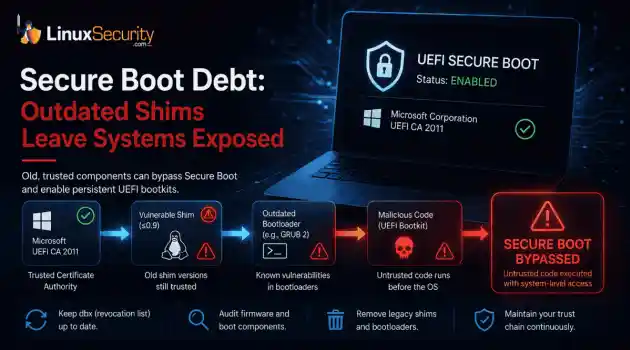
security advisory linux distribution ESET researchers identified 11 old and forgotten Linux UEFI shim bootloaders at versions 0.9 and below that can be used to bypass UEFI Secure Boot on any UEFI-based machine that trusts Microsoft’s Microsoft Corporation UEFI CA 2011 third-party certificate authority, regardless of the installed operating system (OS). Reported shims can be exploited to execute untrusted code during system boot, enabling attackers to deploy malicious UEFI bootkits even on systems with UEFI Secure Boot enabled.....
Jul 16, 2026
 Refine news
X Clear Filters
Get the latest News and Insights
Get the latest Linux and open source security news straight to your inbox.
Community Poll
Is continuous patching actually viable?
Trending News
Loading...
Explore Latest Linux Security news
We found 50 articles for you...
210
 security advisorycriticaldebian
Ubuntu: Chrome High Severity CVE-2025-38235 Escalation Risk MSG_OOB
Let’s talk about CVE-2025-38236 . If you’ve been following the Linux kernel's security track record, you already know how hard developers work to keep it solid. But every now and then, something slips through the cracks—and this time, it’s a big one. This vulnerability, disclosed by Jann Horn of Google’s Project Zero , allows an attacker to bridge the gap between user-level code running inside Chrome’s renderer sandbox and full-blown kernel-level control. That’s not just breaking out of one of the most hardened sandboxes out there—it’s obliterating it. . This critical flaw revolves around a rarely used feature called MSG_OOB . It's tied to UNIX domain sockets and, let’s be honest, probably doesn’t ring a bell for most Linux admins. That’s the problem, though—obscure functionality with poor visibility tends to become fertile ground for vulnerabilities. Before we dive into patches and mitigations, let’s walk through what this vulnerability is, why it’s dangerous, and how you can lock down your systems. The Obscure MSG_OOB : What Does It Even Do? Most Linux admins and developers interact with UNIX domain sockets regularly, but functions like MSG_OOB don’t normally enter the conversation. This feature—introduced back in Linux kernel 5.15—is meant to send “out-of-band” data through a socket. Think of it as a way to send one byte outside the normal data flow. Why one byte? Legacy compatibility. You’ll find it used in some edge cases, like Oracle products, but it’s otherwise forgotten in the shadows of kernel functionalities. The issue is that MSG_OOB was never implemented with modern applications in mind. In theory, it does what it’s supposed to: a single byte of out-of-band data is sent via send() and processed separately by recv() . But on closer inspection, the way this feature interacts with kernel structures—specifically with socket buffers and linked lists—creates dangerous inconsistencies. CVE-2025-38236: A Crippling UAF Bug Here’s where things go sideways. Horn’s write-up breaks it down , but the takeaway is this: there's a use-after-free (UAF) condition. Specifically, when the kernel processes out-of-band messages, it uses a data structure ( oob_skb ) to hold a reference to the socket buffer storing said message. The problem occurs when you start manipulating these buffers. Carefully crafted sequences of send() and recv() calls, which are normally valid, can force the kernel to reuse memory that was never properly cleaned up. Attackers love UAF bugs for obvious reasons. They can reclaim freed memory, poison it with malicious payloads, and trick the kernel into operating on those payloads as if they’re valid data. Combine this with a misconfigured sandbox, and you’ve got a clean path to kernel exploitation. Why Should You Be Concerned About CVE-2025-38236? From an attacker’s perspective, this vulnerability is a dream scenario. It requires no obscure hardware or special tools—just a browser (Chrome) and a target (Ubuntu, Debian, or any Linux system running kernel 6.9 or higher). Once they get past Chrome’s renderer sandbox, they’ve essentially bypassed one of the strongest security boundaries in desktop computing. Chrome’s renderer sandbox is supposed to be bulletproof. It protects users when a malicious website tries to execute arbitrary code. But even strong walls fall apart if they expose weak hinges—and in this case, those hinges are the MSG_OOB feature. Its availability inside the Chrome sandbox effectively handed attackers an overlooked pathway to escalate privileges. Who’s Affected by CVE-2025-38236? If you fit one or more of the following criteria, you are at risk of CVE-2025-38236 exploits: Linux 6.9 and Up: If you’re running Linux kernel 6.9 or later, you’re vulnerable right out of the box. Older kernels aren’t technically affected unless patches backported the feature. Chrome Users on Linux: If Chrome is running on your system, this bug gives malware running inside the renderer enough leverage to target kernel-level memory. Debian-based distributions, specifically Debian Trixie on x86-64 systems, appear to demonstrate the vulnerability clearly. General Desktop Linux Users: While the attack vector for server environments might differ, anyone relying on Linux desktops, particularly for browsing, is at serious risk. What Can You Do to Protect Against CVE-2025-38236? If the possibility of kernel-level control doesn’t already have your attention, then here’s what you need to focus on immediately: Patch, Patch, Patch: The fix is already upstream. As of kernel version 6.9.8 , the memory management bug in MSG_OOB has been patched. That’s your best defense. If you can't deploy the latest kernel straight away, consider temporary mitigations. Disable MSG_OOB: If you’re compiling a custom kernel, disable MSG_OOB entirely by setting CONFIG_AF_UNIX_OOB=n . This was never a particularly useful feature to begin with, and disabling it won’t hurt most environments. Apply System Call Filters: Use seccomp where applicable to limit what system calls untrusted processes (like Chrome’s renderer) can execute. Focus on filtering calls like send() and recv() when they include the MSG_OOB flag. Longer-Term Security Strategies This vulnerability also raises questions about kernel design and sandbox strategies. Obscure features, even those rarely used in practice, risk accumulating technical debt. CVE-2025-38236 is a textbook example of how attackers can exploit overlooked functionality, turning niche-use cases into systemic flaws. Audit Configurations: Review your kernel configurations and disable any features unnecessary for your workload. Sometimes, less is more—less attack surface, less headache. Limit Kernel Exposure: Sandboxing is critical, but it’s only as strong as the kernel it’s isolating you from. Make sure your kernel attack surface is as small as possible by usingminimalist distributions that strip away unneeded features. Closing Thoughts on Combating CVE-2025-38236 If you spend enough time in Linux security, you understand one thing: there’s no such thing as “bulletproof.” Strong security, whether it’s in Chrome’s renderer sandbox or the Linux kernel itself, starts with minimizing complexity and reducing exposure to unnecessary risk. CVE-2025-38236 reminds us that no system operates in isolation. A poorly-understood feature like MSG_OOB , intended for niche use cases, can quietly undermine critical security boundaries when exposed in the wrong context. Malware authors are always watching for these gaps in the armor. For admins, the lesson is clear: stay vigilant, stay updated , and don’t be afraid to strip functionality you don’t need. Linux kernel security is everyone’s responsibility. Every unused feature you disable, every suspicious process you isolate—it all adds up to make your systems just a little more difficult to exploit. And sometimes, that’s enough to stop the next CVE. Stay sharp. . Exploring the critical MSG_OOB exploit affecting Linux systems, how it works, and security measures for protection.. Linux Kernel Bug, CVE-2025-38236, Privilege Escalation, Security Measures. . Brittany Day
 Aug 12, 2025
•
Aug 12, 2025
• Security Vulnerabilities
210
security advisorylocal privilege escalationdebianUbuntu: Sudo Critical Flaws - Local Privilege Escalation Threat
It’s no exaggeration to call sudo the cornerstone of Linux privilege management. It’s one of the first utilities we configure on fresh installs, and it’s baked into almost every Linux distribution by default. Which is precisely why reports of two significant vulnerabilities in sudo—CVE-2025-32462 and CVE-2025-32463—are grabbing headlines and raising red flags. These are local privilege escalation flaws, and if they’re exploited, an attacker could jump from a non-privileged user account straight into the shoes of the almighty root user. . Root access is the holy grail for attackers. It means complete, unrestricted control over a system—access to sensitive files, logs, software installations, and potentially the ability to pivot to other systems in a network. In short, this isn’t a “patch it later when you have time” scenario. If you’re managing Linux systems—whether a single-host VPS or a sprawling on-premises cluster—this is the time to stop, assess, and act. Let's dig into the details and discuss how to keep your systems out of harm's way. So, What’s the Issue with Sudo? At a high level, the two vulnerabilities affect the sudo utility, which sysadmins rely on to grant temporary elevated privileges to non-root users for executing specific tasks. These vulnerabilities could allow an attacker to leapfrog those enforced boundaries and escalate their privileges to root. Over time, accumulated permissions can quietly become a major risk, which is why addressing privilege creep should be part of any long-term access review process. Details This one is tied to how sudo validates and processes certain inputs from users. The exploit scenario involves carefully crafting input data that tricks sudo into mismanaging permission checks or memory management. The result? An attacker bypasses regular user restrictions. CVE-2025-32463 Details The second vulnerability revolves around a flaw in how sudo handles environment variables or command arguments, depending onthe configuration. By exploiting this flaw within local constraints, an attacker could gain root-level execution. Crucially, neither vulnerability can be exploited remotely—an attacker needs local access first. But even with that barrier, it’s still a high-risk scenario considering the prevalence of shared, multi-user environments in modern Linux deployments. Why These Vulnerabilities Matter Privilege escalation is bad enough on its own, but let’s look at the ripple effects here: System Compromise There’s no sugarcoating it. Once an attacker gains root access, your system is essentially theirs. They can modify critical system files, deploy malware, disable security mechanisms, and generally wreak havoc. Stealth and Obfuscation The problem with giving attackers root access isn’t just what they can do—it’s how well they can hide it. Sudo typically logs privileged operations, which helps admins trace unusual behavior. But with root access, attackers can easily tamper with logs, hide evidence, or even set up backdoors for persistent access. Implications for Shared Systems If you’re running multi-tenant environments—whether shared hosting, development environments, or organizations with separate user accounts—one insecure user could compromise the entire system. Segmenting permissions means nothing if one weak link is exploited. Extended Attack Surface Many organizations automate tasks using cron jobs, scheduled scripts, or privilege delegation. A compromised sudo utility could turn any of these automation points into an auxiliary attack vector. The bottom line: even with local-only prerequisites, the potential damage makes this a serious, immediate threat. Who’s at Risk? Let’s be clear: if you’re running Linux, you’re at risk, unless you’ve already patched sudo. This includes: Popular Distributions Ubuntu, Debian, CentOS, Red Hat Enterprise Linux (RHEL), Fedora, and pretty much any Linux distro with a stock sudo installation arevulnerable. If you’ve got Linux machines in your environment—and if you’re reading this, you probably do—this is potentially impacting you. Shared or Multi-Tenant Systems Think university servers, cloud-based development platforms, or any shared infrastructure. These environments are ripe for exploitation, with local users interacting on the same system. Organizations Delaying Patches If you’ve been putting off updates to get to “later,” this is your wake-up call. The longer these vulnerabilities remain unpatched, the more exposed your systems are. What Should You Do? Fixing the issue boils down to applying patches and hardening your sudo configuration. Here’s how to approach it step-by-step: Patch Sudo Now First, check if you’re running a vulnerable version of sudo: sudo --version Compare the output against advisories from your distribution’s security team. Most maintainers have released patched versions by now. For those on Debian-based systems: sudo apt update && sudo apt upgrade sudo For Red Hat-based systems: sudo yum update sudo Test the patch in your staging environment if possible, especially for production-critical systems. Restrict Who Can Use Sudo Open the /etc/sudoers file and make sure only trusted users have sudo access. Remove redundant entries. Instead of granting full privileges broadly, consider: username ALL=(ALL) ALL Minimize who gets elevated privileges to only what’s absolutely necessary. Enable Auditing and Logging Use centralized logging solutions to monitor sudo activity. Tools like auditd or SIEM solutions can help spot anomalous sudo usage. Prioritize alerts for unexpected actions from routine users: auditctl -w /usr/bin/sudo -p x -k sudo_exec Harden the System with SELinux or AppArmor Mandatory Access Control (MAC) systems like SELinux or AppArmor can provide an extra layer of sandboxing, limiting what users can do, even with root privileges. Segment High-RiskSystems If a system is handling highly sensitive workloads or frequently sees untrusted user interaction, consider isolation techniques. Use sandboxing, virtualization, or physical separation to minimize the blast radius if an exploit occurs. The Final Word: Stay Vigilant Sudo vulnerabilities like CVE-2025-32462 and CVE-2025-32463 are a stark reminder of how foundational tools can sometimes introduce serious risks. Admins and security teams can’t afford to treat privilege escalation bugs lightly. Make patch management routine. Subscribe to LinuxSecurity newsletters and use tools to automate vulnerability scanning . Maintaining continuous awareness is your best defense, as critical issues like these will inevitably resurface. Lastly, think of privilege boundaries as a layered defense, not a guarantee. Harden configurations, audit activity, and segment systems wherever possible. And when vulnerabilities like these roll around, act swiftly. Root is a dangerous power to leave unguarded! . Admin privileges are the ultimate target for hackers. They signify absolute, unbounded authority over a device.. root access, local privilege escalation, patch sudo, Linux security, sudo vulnerabilities. . Brittany Day
Jul 07, 2025
•
Security Vulnerabilities

78
 security advisorybuffer overflowcritical
Debian 12.11: Security Updates and Critical Fixes for Users
Debian 12.11 isn’t a new chapter in the lineup of Debian releases but rather an important update to fine-tune and patch the existing Debian 12 “Bookworm” series. This eleventh point release brings with it critical improvements in the form of 81 bug fixes and 45 security updates. Whether running a production server or using Debian for personal projects, these updates address vulnerabilities and improve stability, offering peace of mind to system administrators and users alike. . The good news is, upgrading to Debian 12.11 doesn’t mean reinstalling your operating system from scratch. By following standard methods—like leveraging Debian mirrors via apt —you can keep your system up to date with a few quick commands. For those installing Debian for the first time or needing offline installations, updated ISO images are available and ready to deliver the latest improvements immediately. Let's examine what's been fixed and optimized in this release and how you can upgrade to strengthen your security posture as a Debian user. Security Updates: A Layer of Protection You Can Count On One of the key pillars of any Debian update is its security enhancements, and Debian 12.11 delivers strongly in this regard. With 45 security advisories bundled into this point release, several critical vulnerabilities were addressed to protect users from potential exploits or disruptions. What Critical Vulnerabilities Have Been Addressed in Debian 12.11? Let’s examine some of the most significant fixes introduced in this release: OpenSSL had timing side-channel vulnerabilities patched ( CVE-2024-13176 ), securing cryptographic operations for sensitive connections. NGINX , a cornerstone of web server infrastructure, received fixes for buffer under-read issues when handling MP4 files ( CVE-2024-7347 ). This resolves potential crashes or exploits targeting this NGINX. Redis , popular in large-scale caching and data systems, saw denial-of-service flaws corrected ( CVE-2025-21605 ).Without this fix, attackers could potentially compromise or overwhelm Redis servers. The Linux Kernel itself was refined for both security and improved stability (DSA-5900, DSA-5907), closing loopholes that could be exploited in production environments. Applications That Boost Security, Now Hardened The scope of improvements doesn’t stop at the core system. Debian 12.11 brings updates to critical applications, addressing vulnerabilities that could otherwise be problematic in real-world scenarios: Chromium saw browser-related vulnerabilities patched (DSA-5877, DSA-5882), ensuring safer web browsing. PHP , used in countless web apps, received fixes to mitigate cross-site scripting attacks (DSA-5878]. This is essential for anyone hosting PHP-based services. Ghostscript, used for file manipulation and rendering, addressed buffer overflow vulnerabilities (DSA-5888). Thunderbird, the email client of choice for many, has been improved to offer stronger email security (DSA-5891). Exim4 , a widely used email server, patched vulnerabilities to prevent disruptions and potential exploits (DSA-5887). LibreOffice received updates to support smoother usability and prevent potential crashes or system exploits (DSA-5908). Known Issues: The Watchdog Regression As with any update, not everything is smooth sailing. Debian 12.11 does come with one notable regression tied to the Linux 6.1.137-1 kernel. On the amd64 architecture, some watchdog-related modules—such as the w83977f_wdt module—are unable to load. Watchdogs are critical for monitoring and recovering malfunctioning systems, particularly in automated environments, so this regression could be problematic for certain users. Mitigation Strategies for Debian Admins If you’re tasked with overseeing Debian systems, there are a few actionable recommendations you should follow to make the most of this update: Upgrade Systems Without Delay: Start by updating all relevant packages using standardDebian tools, like apt upgrade . Be sure to point your package manager to an official mirror before proceeding. If your setup depends on the functionality of watchdog modules, hold off upgrading the affected kernel version and keep an eye out for future releases that resolve the regression. Review Security Advisories: Take time to validate whether your systems are running any packages impacted by Debian security advisories . Prioritize critical fixes and restart services if needed to ensure patched packages function correctly. Verify Configurations Post-Update: Once updates are complete, review your configurations for services like OpenSSL, Redis, NGINX, and PHP. These optimize the handling of security protocols and best practices for protection against exploits. Updated ISO Images: A Fresh Start with Debian 12.11 For users deploying completely new systems, updated ISO images for Debian 12.11 are available here. These images include all fixes and improvements from this point release, offering a convenient way to start fresh without additional steps. Whether you're spinning up virtual machines for testing or installing operating systems offline, upgrading your Debian OS is a practical, intelligent move! Our Final Thoughts on Debian 12.11's Security Improvements Debian 12.11 is more than just an incremental point release—it’s a robust update designed to secure, stabilize, and improve systems across the board. From its critical security fixes addressing vulnerabilities like buffer overflows and cross-site scripting to its bug patches ensuring reliable usage across key software packages, this release carries immense value for Debian users. Admins maintaining production servers or personal systems can greatly benefit from applying this update promptly. While the kernel regression leaves room for caution, the overall improvements stand to fortify Debian 12 “Bookworm” against modern threats and usability challenges. Whether fixing vulnerabilities or simply wanting a smootherexperience, Debian 12.11 delivers exactly what you need: reliability, security, and progress! . Ubuntu 22.04 introduces significant performance optimizations and bug corrections that improve overall system stability against potential threats.. Debian 12.11 security fixes, bug patches Debian, Debian OS upgrade. . Brittany Day
May 20, 2025
•
Vendors/Products
78
fedoradebianubuntuIn-depth Security Comparisons: Debian, Fedora, and Ubuntu Distributions
As a Linux security admin, choosing the right distribution is a crucial decision that will immensely impact your administration workflow. Debian, Fedora, and Ubuntu are three popular Linux distros that offer unique security features and characteristics. Fedora is like a cutting-edge scientist, constantly innovating with built-in tools like SELinux and delivering rapid security updates. . On the other hand, Debian is the reliable guardian, known for its stability and extensive testing, albeit with slightly slower adoption of new technologies. Then there’s Ubuntu, the user-friendly diplomat, offering a balance between usability and security with features like AppArmor and timely, albeit less frequent, updates compared to Fedora. In this article, I'll dive into the nitty-gritty of these distributions' security landscapes. I'll explore how each handles default configurations, manages updates, and what kind of community support you can expect. I’ll also highlight some pain points — because no distribution is without flaws — and provide practical insights to help you decide which distro best fits your security needs. Whether you're an SELinux wizard, a Debian stability fan, or an AppArmor enthusiast, understanding these differences can make a notable difference in your day-to-day operations. An In-Depth Security Analysis of Debian Debian is a rock-solid choice for many Linux admins, primarily due to its stability and well-maintained security features. One thing that makes Debian stand out is its predictable and stable release cycle. Each stable release gets around five years of security updates, so you can count on your systems staying secure over time without any surprises. The Debian Security Team is on the ball, too. They issue security advisories and updates promptly, and their dedicated security repository ( security.debian.org ) ensures you can get these patches easily and quickly. Also, Debian's default installation is pretty lean and secure right off the bat. It avoids runningunnecessary services, which helps keep the attack surface small. And if you're looking to beef up security further, Debian supports AppArmor , which lets you confine applications to tight security policies. Debian’s participation in the Reproducible Builds project is a big plus, assuring that the binaries you're running are genuine and haven't been tampered with. Another thing I appreciate about Debian is its strong security community. These folks are passionate and extremely collaborative, consistently working on identifying and fixing vulnerabilities. And let's not forget the Debian Security Tracker, which keeps everything transparent—you can check the status of vulnerabilities and the rollout of patches anytime. However, no system is perfect. One gripe some admins have with Debian is its SELinux support. While it supports AppArmor, SELinux , which offers more granular control, isn’t as polished or user-friendly. This might be a sticking point if you come from a Fedora or CentOS background. Also, while Debian does a good job with security patches, it’s conservative. This means you might not get some updates as fast as you would on a rolling-release distro like Arch Linux. Kernel hardening is another area that could use a bit more love. Debian’s default kernel is secure but not as aggressively hardened as in some security-focused distributions like Qubes OS or Kali Linux . If you want those features, you’ll likely dive into manual configurations. Lastly, the commitment to stability sometimes means you're dealing with older versions of packages. This can be a double-edged sword; while you get well-tested software, you might miss out on newer security features found in the latest versions. Debian’s security framework offers an outstanding balance of stability and security, making it a dependable choice for many scenarios, especially on servers. But as with any distribution, knowing its strengths and weaknesses will help you maximize it for your specific use case. Fedora'sProactive Security Approach: Strengths & Challenges Fedora Linux stands out in the Linux ecosystem due to its solid focus on security. As a Linux admin, you'll appreciate that Fedora integrates cutting-edge technologies with a strong emphasis on keeping systems secure. One of its hallmark features is SELinux, which is baked right into the system to enforce strict access controls—imagine sleeping at night knowing that even if a service gets compromised, it's locked down tighter than Fort Knox! Plus, the Fedora team is on the ball with security patches and updates, pushing them out with a sense of urgency that keeps you ahead of potential threats. It’s also handy that Fedora comes with essential security tools, like firewalld , making it easy to hit the ground running. And let’s not underestimate the power of community; Fedora’s security community is teeming with experts whose contributions often improve not only Fedora but the entire Linux landscape. When setting up a new system, you’ll notice that Fedora promotes security best practices from the start, with default settings prioritizing the highest level of safety. On the flip side, some users find SELinux a bit of a beast to tame. Its complexity can be intimidating, especially for those just dipping their toes into Fedora's waters, sometimes leading them to disable it, precisely what you don't want. Also, given how up-to-the-minute everything is, all these frequent updates can be a bit resource-hungry, which might make you think twice if you're managing systems that aren't exactly brimming with hardware prowess. In essence, Fedora’s proactive security stance and robust community support make it a solid choice for any security-savvy admin. Still, it’s wise to brush up on your SELinux skills to make the most of Fedora's offerings. Ubuntu's Comprehensive Security Features: Benefits & Areas for Improvement Ubuntu is well-regarded for its strong security measures, making it a go-to Linux distribution for many users seekingrobust cybersecurity features. One of the main characteristics that stands out is its design philosophy, which prioritizes ease of use and accessibility, helping even those with a minimal technical background configure secure systems. Ubuntu provides regular security updates and patches faster than many other distributions. This proactive approach enables administrators to address vulnerabilities rapidly, reducing exposure to potential threats. Another unique aspect of Ubuntu is its default installation, which is configured with security in mind. By default, it includes a firewall called UFW (Uncomplicated Firewall) , making it easier to implement basic firewall settings without delving into complex configurations. Moreover, Ubuntu integrates with AppArmor, a security module that restricts the capabilities of programs to fortify your system against potential threats. The security community supporting Ubuntu is active and dedicated, frequently sharing best practices and guidelines for improving system security. Resources like Ubuntu Security Notices and Launchpad are vital for staying informed on recent threats and security patches. Ubuntu’s Security Team ensures that security vulnerabilities are closely monitored and promptly addressed. Despite these strong points, there are areas where Ubuntu could enhance its security offerings. For example, while AppArmor provides good protection, some users feel that the SELinux support isn’t as comprehensive as it could be, limiting users accustomed to the more granular policy controls found in SELinux. Although UFW simplifies firewall management, it does not offer the same depth of features as more advanced firewall solutions. Ubuntu's user-friendly security features, reliable update mechanisms, and supportive community make it a solid choice for many. However, there is always room for improvement, especially in broadening the capabilities of built-in security tools to match those in more specialized security distributions. Our FinalThoughts: Choosing the Right Linux Distribution for Optimal Security Choosing the right Linux distribution can significantly impact your security posture. Debian's focus on stability and extensive testing procedures makes it an excellent choice for those prioritizing a time-tested, reliable environment. Fedora's rapid update cycle and cutting-edge security features, such as SELinux, cater to those who need the latest advancements and are willing to manage a more dynamic system. With its balanced approach, Ubuntu provides an accessible yet secure platform, leveraging features like AppArmor to offer protection with ease of use. Your choice should reflect your specific security needs and operational priorities. Whether you prefer Debian's stability, Fedora's innovation, or Ubuntu's balanced approach, understanding what each distribution offers can help you make the right decision. With this knowledge, you can tailor your security strategy to match the unique characteristics of your chosen distro, ensuring robust protection for your systems. . Evaluate Linux distributions like Debian, Fedora, and Ubuntu by considering their unique security strengths and weaknesses to find the best fit for your needs. Debian Security, Fedora Features, Ubuntu Administration. . Brittany Day
Mar 26, 2025
•
Vendors/Products
79
 security advisorycode executiondebian
Debian 12.9 Security Advisory: Critical Updates on Ansible, OpenSSH, Kernel
Debian 12.9 has just been released, offering numerous security enhancements and bug fixes vital for Linux security admins managing Debian systems. This point release for the "Bookworm" series addresses critical vulnerabilities in widely-used packages such as Ansible , OpenSSH , and the Linux kernel , ensuring your systems remain secure against recent threats. With security patches already rolling out via security.debian.org , this update is essential for maintaining a fortified, up-to-date Debian environment. . As new installation media becomes available, Debian users are strongly urged to upgrade and take advantage of its improvements. New packages mitigate risks like denial-of-service vulnerabilities in Avahi and arbitrary code execution issues in Ansible-core. Adopting Debian 12.9 significantly strengthens your security posture against potential exploits - an indispensable way to keep your infrastructure secure against possible threats. Let's examine some of the notable changes and improvements introduced in this release and how they will benefit the security and stability of your Linux systems. Strengthening Core Components Source: 9 to 5 Linux Debian 12.9's focus on fortifying core components sets this release apart. Key packages like Ansible, OpenSSH, and the Linux kernel received crucial security updates that address vulnerabilities that could otherwise lead to system breaches, data leakage, or even full system compromise. Debian 12.9 updates address key flaws in Ansible that allowed for unauthorized code execution so scripts run safely and as intended. OpenSSH updates close security loopholes that attackers could have exploited to gain unauthorized access. Moreover, improvements to the Linux kernel simultaneously address security vulnerabilities and performance issues. Mitigating Critical Vulnerabilities Debian 12.9 goes beyond simply updating core packages; it also addresses various vulnerabilities that have come to light recently. We Debian users can now rest easyknowing that potential denial-of-service attacks in Avahi have been mitigated. These attacks could render services unavailable and reduce productivity if left unpatched. This latest release also addresses Ansible-core's arbitrary code execution vulnerabilities to ensure malicious scripts cannot be used to gain control of systems. These updates go beyond minor fixes; they provide essential protection from known and emerging threats. Enhanced Stability and Bug Fixes While security is paramount, stability is equally crucial in production environments. Debian 12.9 delivers various bug fixes that enhance system reliability on this front. Updating to this latest release means we admins can sidestep many issues that could cause unexpected downtime or erratic behavior. These bug fixes cover many scenarios, from minor annoyances to critical problems. By ironing out these quirks, Debian 12.9 ensures that systems run more smoothly, reducing the administrative overhead caused by troubleshooting and resolving unexpected issues. Simplified Upgrades with New Installation Media Debian 12.9 offers new installation media that makes it easier for admins to deploy new installations or upgrade existing systems. These images contain the most up-to-date patches and improvements to ensure installations begin on a secure footing. Administrators overseeing multiple systems will find this new release more efficient in terms of setting up servers or workstations more quickly and more efficiently than before, thanks to an improved installation process that reduces the time and effort required to bring new systems online, freeing administrators up to focus on optimizing and protecting their environments. Ongoing Security Maintenance Even with all of Debian 12.9's updates, keeping security at the forefront of one's mind is essential. Administrators who regularly sync their systems with security.debian.org will find that many fixes are rolled out regularly. Taking such an active stance ensures systems always runthe latest, most secure versions of software packages. Staying abreast of these updates is of utmost importance, so automating tools and regular maintenance routines are vital in keeping systems updated against threats. By combining Debian 12.9's immediate benefits with ongoing security practices, administrators can secure their systems against potential attacks. How to Upgrade & Best Practices for Upgrading Debian 12.9 images can be downloaded here. These images support 64-bit architectures (amd64), as well as 32-bit architectures (i386) and PowerPC 64-bit Little Endians (ppc64el), IBM System z 390x, MIPS 64-bit Little Endians (mips64el), MIPS 16-bit Little Endians (mipsel), MIPS 32 bit Little Endians (mipsel), and MIPS. Debian 12.9 Live images can also be downloaded from this page, but only on 64-bit systems, preinstalled with KDE Plasma 5.27.5 LTS (Long Term Support), GNOME 43.10, Xfce 4,18, Cinnamon 5.6.8, LXQt 1.26.0, MATE 1.26.0 and LXDE 0.10.0 desktop environments. Download a "Standard" live ISO image without a graphical interface. Debian GNU/Linux 12 "Bookworm" users should update their installation using the sudo update && sudo full-upgrade commands in a terminal emulator. Alternatively, you can update your installation using a graphical package management tool like Synaptic Package Manager. Administrators planning an upgrade to Debian 12.9 should follow several best practices. First and foremost, testing in a staging environment before rolling it out to production systems allows any potential issues with the upgrade to be identified and addressed before impacting live operations. Before initiating an upgrade process, always create backup copies of data and system configurations to avoid risk and disruption during this transition period. Confirm that all dependencies have been fulfilled to prevent interruptions to the upgrade path. Once your upgrade is complete, conduct a post-upgrade review to ensure all services are running as intended and that noconfigurations have changed unexpectedly. This helps ensure that the system performs as anticipated and that all benefits from its new release are fully realized. Our Final Thoughts on the Significance of the Debian 12.9 Release Source: Phoronix Debian 12.9 is a necessary release that offers significant security and stability improvements to Debian systems. Addressing vulnerabilities in key packages like Ansible, OpenSSH, and the Linux kernel fortifies systems against potential threats. At the same time, improved stability and comprehensive bug fixes provide smoother operations with decreased administrative overhead costs. Debian 12.9 offers administrators a more effortless and safer system deployment and upgrade experience with its simplified installation media, making it easier to keep systems secure and up-to-date. With ongoing security maintenance via security.debian.org , Debian 12.9 equips us to safeguard our infrastructures better. Linux admins can unleash the full potential of Debian 12.9 by following best practices for upgrading and proactively managing system security to ensure their systems remain resilient in the face of emerging cybersecurity challenges. . Ubuntu 22.04 introduces vital patches and boosts efficiency, safeguarding users and maintaining robustness across the platform.. Debian 12.9, security updates, stable system, Linux administration. . Brittany Day
Jan 13, 2025
•
Security Projects
79
 security advisorydebiansystem stability
Debian 12.6: Security Fixes And Stability Updates Overview
Debian recently unveiled a significant update to its stable distribution, Debian 12.6 (codename "bookworm"). While not an entirely new release, this upgrade brings important security fixes and fixes for severe problems to ensure an improved, secure operating environment for its users. . To help you understand the significance of this release and the changes you can expect, I'll walk you through the updates and bug fixes introduced in Debian 12.6 and explain how you can upgrade. What Security Fixes & Enhancements Have Been Introduced in Debian 12.6? Debian 12.6 includes several security updates that are crucial in maintaining the integrity and safety of its operating systems, guarding them from potential threats or vulnerabilities that could compromise them: bluez: Substantial updates have been implemented to address remote code execution vulnerabilities ( CVE-2023-27349 , CVE-2023-50230 ), further strengthening Bluetooth security implementations. ClamAV: This update addresses potential heap overflow and command injection vulnerabilities ( CVE-2024-20290 and CVE-2024-20328 ), further strengthening Debian systems' anti-virus capabilities. Glibc: Glibc, one of the primary components of Linux systems, reverted a fix to ensure application compatibility while addressing a TLS module ID reuse issue, thus decreasing data corruption risks. openssl: Debian has recently introduced a new stable release that addresses performance inefficiencies and security vulnerabilities in cryptographic operations, strengthening them against cyber threats and making Debian more resistant. These improvements significantly lower risk levels associated with vulnerabilities that were present prior. Improved Stability & Bug Fixes Debian 12.6 includes not only security patches but also corrections that enhance overall system stability and performance. These improvements include stability fixes that improve system lag time and bug fixes to enhance the overall stability and performance ofDebian systems: libxml-stream-perl: Linux and Nvidia Graphics Drivers have seen updates to improve ABI compatibility or update obsolete components that contribute towards a more effortless, more stable usage experience, critical when handling large XML workflows. debian-installer: This update to debian-installer takes into account recent kernel versions and includes bug fixes from "proposed-updates", making the installation process smoother and more reliable than before. Intel-microcode: Intel has released updates that address several critical vulnerabilities ( CVE-2023-22655 and CVE-2023-8746 , among others) that threaten the stability and security of systems running Intel processors. These updates ensure the Debian systems' security and operational reliability are addressed. Debian 12.6 enhancements offer Linux administrators and users increased security, stability, and reliability in their systems. Security fixes address potential vulnerabilities exploitable by attackers to make servers and personal computers safer environments, and system stability efforts reduce crashes that impact productivity or data integrity. How Can I Upgrade to Debian 12.6? For current Debian users, upgrading to Debian's 12.6 release should be relatively painless. Administrators should point their package management system (e.g., APT) towards one of Debian's HTTP mirrors listed on its mirror page and ensure packages are upgraded efficiently. Using APT will work best. This approach ensures packages will be upgraded at their most optimal rates: Sudo apt-get update Sudo apt-get dist-upgrade These commands will bring in the latest package lists and upgrade all your system's packages to their latest versions from your mirrors or provide fresh install images at regular locations on the Debian website for those starting a fresh install of Debian for the first time or preferring fresh installations. Our Final Thoughts on the Significance of the Debian 12.6 Release Debian 12.6's releasedemonstrates its dedication to creating a secure operating system. Through regular improvements and timely updates, Debian ensures its users - particularly network administrators - have access to one of the most stable and secure Linux distributions currently available. Whether through routine package upgrades or the provision of new installation media, Debian remains accessible while upholding its renowned system integrity and dependability, making Debian 12.6 an essential upgrade for users looking for balance among stability, security and advanced Linux features. I highly recommend you upgrade as soon as possible for a safer, more reliable Debian experience! . Ubuntu 22.04 introduces improvements and features with essential upgrades. Discover the enhancements and the steps to update efficiently.. Debian Upgrade, Security Enhancements, Stability Fixes. . Brittany Day
Jul 01, 2024
•
Security Projects
210
 security advisorydebianDoS
Ubuntu & Debian: Security Updates for Thunderbird and Firefox
Recent security updates for Ubuntu and Debian have been released to address vulnerabilities in Thunderbird, the popular open-source mail and newsgroup client, and Firefox, the widely used open-source web browser. The identified vulnerabilities could result in denial of service attacks, unauthorized access to sensitive information, and the execution of arbitrary code. . To help you protect your critical data and maintain system security and availability, let's examine these bugs, their impact, and the importance of applying the patches released by Thunderbird and Firefox to mitigate risk. What Bugs Have Been Found & Fixed in Thunderbird & Firefox? Vulnerabilities discovered and mitigated in Thunderbird and Firefox include the potential exploitation of users accessing maliciously crafted websites, which could lead to cross-site tracing, denial of service attacks, and unauthorized access to sensitive data ( CVE-2024-2609 , CVE-2024-3852 , CVE-2024-3864 ). Memory management flaws and the lack of limits in Thunderbird's handling of HTTP/2 CONTINUATION frames, which could cause out-of-bounds read exploits and denial of service attacks, have also been identified and fixed. ( CVE-2024-3854 , CVE-2024-3857 , CVE-2024-3859 , CVE-2024-3861 ). To address these issues, the Ubuntu security team has released patches for Ubuntu 23.10, Ubuntu 22.04 LTS, and Ubuntu 20.04 LTS, and the Debian security team has released patches for Debian 11 and Debian 12. What Are the Security Implications of These Flaws? The identified vulnerabilities in Thunderbird and Firefox have significant implications for the security of Ubuntu and Debian systems. Admins must update promptly to protect against potential threats posed by these bugs, including data theft and service disruption. However, the question arises: Were Ubuntu and Debian systems actively attacked before these vulnerabilities were patched? If so, what data could have been compromised? This situation raises concerns about proactive securitymeasures and the importance of continuously monitoring and updating systems. As opposed to applying patches manually as they are released, live kernel patching without system reboots can be beneficial in protecting against security bugs; however, it is important to consider its long-term consequences. By automating the patching process, there is a potential risk of blindly deploying security updates without proper testing, which could inadvertently introduce new vulnerabilities or system instabilities. System administrators must balance automation and thorough testing to ensure the integrity and stability of their systems. The impact of these vulnerabilities is significant for members of the Linux community. This discovery is another wake-up call to prioritize security updates and patch management. These vulnerabilities highlight the importance of user awareness and caution when accessing websites and handling email attachments. Admins can protect their systems and data by proactively addressing these issues and staying informed about emerging threats . Our Final Thoughts on These Recent Thunderbird & Firefox Bugs We hope to have shed light on recent Thunderbird and Firefox vulnerabilities and Ubuntu and Debian's actions to address them. This discovery underscores the need for Linux admins to remain proactive in their approach to system security. The implications of these vulnerabilities highlight the importance of continuous monitoring, regular patching, and user education. Security practitioners can effectively mitigate risks and protect their systems in the ever-evolving cybersecurity landscape by staying informed and taking the necessary precautions discussed in this article. . Recent Thunderbird and Firefox updates fix critical bugs to bolster security, patching issues like email handling flaws and memory safety, improving overall user protection. Thunderbird Security, Firefox Patching, Ubuntu Security, Debian Vulnerabilities, Information Disclosure. . Brittany Day
Jun 27, 2024
•
Security Vulnerabilities
79
 security advisorydebiansecurity
Debian 12 Overview: Balancing Security, Stability, and Innovation
The latest release of Debian , one of the oldest and most trusted distributions within the Linux ecosystem, redefines security, stability, and innovation in open-source OSes. As security practitioners and Linux administrators, we always seek stable and innovative operating systems that can meet our needs while keeping our systems secure. . What Makes Debian 12 an Exceptionally Secure and Stable Open-Source OS? Debian's commitment to stability over frivolous updates appeals to those who value reliability without sacrificing software freshness. This highlights Debian's reputation for providing a rock-solid base for desktop and server environments. It raises the question of how Debian manages to strike the balance between stability and innovation and whether this approach could have long-term consequences for the open-source community. The improved security protocols in Debian 12 should be highlighted, making it a preferred choice for organizations prioritizing safety. Debian 12 also brings updated software repositories, ensuring users have access to the latest and most efficient versions of their favorite tools. This is particularly important for infosec professionals and system administrators who rely on cutting-edge software for their security practices. Debian's influence on the broader open-source community has been significant, as other popular distributions like Ubuntu and Linux Mint build upon Debian's foundation. This raises the question of how Debian's updates shape the direction of Linux development. Does Debian's emphasis on stability hinder the adoption of newer technologies in other distributions? Or does it set an example of how to balance stability and innovation? Debian's impact on various industries, from cloud computing and IoT to AI and big data analytics, is also noteworthy. As security practitioners, it is crucial to consider the implications of Debian's stability and reliability in these rapidly evolving fields. How does Debian support and drive advancements inthese technologies? And how can security practitioners leverage Debian's robustness to secure these areas better? Our Final Thoughts on Debian 12 Debian 12 brings a combination of stability and innovation to the open-source operating system realm. The OS offers security practitioners a comprehensive, secure, and stable environment that can meet the demands of modern computing. As we explore and consider migrating to Debian 12, it is essential to look beyond the surface and evaluate how it fits into our specific security needs and long-term objectives. . Explore the ways Ubuntu 22 optimizes performance and reliability, offering essential features for professionals in the tech ecosystem.. Debian 12, Open Source Security, Linux Stability, System Administration, OS Innovation. . Anthony Pell
May 01, 2024
•
Security Projects

Get the latest News and Insights
Get the latest Linux and open source security news straight to your inbox.
Community Poll
Is continuous patching actually viable?
Trending News
Search Topics
Powered By

Linux Security - Your source for Top Linux News, Advisories, HOWTOs and Feature Releases
QUICK LINKS
subscribe to newsletters!
Like staying secure? So do we.
Sign up for updates, tips, and alerts!