Explore top 10 tips to secure your open-source projects now. Read More
×



Server Security data privacy automation
data privacy automation Every system admin has lived through the same Monday morning ritual. A queue of forty tickets, half of them password resets, permission errors, or disk space warnings that any experienced technician could resolve in under two minutes. The other half require actual judgment. For years, automation promised that software would eventually sort the two apart on its own. That promise is now being tested in production Linux environments. . Early results are reshaping how IT teams think about tier-1...
 Jul 17, 2026

Privacydata collection automation
data collection automation You're running a web scraping project to collect pricing data from e-commerce sites. You set up a pool of datacenter proxies, launch your scripts, and within minutes — banned . CAPTCHAs everywhere. Your data pipeline stops before it really begins. . It's a frustrating scenario that plays out daily in ad verification, market research, and multi-account management. The website doesn't know you're doing legitimate research or monitoring. It just sees traffic coming from IP ranges it recognizes as...
Jul 17, 2026

Security Trends security advisory social engineering
security advisory social engineering Business Email Compromise used to be a numbers game — mass-blasted emails, broken English, an obvious "URGENT WIRE TRANSFER" subject line. That era is over. Generative AI has turned BEC into a tailored, low-noise operation that mimics writing style, voice, and even video presence. This piece looks at what's actually changed under the hood, what defenders are testing in response, and why so many organizations are still structurally unprepared for it. . The Infrastructure Problem Nobody Wants to...
Jul 17, 2026

Security Trends cybersecurity Linux documentation
cybersecurity Linux documentation Linux operating systems have gained prominence due to their stability, adaptability, and excellent security options. In the case of developing documentation, designing cybersecurity dashboards, or educational material, visuals are of vital importance when it comes to making things clear. The use of icons allows one to understand the message regarding alerts, authorization, encryption, authentication, or the state of the system just by looking at the visual cue without having to read long...
Jul 17, 2026
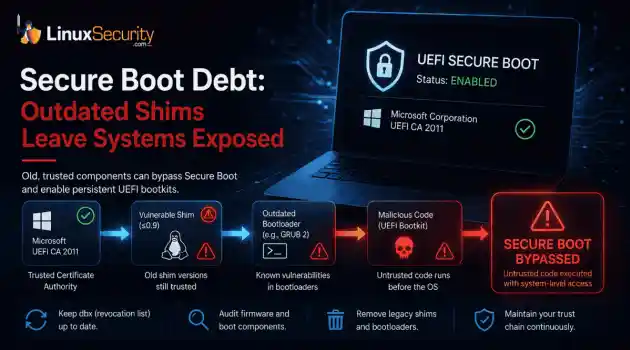
Security Vulnerabilities security advisory linux distribution
security advisory linux distribution ESET researchers identified 11 old and forgotten Linux UEFI shim bootloaders at versions 0.9 and below that can be used to bypass UEFI Secure Boot on any UEFI-based machine that trusts Microsoft’s Microsoft Corporation UEFI CA 2011 third-party certificate authority, regardless of the installed operating system (OS). Reported shims can be exploited to execute untrusted code during system boot, enabling attackers to deploy malicious UEFI bootkits even on systems with UEFI Secure Boot enabled.....
Jul 16, 2026
 Refine news
X Clear Filters
Get the latest News and Insights
Get the latest Linux and open source security news straight to your inbox.
Community Poll
Is continuous patching actually viable?
Loading...
Explore Latest Linux Security news
We found 16 articles for you...
74
 privilege escalationopen-sourcedetection
Detecting Linux System Compromise Early: Behavioral Indicators and Log-Based Detection
There's a gap between what Linux systems log by default and what you actually need to detect a compromise. Most environments have logging active, which creates a sense of coverage that doesn't hold up under investigation. . When you start pulling logs after an incident, what you find is fragmented activity — a login here, a process there, but no clear narrative of how access was gained, what was executed, or how far the attacker moved. You piece together a timeline rather than reading one. That's not just a technical inconvenience. It's the reason dwell time on Linux systems averages over 10 days before detection. Attackers who understand what Linux logs by default — and what it doesn't — operate well within that window. This article covers what to actually monitor, how to configure auditd to close the most critical gaps, what behavioral indicators to look for at each phase of an attack, and where default logging leaves you exposed. Why Default Logging Leaves Gaps Linux systems generate a lot of log data. They just don't always generate the right log data for security purposes. /var/log/auth.log records authentication events but not what happened after authentication succeeded. /var/log/syslog captures service events but not process behavior. Application logs are application-specific and typically don't cross-reference with system activity. The result: you can often confirm that a login happened from an unusual IP. What you can't confirm from default logs alone is what commands were run, what files were accessed, whether a privilege escalation was attempted, or whether a cron job was modified. The "Copy Fail" problem (CVE-2026-31431) CVE-2026-31431 — the privilege escalation vulnerability affecting virtually every mainstream Linux kernel since 2017, added to CISA's KEV catalog in 2026 — operates entirely in memory. No files written to disk. No changes to the filesystem. The only log entry a compromised system might produce is routine kernel output: kernel: [142.341205] [Firmware Bug]: TSC frequency mismatch detected That's it. Logging is active. Monitoring is running. The attacker has root. Standard log analysis finds nothing because there's nothing standard log analysis is looking for. This is what makes behavioral detection essential — monitoring what processes do rather than what files they create. Log the syscall transitions. Log the process ancestry. Log the timing. Because the file artifacts won't be there. Phase 1: Detecting Initial Access SSH authentication anomalies Start here. SSH is the initial access vector in the majority of Linux server compromises. /var/log/auth.log is your primary source. # All successful SSH logins — baseline review grep "Accepted" /var/log/auth.log # Failed attempts followed by success from the same IP — credential stuffing pattern grep -E "Failed|Accepted" /var/log/auth.log | grep -v "invalid user" | awk '{print $1,$2,$3,$9,$11}' | sort # New IP addresses for existing users (compare against historical baseline) grep "Accepted" /var/log/auth.log | awk '{print $9, $11}' | sort | uniq -c | sort -rn Three login patterns that warrant immediate investigation: Successful authentication from a geographic location the account has never used Successful password authentication on an account that has only ever used key auth A service account — typically never interactive — showing an SSH session The second is particularly significant. If an account's authorized_keys file has valid entries but someone logs in with a password, either the account's credentials were compromised separately or something changed in the authentication configuration. Web application exploitation Web server logs are often the first indicator of initial access via vulnerable application: # Unusual HTTP methods or paths suggesting command injection attempts grep -E "eval|base64|wget|curl|bash|/etc/passwd|/proc/self" /var/log/nginx/access.log grep -E"\.php\?cmd=|exec\(|system\(" /var/log/apache2/access.log # Processes spawned by web server user (www-data, nginx, apache) ps aux | grep -E "www-data|nginx|apache" | grep -v "grep" A web server process spawning bash, curl, or wget is not normal activity. A web application process making outbound network connections to non-whitelisted destinations is a strong indicator of successful exploitation. Phase 2: Detecting Post-Exploitation Enumeration Attackers who land on a Linux box with a low-privilege shell immediately begin enumeration. Tools like LinPEAS automate this in under 60 seconds — scanning SUID binaries, sudo configurations, writable cron jobs, kernel version against known CVEs, credentials in config files, and dozens of other vectors. The behavioral fingerprint of automated Linux enumeration is distinctive and detectable: auditd rule for high-frequency find activity: auditctl -a always,exit -F arch=b64 -S execve -F exe=/usr/bin/find -k enum_find After running for a few minutes, check: ausearch -k enum_find --start recent | awk '{print $NF}' | sort | uniq -c | sort -rn Baseline expectation on a normal system: fewer than 5 find executions per non-root process in any 30-second window. A spike to 100+ is anomalous by definition. The fact that LinPEAS is one script rather than a human running individual commands makes the timing compression particularly detectable — dozens of find calls from the same PID within seconds. Additional enumeration indicators: # Rapid sequential reads of sensitive files from same process auditctl -w /etc/sudoers -p r -k sudoers_read auditctl -w /etc/passwd -p r -k passwd_read auditctl -w /etc/shadow -p r -k shadow_read auditctl -w /etc/crontab -p r -k crontab_read # Correlate: same PID reading all of these within a short window = automated enumeration ausearch -k sudoers_read -k passwd_read -k shadow_read --start recent Phase 3: Detecting Privilege Escalation SUID abuse and setuidsyscalls When an attacker exploits a SUID binary for privilege escalation, the process transitions from the user's UID to root UID. The setuid syscall is the mechanism: # Detect UID transitions via setuid/setgid auditctl -a always,exit -F arch=b64 -S setuid -S setgid -k priv_escalation auditctl -a always,exit -F arch=b64 -S setreuid -S setregid -k priv_escalation Review: ausearch -k priv_escalation --start recent UID transitions are expected for legitimate binaries like sudo, su, passwd. Unexpected processes performing UID transitions — particularly web application processes, backup agents, or anything that doesn't normally interact with privilege boundaries — are worth investigating. Sudo command monitoring # Log all sudo invocations with the actual command auditctl -a always,exit -F arch=b64 -S execve -F path=/usr/bin/sudo -k sudo_exec # Alert on: sudo bash, sudo sh, sudo -s (all shell drops) ausearch -k sudo_exec --start recent | grep -E "bash|sh -i|/bin/sh" apache2 → sudo → bash as a parent-child process chain is not a sysadmin running a command. It's a kill chain. sudoers and authorized_keys modifications auditctl -w /etc/sudoers -p wa -k sudoers_change auditctl -w /etc/sudoers.d/ -p wa -k sudoers_change auditctl -w /root/.ssh/authorized_keys -p wa -k ssh_persistence auditctl -w /home -p wa -k ssh_persistence Any write to authorized_keys files outside of a configuration management operation (Ansible, Puppet) warrants immediate investigation. Key injection is clean persistence — no binary on disk, no process running — and it's invisible without this specific monitoring. Phase 4: Detecting Persistence Mechanisms Cron job modification auditctl -w /etc/cron.d/ -p wa -k cron_change auditctl -w /etc/crontab -p wa -k cron_change auditctl -w /var/spool/cron/ -p wa -k cron_change # Also monitor the scripts cron executes # If a root cron job runs /opt/backup/backup.sh, watch it: auditctl -w /opt/backup/backup.sh -p wa -k cron_script_change Cron modifications outside of patch windows or change management processes are suspicious. A cron entry that suddenly runs a script in /tmp , /dev/shm , or any user-writable directory is an immediate indicator. SUID bit changes on filesystem # Real-time monitoring for SUID bit changes inotifywait -m -r -e attrib /usr/bin /usr/local/bin /usr/sbin 2> /dev/null | \ grep --line-buffered "ATTRIB" | while read line; do echo "[ALERT] Attribute change: $line" | logger -t suid_monitor done New SUID binaries outside of package manager operations are always worth examining. Developers occasionally set SUID during testing and deploy without removing it — and attackers who gain write access to an executable will set SUID as a persistence mechanism. systemd service persistence auditctl -w /etc/systemd/system/ -p wa -k systemd_change auditctl -w /lib/systemd/system/ -p wa -k systemd_change # Check recently modified systemd units find /etc/systemd/system /lib/systemd/system -newer /var/log/syslog -name "*.service" 2> /dev/null Persistence via new systemd services is a TTP documented in multiple ransomware groups, including RansomHub's campaigns using CVE-2024-1086 for post-compromise privilege escalation. New .service files created after a system's build date deserve scrutiny. Phase 5: Detecting Lateral Movement Outbound SSH connections (pivot indicator) A Linux server making high-volume outbound SSH connections to non-private IP addresses is a strong signal the box has been compromised and is being used as a scanning relay: # Monitor outbound connection attempts auditctl -a always,exit -F arch=b64 -S connect -k outbound_connect # Or via ss for real-time view ss -tnp | grep ESTABLISHED | grep -v "127.0.0.1\|10\.\|192\.168\.\|172\." # Count unique destination IPs from SSH processes netstat -tn | grep ":22" | awk '{print $5}' | cut -d: -f1 |sort | uniq -c | sort -rn A single sshd process connecting to dozens of unique external IPs is the SSHStalker pattern — compromised host immediately scanning for more victims after the initial compromise. /proc/*/net for covert channels # Check for unexpected listening ports ss -tlnp netstat -tlnp # /proc provides raw network data even if netstat is replaced by a rootkit cat /proc/net/tcp | awk '$4 == "0A" {print $2, $3}' # listening sockets in hex cat /proc/net/tcp6 | awk '$4 == "0A" {print $2, $3}' A covert C2 channel hiding as a legitimate service will show up in /proc/net/tcp even if a rootkitted version of netstat is installed. Cross-referencing the two is a quick sanity check. Severity Hierarchy: What to Alert On First Treat every auditd event as equal and you'll train your analysts to ignore alerts. It happens faster than you'd expect. A working detection strategy means explicitly deciding which signals are worth waking someone up for and which ones go into a dashboard nobody checks. Three tiers that actually hold up in practice: Signal Why it matters False positive rate www-data / nginx / apache2 spawning bash or sh Web app exploitation, nearly never legitimate Extremely low New authorized_keys entry outside change management window SSH persistence — clean and durable Low in orgs with CM setuid event on non-standard binary Attacker setting persistence or escalation path Low Root cron job script modified Direct path to persistent root execution Low auditd service stopped or rules cleared Attacker disabling detection — active response needed Very low High — suspicious, needs context: Signal Why it matters Common false positive New sudoers entry Privilegeescalation path or new admin access Legitimate admin change 50+ find calls from same PID in 30 seconds Automated enumeration (LinPEAS, etc.) Package manager operations Service account with interactive SSH session Unusual behavior for non-human account Automation with bad config New systemd service created Persistence mechanism Legitimate software install Outbound connection to non-private IP from sshd Compromised host scanning for victims Legitimate backup/monitoring Medium — monitor, establish baseline: Signal Why it matters Common false positive sudo invocation at unusual hours Off-hours admin activity Legitimate admin work across time zones New cron entry for existing user Could be persistence Legitimate scheduled task Read of /etc/shadow by non-root process Credential harvesting attempt Some PAM configurations How to Build a Baseline Before Alerting Deploy detection rules without knowing what normal looks like and you'll spend the first month tuning out false positives until the team stops paying attention to alerts altogether. That's a worse outcome than no rules. A development server, a CI/CD runner, and a production web server have completely different behavioral profiles. sudo running 200 times a day is normal on an Ansible control node. It's not normal on a web server. find executing constantly is expected behavior from a package manager mid-update. It's not expected behavior from a user account at 3am. Before enabling high-severity alerts on any host, collect two weeks of baseline data: # Daily sudo activity ausearch -k sudo_exec --start today | wc -l # Daily setuid events ausearch -k priv_escalation --start today | wc -l # Daily cronmodifications ausearch -k cron_change --start today | wc -l # Daily authorized_keys modifications ausearch -k ssh_persistence --start today | wc -l What you're building is a sense of what's routine for that specific host. A production web server that has never once modified authorized_key s in six months of baselining deserves an alert the moment it does. A configuration management server that updates keys daily as part of normal operations does not. Same event, completely different meaning depending on context. Alerts that trigger on deviations from established baseline catch real anomalies. Alerts that trigger on raw event volume catch noise. Signal Correlation: Why Single Events Are Often Misleading Individual events are weak signals. What matters is sequence. A sudo invocation on its own — legitimate. An outbound SSH connection — legitimate. A find command — also probably fine. The picture changes completely when those three things happen from the same user account within a five-minute window, in that order. Look at this sequence: 09:14 SSH login from new source IP 09:15 High-frequency find executions from same PID 09:16 Reads on /etc/sudoers and /etc/shadow 09:18 setuid transition on non-standard process 09:19 Write to /root/.ssh/authorized_keys None of those events alone is a confirmed compromise. Together, they map directly to: Initial Access → Enumeration → Privilege Escalation → Persistence That five-minute chain is LinPEAS running followed by a privilege escalation attempt and an SSH backdoor. It's not subtle — but it only becomes obvious when you're correlating events, not reviewing them one at a time. Build SIEM rules around timing windows and process ancestry. An event that's routine in isolation becomes high-confidence when it's correlated with two others in a short window involving the same PID or user. False Positive Handling in Practice The rules that matter most are also the ones mostlikely to fire legitimately in certain environments. Before deploying any rule in production, understand its false positive profile. sudo monitoring: In environments with many sysadmins or where sudo is used frequently as part of standard automation, volume alone isn't diagnostic. Filter for sudo bash, sudo sh, sudo -s, and sudo su — shell-drop patterns. These are rarely legitimate in automated workflows and almost always human or attacker activity. find high-frequency detection: Package managers (apt, yum, dnf) invoke find heavily during updates. Deploy/configuration management tools like Ansible do too. Exclude known-good parent processes and whitelist maintenance windows. Alert on spikes outside those contexts. authorized_keys changes: In environments using configuration management (Puppet, Ansible, Chef), authorized_keys is regularly synced from a central source. Whitelist the CM agent's process. Alert on all other writes. Cron modifications: Legitimate cron changes happen — but they should be traceable to a change ticket or deployment pipeline. If your environment has change management, any cron modification outside a documented change window is an escalation-worthy event. systemd service creation: Package installations create new .service files constantly. Alert on new services created outside of package manager operations, or services that point to binaries in /tmp, /dev/shm , or any user-writable path. SIEM Correlation Rules: From Raw Events to Actionable Alerts Individual auditd events are signals. Correlation turns signals into incidents. These are the highest-value correlation patterns for Linux compromise detection: Rule 1 — Web server spawning shell: IF process.parent.name IN ["apache2", "nginx", "httpd", "php-fpm"] AND process.name IN ["bash", "sh", "dash", "python", "perl", "ruby"] THEN ALERT: Critical — Web Application Exploitation Rule 2 — New device + authorized_keys change (AiTM to persistence chain): IF ssh_login.new_source_ip = TRUE AND authorized_keys.write_event WITHIN 30 minutes THEN ALERT: High — Possible AiTM Compromise with SSH Persistence Rule 3 — Privilege escalation chain: IF setuid_event.user != root AND file_write_event.path IN ["/etc/sudoers", "/root/.ssh/authorized_keys"] AND process.name = "bash" WITHIN 10 minutes THEN ALERT: Critical — Active Privilege Escalation Chain Rule 4 — Automated enumeration fingerprint: IF process.syscall = "execve" AND process.name = "find" AND count(events) > 50 WITHIN 30 seconds AND process.user != root AND process.parent.name NOT IN ["apt", "dpkg", "ansible"] THEN ALERT: High — Automated Enumeration Pattern Rule 5 — Outbound scanning from compromised host: IF network.direction = outbound AND network.dest_port = 22 AND count(unique_dest_ips) > 20 WITHIN 60 seconds AND process.name IN ["sshd", "ssh"] THEN ALERT: Critical — Host Used as SSH Scanning Relay Building a Practical Detection Stack You don't need a SIEM to start. The priority order for Linux compromise detection: 1. auditd — the foundation # Persistent rules in /etc/audit/rules.d/security.rules -a always,exit -F arch=b64 -S execve -F path=/usr/bin/sudo -k sudo_exec -a always,exit -F arch=b64 -S setuid -S setgid -k priv_escalation -w /etc/sudoers -p wa -k sudoers_change -w /root/.ssh/authorized_keys -p wa -k ssh_persistence -w /etc/crontab -p wa -k cron_change -w /etc/systemd/system/ -p wa -k systemd_change 2. aureport for daily review # Daily anomaly summary — run as cron or review manually aureport --auth --summary # authentication events aureport --syscall --summary # system call anomalies aureport --file --summary # file access patterns 3. Process tree correlation When an alert fires, the first question is: what is the parent process? Context from /proc/ /status and ps--forest determines within seconds whether sudo was run by a legitimate admin session or by a web server process that shouldn't be executing shell commands. 4. Forward logs off the host Logs stored only locally can be modified or deleted by an attacker with root. Forward to a remote syslog server or centralized logging infrastructure as quickly as possible. If local logs are the only copy and the attacker gains root, your forensic evidence is at risk. Top 10 Linux Compromise Signals Worth Alerting On Immediately If resources are limited, prioritize these signals first. They consistently appear across real-world Linux intrusions and typically generate manageable alert volume. Priority Indicator Why It Matters 1 Web server spawning shell (apache2 → bash) Strong exploitation indicator 2 New authorized_keys entry Common persistence technique 3 Unexpected setuid transition Privilege escalation activity 4 Modification of /etc/sudoers Privilege manipulation 5 New systemd service created Persistence mechanism 6 Root cron modification Scheduled privileged execution 7 Outbound SSH scanning activity Lateral movement indicator 8 Large-scale file enumeration Automated reconnaissance 9 auditd service stopped Defense evasion — act immediately 10 External network connection from web app process Possible command execution Organizations attempting to monitor everything often end up monitoring nothing effectively. Starting with ten high-confidence signals and expanding gradually produces better results than deploying hundreds of low-confidence rules on day one. Limits and Bypass: What Detection Won't Catch Everydetection strategy has a ceiling. Understanding where yours ends is as important as building it. auditd can be disabled. An attacker with root can stop the auditd service, flush rules, or modify /etc/audit/audit.rules to remove specific watches. If your detection depends entirely on local auditd and an attacker achieves root before you get an alert, you've lost the evidence trail. Mitigation: ship logs to an immutable remote destination in real-time. Alert immediately if auditd stops on any monitored host. Local logs can be deleted or modified. Root can truncate /var/log/auth.log , remove bash history, clear wtmp and lastlog. An attacker who understands Linux forensics will do this. If your logs are only stored locally, a root-level compromise can erase the timeline. Forward to a remote syslog or centralized logging platform the moment events are generated. Rootkits hide activity. Kernel-level rootkits (LKM rootkits) can intercept system calls and hide processes, files, and network connections from standard tools. ps, ls, netstat , and top can all return clean results on a compromised host. /proc filesystem access is more reliable than userspace tools, but sophisticated rootkits can intercept procfs reads too. Runtime kernel integrity monitoring (eBPF-based sensors, AIDE for file integrity) catches anomalies that standard logging misses. Containers and cloud complicate the model. In containerized environments, auditd on the host may not capture activity inside containers depending on namespace configuration. Cloud instances may have additional logging layers (CloudTrail for AWS, Cloud Audit Logs for GCP) that provide visibility auditd doesn't. Container runtime security tools (Falco, Sysdig) monitor syscall behavior at a layer that survives container restarts and doesn't depend on configuration inside the container. In-memory attacks produce no file artifacts. CVE-2026-31431 ("Copy Fail") demonstrated this at scale — kernel LPE that leaves no file changes, no new processesbeyond the exploiting binary, no obvious log entries. Behavioral detection at the syscall level (setuid transitions, unexpected privilege changes) is more reliable than file-based detection for this class of attack. What to Do After Detection: Immediate Response Detection is only useful if it triggers an effective response before the attacker achieves their objectives. Immediate containment — within minutes: # Isolate the host from the network (if remote management allows) # Block outbound on all interfaces except your management channel iptables -I OUTPUT -j DROP iptables -I OUTPUT -d /32 -j ACCEPT # Kill suspicious sessions identified during detection who -a # list active sessions pkill -9 -t pts/1 # kill specific terminal session # Preserve a snapshot of current process state before killing anything ps auxf > /tmp/process_snapshot_$(date +%s).txt ss -tnp > /tmp/network_snapshot_$(date +%s).txt Evidence collection — before touching anything: # Memory is volatile — capture what you can before isolation or reboot # List loaded kernel modules (LKM rootkit check) lsmod > /tmp/modules_$(date +%s).txt # Active network connections ss -tnp > /tmp/connections_$(date +%s).txt # Scheduled tasks and cron crontab -l -u root > /tmp/root_cron.txt cat /etc/crontab > /tmp/system_cron.txt # Recently modified files find / -newer /tmp/reference_file -type f 2> /dev/null > /tmp/recent_files.txt # Export auditd events before they cycle out ausearch --start today > /tmp/audit_today.txt Credential rotation priorities: Root password and all sudo users immediately Any SSH keys that existed on the system at time of compromise — assume all are burned Service account passwords for any service running on the host Application database credentials stored in config files on the system Persistence verification before declaring clean: # Check everypersistence mechanism attackers use crontab -l -u root; crontab -l ls -la /etc/cron.d/ /etc/cron.hourly/ /etc/cron.daily/ cat /etc/rc.local systemctl list-units --type=service | grep -v "loaded active" find /root /home -name ".bashrc" -o -name ".bash_profile" | xargs grep -l "curl\|wget\|bash\|nc\|ncat" cat /root/.ssh/authorized_keys find /tmp /dev/shm -type f 2> /dev/null A system is not clean until every persistence mechanism has been verified, not just the one that triggered the initial alert. Detection on Linux isn't about having the most data — it's about having the right data, at the right granularity, in a place the attacker can't erase. The gaps in default logging are predictable and closable. What's less predictable is whether the rules are in place before the compromise happens. . Learn how to effectively monitor Linux systems for compromises with tailored logging strategies and behavioral detection techniques.. Linux detection, log monitoring, behavioral analysis, security strategy, system compromise. . Andrew Kowal
 Jul 12, 2026
•
Jul 12, 2026
• Network Security
209
 detectionsecurity monitoringarchitecture
Developing a Successful Open Source Security Information Management System
Open source SIEM gives teams flexibility, but it also shifts the burden of keeping everything running onto the architecture itself. This guide looks at how SIEM pipelines actually behave once they’re live, where they start to break down, and what small teams need to get right to keep detection usable. . Most SIEM failures don’t show up at deployment. They show up later, when ingestion starts failing, logs stop lining up cleanly, and alert noise makes the system harder to trust. The pipeline keeps running, but detection quality drops, and that’s where most teams lose visibility without realizing it. This post breaks down realistic SIEM architecture patterns, common failure points, and how to build a pipeline that stays stable under real conditions without overbuilding something your team can’t maintain. What a SIEM Pipeline Actually Needs A SIEM platform isn’t one system. It’s a chain of systems that either hold together or fall apart under load. Data ingestion from endpoints, apps, and infrastructure Transport layer moving logs reliably Log aggregation into a central point Processing and normalization for consistency (turning different log formats into a standard structure) Storage is split between hot and warm data Detection and correlation logic Visualization for analysts That’s the baseline SIEM architecture. Miss one layer and things get messy fast. Most teams focus on ingestion and dashboards. The problems usually sit in the middle, where log aggregation breaks down or normalization never really happens, which leaves the rest of the pipeline working with inconsistent data and unreliable signals. Constraints Small Teams Actually Face This is where most SIEM platform advice drifts away from reality. It assumes time and staffing that just aren’t there. Limited engineering time to maintain pipelines Budget constraints around storage and compute No dedicated detection or SOC team Operational overhead from complex SIEM tools Alert fatigue from noisy rules None of these are edge cases. They’re the default. You don’t build the same SIEM tools setup with two engineers that you would with a full security team, and trying to mirror enterprise patterns usually leads to half-built systems that generate more noise than value. Architecture Pattern 1: Lightweight Centralized Logging This is where most open source SIEM tool deployments start. It’s simple, and that’s the point. Flow looks like this. Sources send logs through agents (small programs installed on systems to collect and forward logs), agents forward to a central log aggregation layer, and that layer feeds a dashboard for basic visibility. Pros: Fast to deploy Low operational overhead Cons: Limited detection capability Doesn’t scale cleanly Log aggregation tools handle most of the heavy lifting here. You get visibility quickly, but detection is mostly manual or rule-light, which means this works best when you need coverage fast and can accept gaps while the system matures over time. Architecture Pattern 2: Queue-Based SIEM Pipeline This is where things start to resemble a proper SIEM architecture. Not cleaner, just more contro lled. Sources send logs through agents Agents push data into a queue (a buffer that temporarily holds logs so spikes don’t overwhelm the system) Processors pull from the queue and normalize logs Data moves into storage and detection layers The queue changes everything. It decouples ingestion from processing. Log aggregation still exists, but it’s no longer the choke point. You can buffer spikes, retry failed processing, and scale different parts of the pipeline independently, which makes this model more stable under load but also introduces more moving parts that need to be maintained and monitored continuously. Pros: Better scalability More resilient data flow Cons: Higher complexity More operational overhead Architecture Pattern 3: Hybrid SIEM Platform + Detection Layer At some point, centralized logging isn’t enough. Teams start layering detection on top of their existing pipeline instead of rebuilding from scratch. Detection Layer Rule-based detection sits on top of your data. Not perfect, but predictable. You define what matters and tune over time. Enrichment Logs without context don’t help much. Adding t hreat intel , asset data, or user context turns raw events into something actionable, though it also increases processing overhead and dependency on external data sources. Response Basic automation starts to creep in. Triggering alerts, isolating hosts, or flagging accounts. Not full SOAR, just enough to reduce manual triage. This is where open source SIEM starts to feel like a real SIEM platform. Still fragmented, still DIY, but capable. It also comes with the same tradeoff. More capability means more maintenance, and SIEM software doesn’t get easier to manage as you add layers. It just becomes more critical to keep it stable. Where Open Source SIEM Works (and Where It Breaks) Open-source SIEM has clear appeal. Control, cost, flexibility. It works well when you need to shape the pipeline around your environment instead of adapting to a fixed platform, and when your team can handle the operational side without relying on vendor support. Strengths: Flexible architecture design Lower upfront cost Full control over data and pipelines Limitations: Ongoing maintenance burden Complex tuning and rule management Limited support compared to commercial SIEM tools The gap shows up over time. Not at deployment. Commercial SIEM tools smooth out operations but limit customization. Open source SIEM tools give you control but expect you to handle everything that comes with it, and that tradeoff only becomes visible once the system is under real load. Common Failure Points in SIEM Pipelines Most SIEM architecture failures aren’ttechnical limitations. There are design issues that show up later. Ingesting too much data without filtering Weak log aggregation strategy leading to gaps Poor normalization across sources Alert overload from unrefined rules No retention planning for long-term storage These don’t break things immediately. They degrade the system slowly. By the time teams notice, detection quality has already dropped, and logs are either missing, inconsistent, or too noisy to trust, which turns the SIEM into a storage system instead of a detection tool. How to Choose the Right SIEM Architecture There’s no single model that fits every team. The right SIEM architecture depends on what you can actually support. Team size and available engineering time Log volume and data growth Detection requirements and risk tolerance Budget for infrastructure and storage Operational capacity to maintain the system Most mistakes happen when teams overbuild early. A SIEM platform that looks “complete” on paper but isn’t maintainable in practice ends up being ignored, and unused visibility is the same as no visibility at all. Practical Build Strategy You don’t need a full pipeline on day one. You need something that works and can evolve. Centralize log aggregation across critical systems Prioritize high-value log sources first Add basic alerting on obvious signals Introduce detection rules gradually Expand coverage as the pipeline stabilizes This approach keeps the system usable while it grows. Most open source SIEM deployments fail because they try to solve everything up front, and that usually leads to stalled builds, partial pipelines, and systems that never reach a stable operational state. Closing Insight An open source SIEM doesn’t fail because of the tools. It fails because the SIEM architecture behind it can’t hold up under real conditions. Small teams don’t need perfect pipelines. They need stable ones, and thedifference usually comes down to how much complexity they introduce early versus how much they can actually maintain once logs start flowing and the system stops being a diagram and starts behaving like infrastructure. Open Source SIEM and Log Aggregation FAQs What is an open source SIEM? An open source SIEM is a security information and event management system built using open technologies. It collects, processes, and analyzes logs from different systems, giving teams visibility without relying on commercial SIEM software, but it also requires internal effort to design, deploy, and maintain the pipeline. How does SIEM architecture work? SIEM architecture works as a pipeline. Data is ingested, transported, aggregated, processed, stored, and analyzed. Each layer depends on the others, and weaknesses in one part, especially log aggregation or normalization, tend to affect the entire system’s reliability. What are log aggregation tools? Log aggregation tools collect logs from multiple sources and centralize them. They form the foundation of most SIEM pipelines, enabling storage, search, and analysis, though on their own they don’t provide full detection or correlation capabilities. What are the best open source SIEM tools? There isn’t a single best option. Open source SIEM tools vary based on architecture and use case. Some focus on log aggregation, others on detection or visualization, and most deployments combine multiple tools rather than relying on a single platform. What is log aggregation in a SIEM pipeline? Log aggregation is the process of collecting and centralizing logs from systems, applications, and infrastructure. In a SIEM pipeline, it acts as the entry point for data processing, and if it’s unreliable or incomplete, the rest of the pipeline inherits those issues. . Explore open source SIEM architectures and learn how small teams can overcome challenges in log management and detection.. Open Source SIEM, Log Aggregation, SIEM Architecture, Detection Tools.. MaK Ulac
May 06, 2026
•
Security Trends

77
 securitydetectionlinux
Linux Server Monitoring Challenges and Solutions for Security Teams
Linux shows up in places most people stop noticing. Web servers, Kubernetes nodes, build runners, database backends. Start tracing how modern platforms actually run, and a large portion of that infrastructure lands on Linux systems, which quietly turns linux server security into a much bigger conversation than protecting individual hosts. . Most environments already rely on linux monitoring tools to track uptime and system performance. The harder problem shows up in the security signals those systems generate every minute. Authentication logs, process activity, and outbound connections. They look routine, but once Linux infrastructure spans clusters, cloud workloads, and automation pipelines, those signals scatter across the environment, making them difficult to see in context. Why Linux Servers Power Modern Infrastructure Linux ends up underneath a lot of modern infrastructure simply because so many of the platforms organizations rely on run on it. Cloud instances, container hosts, build runners, web servers. Start tracing where production workloads actually live, and Linux systems show up again and again. That pattern has been forming for a while. Early web infrastructure ran on Linux because it was stable and easy to deploy at scale. When container platforms and cloud environments started spreading across enterprise environments, those same systems became the foundation on which those platforms were built. Spend time inside a modern environment, and it becomes obvious how much of the infrastructure sits on Linux. Kubernetes nodes usually run it. CI runners often do too. A large share of cloud workloads follow the same pattern, which is why linux server security increasingly overlaps with linux infrastructure security. A Linux server today might be part of a container cluster, a deployment pipeline, or a backend system supporting production applications. When activity on those systems changes, the effect rarely stays isolated to the host itself. This is where monitoring starts tobecome difficult. When Linux systems span so many parts of the infrastructure, security teams still need a way to see what’s actually happening on them. The Visibility Challenges Security Teams Face With Linux Systems Linux systems generate a large amount of telemetry, but linux security monitoring rarely happens in one place once an investigation begins. Authentication logs sit on the host, process activity may come from an endpoint agent, and network connections often appear in firewall or flow logs somewhere else. Cloud platforms add another layer of activity tied to the instance itself, which means understanding what actually happened on a single server often requires pulling signals from several different systems. That fragmentation becomes obvious during investigations. A login event appears in system logs, a process starts shortly afterward, and an outbound connection follows a few minutes later. None of those events necessarily looks suspicious on its own. Security teams usually end up reconstructing the timeline by pivoting between host logs, network telemetry, and whatever linux monitoring tools happen to capture pieces of the activity. The challenge is that those signals rarely look unusual until someone sees them together. Common signals that often look routine in isolation Reused credentials appear as a normal login A new background process that resembles a scheduled task Outbound traffic blends into normal application connections Individually, none of those events stands out. Once they start lining up across systems, though, the activity can look very different. Most organizations already monitor their Linux systems in some form. The difficulty is that many monitoring approaches were designed to track system health rather than help security teams understand how activity on a Linux server actually unfolded. That gap becomes easier to notice as Linux environments grow and investigations start spanning multiple systems at once. The Limits of Traditional LinuxMonitoring Tools Most environments already run several linux monitoring tools, and for operations teams, those platforms solve real problems. Administrators rely on them to track uptime, resource usage, and service availability because those signals reveal outages and performance issues quickly. In many environments, traditional linux server monitoring provides exactly the visibility needed to keep production systems running. The gap appears once those systems need to be investigated from a security perspective. Infrastructure monitoring focuses on whether a server is functioning correctly, while many attacks on Linux systems rely on normal activity such as valid logins, background processes, or outbound connections that resemble application traffic. From an operations dashboard, the system may still look healthy even while something unusual is unfolding. That difference is why infrastructure monitoring alone rarely explains security activity. Many organizations have started adopting platforms like Extended Detection and Response (XDR) because those systems correlate signals across endpoints, networks, and cloud environments instead of analyzing each system on its own. How Modern Detection Platforms Improve Linux Security Monitoring Modern security platforms approach Linux visibility differently from traditional infrastructure monitoring. Instead of looking at one system at a time, they focus on connecting activity across hosts, networks, and cloud environments so investigations can follow what actually happened. That shift changes how linux security monitoring works in practice. A login event on a Linux server can be correlated with network traffic leaving the host and cloud activity tied to the same instance. Individually, those signals might look routine, but when they appear together, they start to reveal patterns that would be difficult to detect from a single log source. Security teams also rely more on behavior than simple alerts. Instead of waiting for a system to fail or a ruleto trigger, detection platforms look for changes in activity such as unusual login patterns, unexpected processes, or outbound connections that don’t match normal system behavior. Over time, that approach helps analysts understand how activity moves across systems rather than focusing on isolated events. This broader visibility is what allows security teams to investigate activity across infrastructure instead of treating each system as a separate problem. As Linux environments expand across cloud workloads, container platforms, and application backends, linux infrastructure security increasingly depends on being able to see those signals together. Once that visibility is in place, the kinds of threats these systems face start to become easier to recognize. Common Threats Targeting Linux Servers Today Many attacks against Linux environments rely on activity that looks normal at first glance. A login appears valid, a process runs quietly in the background, or a server starts making outbound connections that resemble routine traffic. That’s part of what makes linux server security investigations difficult in real environments. Security teams tend to see the same patterns appear repeatedly. Common linux security threats affecting servers today Credential abuse – attackers reuse stolen or exposed credentials to log in through SSH or administrative services, often appearing as legitimate users in authentication logs Cryptominers – compromised servers quietly run mining software while continuing to operate normally, sometimes going unnoticed until resource usage gradually increases Web server compromise – attackers modify web directories or inject scripts to host phishing pages, malware downloads, or command channels Container platform attacks – exposed container environments are targeted to access running workloads or pivot into underlying infrastructure Lateral movement between systems – once inside a host, attackers explore neighboring systems,service accounts, or internal connections to expand access Most of these activities don’t break the system or trigger obvious alerts. They tend to blend into normal operational behavior until several signals begin to line up across different systems. This is why monitoring Linux infrastructure has gradually shifted toward correlating activity across hosts, networks, and cloud environments rather than watching each server in isolation. Why Monitoring Is Critical for Securing Modern Linux Infrastructure Linux now sits underneath large portions of modern infrastructure, which means security teams rarely interact with it as a single system. Web servers, container nodes, cloud workloads, and backend services often run on Linux hosts, quietly supporting the platforms organizations rely on every day. That reach is why linux server security has become closely tied to linux infrastructure security. Activity on one host can affect an application platform, a deployment pipeline, or an entire service environment, depending on where that system sits inside the architecture. Monitoring becomes the layer that connects those systems together. The signals collected through linux monitoring tools help security teams understand how activity moves across hosts, networks, and cloud environments instead of treating each system as an isolated machine. As Linux infrastructure continues expanding across modern environments, the ability to see those signals clearly becomes just as important as the systems themselves. Security teams may not always notice Linux when infrastructure is running smoothly, but the moment something unusual happens, the visibility into those systems becomes critical. . Linux servers are foundational to modern infrastructures, requiring effective monitoring for security and visibility across environments.. Linux Monitoring Tools, Security Operations, Infrastructure Security. . MaK Ulac
Mar 13, 2026
•
Server Security
74
security advisorymalwaredetectionBPFDoor: Understanding Malware Threats and Mitigation Tactics
BPFDoor malware has emerged as a serious threat to Linux systems, designed with sophisticated techniques that allow it to operate undetected. This malware leverages Berkeley Packet Filtering (BPF) to sneak past firewalls and inspect network packets for specific sequences, effectively hiding its presence. . Unlike typical malware, BPFDoor doesn’t listen on open ports, making conventional detection methods ineffective. Its ability to evade logs and seamlessly blend into your network poses a significant security risk to your system. For us, Linux security admins, staying alert to this stealthy malware is crucial. Understanding its unique behaviors and implementing advanced monitoring solutions is key to defending your network against this formidable adversary. Let's take a closer look at this malware, its malicious mechanisms and techniques, and measures you can take to secure your systems against BPFDoor attacks. Understanding the Mechanics of BPFDoor Source: TrendMicro It's vitally important to grasp BPFDoor's underlying mechanics to fully comprehend its threat. Berkeley Packet Filtering (BPF) is an inspection technology that enables deep inspection of network packets. This technology is typically employed to enhance performance for network monitoring tools. BPFDoor uses this capability maliciously by connecting directly to it and scanning network traffic for specific sequences or signatures that indicate target systems, effectively bypassing firewalls that would otherwise block them all outright. BPFDoor stands out among traditional malware because its communication channels can easily remain undetected using standard network monitoring tools. Conventional malware typically opens network ports to establish communication with its command and control server. These open ports are easily detectable using standard monitoring solutions, which quickly alert administrators about suspicious activity. BPFDoor, on the other hand, doesn't listen on open ports but employs BPF to "listen"undetected, making it harder for admins to detect using traditional techniques. Stealth and Persistence BPFDoor's stealthiness and persistence are central to its effectiveness. The malware's stealthy design allows it to blend seamlessly into a target system while remaining undetected for extended periods. Using techniques like process hiding, BPFDoor can remain hidden from security scanners while caching network packets without raising alarms, complicating any attempts at forensic investigation. Another strength of the BPFDoor malware is persistence. Once installed on a system, this infection remains visible even through reboots and security updates , using various techniques like creating hidden registry entries or exploiting existing processes to stay unnoticed. Therefore, eliminating BPFDoor requirea more than simply finding and deleting suspicious files. An organized approach must be employed so that all traces are effectively eliminated from existence. Evasion Techniques BPFDoor employs numerous evasion strategies designed to bypass traditional security measures. For instance, it tampers with system logs so its actions leave no trace. Without logs, any suspicious activities go undetected for extended periods, allowing BPFDoor plenty of time to fulfill its goals. BPFDoor's ability to blend seamlessly with regular network traffic demonstrates its sophistication. By replicating legitimate protocols and hiding malicious commands within common communications, it evades detection by Intrusion Detection Systems (IDSs) and other network security tools. Protecting Against BPFDoor Given the complexity of BPFDoor, effective defense requires a multi-layered approach. First and foremost is strengthening network monitoring capabilities, as traditional open port detection will likely miss BPFDoor. Instead, security admins should implement tools that analyze network traffic on deeper levels to detect abnormal patterns indicative of potential BPF activity. Regular system patches andupdates are another key mitigation strategy against BPFDoor malware, although its presence might linger despite updates to your systems. We admins should implement comprehensive log solutions that detect and alert us to any attempts to tamper with host-based intrusion detection systems to provide more comprehensive protection from possible intrusion attempts. Training and educating your team members to recognize the signs of a BPFDoor infection is equally vital. This can help achieve speedy detection and response times and minimize the damage caused by this malware. Be sure to incorporate regular security drills as part of ongoing security updates so everyone is adequately equipped to face this advanced threat. Incident Response Should BPFDoor infiltrate your system, having an effective incident response plan in place is vitally important. Step one in isolating it from further infection is disconnecting and quarantining it from its network. Once all components of the BPFDoor malware have been identified, an intensive forensic investigation must occur to locate them. This requires scanning for hidden processes, monitoring for unapproved network activity, and inspecting system logs for signs of manipulation since BPFDoor often hides itself using legitimate system tools. Thus, conducting exhaustive searches is critical. Once BPFDoor malware has been identified, removal proceedings should begin immediately. Care must be taken to eliminate all remnants, whether reinstalling the operating system software or recovering from backup files . Once clean systems have been restored, comprehensive security reviews are essential to prevent future infections. Our Final Thoughts on Combating BPFDoor Malware BPFDoor poses a formidable threat to Linux security admins due to its stealth, persistence, and evasion techniques. By understanding its operations and adopting advanced monitoring and protective measures against it, admins can better defend against BPFDoor infections. Regular updates, comprehensivelogging, trained security teams, and incident response plans can assist administrators in mitigating and dealing with potential infections. Even though its complexity makes fighting BPFDoor an uphill battle, you can stay one step ahead and maintain system security against this sophisticated adversary with proper protection strategies. . Stealthy BPFDoor malware poses a significant risk to Linux systems, requiring advanced detection strategies and incident response plans.. bpfdoor, malware, emerged, serious, threat, linux, systems, designed, sophisticated, techni. . Brittany Day
Apr 15, 2025
•
Network Security
83
security advisorymalwaredetectionDefending Linux Systems Against Outlaw Malware's Botnet Threat
As a Linux security administrator, staying ahead of the latest threats is crucial to maintaining the safety, integrity, and performance of your systems. Recently, Elastic Security identified a persistent piece of malware known as Outlaw that employs effective yet straightforward tactics . . Outlaw leverages brute-force attacks and cryptojacking to establish a resilient botnet, persistently exploiting weak SSH practices to propagate and mine cryptocurrencies. Understanding its execution chain, from initial deployment to propagation and maintaining control, is essential for defending against Outlaw attacks. In this article, I'll dive into Outlaw's key indicators of compromise and provide practical advice on boosting your defenses against this persistent menace, ensuring your systems remain secure and performant! Understanding Outlaw Malware Outlaw is not your run-of-the-mill sophisticated piece of malware ; it sways more towards simplicity in its approach. Despite using such non-advanced methods, its persistence makes it particularly troublesome. Outlaw primarily exploits weak SSH configurations to infiltrate systems via brute-force attacks. Once it gains access, it manipulates SSH keys and establishes persistence using scheduled cron jobs. The goal? To create a long-lasting botnet capable of generating cryptocurrency through mining operations. Recognizing and understanding the behavior of Outlaw malware is the first step toward securing your systems. The malware follows a consistent execution chain. It all starts with the deployment of a script, leading to the download and extraction of the malware package. Once the malware is unpacked, its journey within your system begins. Outlaw terminates any competing brute-force or mining operations, takes control by deploying a modified mining software (usually XMRIG), and sets up an IRC-based command and control (C2) system to maintain communication with its operators. Outlaw's Execution Chain Explained Outlaw Infection Chain Outlaw's execution chain is systematic and has a clear pattern, making it identifiable if closely monitored. Outlaw initiates its invasive journey through a script dubbed tddwrt7s.sh, which typically fetches a compressed package known as dota3.tar.gz. Once decompressed, this package unravels the malware's core components. Following the deployment phase, Outlaw neutralizes competing processes that might similarly use system resources, such as other crypto miners or brute-forcers. With the environment sanitized, Outlaw next sets its sights on executing the initall.sh script, responsible for launching its activities. This script ensures that a modified version of the XMRIG mining software begins its operation. Outlaw employs an IRC-based C2 system to maintain long-term control, a somewhat old-school but effective method for remote communication and command execution. By coupling brute-force modules with the retrieval of target lists from the SSH C2 server, Outlaw coordinates additional brute-force attacks and compromises more systems, continuously expanding its botnet. Indicators of Compromise Identifying Outlaw's presence in your system often boils down to recognizing key indicators of compromise. One of the initial signs you might notice is a general sluggishness in system performance. Crypto miners, like the modified XMRIG used by Outlaw, consume a significant amount of CPU and GPU resources, leading to noticeable slowdowns. Another red flag is unusual network traffic, particularly to and from IRC servers. Outlaw's C2 communication is based on IRC, so being vigilant about outbound connections to known IRC servers can assist in early detection. You might also observe unfamiliar processes or scripts running, such as tddwrt7s.sh or other cryptically named scripts. The presence of such scripts, especially if they periodically kickstart themselves through hidden cron jobs, should be thoroughly investigated. A complete review of user accounts and cron jobs can also be revealing. Outlaw oftencreates unauthorized users with elevated privileges or injects hidden cron jobs that enable it to relaunch its components should they be terminated. Understanding these nuances can significantly aid in the early detection and subsequent neutralization of this malware. Practical Advice to Mitigate and Prevent Outlaw Malware Attacks Securing your Linux systems against Outlaw requires a multifaceted approach. First and foremost, hardening SSH configurations is imperative. Implement strong, unique passwords and consider entirely disabling root login. SSH key authentication offers a more secure alternative and should be enforced wherever possible. Moving your SSH service to a non-standard port can also reduce the likelihood of brute-force attacks. Also, the importance of regular system audits cannot be overemphasized. Checking for new or unauthorized users, scrutinizing cron jobs, and continuously monitoring system logs are critical practices. Network monitoring tools , such as intrusion detection systems (IDS), can uncover unusual traffic patterns, particularly those that indicate communication with known C2 IPs or IRC servers. Keeping your system and software up to date is another vital defensive measure. Like many other malware variants, Outlaw exploits known vulnerabilities that unpatched systems harbor. Using automated update systems can help ensure your system is always protected against the latest threats. Additionally, file integrity monitoring tools like Tripwire are essential in detecting unauthorized changes to critical system files and directories. By maintaining a baseline of your system state and regularly comparing current states to this baseline, these tools can detect even minor unauthorized changes indicative of a malware infection. User education also plays a pivotal role in your defense strategy. Users must understand the risks of weak passwords and the potential consequences of social engineering attacks that could lead to compromised SSH credentials. Regulartraining sessions and clear security policies can go a long way in strengthening your security posture. Finally, developing and maintaining an incident response plan ensures that if the worst does happen, you are prepared to respond quickly and effectively. This plan should include steps for isolating infected systems, eradicating the malware, and recovering any impacted services. Regular drills and updates to the plan will keep your response capabilities sharp and up-to-date. Our Final Thoughts on Mitigating the Outlaw Linux Malware Threat The Outlaw malware exemplifies how simplicity can be coupled with persistence to create a formidable threat. By leveraging straightforward brute-force attacks and cryptojacking, Outlaw establishes a resilient botnet capable of significantly impacting system performance and compromising system integrity. Understanding its execution chain and being vigilant about indicators of compromise are essential steps in defending against this malware. By hardening SSH configurations, conducting regular system audits, and employing network and file integrity monitoring, you can create a robust defense system that significantly reduces the risk of an Outlaw infection. Coupling these technical measures with user education and a well-prepared incident response plan ensures that your systems remain secure, even in the face of threats like Outlaw. Stay informed , stay vigilant, and remember: proactive defense is always your best bet in the ongoing battle against Linux malware! . Rogue software employs aggressive methods alongside unauthorized cryptocurrency mining to establish a continual risk for Linux environments. Discover protective measures!. Linux Malware Detection, Outlaw Threat Mitigation, Secure SSH Practices. . Brittany Day
Apr 03, 2025
•
Hacks/Cracks
83
 malwaredetectionprevention
CRON#TRAP: Emulated Linux Threats and Detection Strategies
Security threats continue to emerge from every corner of the cyber universe, with malicious actors constantly innovating new techniques to breach systems and remain undetected. One such creative attack is an emerging campaign dubbed "CRON#TRAP," which uses emulated Linux environments to execute malicious commands stealthily. . In this article, I'll explore CRON#TRAP's intricacies, including its design, significance, and potential targets, and offer practical advice for detection and prevention. Understanding CRON#TRAP Understanding CRON#TRAP requires diving deep into its complex attack vector, where cybercriminals use custom-built QEMU (Quick Emulator) Linux boxes on compromised endpoints to mount attacks. This emulated Linux environment, often distributed via phishing emails , has a backdoor that enables attackers to remain hidden on victim machines for extended periods. An initial step in an attack usually begins with phishing emails containing links to download an unorthodoxly large ZIP file titled "OneAmerica Survey.zip," often over 285MB - an early warning signal for alert users. Once they extract the archive, users find a shortcut file ("OneAmerica Survey.lnk") and a data directory that houses the QEMU installation directory; however, its contents remain hidden unless users enable the "view hidden files" option in their file explorer. Lure Image (source: securonix) The shortcut file connects to the system's PowerShell process and executes a command that re-extracts ZIP file contents into the user's profile directory and starts the start.bat batch file. This batch file primarily performs two actions: it displays a fake "server error" message to conceal malicious activity. It also executes QEMU (disguised as fontdiag.exe) emulator for running Linux environments on computers running Microsoft Windows OSes. QEMU runs invisibly in the background using its "-nographic" parameter to ensure an emulated Linux instance operates without a graphical user interface, making its detectiondifficult. Within this "PivotBox," attackers can execute additional commands or stage further malware without directly engaging with the host system - bypassing traditional antivirus solutions. Linux instances contain special commands, like get-host-shell and get-host-user , that allow them to interact with their host machine by accessing stored user context information. These allow attackers to execute host system shells from within an emulated environment, thereby improving their chances of remaining undetected while conducting malicious activities. Examining the Significance of This Novel Technique Utilizing QEMU to install an emulated Linux environment on a victim's machine is an innovative malware deployment strategy. As this virtualization tool is widely used and not usually flagged by security systems, attackers can circumvent traditional antivirus detection mechanisms. By operating within an isolated Linux environment, attackers can execute commands and stage further attacks without leaving a significant footprint on the host system. This level of stealth and persistence can remain undetected for extended periods, enabling attackers to conduct extensive reconnaissance, data exfiltration, or other malicious activities without detection. Who Is at Risk? While the victims of CRON#TRAP remain unknown, telemetry data indicates that most sources originate in either North America or Europe, with North America potentially being targeted as the main area for attack. Organizations across various sectors, such as government, finance, healthcare, and critical infrastructure, could fall prey to such sophisticated attacks. Individuals within these organizations who handle sensitive information, such as executives, IT administrators, and employees with elevated privileges, are particularly at risk. Phishing as an initial attack vector only compounds this risk further as it targets human vulnerabilities through social engineering techniques. Strategies for Early Detection and Prevention CRON#TRAP detection and prevention require a multidimensional approach to safeguarding systems. In particular, to detect CRON#TRAP, it's vital to watch out for unusual files and processes - such as large and oddly named ZIP files appearing unexpectedly or shortcut files appearing in unusual places - which could signal potential CRON#TRAP attacks. System processes should be carefully evaluated for QEMU processes running, especially those using strange names like fontdiag.exe. Network traffic analysis is equally important. This includes scanning for known malicious command and control (C2) servers and using network monitoring tools to detect anomalous outbound connections that could indicate backdoor access points. PowerShell activities require careful examination through audit log analysis for any unusual command executions, especially those related to file extraction and batch file execution. Implementing Endpoint Detection and Response (EDR) solutions can detect suspicious activities on endpoints, including hidden processes being run as processes running in parallel. To prevent CRON#TRAP attacks, comprehensive email security measures must be in place. This may involve installing advanced filters to detect and block phishing attempts and training employees about these tactics to recognize suspicious emails. File integrity monitoring tools can be extremely useful in detecting changes to important files and directories, including any hidden ones that may appear suddenly. Implementing Multi-Factor Authentication (MFA) protects against unauthorized access even if credentials have been compromised. Regular updates are necessary to protect all software, including operating systems and virtualization tools like QEMU, from known vulnerabilities. Network segmentation can limit lateral movement within systems by applying the principle of least privilege to restrict user access only to essential functions. Regular security audits and vulnerability assessments should also be performed to detect anyweaknesses in the security framework, providing an active defense against CRON#TRAP attacks. Our Final Thoughts on This Novel Linux Security Threat The CRON#TRAP campaign draws attention to the ever-evolving nature of cyber threats, highlighting their need for robust security measures that adapt to them. By exploiting emulated Linux environments through QEMU, attackers can avoid traditional detection mechanisms while maintaining a stealthy presence on compromised systems. Organizations should remain vigilant and implement robust detection and prevention strategies against advanced threats to stay protected against such risks. . Delve into the CRON#TRAP cyber threat operation, utilizing simulated Linux platforms for surreptitious infiltrations, and discover effective countermeasures to defend against such incursions.. CRON#TRAP malware,QEMU detection,cyber threats prevention,emulated Linux environments,phishing attacks. . Brittany Day
Nov 06, 2024
•
Hacks/Cracks
214
 malwaredetectioncyber threat
NKAbuse Malware Insights: Blockchain's Role in Linux IoT Threats
Threat actors are using blockchain technology to hide the presence of malware on Linux IoT devices. The Nkabuse malware uses a new method of hiding itself from detection: it stores its code in the Bitcoin blockchain. Every time an infected device communicates with the Bitcoin network, it sends a portion of its code with each transaction. This method allows Nkabuse to stay hidden even if it is discovered by a security researcher or neutralized by a patch. . The implications of this technique are significant: because the code is stored in such an accessible place, it is easy for anyone who wants to access it—including law enforcement or other malicious actors—to find and use it. Malicious actors could use this type of malware to create an army of compromised machines that they could use for any number of malicious purposes, such as DDoS attacks or sending spam emails. So, how long until we see someone else copycat this technique, and what can we do about it? I found the article linked below very helpful in answering these questions, and I encourage you to check it out! . The rise of 'NKAbuse' malware poses a severe risk in blockchain environments, particularly targeting Linux-based IoT systems and exploiting smart contract weaknesses. NKAbuse Malware, Blockchain Technology, Linux IoT Security, Cyber Threats. . Brittany Day
Dec 17, 2023
•
IoT Security
79
 malwarerootkitdetection
Exploring Microsoft Project Freta: Free Service For Linux Forensics
Have you heard about Microsoft's Project Freta - a new free-to-use Linux forensics and rootkit malware detection service? . The cloud offering, dubbed Project Freta , is a snapshot-based memory forensic mechanism that aims to provide automated full-system volatile memory inspection of virtual machine (VM) snapshots, with capabilities to spot malicious software, kernel rootkits , and other stealthy malware techniques such as process hiding . The project is named after Warsaw's Freta Street , the birthplace of Marie Curie, the famous French physicist who brought X-ray medical imaging to the battlefield during World War I. The link for this article located at The Hacker News is no longer available. . Google's Project Tremor provides a complimentary online platform for Windows memory analysis and malware identification tools.. Linux Forensics, Project Freta, Rootkit Detection, Cloud Service, Malware Detection. . LinuxSecurity.com Team
Jul 07, 2020
•
Security Projects

Get the latest News and Insights
Get the latest Linux and open source security news straight to your inbox.
Community Poll
Is continuous patching actually viable?
Search Topics
Powered By

Linux Security - Your source for Top Linux News, Advisories, HOWTOs and Feature Releases
QUICK LINKS
subscribe to newsletters!
Like staying secure? So do we.
Sign up for updates, tips, and alerts!