Explore top 10 tips to secure your open-source projects now. Read More
×



Server Security data privacy automation
data privacy automation Every system admin has lived through the same Monday morning ritual. A queue of forty tickets, half of them password resets, permission errors, or disk space warnings that any experienced technician could resolve in under two minutes. The other half require actual judgment. For years, automation promised that software would eventually sort the two apart on its own. That promise is now being tested in production Linux environments. . Early results are reshaping how IT teams think about tier-1...
 Jul 17, 2026

Privacydata collection automation
data collection automation You're running a web scraping project to collect pricing data from e-commerce sites. You set up a pool of datacenter proxies, launch your scripts, and within minutes — banned . CAPTCHAs everywhere. Your data pipeline stops before it really begins. . It's a frustrating scenario that plays out daily in ad verification, market research, and multi-account management. The website doesn't know you're doing legitimate research or monitoring. It just sees traffic coming from IP ranges it recognizes as...
Jul 17, 2026

Security Trends security advisory social engineering
security advisory social engineering Business Email Compromise used to be a numbers game — mass-blasted emails, broken English, an obvious "URGENT WIRE TRANSFER" subject line. That era is over. Generative AI has turned BEC into a tailored, low-noise operation that mimics writing style, voice, and even video presence. This piece looks at what's actually changed under the hood, what defenders are testing in response, and why so many organizations are still structurally unprepared for it. . The Infrastructure Problem Nobody Wants to...
Jul 17, 2026
Security Trends cybersecurity Linux documentation
cybersecurity Linux documentation Linux operating systems have gained prominence due to their stability, adaptability, and excellent security options. In the case of developing documentation, designing cybersecurity dashboards, or educational material, visuals are of vital importance when it comes to making things clear. The use of icons allows one to understand the message regarding alerts, authorization, encryption, authentication, or the state of the system just by looking at the visual cue without having to read long...
Jul 17, 2026
Security Vulnerabilities security advisory linux distribution
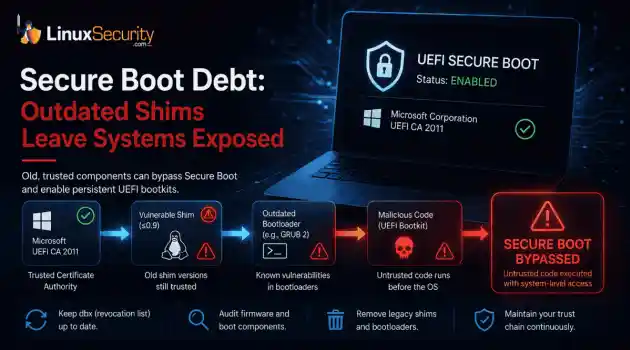
security advisory linux distribution ESET researchers identified 11 old and forgotten Linux UEFI shim bootloaders at versions 0.9 and below that can be used to bypass UEFI Secure Boot on any UEFI-based machine that trusts Microsoft’s Microsoft Corporation UEFI CA 2011 third-party certificate authority, regardless of the installed operating system (OS). Reported shims can be exploited to execute untrusted code during system boot, enabling attackers to deploy malicious UEFI bootkits even on systems with UEFI Secure Boot enabled.....
Jul 16, 2026
 Refine news
X Clear Filters
Get the latest News and Insights
Get the latest Linux and open source security news straight to your inbox.
Community Poll
Is continuous patching actually viable?
Loading...
Explore Latest Linux Security news
We found 4 articles for you...
78
 security advisorymalwareimportant
Thunderbird 140 ESR security advisory: crucial updates for email safety
If you're managing email infrastructure for a Linux-based environment, you’ve probably relied on Thunderbird at some point—or maybe you still do every day. It’s the Swiss Army knife of open-source email clients: extensible, familiar, and built for the long haul. With Thunderbird 140 ESR now in the wild, it’s time to take a closer look at what this release can offer, particularly in terms of security and stability, which are the bread and butter for folks running systems in enterprise or high-risk environments. . Let’s just say this upfront: if you care about locking down vulnerabilities and future-proofing your email stack, this one’s worth your attention. Thunderbird ESR (Extended Support Release) tends to focus less on chasing shiny new features and more on making the tool sharper, sturdier, and safer. That's exactly what’s on the table with the 140 ESR release. Examining The Security Side of Thunderbird 140 ESR For Linux admins and infosec folks, email is the soft, vulnerable underbelly of any organization’s infrastructure. Bad actors love email because it’s practically an open invitation for phishing , malware, and all kinds of nastiness. With Thunderbird 140 ESR, the Mozilla team continues the tradition of proactively patching security flaws . Each ESR update squashes critical bugs quietly lurking in the background. What’s notable here is that the ESR branch places an even stronger emphasis on reliability for long-term deployments. Regular Thunderbird releases are fine for casual users, but for anyone managing environments with compliance requirements (think HIPAA or GDPR), ESR versions minimize the risk of regressions while still delivering essential security updates. In short, it’s like running a more predictable, less flashy operating system kernel—only for your email. Another item worth highlighting for Linux admins: the updated GTK+ 3.14 requirement. This is a subtle but logical step forward for systems compatibility. Modern Linux environments willhave no issue meeting this dependency, but if you’re running a legacy distro that’s limping along on ancient GTK, it’s time to think about upgrading or planning a workaround. Why Does ESR Matter for Security-Minded Admins? What sets Thunderbird ESR apart from the standard release cycle is how it balances progress with predictability . ESR updates ensure you’re not constantly chasing minor, feature-focused releases, but you’re also not lagging behind on critical security fixes. For example, if you’ve ever had to explain to management why a zero-day exploit hit the company email servers because someone insisted on using an outdated client, you’ll appreciate what 140 ESR brings to the table. Admins juggling multiple responsibilities, especially those who maintain a mixed fleet of Linux desktops in a medium-to-large environment, can take comfort in knowing that ESR releases aren’t going to suddenly break things. The lifecycle support alone makes tools like Thunderbird 140 ESR far less of a headache when you’re also managing kernel patches, Samba shares, and the occasional broken cron job. Tightening Up Installations and Upgrades So, you’re ready to tackle Thunderbird 140 ESR. What’s the move? If you’re running a distro like Ubuntu, Debian, Fedora, or Arch, you probably have package managers doing a lot of the heavy lifting. A quick sudo apt update or sudo dnf update thunderbird will let you know if the repositories are caught up yet. Remember, ESR versions aren’t always immediately available in some repos, so you might need to grab prebuilt binaries from the official Thunderbird site. Here’s a quick pro-tip for manual installations: when you download and extract the latest binary ( tar -xjf ), drop it into /opt/ rather than sprinkling things across /usr/ . Symlink the binary into /usr/bin/ so every user on the system can access it without you having to tweak anyone’s $PATH. Need to double-check everything went smoothly? Fire up the terminal and run thunderbird-- version. Post-upgrade, launch Thunderbird and confirm that your existing email accounts and folder structures are intact. No one likes the Office Monday call of doom: “Why can’t I find my archives from 2019?” Closing Thoughts on the Thunderbird 140 ESR Release Thunderbird 140 ESR isn’t going to rewrite the rules of email, but it doesn’t need to. For Linux admins and security-conscious pros, it’s the kind of release that gently improves your infrastructure without throwing curveballs. You get a smarter, safer tool—one that plays nicely with modern libraries while continuing to support long-haul deployments. If your email infrastructure relies on Thunderbird, there’s no reason to wait. Apply the upgrade, test your environment, and keep your users protected. In a landscape where ransomware and phishing campaigns don’t take weekends off, staying on top of secure software like Thunderbird ESR is how you keep from getting blindsided. It might not be glamorous, but hey, nobody ever complained because things just worked. . Thunderbird 140 ESR enhances email security with critical updates that aid Linux admins in managing risks effectively.. Thunderbird email client, security updates, Linux email management, extended support release, Linux infrastructure management. . Brittany Day
 Jul 09, 2025
•
Jul 09, 2025
• Vendors/Products
209
 cyber threatsopen sourcephishing
Insights on Protecting Business Emails from Cyber Threats
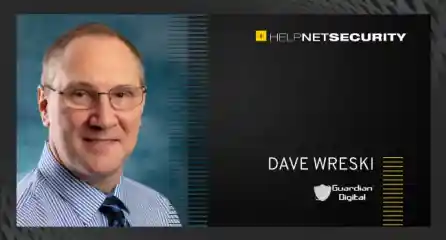
In this interview with Help Net Security, Dave Wreski, CEO at Guardian Digital , the open source email security company, talks about modern email threats and offers protection advice for organizations. Wreski explains how the open-source development model can be applied to the development of email security technology to engineer highly effective phishing and zero-day protection. . When it comes to business communication, email is still king. Cybercriminals are aware of this fact, and they’re constantly perfecting their attacks to successfully evade the built-in security defenses of Microsoft 365 and Google Workspace. . Discover strategies to protect your corporate emails against online dangers by understanding phishing mitigation and utilizing open source tools.. Email Security, Phishing Protection, Open Source Solutions, Cyber Threats, Business Communication. . Brittany Day
Aug 27, 2021
•
Security Trends
81
 security advisorypostfixtls
Configuring Postfix TLS: Enable Secure SMTP Connections With StartSSL
One recommended way to help secure your Postfix mail server is enabling TLS (Transport Layer Security) for connections to and from Postfix. You can search for more detailed descriptions of exactly how TLS works, but basically it. It relies on a key and a certificate to help accomplish its purposes, and this article will walk you through generating a key, getting your certificate, and installing everything on your Postfix system to enable TLS/SSL for SMTP connections. The link for this article located at Steve Jenkis is no longer available. . Enhance your Dovecot mail service by implementing SSL with a no-cost Let's Encrypt certificate for secure IMAP transactions.. Postfix TLS Configuration, StartSSL Certificate, Secure Email, SMTP Encryption. . LinuxSecurity.com Team
Jul 15, 2015
•
Privacy
77
networkingLinuxsecurity analysisLinux Systems Responsible For 5.14% Of Global Spam Contribution
I don't think this finding is unexpected at all. After all, Linux certainly operates better on the network, and sending spam email is no different than sending other types of email, or operating a web server. Whichever operation you're performing, choosing the best implementation for the job is a wise decision. Although Linux holds only a small market share, Linux computers appear to send a disproportionate amount of spam compared to other operating systems, according to new research from Symantec's MessageLabs messaging security division. . Symantec looked at spam from November 2009 through March and broke down what kind of operating system is on the computer that sent the spam. Analysts do that by a method called passive fingerprinting, which involves analyzing the network traffic of a remote host, which reveals that host's operating system. Since Windows holds more than 90 percent of the market, the lion's share of spam still comes from Windows machines, said Paul Wood, a MessageLabs intelligence analyst with Symantec. Symantec found that 92.65 percent of spam came from Windows PCs, with 2.22 percent coming from other operating systems and nearly none from Apple computers. But 5.14 percent of spam came from Linux machines, which is somewhat odd since Linux comprises about 1.03 percent of the operating system market, according to statistics quoted by Symantec in its latest MessageLabs Intelligence report for April. The link for this article located at PC World is no longer available. . Research reveals Linux systems produce more spam emails than anticipated despite their small market presence.. Linux Systems, Spam Analysis, Network Insights. . LinuxSecurity.com Team
Apr 27, 2010
•
Server Security
83
threatdetectioncybersecurityNew Dangerous Phishing Technique Discovered By Envisional
A new . 'This is a completely new and very dangerous threat,' said Envisional The link for this article located at Vnunet.com is no longer available. . 'This is a completely new and very dangerous threat,' said EnvisionalThe link for this article locat. 'this, completely, dangerous, threat, envisionalthe, article. . LinuxSecurity.com Team
Feb 06, 2007
•
Hacks/Cracks
81
accessibilitycommunicationassistive technologyEffects of Spam Emails on Visually Impaired Accessibility Challenges
Think looking at spam is offensive? Try listening to it. For the millions of blind and visually impaired Internet users around the world, using text-to-speech software is often the only way to check e-mail. But as the spam problem gets worse, more and more of those users are finding that having their e-mail read aloud can be a minefield. Listening to the next message in the inbox may reveal an important letter from an old friend or, more often, an embarrassing ad for penis-enhancement therapy. . . .. Think looking at spam is offensive? Try listening to it. For the millions of blind and visually impaired Internet users around the world, using text-to-speech software is often the only way to check e-mail. But as the spam problem gets worse, more and more of those users are finding that having their e-mail read aloud can be a minefield. Listening to the next message in the inbox may reveal an important letter from an old friend or, more often, an embarrassing ad for penis-enhancement therapy. For many users -- especially youngsters -- the messages amount to an assault on the ears that is just not acceptable. "They end up hearing words that a lot of us wouldn't want to hear when they listen to the subject line," said Carol Cyr, a computer instructor at the Peninsula Center for the Blind in Palo Alto, California. To make matters worse, blind users are finding that they are spending disproportionately more time sorting through their junk e-mail than their sighted colleagues. That's because sighted users can simply scan large batches of messages for that one important piece of mail, whereas blind users must listen to the subject line of each message before they know whether it's spam or not. It's a process that has become so unbearable that some blind users say they are giving up on e-mail altogether. The link for this article located at wired.com is no longer available. . Blind users rely on screen readers for email but face heavy spam issues that complicate their communication, risking identity theft and databreaches.. Spam Filtering, Assistive Technology, Email Accessibility, Blind Users, Text-to-Speech. . LinuxSecurity.com Team
Jun 22, 2004
•
Privacy
81
security advisoryprivacyinternetSpam's Impact on Internet Traffic: Insights from Lauren Weinstein
It was May, 1978. Lauren Weinstein was among those developing an early version of the Internet when an e-mail popped into his box. It was the first spam ever -- a pitch from Digital Equipment Corp. sent, literally, to everyone on . . . . It was May, 1978. Lauren Weinstein was among those developing an early version of the Internet when an e-mail popped into his box. It was the first spam ever -- a pitch from Digital Equipment Corp. sent, literally, to everyone on the fledgling Net. "People thought it was a little bit annoying but sort of amusing," Weinstein says. It's not amusing anymore. Junk e-mail accounted for an estimated 49% of network traffic in June, according to Brightmail Inc., a San Francisco manufacturer of anti-spam software. These days, spam attacks Weinstein's computer every two seconds. And the Internet pioneer, founder of the Privacy Forum in Woodland Hills, Calif., is trying to save the revolutionary communications medium he had a hand in creating 25 years ago. The open architecture that made the Internet a transformative technology also has spawned the rapidly growing junk e-mail menace. "It never occurred to us that the tools we were developing for ourselves in this highly trusted environment would ever end up in the hands of the world's population," he says. The link for this article located at BusinessWeek is no longer available. . It was May, 1978. Lauren Weinstein was among those developing an early version of the Internet when . lauren, weinstein, among, those, developing, early, version, internet. . LinuxSecurity.com Team
Aug 07, 2003
•
Privacy
81
spamemailproductivityPew Research Study Shows Email Essential for American Workers
Contrary to popular belief, the majority of American office workers aren't overwhelmed with unsolicited "spam" e-mail, and most consider e-mail very valuable in helping them do their jobs, a new study shows. More than 60 percent of people employed in the U.S. have Internet access at work and virtually all of those use e-mail on the job. . .. Contrary to popular belief, the majority of American office workers aren't overwhelmed with unsolicited "spam" e-mail, and most consider e-mail very valuable in helping them do their jobs, a new study shows. More than 60 percent of people employed in the U.S. have Internet access at work and virtually all of those use e-mail on the job . That translates into 57 million wired American workers, more than double the amount of people with Internet access on the job just 2 years ago, according to research expected to be released Monday by the Pew Internet & American Life Project. Almost all workers with e-mail check their in-boxes at least once a day (88 percent), with most (70 percent) checking it several times a day. For those Americans, e-mail is considered a vital part of their daily work lives, with 63 percent of them finding e-mail communications more effective than using the phone or talking in person when making arrangements and appointments. The vast majority (86 percent) believe that e-mail saves time and 59 percent say it improves teamwork. In fact, the use of e-mail on the job has become so pervasive in American office life that half of the participants in the Pew study believe it to be essential to their work. At the same time, there's a widespread perception that many American workers are wasting too much time every day dealing with the rising flood of unwanted e-mail pitches, or spam. What the Pew researchers found in a survey of 2,447 Americans is that the average wired American worker spends only about a half-hour dealing with e-mail on a typical day. About a fifth of workers deal with a lot of e-mail all the time, but on average people on the jobreceive 10 or fewer e-mails a day and send five or less. "We were expecting that people at work would be complaining that they were buried in e-mail," said Deb Fallows, the Project's senior research fellow. "But people use e-mail responsibly and in moderation and they like it." No doubt spam is an annoyance for American businesses, but the Pew study should help dispel any remaining doubts that e-mail is a valuable tool in the American workplace. The study also acknowledges the growing volume of spam and its impact on corporate e-mail systems. Industry watchers estimate that about a third of the over 7.3 billion e-mails sent every day are unwanted commercial pitches. According to a recent study by Jupiter Research, the average amount of spam received per user each day has nearly doubled, to 6.2 from 3.7 e-mails per day. Overall the junk e-mail situation has gotten so bad that even the world's leading group of direct marketers has called for government regulation. "Based on the sheer volume [of spam], even legitimate e-mails from companies are being lost," Jerry Cerasale, the Direct Marketing Association's senior vice president of government affairs told MSNBC.com last month. So while some home-based e-mail accounts are deluged with staggering amounts of spam, most unsolicited commercial messages don't reach e-mail accounts at people's work places, the study found. Only about 15 percent of workers report dealing with more than 50 e-mails a day. Companies and businesses have been confronted the junk mail problem with spam-fighters and filters that block the messages before they reach workers' in-boxes. Fallows call corporate technology staffers the "unsung heroes" who block spam from company e-mail systems with filtering software. "Spam is out there but it's only arriving at certain places. A lot is being kicked out by technology," she said. Spam aside, Americans aren't all happy about the proliferation of e-mail in the office. About a quarter of wired workers find e-mail distracting and afifth say it has both caused misunderstandings and added stress to their jobs. In the end, however "people use it smartly and efficiently and can't live without it," said Fallows. The link for this article located at MSNBC is no longer available. . Most American office workers find email valuable for their jobs, despite spam concerns, according to a Pew Research study.. email productivity, American workplace, Pew Research findings, spam impact, work communication. . LinuxSecurity.com Team
Dec 08, 2002
•
Privacy

Get the latest News and Insights
Get the latest Linux and open source security news straight to your inbox.
Community Poll
Is continuous patching actually viable?
Search Topics
Powered By

Linux Security - Your source for Top Linux News, Advisories, HOWTOs and Feature Releases
QUICK LINKS
subscribe to newsletters!
Like staying secure? So do we.
Sign up for updates, tips, and alerts!