Explore top 10 tips to secure your open-source projects now. Read More
×



Server Security data privacy automation
data privacy automation Every system admin has lived through the same Monday morning ritual. A queue of forty tickets, half of them password resets, permission errors, or disk space warnings that any experienced technician could resolve in under two minutes. The other half require actual judgment. For years, automation promised that software would eventually sort the two apart on its own. That promise is now being tested in production Linux environments. . Early results are reshaping how IT teams think about tier-1...
 Jul 17, 2026

Privacydata collection automation
data collection automation You're running a web scraping project to collect pricing data from e-commerce sites. You set up a pool of datacenter proxies, launch your scripts, and within minutes — banned . CAPTCHAs everywhere. Your data pipeline stops before it really begins. . It's a frustrating scenario that plays out daily in ad verification, market research, and multi-account management. The website doesn't know you're doing legitimate research or monitoring. It just sees traffic coming from IP ranges it recognizes as...
Jul 17, 2026

Security Trends security advisory social engineering
security advisory social engineering Business Email Compromise used to be a numbers game — mass-blasted emails, broken English, an obvious "URGENT WIRE TRANSFER" subject line. That era is over. Generative AI has turned BEC into a tailored, low-noise operation that mimics writing style, voice, and even video presence. This piece looks at what's actually changed under the hood, what defenders are testing in response, and why so many organizations are still structurally unprepared for it. . The Infrastructure Problem Nobody Wants to...
Jul 17, 2026

Security Trends cybersecurity Linux documentation
cybersecurity Linux documentation Linux operating systems have gained prominence due to their stability, adaptability, and excellent security options. In the case of developing documentation, designing cybersecurity dashboards, or educational material, visuals are of vital importance when it comes to making things clear. The use of icons allows one to understand the message regarding alerts, authorization, encryption, authentication, or the state of the system just by looking at the visual cue without having to read long...
Jul 17, 2026
Security Vulnerabilities security advisory linux distribution
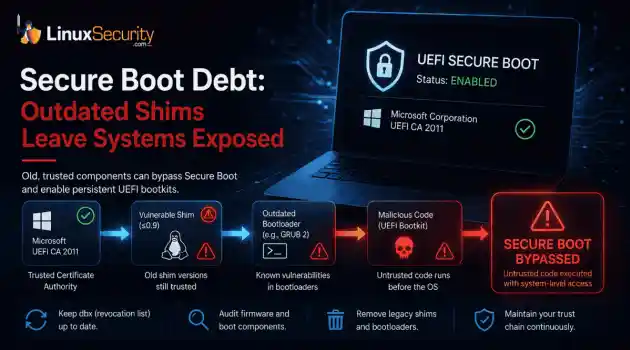
security advisory linux distribution ESET researchers identified 11 old and forgotten Linux UEFI shim bootloaders at versions 0.9 and below that can be used to bypass UEFI Secure Boot on any UEFI-based machine that trusts Microsoft’s Microsoft Corporation UEFI CA 2011 third-party certificate authority, regardless of the installed operating system (OS). Reported shims can be exploited to execute untrusted code during system boot, enabling attackers to deploy malicious UEFI bootkits even on systems with UEFI Secure Boot enabled.....
Jul 16, 2026
 Refine news
X Clear Filters
Get the latest News and Insights
Get the latest Linux and open source security news straight to your inbox.
Community Poll
Is continuous patching actually viable?
Loading...
Explore Latest Linux Security news
We found 22 articles for you...
77
 security advisoryenterpriselinux
Enterprise Linux Managing Pentest Tools: Security Automation Strategies
Security scales poorly. What worked for ten apps starts breaking at a hundred. Each new service adds another scanner, another report, another backlog of findings that no one has time to triage. . For companies building on Linux-based infrastructure, the problem runs deeper. CI/CD pipelines push code hourly, containers spin up and vanish, and old pentesting tools can’t keep pace. The annual pen test model feels outdated. Static scans and PDF reports don’t match a world running continuous integration. The real challenge isn’t finding vulnerabilities. It’s managing the noise that hundreds of scanners create — across different environments, different tools, and different formats. Security leaders now need orchestration as much as detection. The goal isn’t more tests; it’s better control. This is where enterprise-level pentest management becomes its own discipline. A mix of automation, Linux-native visibility, and process discipline that lets security scale as fast as development. Managing Pentest Tools at Scale with Security Orchestration in Linux Environments Every enterprise eventually faces the same scaling problem. Dozens of scanners, inconsistent outputs, and no unified view of risk. SAST, DAST, SCA, and network scanning tools all work fine in isolation. Together, they create noise. CSVs here, JSON there, PDFs somewhere else. Stitching that data into something usable burns hours that should go to triage and patching. In modern Linux infrastructure security , that problem multiplies. Containers come and go in seconds. Microservices talk through APIs that change weekly. OpenVAS runs in staging, Nmap in CI/CD, and Metasploit in a side container someone forgot to shut down. Without strong security orchestration, visibility across Linux systems and cloud workloads breaks down. Compliance pressure makes it worse. SOC 2, HIPAA, and ISO frameworks all demand consistent, traceable evidence. NIST guidance calls for complete asset coverage across production and testingenvironments. Hard to achieve when your pentesting in CI/CD pipelines uses different tools, configurations, and result formats. At this scale, managing pentest tools turns into an engineering problem, not just a security one. DevSecOps automation takes over — scheduling tests, collecting results, and linking vulnerability data directly to deployment workflows. The goal is continuous penetration testing that runs alongside code pushes, not months after release. Most of the real work happens on Linux. The backbone of every container, server, and CI runner. That’s why open-source security tools like Nikto, Nmap, OpenVAS, and Metasploit dominate pentest pipelines. They’re reliable and flexible but lack native coordination. Each instance runs alone, without context or shared baselines. Duplicated findings, missed issues, and inconsistent severity data follow. True vulnerability management at scale needs orchestration that can speak the language of Linux, not just Windows or cloud dashboards. It means aligning open-source tools with enterprise automation, linking findings to patch systems, and mapping coverage to compliance requirements. That’s what makes managing pentest tools sustainable in large, Linux-driven environments — automation that doesn’t lose context, and orchestration that doesn’t slow development. Managing Pentest Tools Across Linux Environments Every team starts with a few scanners and ends with a small zoo. Reports stack up, findings overlap, and triage slows to a crawl. At enterprise scale, managing pentest tools across Linux environments becomes less about scanning and more about orchestration. Centralize and Unify Findings The first step is consolidation. Aggregate scan results from SAST, DAST, and network tools into a central platform — ELK, Grafana, or a dedicated security orchestration layer. Once the data lives in one place, you can start to see patterns across systems. OS-level issues from Linux packages line up next to web app findings. Noise drops,correlation improves, and false positives start to fall off. Linux-native integrations matter here. Tools like Lynis, OpenVAS, or CIS Benchmarks feed system-level results directly into your dashboard. That tight coupling builds a full picture of Linux infrastructure security, not just what’s visible through the web stack. Automate Triage and Prioritization Next comes automation. Use DevSecOps automation to apply logic that separates critical findings from background noise. Rank vulnerabilities based on exposure and privilege level. A remote code execution on a public host should rise to the top; a medium-level flaw in an isolated container can drop to the back of the queue. Automation in Linux is straightforward. Cron jobs, Ansible playbooks, or lightweight scripts can manage recurring scans and triage cycles. The result is cleaner data and faster reaction without adding headcount. Integrate Security into Developer Workflows This is where continuous penetration testing web applications connects with day-to-day work. Integrate your scanners directly into CI/CD systems like GitLab or Jenkins. When new code deploys to a Linux host, trigger pentests automatically. Feed new findings into GitHub or Jira so developers can fix issues early, without waiting for a quarterly audit. That’s what “shifting left” actually means — merging testing with development cycles so security isn’t a separate stage. It’s how AI and DevSecOps automation make pentesting routine, not reactive. In open-source and Linux-heavy shops, this approach builds a living process that scales with the codebase. Managing pentest tools this way turns scattered testing into repeatable, auditable motion. Centralized data. Automated triage. Continuous validation. Real Linux security that keeps pace with the infrastructure underneath it. Building a Unified Pentesting Framework on Linux Infrastructure Most teams already have the pieces. A scanner here, a script there, maybe an old VM still running Metasploit.What’s missing is structure. Managing pentest tools without a unifying layer leads to duplicate scans, missing data, and blind spots that expand with every new deployment. The goal is a single orchestration layer that pulls everything together. Platforms like DefectDojo, Faraday, or ArcherySec work as the glue between scanners. They collect and normalize results from Linux pentesting tools, consolidate findings, and give teams one consistent interface. With that visibility, overlaps stand out fast, and vulnerability data becomes manageable at scale. Automation keeps it steady. Linux-native tools — Bash, Ansible, cron — handle recurring scans and data collection without new infrastructure. A cron job kicks off nightly DAST runs. Ansible updates open-source scanners across nodes. The rhythm stays predictable, no manual scheduling or missed windows. Centralized logging adds depth. The ELK stack or Wazuh can aggregate scan output, system alerts, and audit logs into one pane. That’s how you turn raw findings into something closer to real vulnerability management at scale. Trends show up. Repeated flaws surface. Teams move from reaction to prioritization. Linux stays the backbone . Most enterprise services run on Linux containers or hosts, and orchestration only works if it speaks that language. Integrate vulnerability feeds, patch data, and compliance checks directly into the framework. Tie in OS-level tools like OpenVAS or Lynis to catch misconfigurations early. That’s where orchestration meets infrastructure — one cycle from detection to remediation. When it’s done right, the framework supports continuous pentesting and folds into CI/CD naturally. It’s not another dashboard. It’s the connective tissue that turns scattered tools into a working process. Real visibility, steady automation, and a unified rhythm for modern enterprise pentesting. Common Pitfalls in Scaling Pentest Operations Large environments expose weak coordination. Tools overlap, data fragments, andaccountability slips. These are the failure points most teams hit once testing moves beyond a few apps. 1. Inconsistent Coverage As application counts rise, so do blind spots. Some systems never enter scope. Microservices launch outside standard deployment paths and miss testing cycles entirely. Without a defined inventory process, pentests lose accuracy fast. 2. Alert Overload Multiple scanners flag the same issue differently. Analysts waste hours merging results instead of fixing the root cause. When triage slows, real vulnerabilities sit unpatched. 3. Siloed Reporting Every scanner exports in its own format. Compliance reporting for SOC 2 or ISO frameworks becomes manual work — collecting, normalizing, and mapping evidence. Missed entries or outdated reports weaken overall assurance. 4. Linux Security Debt In Linux-heavy infrastructure, dependency tracking and patch cadence are difficult to maintain. Different package managers, kernel builds, and base images create uneven patch levels. Vulnerabilities get reintroduced when outdated containers or modules are redeployed. This is the quiet form of risk that doesn’t show up in the dashboards but causes repeat findings later. Most of these issues trace back to how organizations handle managing pentest tools. Without strong security orchestration, the process fragments across teams and technologies. Real vulnerability management at scale depends on continuous visibility across Linux systems, applications, and pipelines — not just running more scans. The Future of Enterprise Pentesting: Automation, AI, and Linux Integration Enterprise security is shifting from reaction to prediction. The next phase of managing pentest tools focuses less on running scans and more on anticipating where weaknesses will appear. Machine learning models are starting to identify recurring code patterns linked to known exploit classes. Not perfect yet, but improving fast. Predictive scanning will cut down redundant tests and surface high-risk areasbefore deployment. Automation remains the foundation. DevSecOps automation continues to merge with security orchestration platforms, streamlining workflows that used to depend on manual configuration. Tests trigger automatically when code moves through pentesting in CI/CD pipelines . Findings sync directly with issue trackers. The result is a testing process that behaves more like infrastructure — continuous, versioned, and traceable. Linux integration is expanding, too. Future tools are building direct hooks into security frameworks such as AppArmor, SELinux, and OSQuery. Instead of scanning around the OS, pentest systems will interact with it. That means tighter visibility into process behavior, permission drift, and container isolation — all critical for maintaining Linux infrastructure security. Real-time detection will push the model further. Continuous agents watching for configuration changes or exposed services inside containers will shorten the gap between exploit and response. For larger environments, that’s the only scalable option. Compliance is evolving alongside it. API-first orchestration platforms are beginning to automate evidence collection for frameworks like SOC 2 and ISO 27001. Continuous compliance ties directly into vulnerability management at scale, using scan data and Linux telemetry to prove coverage without manual reporting. AI won’t replace analysts, but it will take over the repetitive work. The outcome is faster triage, tighter integration with open-source security tools , and a more adaptive layer of Linux security across the enterprise stack. The future of pentesting looks less like a quarterly event and more like a living process running in real time. Final Analysis Managing pentest tools across large Linux environments isn’t about volume. More scans don’t equal better coverage. The real work is coordination — keeping automation, Linux practices, and development cycles aligned. Key Takeaways Automation as the baseline: Smartpentesting automation reduces noise and improves triage. It runs quietly inside CI/CD pipelines and supports continuous validation without slowing release cycles. Linux security as the backbone: Strong configuration management, hardened containers, and consistent patch hygiene define the foundation of modern operations. Every orchestration layer depends on stable Linux infrastructure security underneath it. DevSecOps orchestration as the bridge: Integration is where the system holds together. Unified dashboards, API-driven tools, and shared workflows connect scanning to remediation. This is what turns security orchestration from a concept into a daily practice. Visibility and speed: Centralization gives teams a single view. Integration shortens response time. Together, they replace fragmented testing with continuous, measurable control. Enterprise pentesting is shifting toward routine, repeatable motion. The goal isn’t to automate analysts out of the loop — it’s to give them cleaner data, faster signals, and better context. Linux security, automation, and orchestration form the structure that keeps it working at scale. . Explore effective management of pentest tools in enterprise Linux environments, focusing on orchestration and automation for security.. Pentest Management, Security Orchestration, Linux Tools, Enterprise Security, Automation. . MaK Ulac
 Oct 23, 2025
•
Oct 23, 2025
• Server Security
215
 remote accessdevice managementsoftware solutions
Discover Top Linux Device Management Solutions for the Year 2026
Enterprise environments power everything from development machines and servers to kiosks and IoT devices. However, managing these endpoints, especially across distributed teams, isn’t as straightforward as managing them on mainstream platforms like Windows or Android. That’s where Linux device management comes in. . Regardless of whether you are an IT administrator responsible for managing Ubuntu or Arch Linux laptops in a development team or overseeing field devices on Raspberry Pi, selecting the appropriate Linux device management software is essential for maintaining a balance between security, compliance, and productivity. Let’s explore the top contenders in Linux mobile device management for 2026. This isn’t just another checklist. We’re diving into each tool’s standout strengths and evaluating how they serve today’s hybrid Linux ecosystems. Swif.ai MDM AI-Governance Platform Swif.ai is a unified mobile device management platform covering macOS, Windows, iOS, Android, and Linux. It provides policy enforcement controls intended to support compliance with frameworks such as SOC 2, ISO 27001, and CMMC, and includes predefined compliance templates. The platform can integrate reporting data with audit management tools such as Vanta and Drata. For Linux environments, it supports multiple distributions, including Ubuntu and NixOS, and provides centralized visibility into device configuration and compliance posture. What differentiates it: Swif.ai integrates AI-assisted monitoring into traditional MDM controls, allowing IT teams to surface deviations, misconfigurations, and compliance risks without relying solely on reactive troubleshooting. Key Capabilities : Policy-based compliance enforcement Configuration drift monitoring Automated governance workflows Centralized Linux device oversight Real-time posture visibility Security state analytics Trial/Pricing : Available upon request Best suited for : Enterprises seeking automatedgovernance and compliance oversight for Linux environments Scalefusion MDM Scalefusion has rapidly emerged as one of the most user-centric solutions in the Linux device management space. It offers intuitive, script-based enrollment and supports Ubuntu and other Debian distributions, making it ideal for startups, education environments, and enterprise setups with remote Linux fleets. Its centralized dashboard gives real-time access to vital system data such as battery health, encryption status, and OS compliance, all at a glance. Scalefusion also streamlines everyday tasks with policy-based automation and secure kiosk mode, ensuring devices stay locked to purpose. Why it stands out: Because it comes with Linux shell programming, remote terminal access, and application control, IT has full command-line control over Linux machines that are far away without making them harder to use. Notable Features: Linux Kiosk Mode Remote terminal for troubleshooting Location tracking and geofencing Password & browser policy control Granular content and app management Wi-Fi and peripheral settings Trial/Pricing: 14-day free trial; starting at $2/device/month (billed annually) Ideal for: Enterprises with Linux-first or mixed-device infrastructure SOTI MobiControl SOTI MobiControl brings enterprise mobility management (EMM) into the Linux realm with its comprehensive control for remote access, content distribution, and device lockdown. IT teams can enforce location-based rules through geofencing and reduce downtime via remote view and control capabilities. What makes it unique: Its automated lock methods and task scheduler help cut down on manual work and make endpoints more resilient. Features at a Glance: Linux device lock & monitoring File sync and content push Remote diagnostics Geofencing policies Device health alerts Trial/Pricing: 30-day trial for 25 devices; pricing upon request Best suited for: Logistics and fieldoperations relying on Linux tablets or rugged devices ManageEngine Endpoint Central (UEM) Endpoint Central from ManageEngine is a full-fledged UEM that supports Linux endpoints separately. Patch management, fixing security holes, and automatic security enforcement are some of its best features. All of these are necessary for keeping Linux systems safe in real-world work settings. Unique proposition: This solution excels at automating repetitive tasks, such as OS patching and application deployments, across a mix of Linux flavors. Key Capabilities: Malware detection & privilege control Patch management for Linux distros Asset discovery and audit reports Browser hardening & app whitelisting Remote access tools Trial/Pricing: 30-day free trial; pricing on request Good for: IT teams with compliance-heavy environments JumpCloud JumpCloud brings identity-centric Linux device management into the spotlight. It offers robust user access policies, remote patching, and directory-level controls for Linux systems backed by cloud-native agility. Differentiator: It bridges the gap between Linux system control and identity and access management, all under one platform. Top Features: Password management & authentication Remote enrollment commands Patch workflows Admin script automation User directory sync with SSO Trial/Pricing: 30-day trial; starts at $9/user/year Ideal for: Cloud-native businesses and DevOps-focused orgs SureMDM by 42Gears SureMDM is another strong Linux MDM platform offering a simplified yet powerful interface for managing Linux endpoints. Its emphasis on remote command execution and content filtering makes it an excellent tool for enforcing usage boundaries. Why it’s valuable: The tool's remote Linux desktop control and web access blocking capabilities offer granular control over internet exposure on devices. Core Features: Linux kiosk mode App and OS updates Script execution viaterminal Remote file transfer Website blocking rules Trial/Pricing: 30-day free trial for 100 devices; starts at $3.99/month. Target use cases: Digital signage, POS systems, and education tech setups Esper for Linux IoT Devices Esper is gaining popularity in the Linux-powered IoT space. It enables teams to manage embedded Linux devices such as kiosks, wearables, and POS systems by supporting custom firmware, secure OS updates, and telemetry dashboards. Standout strength: Deep control over Linux containers and full A/B OTA updates for mission-critical deployments. Key Features: Secure device provisioning Containerized app deployment OS version control Fleet-wide telemetry insights API integrations Best for: IoT and embedded Linux device management Trial/Pricing: Custom quote on request Fleetsmith (Now Open Source Forks) Although acquired by Apple, open-source forks of Fleetsmith’s original Linux client still see community updates. While limited in UI capabilities, they offer basic inventory management, scripted device configurations, and SSH-based remote controls. Use case: For organizations with a strong DevOps team and a preference for self-hosted Linux device management solutions. Pros: Lightweight agent Free and open-source Easily extensible with shell scripts Limitations: No GUI or official support Good for: Advanced users managing internal Linux fleets Choose the Best Linux Device Management Tool Selecting the right Linux remote device management tool depends on the nature of your infrastructure, your IT maturity, and whether you prioritize GUI simplicity, CLI power, or integration flexibility. Scalefusion leads with a great blend of ease of use, depth, and affordability, which is ideal for growing businesses and cross-platform teams. ManageEngine and JumpCloud shine in compliance-focused or identity-heavy setups. For IoT projects, Esper brings unmatched control over embedded Linuxenvironments. Linux device management in 2026 is no longer an afterthought—it’s the backbone of secure, productive, and compliant enterprise operations. . Regardless of whether you are an IT administrator responsible for managing Ubuntu or Arch Linux lapt. enterprise, environments, power, everything, development, machines, servers, kiosks. . MaK Ulac
Jun 16, 2025
•
Desktop Security

209
 open-sourceenterprisecollaboration
The Shift In Open Source Dynamics And Community Collaboration
"Open-source software's security and reliability aspects have played a significant role in its rise. The availability of source code to a large community of developers allows for thorough code review, which helps promptly identify and address potential security vulnerabilities. With a collective effort to maintain and enhance the software, the open-source approach ensures higher reliability and stability." . In the rapidly evolving world of technology, a seismic shift is taking place as the very ethos of the open-source market finds itself in flux. The cherished ideals of open community standards, collaboration, and crowdsourced innovation are now being challenged by powerful enterprises, many of them publicly-traded corporations, grappling with the balance between shareholder fiduciary responsibilities and community support. Red Hat, one of the longtime leaders in the open-source space, made some key announcements, which I got the chance to discuss with Gunnar Hellekson, the GM of the Red Hat Enterprise Linux business recently, that the company is changing how it approaches the open-source community as it relates to its main source of revenue, Red Hat Enterprise Linux (RHEL). RHEL is an open-source operating system that thousands of organizations, institutions, and government departments use globally. Due to various factors, open-source software has gained significant prominence over the last decade with crowdsourced, open-code bases underpinning some of the fastest-growing software companies such as Redis, SUSE, MongoDB, and Elastic, among others. Open source refers to software that is released with its source code freely available to the public, enabling users to view, modify, and distribute it under specific open-source licenses. This approach has led to the emergence of a collaborative and transparent development model, resulting in widespread adoption and recognition. . In an environment where collaborative software development faces challenges, organizations must balance innovativeprogress with community support for ongoing growth. Open Source Software, Enterprise Linux, Community Collaboration. . Brittany Day
Aug 17, 2023
•
Security Trends
67
 ransomwarecyber threatenterprise
Abyss Locker Ransomware Threatens VMware ESXi Servers in Enterprises
The Abyss Locker operation is the latest to develop a Linux encryptor to target VMware's ESXi virtual machines platform in attacks on the enterprise. . As the enterprise shifts from individual servers to virtual machines for better resource management, performance, and disaster recovery, ransomware gangs create encryptors focused on targeting the platform. With VMware ESXi being one of the most popular virtual machine platforms, almost every ransomware gang has begun to release Linux encryptors to encrypt all virtual servers on a device. Other ransomware operations that utilize Linux ransomware encryptors, with most targeting VMware ESXi, include Akira , Royal , Black Basta , LockBit , BlackMatter , AvosLocker , REvil , HelloKitty , RansomEXX , and Hive . . As companies migrate to cloud infrastructures, cybercriminal organizations focus on Microsoft’s Azure services using Windows cryptors.. Abyss Locker, Linux Ransomware, VMware Security, Enterprise Cyber Threats. . LinuxSecurity.com Team
Jul 31, 2023
•
Cryptography
210
 security advisorycritical issueenterprise
CentOS: Critical Kernel Flaws Disclosed by Google Project Zero
Google Project Zero is a security team responsible for discovering security flaws in Google's own products as well as software developed by other vendors. Following discovery, the issues are privately reported to vendors and they are given 90 days to fix the reported problems before they are disclosed publicly. In some cases, a 14-day grace period is also given, depending on the complexity of the solution involved. . We have covered Google Project Zero's findings extensively in the past as it has reported vulnerabilities in software developed by Google , Microsoft , Qualcomm , Apple , and more. Now, the security team has reported several flaws in CentOS' kernel. As detailed in the technical document here , Google Project Zero's security researcher Jann Horn learned that kernel fixes made to stable trees are not backported to many enterprise versions of Linux. To validate this hypothesis, Horn compared the CentOS Stream 9 kernel to the stable linux-5.15.y stable tree. For those unaware, CentOS is a Linux distro closest to Red Hat Enterprise Linux (RHEL) and its version 9 is based on the linux-5.14 release. . Recent findings from Google Project Zero unveil serious vulnerabilities in the CentOS kernel, prompting worries about the rapid deployment of fixes in corporate systems. CentOS Kernel Issues, Google Project Zero, Security Flaws. . Brittany Day
Mar 26, 2023
•
Security Vulnerabilities
79
open sourceenterpriseresilienceExploring Linux's Progress in Resilience and Self-Healing Innovations
Commercial Unix was expensive so it was carefully tended – and indeed tendered. Linux is free so it has to fend for itself. . Linux itself was inspired by the tried and tested designs of the proprietary Unixes that preceded it – or predeceased it – which it drove into extinction. Some of their tech continues to make its way into Linux, and some is being reinvented, usually to get round IP issues. The goals are to make Linux more resilient : fault-tolerant, self-healing, and in general to lower the cost of its maintenance. Just as desktop distros get their core tech from the lucrative server ones, some of the methods being used started out in old enterprise Unixes, or are reimplementations of tools and methods from them, but that's only the beginning of the influence. A starting point is one of the longest-standing bits of enterprise IT: databases. They've been around for longer than minicomputers and their contents are usually very valuable so lots of time, effort, and money has gone into research into how to make them more resilient. A core property has been to make them transactional – once an important buzzword for big commercial databases, and something that later filtered down to the smaller ones . The idea is to make every alteration of your precious business data into a transaction. Ideally, it completes fully, but if it doesn't, you have a record of what was going to happen, so you can fully undo it, thus putting things back exactly as they were before. . The journey of Linux is rooted in commercial Unixes, crafting robust, budget-friendly alternatives for contemporary technology.. Linux Resilience, Fault Tolerance, Open Source Security, Database Transactions, Cost Reduction. . LinuxSecurity.com Team
Feb 16, 2023
•
Security Projects
78
security advisoryenterpriseRHELRed Hat RHEL 8.7 And 9.1 Beta Launch With Podman Updates
There is more than one type of application container technology that enterprises can choose as they build out cloud-native applications. . Linux vendor Red Hat announced this week the beta release of the latest update for its Red Hat Enterprise Linux (RHEL) platform with the 8.7 and 9.1 milestones. Both RHEL 8.7 and 9.1 add new features and capabilities designed to help organizations more effectively use Podman containers, which is an open source effort led by Red Hat. Red Hat has been a business unit of IBM since it was acquired for $34 billion in 2018. . The open-source stalwart, Canonical, has unveiled the beta version of the newest iteration of its Ubuntu operating system, tailored for enterprise environments.. Red Hat, Podman Containers, Enterprise Linux, Cloud-Native Solutions, RHEL Update. . LinuxSecurity.com Team
Oct 09, 2022
•
Vendors/Products
78
 security advisoryserveroperating system
RHEL 9.0 Review: Improved Security And Management For Enterprises
RHEL 9.0, the latest major release of Red Hat Enterprise Linux , delivers tighter security, as well as improved installation, distribution, and management for enterprise server and cloud environments. . The operating system, code named Plow, is a significant upgrade over RHEL 8.0 and makes it easier for application developers to test and deploy containers. Available in server and desktop versoins, RHEL remains one of the top Linux distributions for running enterprise workloads because of its stability, dependability, and robustness. . The newly released CentOS 9.0 version enhances both security protocols and administrative functionalities, tailored for business server and cloud environments.. RHEL 9, Security Enhancements, Enterprise Management, Linux Features. . LinuxSecurity.com Team
Jul 06, 2022
•
Vendors/Products

Get the latest News and Insights
Get the latest Linux and open source security news straight to your inbox.
Community Poll
Is continuous patching actually viable?
Search Topics
Powered By

Linux Security - Your source for Top Linux News, Advisories, HOWTOs and Feature Releases
QUICK LINKS
subscribe to newsletters!
Like staying secure? So do we.
Sign up for updates, tips, and alerts!