Explore top 10 tips to secure your open-source projects now. Read More
×



Server Security data privacy automation
data privacy automation Every system admin has lived through the same Monday morning ritual. A queue of forty tickets, half of them password resets, permission errors, or disk space warnings that any experienced technician could resolve in under two minutes. The other half require actual judgment. For years, automation promised that software would eventually sort the two apart on its own. That promise is now being tested in production Linux environments. . Early results are reshaping how IT teams think about tier-1...
 Jul 17, 2026

Privacydata collection automation
data collection automation You're running a web scraping project to collect pricing data from e-commerce sites. You set up a pool of datacenter proxies, launch your scripts, and within minutes — banned . CAPTCHAs everywhere. Your data pipeline stops before it really begins. . It's a frustrating scenario that plays out daily in ad verification, market research, and multi-account management. The website doesn't know you're doing legitimate research or monitoring. It just sees traffic coming from IP ranges it recognizes as...
Jul 17, 2026

Security Trends security advisory social engineering
security advisory social engineering Business Email Compromise used to be a numbers game — mass-blasted emails, broken English, an obvious "URGENT WIRE TRANSFER" subject line. That era is over. Generative AI has turned BEC into a tailored, low-noise operation that mimics writing style, voice, and even video presence. This piece looks at what's actually changed under the hood, what defenders are testing in response, and why so many organizations are still structurally unprepared for it. . The Infrastructure Problem Nobody Wants to...
Jul 17, 2026

Security Trends cybersecurity Linux documentation
cybersecurity Linux documentation Linux operating systems have gained prominence due to their stability, adaptability, and excellent security options. In the case of developing documentation, designing cybersecurity dashboards, or educational material, visuals are of vital importance when it comes to making things clear. The use of icons allows one to understand the message regarding alerts, authorization, encryption, authentication, or the state of the system just by looking at the visual cue without having to read long...
Jul 17, 2026
Security Vulnerabilities security advisory linux distribution
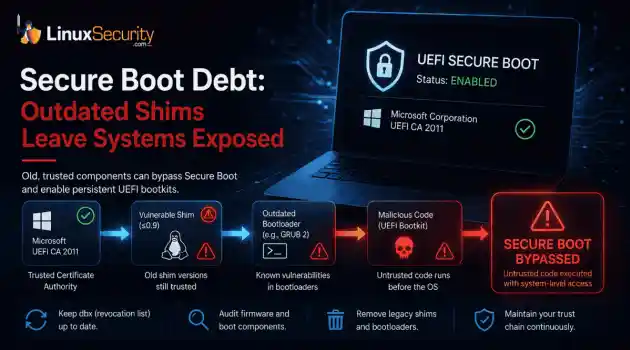
security advisory linux distribution ESET researchers identified 11 old and forgotten Linux UEFI shim bootloaders at versions 0.9 and below that can be used to bypass UEFI Secure Boot on any UEFI-based machine that trusts Microsoft’s Microsoft Corporation UEFI CA 2011 third-party certificate authority, regardless of the installed operating system (OS). Reported shims can be exploited to execute untrusted code during system boot, enabling attackers to deploy malicious UEFI bootkits even on systems with UEFI Secure Boot enabled.....
Jul 16, 2026
 Refine news
X Clear Filters
Get the latest News and Insights
Get the latest Linux and open source security news straight to your inbox.
Community Poll
Is continuous patching actually viable?
Loading...
Explore Latest Linux Security news
We found 91 articles for you...
212
 incident responseenterprise securityemail security
Open Source vs Commercial Email Security: Operational Choices and Risks
Email still looks like plumbing until it becomes the incident timeline, which is why the enterprise email security decision tends to surface only after something slips through and everyone is suddenly counting minutes. By then, the question is no longer about preference or tooling taste; it is about whether the system bends under pressure or holds. . In practice, enterprise email security posture shows up in workload and staffing math, in how much rule tuning you can sustain, how fast false positives pile up, and whether patch cadence quietly slips when priorities shift. The real tradeoff is not freedom versus convenience, but resilience versus operational burden, which is what makes build vs buy email security an ownership decision before it is a technical one. The rest of this piece looks at how those models behave day to day, where they absorb pressure cleanly, and where they tend to fail when detection and response are stressed at the same time. Why the Email Security Gateway Becomes the Risk Boundary Email attacks stopped looking like spam a long time ago, and most enterprise incidents now start with something that clears basic filters and lands cleanly in a real inbox. Business email compromise, credential theft, and ransomware delivery all ride legitimate-looking traffic , which means the pressure shifts from volume blocking to precision detection under constant load. Most of the pressure lands on the email security gateway because that’s where teams feel drift first. Misses show up as longer time-to-detect, noisier alerts, and response workflows that depend on partial logs instead of a clean signal. When attackers adapt, this is the layer that either absorbs it quietly or starts leaking risk into every downstream control. Attacker behavior keeps forcing posture upgrades because small misses at this layer compound quickly once credentials are harvested or lateral movement starts. What Your Gateway Decision Controls How quickly malicious patterns are detected and contained,which directly affects time-to-detect The balance between false positives and false negatives, and how much rule tuning that balance requires The shape of response workflows once something is flagged, including who sees what and when The depth and consistency of audit logs are needed for investigations and compliance How much operational drag shows up during patch cycles and policy changes Whether visibility holds up during sustained attack pressure or degrades quietly The Core Decision: Build vs Buy Is Really an Operational Choice Most debates about email security start with tools, but the friction usually shows up later in staffing calendars and incident queues. Once the gateway is in place, someone owns rule tuning, patch cadence, alert volume, and the long tail of edge cases that never make it into clean demos. That’s where the build vs buy email security question stops being philosophical and turns into a question of operational ownership. For Linux teams, this usually means the same people who own Postfix relays and mail routing also end up owning tuning debt, log fidelity, and incident traceability. In enterprise email security, building means the architecture and its daily behavior live with your team, while buying means you offload baseline defenses and their upkeep to someone else. Neither choice removes responsibility during an incident, but they shift who carries the ongoing load and how much slack exists when response timelines compress. That distinction is what drives build vs buy email security decisions long after the initial deployment is forgotten. Decision Variables That Actually Matter Staffing depth and whether coverage survives vacations, attrition, and on-call fatigue Tolerance for continuous maintenance, including tuning drift and uneven patch cycles Incident response expectations and how quickly teams need full visibility Integration demands with existing logging, SIEM, and compliance workflows Time-to-implement, especially when riskis already elevated Open Source Email Security: Build Your Own Gateway Stack Teams usually arrive at open source email security after deciding they want direct control over how mail is inspected and handled, even if that means owning the rough edges. The model shows up less as a single product and more as an assembled system, where behavior is shaped by configuration choices, tuning discipline, and the amount of operational attention the stack gets week to week, especially when email deliverability stays reliable , which is treated as a hard requirement alongside detection. Over time, that approach becomes an open source email gateway in practice, not by name. What an Open Source Email Gateway Stack Typically Includes At a minimum, the stack is a set of cooperating services running on Linux, each responsible for a narrow slice of the email security gateway pipeline. Components like ClamAV and SpamAssassin handle malware scanning and scoring, while Rspamd often becomes the policy brain that ties signals together. DMARC, DKIM, and SPF tooling sit alongside to enforce authentication and reporting, because identity failures tend to surface only after damage is already done. A mail transfer agent, such as Postfix, to handle message flow Content scanning and scoring engines like ClamAV, SpamAssassin, or Rspamd Authentication and policy components, including OpenDMARC and OpenDKIM How The Stack Is Wired Together Messages enter through the MTA, get scanned and scored, pass authentication checks, and are then routed based on combined policy outcomes. Each stage emits logs and metrics that teams stitch together for visibility, which is where most of the real work accumulates. Nothing here is opaque, but nothing is free of tuning debt either. Inbound mail is accepted and queued by the MTA Scoring, authentication, and policy decisions are applied in sequence Final routing, delivery, and logging for investigation and audit Where Open Source Wins: Control,Transparency, and Deep Integration Open source tends to show its value the moment something novel slips past baseline detection and the clock starts ticking. When teams can see the full scoring path and adjust logic without waiting on a vendor cycle, enterprise email security posture tightens in ways that are hard to replicate with fixed controls. I’ve seen cases where a targeted phish was blocked the same day because someone could write a rule, test it, and push it without negotiating access or priorities. Why that control matters Full visibility into scoring and decision paths, which removes guesswork during investigations Rapid custom rule creation when attackers reuse infrastructure or language patterns No vendor lock-in when detection logic needs to change faster than contracts allow Direct integration with SIEM pipelines for correlation and faster triage Hooks into ticketing systems and internal dashboards that match how teams already work Where Open Source Email Security Can Degrade Over Time Open source email security usually fails quietly, not because the detection logic is weak, but because the work never really stops. Once an open source email gateway is in production, posture depends on whether the same level of attention exists six months later, during patch windows, staffing changes, and uneven alert volume. When that consistency slips, enterprise email security degrades in ways that are easy to miss until exposure shows up downstream. Integration engineering What happens when upstream mail flow changes or a new business unit gets added is more glue work. Connectors drift, logging paths break, and visibility becomes uneven across the org. I’ve seen teams assume coverage exists simply because nothing is alerting. Rule tuning Scoring models age fast. Without regular tuning, false positives climb, alert fatigue sets in, and teams start trusting the system less than they should. The first thing you notice is time-to-detect stretching becausealerts are no longer taken seriously. Patch management Every component has its own cadence. Miss one update and you end up running mixed versions with subtle behavior changes. On Linux, that drift shows up as version mismatches across hosts, service restarts during maintenance windows, and subtle changes in scoring behavior that only become obvious after users complain. Over time, patch gaps turn into blind spots that no dashboard flags clearly. Threat intelligence curation Signals do not arrive pre-assembled. Someone has to source them, validate them, and decide how aggressively to apply them. When staffing thins or on-call burns out, intel coverage becomes inconsistent, and attackers notice before defenders do. Commercial Email Security: Integrated Defense as a Service Commercial email security usually enters the picture when teams want to stabilize posture without expanding headcount or carrying every operational edge case themselves. The model shifts day-to-day maintenance out of the inbox team and into a managed service, which changes how enterprise email security behaves under sustained load. Most of the complexity is abstracted away, whether or not teams think about it that way. What a commercial email security suite typically includes In practice, a commercial email security suite runs as a cloud service where filtering, policy, and inspection collapse into a single pipeline. Filtering, anti-malware, and anti-phishing sit alongside DLP, encryption, and archiving because policy enforcement tends to sprawl quickly once compliance enters the picture. Threat intelligence and monitoring are built into the service, rather than assembled piecemeal. Message filtering and malware inspection at scale Phishing detection tied to global telemetry Policy controls for DLP, encryption, and retention What the vendor manages vs what you still own The vendor typically runs the infrastructure, maintains signatures and models, and operates a SOC that feeds updates intothe platform. Customers still own policy decisions, escalation paths, and incident response once something is flagged. That boundary is where most expectations get set, correctly or not, during deployment. Where Commercial Email Security Holds Under Pressure Commercial platforms tend to hold their shape when pressure rises, mostly because the maintenance never pauses. Updates land continuously, threat intelligence shifts globally, and policy changes propagate without waiting for internal patch windows, which keeps enterprise email security posture from degrading in slow, invisible ways. That consistency matters when response teams are already stretched, and protecting your digital presence depends on controls holding steady between incidents, not just during them. Why That Consistency Shows Up Operationally Global policy enforcement that applies uniformly across regions and business units. SOC-led updates driven by aggregated threat intelligence, not local sightings. Low-level maintenance is offloaded so internal teams can focus on response, not upkeep. Rapid rollout of new controls, often in minutes rather than change cycles. Time-of-click URL inspection that adapts after delivery, not just at receipt. SLAs and support paths that stabilize response expectations when incidents escalate. Where Commercial Breaks: Cost, Control, and Integration Limits Commercial platforms tend to hide their friction until scale and customization demands increase. What starts as a clean deployment can slowly constrain enterprise email security when teams want to validate detections, tune edge cases, or explain decisions during an investigation. Those limits show up at the email security gateway when posture depends on controls you cannot fully see or shape. Cost Subscription pricing scales with users, features, and retention, which means steady growth turns into recurring pressure. Budget conversations start influencing detection choices, even if no one says it out loud. Overtime, cost becomes part of the risk equation. Control Detection logic is largely opaque. Teams get adjustment knobs, not the engine itself, which makes it harder to validate why something passed or failed. That lack of transparency complicates forensics and weakens confidence during incidents. Integration Logs and alerts arrive on the vendor’s terms. Feeding internal dashboards or SIEMs often requires API work, normalization, and ongoing care. If your visibility pipeline starts on Linux, you still end up normalizing vendor logs to match the rest of your telemetry, or your SIEM correlation never lines up cleanly. When integration lags, visibility fragments even if detection itself is strong. Stress Test: How Each Model Fails Under Pressure Failure modes only become obvious when volume spikes or attackers shift tactics midstream. That’s where enterprise email security posture stops being theoretical and starts reflecting who can react cleanly under stress. Open Source Under Fire What happens when a novel phish hits is speed versus staffing. Open source email security can adapt fast, but only if the right people are present and paying attention. When they are not, coverage degrades unevenly, and gaps persist longer than expected. Commercial Under Fire Commercial email security handles broad campaigns well because detection updates propagate globally. Hyper-targeted attacks are harder, especially when they sit just inside allowed behavior and don’t trigger global signals. The baseline holds, but edges can slip through. Recovery With open source, the internal team owns response end-to-end, including forensics and remediation. With commercial platforms, vendor support helps stabilize the incident, but visibility depth and investigative control vary by service. The Strategic Middle Ground: Buy the Baseline, Build the Edge Many mature teams stop treating this as a binary choice. The pattern that holds is a dependable baseline paired with selective customization,which spreads risk without multiplying operational load. That approach aligns build vs buy email security with how work actually gets done. Commercial controls handle baseline defense, global intelligence, and steady maintenance. Open components come into play at the edges, where niche detection, deep forensics, or internal workflows matter most. I’ve seen teams reserve custom rules for the threats that actually hurt them, not for everything that might. Enterprise Email Security FAQs Email security questions usually surface after something breaks or during a buying cycle, so these answers focus on operational meaning rather than textbook definitions. What is enterprise email security? Enterprise email security is the set of controls that detect, block, log, and respond to malicious or risky email activity at an organizational scale. It covers prevention, visibility, and response, not just filtering. Posture depends on how well those controls hold up under workload and attack pressure. Is open source email security safe for enterprises? Open source email security can be safe and effective when teams have the staffing and discipline to maintain it. The risk is not the code, but gaps in tuning, patch cadence, and monitoring when attention slips. Safety tracks consistency, not intent. What does a modern email security gateway protect against? A modern email security gateway protects against phishing, credential theft, malware delivery, and policy violations that move through email workflows. It also controls logging and enforcement, which directly affects time-to-detect and response quality. The gateway is where most failures either stop or spread. What should enterprises look for in a commercial email security suite? Teams usually look for consistent detection, fast updates, and coverage that does not depend on internal patch cycles. Integration depth, logging access, and response visibility matter as much as detection rates. Support expectations should be clear before an incidentforces the issue. What does “build vs buy email security” mean in practice? Build vs buy email security describes who owns daily operations, tuning, and long-term maintenance. Building keeps control internally but increases workload. Buying offloads baseline defense, while teams retain responsibility for response and oversight. Conclusion: What the Right Choice Looks Like for Enterprise Email Security The pattern that emerges is consistent across environments. Open source can deliver best-in-class results when teams have the depth to sustain tuning, patch cadence, and monitoring without gaps. Commercial platforms anchor enterprise email security with predictable coverage and fewer maintenance failures, which is why they become the default baseline in most organizations. What ultimately matters is posture, not preference. Enterprise email security holds when operations are steady, visibility is intact, and response does not degrade under pressure. The right choice follows resources and staffing reality, not ideology, and stays defensible long after deployment fades from memory. . Explore the nuances of email security in enterprises, contrasting open source and commercial solutions for optimal safety guidance.. Email Security Solutions, Operational Burden, Open Source Email, Commercial Email Security, Incident Response Management. . MaK Ulac
 Jan 04, 2026
•
Jan 04, 2026
• Cloud Security
210
 exploitmalwareransomware
LockBit Ransomware Exploits Severe Citrix Bleed Flaw to Encrypt Data
LockBit ransomware is exploiting a critical Citrix bleed vulnerability to break into enterprise networks. The malware spreads via infected USB sticks and allows hackers to steal data and install more malware. . LockBit is being distributed as a self-extracting archive (SFX) file that contains an executable named "Citrix_1.exe," which runs the malicious code on a machine without requiring any user interaction. The file can be distributed over email or any other means of file transfer. After infection, LockBit starts encrypting files on a victim's computer by using AES encryption with a hardcoded key. The malware then displays a ransom note in a text document: "Your files are encrypted! Your personal ID: 1234567890." The malware also installs itself as a service for persistence, which allows it to start automatically when the system boots up. To prevent users from accessing other applications on their systems, LockBit also installs an application lock that prevents users from closing or minimizing windows open in the background while they're trying to work with their files. The link for this article located at The Hacker News is no longer available. . Maze ransomware leverages severe Microsoft Exchange flaw to penetrate systems and lock up data.. LockBit Ransomware, Citrix Bleed Exploit, Cybersecurity Threats. . Brittany Day
Nov 25, 2023
•
Security Vulnerabilities

78
open sourceenterprise securitysecurity complianceUnlocking Open Source Benefits with Ubuntu Pro Support and Security
Attractive as open source is, many organizations still have concerns. With these challenges in mind, Canonical, released Ubuntu Pro, a comprehensive subscription for open source security, compliance, and support. . For modern enterprises, adopting open source isn’t a matter of “if,” but “when.” Open source’s momentum is remarkable and, more and more every year, open source is associated with cutting-edge technologies, cost savings, and a modernized technology stack. Ninety-seven percent of applications leverage open source code, and 90% of companies are applying or using it in some way. According to Forrester , more than half of Fortune 500 companies use open source software for their development projects. In 2022, developers started 52 million new open source projects on GitHub. And, developers across the platform made more than 413 million contributions to open source projects. And yet, attractive as open source is, many organizations still struggle with the “how.” Concerns over support, security, and compliance continue to hover over open source adoption. Those certainly are areas where no enterprise can afford to compromise. . In today's business landscape, integrating open source is no longer a question of "if" but rather "when." Overcome obstacles by utilizing Ubuntu Pro.. Open Source Adoption, Enterprise Solutions, Ubuntu Pro, Security Compliance, Support Services. . LinuxSecurity.com Team
Mar 31, 2023
•
Vendors/Products
83
 malwareenterprise securitycross-platform
Emerging Chaos Malware Affects Linux And Windows Network Devices
Researchers at Black Lotus Labs, security firm Lumen Technologies’ research unit, have identified a novel cross-platform malware. Dubbed Chaos by researchers, this malware has infected numerous Windows and Linux devices, including enterprise servers, FreeBSD boxes, and small office routers. . Lumen’s researchers have dubbed the malware Chaos because this word repeatedly appears in file names, function names, and certificates that the malware uses. The malware is written in Chinese and uses a China-based command and control infrastructure. The malware was first detected on 16 April after its first control servers cluster went live in the wild. Between June and mid-July, hundreds of unique IP addresses were detected that represented devices infected with Chaos. . Wreckage ransomware targets Mac and Unix platforms, infiltrating corporate infrastructures and gateways, posing serious cyber risks.. Chaos Malware,DDoS Attack,Linux Security Threat,Enterprise Servers. . LinuxSecurity.com Team
Oct 09, 2022
•
Hacks/Cracks
83
 cyber attackransomwareenterprise security
Linux Ransomware Attacks VMware ESXi: Emerging Threat Analysis
The ransomware gang behind the notorious attack on CD Projekt Red is now using a Linux variant that targets VMware's ESXi virtual machine platform for maximum damage. . As the enterprise increasingly moves to virtual machines for easier backup and resource management, ransomware gangs are evolving their tactics to create Linux encryptors that target these servers. VMware ESXi is one of the most popular enterprise virtual machine platforms. Over the past year, there has been an increasing number of ransomware gangs releasing Linux encryptors targeting this platform. . With businesses increasingly utilizing cloud infrastructures, ransomware is adapting as Linux strains now focus on Microsoft Azure services.. Linux Ransomware, VMware Security Threats, Cybersecurity Risks. . LinuxSecurity.com Team
Jul 16, 2021
•
Hacks/Cracks
78
 open source toolsenterprise securitysecurity software
Enhance Security Team Capabilities With Six Open Source Tools
Looking to improve your company's security in 2021? Open-source tools can be great additions to your cloud security arsenal. Here are a half-dozen to get you started. . Open source tools are a fact of life in application development. A growing number of open source security tools makes the noncommercial license a realistic option for more security teams. Traditionally, open source tools have been viewed as options for academic institutions and smaller companies. But current-generation open source tools, developed with an emphasis on scale and deployment flexibility, have been developed with larger enterprises in mind. . As the cybersecurity landscape changes, arming your team with top tools is vital. Discover six open-source solutions to enhance your security approach now and in the future. Open Source Tools, Cloud Security, Security Software. . LinuxSecurity.com Team
Jan 07, 2021
•
Vendors/Products
67
 enterprise securitypasswordless accessdigital transformation
SSH Authentication: Embracing Passwordless Solutions for Business Security
"Modern challenges require modern security approaches." Enterprises must transition to using passwordless solutions in order to protect against emerging threats – which is where SSH key-based authentication comes in handy. Learn about the SSH protocol in this comprehensive article. . The business environment is transforming. Enterprises have embarked into a digital transformation journey adopting emerging technologies that allow them to move fast and change how they collaborate, reducing costs and increasing productivity. However, these technologies have vanished the traditional perimeter and identity has become the new line of defense. Modern challenges require modern security approaches. The use of passwords to authenticate privileged access to mission-critical assets is no longer acceptable. Passwords are infamous for being insecure, creating fatigue and a false sense of security. Enterprises need to adopt passwordless solutions – this is where the SSH key-based authentication comes in handy. The link for this article located at Security Boulevard is no longer available. . SSH is essential for secure enterprise access, providing encrypted communication and preventing unauthorized access. Passwordless solutions enhance security and user experience.. SSH Authentication, Key-Based Access, Modern Security, Secure Access, Digital Transformation. . LinuxSecurity.com Team
Sep 11, 2020
•
Cryptography
210
 open sourceenterprise securitysecurity threat
Understanding Open-Source Threats and Mitigation Strategies
Neglecting basic security practices exposes companies to long-standing security threats. Learn what you can do to mitigate the risk that security vulnerabilities pose to your business: . Currently, about 96 percent of the applications in the enterprise market use open-source software. On the one hand, this makes development easier for both developers and third-party vendors. On the other hand, it presents risks and exposes some die-hard vulnerabilities. The reason behind the open-source vulnerability relies exactly on its openness, as the same code is seen by all users, including attackers. Therefore, once they find an exploit or flaw, they will use it to cause harm, retrieving sensitive data from systems that have not been updated. Attackers can lurk inside a network for months undetected, as happened with the Equifax breach in 2017 , which exposed 145 million customers due to outdated software. The link for this article located at Security Today is no longer available. . Overlooking security in open-source projects can leave organizations vulnerable to enduring risks. Explore effective defense measures.. Open Source Vulnerability, Enterprise Security, Security Practices. . Brittany Day
Aug 20, 2019
•
Security Vulnerabilities

Get the latest News and Insights
Get the latest Linux and open source security news straight to your inbox.
Community Poll
Is continuous patching actually viable?
Search Topics
Powered By

Linux Security - Your source for Top Linux News, Advisories, HOWTOs and Feature Releases
QUICK LINKS
subscribe to newsletters!
Like staying secure? So do we.
Sign up for updates, tips, and alerts!