Explore top 10 tips to secure your open-source projects now. Read More
×



Server Security data privacy automation
data privacy automation Every system admin has lived through the same Monday morning ritual. A queue of forty tickets, half of them password resets, permission errors, or disk space warnings that any experienced technician could resolve in under two minutes. The other half require actual judgment. For years, automation promised that software would eventually sort the two apart on its own. That promise is now being tested in production Linux environments. . Early results are reshaping how IT teams think about tier-1...
 Jul 17, 2026

Privacydata collection automation
data collection automation You're running a web scraping project to collect pricing data from e-commerce sites. You set up a pool of datacenter proxies, launch your scripts, and within minutes — banned . CAPTCHAs everywhere. Your data pipeline stops before it really begins. . It's a frustrating scenario that plays out daily in ad verification, market research, and multi-account management. The website doesn't know you're doing legitimate research or monitoring. It just sees traffic coming from IP ranges it recognizes as...
Jul 17, 2026

Security Trends security advisory social engineering
security advisory social engineering Business Email Compromise used to be a numbers game — mass-blasted emails, broken English, an obvious "URGENT WIRE TRANSFER" subject line. That era is over. Generative AI has turned BEC into a tailored, low-noise operation that mimics writing style, voice, and even video presence. This piece looks at what's actually changed under the hood, what defenders are testing in response, and why so many organizations are still structurally unprepared for it. . The Infrastructure Problem Nobody Wants to...
Jul 17, 2026

Security Trends cybersecurity Linux documentation
cybersecurity Linux documentation Linux operating systems have gained prominence due to their stability, adaptability, and excellent security options. In the case of developing documentation, designing cybersecurity dashboards, or educational material, visuals are of vital importance when it comes to making things clear. The use of icons allows one to understand the message regarding alerts, authorization, encryption, authentication, or the state of the system just by looking at the visual cue without having to read long...
Jul 17, 2026
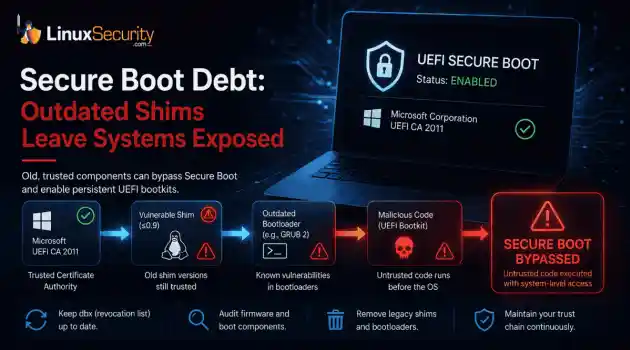
Security Vulnerabilities security advisory linux distribution
security advisory linux distribution ESET researchers identified 11 old and forgotten Linux UEFI shim bootloaders at versions 0.9 and below that can be used to bypass UEFI Secure Boot on any UEFI-based machine that trusts Microsoft’s Microsoft Corporation UEFI CA 2011 third-party certificate authority, regardless of the installed operating system (OS). Reported shims can be exploited to execute untrusted code during system boot, enabling attackers to deploy malicious UEFI bootkits even on systems with UEFI Secure Boot enabled.....
Jul 16, 2026
 Refine news
X Clear Filters
Get the latest News and Insights
Get the latest Linux and open source security news straight to your inbox.
Community Poll
Is continuous patching actually viable?
Trending News
Loading...
Explore Latest Linux Security news
We found 132 articles for you...
83
 exploitmalwareDDoS
XorDDoS Malware Overview: Threats to Linux, IoT, and Botnet Formation
When malware like XorDDoS resurfaces with expanded capabilities, it’s a wake-up call for us security professionals managing Linux-based systems. Initially discovered almost a decade ago, XorDDoS has evolved from a relatively basic threat into a more sophisticated attack. . Its key goal remains the same: compromise as many Linux systems as possible to create botnets capable of launching massive Distributed Denial of Service (DDoS) attacks. However, recent developments have revealed new targets and improved methods, forcing Linux admins to rethink their defenses. The latest version of XorDDoS is no longer limited to traditional Linux environments. It now actively targets Docker containers and Internet of Things (IoT) devices—two areas where security practices often lag. This shift in focus not only broadens its impact but also highlights the increasing sophistication of attackers, who are adapting to new technologies faster than many organizations can secure them. At the heart of XorDDoS’s operations lies one critical weakness in system configurations: insecure SSH setups. Understanding how this malware operates and how it exploits these vulnerabilities is the first step toward protecting your infrastructure. Let's take a closer look at this sophisticated malware's tactcis and techniques and discuss measures you can take to fortify your systems against it. XorDDoS Infection Vectors and Techniques XorDDoS exploits vulnerabilities by brute-forcing SSH credentials to gain access to systems. Attackers deploy automated tools designed to try thousands of username and password combinations until one works. Once inside, the malware installs itself and connects the compromised computer to an attacker-controlled botnet network, which it then uses to launch coordinated attacks, steal sensitive data, and proliferate further across networks. What distinguishes XorDDoS as particularly challenging is its persistence: this malware uses scripts to ensure it respawns after reboot attempts or removal,making it extremely difficult for admins to fully eradicate. Furthermore, its advanced obfuscation techniques and encrypted communication between command-and-control (C2) servers and compromised computers allow it to operate silently for extended periods. These features allow XorDDoS to operate undetected. Newer versions of XorDDoS now have expanded capabilities that enable them to take advantage of containerized environments, such as Docker. Improperly secured Docker instances with open APIs or inadequate access control provide fertile ground for propagating. IoT devices that lack robust security features altogether also serve as targets. These changes demonstrate how attackers have broadened their focus beyond more traditional entry points to form resilient botnets. The Risks of Leaving Systems Vulnerable Consequences of a XorDDoS infection extend far beyond any individual system or device that is compromised. Once infected, compromised machines become part of an expansive network that can disrupt services on a much larger scale. A botnet powered by XorDDoS could generate immense amounts of traffic that overwhelms web servers, causing outages for critical services. Attackers controlling these botnets could rent or use them to extort businesses, inflicting financially and reputationally damaging attacks that affect both their finances and reputations. After DDoS attacks have subsided, organizations must also worry about collateral damage from compromised Linux systems within their networks, which can serve as launch pads for attackers seeking to penetrate other systems and access sensitive information. Organizations running modern hybrid infrastructures that combine on-premises servers with cloud workloads or containers may find that one breach can cascade into a widespread operational disruption. XorDDoS' targeting of IoT devices and Docker containers significantly ratchets up the stakes. Given the interdependency of IoT ecosystems , vulnerabilities in seemingly harmless devices could openpaths into critical systems. Meanwhile, Docker containers' pivotal role in modern DevOps pipelines makes their breach all the more powerful, as it could threaten applications and services downstream. Strengthening Defenses Against XorDDoS Reinforcing SSH security is key to protecting against XorDDoS attacks that rely on brute force. Organizations still relying on username-password authentication are particularly at risk. Using key-based authentication significantly decreases this risk. Attackers cannot brute-force private keys without extensive computational resources, and disabling password-based login for SSH can stop many automated attacks at their source. Reducing SSH access altogether should also not be overlooked. By restricting login attempts to specific IP addresses or using firewalls to monitor suspicious SSH activity, admins can drastically resuce the attack surface and minimize attacks before they succeed. Tools like Fail2Ban offer additional layers of defense by temporarily banning IP addresses after repeated failed login attempts, which helps stop brute-force attacks before they take hold. Additionally, Docker containers require secure configuration practices in environments that use them. To protect environments using Docker, this means shutting down unnecessary access points, such as open APIs, and applying the principle of least privilege when assigning user permissions. Regular vulnerability scans and manual reviews of container images can help identify weak points before attackers do. The Importance of Monitoring and Incident Response Proactive monitoring is key to early detection and mitigation of XorDDoS infections. Though designed to avoid detection, subtle signs like unexplained spikes in outbound traffic, CPU usage fluctuations, or processes connecting to external IP addresses could indicate a compromise. Network monitoring tools that flag excessive or anomalous communication with external domains are especially valuable, given XorDDoS' dependence on C2servers for coordination. These tools are particularly helpful as the malware relies on them as coordination points for its activities. We admins should perform regular system integrity checks to detect changes caused by persistent malware, especially in critical directories like /etc/, where malware scripts may reside. Once an infection is identified, immediate containment and remediation measures should be undertaken as quickly as possible to limit further spread and remove malware remnants that remain after cleanup efforts are complete. Given XorDDoS' persistence capabilities, however, a complete system reinstallation may sometimes be required in severe cases to ensure all malware has been removed from a machine's booting environment. Our Final Thoughts on Staying Ahead of the XorDDoS Threat Although XorDDoS is only an example of evolving Linux-based malware, its resilience provides a timely reminder of the complexity of modern cyber threats. Attackers continue to find innovative ways to exploit security oversights. Their success often stems from outdated systems with poor configurations or unmonitored environments. For Linux administrators, protecting against these advanced threats requires taking an aggressive and proactive approach focused on prevention rather than reaction. Staying abreast of emerging threats means regularly reviewing system logs, configuration files and network activity. Employing an effective defense strategy, including robust SSH security, container security best practices , IoT policy enforcement, and incident monitoring, can significantly reduce your likelihood of falling prey to threats like XorDDoS. . XorDDoS targets Linux and IoT devices, forming extensive botnets for executing DDoS attacks. Investigate effective security measures to mitigate these threats.. XorDDoS, Linux Malware, Botnet Security, Container Security, IoT Threats. . Brittany Day
 Apr 21, 2025
•
Apr 21, 2025
• Hacks/Cracks
210
 security advisoryremote accessexploit
OpenSSH regreSSHion Bug: Urgent Actions Needed to Address Critical Threat
The infamous OpenSSH "regreSSHion" vulnerability, CVE-2024-6387, sent shockwaves through the Linux security community when it was discovered this past summer. This critical flaw threatens a core component of Linux system security: OpenSSH. . Used widely for remote login and other network services, any breach could have devastating repercussions: attackers could gain unwarranted access, elevate privileges, or execute malicious code that leads to data breaches, system disruptions, and loss of control over affected systems. With attackers now having access to PoC code to exploit this vulnerability directly, security admins must take immediate action against any attacks attempting to exploit this bug to harm their systems. I'll explain how this exploit works and its potential impacts and offer practical advice for securing your systems against this threat. Understanding the OpenSSH regreSSHion Bug The notorious "regreSSHion" vulnerability exploits weaknesses in OpenSSH's handling of SSH sessions, potentially allowing attackers to execute code remotely by manipulating specific session parameters during authentication or connection establishment. Attackers could gain unauthorized access and perform operations with elevated privileges by sending maliciously structured packets or exploiting buffer overflows in its protocol implementation. This vulnerability affects OpenSSH versions 8.5p1 through 9.8p1 on glibc-based Linux systems, as these contain flawed code that could allow attackers to gain unauthorized system access. As is always recommended with critical vulnerabilities, the best course of action to limit potential risks is updating to the most recent version, where any known issues have been rectified by applying security patches provided by OpenSSH maintainers. Immediate Mitigation Requires Patching & Updates For Linux security admins, the first and most essential step in securing against this bug is applying all patches and updates provided by OpenSSH maintainers. When criticalvulnerabilities such as CVE-2024-6387 emerge, the OpenSSH team responds quickly by issuing patches that remove exploitable security flaws. Quickly updating all systems running OpenSSH can close off potential openings used by attackers to gain entry and exploit any vulnerabilities present. Enhancing Authentication Practices Patches are only the first step toward strengthening authentication methods against "regreSSHion." SSH access is essential to administrative duties, so its security should remain tight. Strong passwords should always be used; however, moving beyond password-based methods into key-based methods provides an extra layer of protection. Public key authentication eliminates password entry and decreases the risk of brute-force attacks. Multi-factor authentication (MFA) can further strengthen security. With MFA in place, even if an attacker gains SSH credentials, they would still require additional forms of verification - like time-based one-time passwords (TOTPs). Implementing MFA can significantly decrease the risk of unauthorized access. Limit SSH Access Another effective protection measure is to limit SSH access as much as possible. SSH should only be accessible from trusted IP addresses. Setting firewall rules that permit connections from specific IP ranges or networks can reduce the attack surface significantly. After all, any PoC exploit used will not have any effect against systems that attackers cannot reach. Consider tools such as fail2ban for additional restrictions. This system analyzes authentication logs and blocks IP addresses that display any sign of suspicious activity, providing an extra safeguard against potential exploit attempts. Vigilant Monitoring and Network Analysis Staying aware and responding swiftly to potential intrusions is critical to maintaining system integrity and security. Implementing robust monitoring solutions capable of detecting suspicious activities and alerting administrators quickly is essential. Network traffic analysistools like Snort can aid in quickly recognizing patterns indicative of attacks for timely intervention. We strongly recommend establishing an Intrusion Detection or Intrusion Prevention System (IDS/IPS). These systems can monitor traffic and system logs and alert administrators of activities that deviate from the norm. Security teams can quickly detect potential exploits by monitoring network traffic on ports typically used by SSH clients. Regular Audits and User Activity Monitoring Conducting frequent software audits is another effective strategy for creating a secure environment. Unnecessary or outdated software can introduce vulnerabilities, providing potential attack vectors. Regular audits and frequent checks ensure that only essential and up-to-date software packages remain installed, decreasing the risk of exploitation. Monitoring user activity helps detect and combat suspicious actions, including login attempts from unfamiliar locations or unauthorized access to sensitive files that might indicate compromise. Implementing robust user activity monitoring enhances our ability to detect and respond to potential threats quickly. Staying Informed and Proactive Staying informed on the latest security threats is vital to effective defense. Reviewing LinuxSecurity advisories and subscribing to LinuxSecurity newsletters will keep you abreast of potential vulnerabilities, patches, or mitigation solutions as soon as they become known. Be prepared to act swiftly when new information is available! Our Final Thoughts on Mitigating This Notorious OpenSSH Flaw The "regreSSHion" (CVE-2024-6387) vulnerability must be treated as an immediate and critical threat, with newly available proof-of-concept code increasing risks to Linux systems. Urgent measures should be implemented immediately to counter this threat and secure all affected Linux devices. Applying patches, strengthening authentication mechanisms, restricting SSH access, and implementing stringent monitoring practices areessential to protect systems against potential exploits. Regular software audits, user activity monitoring, and staying abreast of emerging threats are foundational practices to ensuring adequate security in your Linux environment and providing protection from vulnerabilities like "regreSSHion." Taking such proactive steps can help safeguard our systems effectively against emerging risks like the "regreSSHion" flaw. Implementing these measures requires concerted effort and a commitment to avoiding new and known risks, but their benefits cannot be ignored. By prioritizing security and utilizing all available tools and best practices, we can protect our systems from this critical vulnerability and others that arise in the future. . Immediate updates and protective actions are essential for a significant OpenSSH vulnerability to protect Unix-like environments.. OpenSSH Security, regreSSHion Exploit, Remote Access Vulnerabilities, Linux Authentication Best Practices. . Brittany Day
Jan 08, 2025
•
Security Vulnerabilities

210
 security advisoryexploitIntel
Intel & AMD: Spectre Bypass Critical Threat on Linux Systems
A new Spectre bypass exploit has exposed vulnerabilities in recent Intel processors and older AMD microarchitectures running Linux, with severe ramifications for ongoing efforts to combat speculative execution attacks. . To help you understand and prepare for this emerging threat, I'll discuss how this exploit works, the processors at risk, and how it was discovered. I'll also provide practical advice users can follow to reduce risk. Let's begin by understanding speculative execution and common risks associated with this feature. Understanding Speculative Execution Modern CPUs employ speculative execution as a performance optimization, anticipating future tasks and executing instructions early. This mechanism speeds up processing by making educated guesses about the next set of instructions based on past performance. When these predictions prove correct, executed instructions improve overall performance; however, when they don't match up properly with expectations, they may be disregarded altogether and called transient instructions instead. Though speculative execution provides performance benefits, it also creates security threats—mainly through side-channel attacks such as Spectre . Such attacks involve manipulating the speculative execution process to access sensitive data stored in CPU cache memory. Even after terminating speculative instructions, the data accessed could still be retrieved, leading to potentially serious security breaches. Examining The Newly Disclosed Spectre Bypass Johannes Wikner and Kaveh Razavi from ETH Zurich recently unveiled newly discovered variants of Spectre-like attacks that bypass existing mitigations. Their contribution includes two attacks that bypass the indirect branch predictor barrier (IBPB), showing how resilient speculative execution vulnerabilities remain despite ongoing mitigation efforts. Intel CPUs are vulnerable to cross-process attacks due to an issue in their microcode where IBPB doesn't completely invalidate return predictionsafter context switches, enabling attackers to manipulate speculative execution of return instructions, which in turn leak sensitive information (for instance, leaking the hash of the root password from an SUID process). For AMD processors, however, this issue arises from improper application of IBPB-on-entry in the Linux kernel, allowing return predictors to retain outdated predictions even after IBPB has been applied. Attackers could then hijack return predictors to gain kernel memory access. What Processes Are at Risk? A wide variety of processors from Intel and AMD is at risk of this new exploit: Intel: Their latest consumer generations include the 12th, 13th, and 14th series and 5th and 6th generation Xeon server processors. AMD: AMD products utilize older microarchitectures such as Zen 1, Zen 1+, and Zen 2. However, AMD's advisory included Zen 3 products despite not being listed in the ETH Zurich paper . How Was This Vulnerability Discovered? Researchers from ETH Zurich discovered these vulnerabilities as part of a more extensive investigation into speculative execution attacks, informing both Intel and AMD in June 2024 of their discoveries. Intel had already recognized it internally under the CVE-2023-38575 identifier. In March of that same year, they issued a microcode update, which affected most operating systems, including Ubuntu. However, some updates still haven't yet reached all operating systems, such as MacOSX. AMD had already identified this flaw under CVE-2022-23824 ; however, because they perceived it as a software bug rather than a hardware flaw, they opted not to issue a corrective microcode. Practical Mitigation Advice for Impacted Users Users impacted by these vulnerabilities should take immediate, concrete steps to minimize risks: Firmware Updates: Make sure that your firmware is always up-to-date and contact their hardware providers to get any available firmware updates. Operating System Updates: Maintain regular OS updates.Linux kernel maintainers are constantly developing patches to address AMD processor issues. Keeping an eye out for official kernel updates and applying them as quickly as possible is essential for optimal system performance. Restrict Privileges: Where possible, try to minimize the number of processes requiring elevated permissions, as this reduces the attack surface for exploits targeting high-privilege operations. Enable Security Features: Where supported, use available security features and software updates that provide additional protection against speculative execution attacks, such as Indirect Branch Restricted Speculation (IBRS) or Single Thread Indirect Branch Predictors (STIBP) . Utilize Secure Configurations: Set up your systems using the most secure settings possible, disabling features susceptible to exploitation in environments where security precedes performance. Our Final Thoughts on This Emerging Threat This recently revealed Spectre bypass underscores a persistent challenge in protecting modern CPUs. While speculative execution offers performance benefits, it also comes with significant risks. Despite multi-year efforts to mitigate vulnerabilities related to it, new variants continue to arise and necessitate constant vigilance and prompt responses. Intel and AMD's responses to these new findings indicate that while progress has been made, gaps exist between applied fixes and their reach and implementation. Staying up-to-date with firmware and operating system updates, implementing restrictive privilege controls, and taking advantage of available security features can significantly mitigate risks presented by speculative execution vulnerabilities. As time progresses, ongoing collaboration among hardware manufacturers, software developers, and security researchers will be crucial in effectively meeting and mitigating such complex challenges. . Learn about the Spectre bypass exploit affecting Intel and AMD CPUs on Linux, its risks, and effective mitigationstrategies to ensure system security. Spectre Exploit, Intel Security, AMD Vulnerability, Microarchitecture Threat, Linux Mitigation. . Brittany Day
Oct 18, 2024
•
Security Vulnerabilities
210
 security advisoryexploitLinux kernel
Spectre V2 Exploit: Mitigation Strategies for Linux Kernel Security
A significant security threat, known as the Spectre v2 exploit, has been observed targeting Linux systems running on modern Intel processors. Let's delve into the details of the Spectre v2 exploit, its implications, and the measures being taken to mitigate its impact. . What Is This Exploit? What Is Its Significance in the Realm of Linux Security? Speculative execution is a performance optimization technique that inadvertently exposes sensitive data in CPU caches, potentially allowing unauthorized access to confidential information. While it improves processing speed, it also inadvertently exposes sensitive data in CPU caches, providing an open door for attackers. Spectre V2 employs two primary attack methods: Branch Target Injection (BTI) and Branch History Injection (BHI). These methods manipulate the CPU's branch prediction and branch history to execute unauthorized code paths and leak sensitive information. The implications of Spectre V2 for Linux systems are significant. A separate Common Vulnerabilities and Exposures (CVE) identifier, CVE-2024-2201 , has been assigned for a new Spectre v2 exploit affecting the Linux kernel . This raises questions about the potential impact on Linux systems and the urgency in implementing mitigation strategies to protect against the exploit. How Can I Mitigate My Risk? Mitigation efforts for Spectre V2 include disabling unprivileged Extended Berkeley Packet Filter (eBPF) functionality, enabling Enhanced Indirect Branch Restricted Speculation (eIBRS), and activating Supervisor Mode Execution Protection (SMEP). Implementing LFENCE instructions and software sequences to clear the Branch History Buffer (BHB) for added security is also crucial. However, it is critical to raise questions about the effectiveness of these measures and whether they are sufficient to mitigate the threat entirely. Significant industry players like Illumos, Linux Foundation, Red Hat, SUSE Linux, and Xen have responded to this issue. These organizations have activelyaddressed the Spectre v2 threat through various mitigation efforts and updates . Intel's commitment to enhancing processor security and integrating mitigations for speculative execution vulnerabilities into future CPU models should be noted. This raises the question of what long-term consequences Spectre V2 may have on the design and architecture of processors. Our Final Thoughts on the Spectre V2 Threat For security practitioners, the impact of Spectre V2 cannot be understated. Linux admins, infosec professionals, and sysadmins must be aware of the vulnerability and take active steps to mitigate its impact. This article aims to provide a comprehensive overview of the Spectre V2 threat targeting Linux systems by explaining the technical details of the exploit, highlighting the implications for security practitioners, and discussing mitigation efforts. Staying informed and implementing proactive security measures is essential to prevent attacks like Spectre V2. Stay safe out there, Linux users! . The Spectre V2 vulnerability is a critical issue for Linux users, exploiting CPU speculative execution to access sensitive data like passwords.. Spectre V2, Linux Kernel Security, Exploit Strategies, Branch Prediction. . Brittany Day
May 16, 2024
•
Security Vulnerabilities
210
 security advisoryexploitdata breach
Thunderbird & Firefox: Data Breach Risks and Defensive Actions
Several significant vulnerabilities have been found in the Thunderbird email client and Firefox web browser. An attacker could exploit these issues to disrupt services, obtain sensitive data, bypass security restrictions, perform cross-site tracing, run rogue programs on your computer, or escalate privileges on impacted systems. . What Are These Vulnerabilities & How Do They Impact Me? The following security issues were discovered and fixed in Thunderbird and Firefox: If a user were tricked into opening a specially crafted website in a browsing context, an attacker could exploit these to cause a denial of service, obtain sensitive information, bypass security restrictions, perform cross-site tracing, or execute arbitrary code. ( CVE-2023-6858 ) Thunderbird did not properly parse a PGP/MIME payload that contains digitally signed text. An attacker could exploit this issue to spoof an email message. ( CVE-2023-50762 ) Thunderbird did not properly compare the signature creation date with the message date and time when using a digitally signed S/MIME email message. An attacker could exploit this issue to spoof the date and time of an email message. ( CVE-2023-50761 ) Thunderbird did not properly manage memory when used on systems with the Mesa VM driver. An attacker could exploit this issue to execute arbitrary code. ( CVE-2023-6856 ) Thunderbird did not properly validate the textures produced by remote decoders. An attacker could exploit this issue to escape the sandbox. ( CVE-2023-6860 ) An attacker could escalate privileges through devtools, enabling them to view additional infrastructure to attack, add or delete users, or modify permissions of files or other users. ( CVE-2024-0751 ) Bugs fixed in Firefox 122, Firefox ESR 115.7, and Thunderbird 115.7 threaten memory safety ( CVE-2024-0755 ). Out-of-bounds memory read in networking channels. ( CVE-2024-1546 ) Alert dialog could have been spoofed on another site. ( CVE-2024-1547 ) Fullscreen Notification could have beenhidden by a select element. ( CVE-2024-1548 ) Custom cursor could obscure the permission dialog. ( CVE-2024-1549 ) The mouse cursor re-positioned unexpectedly could have led to unintended permission grants. ( CVE-2024-1550 ) Multipart HTTP Responses would accept the Set-Cookie header in response parts. ( CVE-2024-1551 ) Incorrect code generation on 32-bit ARM devices. ( CVE-2024-1552 ) Memory safety bugs fixed in Firefox 123, Firefox ESR 115.8, and Thunderbird 115.8. ( CVE-2024-1553 ) Firefox did not properly manage memory when accessing the built-in profiler. An attacker could potentially exploit this issue to cause a denial of service. ( CVE-2024-1556 ) The encrypted subject of an email message could be incorrectly and permanently assigned to an arbitrary other email message in Thunderbird's local cache. As a result, when replying to the contaminated email message, the user might accidentally leak the confidential subject to a third party. ( CVE-2024-1936 ) NSS was susceptible to a timing side-channel attack when performing RSA decryption, potentially allowing an attacker to recover the private data. ( CVE-2023-5388 ) An unchecked return value in the TLS handshake code could have caused a potentially exploitable crash. ( CVE-2024-0743 ) The encrypted subject of an email message could be incorrectly and permanently assigned to an arbitrary other email message in Thunderbird's local cache. As a result, when replying to the contaminated email message, the user might accidentally leak the confidential subject to a third party. ( CVE-2024-1936 ) Return registers were overwritten which could have allowed an attacker to execute arbitrary code. ( CVE-2024-2607 ) `AppendEncodedAttributeValue(), ExtraSpaceNeededForAttrEncoding()` and `AppendEncodedCharacters()` could have experienced integer overflows, causing underallocation of an output buffer leading to an out-of-bounds write. ( CVE-2024-2608 ) Using a markup injection, an attacker could have stolen nonce values. This issuecould have been used to bypass strict content security policies. ( CVE-2024-2610 ) A missing delay on when pointer lock was used could have allowed a malicious page to trick a user into granting permissions. ( CVE-2024-2611 ) If an attacker could find a way to trigger a particular code path in `SafeRefPtr`, it could have triggered a crash or potentially be leveraged to achieve code execution. ( CVE-2024-2612 ) Memory safety bugs present in Firefox 123, Firefox ESR 115.8, and Thunderbird 115.8 have shown evidence of memory corruption, and we presume that with enough effort, some of these could have been exploited to run arbitrary code. ( CVE-2024-2614 ) To harden ICU against exploitation, the behavior for out-of-memory conditions was changed to crash instead of attempt to continue. ( CVE-2024-2616 ) Exploitation of these bugs could result in the compromise of sensitive information or loss of system availability. The Firefox update released to fix these issues introduced several minor regressions, which have now been fixed in the latest version of Firefox. How Can I Secure My Linux Systems? Crucial updates for Thunderbird and Firefox have been released to fix these impactful vulnerabilities. Given these flaws’ severe threat to affected systems, if left unpatched, we strongly recommend all impacted users apply the updates released to protect against data theft and loss of system access. To stay on top of essential updates released by the open-source programs and applications you use, register as a LinuxSecurity user , subscribe to our Linux Advisory Watch newsletter , and customize your advisories for your distro(s). This will enable you to stay up-to-date on the latest, most significant issues impacting the security of your systems. Follow @LS_Advisories on X for real-time updates on advisories for your distro(s) . . What Are These Vulnerabilities & How Do They Impact Me? The following security issues were discovere. significant, vulnerabilities, found,thunderbird, email, client, firefox. . Brittany Day
May 02, 2024
•
Security Vulnerabilities
210
security advisoryexploitmemory leakNative Spectre V2 Exploit Analysis: Implications for Linux Admins
The recently uncovered "Native Branch History Injection (BHI)" exploit against the Linux kernel marks a significant milestone in the ongoing battle against Spectre v2 vulnerabilities. Researchers have revealed that BHI can bypass existing Spectre v2/BHI mitigations to read sensitive data from the memory of Intel systems. . This exploit highlights the need for continued vigilance in Linux security and raises questions about the long-term consequences of such vulnerabilities. What Is the Impact of This Exploit on Affected Systems? The novel nature of the BHI exploit, tracked as CVE-2024-2201 , can be described as the "first native Spectre v2 exploit." This statement immediately captures the interest of Linux admins, infosec professionals, and internet security enthusiasts, suggesting that this discovery could have far-reaching consequences for the security of Linux systems. The fact that BHI can leak arbitrary kernel memory at a rate of 3.5 kB/sec is alarming and intriguing, as it exposes potential avenues for attackers to obtain sensitive information. Existing Spectre v2 and BHI mitigations do not adequately protect against the Native BHI expl oit. Intel's recommendation to disable unprivileged eBPFs , one of the attack vectors used by BHI, may seem like a logical countermeasure. However, the researchers behind BHI have successfully demonstrated that it is possible to carry out the exploit without relying on eBPFs. This finding raises important questions about the effectiveness of current defense strategies and calls for reassessing security measures employed by Linux admins and sysadmins. The impact of BHI extends beyond Intel systems, as it affects all vulnerable Intel hardware. This finding reminds us that the consequences of hardware vulnerabilities can be widespread and affect a broad range of devices and software deployments. The confirmation that known platforms such as Illumos, Red Hat, SUSE Linux, Triton Data Center, and Xen are affected further emphasizes the need for immediateaction. Additionally, this discovery draws attention to recent similar exploits, such as GhostRace , a variant of Spectre v1, and the Ahoi Attacks . These examples demonstrate a worrying pattern of increasingly sophisticated attacks targeting CPU architectures and hardware-based trusted execution environments. As security practitioners, it is crucial to stay informed about these developments to proactively adapt defenses and protect against emerging threats. Our Final Thoughts on the Implications of This Exploit The uncovering of the Native Spectre v2 exploit, BHI, raises significant concerns for the Linux security community. It reinforces the need for constant vigilance and highlights the challenges of securing complex systems. Linux admins, infosec professionals, and sysadmins should reassess their security measures, considering the limitations of existing mitigations and adopting a proactive mindset. The impact of these vulnerabilities extends beyond a single operating system or hardware vendor and demands international collaboration to enhance cybersecurity measures. By actively staying informed, security practitioners can be better equipped to address and mitigate the threats posed by native exploits like BHI. . Recent findings concerning the Native Branch History Injection vulnerability have exposed significant security weaknesses in Linux, particularly impacting Intel architecture.. Branch History Injection, Memory Leak, Linux Exploit, Intel Vulnerability, Security Implications. . Dave Wreski
Apr 25, 2024
•
Security Vulnerabilities
74
 security advisorycriticalremote access
Razor Bindview: 2001 Advisory Critical SSH Exploit - CRC32 Attack
In February 2001, Razor Bindview released their "Remote vulnerability in SSH daemon crc32 compensation attack detector" advisory, which outlined a gaping hole in deployed SSH servers that can lead to a remote attacker gaining privileged access. At this writing, over . . . . In February 2001, Razor Bindview released their "Remote vulnerability in SSH daemon crc32 compensation attack detector" advisory, which outlined a gaping hole in deployed SSH servers that can lead to a remote attacker gaining privileged access. At this writing, over 30% of all SSH servers appear to have the CRC32 bug. . Uncover the vital SSH service vulnerability highlighted in the 2001 report by Razor Bindview concerning CRC32 weaknesses.. SSH Exploit, Remote Access Security, CRC32 Attack. . Anthony Pell
Nov 27, 2023
•
Network Security
210
exploitmalwareransomwareLockBit Ransomware Exploits Severe Citrix Bleed Flaw to Encrypt Data
LockBit ransomware is exploiting a critical Citrix bleed vulnerability to break into enterprise networks. The malware spreads via infected USB sticks and allows hackers to steal data and install more malware. . LockBit is being distributed as a self-extracting archive (SFX) file that contains an executable named "Citrix_1.exe," which runs the malicious code on a machine without requiring any user interaction. The file can be distributed over email or any other means of file transfer. After infection, LockBit starts encrypting files on a victim's computer by using AES encryption with a hardcoded key. The malware then displays a ransom note in a text document: "Your files are encrypted! Your personal ID: 1234567890." The malware also installs itself as a service for persistence, which allows it to start automatically when the system boots up. To prevent users from accessing other applications on their systems, LockBit also installs an application lock that prevents users from closing or minimizing windows open in the background while they're trying to work with their files. The link for this article located at The Hacker News is no longer available. . Maze ransomware leverages severe Microsoft Exchange flaw to penetrate systems and lock up data.. LockBit Ransomware, Citrix Bleed Exploit, Cybersecurity Threats. . Brittany Day
Nov 25, 2023
•
Security Vulnerabilities

Get the latest News and Insights
Get the latest Linux and open source security news straight to your inbox.
Community Poll
Is continuous patching actually viable?
Trending News
Search Topics
Powered By

Linux Security - Your source for Top Linux News, Advisories, HOWTOs and Feature Releases
QUICK LINKS
subscribe to newsletters!
Like staying secure? So do we.
Sign up for updates, tips, and alerts!