Explore top 10 tips to secure your open-source projects now. Read More
×



Server Security data privacy automation
data privacy automation Every system admin has lived through the same Monday morning ritual. A queue of forty tickets, half of them password resets, permission errors, or disk space warnings that any experienced technician could resolve in under two minutes. The other half require actual judgment. For years, automation promised that software would eventually sort the two apart on its own. That promise is now being tested in production Linux environments. . Early results are reshaping how IT teams think about tier-1...
 Jul 17, 2026

Privacydata collection automation
data collection automation You're running a web scraping project to collect pricing data from e-commerce sites. You set up a pool of datacenter proxies, launch your scripts, and within minutes — banned . CAPTCHAs everywhere. Your data pipeline stops before it really begins. . It's a frustrating scenario that plays out daily in ad verification, market research, and multi-account management. The website doesn't know you're doing legitimate research or monitoring. It just sees traffic coming from IP ranges it recognizes as...
Jul 17, 2026

Security Trends security advisory social engineering
security advisory social engineering Business Email Compromise used to be a numbers game — mass-blasted emails, broken English, an obvious "URGENT WIRE TRANSFER" subject line. That era is over. Generative AI has turned BEC into a tailored, low-noise operation that mimics writing style, voice, and even video presence. This piece looks at what's actually changed under the hood, what defenders are testing in response, and why so many organizations are still structurally unprepared for it. . The Infrastructure Problem Nobody Wants to...
Jul 17, 2026

Security Trends cybersecurity Linux documentation
cybersecurity Linux documentation Linux operating systems have gained prominence due to their stability, adaptability, and excellent security options. In the case of developing documentation, designing cybersecurity dashboards, or educational material, visuals are of vital importance when it comes to making things clear. The use of icons allows one to understand the message regarding alerts, authorization, encryption, authentication, or the state of the system just by looking at the visual cue without having to read long...
Jul 17, 2026
Security Vulnerabilities security advisory linux distribution
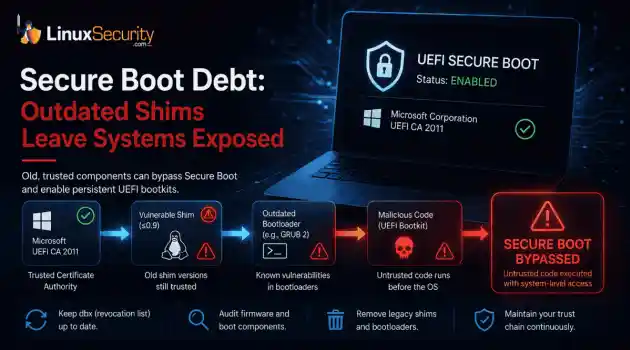
security advisory linux distribution ESET researchers identified 11 old and forgotten Linux UEFI shim bootloaders at versions 0.9 and below that can be used to bypass UEFI Secure Boot on any UEFI-based machine that trusts Microsoft’s Microsoft Corporation UEFI CA 2011 third-party certificate authority, regardless of the installed operating system (OS). Reported shims can be exploited to execute untrusted code during system boot, enabling attackers to deploy malicious UEFI bootkits even on systems with UEFI Secure Boot enabled.....
Jul 16, 2026
 Refine news
X Clear Filters
Get the latest News and Insights
Get the latest Linux and open source security news straight to your inbox.
Community Poll
Is continuous patching actually viable?
Loading...
Explore Latest Linux Security news
We found 7 articles for you...
77
 cybersecuritydns securitydns attack
How DNS Attacks Affected The Incident Involving The New York Times
When the New York Times. The NYT attack actually targeted the site's records in the Internet's DNS, or Domain Name System. Since computers speak in numbers and we speak in letters, DNS is what converts any IP address to a easy-to-remember address like nytimes.com. DNS hacking is a vulnerability that every website faces. (In the NYT's case, the attackers apparently changed its DNS records so that visitors to the newspaper instead ended up on a Syrian website.) The link for this article located at Read Write Hack is no longer available. . The NYT attack actually targeted the site's records in the Internet's DNS, or Domain Name System. Si. times, attack, actually, targeted, site's, records, internet's. . LinuxSecurity.com Team
 Aug 29, 2013
•
Aug 29, 2013
• Server Security
83
security riskshacktivismcyberattackExploring Hackers’ Impact on the Super Bowl Blackout Incident
Beyonce and voodoo have been ruled out as potential culprits in the bizarre 33-minute blackout during last night's Super Bowl. But what about hackers? It took just a few minutes after the lights went out in the Superdome for hackers to begin hinting they had something to do with it. "#TangoDown Superbowl XLVII," tweeted the most popular Twitter account of the hacktivist collective Anonymous. It's an outlandish claim and almost certainly a troll. But it's possible, and here's how it might have happened. . To be clear, there's no reason to suspect hackers are to blame for the blackout according to Entergy, the power company that supplies electricity to the Superdome. "We haven't seen anything at this time to suggest that this is a cyberattack," Entergy spokesman Michael J. Burns told me this afternoon. The link for this article located at Gawker is no longer available. . To be clear, there's no reason to suspect hackers are to blame for the blackout according to Entergy. beyonce, voodoo, ruled, potential, culprits, bizarre, 33-minute, blackout, durin. . LinuxSecurity.com Team
Feb 06, 2013
•
Hacks/Cracks

83
data breachdatabase securitydata exposureMajor Data Breaches in Healthcare: Lessons from 2011's Exposure Cases
Though the second half of the year has been comparably calmer than the first half's excitement over database breaches at RSA, Sony, and Epsilon, the breach numbers continued to roll in -- especially at healthcare organizations, which made up a disproportionate number of exposed records. Here are some of the biggest breaches that went down in the second half of the year, along with a few database security lessons learned.. 1. The Breach Victim: Nemours Assets Stolen/Affected: Names, addresses, dates of birth, Social Security numbers, insurance data, medical treatment data, and bank account information for 1.6 million patients, vendors, and employees. Three unencrypted tapes containing a mother lode of personal information on patients, vendors, and employees were lost amid the dust of a facility remodel project when a cabinet that held them since 2004 went missing. The link for this article located at Dark Reading is no longer available. . 1. The Breach Victim: Nemours Assets Stolen/Affected: Names, addresses, dates of birth, Social Secur. though, second, comparably, calmer, first, half's, excitement. . LinuxSecurity.com Team
Dec 15, 2011
•
Hacks/Cracks
83
cybercrimeweb securitydns attackIn-depth Examination of DNS Attacks Impacting Multiple Websites Worldwide
When I first heard that The Register, a popular United Kingdom, technology news site had been hacked, I was doubtful that the site itself had actually been cracked. The first headline I saw read, The Register Hacked. That isn. I was right. What I didn The link for this article located at ZDNet is no longer available. . I was right. What I didnThe link for this article located at ZDNet is no longer available.. first, heard, register, popular, united, kingdom, technology, hacked. . LinuxSecurity.com Team
Sep 05, 2011
•
Hacks/Cracks
81
network securityincident analysiscybersecurity threatU.S. Analysis: China Telecom's Internet Hijacking Incident
Internet security concerns have amplified after a U.S. government report published last Wednesday claims that a percentage of the internet was hijacked this past April and was rerouted through Chinese servers.. China Telecom, China The link for this article located at Third Age is no longer available. . China Telecom, ChinaThe link for this article located at Third Age is no longer available.. internet, security, concerns, amplified, government, report, published, wednesday. . LinuxSecurity.com Team
Nov 22, 2010
•
Privacy
74
network securitycyber threatddos attackInvestigating DDoS Attacks: Unmasking Unsophisticated Attack Methods
The latest distributed denial-of-service (DDoS) attacks that have wrangled some U.S. and South Korean government websites appear to be the work of a relatively unsophisticated attacker and not the actions of a state sponsored professional, according to experts analyzing the traffic from the botnet behind the attacks.. Experts say the methods used to conduct the DDoS attacks are so unsophisticated that there's a chance that they could be traced back to an attacker. Still, some news reports have painted a broad brush on the DDoS attacks, calling them sophisticated and trumpeting them as a cyberwar with North Korea ties. Others are citing security experts who are speculating on the attacker's intent. The link for this article located at Search Security is no longer available. . Cyber assaults targeting platforms in the U.S. and South Korea showcase primitive tactics that can be linked directly to the perpetrators.. DDoS Attack Analysis, Cybersecurity Threats, Government Cybersecurity, Botnet Activity, Recent DDoS Incidents. . Anthony Pell
Jul 16, 2009
•
Network Security
77
debiancybersecuritysystem securityDebian: SSH Password Attack Analysis and Response Recommendations
This document describes the compromise of a Debian Linux server on an internal network. We look at how the incident first came to light, the response procedures and an analysis of the actions of the attacker. This leads us to some recommendations on how to secure systems against this kind of exploitation in future. None of this is particularly new or surprising, but hopefully will serve as a welcome reminder, or as useful material when trying to justify particular security policies.. The link for this article located at InfoSec Writers is no longer available. . In April 2021, the Debian Linux community faced a security breach affecting its package repositories, prompting urgent audits and user advisories for updates and security enhancements. Debian Security, SSH Compromise, Password Attack Incident. . LinuxSecurity.com Team
Jan 31, 2006
•
Server Security
74
unauthorized accessDoSmalwareAnalyzing Network Security Trends: Unauthorized Access And DoS Risks
Counterpane Internet Security, Inc., monitors more than 450 networks in 35 countries, in every time zone. In 2004 we saw 523 billion network events, and our analysts investigated 648,000 security "tickets." What follows is an overview of what's happening on the Internet right now, and what we expect to happen in the coming months. . In 2004, 41 percent of the attacks we saw were unauthorized activity of some kind, 21 percent were scanning, 26 percent were unauthorized access, 9 percent were DoS (denial of service), and 3 percent were misuse of applications. Over the past few months, the two attack vectors that we saw in volume were against the Windows DCOM (Distributed Component Object Model) interface of the RPC (remote procedure call) service and against the Windows LSASS (Local Security Authority Subsystem Service). These seem to be the current favorites for virus and worm writers, and we expect this trend to continue. The virus trend doesn't look good. In the last six months of 2004, we saw a plethora of attacks based on browser vulnerabilities (such as GDI-JPEG image vulnerability and IFRAME) and an increase in sophisticated worm and virus attacks. More than 1,000 new worms and viruses were discovered in the last six months alone. In 2005, we expect to see ever-more-complex worms and viruses in the wild, incorporating complex behavior: polymorphic worms, metamorphic worms, and worms that make use of entry-point obscuration. For example, SpyBot. The link for this article located at Schneier on Security is no longer available. . In 2004, 41 percent of the attacks we saw were unauthorized activity of some kind, 21 percent were s. counterpane, internet, security, monitors, networks, countries, every. . Brittany Day
Jun 07, 2005
•
Network Security

Get the latest News and Insights
Get the latest Linux and open source security news straight to your inbox.
Community Poll
Is continuous patching actually viable?
Search Topics
Powered By

Linux Security - Your source for Top Linux News, Advisories, HOWTOs and Feature Releases
QUICK LINKS
subscribe to newsletters!
Like staying secure? So do we.
Sign up for updates, tips, and alerts!