Explore top 10 tips to secure your open-source projects now. Read More
×



Server Security data privacy automation
data privacy automation Every system admin has lived through the same Monday morning ritual. A queue of forty tickets, half of them password resets, permission errors, or disk space warnings that any experienced technician could resolve in under two minutes. The other half require actual judgment. For years, automation promised that software would eventually sort the two apart on its own. That promise is now being tested in production Linux environments. . Early results are reshaping how IT teams think about tier-1...
 Jul 17, 2026

Privacydata collection automation
data collection automation You're running a web scraping project to collect pricing data from e-commerce sites. You set up a pool of datacenter proxies, launch your scripts, and within minutes — banned . CAPTCHAs everywhere. Your data pipeline stops before it really begins. . It's a frustrating scenario that plays out daily in ad verification, market research, and multi-account management. The website doesn't know you're doing legitimate research or monitoring. It just sees traffic coming from IP ranges it recognizes as...
Jul 17, 2026

Security Trends security advisory social engineering
security advisory social engineering Business Email Compromise used to be a numbers game — mass-blasted emails, broken English, an obvious "URGENT WIRE TRANSFER" subject line. That era is over. Generative AI has turned BEC into a tailored, low-noise operation that mimics writing style, voice, and even video presence. This piece looks at what's actually changed under the hood, what defenders are testing in response, and why so many organizations are still structurally unprepared for it. . The Infrastructure Problem Nobody Wants to...
Jul 17, 2026

Security Trends cybersecurity Linux documentation
cybersecurity Linux documentation Linux operating systems have gained prominence due to their stability, adaptability, and excellent security options. In the case of developing documentation, designing cybersecurity dashboards, or educational material, visuals are of vital importance when it comes to making things clear. The use of icons allows one to understand the message regarding alerts, authorization, encryption, authentication, or the state of the system just by looking at the visual cue without having to read long...
Jul 17, 2026
Security Vulnerabilities security advisory linux distribution
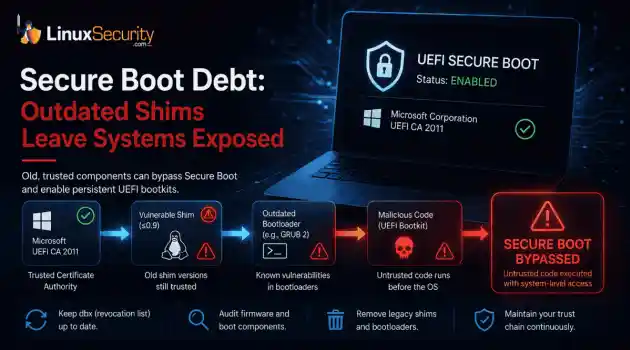
security advisory linux distribution ESET researchers identified 11 old and forgotten Linux UEFI shim bootloaders at versions 0.9 and below that can be used to bypass UEFI Secure Boot on any UEFI-based machine that trusts Microsoft’s Microsoft Corporation UEFI CA 2011 third-party certificate authority, regardless of the installed operating system (OS). Reported shims can be exploited to execute untrusted code during system boot, enabling attackers to deploy malicious UEFI bootkits even on systems with UEFI Secure Boot enabled.....
Jul 16, 2026
 Refine news
X Clear Filters
Get the latest News and Insights
Get the latest Linux and open source security news straight to your inbox.
Community Poll
Is continuous patching actually viable?
Loading...
Explore Latest Linux Security news
We found 25 articles for you...
83
 data protectionthreat analysisincident response
Combatting BlackLock Ransomware: Strategies for Linux Security Admins
Since its discovery in March 2024, BlackLock (also known as El Dorado or Eldorado) has quickly established itself as a serious threat within the ransomware-as-a-service ecosystem. Linux security admins face an adversary capable of targeting Linux environments alongside Windows and VMWare ESXi systems. Its custom malware poses an additional danger with its double extortion strategy involving data encryption and theft to coerce victims into paying ransom. . Linux administrators seeking to defend against BlackLock must keep systems updated, implement reliable backups, and increase endpoint security. Understanding BlackLock's infrastructure and tactics - such as sophisticated data leak sites or recruitment via cybercriminal forums - is also key. By being aware of their techniques and evolution, we can better safeguard environments against this rapidly growing threat. Let's take a closer look at BlackLock ransomware, its defining tactics and techniques, and practical measures you can take to secure your Linux environment against this advanced threat. The Rising Threat of BlackLock BlackLock’s ascent in the ransomware world has been nothing short of alarming. By Q4 of 2024, activity linked to BlackLock had surged by an astounding 1,425%, marking it as a threat that cannot be ignored. This exponential growth is due to its widespread campaigns and sophisticated ransomware attack approach. Unlike many ransomware groups that rely on off-the-shelf malware, BlackLock invests in developing custom malware tailored for maximum impact. This bespoke approach allows them to fine-tune their attacks to specific vulnerabilities, enhancing their success rate. Understanding BlackLock's Double Extortion Tactic BlackLock stands out for employing an advanced double extortion tactic. Traditional ransomware attacks primarily threaten victims with data encryption: attackers encrypt victim's data and demand payment in exchange for decryption keys. However, Blacklock takes this a step further by not onlyencrypting but also exfiltrating data. BlackLock victims risk their data being released publicly or sold if they fail to comply with ransom demands made by attackers. BlackLock uses this tactic to exert double pressure on victims. Data leaks can devastate businesses, as they threaten reputational harm, legal liability, and client trust issues - increasing the chance that victims pay the ransom and making this approach very lucrative for BlackLock. Practical Advice for Protecting Linux Environments Given BlackLock’s specific targeting of Linux systems, Linux security admins must adopt proactive and comprehensive defense strategies. Ensuring all systems are routinely updated with the latest security patches is a crucial first step. Outdated software often has unpatched vulnerabilities that attackers can exploit, so staying current is imperative. Beyond updates, admins should focus on implementing robust backup solutions . Having regular and isolated backups can mitigate the impact of ransomware by ensuring that critical data can be restored without succumbing to ransom demands. However, it is essential to test these backups regularly to ensure they function correctly when needed. Enhancing Endpoint Security Enhancing endpoint security is another essential aspect of combatting BlackLock. Implementing advanced endpoint protection solutions with real-time threat detection and response features can assist in quickly detecting and neutralizing ransomware before it causes irreparable harm to systems and data. As BlackLock often deploys customized malware, behavior-based detection mechanisms will prove particularly effective in mitigating risk. Reducing administrative privileges can limit the extent of an attack, providing users with only those permissions required for their roles. Using multi-factor authentication (MFA) on critical systems can further lower risk. This helps admins prevent ransomware from spreading across networks. Understanding BlackLock's Infrastructure Anessential aspect of combatting BlackLock involves understanding its infrastructure and evasion techniques. With secure communication mechanisms, BlackLock uses sophisticated data-leak websites that are well-protected against takedown attempts. Awareness of their operations and regularly checking known threat actor forums can provide valuable insights into upcoming threats or ongoing campaigns that BlackLock may undertake. BlackLock's recruitment on cybercrime forums indicates a well-planned and expanding operation. It also provides security professionals with early warning of new tools and techniques that collaborators might employ and provides critical intelligence gathering to anticipate attacks. The Importance of Incident Response Planning Even with the most stringent precautions in place, breaches may still occur. Therefore, having a comprehensive incident response plan in place is crucial - one that outlines specific steps for detecting, containing, and eliminating ransomware from your network, along with protocols for communicating with stakeholders and law enforcement officials in case an attack does occur. Regular incident response drills can help ensure that teams are prepared to act swiftly and effectively should a ransomware attack occur. Such drills help identify any gaps or flaws in their response plans and allow them to fine-tune processes and procedures. Our Final Thoughts on Staying Vigilant in the Face of This RaaS Threat BlackLock's rapid ascension as a significant ransomware threat reinforces the necessity of vigilance and preparation to combat attacks like these. By understanding BlackLock's tactics, techniques, and infrastructure, we can better defend our environments against potential attacks. Staying up-to-date with ransomware developments, regularly updating and backing up systems , strengthening endpoint security, and having an incident response plan are essential components of an effective defense strategy. In the face of sophisticated adversaries like BlackLock,taking a proactive and informed approach is the only effective means of protecting sensitive data while upholding your Linux system's safety and integrity. . System administrators need to remain informed and bolster device safety measures to tackle BlackLock ransomware with efficiency.. Linux Ransomware Protection, BlackLock Threat, Endpoint Security Strategies. . Brittany Day
 Feb 20, 2025
•
Feb 20, 2025
• Hacks/Cracks
210
 security advisoryuser protectionlinux security
Chrome 131: Emergency Update for High-Risk Vulnerabilities in Linux
Google recently unveiled a critical security update to their popular web browser, Google Chrome, addressing over a dozen significant security vulnerabilities. Chrome version 131 is now available in stable channels for Windows, Mac, Linux, and Android, and users should update promptly so their systems remain secure. . In this article, we explore these recent Chrome vulnerabilities, their impact, and how users can protect themselves. In addition, we offer mitigation advice to Linux admins looking to protect themselves from future Chrome bugs. Understanding These Vulnerabilities & Their Impact Chrome 131 includes several security fixes aimed at improving users' system security. Below is an overview of the vulnerabilities recently found and fixed in Chrome: CVE-2024-11110 : Inappropriate Implementation in Blink Severity: High Reported by: Vsevolod Kokorin (Slonser) of Solidlab Reported on: 2024-10-14 Description: This issue concerns an inappropriate implementation in Blink, Chrome's browser engine. The vulnerability could allow attackers to exploit the system, potentially leading to unauthorized access or manipulation of the user's data. CVE-2024-11111 : Inappropriate Implementation in Autofill Severity: Medium Reported by: Narendra Bhati, Suma Soft Pvt. Ltd - Pune (India) Reported on: 2024-08-18 Description: This vulnerability involves Autofill functionalities, which could result in sensitive information being incorrectly supplied or leaked. CVE-2024-11112 : Use-After-Free in Media Severity: Medium Reported by: Nan Wang and Zhenghang Xiao of 360 Vulnerability Research Institute Reported on: 2024-07-23 Description: This use-after-free vulnerability affects Chrome's media handling, which could allow attackers to execute arbitrary code or cause a denial of service. CVE-2024-11113 : Use-After-Free in Accessibility Severity: Medium Reported by: Weipeng Jiang of VRI Reported on: 2024-08-16 Description: This issue involves the Accessibilitycomponent. Similar to the media vulnerability, it could enable arbitrary code execution or crash the application. CVE-2024-11114 : Inappropriate Implementation in Views Severity: Medium Reported by: Micky Reported on: 2024-10-02 Description: This vulnerability pertains to the Views feature, leading to potential unauthorized interactions or data manipulation. CVE-2024-11115 : Insufficient Policy Enforcement in Navigation Severity: Medium Reported by: mastersplinter Reported on: 2024-10-07 Description: Issues in navigation policy enforcement could result in unauthorized navigation actions that bypass intended security controls. CVE-2024-11116 : Inappropriate Implementation in Paint Severity: Medium Reported by: Thomas Orlita Reported on: 2023-11-14 Description: Vulnerabilities in the Paint feature can lead to improper rendering or manipulation of user content. CVE-2024-11117 : Inappropriate Implementation in FileSystem Severity: Low Reported by: Ameen Basha M K Reported on: 2023-01-06 Description: This issue affects the FileSystem API and could expose file-handling operations to unauthorized actions. CVE-2024-11395 : Type Confusion Issue in V8 Severity: High Reported by: Anonymous Reported on: 2024-11-05 Description: A Type Confusion issue in V8, Chrome’s JavaScript engine, allowed a remote attacker to potentially exploit heap corruption via a crafted HTML page. CVE-2024-12053: Type Confusion Issue in V8 Severity: High Reported by: Anonymous Reported on: 2024-12-03 Description: A Type Confusion Bug in V8 in Google Chrome before 131.0.6778.108 allowed a remote attacker to exploit object corruption via a crafted HTML page. Additional issues were identified and resolved through Google’s internal security work, leveraging tools like AddressSanitizer, MemorySanitizer, and other fuzzing initiatives . These preventive measures are essential in identifying and addressing vulnerabilities before exploitation. At-Risk Chrome Versions Google Chrome versions before 131.0.6778.108/.109 for Linux are vulnerable, so users on these platforms must update their browsers immediately to reduce potential threats. Consistently updating Chrome ensures you benefit from the latest security patches and feature enhancements. How Can I Update Google Chrome on Linux? Updating Google Chrome is crucial because it ensures you have the latest security patches, protecting you from potential threats like malware and phishing attacks while also providing access to new features and performance improvements, making your browsing experience safer and more efficient; essentially, keeping your Chrome browser up-to-date is vital for optimal security and functionality. Updating Google Chrome on your Linux system using a package manager is straightforward and necessary for us security-conscious admins! The LinuxSecurity team has put together a comprehensive guide on keeping your distro updated that explains the steps you can follow to update Chrome to the latest version for your distro. You can also verify that you're using the latest version of Chrome by following a few simple steps. After performing the update using a package manager, open Google Chrome and click on the three-dot menu in the upper-right corner. Then, navigate to Help > About Google Chrome . This will display the current version of Chrome installed on your system. Compare this with the latest version. If the versions match, your update was successful. Additionally, you can use commands like google-chrome --version on the command line to check the installed version directly. Ensure the version number reflected here matches the latest release. It is essential to stay informed and proactive about maintaining your system's security and functionality, and LinuxSecurity's Feature articles and newsletters are an excellent way to do so. Practical Mitigation Advice for Linux Administrators Linux admins can implement additional safeguards tofortify their systems against browser-related vulnerabilities. While staying current with Chrome updates is the primary solution, the measures below will further protect your systems: Regular Updates Implement a policy of regular system updates, including browser updates and updates to your Linux distro(s). Also, admins should Use package managers like APT (Debian-based systems) or YUM (RedHat-based systems) to keep software up-to-date automatically. Restrictive Permissions Limit the permissions of browser processes using AppArmor or SELinux policies to limit what Chrome can access on the system and minimize potential impact from compromised browsers. Sandboxing for Isolation Use tools like Firejail to run Chrome in an isolated sandbox environment, which adds another layer of protection and limits an attacker's reach even if Chrome becomes compromised. Restrict Network Activity Apply network-level protections to filter and monitor traffic, restricting connections to known safe locations while looking for suspicious activity. Security Hardening Apply general hardening policies across all systems. Disable unnecessary services, limit user permissions and enforce strong password policies. Regular Security Audits and Penetration Testing Conduct regular security audits and penetration testing to detect vulnerabilities in system configuration and software before hackers can exploit them. Our Final Thoughts on Securing Against These Recent Chrome Bugs Linux administrators can significantly mitigate browser vulnerability risks and maintain robust system security by taking proactive steps and implementing these mitigation measures. By understanding the nature of these vulnerabilities, swiftly updating Chrome, and applying recommended mitigation strategies, users and administrators can better protect their systems from potential threats and enjoy a safer browsing experience. . Investigate the newest Chrome security flaws, their consequences, and the best methods tosafeguard your systems efficiently.. Chrome Update, System Security, Browser Vulnerabilities, User Protection. . Brittany Day
Dec 04, 2024
•
Security Vulnerabilities

209
 cyber threatsquality assurancelinux security
Exploring AI & ML's Role in Boosting Linux Security Quality Assurance
As cyber threats evolve and increasingly target Linux systems critical to our digital infrastructure, more advanced quality assurance (QA) methods are needed to protect them. Linux systems serve as the foundation for many servers and cloud environments worldwide, making Linux vulnerabilities prime targets of cybercriminals. . Traditional manual code reviews and penetration tests no longer suffice against modern threats. AI and Machine Learning (ML) technologies promise to revolutionize how we protect Linux systems in this increasingly hostile cyber environment. With operating system vulnerabilities being reported at an alarmingly rapid pace--an average of 70 incidents every week--an advanced approach to cybersecurity has never been more necessary in Quality Assurance processes. In this article, I’ll delve into the transformative potential of integrating AI and ML into quality assurance practices, demonstrating their central role in fortifying Linux security. I’ll investigate how these technologies can automate security measures through real-time monitoring, predictive analytics, and automated threat detection, boosting QA processes and significantly increasing Linux security. Understanding The Role of Quality Assurance in Cybersecurity One of the concepts integral to comprehensive cybersecurity strategies is quality assurance. Quality assurance consists of steps that are part of an overall deep-set system of checks and balances to ensure that systems and applications are secure from known vulnerabilities. Traditionally, organizations have relied on manual code reviews, penetration testing, and compliance checks as part of QA practices to find and remediate vulnerabilities. When it comes to operations technology (OT), applying these QA practices must be done with an added layer of security due to the unique infrastructure challenges OT environments face. Leveraging frameworks such as NERC CIP standards is essential to ensure that cyber risk management is effectivelyintegrated, allowing organizations to maintain compliance while securely managing critical systems. While effective in their own right, these methods are also not without their attendant flaws. Manual processes are resource-intensive and prone to human error; thus, they cannot be efficient given modern complex cyber threats. The development of cyber threats explains traditional QA methods when the attackers turn out to be more sophisticated; these methods keep pace very seldom. That's where AI and ML, integrated into the QA process, become a transformative possibility: the rise of new technologies in the cybersecurity paradigm has begun to let organizations do much more with QA. QA Transformation with AI and Machine Learning AI and ML make cybersecurity, particularly quality assurance, run unprecedentedly fast. These technologies automate many of the processes that, up until now, have required human oversight, thus making the QA landscape much faster and more accurate. For instance, AI-powered utilities can detect potential threats independently by processing large data volumes in real time. This allows organizations to respond immediately to incidents compared to manual means. Predictive analytics, using AI and ML algorithms, can determine a likely weakness by examining past behavior, recognizing anomalies, and spotting patterns. This proactive approach allows an organization to take action against weaknesses before a cybercriminal exploits them, reducing the likelihood of a breach. AI technologies offer continuous monitoring to organizations, providing real-time insight into their security posture and finding emerging threats and vulnerabilities usually missed by traditional QA techniques. Machine learning algorithms learn from previous incidents, cementing their effectiveness in QA practices. They can examine past security breaches for common characteristics and tactics used by attackers and devise a strategy for handling similar attacks going forward. This iterative learning helps anorganization gain knowledge continuously to build better defenses and hone QA processes. The Importance of Integrating AI and ML into Your Linux Security Strategy AI and ML integrated into QA practices cure the deficiencies of traditional approaches and bring several advantages in general and Linux security. The most significant benefit is increased efficiency: by freeing the security teams from routine tasks, AI and ML devote more time to activities requiring human intervention in complicated cases. That efficacy then translates into the swiftness with which vulnerabilities are identified and resolved, a prime necessity in today's landscape, where time is often a factor. More importantly, an organization should be able to increase vulnerability detection accuracy using machine learning algorithms. Such algorithms reduce false positives, meaning that security teams assure their organizations of real threats rather than benign anomalies. Improvement in the incident response process applies additional accuracy, essential for efficient threat management and resource optimization. Scalability is another factor in adopting these emerging AI and ML technologies. In this respect, scaling security solutions proportionately becomes increasingly crucial as the organization grows along with the complexity of its IT environment. AI and ML technologies can adapt to environmental changes; therefore, organizations scaling up the security effort without compromising effectiveness will be facilitated from this perspective. This also applies to cloud environments where Linux systems are typically deployed, and agile security measures are required. In addition, AI-powered tools give organizations real-time threat intelligence that gives them an edge over emerging threats. By constantly analyzing data from various sources, the tools can identify potential vulnerabilities and recommend remedial action so that an organization can act quickly and effectively. This level of responsiveness is tantamount to maintaininga solid security posture in an ever-shifting cyber landscape. Our Final Thoughts on the Importance of QA for Robust Linux Security Integrating Artificial Intelligence and Machine Learning into quality assurance practices is a significant development in cybersecurity, particularly Linux systems. As the cyber threat landscape continues to evolve at an unprecedented pace, organizations must adopt state-of-the-art measures to secure their assets from these advanced attacks. Traditional QA methods have been considered the backbone of cybersecurity considerations; however, they prove insufficient in isolation. By leveraging such capabilities of AI and ML technologies, organizations can enhance the QA processes to monitor in real-time, predictive analytics, and automated threat detection. These add to a more robust and adaptive Linux security framework that creates an environment where no vulnerability can arise, and even if it does, the chances are that it would have been identified and fixed before the hackers could use it. Are you incorporating AI and ML into your cybersecurity QA strategy? We'd love to hear about it! Connect with us on X @lnxsec , and let's have a discussion! . Traditional security audits and vulnerability assessments fall short in addressing modern dangers; leveraging AI and machine learning enhances the security posture of Linux systems.. Linux security, AI in cybersecurity, machine learning applications, quality assurance practices, cyber threat detection. . Brittany Day
Oct 29, 2024
•
Security Trends
83
 data protectionencryptionmalware
Emerging Mallox Ransomware Targets Linux: Mitigation and Strategies
A new variant of the Mallox ransomware, which traditionally targeted Windows systems, has been observed targeting Linux environments. This ransomware strain is based on the leaked source code of the Kryptina ransomware. . To help you better understand this emerging threat and take proactive measures to secure your Linux systems against it, I'll explore its operational tactics and the role of leaked Kryptina source code in its development. I'll then provide practical mitigation strategies you can implement to safeguard your systems and your data. Can you imagine suffering an attack and losing access to your critical systems and sensitive information? Ransomware prevention is far better than remediation! Let's look at how to stay ahead of attackers and prepare for this new and concerning threat. Understanding The Threat Landscape Mallox ransomware, also known as TargetCompany, has evolved significantly over time. Traditionally, it targeted Windows operating systems, causing considerable disruptions. However, recent findings by SentinelLabs have revealed that an affiliate of the Mallox ransomware operation is now targeting Linux systems using a slightly modified version of the Kryptina ransomware. This shift to Linux indicates a broadened attack surface for the ransomware, which now includes Linux and VMware ESXi systems. This evolution in targeting marks a significant progression for the Mallox operation, widening the potential victim base and posing a new set of challenges for sysadmins and cybersecurity professionals running Linux systems. How Does Mallox Ransomware Operate? The core mechanics of the new Mallox Linux variant are built on the foundation of the Kryptina ransomware's source code. Launched initially as a low-cost ransomware-as-a-service (RaaS) platform for Linux systems in late 2023, Kryptina failed to gain substantial traction within the cybercrime community. However, its purported administrator, "Corlys," leaked its source code on hacking forums in February 2024. This leakallowed random ransomware actors to use a functional Linux variant maliciously. Encryption Mechanism and Deployment Kryptina Source Code on Exposed Server (source: SentinelLabs) The new Mallox variant, "Mallox Linux 1.0," employs the same AES-256-CBC encryption mechanism used by Kryptina and identical decryption routines. It uses a command-line builder and configuration parameters and retains the core functionality found in Kryptina. The most notable modification made by the Mallox affiliate was rebranding. They changed the name and appearance, removed references to Kryptina, and transplanted the existing documentation into a simplified form. Operational Tactics In addition to the ransomware, SentinelLabs discovered various tools on the threat actors' servers that complement their operational tactics. These include: A legitimate Kaspersky password reset tool (KLAPR.BAT) An exploit for CVE-2024-21338, a privilege escalation flaw on Windows 10 and 11 Privilege escalation PowerShell scripts Java-based Mallox payload droppers Disk image files containing Mallox payloads Data folders for 14 potential victims These tools suggest that the threat actors can escalate privileges on compromised systems, deploy ransomware payloads effectively, and target multiple victims. Examining the Role of Leaked Kryptina Source Code in Mallox Ransomware Attacks The leaked Kryptina source code was crucial in developing the Mallox Linux variant. By leveraging this code, the Mallox affiliate was able to rapidly rebrand and repurpose an existing ransomware framework to target Linux systems, significantly reducing development time and costs. The emergence of Mallox ransomware underscores the broader issue of leaked malware source code, which facilitates the rapid proliferation of new variants and empowers even less sophisticated threat actors to launch damaging attacks. Mitigation Strategies for Linux Admins For system administrators looking to secure their environmentsagainst Mallox ransomware and similar threats, we recommend the following mitigation strategies: Regular Backups: Implement regular backups of all critical data. Use a combination of on-site and off-site backups to mitigate the risk of data loss. Regularly test your backups to ensure they can be restored successfully. Patch Management: Immediately apply patches and updates to all systems and software, especially those related to known vulnerabilities. Employ automated patch management tools to streamline this process. Network Segmentation: Divide your network into segments to isolate critical systems and limit the spread of ransomware. Use VLANs and access control lists (ACLs) to enforce network segmentation. User Training: Educate users about the risks of ransomware and phishing attacks. Conduct regular training sessions to ensure employees recognize and report suspicious emails and links. Access Controls: Follow the least privilege principle by restricting user permissions to only what is necessary for their role. Implement multi-factor authentication (MFA) to add an extra layer of security. Intrusion Detection and Prevention: Use intrusion detection and prevention systems to monitor network traffic for malicious activity. Configure these systems to alert and block detected threats. Incident Response Plan: Develop and regularly update an incident response plan. Ensure all team members understand their roles and responsibilities during ransomware attacks. Endpoint Security: Deploy comprehensive endpoint security solutions that include antivirus, anti-malware, and behavioral analysis technologies to detect and prevent ransomware. Our Final Thoughts on Combating Mallox Ransomware The emergence of the new Mallox ransomware Linux variant is yet another prime example of the continuous evolution of the ransomware threat landscape. By leveraging leaked Kryptina source code, threat actors have adapted their tactics to target Linux systems,expanding their potential victim base. System administrators must implement robust mitigation strategies to protect their Linux environments against this growing threat. Regular backups, patch management, network segmentation, user training, access controls, intrusion detection, incident response planning, and endpoint security are crucial components of a comprehensive defense-in-depth strategy. By staying vigilant and proactive, admins and organizations can better secure their systems and minimize the risk of a Mallox ransomware attack. . Uncover the recent rise of Nuvax ransomware targeting Linux systems, exploring its roots, methodologies, and robust defense measures.. Mallox Ransomware, Linux Security, Ransomware Prevention, Cyber Threats, Kryptina Code. . Brittany Day
Sep 24, 2024
•
Hacks/Cracks
210
 security analysislinux securitydata leakage
Exploring GhostRace Attack: Critical Threats Affecting Major CPUs
A new data leakage attack called GhostRace ( CVE-2024-2193 ) was recently discovered. It affects major CPU manufacturers and widely used software. This critical analysis will investigate the implications of this attack and discuss its significance for Linux admins, infosec professionals, and Internet security enthusiasts. . What Is the GhostRace Attack? IBM and VU Amsterdam University researchers have identified a new type of attack called GhostRace. This attack exploits speculative race conditions (SRCs) to leak sensitive information from a system's memory. Speculative execution, a technique commonly employed in CPU attacks, is combined with race conditions to bypass synchronization primitives implemented in operating systems, enabling the leakage of critical information. Race conditions exist when there is insufficient synchronization with a shared resource, allowing multiple threads to access it simultaneously. The GhostRace attack presents a significant threat to security practitioners and organizations relying on major CPU manufacturers. This attack highlights the vulnerability of software utilizing conditional branches without any serializing instructions. The fact that all major hardware vendors, including Intel, AMD, Arm, and IBM, are impacted indicates the breadth of the issue. Researchers have used the term "Speculative Concurrent Use-After-Free (SCUAF)" attack to describe the GhostRace attack technique. This points to the creative ways attackers exploit vulnerabilities, emphasizing the need for vigilant security practices and continuous monitoring. The GhostRace attack also uses Inter-Process Interrupt (IPI) Storming, a new technique researchers employ to interrupt the victim process and perform the SCUAF attack. This raises questions about the effectiveness of current measures to prevent such interruptions and highlights the importance of implementing robust defense mechanisms at the hardware and software levels. The extensive research conducted by the IBM and VU Amsterdamteams includes identifying potentially exploitable gadgets in the Linux kernel . This information is invaluable for Linux admins and developers when assessing their systems' vulnerability. However, the lack of immediate action by Linux developers due to performance concerns may concern security practitioners. What Are the Implications and Long-Term Consequences of This Threat? The GhostRace attack severely impacts security practitioners and organizations relying on CPU manufacturers and software vendors. It exposes the vulnerabilities in synchronization primitives and speculative execution techniques, which may have long-term consequences for designing and implementing future CPUs and operating systems. Security professionals must be proactive in their approach to mitigating this threat. They should actively monitor for any advisories or updates from CPU and software vendors, such as AMD and Xen, to address the GhostRace vulnerability. Also, Linux admins should consider implementing the IPI rate-limiting feature to enhance their security. Our Final Thoughts on the GhostRace Attack The GhostRace attack unveils a new type of data leakage attack that compromises the security of major CPU manufacturers and widely used software. We emphasize the importance of staying informed about emerging vulnerabilities and taking proactive measures to secure systems against such threats. By addressing the issues raised by GhostRace, it is possible to fortify security practices and protect critical data from malicious actors. . Spectral Chase vulnerability affects top providers. Examine its consequences for Unix administrators and cybersecurity experts.. GhostRace Attack, CPU Security Threats, Data Leakage Techniques, Speculative Execution. . Brittany Day
Mar 15, 2024
•
Security Vulnerabilities
77
 cyber threatsmalwarerootkit
Mélofée Malware Targets Linux Servers Linked To APT Groups Linked To APTs
ExaTrack, a France-based cybersecurity firm, has discovered a “novel” malware, which they have named Mélofée. According to the researchers, this malware is specifically targeting Linux servers and is believed to be operated by an unidentified Chinese state-backed APT group . . The researchers have linked this malware to the notorious Winnti group with high confidence. “We linked with high confidence this malware to Chinese state-sponsored APT groups, in particular the notorious Winnti group,” researchers said in a blog post . According to THN’s report, the malware has also been linked to another state-sponsored APT group called Earth Berberoka (or GamblingPuppet), which mainly targets gambling websites in China and has been active since 2020. The group uses multi-platform malware such as Pupy RAT and HelloBot. The malware’s capabilities include a kernel-mode rootkit, which is based on an open-source project called Reptile. The rootkit has limited features, as it mainly installs a hook designed to keep itself hidden. . Uncover the specifics of Sanctifex, the malicious software aimed at Linux systems associated with government-sponsored APT factions.. Mélofée Malware,Linux Threats,Cybersecurity Insights,APT Groups Analysis. . LinuxSecurity.com Team
Mar 31, 2023
•
Server Security
77
 open source toolsattack preventionserver protection
Uncover Open Source Instruments For Securing Your Linux Servers
While Linux does have a variety of security features to help make it safer, it’s not impenetrable, which is why you need open-source tools to secure your Linux server. . You need the right software to sniff out potential attacks and vulnerabilities. On its own Linux isn’t going to keep your server safe. It’s the other security measures you take. Luckily, open-source tools make this job easier. . Uncover vital open-source resources to proficiently safeguard your Linux server from imminent threats and weaknesses.. Open Source Security Tools, Linux Server Security, Cybersecurity Applications. . LinuxSecurity.com Team
Dec 14, 2022
•
Server Security
83
 linux securitysoftware attackmalicious package
Malicious PyPI Package Installs Monero Cryptominer on Linux Systems
A malicious PyPI package was used to install a Monero cryptominer on Linux systems. . The package in question, secretslib, was pushed to the official third-party software repo for Python on 6th August 2022. The package was described as “secrets matching and verification made easy”. Sonatype’s automated malware detection system flagged secretslib as potentially malicious. Further analysis proved its suspicions to be correct. The link for this article located at Developer is no longer available. . An exploitative package on PyPI dubbed pycryptominer was discovered deploying a Zcash mining tool across Linux platforms.. Linux Cryptominer Threat, PyPI Malware, Malicious Package Installation. . LinuxSecurity.com Team
Aug 15, 2022
•
Hacks/Cracks

Get the latest News and Insights
Get the latest Linux and open source security news straight to your inbox.
Community Poll
Is continuous patching actually viable?
Search Topics
Powered By

Linux Security - Your source for Top Linux News, Advisories, HOWTOs and Feature Releases
QUICK LINKS
subscribe to newsletters!
Like staying secure? So do we.
Sign up for updates, tips, and alerts!