Explore top 10 tips to secure your open-source projects now. Read More
×



Server Security data privacy automation
data privacy automation Every system admin has lived through the same Monday morning ritual. A queue of forty tickets, half of them password resets, permission errors, or disk space warnings that any experienced technician could resolve in under two minutes. The other half require actual judgment. For years, automation promised that software would eventually sort the two apart on its own. That promise is now being tested in production Linux environments. . Early results are reshaping how IT teams think about tier-1...
 Jul 17, 2026

Privacydata collection automation
data collection automation You're running a web scraping project to collect pricing data from e-commerce sites. You set up a pool of datacenter proxies, launch your scripts, and within minutes — banned . CAPTCHAs everywhere. Your data pipeline stops before it really begins. . It's a frustrating scenario that plays out daily in ad verification, market research, and multi-account management. The website doesn't know you're doing legitimate research or monitoring. It just sees traffic coming from IP ranges it recognizes as...
Jul 17, 2026

Security Trends security advisory social engineering
security advisory social engineering Business Email Compromise used to be a numbers game — mass-blasted emails, broken English, an obvious "URGENT WIRE TRANSFER" subject line. That era is over. Generative AI has turned BEC into a tailored, low-noise operation that mimics writing style, voice, and even video presence. This piece looks at what's actually changed under the hood, what defenders are testing in response, and why so many organizations are still structurally unprepared for it. . The Infrastructure Problem Nobody Wants to...
Jul 17, 2026

Security Trends cybersecurity Linux documentation
cybersecurity Linux documentation Linux operating systems have gained prominence due to their stability, adaptability, and excellent security options. In the case of developing documentation, designing cybersecurity dashboards, or educational material, visuals are of vital importance when it comes to making things clear. The use of icons allows one to understand the message regarding alerts, authorization, encryption, authentication, or the state of the system just by looking at the visual cue without having to read long...
Jul 17, 2026
Security Vulnerabilities security advisory linux distribution
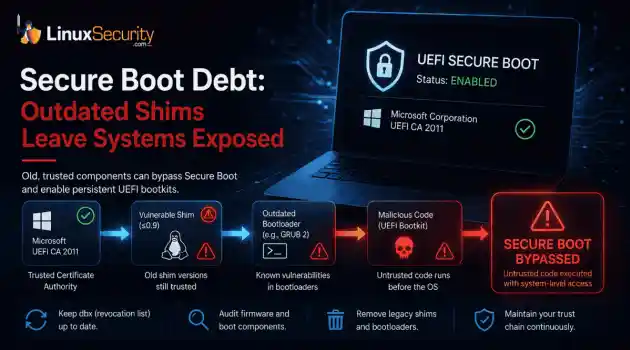
security advisory linux distribution ESET researchers identified 11 old and forgotten Linux UEFI shim bootloaders at versions 0.9 and below that can be used to bypass UEFI Secure Boot on any UEFI-based machine that trusts Microsoft’s Microsoft Corporation UEFI CA 2011 third-party certificate authority, regardless of the installed operating system (OS). Reported shims can be exploited to execute untrusted code during system boot, enabling attackers to deploy malicious UEFI bootkits even on systems with UEFI Secure Boot enabled.....
Jul 16, 2026
 Refine news
X Clear Filters
Get the latest News and Insights
Get the latest Linux and open source security news straight to your inbox.
Community Poll
Is continuous patching actually viable?
Trending News
Loading...
Explore Latest Linux Security news
We found -2 articles for you...
209
 security implicationslinux distributionslinux software
Exploring Linux Software Packages for Quantum Computing Technologies
The intersection of Linux and quantum computing has become increasingly apparent, emphasizing the importance of Linux-based operating systems in developing and deploying quantum computing technologies. As quantum computing technology advances, there is a growing need for operating systems that can support quantum computing frameworks. . Linux has emerged as an ideal OS for quantum computing thanks to its robust security, customization, and compatibility. Let's explore Linux's central role in quantum computing advancements and notable Linux software packages for quantum computing. We'll begin by discussing quantum computing basics. What Is Quantum Computing? How Does it Differ from Regular Computing? Quantum computers are fundamentally different from classic computers. The classic computer chip relies on millions of transistors, either on or off. Quantum computers, however, use qubits in place of transistors. These qubits can be in several states simultaneously thanks to quantum mechanical principles such as superposition and entanglement. A qubit can be either in an on or off state or a combination. This allows for a wide range of processing possibilities. Quantum computers are excellent at solving some problems, but they won't replace classic computers. The Increasingly Vital Role of Linux in Quantum Computing Quantum computing is rapidly evolving, showcasing its potential to solve complex problems that are practically impossible for classical computers, thus sparking curiosity about the practical applications of quantum computing in various fields. For instance, major tech companies like Google and IBM have substantially invested in quantum computing. IBM makes their quantum computers available online, allowing anyone to learn about quantum computing and run workloads through quantum logic gates. Linux's increasing role in quantum computing has become increasingly apparent. Linux's open-source nature has enabled the development of operating systems that are both flexible and robust,making them inherently compatible with most quantum computing software and tools. As quantum computing technology becomes more affordable and accessible, Linux distributions must ensure integration with quantum computing processing units and peripherals, raising questions about the security implications of integrating quantum computing systems with Linux infrastructure. Linux's customizability, compatibility, open-source community, and security attributes suit quantum computing applications well. However, this raises questions about how Linux will adapt to the evolving security concerns and specialized drivers needed for quantum computing hardware. What Linux Software Packages Exist for Quantum Computing? Various software packages for Linux have been engineered specifically for quantum computing. Some of the most notable include: Qiskit: Qiskit , IBM's Python-based framework for quantum computing development, is a toolkit for circuit simulation and design. It is well-known and widely used because it is compatible with multiple Linux distributions. QuTiP: The Python software package " QuTiP " is short for "Quantum Toolbox Python." It allows simulations of quantum computing. QuTiP uses the NumPy NumPy library to simulate quantum computing systems. It works with Linux distributions and is often used in quantum optics and quantum information science. ProjectQ: ProjectQ is a Python-based quantum computing framework that simplifies the development of quantum algorithms and applications using APIs and abstractions. It is compatible with the majority of Linux distributions and supports a variety of quantum backends. Our Final Thoughts on Linux's Role in Quantum Computing It is increasingly critical to understand Linux's evolving role in quantum computing and its potential impact on Linux admins and infosec professionals globally. Thanks to its open-source roots, Linux is an ideal quantum computing OS due to its robust security, customization, and compatibility. Weexpect Linux to become an increasingly central part of Quantum computing advancements in the coming years. . Unix-based systems play a crucial role in machine learning, providing robust reliability and integrative capabilities for cutting-edge applications.. Linux Quantum Computing, Open Source Frameworks, Quantum Software Packages. . Brittany Day
 May 26, 2024
•
May 26, 2024
• Security Trends
81
 secure communicationencrypted messaginglinux software
Best Private Encrypted Chat Apps For Secure Linux Communication
For those who want more control over their privacy while chatting online, your search for a secure Linux chat app has finally come to an end. . When you switch to Linux, you make your digital life substantially more private. The overwhelming majority of Linux distributions do not track or otherwise log what you do on your computer. But if you install one of the mainstream chat apps onto your Linux machine, you're still giving some company a record of your personal conversations. To keep your communications comparably private to what you do on your PC, you need an encrypted chat app. Fortunately, there are many options to choose from with Linux support, all of which have a compatible mobile app as well. . Explore top private chat apps for Linux that prioritize security and user privacy. Discover Signal, Element, and more for safe communications and collaboration. Encrypted Chat, Linux Applications, Privacy Software, Secure Messaging, Chat Apps. . LinuxSecurity.com Team
Sep 25, 2022
•
Privacy

78
 buffer overflowformat stringsecurity software
Libsafe 2.0 Release: Enhancing Linux Security Against Attacks
AVAYA Labs Research has released Libsafe 2.0, the latest version of its free security software for Linux systems, the company announced this week at CeBit. The new version of Libsafe shields servers from both buffer overflow and format string attacks, Avaya . . . . AVAYA Labs Research has released Libsafe 2.0, the latest version of its free security software for Linux systems, the company announced this week at CeBit. The new version of Libsafe shields servers from both buffer overflow and format string attacks, Avaya said in a statement. Such attacks occur when unauthorized users take advantage of loopholes in software running on servers, allowing the attackers to override existing codes in a running program with their own code. This gives the hackers control over the affected server software, allowing them to access confidential information that may be in the system. The CERT Coordination Center at Carnegie Mellon University, which researches Internet security issues, cited on its Web site domain name server utility BIND (Berkeley Internet Name Domain), among other software, as having vulnerabilities that could leave it open to such hacker attacks. The link for this article located at InfoWorld is no longer available. . OVERTURE Security Innovations unveiled GuardSafe 3.1, boosting Windows protection against injection and race condition vulnerabilities.. Libsafe, Avaya Labs, Linux Security Software, Buffer Overflow Prevention, Format String Protection. . LinuxSecurity.com Team
Mar 23, 2001
•
Vendors/Products

Get the latest News and Insights
Get the latest Linux and open source security news straight to your inbox.
Community Poll
Is continuous patching actually viable?
Trending News
Search Topics
Powered By

Linux Security - Your source for Top Linux News, Advisories, HOWTOs and Feature Releases
QUICK LINKS
subscribe to newsletters!
Like staying secure? So do we.
Sign up for updates, tips, and alerts!