Explore top 10 tips to secure your open-source projects now. Read More
×



Server Security data privacy automation
data privacy automation Every system admin has lived through the same Monday morning ritual. A queue of forty tickets, half of them password resets, permission errors, or disk space warnings that any experienced technician could resolve in under two minutes. The other half require actual judgment. For years, automation promised that software would eventually sort the two apart on its own. That promise is now being tested in production Linux environments. . Early results are reshaping how IT teams think about tier-1...
 Jul 17, 2026

Privacydata collection automation
data collection automation You're running a web scraping project to collect pricing data from e-commerce sites. You set up a pool of datacenter proxies, launch your scripts, and within minutes — banned . CAPTCHAs everywhere. Your data pipeline stops before it really begins. . It's a frustrating scenario that plays out daily in ad verification, market research, and multi-account management. The website doesn't know you're doing legitimate research or monitoring. It just sees traffic coming from IP ranges it recognizes as...
Jul 17, 2026

Security Trends security advisory social engineering
security advisory social engineering Business Email Compromise used to be a numbers game — mass-blasted emails, broken English, an obvious "URGENT WIRE TRANSFER" subject line. That era is over. Generative AI has turned BEC into a tailored, low-noise operation that mimics writing style, voice, and even video presence. This piece looks at what's actually changed under the hood, what defenders are testing in response, and why so many organizations are still structurally unprepared for it. . The Infrastructure Problem Nobody Wants to...
Jul 17, 2026

Security Trends cybersecurity Linux documentation
cybersecurity Linux documentation Linux operating systems have gained prominence due to their stability, adaptability, and excellent security options. In the case of developing documentation, designing cybersecurity dashboards, or educational material, visuals are of vital importance when it comes to making things clear. The use of icons allows one to understand the message regarding alerts, authorization, encryption, authentication, or the state of the system just by looking at the visual cue without having to read long...
Jul 17, 2026
Security Vulnerabilities security advisory linux distribution
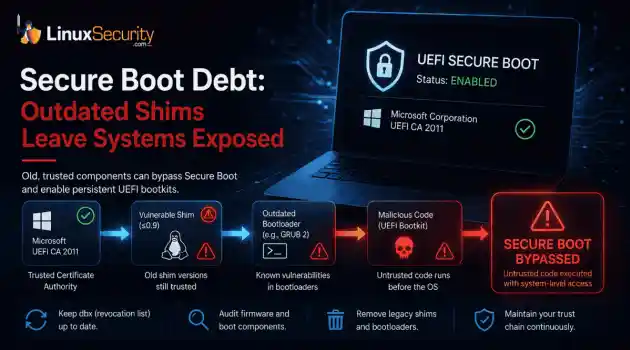
security advisory linux distribution ESET researchers identified 11 old and forgotten Linux UEFI shim bootloaders at versions 0.9 and below that can be used to bypass UEFI Secure Boot on any UEFI-based machine that trusts Microsoft’s Microsoft Corporation UEFI CA 2011 third-party certificate authority, regardless of the installed operating system (OS). Reported shims can be exploited to execute untrusted code during system boot, enabling attackers to deploy malicious UEFI bootkits even on systems with UEFI Secure Boot enabled.....
Jul 16, 2026
 Refine news
X Clear Filters
Get the latest News and Insights
Get the latest Linux and open source security news straight to your inbox.
Community Poll
Is continuous patching actually viable?
Trending News
Loading...
Explore Latest Linux Security news
We found 4 articles for you...
79
 security enhancementsystem securityLinux architecture
Linux 6.15: MSEAL Memory Protection Enhancements for System Security
With the roll-out of Linux 6.15, security administrators are gaining access to a powerful new tool: MSEAL protection for system mappings. This feature safeguards critical virtual memory areas (VMAs) by locking down system mappings like vdso, vvar, and sigpage, ensuring they remain unchanged throughout a process’s lifecycle. . Especially beneficial for x86-64 and arm64 architectures, MSEAL is set to transform how admins approach memory protection in their environments. Let’s dive into the practical applications and benefits this new feature brings to the Linux security community. Understanding the Need for MSEAL The concept of system memory protection is a cornerstone of operating system security. Unfortunately, attackers who find innovative ways to exploit vulnerabilities, particularly memory corruption , often target this security. Many of these attacks manipulate pointers or commands to remap areas of memory that should be immutable. Traditionally, Linux has had mechanisms to protect certain areas of system memory. Still, the advent of MSEAL kicks this protection into high gear, providing a new level of defense against such vulnerabilities. What MSEAL Brings to the Table MSEAL offers a lock-down mechanism for critical memory components at its core, making them impervious to runtime modifications. This means you can prevent re-mapping of protected areas once they're set, which is crucial in preventing unauthorized access or tampering. The ability to maintain read-only and execute-only permissions on specific VMAs elevates the overall security, ensuring that threat actors cannot exploit these memory areas for malicious purposes. Understanding How MSEAL Works MSEAL achieves its protection by using a new system call that effectively seals certain VMAs. Doing so ensures that areas like vdso, vvar, and sigpage remain constant during the execution of a process. This is especially useful in environments where the integrity of these mappings is critical for system operations andsecurity. By using MSEAL, administrators can block attempts to remap these pages or change their protections after a process has started, closing a gap that has been historically exploited. Notable Benefits of Implementing MSEAL For us, Linux security admins, the benefits of implementing MSEAL are multifold. Firstly, protecting against a common vector for memory corruption exploits significantly reduces the attack surface. By maintaining the integrity of VMAs, we can have increased confidence that our systems are resilient against attacks that rely on altering process memory. Furthermore, this feature is supported on popular architectures like x86-64 and arm64, which have been widely adopted in enterprise environments, maximizing MSEAL's impact. Architectural Considerations While MSEAL currently supports x86-64 and arm64 architectures, we admins must understand its application within different system architectures. These architectures are prevalent in desktop and server environments, representing most systems used in business and enterprise settings. Implementing MSEAL on these platforms ensures a broad scope of security applications, providing a uniform method to secure memory across diverse systems. Plans for expanding support to other architectures could further this reliability, ensuring no potential exploitation paths are left open for attackers. Implementing MSEAL in Your Environment Getting started with MSEAL involves understanding your current memory protection mechanisms and identifying areas where MSEAL can enhance security. Incorporating MSEAL into existing security protocols requires a methodical approach: review current processes, identify critical VMAs for your applications, and evaluate how sealing these mappings will affect system performance and security. Additionally, we admins must keep abreast of the latest developments and best practices for implementing MSEAL to effectively leverage its full potential. Challenges and Considerations While MSEAL brings substantialbenefits, there are considerations to weigh. Admins must ensure that the locked-down VMAs do not interfere with legitimate operations requiring dynamic memory management. Understanding the trade-offs between immutability and functionality is key, as is testing in a controlled environment before rolling out broad changes. Additionally, staying informed about ongoing updates and improvements in MSEAL’s functionality will ensure compliance with the latest security standards and practices. Our Final Thoughts on MSEAL Protection in Linux 6.15 Linux 6.15's introduction of MSEAL protection for system mappings is a significant advancement for Linux security administrators, offering a robust solution to protect against memory corruption exploits. By ensuring essential VMAs are locked from modification, MSEAL significantly enhances system security, particularly on widely used x86-64 and arm64 platforms. As we look to strengthen our security posture, adopting MSEAL reflects a proactive step towards securing our environments against emerging threats. With a focus on implementation and ongoing adaptation of this tool, organizations can secure memory integrity and ensure robust protection against unauthorized modifications. . MSHIELD unveils groundbreaking improvements for safeguarding memory, bolstering defense for x86-64 and arm64 systems.. Memory Protection Techniques, System Security Enhancements, Linux Architecture Innovations, MSEAL Implementation Guide. . Brittany Day
 Apr 08, 2025
•
Apr 08, 2025
• Security Projects
79
security advisorykey managementmemory protectionLinux Kernel 6.14: Critical Security Fixes and Networking Updates
Linux kernel version 6.14 has been released with essential updates that Linux security admins won't want to miss. This version, unveiled on March 24, 2025, brings crucial optimizations and security improvements to provide a smoother and more secure computing experience. With a focus on key vulnerability patches, such as those addressing use-after-free issues in the key management system, every system admin's role in maintaining secure, reliable environments just got a little easier. . Moreover, this release brings significant enhancements in networking security, including critical fixes for Bluetooth connections and IPv6 stability, ensuring that network operations remain resilient against potential threats. Alongside these network improvements, memory management and protection have been boosted with better initialization processes. These advancements not only enhance the stability of the kernel but also shore up defenses against unauthorized memory access, making this release a must-adopt for security-conscious admins. Let's examine some key highlights of the Linux kernel 5.14 release and their impact on your security and productivity. Improved Key Management Systems One of the standout features of this release is the critical fix addressing a vulnerability in the kernel's key management system. The patch , expertly developed by David Howells, targets a Use After Free (UAF) condition in the key_put() function. This vulnerability posed a serious security risk as it could allow an attacker to exploit freed memory, leading to unpredictable behavior or even the execution of malicious code. This fix enhances the security handling of key management systems by ensuring that keys are managed more safely and effectively, preventing inappropriate memory access. For system administrators, this means a more robust defense against potential exploits arising from improper handling of cryptographic keys. By safeguarding this kernel aspect, version 6.14 ensures more reliable and secure key operations,a critical component of any security strategy. Strengthened Networking Security Linux kernel 6.14 brings several crucial updates that significantly enhance network security and stability. One of the noteworthy fixes addresses a Bluetooth security issue. Before this release, there was a persistent problem concerning the connection between Low Energy (LE) and non-LE Bluetooth adapters. Arkadiusz Bokowy's patch resolves this issue, ensuring smooth and secure communication between Bluetooth devices. This improvement is significant for environments that rely on Bluetooth technology for secure communication and data transfer, fortifying the reliability and safety of Bluetooth interactions by addressing potential connection vulnerabilities. Another significant networking enhancement involves IPv6 improvements. Implemented by Felix Fietkau, the fix addresses a critical issue around TCP General Segmentation Offload (GSO) in Network Address Translation (NAT) environments. This improvement is pivotal for ensuring stable and secure network operations, particularly in systems where efficient packet processing is crucial. By fixing the segmentation handling in NAT environments, this update ensures that network performance is optimized and secure against potential exploits that could arise from improper packet segmentation. Advanced Memory Management and Protection The Linux kernel 6.14 also introduces significant advancements in memory management and protection, vital for maintaining system stability and security. Kirill A. Shutemov's patch addresses a noteworthy issue in memory allocation processes. His fix ensures that memory is initialized correctly before the system's watermarks are set, preventing the kernel from accepting memory in an uninitialized state. This enhancement is crucial for preventing unauthorized memory access and ensuring the safe initialization of memory. Proper memory management is a cornerstone of system security, and this fix contributes to a more robust kernel that canbetter protect against memory-related vulnerabilities. This means an added layer of protection and reliability, ensuring our systems operate smoothly without the risk of unexpected memory-related issues. A Holistic Approach to Kernel Security The updates in Linux kernel 6.14 reflect a holistic approach to security, addressing key areas that could be exploited. The attention to detail in key management, networking security, and memory management highlights the ongoing commitment of the Linux kernel development community to provide a secure and stable platform for users and administrators. By addressing and patching known vulnerabilities, the kernel developers ensure that Linux systems are equipped to handle persistent and emerging security threats. This is a testament to the strength of the open-source community, where collaborative efforts lead to robust solutions that benefit all users. Practical Implications for System Administrators The practical implications of these updates are profound for system administrators. The enhanced key management system allows for more secure cryptographic operations, essential for protecting sensitive data and ensuring secure communications. The improved networking security features, including the Bluetooth and IPv6 enhancements, ensure that networked environments remain safe and reliable, reducing the risk of exploits that target network vulnerabilities. Advances in memory management and protection offer peace of mind, knowing that the kernel is better equipped to handle memory allocation securely. This reduces the likelihood of unauthorized memory access and potential system instability. These updates empower administrators to maintain safe, efficient, and stable systems. Embracing the New Kernel As with any new kernel release, administrators must thoroughly test these updates in a controlled environment before deploying them across production systems. This ensures compatibility with existing configurations and allows for identifying any potentialissues that may arise from the new kernel. In addition to testing, admins should stay informed about the latest patches and updates from the kernel development community. Regularly applying security updates and staying abreast of new developments is essential for maintaining a secure and reliable Linux environment. Our Final Thoughts on the Linux Kernel 6.14 Release Linux kernel version 6.14 brings important updates that significantly enhance security and performance. The key management system improvements, networking security fixes, and advanced memory management enhancements highlight the ongoing efforts to provide a robust and secure kernel. For security-conscious administrators, this release offers vital tools and improvements essential for maintaining a safe and stable Linux environment. By embracing these updates and integrating them into our systems, we can ensure that our systems continue to operate securely and efficiently in the face of evolving security challenges. . Linux kernel 6.14 rolls out essential security enhancements, boosting access control, network protocols, and memory safeguards.. Linux Kernel Updates, Security Fixes, Network Security Enhancements, Key Management Enhancements. . Brittany Day
Mar 26, 2025
•
Security Projects

79
security enhancementsmemory protectioncapability-based securityArm: Morello Support Integration - Advanced Memory Protection Techniques
The third installment of Arm's Linux kernel patches integrates support for Morello, an experimental extension of Arm architecture infused with capability-based security features from CHERI. What does this mean for us admins? Morello allows us to experiment with advanced memory protection techniques to prevent buffer overflowsbuffer overflows directly at the hardware level. . Currently, patches focus on DeviceTree support for the Arm Morello System Development Platform. Although not yet ready for production use, these updates show what can be accomplished when combining ARM and CHERI's strengths into an effective security architecture. Therefore, we must monitor these developments closely and conduct controlled tests of the Morello platform. As this project evolves, capability-based controls could provide substantial security benefits. Let's have a closer look at how these patch updates could improve the security of Morello and how adopting the Morello architecture could enhance the security posture of your Linux systems. What Is Morello? Morello is an ambitious project developed through collaboration between Arm and the UK government that aims to create a more secure computing environment by addressing some of the fundamental flaws found in traditional architectures. At its core, Morello extends Armv8.2-A with principles from CHERI (Capability Hardware Enhanced RISC Instructions), an initiative intended to increase processor security through fine-grained memory protection and capability-based security controls. Morello stands out as an innovator by employing capability-based security, which means relying on tokens specifying permissions rather than traditional address-based memory protection for more precise memory access control - helping prevent vulnerabilities like buffer overflows and use-after-free errors from occurring at an early stage in software development. Morello aims to lay down a foundation for significantly more secure software by addressing such vulnerabilities directly atthe hardware level. DeviceTree Support and Its Importance Recent Linux kernel patches for Morello have focused on adding DeviceTree support for the Arm Morello System Development Platform . DeviceTree is a data structure describing hardware that allows an operating system to better comprehend its workings. Specifically with Morello, it helps the kernel interact with its unique capabilities more efficiently. Through DeviceTree support, these patches allow developers and security admins to begin experimenting with Morello even before it is ready for production use. Experimentation is essential in understanding how the Morello architecture can be leveraged to increase security and identify any issues or limitations. This experimentation process opens up further development and eventual adoption in more widespread scenarios. The Road Ahead: Potential Benefits and Considerations Adopting Morello can bring many potential advantages. Chief among them is improved memory safety. While traditional mechanisms are often too coarse-grained, leaving systems vulnerable to various attacks, Morello's capability-based approach provides much tighter controls that can potentially eliminate entire classes of vulnerabilities that are challenging to address with existing technologies. Integrating Morello into Linux systems could provide a stronger foundation for security-critical applications, including financial services, healthcare, and critical infrastructure environments where security is paramount. Morello could also reduce memory-related vulnerabilities that threaten data integrity and privacy. As this technology is still in its experimental stage, bugs and issues may need to be worked out. Furthermore, as Morello represents such a departure from traditional architectures, there will likely be a learning curve for developers and security admins alike. Investing the time to understand capability-based security implemented within Morello will allow you to maximize its full potential. Preparing forImplementation: Testing and Learning Due to the experimental nature of current patches, it is advisable to begin testing Morello in a non-production environment before moving it into production. Set up a sandbox or test lab where you can safely explore Morello's features while gauging their impact on the security and performance of your system. Pay close attention to updates provided by Arm and the CHERI project to stay abreast of the latest developments or any known issues. As soon as testing begins, focus on understanding how Morello's capability-based security model functions in practice. This means understanding the concept of capabilities, their assignment/enforcement within your system, and any new tooling or modifications to existing tools required to support Morello-enabled systems. Engaging with the larger Morello community of developers and security professionals is also worthwhile. Online forums, mailing lists, and conferences provide invaluable opportunities for sharing experiences, troubleshooting issues, learning from others' insights, and speeding up learning as newer versions become available. By developing relationships with others exploring Morello, you can accelerate your learning experience while staying up-to-date on best practices as the technology matures. Looking to the Future Morello's development could significantly shift how we approach system security. With its emphasis on hardware-enforced capabilities, Morello may inspire new standards and practices across industries and lead to more secure computing environments - both opportunities and challenges for Linux security admins. Staying ahead with Morello requires an ongoing commitment to learning and adaptation, but the benefits could well outweigh the investment. In the short term, monitoring the progress of Morello-related patches and updates within the Linux kernel is essential. Participate in tests and provide feedback so developers can address issues while improving the platform. By being active and engaged -you can help shape Morello's future! Our Final Thoughts on Recent Arm Morello Linux Kernel Patches Arm's recent Linux kernel patches integrate support for Morello, giving us an early glimpse of a future where hardware-enforced capability-based security can strengthen our defenses against common vulnerabilities . Though still experimental, Morello's promise of improving memory safety and offering greater system security makes it worth watching. Linux security admins now have an opportunity to stay ahead of the curve, experiment with cutting-edge technologies, and prepare for a future where advanced security models like Morello may become standard practice. As cybersecurity progresses, staying aware and informed about innovations like Morello will help maintain robust protection in your systems. . Explore Arm's modifications to the Linux kernel that introduce Morello support, enhancing memory security with capability-based protections to combat vulnerabilities. Morello Architecture, DeviceTree Support, Memory Protection, Arm Linux Kernel, Security Enhancements. . Brittany Day
Jan 03, 2025
•
Security Projects
79
 security advisoryBluetooth securitysystem upgrade
Linux 6.10 Upgrades: Enhanced Memory Protection and Filesystem Features
The Linux 6.10 release has generated considerable interest in the technology community. This is especially true among system administrators responsible for maintaining and securing networks and systems. . Linus Torvalds - the man behind the Linux kernel - commented on the importance of this release. "Linux is not just a number." This release brings significant improvements that will change how we look at security and efficiency within Linux systems. In this article, I'll walk you through the security improvements that Linux 6.10 brings and advise you on how to upgrade. Linux 6.10: What Security-related Changes Have Been Made? The following changes have been made in Linux 6.10 to enhance Linux security: Addition of the mseal() System Call: Adding the mseal() system call is a highlight of the Linux 6.10 release. This marks a significant leap forward in the Linux ecosystem's security, as it prevents modifications to memory areas within a process. Torvalds says, "The addition of mseal() represents a significant step in our efforts to make Linux systems more resilient against attacks that involve memory manipulation." This additional layer of memory protection will be especially useful for applications that require tight security measures to protect against vulnerabilities. Filesystem Progressions: The filesystem has significantly improved in Linux 6.10, including a new protocol to control NFS servers and an improved FUSE subsystem for integrity protection. These improvements ensure data authenticity and integrity, crucial to maintaining secure Linux environments. Bluetooth and Driver Safety: The release, which includes Bluetooth support for MediaTek MT7922, enhances wireless communication security by improving hardware compatibility and bolstering security. Enhanced Arm Support: Linux 6.10 is focused on security, reflected in the Arm architecture enhancements, especially for ARM64-based systems. The userfaultfd() Write-Protect adds an essential layer ofprotection while improving system responsiveness. How Will Admins Benefit from These Changes? Security enhancements in Linux 6.10 provide system administrators with critical tools to strengthen defense mechanisms, including: Sandboxing Memory Protection: mseal() allows for more secure application operation, which is essential to maintaining critical processes' integrity and security. Ensured File Integrity: FUSE's integrated fs verify support allows administrators to protect against unauthorized file modification, preserving the integrity of system data. Improved Bluetooth security: The kernel's improved handling of Bluetooth communications mitigates potential wireless vulnerabilities. Next Steps & Final Thoughts: How Can I Upgrade to Linux 6.10? Linus Torvalds urges administrators to upgrade to Linux 6.10. He says, "Upgrading Linux 6.10 does not only mean adopting the latest feature but also making a conscious decision toward a safer and more reliable system." Here's how you can upgrade: Backup Your System: Before upgrading, ensure you have a copy of all critical data and configuration settings. Check Compatibility: Verify that the hardware and software configurations are compatible with Linux 6.10. Drivers and third-party apps will continue to work. Update Your Repository: Prepare for the upgrade by updating your repository with the Linux 6.10 package. Install the New Kernel: Use your distribution's package manager to install Linux 6.10. Restart Your System: After the upgrade, restart your system and check the kernel version to ensure the update succeeded. Test System Functions: Extensively test the updated system to ensure all services work correctly with the new kernel. These steps will allow system administrators to take advantage of the enhanced security and new features in Linux 6.10. Torvalds concludes, "Adapting the latest kernel is critical for maintaining security, stability, and efficiency in your computingenvironment." This advice is especially relevant for administrators who want to ensure their systems remain secure in a digital world that is constantly evolving. . Delve into significant security improvements and modifications introduced in Linux 6.10. Discover strategies to efficiently upgrade and fortify your systems.. Linux upgrades, security enhancements, Linux 6.10 features, system administration, memory protection. . Brittany Day
Jul 16, 2024
•
Security Projects
79
security advisoryvirtualizationkernel enhancementLinux 6.8 Kernel: KVM Enhancements Impacting Security Protocols
Notable virtualization changes and enhancements have been integrated into the Linux kernel 6.8 . Significant features include enhanced support for confidential VMs, software-protected VMs, and improvements for specific architectures like x86 and ARM. These changes offer intriguing possibilities for Linux admins, infosec professionals, Internet security enthusiasts, and sysadmins but also raise important considerations for security and long-term consequences. Let's have a look at these changes and their implications for the security of your Linux systems. . Notable Virtualization Changes in the Linux 6.8 Kernel The inclusion of the new KVM_SET_MEMORY_ATTRIBUTES ioctl in Linux 6.8 brings about improved support for confidential and secure VMs. The ability to specify per-page attributes for guest memory enables stronger isolation and protection for VMs utilizing technologies like AMD SEV-SNP, Intel TDX, and ARM pKVM. This feature is particularly relevant for security practitioners who deal with sensitive workloads and require robust mechanisms to ensure data confidentiality. Another intriguing feature mentioned in the article is the support for "software-protected VMs" on x86, which serves as a testing method for interfaces related to guest_memfd and page attributes. While this may not have immediate practical implications, it represents an effort to innovate and develop more secure mechanisms for VMs. Security practitioners should keep an eye on these advancements to ensure they align with their requirements and evaluate the potential impact on their security posture. The addition of Intel Linear Address Masking (LAM) support for KVM guests allows better control over guest access to memory, which can enhance security by ensuring that guests only have access to the appropriate memory regions. Linux admins and infosec professionals should consider the implications of these advancements and assess how they can leverage this feature to strengthen the security of their virtualized environments. Additionally, flush-by-ASID support now exists for nSVM, unconditionally on KVM. This change facilitates compatibility with the latest versions of VMware Workstation, a widely used virtualization platform. While this may seem like a minor improvement, compatibility with popular platforms is crucial for security practitioners to manage and secure their virtualized infrastructure effectively. Furthermore, the introduction of the "CONFIG_KVM_HYPERV" Kconfig option raises questions about the potential impact on KVM support for Microsoft Hyper-V emulation. This option provides flexibility to disable Microsoft Hyper-V emulation support at build time. It raises concerns for security practitioners relying on Hyper-V and KVM integration. They have to weigh the pros and cons of such a decision and assess if the trade-off is worth it regarding security, performance, and management. Our Final Thoughts on the Impact of Linux 6.8 Kernel Enhancements on Security In conclusion, the KVM changes in Linux 6.8 bring promising enhancements for virtualization and security. The improved support for confidential VMs, software-protected VMs, Intel LAM, and architectural-specific features like ARM64 LPA2 and LoongArch LSX/LAX SIMD CPU instructions provide opportunities for security practitioners to strengthen their virtualized environments. However, it is crucial to consider the long-term consequences and potential trade-offs associated with these changes. By staying informed and analyzing the implications of these advancements, Linux admins, infosec professionals, Internet security enthusiasts, and sysadmins can make informed decisions to enhance the security of their systems and stay ahead of emerging threats. We encourage you to stay up-to-date on the latest Linux security news, updates, and advisories by subscribing to our weekly newsletters. Stay informed and secure, fellow Linux users! . The Linux kernel 6.8 showcases major upgrades to KVM, enhancing memory management, strong security measures, and performancetools for virtual settings. Linux Kernel 6.8, KVM Features, Virtualization Security, Software Protection. . LinuxSecurity.com Team
Jan 14, 2024
•
Security Projects
83
 security advisoryOpenSSHside-channel attack
OpenSSH Update: Protecting Against RAMBleed Side-Channel Attacks
The OpenSSH project has received a patch that prevents private keys from being stolen through hardware vulnerabilities that allow hackers to access restricted memory regions from unprivileged processes. The same approach could be used by other software application to protect their secrets in RAM until the issues are fixed in future generations of SDRAM chips and CPUs. . The patch comes after a team of researchers recently presented an attack dubbed RAMBleed that exploits the design of modern memory modules in to extract information from memory regions allocated to privileged processes and the kernel. RAMBleed uses a software technique called Rowhammer to trigger bit flips inside physical memory cells and then recover sensitive information through a side channel. The researchers demonstrated their attack by recovering an RSA 2048-bit signing key from an OpenSSH server using code running with user-level privileges. . The update resolves vulnerabilities in OpenSSH that are susceptible to RAMBleed assaults, significantly improving data security.. OpenSSH Memory Protection, RAMBleed Attack, Software Security Patch. . LinuxSecurity.com Team
Jul 02, 2019
•
Hacks/Cracks
78
 application securityoperating systemsecurity feature
Comprehensive Security Overview and Key Features of Apple Snow Leopard 10.6
The release on Friday of Apple's Mac OS X 10.6, known as "Snow Leopard," has elicited criticism from security companies, which may have business to lose if Apple's latest operating system reduces interest in third-party security software.. Snow Leopard includes several security enhancements. According to Apple, Snow Leopard supports 64-bit applications, which the company claims are more secure than 32-bit applications because of the way the operating system handles function-passing. Mac OS X 10.6 also includes hardware-based execution control for heap memory, stronger checksums for preventing memory corruption attacks, and antivirus capabilities. The link for this article located at Information Week is no longer available. . Snow Leopard includes several security enhancements. According to Apple, Snow Leopard supports 64-bi. release, friday, apple's, known, 'snow, leopard, elicited, criticism. . LinuxSecurity.com Team
Aug 31, 2009
•
Vendors/Products
78
security advisoryTrustixmemory protectionTrustix Secure Enterprise Linux: Enhanced Stack Protection Launch
In essence, Trustix is issuing a new Enterprise version, which will contain memory-stack protection. The freely-available standard product will actually have support for memory-stack protection removed. . . .. Hello, With such an exciting roadmap now being planned for the future developments in the Trustix range of Secure Linux solutions it was apparent that a separation of the products was essential to establish the Trustix brand across multiple market sectors. Using the well proven routes to market of Comodo and their ever growing reseller network across multiple geographies Trustix will now be pushed out into a wider market. The same message that Trustix Secure Linux has consistently delivered in the past - Security for Servers will be given, however in order to avoid any confusion over which distribution of Trustix should be used by which market sector, it was necessary to split the product range and rename it. Trustix Secure Enterprise Linux will soon be released to the market. The initial differentiation in the Enterprise market will focus on the Stack protection technology required by this market, but it will also consist of support packages and support across multiple platforms etc. Trustix Secure Linux in its freely available version will be re-released at revision 2.1, removing the stack protection support. Both versions will then migrate forward in the future. In addition, a number of packages have been updated to address the problems found in them. The Trustix Secure Linux Team _______________________________________________ tsl-announce mailing list
Mar 19, 2004
•
Vendors/Products

Get the latest News and Insights
Get the latest Linux and open source security news straight to your inbox.
Community Poll
Is continuous patching actually viable?
Trending News
Search Topics
Powered By

Linux Security - Your source for Top Linux News, Advisories, HOWTOs and Feature Releases
QUICK LINKS
subscribe to newsletters!
Like staying secure? So do we.
Sign up for updates, tips, and alerts!