Explore top 10 tips to secure your open-source projects now. Read More
×



Server Security data privacy automation
data privacy automation Every system admin has lived through the same Monday morning ritual. A queue of forty tickets, half of them password resets, permission errors, or disk space warnings that any experienced technician could resolve in under two minutes. The other half require actual judgment. For years, automation promised that software would eventually sort the two apart on its own. That promise is now being tested in production Linux environments. . Early results are reshaping how IT teams think about tier-1...
 Jul 17, 2026

Privacydata collection automation
data collection automation You're running a web scraping project to collect pricing data from e-commerce sites. You set up a pool of datacenter proxies, launch your scripts, and within minutes — banned . CAPTCHAs everywhere. Your data pipeline stops before it really begins. . It's a frustrating scenario that plays out daily in ad verification, market research, and multi-account management. The website doesn't know you're doing legitimate research or monitoring. It just sees traffic coming from IP ranges it recognizes as...
Jul 17, 2026

Security Trends security advisory social engineering
security advisory social engineering Business Email Compromise used to be a numbers game — mass-blasted emails, broken English, an obvious "URGENT WIRE TRANSFER" subject line. That era is over. Generative AI has turned BEC into a tailored, low-noise operation that mimics writing style, voice, and even video presence. This piece looks at what's actually changed under the hood, what defenders are testing in response, and why so many organizations are still structurally unprepared for it. . The Infrastructure Problem Nobody Wants to...
Jul 17, 2026

Security Trends cybersecurity Linux documentation
cybersecurity Linux documentation Linux operating systems have gained prominence due to their stability, adaptability, and excellent security options. In the case of developing documentation, designing cybersecurity dashboards, or educational material, visuals are of vital importance when it comes to making things clear. The use of icons allows one to understand the message regarding alerts, authorization, encryption, authentication, or the state of the system just by looking at the visual cue without having to read long...
Jul 17, 2026
Security Vulnerabilities security advisory linux distribution
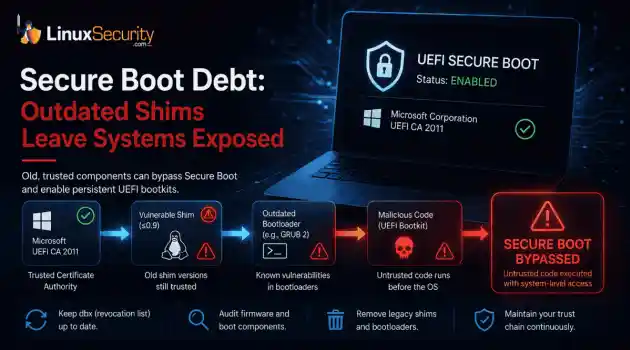
security advisory linux distribution ESET researchers identified 11 old and forgotten Linux UEFI shim bootloaders at versions 0.9 and below that can be used to bypass UEFI Secure Boot on any UEFI-based machine that trusts Microsoft’s Microsoft Corporation UEFI CA 2011 third-party certificate authority, regardless of the installed operating system (OS). Reported shims can be exploited to execute untrusted code during system boot, enabling attackers to deploy malicious UEFI bootkits even on systems with UEFI Secure Boot enabled.....
Jul 16, 2026
 Refine news
X Clear Filters
Get the latest News and Insights
Get the latest Linux and open source security news straight to your inbox.
Community Poll
Is continuous patching actually viable?
Loading...
Explore Latest Linux Security news
We found 11 articles for you...
78
 security advisoryimportantVPN
Mozilla VPN: Assessing Security and Usability in Linux Environments
Mozilla's VPN client hitting Flathub might not make headlines in the broader tech world, but if you’re a Linux admin or infosec professional, this is noteworthy. Why? Because it’s no longer just a convenient option for privacy-conscious users – it’s a potential tool for your security stack. . If you’ve been managing Linux systems for any length of time, you know the balancing act. Privacy. Security. Compatibility. Usability. Every choice feels like threading a fine needle, and VPNs are no different. Mozilla VPN has always positioned itself as a privacy-first solution, and now that it’s on Flathub, it’s more approachable for Linux users than ever. But before you start rolling it out to your team or infrastructure, let’s analyze how it fits (or doesn’t fit) into your environment. Why Should Admins Care About the Mozilla VPN Client's Flathub Availability? First, let’s talk practicality. Before its Flathub debut, getting Mozilla VPN running on Linux wasn’t exactly frictionless unless you were on an Ubuntu-based distro. You had to grab the DEB package from Mozilla’s APT repository, which might have been fine for personal setups. But managing it across diverse environments? Forget it. Now, with Flathub, it’s a cross-distro game. Distributing the app as a Flatpak means it’s compatible with just about every modern Linux flavor, from Fedora to Arch. For admins, that’s a serious convenience boost, especially if you’re tired of juggling package formats or dealing with edge cases on non-Debian systems. Flatpak also brings sandboxing into the mix. That’s not foolproof, but it is a bonus. Every Flatpak runs in an isolated environment, limiting its direct interaction with the host system. If a vulnerability shows up in the Mozilla VPN client (hey, nothing’s invulnerable), the sandbox hopefully keeps your broader system safe, assuming you’ve reviewed and configured the app’s permissions properly. But don’t get complacent. Flatpak apps, even those on Flathub,aren’t inherently bulletproof. While Mozilla has a solid track record, you’ll want to verify the digital signature of the app and double-check the permissions it’s requesting. And if you’re using Linux Mint , there’s an extra snag: Flathub apps under verification, like Mozilla VPN, require overriding Mint’s “only use verified apps” policy. Manually granting that exception means spending more time upfront on due diligence. Mozilla VPN: A (Mostly) Trustworthy Option Let’s move on to the client itself. Mozilla VPN takes a strong stance on privacy, aligning with its parent organization’s long-standing mission: no tracking, no logging, no nonsense. That’s a solid foundation for a VPN, especially if you’re recommending it to less tech-savvy users or employees. Under the hood (wait… pretend I didn’t say that), it’s powered by WireGuard . If you’re unfamiliar with WireGuard at this point, here’s the TL;DR: it’s modern, lightweight, fast, and secure. Compared to legacy protocols like OpenVPN or IPSec, WireGuard is the current front-runner in VPN protocol efficiency. Network performance tests regularly show WireGuard outperforming its predecessors, offering near-native speeds with beefed-up encryption. That’s fantastic for users relying on VPNs in performance-sensitive scenarios like gaming or streaming. For sysadmins, it’s one fewer thing to worry about when users moan about latency. But pay attention here: Mozilla VPN falls under the “paid service” category. While open source, it’s not self-hosted. Your traffic runs through Mozilla’s infrastructure (courtesy of a partnership with Mullvad), and that’s something you’ll need to weigh carefully. Mullvad has a stellar reputation, but by using this VPN, you’re still relying on their centralized system to enforce your privacy. Compare this with rolling your own WireGuard server – a heavier lift but with complete control over your organization's traffic and data handling. If your policies demand thehighest degree of privacy or you want ironclad assurance about traffic routing sovereignty, you may need to look elsewhere. Tools like Algo VPN allow you to set up a WireGuard-based system you own outright. The tradeoff is that you’re on the hook for maintenance, configuration, and infrastructure costs. When Simplicity Comes First Where Mozilla VPN shines is simplicity. This client isn’t designed for those of us who thrive on tinkering in the CLI. It’s for cases where ease of use matters – maybe a mixed team where not everyone’s comfortable running wg-quick commands or wrestling with config files. Deploying a GUI-based solution like this saves you time explaining to less-technical users what “default routes” are and how to check if a VPN is working properly. Cross-platform availability doesn’t hurt, either. If your team includes macOS or Windows users alongside the Linux crew, Mozilla VPN standardizes the experience across the board. The Flathub Factor: What’s the Catch? Flathub makes adoption easier, but there are a few points to keep in mind: Sandboxing Helps but Isn’t Infallible: Flatpak apps are confined in their own isolated environments, which reduces but doesn’t eliminate risk. Admins should always check app-specific permissions and regularly audit the configurations. Flathub Verification Still Pending: At the time of writing, Mozilla VPN hasn’t completed the Flathub verification process. That extra step for Mint users (or anyone strictly enforcing verified app policies) isn’t ideal. Centralized Distribution Isn’t Flexible: An app on Flathub is handy, but larger teams or high-security environments won’t want to rely on external repositories entirely. Hosting internal, trusted versions of essential applications reduces dependency on third-party services. Let’s Wrap It Up Mozilla VPN landing on Flathub is a win for Linux admins, no question. It simplifies installation and improves compatibility across distros, and its WireGuardbackbone makes it a strong contender in the consumer VPN space. For small teams or individuals who need a fast, privacy-first option with minimal hassle, it’s a solid choice, especially at $4.99/month for annual plans. That said, admins overseeing high-security environments might pause before fully embracing it. While Mozilla’s infrastructure and Mullvad partnership are trustworthy today, they still require an element of third-party trust. For those who prioritize absolute traffic control, self-hosted VPN options remain king. Ultimately, Mozilla VPN is another reminder of how the Linux software ecosystem is maturing. Tools like Flatpak and repositories like Flathub aren’t just making Linux more accessible – they’re making it easier for security-conscious users to access and deploy privacy-focused solutions with confidence. Just don’t forget to dot your i’s and cross your t’s during implementation. After all, in cybersecurity, no tool is perfect, and no app is above scrutiny. . Mozilla VPN is currently unavailable on Flathub, restricting access for Linux users who favor Flatpak installations for their applications and updates. Mozilla VPN, Linux security, Flathub application, VPN usability, Linux privacy solutions. . Brittany Day
 Jul 10, 2025
•
Jul 10, 2025
• Vendors/Products
78
 security enhancementmozillafirefox
Firefox Introduces NextDNS as New DNS-Over-HTTPS Provider
Are you a Mozilla Firefox user looking to better protect your privacy online? Good news for Firefox users interested in turning on the browser’sDNS-over-HTTPS (DoH)privacy feature – they now have two providers to choose from. Learn more: . The first, of course, is Cloudflare, which Mozilla partnered with during the two-year development and testing of its DoH service, finally turned on for users in September. Not all Firefox users were at ease with this – entrusting DNS privacy to a single company felt like a risk no matter how many assurances were being offered. The link for this article located at Naked Security is no longer available. . Mozilla Firefox enhances user privacy by integrating two DNS-over-HTTPS providers, encrypting DNS queries to prevent interception of user data online. DNS Over HTTPS, Privacy Feature, Mozilla Firefox, Cloudflare, Online Security. . LinuxSecurity.com Team
Dec 18, 2019
•
Vendors/Products

81
 network securitymozillafirefox
Firefox: Enhanced Browser Privacy With Encrypted DNS Support
Are you a Firefox user? Mozilla is increasing browser privacy with encrypted DNS. Learn more: . Mozilla is about to turn on-by-default an oft-overlooked privacy feature in Firefox. The desktop version of the browser will soon automatically encrypt your website requests using a feature called DNS-over-HTTPS (DoH), itsaid on Friday. DoH lets browsers send Domain Name System (DNS) requests over the encrypted version of the HTTP protocol. DNS is the service that takes a human-readable name like nakedsecurity.sophos.com and turns it into an IP address a computer can use. Your browser asks a DNS resolver for this information. In turn, it asks several other DNS servers on your behalf. It then returns the IP address linked to that URL so that a browser like Firefox can contact it to download web pages. Your DNS service provider is usually your ISP, but it doesn’t have to be. There are third party commercial DNS services too. The link for this article located at NakedSecurity is no longer available. . Mozilla is enabling encrypted DNS in Firefox for improved browser privacy by default with DNS-over-HTTPS.. Firefox, Encrypted DNS, Network Security, Mozilla, DNS-over-HTTPS. . LinuxSecurity.com Team
Sep 10, 2019
•
Privacy
78
 updatesecuritymozilla
Mozilla Firefox 59 Launches With New Privacy And Security Options
Mozilla is currently working on the next stable release of its popular Firefox web browser, version 59, which is expected to land in the second week of March with new privacy and security features.. Firefox is known as one of the most secure browsers on the market, but Mozilla wants it to be more privacy-aware and secure than ever before. That's why it looks like Firefox 59 will be coming with new privacy settings that won't allow intrusive sites to access your camera, microphone or location, nor to ask you if you want to receive any notifications.. Mozilla is enhancing Firefox 59 with new features to boost privacy and security for users, ensuring a safer browsing experience.. Mozilla Firefox privacy update, secure web browser features, Firefox 59 release. . LinuxSecurity.com Team
Mar 02, 2018
•
Vendors/Products
78
user safetymozillafirefoxMozilla Data Breach Exposes 185 Unresolved Firefox Vulnerabilities
Earlier this month, it was reported that hackers managed to breach the bug database of Mozilla. From here, the attackers accessed 185 non-public bugs for the popular Internet browser Firefox, 53 of which were categorized as . Now, it might not just be Mozilla . Uncover the implications of a leak in Mozilla's system that revealed unaddressed vulnerabilities in Firefox, sparking fears about user safety.. Mozilla Security Breach, Unpatched Firefox Bugs, Database Access, User Privacy. . LinuxSecurity.com Team
Sep 21, 2015
•
Vendors/Products
78
security advisorycriticalremote code executionMozilla Firefox Disables Flash Critical Remote Code Exec 164935
As the zero days in Adobe Flash continue to pile up, Mozilla has taken the unusual step of disabling by default all versions of Flash in Firefox.. The move is a temporary one as Adobe prepares to patch two vulnerabilities in Flash that were discovered as a result of the HackingTeam document dump last week. Both vulnerabilities are use-after-free bugs that can be used to gain remote code execution. One of the flaws is in Action Script 3 while the other is in the BitMapData component of Flash. The link for this article located at ThreatPost is no longer available. . Mozilla has temporarily disabled Flash in Firefox as Adobe works on patches for critical remote code execution flaws.. Mozilla Firefox, Adobe Flash, Remote Code Execution. . LinuxSecurity.com Team
Jul 14, 2015
•
Vendors/Products
79
mozillafirefoxbrowser securityMozilla Firefox Moves To Complete HTTPS Enforcement For Secure Browsing
The Mozilla Foundation is initiating the process to phase out insecure HTTP connections in the Firefox browser. The decision is part of a broader movement to encrypt the Web, which in the case of Mozilla Firefox, means permitting only encrypted HTTPS browser connections.. Mozilla is the developer of Firefox. It accounts for between 12 and 22 percent of the browser market share throughout its various versions. The group has not yet established a timeline for the deprecation of HTTP. The link for this article located at ThreatPost is no longer available. . Mozilla is advancing Firefox with a focus on complete HTTPS adoption to enhance web safety and eliminate outdated HTTP links.. Mozilla Foundation, HTTPS Enforcement, Firefox Security. . LinuxSecurity.com Team
May 04, 2015
•
Security Projects
78
security advisorymozillassl interceptionMozilla Firefox Significant Superfish Adware Elimination Notice 163389
Mozilla has issued a hot fix for Firefox that removes the Superfish root certificate from the browser. The Superfish adware performs SSL interception The link for this article located at ThreatPost is no longer available. . Mozilla updates Firefox to remove Superfish adware, enhancing browser security against adware interception.. Mozilla Firefox, Superfish adware, browser security, SSL interception, adware removal. . LinuxSecurity.com Team
Mar 03, 2015
•
Vendors/Products

Get the latest News and Insights
Get the latest Linux and open source security news straight to your inbox.
Community Poll
Is continuous patching actually viable?
Search Topics
Powered By

Linux Security - Your source for Top Linux News, Advisories, HOWTOs and Feature Releases
QUICK LINKS
subscribe to newsletters!
Like staying secure? So do we.
Sign up for updates, tips, and alerts!