Explore top 10 tips to secure your open-source projects now. Read More
×



Server Security data privacy automation
data privacy automation Every system admin has lived through the same Monday morning ritual. A queue of forty tickets, half of them password resets, permission errors, or disk space warnings that any experienced technician could resolve in under two minutes. The other half require actual judgment. For years, automation promised that software would eventually sort the two apart on its own. That promise is now being tested in production Linux environments. . Early results are reshaping how IT teams think about tier-1...
 Jul 17, 2026

Privacydata collection automation
data collection automation You're running a web scraping project to collect pricing data from e-commerce sites. You set up a pool of datacenter proxies, launch your scripts, and within minutes — banned . CAPTCHAs everywhere. Your data pipeline stops before it really begins. . It's a frustrating scenario that plays out daily in ad verification, market research, and multi-account management. The website doesn't know you're doing legitimate research or monitoring. It just sees traffic coming from IP ranges it recognizes as...
Jul 17, 2026

Security Trends security advisory social engineering
security advisory social engineering Business Email Compromise used to be a numbers game — mass-blasted emails, broken English, an obvious "URGENT WIRE TRANSFER" subject line. That era is over. Generative AI has turned BEC into a tailored, low-noise operation that mimics writing style, voice, and even video presence. This piece looks at what's actually changed under the hood, what defenders are testing in response, and why so many organizations are still structurally unprepared for it. . The Infrastructure Problem Nobody Wants to...
Jul 17, 2026

Security Trends cybersecurity Linux documentation
cybersecurity Linux documentation Linux operating systems have gained prominence due to their stability, adaptability, and excellent security options. In the case of developing documentation, designing cybersecurity dashboards, or educational material, visuals are of vital importance when it comes to making things clear. The use of icons allows one to understand the message regarding alerts, authorization, encryption, authentication, or the state of the system just by looking at the visual cue without having to read long...
Jul 17, 2026
Security Vulnerabilities security advisory linux distribution
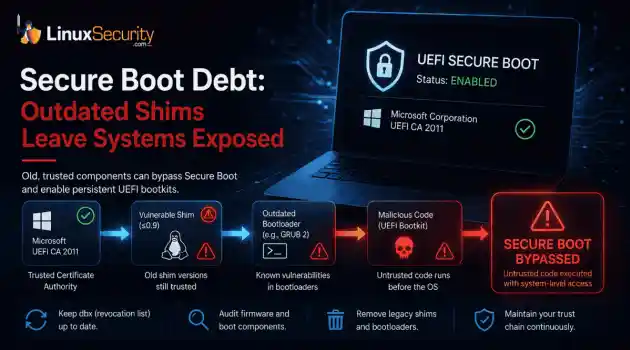
security advisory linux distribution ESET researchers identified 11 old and forgotten Linux UEFI shim bootloaders at versions 0.9 and below that can be used to bypass UEFI Secure Boot on any UEFI-based machine that trusts Microsoft’s Microsoft Corporation UEFI CA 2011 third-party certificate authority, regardless of the installed operating system (OS). Reported shims can be exploited to execute untrusted code during system boot, enabling attackers to deploy malicious UEFI bootkits even on systems with UEFI Secure Boot enabled.....
Jul 16, 2026
 Refine news
X Clear Filters
Get the latest News and Insights
Get the latest Linux and open source security news straight to your inbox.
Community Poll
Is continuous patching actually viable?
Loading...
Explore Latest Linux Security news
We found 12 articles for you...
72
 security advisoryfirewalllinux
Comprehensive Guide to Troubleshooting Linux UFW Firewall Issues
UFW looks simple until you put it on a long-lived server and real traffic hits it. This focuses on the gap between what ufw status shows and what packets are actually doing on production hosts, after rules have already been set up and systems have been up for a while. . Why Does UFW Say a Port Is Blocked, But It Is Still Reachable? One possibility is that the connection was already established before the rule changed. UFW is stateful, and existing TCP sessions are allowed to continue even after a deny is applied. You usually run into this during a scan or a quick external test. ufw status shows the port as blocked, but traffic still flows because the kernel is tracking an active session and honoring it. This is normal behavior, not a bypass. You can confirm this by looking at current connections. ss -atp If you see the port in ESTAB state, that session will persist until it closes. To prove the rule itself is working, terminate the connection and test again. ss -K dst dport = Once the session is gone, new connection attempts should fail. When they do, it confirms the firewall rule is being enforced, and the earlier reachability was explained by state tracking, which is often the root cause when debugging the UFW firewall. How Can I Confirm Which Ports are Actually Exposed on a Server? By testing what the kernel sees and what the network can reach, not what UFW intends to allow or deny. ufw status reflects the configured policy, but it does not tell you whether packets arrive or whether anything is actually listening. Confirming exposure means stepping outside the abstraction. You need to observe traffic at the socket and packet level, and you need at least one test from outside the host to remove local assumptions. Tool What the tool tells you nmap Whether the port is reachable from the network curl Whether the application responds on that port ss-tulpen Whether a process is actually listening tcpdump Whether packets arrive at the interface A port is exposed only when packets arrive, and a listener exists to receive them. Anything else is intent, configuration, or guesswork. Why Do My UFW Rules Look Correct, But Do Not Match Real Network Behavior? Because the rule you are reading is not the rule being applied to the packet. This usually comes down to attribution errors rather than syntax mistakes. Check whether the service is even listening on the protocol you think it is. ss -tulpen Verify that the rule exists in the active chains and is evaluated where you expect. ufw show raw Confirm which interface and route the packet actually uses to reach the host. ip route get If the protocol does not match, the ingress interface is different, or another rule matches first, the UFW rule you are focused on will never fire. When a rule is shadowed or evaluated after an earlier accept, it becomes invisible to the traffic you are trying to explain, which is where most firewall troubleshooting efforts stall. How Does Docker Bypass UFW Firewall Rules? Docker programs its own iptables chains and routes container traffic through them before UFW rules are evaluated. In many cases, UFW never sees the packets at all. This shows up when a host-level deny looks correct but a containerized service remains reachable. Docker inserts NAT and filter rules that short-circuit the normal UFW path, so traffic can be accepted long before it would hit a UFW -managed chain. You can see where this happens by inspecting the Docker user chain. iptables -L DOCKER-USER -n If traffic is accepted here, it bypasses UFW -managed chains entirely. At that point, the firewall behavior is being defined by Docker’s rule set, not by anything you configured through the UFW CLI. Why Do UFW Logs Show Ports Instead of Application Profile Names? Because UFW application profilesonly exist at the UFW layer. Once packets reach the kernel, they are evaluated and logged by port, protocol, and address, not by profile labels. Profiles are a convenience for rule management, not a runtime attribute. Netfilter has no concept of Apache or OpenSSH, only TCP and UDP flows tied to numbers. That distinction disappears as soon as the packet hits the logging path. Operationally, this matters when reading UFW logging output. The logs confirm that packets moved through the firewall and how they were handled, but they do not reflect which profile you thought you were enforcing. They validate packet flow, not profile intent, which is the correct way to interpret UFW logging . Why Is a Port Still Open After I Deleted a UFW Rule or Profile? Because either the traffic is already established, or the traffic is never governed by the rule you removed. There are only two causes that consistently appear in real environments. The first is existing connections. UFW does not tear down active TCP sessions when a rule or profile is deleted. Those sessions stay alive until they close, by design. ss -atp If you see the port tied to ESTAB connections, that traffic will continue regardless of rule changes. Nothing is misconfigured. The kernel is doing exactly what state tracking requires. The second cause is rule precedence outside the UFW CLI. Rules defined in UFW ’s early chains are evaluated before any deny rules you added or removed later. grep ACCEPT /etc/ufw/before.rules Any accept here overrides CLI-level denies. If traffic matches these rules, deleting a UFW rule will not change behavior, because that rule was never in the decision path to begin with. Why Does Blocking a Client IP Not Stop Access in UFW? Because the IP you are blocking is not the IP reaching the firewall. NAT , reverse proxies, and load balancers all rewrite source addresses before packets hit UFW . What UFW evaluates is the post- NAT source. If traffic is coming through aproxy or a managed frontend, the original client address is already gone by the time filtering happens. You can see this directly by watching traffic arrive. tcpdump -i any port -n The source IP in the capture is the only one UFW can act on. If that address is allowed, blocking the original client IP will have no effect. Why Do UFW Rules Work After Reload but Fail After Reboot? Because rule evaluation depends on timing and ownership during startup. After a reload, UFW applies rules to a live, initialized network stack. After a reboot, that order is not guaranteed. Interfaces may not be up when rules load, or routes may not exist yet. Other tools can insert or rewrite iptables rules later in the boot process, changing evaluation order without touching UFW configuration. From a diagnostic standpoint, the key is recognizing that this is a sequencing problem, not a syntax one. When behavior changes across reboots without rule changes, something else is influencing when and how the firewall rules are applied. How Do I Troubleshoot UFW on Production Servers? By starting with what the server actually sees on the wire, not what the rules claim should happen. On production hosts, traffic almost never enters the way the mental model assumes. Multiple interfaces shift where rules apply. Reverse proxies collapse many clients into a single private source. Bastion hosts turn inbound access into internal traffic. Internal-only services often get tested on paths they were never exposed to. The rules look right because they are right, just not for the packets you are thinking about. A typical case is a database port that looks blocked but stays reachable from an application tier. The deny is written for eth0 , but the traffic arrives on eth1 from a private address after passing through a proxy. UFW evaluates the packet correctly. It just evaluates a different packet than the admin had in mind. Once you get used to tracing traffic from the client to the interface and into thekernel, these mismatches stop looking mysterious. That perspective tends to matter more than any individual rule when running UFW for Servers. What Is the Correct Order to Troubleshoot UFW Issues? The order matters because each step answers a different question about where traffic is being handled or dropped. Skipping ahead usually creates false conclusions. Check Intent: ufw status verbose (Is the rule actually there, and is the default policy what you think it is?) Check the Socket: ss -tulpen (Is the application actually bound to the port and interface?) Check the Raw Rules: ufw show raw (Is an earlier ACCEPT chain in iptables shadowing your new rule?) Check the Wire: tcpdump -i any port -n (Are packets even reaching the network card?) If the behavior still persists after disabling UFW entirely, then UFW is not the cause. The Isolation Test: ufw disable (If the problem persists, the issue is upstream—check Cloud Security Groups or your ISP.) That isolation test is blunt, but it is definitive. When traffic behaves the same way with UFW off, the problem is somewhere else in the path. Why Does UFW Allow Traffic but Nothing Reaches the Server? Because the packets never arrive at the host. An allow rule cannot act on traffic that is dropped upstream. You can confirm this by watching for packets directly. tcpdump -i any port If nothing shows up, the block is happening before the server ever sees the traffic. That usually means a cloud security group, provider firewall, or upstream network control, not UFW . How Does UFW Fit Into the Linux Firewall Stack? UFW is a frontend that writes rules. Netfilter is what actually enforces them. All diagnostics that matter happen at the kernel level because that is where packets are accepted, dropped, or forwarded. UFW only shapes intent and ordering before that point. When behavior and configuration diverge, the kernel view is the authoritative one, which is whyeffective troubleshooting always anchors on UFW in Linux. . Explore troubleshooting techniques for UFW on Linux servers to ensure effective firewall rule application and diagnose issues.. UFW troubleshooting,Linux firewall,network security,firewall rules,packet inspection. . MaK Ulac
 Jan 16, 2026
•
Jan 16, 2026
• Firewalls
210
 security advisoryprivilege escalationUbuntu
Ubuntu: Kernel Important Privilege Escalation and DoS Risk USN-7289-1
Ubuntu has issued patches for multiple Linux kernel vulnerabilities now under active review by the security community. The flaws sit inside core components — GPU, network, and Netlink subsystems — where routine processes handle device communication and system traffic. . When those controls break, even limited accounts can gain higher privileges or crash critical services. That opens paths to privilege escalation and denial-of-service attacks across Linux servers, desktops, and container environments. For teams managing Linux fleets, kernel flaws like these don’t stay quiet. Once exploit code circulates, patch speed decides who gets hit first. Once a working exploit appears, attackers fold it into existing toolkits fast, and systems lagging behind on updates become the soft targets. Technical Breakdown of Recent Linux Kernel Vulnerabilities Ubuntu’s latest security notice (USN-7289-1) highlights several Linux kernel vulnerabilities now patched across supported releases. The bugs sit deep in the system — GPU, network, and Netlink code — the parts that keep devices talking to the kernel. When those paths fail, privilege boundaries blur fast. Each flaw works a little differently, but the outcome looks the same: possible privilege escalation or kernel crashes that ripple across Linux servers, desktops, and containers. CVE Details and Kernel Privilege Escalation Risks CVE-2024-26700 — a memory handling bug inside the GPU driver. Bad data can corrupt memory during device operations. CVE-2025-38727 — an issue in the Netlink interface that links the kernel and the user space. With crafted messages, a local user could climb to kernel-level privileges. CVE-2023-52593 — a network driver mishandling that can crash the system under certain traffic patterns, leading to denial-of-service. CVE-2024-26896 — a kernel memory exposure flaw that can leak data or destabilize running processes. Together, they map out another round of Linux kernel vulnerabilitieswhere small coding gaps lead to outsized impact — local users or containers gaining system-wide reach. Affected Linux Kernel Components and Distributions The weaknesses hit GPU and network drivers in newer kernel builds, and the Netlink subsystem that handles inter-process communication. HKCERT’s bulletin confirms these same issues stretch beyond Ubuntu, affecting multiple Linux distributions that share upstream kernel code. That overlap means patching on one distribution doesn’t always close the hole everywhere else. Teams should check which kernel branch they’re actually running before assuming the update covers it. How Attackers Could Exploit These Kernel Vulnerabilities These aren’t remote exploits. They need local access — a valid user, or a process inside a container. But once triggered, they give leverage. Attackers can escalate privileges, crash hosts, or use the kernel foothold to move laterally inside a network. In enterprise setups, a single unpatched node can be enough. Kernel privilege escalation removes most of the usual guardrails, turning a contained compromise into a full system takeover. Impact and Context: Why These Linux Kernel Vulnerabilities Matter Linux kernel vulnerabilities like these sit at the core of modern infrastructure. Once active in production, they affect everything built on top — servers, containers, and cloud workloads that depend on the same kernel base. Ubuntu’s latest security update closes several privilege escalation paths before attackers can use them in real-world environments. Enterprise Risk and Exposure in Linux Environments Unpatched systems are the main concern. A kernel privilege escalation bug gives local users a route to full control, and in shared or containerized environments, that access can spill across instances. The Ubuntu kernel update shows how narrow the patch window can be. Miss it, and a single node can turn into an entry point for persistence or lateral movement. Ongoing Kernel Security Trendsand Patch Cadence Challenges Linux security has long wrestled with the same tradeoff: rapid kernel development versus consistent patch rollout. Driver-level flaws keep surfacing because the code base is huge and deeply reused. Upstream maintainers often ship fixes fast, but enterprise deployment lags. That’s where real exposure builds — not in discovery, but in delay. The Ubuntu 7289-3 notice underscores this cycle. Patches arrive quickly, yet older kernels stay in rotation, giving attackers a small but critical window before updates land everywhere. Cross-Distribution Impact and Shared Kernel Codebase Although this round of flaws was disclosed through an Ubuntu security update, they exist upstream in the Linux kernel itself. Debian, Fedora, and RHEL derivatives inherit the same code and will need matching fixes. Shared architecture simplifies maintenance but also links their risk. Once a vulnerability appears at the kernel layer, it becomes a cross-distro issue until every branch applies the patch. Mitigation and Response for Linux Kernel Vulnerabilities Apply Ubuntu’s latest kernel updates as soon as possible. Reboot each system to complete the patch cycle and clear any loaded modules tied to older builds. Leaving a vulnerable kernel running, even after an update, keeps the same privilege escalation risk in memory. Container hosts need their own step. Rebuild and redeploy images that include affected kernel versions so patched layers replace the old base. Many overlook this stage — the host gets fixed, but the container still carries the flaw. Reduce exposure by tightening local permissions. Limit unprivileged access to device drivers and shared system paths that interact directly with the kernel. Watch for warning signs that show privilege misuse — repeated sudo errors, kernel audit logs with unexpected module loads, or spikes in system calls from non-administrative accounts. Those patterns often appear before a crash or escalation attempt. Linux security staysstrongest when updates move fast and are routine. Each kernel release closes one gap, but discipline in patch management keeps the next one from turning into an incident. Broader Takeaway: Keeping Pace with Kernel-Level Risks Linux kernel vulnerabilities don’t stop at version numbers. Even mature kernels keep revealing driver-level flaws that open quiet privilege escalation paths. The pattern doesn’t change much — small mistakes at the kernel layer still carry the biggest consequences when left unpatched. Effective patch management is what holds Linux security together. Building kernel updates into standard vulnerability response cycles turns it from a scramble into routine maintenance, cutting the time attackers have to move. For a wider look at how these kernel risks keep evolving across distributions, see the latest coverage of 2025 kernel vulnerabilities . It reinforces the same point: resilience comes from pace, not panic. . When those controls break, even limited accounts can gain higher privileges or crash critical servic. ubuntu, issued, patches, linux, kernel, vulnerabilities, under, active, review. . MaK Ulac
Oct 21, 2025
•
Security Vulnerabilities

210
 security advisorydenial of servicecritical
Ubuntu: Kernel Critical Updates Network DoS Vulnerabilities 2025:0011-1
Canonical has released a coordinated set of Ubuntu kernel advisories, including USN-7789-2, USN-7792-3, USN-7809-1, USN-7810-1, and USN-7811-1. Each update addresses critical flaws affecting several kernel builds. The patches span cloud environments like AWS, Azure, and GKE, as well as hardware targets such as Tegra IGX and Raspberry Pi. . The timing and scope of these advisories point to a shared underlying issue. Instead of a handful of isolated bugs, this is a single security event spread across the Linux ecosystem. The same vulnerabilities appear in multiple builds, reflecting how quickly kernel-level flaws can propagate when systems share core components. This incident shows a deeper reality about Linux security. Shared code brings speed, flexibility, and transparency, but it also means one weakness can reach every environment built on that foundation. We’ll examine the technical layers underlying these advisories and explore the connections that bind them beneath the surface. Technical Summary: The Kernel Weak Points Behind the Advisories The five Ubuntu kernel advisories address a cluster of related vulnerabilities found across several kernel builds. Each one targets a different deployment tier, but the flaws trace back to the same core code paths in the networking and virtualization layers. Canonical released all five updates within hours of each other, signaling a coordinated Linux security response rather than routine patch maintenance. Affected Kernel Variants Azure and AWS kernels: Optimized for virtualized cloud workloads. These rely heavily on vSockets and network drivers, both affected by the same underlying flaws. GKE kernels: Used in container orchestration environments where namespace isolation and network filtering are central to workload separation. Tegra IGX and Raspberry Pi builds: Deployed in edge and embedded systems. These variants often face longer patch windows, which increases the likelihood of lingering exposure even after fixes arepublished. Vulnerabilities and CVEs The shared CVEs — 2025-38617, 2025-38477, and 2025-38618 — indicate issues in packet processing and communication between the kernel and user space. While Canonical’s advisories describe them broadly as memory handling and validation errors, their overlap suggests a common failure in the network I/O stack . Each one represents a slightly different path to system instability or denial-of-service conditions under crafted traffic or abnormal packet flow. Subsystems Affected Packet sockets and network traffic control: Vulnerable to memory corruption and potential denial-of-service triggers when handling malformed packets . VMware vSockets driver: Susceptible to local exploitation through inter-VM messaging, which could allow unintended access or service disruption. Architecture-specific builds (ARM, x86, PowerPC): All display similar unsafe memory handling behaviors, showing that the flaw lies in shared kernel logic rather than hardware-specific drivers. Our Analysis These advisories share more than CVE numbers; they share code lineage. The same vulnerable functions appear across kernel variants built for entirely different environments. That overlap demonstrates how modern Linux systems, from cloud to embedded, remain interconnected through the same upstream kernel components. Canonical’s synchronized patch release reflects how seriously the exposure was treated. Achieving parity across mainline, cloud, and edge builds requires a coordinated pipeline — one that can propagate fixes without breaking compatibility. Few vendors can deliver that level of consistency under time pressure. Network and virtualization subsystems continue to be the most complex areas to secure within the Linux kernel. They evolve constantly to support scale and performance, and that churn leaves space for subtle bugs to reappear. This latest Linux kernel patch wave shows that even mature, well-audited components can still surface as risk points inLinux security when shared across so many environments. Understanding where these weaknesses appear helps explain why the same subsystems keep resurfacing in Linux system security updates and kernel hardening efforts. Why These Subsystems Matter in Linux Security Networking and virtualization code sits at the intersection of exposure and control. These are the kernel’s front doors — the places where untrusted data first crosses into privileged space. Every packet, socket call, or virtual interface request passes through layers that manage both communication and containment. That’s what makes them such reliable targets for attackers and such difficult components to secure. When vulnerabilities appear here, the effects cut deep. A single memory handling error can compromise kernel stability, disrupt network flow, or weaken the boundaries that isolate workloads. In cloud or containerized deployments, this can translate into cross-tenant interference or complete service interruption. What ties these issues together isn’t just the CVEs themselves but the shared code they stem from. The same core functions that route traffic in a data center also run inside small-footprint edge devices. The same virtualization stack used in enterprise hypervisors powers lighter embedded workloads. That shared codebase brings efficiency, but it also means that one overlooked bug can echo across architectures and environments. What This Cluster Says About Linux Security Kernel vulnerabilities rarely stay in one place. The same source trees that power every Ubuntu variant connect servers, containers, and edge devices through shared code. When that code fails, the impact spreads fast. It’s the thread that ties these advisories together — a reminder that Linux security isn’t isolated by version or hardware. In real deployments, that interconnection cuts both ways. In a Kubernetes cluster, one unpatched node can quietly reintroduce a fixed flaw across workloads. In cloud infrastructure, an outdatedimage might expose tenant data even if newer builds are fully hardened. It doesn’t take many gaps to open a path. The challenge here runs deeper than missing updates. Linux security depends on consistency, but consistency can also create fragility. Shared components simplify development and maintenance, yet they turn the kernel into a single, global surface for exploitation. That tradeoff is built into the ecosystem itself — the same efficiency that makes Linux adaptable also means a single issue can travel from a data center to an IoT gateway without much resistance. The Interdependence Factor When one module breaks, every environment that reuses it inherits the risk. The modular design that keeps the kernel flexible also makes it demanding to maintain. Each subsystem evolves on its own timeline, but once deployed, it becomes part of a much larger chain of dependencies . For defenders, speed and visibility matter as much as the fix itself. Knowing where that shared code resides — which kernels, which branches, and which workloads — determines how far the exposure extends and how quickly it can be closed. Securing Systems After the Ubuntu Kernel Fixes Canonical has advised all users to apply the latest kernel updates without delay. The process is direct: sudo apt update && sudo apt full-upgrade Once updates are installed, systems need to be rebooted so the patched kernel can load. That final step is what closes the loop; without it, the old kernel remains active and the vulnerabilities stay exposed. Cloud administrators should confirm that images used for automated deployments — whether on AWS, Azure, or GCP — have been rebuilt or replaced with patched versions. In multi-environment setups, patch timing matters. A single outdated image in a deployment pipeline can silently reintroduce the same flaw to hundreds of instances. Patching across environments must happen in sync. The vulnerabilities addressed here are shared, not unique to any one build. A staggered orincomplete rollout leaves openings that threat actors can exploit in predictable ways. Long-term protection depends on more than manual updates. Integrating kernel patch automation, vulnerability scanning, and configuration checks into CI/CD pipelines keeps exposure windows short and repeatable. Teams that treat kernel maintenance as part of continuous integration, not post-incident recovery, are the ones that maintain real Linux security resilience. Operational Takeaways from the Kernel Advisory Cluster This series of Ubuntu kernel patches shows how shared code can quickly turn into shared risk. When the same CVEs appear across multiple builds, one kernel issue can reach everything from cloud workloads to edge devices. For administrators, the priority is consistency. Kernel updates need to be tracked and verified across all deployments — not just production servers. That means checking base images, containers, and any automation pipelines that might reintroduce outdated kernels. Speed matters, but so does completeness. A single lagging node or stale image can reopen exposure after a patch cycle. Verification steps and automated scans close those gaps before they spread. Most of these vulnerabilities sit in the networking and virtualization layers, which continue to produce the highest-impact kernel flaws. Systems that depend heavily on those components should plan for shorter patch intervals, tighter kernel hardening practices, and closer monitoring. Based on Ubuntu Security Notices USN-7789-2 , USN-7792-3 , USN-7809-1 , USN-7810-1 , and USN-7811-1 , October 2025. . Critical issues in Ubuntu's kernel show vulnerabilities across multiple environments. Patches are essential.. Ubuntu kernel patches, technical advisory, security response, cloud vulnerabilities, system resilience. . MaK Ulac
Oct 08, 2025
•
Security Vulnerabilities
74
 security advisorymalwaredetection
BPFDoor: Understanding Malware Threats and Mitigation Tactics
BPFDoor malware has emerged as a serious threat to Linux systems, designed with sophisticated techniques that allow it to operate undetected. This malware leverages Berkeley Packet Filtering (BPF) to sneak past firewalls and inspect network packets for specific sequences, effectively hiding its presence. . Unlike typical malware, BPFDoor doesn’t listen on open ports, making conventional detection methods ineffective. Its ability to evade logs and seamlessly blend into your network poses a significant security risk to your system. For us, Linux security admins, staying alert to this stealthy malware is crucial. Understanding its unique behaviors and implementing advanced monitoring solutions is key to defending your network against this formidable adversary. Let's take a closer look at this malware, its malicious mechanisms and techniques, and measures you can take to secure your systems against BPFDoor attacks. Understanding the Mechanics of BPFDoor Source: TrendMicro It's vitally important to grasp BPFDoor's underlying mechanics to fully comprehend its threat. Berkeley Packet Filtering (BPF) is an inspection technology that enables deep inspection of network packets. This technology is typically employed to enhance performance for network monitoring tools. BPFDoor uses this capability maliciously by connecting directly to it and scanning network traffic for specific sequences or signatures that indicate target systems, effectively bypassing firewalls that would otherwise block them all outright. BPFDoor stands out among traditional malware because its communication channels can easily remain undetected using standard network monitoring tools. Conventional malware typically opens network ports to establish communication with its command and control server. These open ports are easily detectable using standard monitoring solutions, which quickly alert administrators about suspicious activity. BPFDoor, on the other hand, doesn't listen on open ports but employs BPF to "listen"undetected, making it harder for admins to detect using traditional techniques. Stealth and Persistence BPFDoor's stealthiness and persistence are central to its effectiveness. The malware's stealthy design allows it to blend seamlessly into a target system while remaining undetected for extended periods. Using techniques like process hiding, BPFDoor can remain hidden from security scanners while caching network packets without raising alarms, complicating any attempts at forensic investigation. Another strength of the BPFDoor malware is persistence. Once installed on a system, this infection remains visible even through reboots and security updates , using various techniques like creating hidden registry entries or exploiting existing processes to stay unnoticed. Therefore, eliminating BPFDoor requirea more than simply finding and deleting suspicious files. An organized approach must be employed so that all traces are effectively eliminated from existence. Evasion Techniques BPFDoor employs numerous evasion strategies designed to bypass traditional security measures. For instance, it tampers with system logs so its actions leave no trace. Without logs, any suspicious activities go undetected for extended periods, allowing BPFDoor plenty of time to fulfill its goals. BPFDoor's ability to blend seamlessly with regular network traffic demonstrates its sophistication. By replicating legitimate protocols and hiding malicious commands within common communications, it evades detection by Intrusion Detection Systems (IDSs) and other network security tools. Protecting Against BPFDoor Given the complexity of BPFDoor, effective defense requires a multi-layered approach. First and foremost is strengthening network monitoring capabilities, as traditional open port detection will likely miss BPFDoor. Instead, security admins should implement tools that analyze network traffic on deeper levels to detect abnormal patterns indicative of potential BPF activity. Regular system patches andupdates are another key mitigation strategy against BPFDoor malware, although its presence might linger despite updates to your systems. We admins should implement comprehensive log solutions that detect and alert us to any attempts to tamper with host-based intrusion detection systems to provide more comprehensive protection from possible intrusion attempts. Training and educating your team members to recognize the signs of a BPFDoor infection is equally vital. This can help achieve speedy detection and response times and minimize the damage caused by this malware. Be sure to incorporate regular security drills as part of ongoing security updates so everyone is adequately equipped to face this advanced threat. Incident Response Should BPFDoor infiltrate your system, having an effective incident response plan in place is vitally important. Step one in isolating it from further infection is disconnecting and quarantining it from its network. Once all components of the BPFDoor malware have been identified, an intensive forensic investigation must occur to locate them. This requires scanning for hidden processes, monitoring for unapproved network activity, and inspecting system logs for signs of manipulation since BPFDoor often hides itself using legitimate system tools. Thus, conducting exhaustive searches is critical. Once BPFDoor malware has been identified, removal proceedings should begin immediately. Care must be taken to eliminate all remnants, whether reinstalling the operating system software or recovering from backup files . Once clean systems have been restored, comprehensive security reviews are essential to prevent future infections. Our Final Thoughts on Combating BPFDoor Malware BPFDoor poses a formidable threat to Linux security admins due to its stealth, persistence, and evasion techniques. By understanding its operations and adopting advanced monitoring and protective measures against it, admins can better defend against BPFDoor infections. Regular updates, comprehensivelogging, trained security teams, and incident response plans can assist administrators in mitigating and dealing with potential infections. Even though its complexity makes fighting BPFDoor an uphill battle, you can stay one step ahead and maintain system security against this sophisticated adversary with proper protection strategies. . Stealthy BPFDoor malware poses a significant risk to Linux systems, requiring advanced detection strategies and incident response plans.. bpfdoor, malware, emerged, serious, threat, linux, systems, designed, sophisticated, techni. . Brittany Day
Apr 15, 2025
•
Network Security
210
 security advisoryexposurenetwork
Ring Doorbell Security Advisory: Wi-Fi Password Exposure
Are you a Ring doorbell owner? Have you heard about the security bug that researchers discovered in Ring doorbells that sent Wi-Fi passwords over the network in plain HTTP rather than being encrypted? Learn more: . Ring doorbells contained a security vulnerability that exposed passwords to the Wi-Fi networks they were connected to, according to research published by Bitdefender . The security technology company said that the doorbell, which is owned and sold by Amazon, was sending Wi-Fi passwords in cleartext, or unencrypted text, as the doorbell joined the network. This vulnerability would allow nearby hackers to learn the Wi-Fi password and potentially gain access to other devices connected to the network, TechCrunch reported . The link for this article located at Security Today is no longer available. . Smart home devices have exposed sensitive Wi-Fi credentials, allowing cybercriminals to infiltrate private networks.. Ring Doorbell Security, Wi-Fi Password Exposure, Amazon Security Issue. . Brittany Day
Nov 13, 2019
•
Security Vulnerabilities
77
 security advisorythreatmalware
GoScanSSH: A New Malware Threat to Linux Systems Spreading Rapidly
A new strain of malware that targets vulnerable Linux-based systems is loose in the wild, with an interesting habit of avoiding government and military networks.. Dubbed GoScanSSH (a mash-up of its hallmarks: its Golang-based coding, its ability to scan for new hosts from infected machines, and use of the SSH port), the malware is being used in a widespread campaign that includes more than 70 unique malware samples and multiple versions, indicating that this threat is continuing to be actively developed and improved upon by the attackers. The earliest instance of a variant dates back to last summer, so the campaign has been ongoing for at least nine months.. Dubbed GoScanSSH (a mash-up of its hallmarks: its Golang-based coding, its ability to scan for new h. strain, malware, targets, vulnerable, linux-based, systems, loose. . LinuxSecurity.com Team
Apr 03, 2018
•
Server Security
83
security advisorymalwarewormF-Secure: RDP Worm Spreads Causing Surge on Port 3389 TCP
It. F-Secure is reporting that the worm is behind a spike in traffic on Port 3389/TCP. Once it The link for this article located at The Register UK is no longer available. . A report from Trend Micro highlights a malware strain generating high volume traffic on Port 80/TCP, suggesting significant risks for web servers.. RDP Threat, Malware Spread, Network Traffic. . LinuxSecurity.com Team
Aug 29, 2011
•
Hacks/Cracks
74
threatmalwarerootkitFirmware Rootkits and Their Concealment Techniques by Guillaume Delugr
Security expert Guillaume Delugr. He was then able to conceal a rootkit within the firmware, making it untraceable by the virus scanners usually installed on a PC. Delugr The link for this article located at H Security is no longer available. . An extensive exploration on the methods utilized by firmware rootkits to bypass identification, featuring professional perspectives on cybersecurity risks in network environments.. Firmware Threats, Rootkit Concealment, Network Security, Malware Techniques. . Alex
Nov 24, 2010
•
Network Security

Get the latest News and Insights
Get the latest Linux and open source security news straight to your inbox.
Community Poll
Is continuous patching actually viable?
Search Topics
Powered By

Linux Security - Your source for Top Linux News, Advisories, HOWTOs and Feature Releases
QUICK LINKS
subscribe to newsletters!
Like staying secure? So do we.
Sign up for updates, tips, and alerts!