Explore top 10 tips to secure your open-source projects now. Read More
×



Server Security data privacy automation
data privacy automation Every system admin has lived through the same Monday morning ritual. A queue of forty tickets, half of them password resets, permission errors, or disk space warnings that any experienced technician could resolve in under two minutes. The other half require actual judgment. For years, automation promised that software would eventually sort the two apart on its own. That promise is now being tested in production Linux environments. . Early results are reshaping how IT teams think about tier-1...
 Jul 17, 2026

Privacydata collection automation
data collection automation You're running a web scraping project to collect pricing data from e-commerce sites. You set up a pool of datacenter proxies, launch your scripts, and within minutes — banned . CAPTCHAs everywhere. Your data pipeline stops before it really begins. . It's a frustrating scenario that plays out daily in ad verification, market research, and multi-account management. The website doesn't know you're doing legitimate research or monitoring. It just sees traffic coming from IP ranges it recognizes as...
Jul 17, 2026

Security Trends security advisory social engineering
security advisory social engineering Business Email Compromise used to be a numbers game — mass-blasted emails, broken English, an obvious "URGENT WIRE TRANSFER" subject line. That era is over. Generative AI has turned BEC into a tailored, low-noise operation that mimics writing style, voice, and even video presence. This piece looks at what's actually changed under the hood, what defenders are testing in response, and why so many organizations are still structurally unprepared for it. . The Infrastructure Problem Nobody Wants to...
Jul 17, 2026

Security Trends cybersecurity Linux documentation
cybersecurity Linux documentation Linux operating systems have gained prominence due to their stability, adaptability, and excellent security options. In the case of developing documentation, designing cybersecurity dashboards, or educational material, visuals are of vital importance when it comes to making things clear. The use of icons allows one to understand the message regarding alerts, authorization, encryption, authentication, or the state of the system just by looking at the visual cue without having to read long...
Jul 17, 2026
Security Vulnerabilities security advisory linux distribution
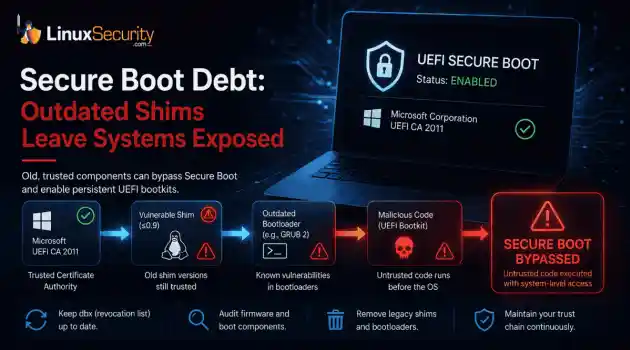
security advisory linux distribution ESET researchers identified 11 old and forgotten Linux UEFI shim bootloaders at versions 0.9 and below that can be used to bypass UEFI Secure Boot on any UEFI-based machine that trusts Microsoft’s Microsoft Corporation UEFI CA 2011 third-party certificate authority, regardless of the installed operating system (OS). Reported shims can be exploited to execute untrusted code during system boot, enabling attackers to deploy malicious UEFI bootkits even on systems with UEFI Secure Boot enabled.....
Jul 16, 2026
 Refine news
X Clear Filters
Get the latest News and Insights
Get the latest Linux and open source security news straight to your inbox.
Community Poll
Is continuous patching actually viable?
Trending News
Loading...
Explore Latest Linux Security news
We found 4 articles for you...
74
 traffic analysissecurity challengesnetwork infrastructure
Datacenter Proxies Overview: Linux Security Implications
Datacenter proxies are simply IP addresses hosted in commercial data centers. No mystery there. They sit on cloud and hosting infrastructure that Linux security teams already monitor every day, often without labeling it as such. . In practice, Linux security teams encounter datacenter proxy traffic whether they are looking for it or not. It shows up in access logs, firewall events, and flow data alongside everything else hitting exposed services, sometimes quietly, sometimes in bursts, rarely explained. The problem is not their presence. The problem is how often this traffic gets interpreted through assumptions instead of evidence. Misunderstanding datacenter proxies leads to misclassification, noisy alerts, and detection logic that drifts away from what the logs are actually saying. Why Are Datacenter Proxies Commonly Misunderstood in Security Analysis? Most misconceptions form long before anyone opens a log file. They come from how datacenter proxies are described, repeated, and absorbed into everyday security shorthand. How Are Datacenter Proxies Typically Described by Service Providers? Providers tend to describe datacenter proxies in broad infrastructure terms. The language focuses on scale and availability, not on how that infrastructure appears once it starts interacting with Linux systems. Those descriptions are not wrong, but they are incomplete for defensive Linux security analysis. They stop at capability and never touch observability. What matters to analysts is not how big an IP pool is, but how that pool behaves once it starts generating requests and touching services. Why Do These Descriptions Shape Security Team Assumptions? Marketing language has a way of becoming shorthand. Teams repeat phrases they hear without validating them against their own telemetry, especially when the traffic looks unfamiliar or arrives at volume. Over time, advertised capability replaces observed behavior. The gap between what is claimed and what actually shows up in Linuxlogs rarely gets examined, even though the evidence is already there. Do Datacenter Proxies Provide Anonymity in Linux Security Monitoring? In Linux security monitoring, anonymity does not survive contact with metadata. Datacenter IP space is attributable by design, and that attribution shows up quickly once you start correlating logs. Ownership and infrastructure metadata cut through most anonymity claims. Hosting providers publish ranges, ASNs are stable, and reverse DNS tends to be consistent across large blocks. Under routine monitoring, these signals collapse the idea that datacenter proxies are meaningfully anonymous. What looks opaque at a distance becomes traceable once you watch it over time. Reuse patterns alone are often enough to break the illusion. Key observables that surface repeatedly include: ASN ownership visibility across requests Reverse DNS consistency within provider ranges Repeated IP reuse across sessions and services Are Datacenter Proxies Difficult to Detect in Linux Environments? They are often described that way, but Linux environments tend to disagree once enough data accumulates. What Traffic Patterns Are Common in Datacenter Proxy Activity? At scale, patterns settle in. Request rates become regular. Client behavior flattens out. Sessions start to look uniform across IPs that should, in theory, behave independently. Once you have seen a few weeks of this traffic, it stops looking exotic. The predictability is not subtle, especially when compared against organic client variation. Which Linux Logs Commonly Reveal Datacenter Proxy Traffic? Web server access logs usually show it first. Firewall and NetFlow logs fill in the edges, especially when traffic fans out across ports or services. Correlation is where it becomes obvious. When the same infrastructure fingerprints appear across multiple Linux services, the picture sharpens without needing any special tooling or configuration. Is All Datacenter Proxy Traffic Malicious? No. Datacenter proxy traffic is not inherently malicious, and treating it that way creates more analytical problems than it solves. Infrastructure alone does not define intent. The same hosting providers routinely support benign automation, research activity, misconfigured clients, and outright abuse, often at the same time. Collapsing all of that activity into a single category breaks attribution and erodes confidence in detection outcomes. The greater risk is not missing attacks. The risk is training detection logic to fire on the wrong signals, until everything looks hostile and nothing stands out anymore. How Do Datacenter Proxies Appear in Linux Security Monitoring and Logs? In practice, they cluster. IPs group tightly within hosting provider ranges. Log signatures repeat with small variations. User agents and request structures line up more often than chance would suggest. Compared to residential and mobile sources, the difference is in texture. Datacenter proxy traffic tends to be cleaner, more uniform, and less noisy. That contrast is visible without guessing once you start lining up sources side by side. How Does an External Perspective Help Correct Proxy-Related Security Assumptions? An external perspective helps when internal narratives get stale. Comparing how datacenter proxies are described in the market with what actually shows up in Linux telemetry exposes the mismatches quickly. An external perspective helps when internal narratives get stale. Comparing how proxy infrastructure is described in the market, including neutral industry overviews such as the one published by Oxylabs , with what actually shows up in Linux telemetry exposes the mismatches quickly. Reviewing those descriptions is not about endorsement. It is about understanding where assumptions came from, and why they no longer fit the evidence. That awareness tightens classification and forces detection logic back toward observed behavior instead of inherited language. Why Understanding DatacenterProxies Matters for Linux Security Teams Misconceptions degrade detection quality in quiet ways. Alerts drift. Classifications blur. Reports lose confidence because the underlying assumptions were never challenged. When those assumptions are corrected, analysis improves almost immediately. The work gets calmer. Decisions get easier to defend. Operational improvements that tend to follow include: Improved alert accuracy Reduced false positives Stronger attribution confidence Conclusion: Proxies Not Inherently Malicious Datacenter proxies are infrastructure, visible and measurable, that Linux security teams already observe every day. The gap has never been access to data. It has been interpreted. When classification is grounded in evidence instead of assumption, proxy traffic becomes just another signal to evaluate, not a shortcut for intent. . Datacenter proxies affect Linux security operations more than assumed, impacting traffic analysis and detection methods.. Datacenter Proxy, Linux Security, Traffic Analysis, Detection Challenges. . MaK Ulac
 Jan 13, 2026
•
Jan 13, 2026
• Network Security
210
 security advisorycriticalCisco
Cisco: SNMP Critical Linux Rootkit Exploit CVE-2025-20352 RCE
Attackers are using a new Linux rootkit to compromise Cisco network devices and keep access long after the initial breach. The exploit begins in the SNMP service, where a privilege flaw provides the necessary foothold to access the kernel. From there, the code blends in with regular system activity and hides everything that matters. . Once it’s running, the rootkit masks processes, rewrites logs, and filters what monitoring tools can see. A system check might look clean while the attacker still has control. That’s what makes this campaign so effective — it doesn’t break anything loud enough to notice. For security teams managing Linux infrastructure, this is a clear reminder of how persistence has evolved. It’s not about desktop malware or file infections anymore. It’s about attackers targeting the kernel itself, which means Linux security must extend beyond routine visibility. What Is the Cisco SNMP Vulnerability and Why It Matters for Linux Security The issue at the center of these attacks sits in Cisco’s SNMP service — software most admins rarely think about until something goes wrong. It’s been part of network infrastructure for decades, meant for management and monitoring, not for intrusion. But a small flaw in the way it handles packets has opened a door that attackers are now walking through. CVE-2025-20352 Overview and Technical Details The flaw is triggered by a malformed SNMP request that overflows a buffer in the SNMP handler. This is not a blind internet-wide RCE — attackers need SNMP access, such as a community string or SNMPv3 credentials, typically with write privileges. Once authenticated, they can deliver a packet that overflows the handler and leads to code execution and full device compromise. Where it lives: The SNMP service listens on UDP port 161. In many networks, it’s still exposed because the service predates the current approach to segmentation. Who’s affected: Devices running older builds of IOS and IOS XE firmware arevulnerable. Cisco confirmed this in its Cisco advisory , which also lists the firmware versions that need immediate patching. Severity and timeline : The flaw carries a critical CVSS score of 7.7. Cisco moved quickly to issue updates once it was reported, and the NVD listing later confirmed the technical vector — remote code execution through SNMP. At its core, this is a simple overflow with complex consequences. It turned a background management protocol into a direct path for kernel-level control. That’s why it matters for Linux security — because it shows how deep attackers can go when old services stay exposed. How Attackers Exploited the Flaw to Deploy a Linux Rootkit Once word got out, attackers didn’t waste time. They scanned for exposed devices, found ones running vulnerable SNMP builds, and sent carefully crafted packets to trigger the flaw. From there, they gained root access and installed a Linux rootkit built specifically for persistence. Entry and escalation: The exploit begins with reconnaissance. Attackers identify reachable SNMP endpoints, confirm firmware, and trigger the overflow to execute code as root. Payload deployment: After gaining control, they drop the rootkit into the system — code that integrates with the kernel and hides its presence from both local tools and remote monitoring. Evidence in the wild: Analysts have seen traffic leading to command servers and system binaries replaced by modified versions. Infected devices still respond normally to most commands, which makes detection slow. The NVD CVE-2025-20352 record confirms how the exploit works. What matters more is what happens next — the rootkit turns that one-time vulnerability into a lasting foothold inside the system. Inside the Linux Rootkit: What It Does and How It Hides So far, observed behavior indicates the implant’s purpose is stealth and persistence rather than autonomous propagation. It hooks directly into the kernel, intercepts calls that listprocesses or files, and forges clean results when admins check what’s running. Persistence: The implant loads with the kernel itself, giving it the same privileges as the operating system. Once active, it can reload after reboots and survive most basic recovery steps. Concealment: It filters out its own entries in process lists and hides active network sockets. If you run ps or netstat, everything looks fine. Communication: It maintains encrypted contact with its command servers through ports that blend into routine SNMP and HTTPS traffic. Detection challenges: Firmware-level inspection tools may catch signs of tampering, but traditional monitoring will not. The deeper it sits, the quieter it gets. For teams focused on Linux security, the lesson is clear: visibility has to extend below the surface. The hardest part about defending against a Linux rootkit isn’t removing it — it’s realizing it’s there in the first place. The Impact of This Attack on Linux Security and Network Infrastructure This attack doesn’t just target Cisco devices — it goes after the Linux core that runs beneath them. It’s a reminder that network infrastructure is part of the Linux ecosystem, and when attackers reach the kernel, the rest of the stack follows. Devices and Systems at Risk The affected devices include Cisco routers and switches running older versions of IOS and IOS XE firmware. Both rely on Linux kernels that can be modified once attackers gain system-level access. The issue is less about model numbers and more about configuration and patch discipline. Enterprise environments: In corporate networks, SNMP remains widely deployed for visibility. Many devices still use legacy credentials or public community strings that make them easy to enumerate. Attackers can scan the internet for exposed SNMP services, identify outdated firmware, and exploit it remotely. Industrial networks: In manufacturing and energy sectors, firmware updates require downtime thatrarely happens. That’s left many installations running years-old builds — stable, but vulnerable. Persistence risk: Once the exploit lands, the Linux rootkit embeds itself in the kernel and can possibly survive firmware updates that don’t fully rewrite the affected components. That persistence turns a short-term exploit into long-term control. This isn’t an isolated case. The Houken kernel rootkit used the same approach earlier this year in attacks against Ivanti Connect Secure gateways. Different target, same concept — compromise the Linux kernel on an appliance that most defenders consider “infrastructure,” not “endpoint.” That’s what makes this shift significant for Linux security: it blurs the distinction between where the operating system ends and where the network begins. Why This Attack Matters for Linux Security Defense Strategies Rootkits have always been a blind spot in Linux defense, but this campaign shows how much harder detection has become. Once attackers gain kernel access, they control what the system reports. Metrics, process lists, even logs — all can be rewritten to look normal. For teams managing Linux-based infrastructure, this demands a shift in priorities. Detection has to rely less on what the system says and more on what can be independently verified. Validate kernel modules and hashes against known-good baselines. Monitor firmware integrity, not just software configuration. Restrict SNMP and other management services to isolated segments. Large-scale campaigns like Cyclops Blink and VPNFilter used the same principle: compromise network gear running Linux, stay quiet, and move laterally through trusted traffic. What’s different now is how refined that persistence has become. As shown in the analysis of how secure Linux is , even hardened systems can be manipulated once attackers move below the user space. It’s not a Linux weakness — it’s a matter of depth. Once the kernel is compromised, everything above itbecomes unreliable. What the Cisco Exploit Reveals About Linux Rootkit Evolution The Cisco campaign underscores how far rootkits have evolved and how well attackers now understand embedded Linux. They’re not brute-forcing visibility anymore — they’re shaping it. Embedded Linux as a platform: Nearly every modern router, switch, and firewall runs on some form of Linux. Once attackers figure out kernel behavior on one platform, that knowledge scales across others. Open architecture, dual impact: Transparency has always been Linux’s strength, allowing defenders to inspect and verify the system at every level. It’s also what makes development easier for attackers who can study the same codebase to refine their implants. Future trajectory: The focus is shifting from infection to persistence. Rootkits like this don’t aim to disrupt; they aim to disappear. That persistence gives attackers time to watch, map, and move. For defenders, the message is straightforward. Linux security can’t stop at patches or intrusion alerts. It must include continuous verification of the kernel, the firmware, and the intervening systems. Because once control slips below the surface, you can’t defend what you can’t see. How to Mitigate the Vulnerability and Strengthen Linux Security Threat Vector Mitigation Strategy Linux Security Rationale SNMP service exposure Disable or restrict SNMP to local networks Reduces the attack surface on Linux-based systems and limits remote exploitation paths Unpatched firmware Apply Cisco firmware updates immediately Eliminates the remote code execution vector before it can be weaponized Rootkit persistence Re-flash firmware or verify kernel integrity Restores a trusted state and re-establishes kernel-level assurance Applying these mitigations quickly is critical to maintaining Linux infrastructure trust.Disabling exposed SNMP services closes off the entry point that attackers used here. Firmware updates and kernel verification prevent persistence — the step that turns an exploit into a long-term breach. These actions aren’t just reactionary. They’re part of the broader discipline of continuous hardening and visibility that defines strong Linux defense today. As outlined in current best practices for how to optimize Linux security , maintaining kernel integrity and enforcing tight patch cycles are central to preventing deep compromises like this one. Together, they move Linux systems back toward a known, verifiable state — the foundation of effective incident recovery and resilience. How to Mitigate the Vulnerability and Strengthen Linux Security Start with the entry point. If SNMP isn’t needed, disable it. If it is, keep it local and monitored. Most of the exposure seen in these attacks comes from management ports left open to the internet. Reducing that reach cuts off the simplest path to compromise and limits what an attacker can touch inside Linux-based systems. From there, patch fast. Cisco’s firmware update closes the flaw that makes remote code execution possible. Unpatched devices stay visible to automated scans, and attackers have already shown they’re looking for them. Firmware maintenance isn’t optional anymore — it’s a baseline for keeping Linux infrastructure trustworthy. If a system’s already been hit, persistence is the problem. Rootkits can live below what most tools see. Re-flashing the firmware or verifying the kernel against a trusted baseline is the only way to be sure the system’s clean. Once the kernel is trusted again, everything above it can be trusted too. These aren’t one-off fixes; they’re habits. This kind of hygiene — limiting exposure, patching quickly, validating integrity — is what separates recovery from recurrence. It’s the same principle behind every effective Linux security program: keep the surface small, keep the kernelverified, and never assume what you can’t confirm. What This Incident Teaches About the Future of Linux Rootkit Threats This attack makes one thing clear: Linux security doesn’t stop at servers. The same kernel runs in routers, VPN gateways, firewalls, and appliances that rarely get attention until something breaks. When attackers plant a rootkit in one of those systems, they’re not just stealing access — they’re taking control of the infrastructure that everything else depends on. The shift we’re seeing isn’t just about tools. It’s about awareness. Adversaries understand Linux well enough now to build implants that live quietly inside trusted systems. They know defenders are watching processes and logs, not kernel hooks and firmware calls. That’s where the next fights will happen — at the level most teams still treat as static. Improving defense means going deeper. Open-source firmware audits, kernel integrity checks, and shared research between vendors and the community aren’t optional anymore. They’re how we keep visibility in places where attackers now live. The focus needs to stay here: Rootkit research: Track how attackers are modifying kernel behavior before it reaches production environments. Embedded system defense: Apply Linux hardening and monitoring to the infrastructure layer, not just endpoints. Open-source transparency: Keep sharing what’s found, fixing it fast, and making those fixes public. Linux was built on that kind of openness. It’s what gives defenders a chance to stay ahead — if we keep looking where the code actually runs . Explore the impact of Cisco's SNMP flaw leading to Linux rootkit installations, emphasizing critical security insights.. Cisco SNMP Flaw, Linux Rootkit, Kernel Exploitation, Network Security, Cyber Threats. . MaK Ulac
Oct 17, 2025
•
Security Vulnerabilities

82
 government surveillancenetwork infrastructurecyber warfare
Exploring The NSA QUANTUM Program And Its Internet Manipulation Tactics
The internet backbone . According to revelations about the QUANTUM program, the NSA can The link for this article located at Wired is no longer available. . According to revelations about the QUANTUM program, the NSA can The link for this article located at. internet, backbone, according, revelations, about, quantum, program. . Alex
Nov 29, 2013
•
Government
74
ipv6network infrastructureinternet protocolUnderstanding Why World IPv6 Day Is Crucial For Internet Growth
While you. As the The Internet Society explained, The link for this article located at ZDNet Blogs is no longer available. . As the The Internet Society explained, The link for this article located at ZDNet Blogs is no longer. while, internet, society, explained, article, located, zdnet, blogs. . Anthony Pell
Jun 07, 2011
•
Network Security
78
security incidentnetwork infrastructuremobile networkDDoS Threats Impact Mobile Networks: 55% Outages in 2010 Report
Arbor Networks' annual infrastructure report for 2010 shows mobile networks in the crosshairs, DDoS attacks against ISPs intensify. In a painful reminder of the fragile state of wireless network security, some 55 percent of mobile providers worldwide suffered outages in 2010 due to security incidents, according to a new report on network infrastructure released today. . And more than half admit to having limited visibility into their networks. Meanwhile, DDoS attacks against ISPs have hit a new high, breaking the 100-Gbps barrier, and application-layer attacks continue to rise beyond HTTP, with attacks against HTTPS, SMTP, and VOIP, Arbor Networks' 2010 Infrastructure Security Report found. And with the wave of attacks on high-profile commercial websites in the wake of the arrest of WikiLeaks founder Julian Assange, DDoS has become more of a household name. The link for this article located at Dark Reading is no longer available. . Telecommunication systems encounter major vulnerabilities, as 52% indicate disruptions due to DDoS attacks. Discover further details on the dangers.. Mobile Network Security,DDoS Threats,ISP Outages,Infrastructure Reporting. . LinuxSecurity.com Team
Feb 03, 2011
•
Vendors/Products
74
network infrastructureremote connectivityvpn solutionHughes VPN Accelerator: Satellite Solution For Remote Access
Hughes Network Systems Inc. hopes to provide companies with a satellite option to connect a VPN for users in remote locations that otherwise lack adequate network infrastructure. . . .. Hughes Network Systems Inc. hopes to provide companies with a satellite option to connect a VPN for users in remote locations that otherwise lack adequate network infrastructure. Hughes unveiled the Direcway VPN Accelerator for multinational companies operating in remote locations around the globe and any company dealing with telecommuters. The VPN Accelerator service is based on the IPsec standard; it connects individual workers, either at home or in the field, to their company's private network through a satellite service. While it will share information with Nortel IPsec networking components, Hughes also plans integration with Check Point and Cisco gear. The VPN Accelerator service is available now and costs between $7,999 and $24,000, depending on the number of tunnels or connections supported to the satellite. The link for this article located at Martin J. Garvey, InformationWeek is no longer available. . Investigate the satellite VPN service offered by Hughes Network as a solution for remote connectivity, expanding internet accessibility for enterprises globally.. VPN Service, Satellite Connection, Remote Access, IPsec Technology. . Anthony Pell
Sep 16, 2004
•
Network Security
74
security risksinternet accessnetwork infrastructureRepublican National Convention Prioritizes Cabling Over Wi-Fi For Security
For their convention, the Republican Party eschewed Wi-Fi wireless networks in favor of 40,000 miles of cables that feed phones, high-speed Internet connections, and broadcast circuits. . . .. Wi-FiNEW YORK (AP) -- The wiring at the Republican National Convention is rich enough to download the entire Encyclopedia Britannica in roughly 30 seconds. More noteworthy, though, is what the gathering lacks: Wi-Fi wireless networks for Internet access. Max Everett, the convention's infotech director, considered Wi-Fi unproven technology that carries security risks and could interfere with remote-control technologies used by broadcast networks. So Verizon Communications Inc. returned to the basics with cabling: Some 40,000 miles that snake through Madison Square Garden and the adjacent media center, feeding more than 5,000 phone lines, 300 high-speed Internet connections, and 140 broadcast circuits. Thin red, orange, blue, and green wires jut out of racks of networking equipment hidden in one makeshift utility closet. Bundles of cables drop from the ceiling into skyboxes used by broadcasters. Wires poke through small holes on the floor of the main convention hall. The link for this article located at Anick Jesdanun, AP Internet Writer is no longer available. . Wi-FiNEW YORK (AP) -- The wiring at the Republican National Convention is rich enough to download th. their, convention, republican, party, eschewed, wi-fi, wireless, networks, favor, miles. . Anthony Pell
Aug 31, 2004
•
Network Security
82
cybersecuritysecurity concernsnetwork infrastructureNavy Marine Corps Intranet Security Issues and Standards Overview
The need for a more secure network infrastructure was one of the driving forces behind the U.S. Navy's quest to build the $6.9 billion Navy/Marine Corps Intranet. But with only a few months left before the majority of N/MCI seats are . . . . The need for a more secure network infrastructure was one of the driving forces behind the U.S. Navy's quest to build the $6.9 billion Navy/Marine Corps Intranet. But with only a few months left before the majority of N/MCI seats are deployed, questions and concerns about security remain. During the Navy/Marine Corps Intranet Industry Symposium here last week, officials from both the Navy and its prime contractor, Electronic Data Systems Corp., touted N/MCI as "the most secure network in the Department of Defense" and possibly in all of the federal government. "Today, N/MCI is an industry standard," said Al Edmonds, president of EDS Government Solutions. But some Navy users, senior officials and even EDS business partners raised concerns about the N/MCI program's approach to security. The link for this article located at ComputerWorld is no longer available. . In the face of uncertainties and obstacles, the U.S. Air Force endeavors to maintain a robust communication framework for its missions.. Navy Intranet, Security Concerns, Network Solutions, Defense Infrastructure, Cybersecurity Standards. . Anthony Pell
Jun 24, 2003
•
Government

Get the latest News and Insights
Get the latest Linux and open source security news straight to your inbox.
Community Poll
Is continuous patching actually viable?
Trending News
Search Topics
Powered By

Linux Security - Your source for Top Linux News, Advisories, HOWTOs and Feature Releases
QUICK LINKS
subscribe to newsletters!
Like staying secure? So do we.
Sign up for updates, tips, and alerts!