Explore top 10 tips to secure your open-source projects now. Read More
×



Server Security data privacy automation
data privacy automation Every system admin has lived through the same Monday morning ritual. A queue of forty tickets, half of them password resets, permission errors, or disk space warnings that any experienced technician could resolve in under two minutes. The other half require actual judgment. For years, automation promised that software would eventually sort the two apart on its own. That promise is now being tested in production Linux environments. . Early results are reshaping how IT teams think about tier-1...
 Jul 17, 2026

Privacydata collection automation
data collection automation You're running a web scraping project to collect pricing data from e-commerce sites. You set up a pool of datacenter proxies, launch your scripts, and within minutes — banned . CAPTCHAs everywhere. Your data pipeline stops before it really begins. . It's a frustrating scenario that plays out daily in ad verification, market research, and multi-account management. The website doesn't know you're doing legitimate research or monitoring. It just sees traffic coming from IP ranges it recognizes as...
Jul 17, 2026

Security Trends security advisory social engineering
security advisory social engineering Business Email Compromise used to be a numbers game — mass-blasted emails, broken English, an obvious "URGENT WIRE TRANSFER" subject line. That era is over. Generative AI has turned BEC into a tailored, low-noise operation that mimics writing style, voice, and even video presence. This piece looks at what's actually changed under the hood, what defenders are testing in response, and why so many organizations are still structurally unprepared for it. . The Infrastructure Problem Nobody Wants to...
Jul 17, 2026

Security Trends cybersecurity Linux documentation
cybersecurity Linux documentation Linux operating systems have gained prominence due to their stability, adaptability, and excellent security options. In the case of developing documentation, designing cybersecurity dashboards, or educational material, visuals are of vital importance when it comes to making things clear. The use of icons allows one to understand the message regarding alerts, authorization, encryption, authentication, or the state of the system just by looking at the visual cue without having to read long...
Jul 17, 2026
Security Vulnerabilities security advisory linux distribution
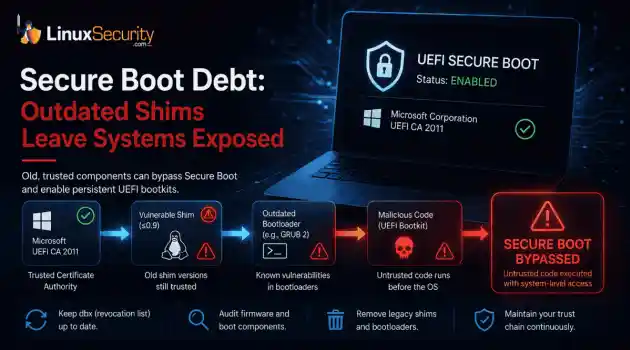
security advisory linux distribution ESET researchers identified 11 old and forgotten Linux UEFI shim bootloaders at versions 0.9 and below that can be used to bypass UEFI Secure Boot on any UEFI-based machine that trusts Microsoft’s Microsoft Corporation UEFI CA 2011 third-party certificate authority, regardless of the installed operating system (OS). Reported shims can be exploited to execute untrusted code during system boot, enabling attackers to deploy malicious UEFI bootkits even on systems with UEFI Secure Boot enabled.....
Jul 16, 2026
 Refine news
X Clear Filters
Get the latest News and Insights
Get the latest Linux and open source security news straight to your inbox.
Community Poll
Is continuous patching actually viable?
Trending News
Loading...
Explore Latest Linux Security news
We found 10 articles for you...
74
 network securitynetwork protocoltraffic analysis
Understanding Linux Network Protocols for Enhanced Security and Performance
Modern computing depends heavily on networking to enable communication among systems and devices, with Linux as one OS that stands out for its versatility and robustness regarding network operations and security. Network protocols are formal policies and standards that define how data exchanged on networks occurs, including rules, procedures, formats, etc. They help ensure efficient device communications regardless of architecture design, making the Internet an invaluable source of data exchange across an endlessly variable landscape. . Let's dive into Linux's network protocols and packet handling techniques so we are better equipped to secure our Linux systems. Why Is Understanding & Properly Using Linux Network Protocols Essential for Linux Admins? Linux network protocols for packet processing are vital for Linux administrators and security practitioners due to their robust nature and versatility in network operations and security. Utilizing Linux's network protocols will enable administrators to maximize its potential, creating efficient yet secure networks. Network protocols define rules, procedures, and formats for data exchange on networks. By using TCP, IP, and UDP protocols on Linux networks, administrators can ensure reliable and efficient transmission between devices—essential to maintaining smooth communications and optimizing network performance. Linux network protocols are essential to network security. They provide firewall rules, packet filtering, and NAT (Network Address Translation) that protect against unauthorized access or malicious network activities. Understanding these protocols is essential for implementing robust measures against potential security risks to protect Linux systems. Administrators must have an in-depth knowledge of Linux network configuration commands and tools. Tools like ifconfig, ip, route and iptables provide efficient network management; netstat, iftop, iperf, tcpdump and Wireshark help analyze traffic while diagnosing issues on networks. Understanding Linux network protocols can give administrators more control of network operations, including optimizing packet flow, setting up efficient routing routes, managing firewall rules efficiently, and allocating network bandwidth efficiently - leading to enhanced network performance and reliability. Acquaintance with Linux network protocols also equips administrators to resolve network issues efficiently. By analyzing network traffic, packet headers, errors, or congestion points and quickly isolating and rectifying issues, they can quickly isolate and resolve them, minimizing downtime while maintaining smooth network operations. Now, let's dive in, beginning by examining common Linux network protocols and configuration commands and the basics of the Linux network stack, the OSI model, and Linux packet flow. Common Linux Network Protocols & Practical Linux Network Configuration Commands to Be Familiar With Common and essential Linux network protocols include: Transmission control protocol (TCP): TCP ensures reliable data transmission between devices. It breaks data down into packets and ensures delivery. Internet Protocol: IP is responsible for routing and addressing packets of information so they can travel over networks and reach their correct destination. User Datagram Protocol: UDP allows faster data transmission but at the cost of reliability. It is used when speed is critical, like in video streaming and online gaming. HTTP/HTTPS: These protocols are the foundation for data communication on the World Wide Web. HTTPS is a secure version of HTTP. FTP: File Transfer Protocol (FTP) transfers files between a client on a network and a server. Secure Shell: Secure Shell is a network security tool that provides a communication channel over an unprotected network. ICMP: ICMP sends error messages and operational data, like the well-known ping command. Address Resolution Protocol: This protocol maps IP addresses into physical MACaddresses. This is important for packet delivery on local networks. DHCP Dynamic Host Configuration Protocol assigns IP addresses dynamically to devices in a network. This ensures efficient IP management. Common network configuration commands that admins should be familiar with include: Ifconfig: A tool older for configuring network interfaces. It can display interface settings, assign IP addresses, and manage other interfaces. IP: A more powerful, newer tool for network configuration. It is part of the iproute2 Suite and offers extensive capabilities for managing interfaces, tunnels, and routing. route: Displays, manipulates, and displays the IP Routing Table. It allows users to add or delete static routes. ip-route: Offers advanced routing capabilities and is preferred over the older route command when managing routing tables. iptables: A user-space tool to configure the Linux Kernel Firewall implemented by Netfilter. It allows users to define packet filtering, NAT, and packet-mangling rules. Linux Network Stack Basics In Linux, network operations are divided between kernel space and user space. Kernel space handle s low-level networking functions like packet routing, firewall rules, and network interface control. It also handles security and performance. User space ensures stability and involves applications using system calls to interact with the network stack. Critical components of the Linux network stack include network interfaces, protocol handlers, and sockets. Network interfaces are either physical or virtual. They connect Linux to a local network. Examples include Ethernet, Wi-Fi, and Loopback. The kernel uses protocol handlers to process different network protocols. For example, tcp_v4_rcv handles incoming TCP packets. Sockets are communication endpoints defined by IP addresses and port numbers that allow applications to send and receive data over the network. What Is the OSI Model? The OSI Model offers a powerfulframework for understanding network interactions. Linux networking components align with various layers in this model; understanding this correlation helps administrators troubleshoot and optimize network operations effectively. These layers are: Physical layer: deals with the physical connections between devices, including cables, switches, and other hardware. Data link layer: Manages data transfer between directly connected nodes, including error detection and MAC addressing. Network layer: Manages routing of data packets over networks, including protocols such as IP. Transport layer: ensures reliable data transfers and includes protocols such as TCP and UDP. Session layer: Manages connections between applications, including setting and managing them. Presentation layer: Translates between the application and the network and handles encryption and compression. Application layer: This layer interfaces with applications directly and facilitates network-based services such as email, file transfers, and web browsing. Linux networking components map to specific layers of the OSI model. The Phyical and Data Link layers are handled by network interfaces and device drivers. The Network layer maps to the kernel’s IP stack, while protocols like TCP and UDP handle the Transport layer within the kernel. The application layer is managed by user-space applications like web browsers, email clients, and network utilities. Packet Flow in Linux Linux packet flow starts at the network interface (NIC) and then travels to various layers in the kernel before reaching the user-space application or being sent out. Understanding the packet flow is crucial for network optimization and troubleshooting. Packet flow can be broken down into packet reception, packet handling in the kernel, and packet transmission. During packet reception, the Network Interface Card (NIC) receives packets from the physical network medium and transfers them into the system memory. When apacket arrives, the NIC sends an interrupt. The CPU processes these interrupts quickly to minimize packet loss. Network drivers manage the interaction between NICs and operating systems, ensuring packets are passed correctly to the network stack. Packet handling in the kernel involves the Netfilter framework, which includes packet filtering and NAT functions and allows packet manipulation. Based on the routing table, the kernel determines the packet's path and forwards it either to the correct interface on the network or to a local program. NAT (Network Address Translation) modifies the packet headers to translate between public and private IP addresses, allowing multiple devices to use a single IP address. Packet transmission involves routing tables, firewall rules, and queueing packets for transmission. To manage packet transmission and ensure fair bandwidth distribution, the kernel uses queueing disciplines (qdiscs). Useful Tools for Analyzing Linux Network Traffic Network monitoring tools are vital for maintaining secure networks. They allow you to monitor all connected devices from one location. These tools help identify devices performing poorly, making troubleshooting and intervening at the source easier. A t horough troubleshooting process can help reduce performance problems and protect against security vulnerabilities. Routine network maintenance can also prevent disruptions, which could take thousands of customers offline. Various packet capture and network monitoring tools exist to help admins analyze Linux network traffic. They include: Netstat: Provides statistics about network connections, routing tables, interface statistics, and masquerade connections. Iftop: Displays network traffic in real-time on an interface. iperf: An instrument for measuring network quality and bandwidth. It can be used to test the maximum bandwidth between hosts. tcpdump: A command line packet analyzer allowing users to capture and analyze network traffic inreal-time. It gives detailed insight into network operations. Wireshark: A graphic tool for network protocol analyses. It is used to troubleshoot and educate and offers extensive features for deep examination of hundreds of protocols. The above tools will enable you to auto-discover connected devices, view past and real-time performance data on devices and apps, set alerts for unusual activity, and generate reports and graphs to analyze network activity. Notable Benefits of Network Monitoring Network monitoring with the tools described above offers several key benefits. First, it expedites issue resolution by rapidly detecting and fixing network problems to reduce disruptions and downtime. Second, it allows prioritization of traffic, ensuring critical apps receive sufficient attention to keep business operations running smoothly. Network monitoring increases customer satisfaction by providing quick access to information and resources. Businesses that deploy network monitoring can create an excellent customer experience by promptly resolving any issues as soon as they arise, which helps build loyalty from existing clients. An effective network monitoring system gives businesses invaluable insights into network performance, helping them manage ever-evolving network environments efficiently and adapt quickly to change. Through traffic monitoring, businesses can detect issues or adapt quickly when necessary. Network monitoring is key to increasing security. It helps identify threats and vulnerabilities, prevent attacks, and protect networks against ever-evolving risks. Network monitoring bolsters efficiency by tracking performance in real-time and quickly detecting issues. It informs businesses on how best to use their infrastructure for improved performance and lower costs. This information allows organizations to optimize their infrastructures for maximum benefit with minimum expense. By regularly monitoring their network, businesses can quickly detect and resolve issues beforethey escalate into serious disruptions or data loss, helping to keep costs at bay and improve bottom lines. Our Final Thoughts on Using Linux Network Protocols for Better Packet Processing System administrators and network engineers must understand Linux's network protocols and packet handling. These concepts will help professionals manage, optimize, and troubleshoot network operations. This guide provides an overview of the Linux networking stack, packet processing, and fundamental protocols. We encourage subscribing to our free educational newsletters for those who want to expand their knowledge of Linux network security and related topics. . Explore Linux network protocols for effective packet processing and optimized network performance.. modern, computing, depends, heavily, networking, enable, communication, among, systems, devices. . Brittany Day
 May 25, 2024
•
May 25, 2024
• Network Security
77
 remote accesslinux toolsnetwork protocol
Top SSH Clients For Linux To Securely Connect To Remote Servers
To establish an SSH connection between your Linux PC and a remote server, you need to have an SSH client installed. Here are some of the best options. . Secure Shell (SSH) is a network connection protocol that allows you to control remote computers over a network. To use SSH on Linux, you need to install an SSH Client. Here's a list of some of the most popular SSH Clients for Linux for you to choose from. . Investigate leading SSH tools for Linux that guarantee safe links to distant servers with convenience and effectiveness.. SSH Clients, Remote Access Tools, Secure Shell Connections. . LinuxSecurity.com Team
Jun 19, 2023
•
Server Security

67
 network protocolencryption toolsecure connection
Exploring OpenSSL: Tools For Secure SSL/TLS Connections
Secure Sockets Layer (SSL) is an internet security protocol. It establishes encrypted connections between computers on a network, such as the internet. The OpenSSL Project dates back to 1998 to develop a free, versatile set of encryption tools for online use. . Amongst other things this includes open-source versions of both the SSL and TLS protocols . As the source code is freely available OpenSSL is supported on a number of platforms including Linux, macOS and Windows. The core library (libssl) of OpenSSL is written in the C Programming Language. It’s designed to allow users to enable support for SSL/TLS in both client and server applications. This is useful for websites, messaging apps , and VPN services , including free VPNs . The library relies heavily on OpenSSL’s comprehensive cryptographic library, libcrypto. This supports a huge number of algorithms including the industry standard Advanced Encryption Standard ( AES ). The libcrypto library also supports older encryption algorithms like Blowfish and Camellia. . LibreSSL provides free-to-use libraries and tools for establishing secure communications utilizing HTTPS and TLS safeguards for protected digital exchanges.. OpenSSL, Encryption Tools, TLS, Network Protocols, SSL. . LinuxSecurity.com Team
Feb 21, 2023
•
Cryptography
210
 security advisorynetwork protocolLinux distribution
Netflix Uncovers Several HTTP/2 DoS Vulnerabilities in Linux Systems
Have you heard that Netflix hasidentifiedseveral denial of service (DoS) flaws in numerous implementations of HTTP/2, a popular network protocol that underpins large parts of the web? Exploiting them could make servers grind to a halt. These vulnerabilities affect various Linux distributions and open-source vendors and projects. Learn the details in this article: . HTTP/2 is the latest flavour of HTTP, the application protocol that manages communication between web servers and clients. Released in 2015, HTTP/2 introduced several improvements intended to make sessions faster and more reliable. The link for this article located at Naked Security is no longer available. . Investigate the DoS vulnerabilities in HTTP/2 identified by Netflix that impact various Linux distros and open-source initiatives.. HTTP/2 DoS Flaw, Netflix Security, Linux Vulnerabilities, Open Source Flaws, Network Protocols. . Brittany Day
Aug 19, 2019
•
Security Vulnerabilities
67
 data securityinformation securitynetwork protocol
Examining Design Flaws In Cryptographic Protocols: ENISA Insights
The cryptographic protocols used to secure data moving across the web are putting users at risk due to design flaws that date back many years. Given the current push to encrypt everything in response to revelations of government surveillance, it's important that the protocols being used to do the job are actually secure.. The problem is that these protocols often aren't up to the task, a problem that researchers at the European Union Agency for Network and Information Security (ENISA) are aiming to remedy. The link for this article located at ZDNet Blogs is no longer available. . The National Cyber Security Centre studies network security models to address vulnerabilities and improve information protection measures.. cryptographic protocols, data security, network risks. . LinuxSecurity.com Team
Nov 24, 2014
•
Cryptography
74
security advisoryupdatebuffer overflowWireshark: 1.2.14 & 1.4.3 Critical: DoS Attack Risk from Buffer Overflow
The Wireshark development team has released version 1.2.14 and 1.4.3 of its open source, cross-platform network protocol analyser. According to the developers, the security updates address a high-risk vulnerability (CVE-2010-4538) that could allow a remote attacker to initiate a denial of service (DoS) attack or possibly execute arbitrary code on a victim's system.. Affecting both the 1.2.x and 1.4.x branches of Wireshark, the issue is reportedly caused by a buffer overflow in ENTTEC (epan/dissectors/packet-enttec.c) The link for this article located at H Security is no longer available. . Wireshark has issued crucial updates to address a severe buffer overflow vulnerability that threatens service integrity and security, allowing code execution. Wireshark Update, Buffer Overflow Fix, Network Protocol Security. . Anthony Pell
Jan 13, 2011
•
Network Security
74
security advisorysecurity risksnetwork protocolExploring IPv6 Security Flaws: Risks and Protocol Challenges Ahead
Ready or not, IPv6 is finally visible on the horizon... And researchers are already finding major security problems with it. IPv6, which is supported in some of the latest OSes and network devices, is all about end-to-end, or peer-to-peer communications. Aside from offering more address space than its IPv4 predecessor which has made it immediately popular in some parts of the world it offers a redesigned IP packet format that simplifies route processing, making it ideal for applications such as voice over IP or instant messaging. . But IPv6 presents a whole range of new security problems, experts say. French researchers recently found problems in the IPv6 protocol specification itself, namely in the routing header. Bottom line: The specification lets the sender add an arbitrary number of extra headers on IPv6 packets, and the IPv6-based routers or hosts must process these headers. It's a denial-of-service attacker's dream come true. The link for this article located at DarkReading is no longer available. . But IPv6 presents a whole range of new security problems, experts say. French researchers recently f. ready, finally, visible, horizon, researchers, already, finding, major. . Bill Locke
May 09, 2007
•
Network Security
74
security advisoryhigh severityCiscoISAKMP Flaw High Severity: Cisco, 3Com, Juniper Affected
Finnish researches today announced a high-risk vulnerability in a security protocol that serves an important role in key exchanges in IPsec VPNs. The severity of the flaw depends on different vendors, some of whom report it exists in their products and others who for now maintain their offerings are unaffected. But its impact could be great, given those vendors include heavyweights Cisco Systems, 3Com, Juniper Networks, Microsoft and IBM. . At issue is the handling of an international standard known as Internet Security Association and Key Management Protocol (ISAKMP), published by the Internet Engineering Task Force to establish, negotiate, modify and delete security associations. ISAKMP is a derivative of IKE and provides a framework for transferring key and authentication data that's independent of authentication, encryption algorithm or any key-generation technique, according to an advisory issued by CERT-FI and the United Kingdom's National Infrastructure Security Coordination Center. The link for this article located at CrimeResearch is no longer available. . At issue is the handling of an international standard known as Internet Security Association and Key. finnish, researches, today, announced, high-risk, vulnerability, security, protocol, serves. . Benjamin D. Thomas
Nov 15, 2005
•
Network Security

Get the latest News and Insights
Get the latest Linux and open source security news straight to your inbox.
Community Poll
Is continuous patching actually viable?
Trending News
Search Topics
Powered By

Linux Security - Your source for Top Linux News, Advisories, HOWTOs and Feature Releases
QUICK LINKS
subscribe to newsletters!
Like staying secure? So do we.
Sign up for updates, tips, and alerts!