Explore top 10 tips to secure your open-source projects now. Read More
×



Server Security data privacy automation
data privacy automation Every system admin has lived through the same Monday morning ritual. A queue of forty tickets, half of them password resets, permission errors, or disk space warnings that any experienced technician could resolve in under two minutes. The other half require actual judgment. For years, automation promised that software would eventually sort the two apart on its own. That promise is now being tested in production Linux environments. . Early results are reshaping how IT teams think about tier-1...
 Jul 17, 2026

Privacydata collection automation
data collection automation You're running a web scraping project to collect pricing data from e-commerce sites. You set up a pool of datacenter proxies, launch your scripts, and within minutes — banned . CAPTCHAs everywhere. Your data pipeline stops before it really begins. . It's a frustrating scenario that plays out daily in ad verification, market research, and multi-account management. The website doesn't know you're doing legitimate research or monitoring. It just sees traffic coming from IP ranges it recognizes as...
Jul 17, 2026

Security Trends security advisory social engineering
security advisory social engineering Business Email Compromise used to be a numbers game — mass-blasted emails, broken English, an obvious "URGENT WIRE TRANSFER" subject line. That era is over. Generative AI has turned BEC into a tailored, low-noise operation that mimics writing style, voice, and even video presence. This piece looks at what's actually changed under the hood, what defenders are testing in response, and why so many organizations are still structurally unprepared for it. . The Infrastructure Problem Nobody Wants to...
Jul 17, 2026

Security Trends cybersecurity Linux documentation
cybersecurity Linux documentation Linux operating systems have gained prominence due to their stability, adaptability, and excellent security options. In the case of developing documentation, designing cybersecurity dashboards, or educational material, visuals are of vital importance when it comes to making things clear. The use of icons allows one to understand the message regarding alerts, authorization, encryption, authentication, or the state of the system just by looking at the visual cue without having to read long...
Jul 17, 2026
Security Vulnerabilities security advisory linux distribution
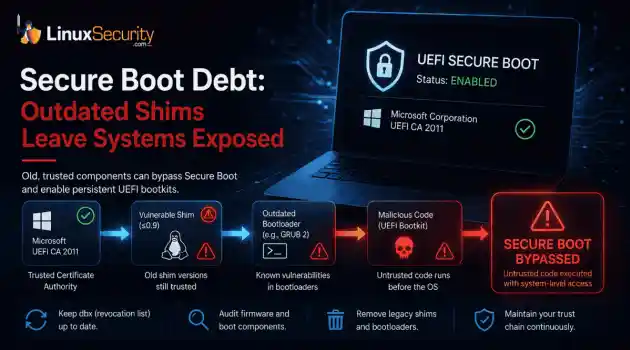
security advisory linux distribution ESET researchers identified 11 old and forgotten Linux UEFI shim bootloaders at versions 0.9 and below that can be used to bypass UEFI Secure Boot on any UEFI-based machine that trusts Microsoft’s Microsoft Corporation UEFI CA 2011 third-party certificate authority, regardless of the installed operating system (OS). Reported shims can be exploited to execute untrusted code during system boot, enabling attackers to deploy malicious UEFI bootkits even on systems with UEFI Secure Boot enabled.....
Jul 16, 2026
 Refine news
X Clear Filters
Get the latest News and Insights
Get the latest Linux and open source security news straight to your inbox.
Community Poll
Is continuous patching actually viable?
Loading...
Explore Latest Linux Security news
We found 4 articles for you...
210
 security advisorymicrosoftimportant
Microsoft Blocks Open Source Dev Accounts, Disrupting Security Pipelines
When developer accounts are blocked, the impact is felt far beyond a single login screen. For many projects, these accounts are the access points for the entire delivery pipeline. If a maintainer is locked out, the flow of security updates stops. In a world where hackers move fast, a stalled pipeline is a massive vulnerability. . Recent account suspensions at Microsoft have affected several major open-source projects. While these events are often seen as small administrative errors, they expose a structural risk: our decentralized, open-source world runs on centralized pipes. When those pipes are cut, the fixes we rely on can no longer reach the systems that need them. Open-Source Dependency on Centralized Infrastructure We often assume open source is independent because the code is public. However, the machinery used to ship that code often relies on services controlled by a single vendor. The Integrity Chain Bottleneck Source: Applied Sciences, MDPI. "A Cross-Chain Solution for Supply Chain Traceability." To maintain software integrity, users need to know that the code they download hasn't been tampered with. This relies on code signing to maintain a verifiable chain of custody for every update. Many cross-platform projects route their release validation through infrastructure linked to Microsoft systems. If a maintainer is locked out of their Microsoft Partner Center account, that chain is broken. They cannot verify new builds, and the package managers you trust cannot receive "official" updates. The Release Pipeline Modern software delivery isn’t just a file transfer; it’s a high-speed pipeline. Code is written, built by automated systems, and distributed to mirrors. Many projects route this flow through GitHub Actions . If the account at the start of that chain is suspended, the machinery snaps. The code might be ready, but it is effectively trapped on a developer’s local machine with no path to production. The Vulnerability Disclosure Cycle Thisinterruption is most dangerous during the vulnerability disclosure process. When a critical bug is found, the fix must move through the pipeline instantly to minimize exposure. If the maintainer’s access is pulled, the patch is paralyzed. This creates a "false sense of security" where the community knows a fix exists, but it cannot be deployed to protected systems. Operational Risks of Pipeline Interruption When a maintainer loses access, the failure isn't a loud crash. It is a quiet drift away from a secure state. Exposure Windows and Version Drift: Attackers scan for bugs the moment they are disclosed. Every hour a maintainer is locked out is an hour that the exploit window stays open. This leads to version drift, where your defense tools are tuned for a version of a package that is now known to be broken. The Synchronization Problem: Linux depends on a healthy software supply chain to ensure that libraries and dependencies are updated in sync. If one key maintainer is blocked, their project stalls while everything around it keeps moving. This creates a gap that hackers use to find a weak link in your stack. Implicit Trust Model Failures: We trust signed packages because we trust the maintainer’s identity. If maintainers are forced to use unsafe workarounds or unsigned builds during a lockout, the entire security model of the repository begins to crumble. The Decentralization Paradox in Modern Security Linux is decentralized by design, which is its greatest strength. However, the delivery of that code has become highly centralized. We rely on a small number of hosting providers to keep the global software supply chain moving. When a provider like Microsoft or GitHub suspends accounts, the "coordination without authority" model of open source is tested. There is no central vendor to provide an SLA or a backup path. This highlights a quiet reliance on centralized services inside a system that is marketed as being independent. If the delivery mechanism is a singlepoint of failure, the "decentralized" nature of the code doesn't actually protect you from a shutdown. Exploit Surface of Administrative Lockouts Imagine a critical vulnerability is found in a core system utility. The developer writes a fix in an hour and prepares to push it to the main repository. But during the upload, they find their account has been suspended for an automated "identity verification" check. The developer cannot sign the new version. They cannot trigger the build system. Meanwhile, a public CVE (Common Vulnerabilities and Exposures) has already notified the world that the bug exists. The lockout itself becomes the security hole. The fix is ready, but because of a centralized administrative error, the enterprise infrastructure and critical systems that run our businesses stay vulnerable to an active threat. Identifying Supply Chain Gaps Because these failures are silent, security teams must look for the "absence" of activity rather than just error messages. Audit Upstream Activity: Watch for a mismatch between code commits and actual releases. If a maintainer is active on GitHub but the package version hasn't changed, the pipeline might be stuck. Verify Repository Integrity: Monitor for broken signing chains or unsigned packages in your mirrors. A sudden change in how a project signs its code is often a sign of an upstream access crisis. Map Dependency Concentration: Use OpenSSF tools to understand which of your core libraries rely on a single build path. If those paths route through one vendor, you have a centralized risk that needs a backup plan. A Fix That Can’t Ship Is No Fix At All The recent account suspensions are a reminder that your security posture must account for the delivery pipes, not just the code. Open source is a chain of trust. If the pipeline stops, the speed at which we write patches doesn't matter. A fix that is trapped behind a login screen is a fix that doesn't exist. To protect the ecosystem, we have to ensure thatour decentralized software isn't entirely dependent on centralized keys that can be turned off without warning. . Recent account suspensions at Microsoft have affected several major open-source projects. While thes. developer, accounts, blocked, impact, beyond, single, login, screen. . MaK Ulac
 Apr 09, 2026
•
Apr 09, 2026
• Security Vulnerabilities
210
 security advisoryupdatecritical
Linux Kernel Netfilter Vulnerability: CVE-2024-26925 Critical DoS Threat
A critical vulnerability was discovered in the Linux kernel's netfilter subsystem, specifically within the nf_tables component, posing potential risks to systems worldwide. The vulnerability, CVE-2024-26925 , arises from improperly releasing a mutex within the garbage collection (GC) sequence of nf_tables. It could potentially lead to race conditions and compromise the stability and security of the Linux kernel. . What Is the Impact of This Vulnerability on Linux Security? The technical details of the vulnerability and its impact on the Linux kernel's security should be highlighted. During the critical section, the commit mutex must not be released between nft_gc_seq_begin() and nft_gc_seq_end. The async GC worker could collect expired objects and get the released commit lock within the same GC sequence if this occurs. The implications of this kernel flaw are severe for systems utilizing the nf_tables for network packet filtering. Thus, admins and users should apply the latest updates to safeguard their systems. This proactive patching underscores the Linux community's commitment to security and stability and the importance of staying updated and informed on Linux security patches and best practices. For Linux admins, infosec professionals, internet security enthusiasts, and sysadmins, this vulnerability could have substantial long-term consequences for their systems and networks. It raises questions about the overall security of the Linux kernel and prompts critical analysis of the patching process and its effectiveness. However, the implications of this vulnerability extend beyond the immediate need for patching, elevating the importance of understanding and addressing potential weaknesses in open source and Linux security . This article aims to ensure that users are aware of their risks and equipped to take necessary actions to mitigate potential threats. Our Final Thoughts on This Critical Kernel Bug The critical vulnerability identified in the Linux kernel's netfiltersubsystem underscores the ongoing challenges in maintaining robust security measures for open-source software. The implications of this vulnerability on systems worldwide necessitate a heightened focus on proactive security measures, patching, and ongoing monitoring to ensure the resilience of Linux environments. This article aims to provide valuable insights and takeaways for the global community of Linux admins, infosec professionals, internet security enthusiasts, and sysadmins by emphasizing the impact of this flaw on security practitioners and offering actionable mitigation recommendations. . This critical weakness in the Linux kernel presents considerable dangers, requiring immediate response from system administrators and cybersecurity personnel.. Linux Kernel, Netfilter, Critical Risk, DoS, Security Update. . Brittany Day
Apr 30, 2024
•
Security Vulnerabilities

79
 security advisoryRed Hat Enterprise Linuxoperating system
Red Hat Enterprise Linux 6 Security Advisory: Patch Management And Uptime
With Red Hat Enterprise Linux 6 now cutting its way into the enterprise-calibre open source operating systems space, there is much to talk about as the terms security and virtualisation are increasingly used to highlight its key new features.. It has been almost eight years since the first release of Red Hat Enterprise Linux and Red Hat says it has experienced no major changes to the ABI (application binary interface) or API (application programming interface) that might otherwise affect application compatibility since the Release Candidate stage was announced a few months back. Interestingly perhaps, at this time of cheer and merriment, Red Hat has chosen to adorn the 'overview' section of its RHEL 6 web pages with news of a CIO Insight Magazine Vendor Value survey that has reported that Red Hat Enterprise Linux delivers superior uptime to Microsoft -- and has the ability to install patches faster than for Microsoft Windows Server 2003 or Windows Server 2008. The link for this article located at Computer Weekly is no longer available. . It has been almost eight years since the first release of Red Hat Enterprise Linux and Red Hat says . enterprise, linux, cutting, enterprise-calibre, source, operatin. . LinuxSecurity.com Team
Dec 07, 2010
•
Security Projects
77
open sourcepatchingfeaturesExploring Differences in Linux Patching for Various Distros
With all the different distributions of Linux available -- many for free -- what distinguishes one over another? Most have the same set of standard bells and whistles. A few have support options that might be appealing for enterprise-level deployments. Nevertheless, underneath the surface, they all share pretty much the same code base. After all, that's what makes Linux so intriguing: busy open source developers all over the planet are always adding features or fixing bugs, and anybody can take advantage of their work. . The link for this article located at TechTarget.com is no longer available. . Explore the diverse world of Linux distributions, from stable Debian-based systems to innovative Red Hat versions, each with unique patch management strategies. Linux Patching,Distro Features,Open Source Deployment,Distribution Differences. . LinuxSecurity.com Team
Jul 28, 2006
•
Server Security
76
open sourcesecurity toolsauthenticationInsights From Linux Security Experts On Patching And Security Practices
To celebrate the launch of the new LinuxSecurity.com, we hosted a community chat event. It was held yesterday (December 1st 2004) at 4:00pm, and featured several prominent visionaries from the open source community including Jay Beale, Brian Hatch, Paul Vixie, Lance Spitzner, and Dave Wreski. The topics discussed ranged from authentication, patch management, honeypots, virtues of open source, SELinux, as well as others. We are planning another event to held in January; please send us your ideas! . Robin, would you like to begin with the first question? Good Morning/Afternoon/Evening/Night, ladies and boys, gentlemen and girls. .. Welcome to Linux Jeopardy, the game where we *prevent* Linux Jeopardy! Let's launch right in with questions for our esteemed guests... 1st question: For Brian Hatch - You've written several books on hardening L inux. How do you view the current state of Linux Security? For Jay Beale: Jay, do you believe the open source nature of Linux provides a superior vehicale to making security vulnerabilities easier to spot and fix? Linux security, as it shall ever be, is a work in progress. (Are we looking to all take turns, or should we write offline and post when complete?) **I'll let Qs overlap a little to allow typing time but still keep things m oving** yes, Brian's question. Linux security continues to be something we all need to strive for, and will never actually achieve. (So JayBeale - work on your Q while Brian_Hatch replies) Etc. There are many things in the linux kernel that are making great strides forward to enabling better security models for Linux. For example, the number of advanced Linux security patches and models, such as SELinux, grsecurity, are very encouraging. LSM, the common framework (for those authors who wish to support it) ma kes creating a machine that has these handened non-standand unix security setups much easier. IN that respect Linux kernel security has a boatloadof possibilities t hat it didn't a few years ago. Linux *machines*, which is the sum of the kernel and the applications ( mostly open source, certainly from your distribitution of choice) will always be vulnerable to misconfigurations, bugs in your software, and plain human error. You'll never achive a 100% secure linux box. Just like you'll never ha ve a 100% secure windows, mac, etc. But things we didn't have before, such as advanced file ACLs, make it p ossible for us to go further with our security models, to support better tailoring of privilages, fo r example. Linux security just gets better and better. (over.) Thoughts from any others as well? sure. Let's do the person-specific Qs first. Jay? And while Jay types, the next Q = For Paul Vixie: Paul, how important is st rong authentication? What have you done to improve standard Linux authentication mechanisms? ok, my specific. in terms of easier to find, it's clear that open source makes them somewha t easier to find, but black box vulnerability-hunting has become much easier with tools like IDA Pro . There's a lot you can do from the black box perspective. Halvar Flake, for example, reverse engi neers Windows patches to find the vulnerabilities they fix. (them == security vulnerabilities) in terms of easier to fix, open source is very, very powerful that way. Security is all about tradeoffs. As our experiences grow, so do the level of d ifficulty of attacks that have to be prevented. I remember back when the ping-of-death vulnerability was first announced that the Linux people had a fix out in something like 4 or 7 hours. The strength is that anyone can create a patch. They can do it on a weekend, they can do it at night. Shops that have som eone on staff capable of vetting that patch can reduce their window of vulnerability massively. Shops that don't can still get a patch sooner, if they've got someone capa ble of compilingsoftware as that person can get the patch from the code maintainer, which tends to be released before the distros are able to finish packaging and testing. re: strong authentication q. it's important to distinguish between anonymity ( which is a necessary property of some parts of digital society) and non-accountability (which is eit her not important, or important to prevent, depending.) i would like to know that there's "recourse " between myself and an agent (host, service, person, whatever) before i agree to spend any resource s (including my time) communicating with that agent. i don't need to know its ident For Lance Spitzner: Lance, I loved your book on honeypots. Do you know of, or can you tell us about any large corporations who have adopted honeypots as a technique for intrus ion detection? I'd just have to second JayBeale's comment on the power you have in hav ing the source code: when a bug is found, you - the end user - are capable of applying it (perhaps even a single line change is all that's required) and compile the bug-free version. That's somethin g that you can never match if you are not the one who has control of the source code. It also provides you with the ability to make an educated choice about the ris ks involved in using the software, free of spin from a specific vendor lance is up next... meanwhile, can prepare to answer this follow-up... Follow up: Any one can create a patch, lots of people then blindly install them without checking sources, what is the risk of getting a trojan through rouge patch? Have you heard of any examples? I can take that until Lance finishes. Go ahead, JayBeale I was trying to address that. Shops that have a programmer on staff or a sysadmin with the skills can generally vet wrt human involvement in creating and applying/accepting patches... the ping of death vulnerability is still present in a lot of machines that have had no other reason to upgrade. i feel the opensource force strongly. but i also fear that someday linux and bsd will be contrib uting their fair share of drones to the armies who mass and launch ddos attacks. humans are great, but let's make it easier to be patched than not, ok? the patch well enough. vix: they are easy to patch. vix: the vendors all have automated patch tools, vix: most of which will allow you to download-only and then patch, or even patch without any human involvement. vix: My Red Hat system tells me when it's low on patches. My Unix-based Ap ple also checks on its own for missing patches. i dunno. a bunch of redhat clients at my son's middle school were running code old enough to not have a patch mechanism enabled by default at installation time, and the teachers there didn't know what they weren't getting. modern redhat and suse is pretty much better in this r egard but there are a lot of distros making up the rest of the market. who defends those? who will defend us against those? apt-get install cron-apt
Dec 02, 2004
•
Organizations/Events
78
security advisorydata protectionpatchingOracle Database Critical Issues: Security Flaws and Patching Needed
In 2001, Oracle CEO Larry Ellison told the world his company's software was "unbreakable" and invited the hacker community to bring it on. The results? By Oracle's own admission, critical security flaws are now legion . . .. In 2001, Oracle CEO Larry Ellison told the world his company's software was "unbreakable" and invited the hacker community to bring it on. The results? By Oracle's own admission, critical security flaws are now legion. The problems affect all of Oracle's flagship products, including Oracle Database 8i, 9i and even the new 10g, with the exception of the just-released version 10.1.0.3. Oracle Application Server is also affected, though a patched version 9.0.4.2 is due out soon. The vulnerabilities run across multiple modules and functions. The database products have holes in the Database Server and Listener elements, and these don't even require a valid user account to exploit. Oracle Application Server is similarly vulnerable in its Portal and iSQL*Plus components. Oracle Enterprise Manager's holes are somewhat less severe--they can be exploited only by those with a valid OS-level user account--but other Oracle products, such as Oracle Collaboration Suite and E-Business Suite 11i, will necessitate full patching of their underlying database server and application server components. With no work-arounds available, Oracle recommends applying patches immediately. The link for this article located at Richard Hoffman, Network Computing is no longer available. . Microsoft's previously celebrated "impenetrable" systems encounter significant vulnerabilities; immediate updates are essential to safeguard information.. Oracle Database, Security Flaws, System Patching, Critical Issues, Data Protection. . LinuxSecurity.com Team
Sep 14, 2004
•
Vendors/Products
83
security managementthreat mitigationpatchingThe Critical Importance of Patching in Effective Security Management
As a result, this easily avoidable problem has reached near-epidemic proportions. Making matters more frustrating is knowing that so many losses could have been easily avoided with a few mundane but crucial steps. "I would put patching in the top two . . . . As a result, this easily avoidable problem has reached near-epidemic proportions. Making matters more frustrating is knowing that so many losses could have been easily avoided with a few mundane but crucial steps. "I would put patching in the top two things an admin can do to secure their computers," said Lance Spitzner, coordinator for the security group Honeynet Project. The others are turning off unnecessary services, like serving up Web pages, allowing file transfers, or responding to remote logins. Every day, the underground elements of the Internet use scanners to find servers susceptible to what security experts have taken to calling the "exploit du jour." Depending on the type of flaw and connection speed, anywhere from tens of thousands to millions of Internet addresses can be scanned in a single day. If even less than 1 percent of the scanned servers connected to each address are vulnerable, that can still result in thousands of defenseless possibilities for a hacker. The link for this article located at ZDNet is no longer available. . As a result, this easily avoidable problem has reached near-epidemic proportions. Making matters mor. easily, avoidable, problem, reached, near-epidemic, proportions, making, matters. . LinuxSecurity.com Team
Jan 24, 2001
•
Hacks/Cracks
83
security advisoryopen-sourcepatchingEvaluating Ramen Worm Effects on Open Source Security and Patch Delivery
Still, the continuing spread of Ramen raises some serious questions about the ability of the open-source community to live up to its security boasts. Linux supporters have long claimed the transparent nature of open-source development produces more secure software and fixes . . . . Still, the continuing spread of Ramen raises some serious questions about the ability of the open-source community to live up to its security boasts. Linux supporters have long claimed the transparent nature of open-source development produces more secure software and fixes bugs faster than proprietary companies such as Microsoft and Oracle do. Even if that's true, Linux will need to prove it can deliver this security to the growing mass of open-source converts who are not particularly tech-savvy and are accustomed to Microsoft-style one-click upgrades. Red Hat hustled out patches for the Ramen worm within weeks, but too many Red Hat users remain unprotected. "I think the community's response to the Ramen virus has been to the credit of open source. Where it breaks down is the last mile of getting that fix to the customer," says Ned Lilly, vice-president for hacker relations at open-source database concern Great Bridge. The link for this article located at BusinessWeek is no longer available. . The proliferation of vulnerabilities poses significant concerns regarding the integrity of open-source software and the community's capacity to implement prompt resolutions.. Ramen Virus, Open-Source Challenges, Bug Fixing in Linux, Security Patching Process. . LinuxSecurity.com Team
Jan 23, 2001
•
Hacks/Cracks

Get the latest News and Insights
Get the latest Linux and open source security news straight to your inbox.
Community Poll
Is continuous patching actually viable?
Search Topics
Powered By

Linux Security - Your source for Top Linux News, Advisories, HOWTOs and Feature Releases
QUICK LINKS
subscribe to newsletters!
Like staying secure? So do we.
Sign up for updates, tips, and alerts!