Explore top 10 tips to secure your open-source projects now. Read More
×



Server Security data privacy automation
data privacy automation Every system admin has lived through the same Monday morning ritual. A queue of forty tickets, half of them password resets, permission errors, or disk space warnings that any experienced technician could resolve in under two minutes. The other half require actual judgment. For years, automation promised that software would eventually sort the two apart on its own. That promise is now being tested in production Linux environments. . Early results are reshaping how IT teams think about tier-1...
 Jul 17, 2026

Privacydata collection automation
data collection automation You're running a web scraping project to collect pricing data from e-commerce sites. You set up a pool of datacenter proxies, launch your scripts, and within minutes — banned . CAPTCHAs everywhere. Your data pipeline stops before it really begins. . It's a frustrating scenario that plays out daily in ad verification, market research, and multi-account management. The website doesn't know you're doing legitimate research or monitoring. It just sees traffic coming from IP ranges it recognizes as...
Jul 17, 2026

Security Trends security advisory social engineering
security advisory social engineering Business Email Compromise used to be a numbers game — mass-blasted emails, broken English, an obvious "URGENT WIRE TRANSFER" subject line. That era is over. Generative AI has turned BEC into a tailored, low-noise operation that mimics writing style, voice, and even video presence. This piece looks at what's actually changed under the hood, what defenders are testing in response, and why so many organizations are still structurally unprepared for it. . The Infrastructure Problem Nobody Wants to...
Jul 17, 2026

Security Trends cybersecurity Linux documentation
cybersecurity Linux documentation Linux operating systems have gained prominence due to their stability, adaptability, and excellent security options. In the case of developing documentation, designing cybersecurity dashboards, or educational material, visuals are of vital importance when it comes to making things clear. The use of icons allows one to understand the message regarding alerts, authorization, encryption, authentication, or the state of the system just by looking at the visual cue without having to read long...
Jul 17, 2026
Security Vulnerabilities security advisory linux distribution
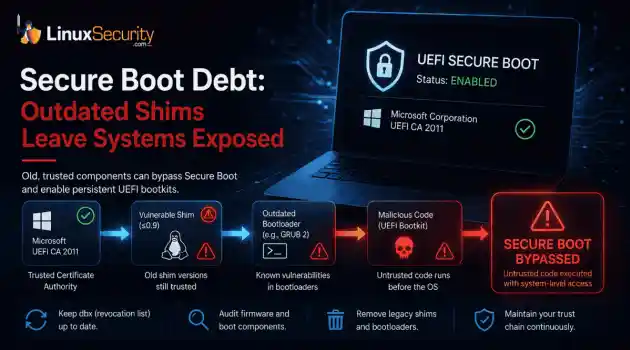
security advisory linux distribution ESET researchers identified 11 old and forgotten Linux UEFI shim bootloaders at versions 0.9 and below that can be used to bypass UEFI Secure Boot on any UEFI-based machine that trusts Microsoft’s Microsoft Corporation UEFI CA 2011 third-party certificate authority, regardless of the installed operating system (OS). Reported shims can be exploited to execute untrusted code during system boot, enabling attackers to deploy malicious UEFI bootkits even on systems with UEFI Secure Boot enabled.....
Jul 16, 2026
 Refine news
X Clear Filters
Get the latest News and Insights
Get the latest Linux and open source security news straight to your inbox.
Community Poll
Is continuous patching actually viable?
Loading...
Explore Latest Linux Security news
We found 268 articles for you...
78
 security advisoryrisk managementclamav
What Is ClamAV? A Linux Admin’s Guide to Risk, Monitoring, and Real-World Use
If you’ve worked with Linux long enough, ClamAV has probably crossed your path. It shows up in package repositories, mail server documentation, and the occasional compliance discussion around Linux antivirus. . In many environments, it gets added once a system starts handling untrusted files, such as mail flow, user uploads, shared storage, or cross-platform file exchange. Sometimes that decision is deliberate. Sometimes it is just the default recommendation. Either way, it tends to appear when a Linux host becomes a content boundary. What matters is whether it meaningfully reduces risk in that role or simply satisfies an expectation. The difference comes down to placement, scope, and understanding what ClamAV is designed to do. What Capabilities Does ClamAV Provide? ClamAV is a signature-based antimalware engine. At its core, it compares files against a database of known malicious patterns. That sounds basic, but in the right place it’s effective. It scans files on disk, mail attachments, and file streams. It can unpack common archive formats and inspect nested content. That matters if you’re dealing with compressed attachments or bundled payloads. ClamAV is known for two defining features: First, it supports content inspection beyond just “is this malware?” You can use it to enforce file type rules, block specific file patterns, and inspect archives deeply. In practice, that gives you lightweight DLP-style controls. Not full enterprise DLP , but enough to flag unexpected executables or restricted content moving through mail or upload paths. Second, it’s open source. The signature database is maintained publicly, and you can create and deploy your own signatures. That makes ClamAV closer to a scanning framework than a fixed product. If your environment has known bad artifacts, internal red team samples, or policy-based file restrictions, you can encode those as custom signatures. You’re not waiting on a vendor to define what “bad” means. That flexibilityis one of its real advantages. Do You Actually Need ClamAV? Start with exposure. Are you accepting untrusted files from the internet? Are users uploading documents to your applications? Are you hosting Samba shares for Windows clients? If yes, you have a file-based risk crossing a boundary. ClamAV is designed for that boundary. If your server is a minimal API node with no file uploads and no shared storage, ClamAV probably doesn’t change your risk profile. It won’t stop SSH key abuse, privilege escalation , or kernel exploits. It won’t detect lateral movement through valid credentials. Here’s the practical rule. If your Linux host is acting as a content gateway or file broker, ClamAV is worth evaluating. If it’s just running services with no file ingestion, your effort is usually better spent on patching, hardening, and logging. Does ClamAV Scan Your Whole System? By default, no. ClamAV does not automatically scan your entire filesystem in real time. You decide what gets scanned. You can: Run on-demand scans against specific directories Schedule recurring scans with cron Use clamd for faster scanning of high-traffic paths Integrate it with mail servers or upload workflows There is on-access scanning support on some platforms using fanotify, but that adds overhead and needs careful testing. Most production deployments focus on ingestion points. Mail spool directories. Upload folders. Shared mounts. Scanning / recursively on a busy production server is usually unnecessary and expensive. If you’re thinking, “Does it watch every process and file like endpoint security?” the answer is no. That’s not its model. What Does ClamAV Prevent? ClamAV is strongest against known, file-based threats. It helps prevent: Commodity malware delivered via email attachments Infected files are being redistributed from shared storage Obvious malicious uploads in web applications Known ransomware samples at the file stage Policyviolations based on file signatures or types What Are ClamAV’s Limitations? ClamAV does not prevent: Zero-day kernel exploits Credential abuse over SSH Privilege escalation via local vulnerabilities Fileless attacks Post-exploitation activity in memory In a real incident, you might see ClamAV catch a malicious macro document before a Windows user downloads it. That’s useful. But if an attacker logs in with stolen keys and starts moving laterally, the signal will be in auth logs and process telemetry, not in ClamAV output. It’s a file inspection control. Not a behavior engine. What Are ClamAV’s Requirements? ClamAV is not heavy, but it isn’t free from cost. You need: Enough CPU to handle scans, especially for large archives Memory for the signature database, particularly with clamd Disk I/O capacity if scanning large directory trees A process for monitoring freshclam updates Log aggregation so detections are visible On a mail gateway or file server, this overhead is usually acceptable. On a performance-sensitive application node, you’ll want to test under load. In practice, update failures cause more problems than CPU or memory limits. If freshclam stops running, the database becomes outdated quickly, and detection quality drops. It is crucial to keep in mind that any deployment should include monitoring for signature updates and scan health. How Long Does ClamAV Take to Run? This depends entirely on the scope. Scanning a single attachment through a mail filter is fast, often measured in milliseconds to seconds, depending on size. Scanning a multi-gigabyte directory tree with nested archives can take minutes or longer. Archive depth and compression matter. Large compressed files are expensive to unpack and inspect. If you care about performance, test against real data. Drop representative files into the target directory and measure scan time under load. Don’t assume lab behavior matches production traffic. Is ClamAV Difficult to Use? Operationally, no. Installation is straightforward on most distributions. Configuration is text-based and predictable. Integration with mail servers and upload workflows takes some plumbing, but it’s well documented and widely deployed. The complexity is not in running it. It’s in placing it correctly and monitoring it consistently. You need to: Confirm signatures update regularly Test detection with something like the EICAR file Ensure detections are logged centrally Define who handles alerts Without clear ownership, alerts are likely to be ignored. Does ClamAV Provide DLP? Not in the enterprise, policy-heavy sense. But it does give you content inspection controls. You can: Block specific file types Detect embedded executables inside archives Create custom signatures for sensitive patterns Enforce limits on archive recursion and size In practical terms, that lets you prevent obvious data exfiltration methods or policy violations passing through mail or upload paths. It’s lightweight, but for many environments that’s enough. This is where ClamAV’s open source model matters. You can define what you care about and encode it. Detection logic is not limited to a vendor-defined rule set. Are There Alternatives to ClamAV? Yes. Commercial Linux antivirus and EDR products provide behavioral detection, centralized management, and deeper host visibility. They’re closer to full endpoint protection. There are other open-source scanning tools , but ClamAV remains one of the most widely packaged and integrated options for mail and file workflows. If your goal is behavioral detection and response, evaluate EDR platforms. If your goal is file-based malware scanning at ingestion points, ClamAV is often sufficient. Final Thoughts: When ClamAV Makes Sense ClamAV makes sense when a Linux system is acting as a file ingestion point. Mail gateways, web applications that accept uploads, shared storageserving Windows clients, and any workflow that moves untrusted files across systems are practical examples. In those scenarios, it provides measurable value by scanning content at the point of entry and blocking known file-based threats before they propagate. That is its strength. It is less relevant on systems that do not handle external files. On application nodes with no upload paths or file exchange, effort is usually better spent on patching, access control, logging, and hardening. ClamAV is a signature-based antimalware engine with a defined scope. When deployed at clear ingestion points and monitored properly, it reduces predictable file-based risk. Outside of that role, its impact is limited. . Explore ClamAV's role in Linux security, highlighting its application in malware detection and risk management.. ClamAV antivirus Linux, malware scanning, Linux security controls, file-based malware. . Brittany Day
 Feb 28, 2026
•
Feb 28, 2026
• Vendors/Products
77
 security advisoryrisk managementincident response
Linux Security in 2026 Hardening Monitoring and Defense Strategies
Linux runs an enormous share of the modern internet - cloud workloads, web backends, containers, routers, IoT devices, and the quiet infrastructure nobody notices until it breaks. That ubiquity is exactly why attackers keep coming back to it. If you can compromise Linux at scale, you don’t just get one machine. You get leverage: access paths, compute, data, and sometimes an entire supply chain. . In 2026, exploitation cycles run in hours, not weeks. Reconnaissance is assisted by AI. Supply chains are probed for weak links. And ransomware crews have gotten comfortable going after servers, because that’s where the business-critical assets live. In that environment, “we patch when we can” and “we have a firewall” isn’t a security strategy. It’s a hope. Real defense means layers: hardened hosts, controlled access, segmented networks, continuous vulnerability management, strong monitoring, and the ability to respond quickly when something slips through. How Linux Servers Are Being Attacked in 2026 Attackers don’t need to be brilliant to be dangerous anymore. Automation does a lot of the heavy lifting. Mass scanners search for exposed services and known CVEs. Botnets built on compromised Linux nodes can DDoS, mine crypto, or provide infrastructure for the next intrusion. And when an organization does everything “mostly right,” attackers increasingly lean on quieter paths: misconfigurations, leaked credentials, or poisoned dependencies. Supply chain compromise is one of the nastiest trends because it abuses trust. The OWASP Software Supply Chain Security guidance outlines this risk in detail. If a legitimate library, package, or build tool gets tampered with, then the malicious payload spreads through normal update channels. The victim doesn’t “download malware.” They update the software. Advanced intrusions also look more like campaigns than single events: initial access, lateral movement, privilege escalation, persistence, and careful data extraction.Linux environments with flat networks and weak privilege boundaries make that progression far easier than it should be. Ransomware fits into this picture, too. Encrypting a laptop is annoying. Encrypting a database server or production file system can stop a company cold. That’s why server-side ransomware is so lucrative - and why Linux remains firmly in the crosshairs. OS Hardening: Reduce the Surface Area Before You Need to Defend It Most breaches don’t start with Hollywood hacking. They start with something exposed that didn’t need to be exposed. Hardening is about making that less likely: Install less Run fewer services Restrict permissions Lockdown defaults Enforce boundaries even if a process gets compromised. “Minimal installs” sound boring, but they matter. Every extra package is one more thing to patch, one more code path that might contain a vulnerability, and one more place an attacker can hide. Service configuration is the same story. If a service only needs local access, don’t bind it to every interface. If it doesn’t need root, don’t run it as root. If it’s unused, disable it. For teams running traditional web stacks, disciplined LAMP stack hardening is part of this baseline work, especially when Apache, PHP, and MySQL sit behind internet-facing services. File permissions still get people, too. World-writable directories, sloppy config files, permissive home folders - all of these become footholds for persistence or privilege escalation when combined with even a small initial compromise. SELinux or AppArmor is where many teams hesitate because it requires tuning. But that’s also why it’s effective. Mandatory access control can contain damage even when something is exploited, because “code execution” doesn’t automatically mean “full access.” Done properly, it turns many intrusions into dead ends. In one finance environment, attackers compromised a web service but could not pivot further because SELinux policiesrestricted access to sensitive data and other services. The incident required a response, but it never escalated into a breach. Patching and Vulnerability Management on Linux Patching is obvious. The hard part is patching quickly and safely. The healthiest teams treat vulnerability management as a pipeline: Discover issues continuously Prioritize based on exploitability and impact Test updates where possible Deploy in controlled waves Verify and monitor Automated patch tooling helps, but it shouldn’t mean pushing everything to production instantly. Critical security fixes often need hours, not weeks - but staging checks and rollback plans still matter. Vulnerability scanners also catch things patching won’t: insecure defaults, misconfigurations, weak SSH settings, exposed admin panels, forgotten services. The value is consistency. Humans forget. Scanners don’t. Configuration drift is another quiet risk. A server starts secure, then over months, someone “temporarily” changes a setting, and it never gets reverted. Compliance monitoring that flags drift early prevents slow-motion incidents. Third-party dependency tracking matters even more now, because modern apps pull in large dependency graphs. You can be perfectly patched at the OS level and still vulnerable through one indirect library you didn’t even know you had. Limiting Lateral Movement in Linux Networks Even strong host security isn’t perfect, so you assume something will eventually get in - and design the network so that “getting in” doesn’t mean “getting everywhere.” Segmentation is practical: Public-facing services in a DMZ App tiers in protected internal zones Databases in heavily restricted data networks Management interfaces are isolated and locked down Host firewalls matter too. A default-deny stance, with only explicit rules, reduces blast radius when perimeter assumptions fail. IDS/IPS solutions can help, especially when combined with anomalydetection, but they’re not a magic wall. They provide visibility and early warning. Remote access remains a common entry point. SSH and VPN hardening is non-negotiable: MFA, certificate-based authentication where possible, restricted source IPs, short-lived credentials, and strong logging. In one SaaS deployment processing sensitive customer data, micro-segmentation, and zero-trust policies required authentication for every internal connection. When attackers gained an initial foothold, traffic analysis flagged abnormal east-west movement and prevented expansion beyond the compromised service. Linux Access Control and Privileged Account Security Modern Linux security is less about “who’s on the network” and more about “who can do what, when, and why.” MFA is table stakes. It proves someone is who they claim to be. Least privilege is where most teams struggle, because once access is granted, the real question is how much that account can actually do. Privilege is the blast radius multiplier. Administrative rights should be tightly controlled: Limit who has it Limit when it’s granted Log privileged sessions Use just-in-time elevation instead of permanent administrative rights SSH is where this often falls apart. Key sprawl creeps in quietly across Linux environments. Without rotation, revocation of stale keys, and centralized oversight, you end up with access paths nobody remembers creating. That’s why centralized identity matters. LDAP, IdP integrations, SSO. Revocation becomes immediate instead of manual cleanup across dozens of hosts. And when something does go wrong, you need proof. Session recording and audit trails aren’t compliance theater. They reduce insider risk and give incident response teams a record of what actually happened. Linux Security in Containers and Cloud Deployments Containers and cloud infrastructure don’t remove risk - they rearrange it. In containerized environments, common issues include vulnerable base images,oversized images packed with unnecessary packages, misconfigured runtime permissions, weak isolation settings, and supply chain risks in image sources. Image scanning helps catch known vulnerabilities before deployment. Runtime security tooling detects behavior anomalies, unexpected outbound calls, or abuse of privileges that static scanning cannot see. For cloud environments, many major breaches trace back to misconfiguration: open storage buckets, overly permissive security groups, exposed metadata endpoints, and leaked access keys. Cloud security posture management tools exist because manual review doesn’t scale. Infrastructure-as-code security checks are particularly valuable. Catching a bad Terraform or Kubernetes configuration before deployment prevents production exposure and eliminates cleanup work later. Logging, Monitoring, and Incident Response Security controls don’t mean much if you can’t see when they fail. Detection is what turns controls into defense. Logs need to leave the host. If they sit only on the box that gets popped, they disappear with it. Centralized logging with protected storage and sane retention isn’t advanced. It’s baseline. To extend visibility beyond individual systems, many organizations integrate centralized logging and analysis platforms such as Security Information and Event Management (SIEM) systems , which aggregate events across hosts, correlate suspicious activity, and provide a broader view of potential threats within a Linux environment. SIEM helps, but only if it’s tuned. Correlating brute-force attempts, odd privilege jumps, strange east-west traffic, and new processes spawning under system accounts. That’s useful. Flood the team with noise, and they’ll mute the alerts within a week. Incident response has to exist before the incident. Who owns containment? Who handles forensics? Who talks to leadership? If that gets decided during the breach, you’ve already lost time you won’t get back. Security Automation inLinux Environments Attack volume is too high for a purely manual response. Automation is how serious environments keep pace. Good automation relies on playbooks: Block obvious brute-force sources Isolate hosts with strong compromise indicators Revert known-bad configuration drift Terminate suspicious processes Open incident tickets with context attached Security orchestration connects tools so analysts aren’t jumping between disconnected dashboards. Automated vulnerability remediation reduces the time between disclosure and patching, which is exactly the window attackers target. Configuration management tools such as Ansible, Puppet, or Chef enforce secure baselines continuously instead of relying on a one-time setup. An e-commerce platform processing millions of transactions implemented automated threat blocking, self-healing configuration remediation, and orchestrated response playbooks. During peak traffic, intrusion attempts were contained within minutes without requiring a large security operations team. Where Linux Security Is Headed In 2026, Linux security isn’t a single tool or a single policy. It’s a system. Defense-in-depth works because it assumes failure is possible and makes those failures survivable. Hardening reduces the attack surface. Access control limits damage. Segmentation slows movement. Monitoring provides visibility. Automation shortens response time. Teams that treat security as an ongoing operational discipline - not a quarterly checklist - build resilience over time. Teams that rely on outdated habits remain reactive, constantly cleaning up instead of improving. Threats will keep evolving. The Linux environments that stay secure will be the ones defended by people, processes, and controls that evolve just as quickly. . In 2026, exploitation cycles run in hours, not weeks. Reconnaissance is assisted by AI. Suppl. linux, enormous, share, modern, internet, cloud, workloads, backends, containers. . MaK Ulac
Feb 27, 2026
•
Server Security

79
 security advisoryrisk managementsupply chain
New Rust Tool Traur Analyzes Arch Linux AUR Packages for Hidden Risks
Most of us have pulled something from the AUR because it was faster than packaging it ourselves. You need a tool; it’s there, it builds cleanly, and the system keeps moving. No alerts. No obvious red flags. That’s usually how supply chain issues begin, not with explosions but with convenience. . The Arch Linux AUR is one of the reasons people like the ecosystem. It is flexible, fast, and community-driven. But it is also a collection of user-submitted build scripts that execute on your machine, often with elevated privileges. There is no central security review board. There is no vendor QA pipeline. What you have is transparency, version history, and whatever scrutiny the community happens to apply. Many admins skim the PKGBUILD, check the version, glance at the source URL, maybe verify the checksum, and move on. If it compiles and installs without errors, it feels fine. The problem is that supply chain security rarely fails in obvious ways. It fails in small changes that blend in with normal updates. Traur is interesting in that context. Not because it is written in Rust, and not because it promises to catch everything. It is interesting because it forces a closer look at how thin most AUR review processes really are. When you run a scanner, and it flags behavior you did not notice in your own quick review, that tells you something about your process, not just the package. If you run Arch Linux in a lab, this is an educational issue. If you run it on developer workstations, build servers, or anything tied to production, it becomes a supply chain security question. What you allow to build locally can shape what eventually ships. In this article, we are going to look at where AUR risk actually shows up in real environments, how malicious PKGBUILDs slip through casual review, what you should audit before installing, and what this means for policy and monitoring. The goal is not to scare you off the AUR. It is to make sure you are using it with intent rather than habit. The OngoingRisk in the Arch Linux AUR Ecosystem When people talk about AUR risk, it often sounds like an occasional incident. A compromised package here, a bad maintainer there. In practice, the risk in the Arch Linux AUR is structural. It comes from how it works, not from a few bad actors. AUR packages are build scripts. They are not vetted binaries signed by a central authority. A PKGBUILD can fetch source from almost anywhere, apply patches, run arbitrary shell logic in prepare(), build(), or package(), and install files with post-install hooks. That flexibility is the feature. It is also the exposure. Popularity does not change that. Votes, comments, and install counts are signals of usefulness, not of safety. You will see packages with thousands of votes and no formal security review. You start to notice that social proof becomes a substitute for verification, especially on busy teams. Maintainer turnover is another quiet factor. Accounts can be hijacked. Packages can become orphaned and then adopted by someone new. A small change in a source=() array, a new install scriptlet, or a checksum update that aligns with a fork instead of the original upstream can slide through without much attention. In the context of supply chain security, those small edits are where problems hide. In the real world, it looks ordinary. A package that has worked for years suddenly pulls from a different Git repository. A maintainer update adds a curl call in prepare() that pipes output to a local script. A dependency you never reviewed introduces a post_install that tweaks user configuration files. Nothing crashes. Nothing screams malware. It just changes behavior slightly. What I watch for first is history. Maintainer changes in the AUR Git log. Source URL drift over time. New pre or post hooks that were not there in previous releases. Sudden checksum updates without a corresponding upstream version bump. If you track a package for long enough, you begin to see what normal looks like. Deviations stand out. What breaksis the assumption that automation equals safety. Automated fleet provisioning that pulls AUR packages directly without pinning commits. CI systems that build from the live AUR repository instead of a known snapshot. Blind trust in votes because the package has been around forever. Before I trust an AUR package in anything tied to production, I verify a few basics. I look at the full commit history of the PKGBUILD. I confirm that the source origin is consistent with the official upstream project. I check that checksums match a real release artifact. I build in a controlled environment and watch for unexpected network calls during the build process. Here is what you need to do. Treat every AUR package as executable instructions from the internet, because that is exactly what it is. From an admin standpoint, this means defining where AUR usage is allowed and under what conditions. A habit of “I reviewed it quickly” is not a policy. If Arch Linux is part of your production or CI story, you need an explicit position on how community packages fit into your supply chain security model. How Malicious PKGBUILDs Slip Through Casual Review Most malicious PKGBUILDs do not look malicious at first glance. They build. They install. They pass a quick skim. That is usually enough to get them onto a developer workstation or into a CI job. The problem is not dramatic malware. It is subtle behavior tucked inside normal-looking shell logic. In the context of AUR packages and supply chain security, attackers do not need something flashy. They need something that blends in with routine maintenance. You start to notice trends once you review enough of these. Abuse of prepare(), build(), or package() to execute additional shell commands. Network calls during the build process that fetch more than the declared source. Conditional logic that only triggers under specific environment variables. Install scriptlets that modify user configuration files or system-wide settings. Typosquatted packagenames that resemble popular tools. Obfuscated variable expansion to hide the real command being executed. None of that looks extreme on its own. It looks like shell scripting. And most of us are used to shell scripts doing messy things. In practice, this is how it shows up. A PKGBUILD verifies a checksum, and if it fails, it quietly pulls a fallback binary from a different location. A post_install script appends a line to ~/.bashrc to “enable” something. A dependency points to a personal GitHub fork rather than the official project, but the name is close enough that you do not notice on first pass. If you are only checking the version and checksum, you will miss it. If you review diffs but do not expand every function, you will miss it. If you assume makepkg contains everything safely, you are trusting the script to behave. What I look for first is any use of curl, wget, or git clone beyond fetching the declared source. I look for dynamic URLs built from variables. I check whether anything writes outside $pkgdir. I pay attention to output redirection to /dev/null, because that is often used to suppress warnings that would otherwise look suspicious. This is the part people skip. They glance at the top of the file, see familiar metadata, and move on. Before I trust a PKGBUILD, I want to confirm that the build steps are deterministic. That running the same build twice produces the same result. I want to confirm there is no runtime persistence being introduced through install hooks. I want to see that global configuration is not being modified unless that is the explicit and documented purpose of the package. If you are seeing complex shell logic in a PKGBUILD, slow down. Complexity is not proof of compromise, but it increases the surface area for abuse. From a team perspective, this is where an informal review process falls apart. You need a documented checklist for auditing AUR packages, not just “someone looked at it.” That shift alone changes how seriously your organizationtreats supply chain security in Arch Linux environments. Why Community Repositories Remain a Supply Chain Target Once you look at this from an attacker’s perspective, the appeal becomes obvious. Community repositories sit outside formal vendor signing pipelines. They rely on transparency and shared oversight, which works well for functionality, but is softer from a supply chain security standpoint. In the Arch Linux ecosystem, the AUR is especially attractive because it lives so close to development workflows. Developers install compilers, language runtimes, database clients, and niche tooling from it every day. Those machines are not isolated toys. They often hold SSH keys , API tokens, cloud credentials, and access to CI systems. That is the real incentive. A compromised developer workstation is rarely the end goal. It is a pivot point. From there, lateral movement is practical. Steal an SSH key. Extract a Git token. Modify a build pipeline. None of that requires loud malware. It requires patience and access. You see a few recurring scenarios: A developer installs a small helper tool from the AUR, which later introduces a malicious update. A CI pipeline builds directly from the live AUR repository without pinning a commit. An orphaned package is adopted by a new maintainer who quietly alters the source URL. A dependency of a dependency changes behavior, and no one notices because it is two layers deep. What I watch for is simple but telling. AUR usage on build servers. Tokens stored on systems that regularly install community packages. Packages that touch compilers, interpreters, shells, or system libraries. Those have a higher potential impact if something goes wrong. What breaks is the assumption that developer endpoints are low-risk. They are often treated as flexible environments where convenience matters more than control. That works until those same endpoints are connected to production systems. Before I trust AUR usage in a given environment, I verifyboundaries. Which machines are allowed to install from the AUR. Whether builds are isolated from the rest of the network. Whether artifacts are reproducible and then signed internally before distribution. If a build server pulls directly from the internet and pushes artifacts into production, that is not a small gap. It is a direct path. Do not waste time debating whether the AUR is safe in abstract terms. Decide where it is allowed, and contain the impact if something slips through. For Arch Linux deployments beyond a personal machine, that usually means separating dev and production, restricting AUR access on sensitive systems, and treating community packages as external code entering your supply chain. Once you frame it that way, the controls you need become clearer. What Traur Changes in a Practical Workflow Up to this point, the pattern is clear. The risk is not theoretical, and the review most teams apply to AUR packages is lighter than they think. This is where a tool like Traur fits in, but it helps to be precise about what it changes and what it does not. Traur analyzes PKGBUILDs and looks for patterns that tend to correlate with risky behavior. Suspicious commands. Unexpected network access. Install hooks that reach beyond normal packaging boundaries. It is written in Rust, which matters from an implementation standpoint, but operationally, what matters is consistency. You get the same scrutiny every time. That consistency is the real value. In a practical workflow, this usually means: Running Traur against a PKGBUILD before approving it for internal use. Integrating it into CI jobs that build from AUR sources. Using its findings as part of a documented review process. Storing scan results alongside the approved PKGBUILD in version control. When you do that, you reduce reliance on memory and individual expertise. You stop depending on whether the one person reviewing the package happens to notice an odd curl invocation buried in prepare(). But there arelimits. Pattern-based analysis can flag obvious red flags, yet it does not understand intent. A legitimate package might fetch additional resources during build. A complex but safe PKGBUILD might look noisy. You will see false positives. You will also see clean reports that still deserve human review. This is where people get it wrong. They treat scanner output as a verdict instead of input. What I watch for is overconfidence. Teams that stop reading the PKGBUILD because the tool did not complain. Or worse, teams that silence warnings to make the pipeline green. At that point, the tool becomes theater. Before I trust a Traur result, I verify that someone has actually reviewed the flagged items. I confirm that automated scanning is paired with manual sign-off. I make sure the version of the tool and its rule set are maintained, not forgotten after initial rollout. Here is what you need to do. Treat Traur like a fast junior analyst. It can surface patterns quickly, it can standardize part of your supply chain security review, but it cannot make the final call for you. In Arch Linux environments that depend on AUR packages, that shift alone matters. You move from ad hoc review to repeatable analysis. Not perfect security. Just fewer blind spots, applied the same way every time. What You Should Actually Audit Before Installing an AUR Package At some point, the conversation has to move from theory to practice. If you are about to install an AUR package on an Arch Linux system that matters, what are you really checking? The first thing I try to confirm is simple. Is this package doing only what it claims to do. That sounds obvious, but most problems show up when a package does one small extra thing that was not part of the stated purpose. I start with the full PKGBUILD, not just the diff from the last version. Diffs are useful, but they hide context. I read through prepare(), build(), and package() carefully, especially if there is nontrivial shell logic. I look at the source=() array andtrace each URL back to an official upstream release or repository. If the source suddenly points to a personal fork, that is not automatically malicious, but it deserves a reason. Maintainer history matters more than people think. A quick review of the AUR Git log tells you whether the package has been stable for years or has changed hands recently. A maintainer switch combined with structural changes in the PKGBUILD is where I slow down. You start to see it once you review enough of them. Stable packages tend to evolve predictably. Abrupt shifts stand out. Checksums are not just a box to tick. I confirm that the checksum matches a known upstream artifact, not just whatever file happens to be served at the URL today. Running makepkg --verifysource is part of that, but I also want to know what I am verifying against. If the upstream project publishes signed releases, I prefer to validate against those rather than trust a random tarball. Install and post-install scriptlets deserve separate attention. Anything that writes to user home directories, modifies global configuration, enables services, or adjusts permissions should be explicit and documented. Silent changes to ~/.bashrc or system-wide config files are a red flag, even if the package itself is legitimate. Dependencies are where things quietly expand. An AUR package that depends on several other AUR packages multiplies your review surface. I map that dependency tree before installation and decide whether I am comfortable inheriting all of it. Building in a clean chroot using the Arch devtools helps here, because it makes unexpected dependencies more obvious and avoids contamination from your local environment. Here is the workflow I rely on. I define a clear question first. Is this package limited to its stated function. Then I review the PKGBUILD in full, confirm source origin and checksums against upstream releases, examine scriptlets for side effects, and build in isolation. What good looks like is a simple, deterministic build that placesfiles where expected and does not reach outside its boundaries. What broken looks like is dynamic downloads, obfuscated commands, unexplained hooks, or writes outside $pkgdir. If this feels too clean, you are probably not looking at the full dependency chain or you are building in an environment that hides network behavior. For teams, this cannot live in one person’s head. It needs to become an internal standard. A written audit checklist, clean chroot builds for anything destined for production, and a rule that no one installs directly from the AUR on sensitive systems without review. That is how you move from habit to control without abandoning the flexibility that makes Arch Linux useful in the first place. Policy and Monitoring Changes for Arch Linux Environments Once you accept that AUR packages are external code entering your environment, policy stops being optional. It becomes the structure that keeps convenience from quietly turning into exposure. In many Arch Linux deployments, AUR usage grows organically. A developer installs a helper tool. Another team member copies the setup. Eventually, the package is assumed to be part of the standard build. No one formally approved it. No one documented why it is there. That is how informal decisions harden into production dependencies. If supply chain security is part of your mandate, you need a clear position on where AUR is allowed. Not a cultural norm. A written rule. Developer workstations might be permitted with review. CI systems might require pinned commits and automated scanning. Production systems might prohibit direct AUR installs entirely and rely only on internally built artifacts. Monitoring is the part people skip. Pacman activity should be logged centrally, especially on systems tied to production. If a new AUR package appears on a build server, that should not be invisible. Over time, you want to be able to answer simple questions. Which systems have community packages installed. When were they added. Who approved them. Drift is subtle. A package approved six months ago may no longer match the PKGBUILD currently in the AUR repository. If you are not mirroring and pinning approved versions internally, you are trusting that upstream state remains benign. That is not control. That is hope. What I verify in environments that take this seriously is straightforward. Only approved PKGBUILDs live in an internal repository. CI builds artifacts once, in isolation, and those artifacts are what get distributed. No production system builds directly from the internet. Logs for package installation and upgrades are retained long enough to support real audits, not just troubleshooting. What breaks is ad hoc privilege use. Someone runs an AUR helper with sudo on a sensitive system because it is faster than going through review. Or logging is local only, so there is no visibility into when community packages are added. Those are process failures, not technical limitations. Start with policy. Then enforce it technically. Restrict direct AUR access where it does not belong. Require review and scanning before approval. Monitor installation activity the same way you monitor authentication or configuration changes. At that point, Arch Linux remains flexible, but it operates within defined boundaries. That is the difference between unmanaged convenience and intentional supply chain security. Our Final Thoughts: Treat the AUR Like Code You’re About to Run as Root If you strip this down to fundamentals, the AUR is a distribution channel for shell scripts that execute on your system. Sometimes, as your user. Sometimes effectively as root. That framing alone changes how you think about it. Nothing in this discussion says you should stop using the AUR. For many Arch Linux users, it is essential. The issue is not usage. It is posture. Casual review is not enough once systems connect to something larger than a personal lab. A PKGBUILD does not need to contain obvious malware to create risk. A small upstream change, a newmaintainer, an extra network call during build, that is often all it takes. Quiet adjustments compound over time. Tools like Traur help because they introduce consistency. They surface patterns you might overlook after a long day of reading shell scripts. They make it easier to standardize part of your supply chain security process. What they do not do is understand your environment, your trust boundaries, or your tolerance for risk. That judgment stays with you. In practice, the real exposure usually starts on developer machines. A helper tool pulled from the AUR works fine for months. Then it updates. The workstation holds SSH keys, API tokens, maybe access to CI. If that package introduces unexpected behavior, the impact does not stay local. You see the path only after you map it out. So the decision is straightforward, even if the implementation is not. Are AUR installs treated as informal conveniences or as external code that must pass review before entering your environment? Once you answer that honestly, policy, monitoring, and tooling fall into place. If you run Arch Linux beyond a personal system, start small. Define where AUR is allowed. Require review and scanning. Build in isolation. Log what gets installed. Expand those controls gradually instead of assuming the community will catch every issue for you. Boring controls tend to age well. Unexamined trust does not. . The Arch Linux AUR is one of the reasons people like the ecosystem. It is flexible, fast, and commun. pulled, something, because, faster, packaging, ourselves. . Brittany Day
Feb 17, 2026
•
Security Projects
212
 security advisoryrisk managementlinux
Understanding the AWS Shared Responsibility Model and Linux Security Risks
For Linux teams, the AWS shared responsibility model becomes real the first time an issue crosses layers you cannot inspect. The question isn’t philosophical. It’s practical. Can you see the system that failed, and can you change its behavior directly? In AWS, the answer is often no. That’s the defining characteristic of the model in practice. Linux security work continues, but only within the layers AWS exposes. Anything below that boundary is enforced, monitored, and remediated by AWS on its own terms. Where AWS Responsibility Ends and Linux Responsibility Begins AWS responsibility ends at the physical infrastructure and the hypervisor. That includes data centers, hardware lifecycle, storage systems, and the virtualization layer that runs your instances. Linux teams do not get access to host-level logs, hypervisor metrics, or physical failure indicators. Those controls are fully owned by AWS. Linux responsibility begins at the guest operating system. You own the OS configuration, kernel settings, package state, identity bindings, network exposure, application processes, and data handling. If a Linux instance is compromised through a misconfigured service or weak credentials, the responsibility is unambiguous, even though the environment is hosted. This is where “AWS-managed” causes confusion. Managed does not mean removed from the responsibility model. A managed service still relies on customer-controlled identity policies, network access rules, encryption settings, and usage patterns. AWS reduces operational risk, but configuration errors remain entirely on the customer side. Why the Shared Responsibility Model Functions as a Security Boundary The shared responsibility model functions as a boundary because it constrains investigation and response. When a failure occurs below the OS, Linux teams cannot validate the root cause directly. You work from symptoms, service metrics, and provider notifications rather than from system internals. This changes how incidents arehandled. Linux teams still own detection, containment, and recovery at the application and OS layers. They do not control remediation for issues rooted in AWS-managed infrastructure. Timelines depend on provider response, and evidence is limited to what AWS chooses to expose. Over time, teams adapt their expectations. Some alerts become informational rather than actionable. Some failures are accepted as external. That adjustment is not a best practice or a failure of discipline. It is the operational reality imposed by the AWS shared responsibility model. What Linux Teams Lose When AWS Becomes the Control Boundary The costs of the AWS shared responsibility model usually don’t appear during steady state. They show up during investigation, outage, or abuse scenarios, when Linux teams need precision and discover that some of the systems involved are intentionally opaque. For Linux security teams, these losses aren’t theoretical. They affect how incidents are diagnosed, how mistakes propagate, and how much leverage teams have once something goes wrong. Reduced Visibility Into Underlying Systems and Failure Conditions Linux teams lose visibility below the guest operating system. Kernel-level behavior on the host, hypervisor scheduling issues, storage subsystem failures, and physical network faults are all abstracted away. You receive summaries, metrics, and service health indicators, but not raw evidence. AWS logs and telemetry are useful, but they are selective. You see what AWS chooses to expose, at the resolution AWS defines. When failures originate below that layer, troubleshooting becomes inferential. You correlate symptoms across services rather than confirming causes directly. This changes investigative confidence. Root cause often remains probabilistic, even after resolution. For Linux teams used to tracing failures from syscall to hardware, that loss is material. Blast Radius Concentration and Control Coupling Centralization increases blast radius. IAM is the clearestexample. A single policy change can affect thousands of resources across regions in seconds. Mistakes propagate faster than they ever did in host-based models. Isolation failures behave differently as well. In on-prem environments, segmentation errors tend to be localized. In AWS, account-level and region-level constructs mean failures can span entire environments if guardrails are weak or misunderstood. The AWS shared responsibility model doesn’t prevent these failures. It reshapes them. Control coupling replaces physical separation, and Linux teams have to reason about impact at the account level rather than the host level. Dependency Risk Introduced by Managed Services Managed services reduce operational burden but introduce dependency risk. When a service degrades, throttles, or behaves incorrectly, Linux teams have limited options. You cannot inspect internals, apply hot fixes, or reroute traffic arbitrarily. Fallbacks are often constrained. Alternatives may exist on paper, but not in timeframes that matter during an incident. In practice, teams wait, mitigate around the edges, or redesign after the fact. For Linux security, this means accepting that some risks are unmitigable in real time. The responsibility is shared, but the control is not. Shared Responsibility Blind Spots That Affect Linux Security Teams The AWS shared responsibility model leaves gaps that are easy to overlook because no single party fully owns the outcome. AWS owns the platform. Customers' own configuration and usage. What sits between those two often becomes an assumption rather than a control. For Linux security teams, these blind spots usually surface after something has already gone wrong. The failure is real, the impact is clear, but responsibility feels fragmented because technical control and accountability are not aligned. Several patterns show up repeatedly. Configuration drift responsibility AWS keeps infrastructure stable, but it does not limit how customer-controlled settingsgrow over time. IAM policies expand to solve short-term access problems. Security groups pick up temporary rules that never get removed. AMIs remain in use long after their original assumptions no longer apply. Linux teams often assume these controls remain bounded, when in practice their scope only increases unless actively constrained. Detection versus prevention gaps AWS provides detection signals through logs and managed findings, but prevention remains largely configuration-driven. Guardrails can alert after exposure occurs, not before. Linux teams sometimes assume platform-level protections will block unsafe states when they only report them. Incident response authority boundaries During incidents that cross into AWS-managed layers, Linux teams retain responsibility for response without full authority. You can rotate credentials, isolate workloads, or throttle traffic, but you cannot force remediation below the OS. That gap delays resolution and complicates post-incident analysis. These blind spots are not edge cases. They are structural results of the AWS shared responsibility model, and they persist regardless of tooling maturity or team experience. How Linux Security Teams Should Reason About Control Ownership in AWS Reasoning about control ownership in AWS is less about documentation and more about accepting where leverage exists. The AWS shared responsibility model defines what is theoretically owned. Linux teams still have to decide what that ownership allows them to change under pressure. The useful question is not “who is responsible,” but “what can we actually influence when something fails.” That distinction shapes how teams design controls and where they invest attention. Mapping Controls You No Longer Own The first step is being explicit about which controls are no longer accessible. Physical hosts, hypervisors, storage subsystems, and core networking fabric are fully delegated to AWS. Loss of ownership here is absolute, not partial. What thismeans operationally is that verification disappears along with control. You cannot audit these systems directly, cannot instrument them beyond exposed metrics, and cannot intervene when they misbehave. Accepting these matters early, because compensating controls cannot recreate lost access. Once delegated, these controls are gone for good. Linux teams that assume they can regain insight later usually discover the limitation during an incident, not during planning. Identifying Controls You Still Fully Own Some controls remain entirely in the customer's hands. Identity configuration through IAM. OS-level hardening. Patch state for self-managed instances. Application security and data-layer protections. These are not shared responsibilities in practice. Mistakes here behave exactly as they did outside AWS. Overprivileged roles lead to abuse. Weak host configurations lead to compromise. Poor secrets handling leads to lateral movement. The platform does not soften these outcomes. These layers deserve more attention, not less, because they sit directly on the boundary. Errors propagate faster due to centralization, but ownership is unambiguous. Deciding Where Additional Compensating Controls Are Required AWS-native controls are often sufficient for baseline risk, but they are not comprehensive. Linux teams need to decide where additional controls make sense without trying to recreate on-prem visibility. Compensating controls work best when they acknowledge the boundary. Host-based monitoring that focuses on behavior rather than infrastructure health. Identity guardrails that limit blast radius rather than detect misuse after the fact. Logging strategies that assume partial telemetry. Alignment with AWS security best practices helps here, but only when treated as a floor rather than a guarantee. The goal is not completeness. It is resilience within constraints. Evaluating AWS From an External Perspective At least once, teams should step back and evaluate AWS from an externalperspective , even when it has become the default environment. This is not about distrust. It is about recalibrating assumptions that fade with familiarity. Behaviors that would feel unacceptable on-prem start to feel routine in the cloud because the platform absorbs friction. Reduced visibility, delayed root cause, and indirect remediation become expected rather than questioned. Comparing boundary trust across environments helps clarify this. On-prem failures expose internals but require more effort to operate safely. AWS failures reduce operational load but constrain investigation. Hybrid models surface the contrast most clearly, especially during incidents that cross environments. This exercise does not require changing providers or architectures. It exists to keep the boundary visible, rather than letting it disappear into habit. Failure Modes Linux Teams Should Plan for Inside AWS Failure planning inside AWS works best when it focuses on patterns rather than playbooks. The AWS shared responsibility model shapes which failures are likely and how much control Linux teams retain when they occur. For Linux security, several failure modes deserve explicit consideration. IAM misconfiguration failures Overly broad roles, unintended trust relationships, and policy drift remain the fastest path to large-scale impact. Centralization magnifies mistakes, and rollback is not always clean once credentials are abused. Region or service-level outages AWS absorbs infrastructure failures, but service dependencies can still cause cascading failures. Linux teams may have healthy systems that are functionally unavailable due to upstream service degradation that they cannot remediate. Monitoring blind spots Telemetry gaps appear when failures originate below exposed layers. Alerts trigger on symptoms, not causes, and investigation relies on correlation rather than confirmation. Response delays caused by shared control When remediation depends on AWS action, response timelinesstretch. Linux teams mitigate at the edges while waiting for platform-level resolution, often without clear estimates. Planning for these failures does not eliminate them. It reduces surprise when the boundary asserts itself. Conclusion: Treating AWS as a Security Boundary AWS is often discussed as a platform choice, but for Linux security teams, it functions first as a boundary. The AWS shared responsibility model defines where control ends, where visibility narrows, and where investigation becomes indirect by design. Treating that boundary as explicit rather than incidental changes how teams reason about risk. It clarifies which failures can be prevented, which can only be mitigated, and which must simply be absorbed. The work does not become easier or harder in absolute terms. It becomes different. Linux teams that internalize this distinction tend to respond faster and with fewer surprises. Not because they control more, but because they stop expecting control where it no longer exists. . . Explore the AWS shared responsibility model's implications for Linux security teams and their operational realities.. AWS Shared Responsibility, Linux Security Teams, Cloud Control Ownership, Incident Management, Risk Mitigation. . MaK Ulac
Jan 13, 2026
•
Cloud Security
76
security advisoryrisk managementimportantCISSP: Bridging Linux Security and Organizational Compliance Needs
Linux security professionals spend most of their time on concrete problems. Hardening SSH. Configuring SELinux or AppArmor. Building secure CI/CD pipelines. Managing patches across server fleets. The work is technical, hands-on, and measurable. . Then someone from finance asks for a security budget increase. Or compliance announces the organization needs SOC 2 certification. Or leadership wants to know how the security program aligns with business risk. Suddenly, the technical work doesn't matter as much as the ability to translate it. Executives don't care about iptables rules. Auditors don't care how elegant container security implementations are. They want to see frameworks, documentation, and risk assessments. Most Linux admins hit this wall eventually. The technical skills that make them valuable don't help them communicate that value to people who make budget and compliance decisions. The Certified Information Systems Security Professional (CISSP) certification fills that translation gap. Not by teaching Linux professionals how to secure systems—they already know that—but by teaching them how to frame security work in terms that organizations actually understand and require. Where Technical Work Meets Organizational Reality Open source security professionals operate in environments driven by tools and implementation. Fix vulnerabilities. Automate security checks. Lock down access. The feedback loop is immediate and technical. Organizational security operates differently. It requires documented procedures, formal risk assessments, compliance evidence, and governance structures. Without that layer, day-to-day security work can be solid and still fall apart the moment someone asks you to prove it. This creates friction. A Linux admin might have excellent vulnerability management practices. But when SOC 2 auditors show up, they don’t just want to hear “we patch fast.” They want policies, evidence, and a trail that shows it happens the same way every time. The workwas done. The documentation just isn’t there in a form that auditors recognize. CISSP helps security professionals put structure around that work and explain it in the language that audits and leadership expect. Not as busywork. As evidence that security exists as a managed program, not just ad-hoc technical fixes. Where CISSP Provides Practical Value The certification becomes useful in specific situations that Linux security professionals encounter regularly. Budget justification: Organizations allocate security budget based on risk reduction and compliance requirements, not technical elegance. CISSP teaches professionals to frame infrastructure hardening in terms of quantifiable business risk. It connects Linux fleet security directly to regulatory requirements and insurance coverage. Compliance requirements: ISO 27001, SOC 2, and PCI DSS all require specific security controls with proper documentation. Open source tools like OpenVAS / Greenbone and Wazuh (OSSEC) can help support compliance efforts. But organizations still need security professionals who understand which controls these tools actually satisfy and how to document them appropriately. CISSP covers the governance structures and control frameworks that compliance audits expect to see. Cross-functional communication: When organizations outsource security operations and need to interface with SOC providers, internal teams need a common vocabulary. CISSP provides a shared language between technical staff, vendors, auditors, and leadership. How Linux Experience Maps to CISSP Domains Linux security professionals already perform work that aligns with CISSP domains. The certification formalizes existing knowledge into recognized frameworks. Security Operations: Daily work with log analysis tools like Elastic or Graylog, incident playbooks, and vulnerability scanning directly maps to CISSP security operations concepts. The certification adds formal structure around incident classification, response coordination, anddisaster recovery that organizations expect to see documented. Asset Security: Managing server inventories, enforcing encryption, and handling sensitive data are standard Linux admin tasks. CISSP connects these activities to data lifecycle management and retention policies that auditors look for during compliance reviews. Software Development Security: Linux professionals securing CI/CD pipelines are already implementing DevSecOps principles. Modern DevSecOps embeds controls like role-based access, signed artifacts, and SBOM generation directly into code delivery pipelines. CISSP formalizes how these practices fit into secure software development lifecycle frameworks that organizations use to demonstrate security maturity. Risk Management: Every decision about vulnerability prioritization or patch scheduling represents risk management. CISSP gives professionals a more formal way to document those decisions using standard risk methods. That kind of documentation matters when auditors or executives need evidence that security decisions aren’t being made on gut instinct. When CISSP Doesn't Make Sense The CISSP certification takes real time. Eight domains of study. Five years of paid experience across at least two domains, with a one-year waiver possible if you have a degree or an approved credential. For professionals managing production systems full-time, this represents months of preparation. CISSP may not provide value when: Security roles focus exclusively on technical implementation with no governance responsibilities Organizations maintain dedicated governance, risk, and compliance teams that handle all framework alignment Career paths prioritize deep technical specialization over breadth Work environments don't require compliance certifications or formal security program documentation CISSP provides measurable value when: Security professionals need to justify investments or headcount to non-technical leadership Organizations pursue ormaintain compliance certifications like SOC 2, ISO 27001, or PCI DSS Career progression leads toward positions managing both technical teams and organizational security programs Roles require interfacing with auditors, insurance providers, or executives who expect industry-standard security frameworks Organizations operate in environments where compliance frameworks like SOC 2, HIPAA , and ISO require consistent, traceable evidence The Real Value Proposition Linux expertise makes security professionals technically capable. Governance knowledge makes them organizationally effective. Kubernetes and cloud-native practices require integrating security into every layer, working closely with developers from the outset. This integration demands both technical implementation skills and the ability to communicate security requirements across organizational boundaries. CISSP provides the frameworks and vocabulary for that cross-functional communication. It doesn't replace technical knowledge. It extends the impact of that knowledge into contexts where technical details matter less than documented security programs. Most Linux security professionals eventually face situations where their technical competence is assumed, but their ability to frame that competence organizationally determines outcomes. Budget approvals. Compliance audits. Leadership discussions. Insurance reviews. CISSP addresses those situations by teaching security professionals how to translate technical work into organizational language. The certification demonstrates that technical competence exists within a managed security program framework, not as isolated technical wins. . CISSP training enhances Linux security professionals' ability to translate technical work into organizational language effectively.. Linux Security, CISSP, Risk Management, Compliance, Open Source. . MaK Ulac
Dec 24, 2025
•
Organizations/Events
210
 security advisoryrisk managementvulnerability assessment
Understanding the 80/20 Rule in Linux Vulnerability Management
Linux administrators deal with steady pressure from patching, configuration changes, and the slow accumulation of technical debt. Environments rarely break because of one vulnerability. . Problems build in layers until the wrong weakness becomes reachable. When you look at real incidents, though, the pattern isn’t random. A small group of issues shows up repeatedly, while most of the CVEs published each week never factor into actual compromises. This imbalance is where the 80/20 rule becomes visible in Linux security. Why Most Linux Vulnerabilities Never Become Real Risks Most Linux vulnerabilities never become real risks because attackers rely on specific weaknesses that give them consistent results. The bulk of published advisories involve software paths, features, or configurations that never appear in common deployments. The issues that matter tend to fall into the same categories across investigations. This is also why teams use a mix of scanners and vulnerability management tools to separate noise from conditions that influence real attack paths. Tools alone do not solve the problem, but they help show which vulnerabilities sit in the parts of the environment attackers actually reach. Kernel Exploitation Paths in Linux Kernel issues show up in investigations more often than people expect. You usually see the same pattern. Someone gets a limited foothold, then looks for an elevation path that works across a wide range of systems. Dirty COW , Dirty Pipe, the overlayfs bugs. They weren’t just interesting vulnerabilities. They were dependable. Once a working exploit appeared, it stayed in use because the kernel versions out in the world don’t move as fast as advisories do. Most teams patch the applications first and the kernel later. Attackers know that, so they lean on whatever gives them root without guesswork. Commonly Exposed Linux Services Attackers Target When you look at scans against the public internet, the same services rise to the top on Linux systems.SSH, Apache, Nginx, Redis, Docker APIs. None of these is obscure, and none requires an unusual setup. They sit at the edge of a lot of deployments, so attackers spend most of their time checking versions, testing weak authentication, and looking for misconfigurations. Many intrusions start this way. Not with an exotic bug, but with a service that had been running quietly for months without anyone checking how it was configured or who could reach it. Linux Misconfigurations That Create Entry Points Misconfigurations show up in real compromises even when software is fully patched. It always comes back to something small. An SSH setting left too permissive. A test account that never made it out of production. A sudo rule written during a deadline and never corrected. NFS exports that expose more than intended. Files or directories that should have been locked down but were not. These aren’t edge cases. They travel with Linux because they come from how environments evolve, not from the packages themselves. Attackers use them because they work, not because they are clever. Supply Chain Weaknesses in Linux Ecosystems The 2024 XZ Utils backdoo r demonstrated how a compromise in an upstream component can reach Linux distributions before detection. Past events such as the Linux Mint ISO compromise or malicious PyPI modules arriving on Linux systems show similar patterns. Small upstream shifts can move quickly into production environments through trusted package channels. These examples outline why only a small percentage of vulnerabilities shape the majority of meaningful Linux incidents. Where Traditional Vulnerability Management Falls Short for Linux Traditional vulnerability management falls short for Linux because most tools were built to catalog weaknesses, not interpret how Linux systems are deployed, updated, and accessed. The assumptions built into those tools do not hold up when environments shift frequently. Excessive CVE Volume Across Linux Systems Linux distributions maintainlarge package ecosystems, which leads to frequent CVE publication. Many of these advisories involve features not enabled in common deployments or vulnerabilities that require specific, unlikely conditions. Scanners surface these items without context, which expands the list without improving understanding. Why Context Matters More in Linux Vulnerability Triage Context determines whether a vulnerability can be used. A flaw in an Apache module only matters if the module is enabled. A library CVE matters only if the application uses the code path. A kernel vulnerability matters only when a working exploit exists. Traditional scoring systems do not measure context, so they group unrelated issues together. How Exploit Timing Accelerates Linux Risk Exploit code for Linux vulnerabilities often appears quickly. Dirty Pipe had public exploit code shortly after disclosure. The OpenSSH regreSSHion flaw (CVE-2024-6387) triggered widespread scanning within hours. This timing compresses the window defenders have to respond and creates a risk that traditional patch cycles cannot match. The Impact of Linux Architecture Drift on Vulnerability Programs Linux environments change constantly. Containers freeze libraries while hosts evolve. Kubernetes schedules workloads across nodes with different patch levels. Cloud instances appear and disappear. These changes undermine static lists of vulnerabilities because the underlying systems shift faster than reports can capture. Because of this, Linux teams often rely on a mix of scanning, behavioral detection, configuration auditing, and targeted monitoring rather than long lists of raw CVEs. How to Identify High-Risk Vulnerabilities in Linux Environments You identify high-risk Linux vulnerabilities by looking at the conditions attackers consistently use. Once you narrow the focus to observable behavior rather than advisory counts, the same traits appear across most incidents. Indicators of Actively Exploited Linux Vulnerabilities Actively exploitedvulnerabilities matter immediately because attackers have demonstrated a reliable path to compromise. Kernel privilege escalation flaws , OpenSSH vulnerabilities, and common web server bugs move quickly from disclosure to exploitation. Once exploit code is accessible, the vulnerability becomes a predictable attack tool. Why Public Exposure Increases Linux Exploitability Public exposure shapes risk more than severity ratings. Internet-facing Linux systems receive constant scanning for SSH, HTTP, Redis, and container APIs. Telemetry from internet scanning projects shows that brute-force attempts and version enumeration occur continuously across these services. If a vulnerability exists on a reachable system, its real-world impact increases significantly. High-Value Linux Systems That Amplify Risk Certain Linux systems influence the environment more than others. LDAP servers, Kubernetes control planes, bastion hosts, and CI/CD runners carry privileges that extend beyond their footprint. A vulnerability or misconfiguration on any of these systems can allow attackers to pivot across the environment. These systems shape incident outcomes more than general-purpose workloads. Identity and Configuration Flaws in Linux Environments Identity and configuration issues appear often in real intrusions. Misconfigured PAM rules, permissive sudo policies, weak SSH settings, and exposed Docker sockets give attackers mobility after initial access. These weaknesses persist across distributions because they emerge from operational decisions, not from software defects. Risks Posed by Unsupported or Outdated Linux Systems Unsupported Linux distributions accumulate vulnerabilities without patches. Older appliances running outdated kernels remain common targets because public exploit kits cover many of these versions. These systems introduce predictable risk because every new vulnerability becomes permanent once support ends. Once these signals are visible, prioritization becomes more accurate than any staticseverity score. Tools That Help Prioritize Linux Vulnerabilities More Accurately Tools that help Linux teams prioritize vulnerabilities effectively are the ones that highlight exposure, behavior, and configuration rather than produce long inventories. These tools improve decision-making because they reflect how Linux systems operate in production. Attack Surface Discovery Tools for Linux Hosts Attack surface discovery identifies Linux systems that fall outside normal monitoring. Shadow VMs, abandoned cloud instances, outdated containers, and untracked development systems create paths attackers can use if left exposed. These systems rarely appear in traditional scans because the inventory is incomplete. Threat Intelligence Sources Focused on Linux Exploits Linux-focused threat intelligence highlights changes in attacker behavior, such as scanning waves, exploit releases, and malware families targeting Linux services. This information narrows attention to vulnerabilities with measurable activity rather than theoretical risk. Risk-Based Tools That Apply Linux Context to Prioritization Risk-based tools combine exploitability, asset importance, configuration state, and exposure. This blend aligns well with Linux workloads because it removes noise from vulnerabilities that cannot be reached from any meaningful attack path. Linux Configuration and Hardening Assessment Tools Configuration assessment catches weaknesses that scanning cannot see. SSH policies, kernel parameters, file permissions, container isolation , and Kubernetes roles influence real exposure. These settings explain many intrusions where no CVE played a direct role. Automation Platforms That Improve Linux System Consistency Automation reduces drift. Automated patching, image rebuilding, and configuration enforcement limit the time attackers have to exploit misconfigurations or outdated software. Environments that automate foundational tasks experience fewer recurring issues. Linux-Native Security Tools ThatReveal Real Risk Tools such as Lynis, Falco, OpenVAS, Greenbone, Wazuh, Tripwire, OSQuery, Sysdig, and eBPF-based detectors provide event-level visibility and configuration detail. They surface activity that matches known intrusion patterns and highlight conditions scanners miss. These tools support the 80/20 approach by exposing the parts of the environment that shape real-world incidents. What the 80/20 Rule Means for Linux Security Teams The 80/20 rule matters for Linux teams because a small subset of vulnerabilities and misconfigurations drives most real compromises. Once teams recognize this imbalance, they can prioritize based on observable behavior instead of exhaustive lists. This shift reduces noise and aligns work with the weaknesses attackers consistently use. Linux environments have always contained more vulnerabilities than any team can address fully. The difference comes from knowing which issues shape outcomes and which remain theoretical. . Understand how the 80/20 rule applies to Linux risk management and vulnerability prioritization for security teams.. Linux risk management,vulnerability prioritization,exploit detection,threat intelligence,configuration assessment. . MaK Ulac
Nov 26, 2025
•
Security Vulnerabilities
76
 risk managementsecurity practicessecurity measures
OpenSSF: Security Baseline Initiative Enhances Open-Source Protection
Open Source Security Foundation (OpenSSF) recently unveiled its Security Baseline initiative to assist Linux security admins and developers in incorporating essential security measures into open-source projects. This set of guidelines, available on February 25, offers three tiers of practices explicitly tailored for project maturity levels, ensuring open-source software provides consistent and dependable protection from day one. . Understanding and following these guidelines means taking proactive measures against vulnerabilities while strengthening user trust in projects. Operating at version 20250225, the OSPS Baseline outlines basic security for open-source projects, serving as a practical guide for developers and project maintainers. This initiative encourages security awareness within communities so everyone can collaborate to refine and improve practices. Adding this guideline into your workflow can make the open-source ecosystem safer while aligning yourself with broader community efforts to remain vigilant against security threats. Let's take a closer look at this initiative, its significance, and practical measures you can take to adhere to these guidelines while overcoming implementation challenges. Understanding the Security Baseline Initiative On February 25, OpenSSF introduced its Security Baseline initiative, providing an organized framework for securing open-source projects according to their level of maturity. Since open-source software development involves collaborative efforts without central oversight, maintaining consistent standards can be challenging. Thankfully, the Security Baseline offers three guidelines that ensure basic security fundamentals are always met. This design makes this initiative particularly advantageous for diverse projects ranging from fledgling developments to mature software offerings. Why Tiered Guidelines Matter Security in software development cannot be addressed with one-size-fits-all solutions. Projects vary significantly incomplexity, size, and sensitivity - therefore, security frameworks and solutions must reflect this diversity. The Security Baseline's tiered guidelines were specifically tailored to this reality to enable projects at various stages of maturity to adopt appropriate security practices at different points during their journeys. This scalability ensures burgeoning projects start with manageable security goals while adding more sophisticated measures as they expand. As a result, it supports projects as they develop, facilitating sustained security improvement over their lifecycles. Building Trust in Open-Source Software One of the main objectives of the Security Baseline is to build trust in open-source software by assuring its security is comparable with proprietary solutions. Security breaches and vulnerabilities can erode trust in an open-source project and prompt users to seek alternatives. By adhering to OpenSSF guidelines, developers can demonstrate their dedication to user and stakeholder security and position projects favorably in trust-driven ecosystems. Engaging the Linux Security Community in This Initiative Linux security admins will play an instrumental role in adopting and implementing the OpenSSF Security Baseline. As security leaders within their projects, these individuals are in an ideal position to advocate for and integrate this set of guidelines into existing workflows, thus leading initiatives prioritizing security from their inception and creating an atmosphere that values proactive risk management practices. The Security Baseline allows Linux admins to interact with and engage with the broader security community. With its active maintenance and open-source nature, there is room for collaboration and contribution - and community members are encouraged to provide feedback, suggest improvements, and refine the guidelines in response to emerging security threats or advancements in technology. A Practical Guide to Implementation Implementing the Security Baseline within aproject begins with understanding the project's security needs and maturity level. This includes a current security posture assessment, gap analysis, and selecting appropriate tier levels from guidelines to address those gaps. Newer projects might focus on security measures like secure coding practices or vulnerability scanning . In contrast, more mature ones could focus more heavily on advanced threat modeling and incident response plans. Open-source initiatives provide greater flexibility when applying these guidelines, enabling administrative teams to tailor practices according to their operational environment. By carefully considering each tier, projects can create an adaptive security strategy that scales with their growth while responding quickly to changing risks. Overcoming Common Challenges Adopting new security guidelines can be challenging for projects with limited resources or stretched teams. One key solution lies in education and awareness: ensuring all contributors understand why security is necessary and how it can be incorporated into their work without disrupting the workflow. Collaboration is another vital asset. Networking with other projects and developers who have successfully applied the guidelines can provide invaluable practical insight and experiences to guide your efforts. This community-centric approach to open-source development fosters increased collective security through shared knowledge. Our Final Thoughts: Understanding The Path Forward As the open-source community expands, its security challenges will also grow. To meet this need, the OpenSSF Security Baseline initiative was formed. By adopting its guidelines, we Linux security admins and developers can increase our projects' security while protecting ourselves from emerging threats and building trust between ourselves and users. The journey towards comprehensive open-source security is complex yet rewarding. Initiatives like Security Baseline are helping the open-source community meet challengeshead-on while making sure open-source software remains an enduring platform for innovation now and in the future. Have you adopted the OpenSSF Security Baseline guidelines in your open-source development workflow? Let us know on X @lnxsec ! . Bolster the resilience of open-source applications by implementing multi-level protocols from the OpenSSF framework, aimed at reducing vulnerabilities and fostering confidence.. OpenSSF, security practices, open-source guidelines, risk management, Linux admin. . Brittany Day
Feb 27, 2025
•
Organizations/Events
79
 risk managementdata protectionincident response
CMMC Compliance: Elevate Your Cybersecurity Posture for DoD Contracts
As the world becomes increasingly digital—transforming education, healthcare, and businesses— cybersecurity threats are keeping pace. These challenges aren’t just growing in number; they’re becoming more complex, and the consequences of a single attack can be devastating, both financially and reputationally. . For companies working with the DoD, the attacks are real, so government agencies are not taking chances. That's where CMMC comes in. The CMMC framework is like a guide organizations can follow to improve their cybersecurity posture and keep important information safe. It outlines the best practices that help users protect themselves against cyber threats. You can save time and money by using CMMC instead of creating an ineffective framework yourself. You can use it to address your organization’s risks and improve data protection. It also increases trust with your clients and partners. Here are some ways CMMC compliance benefits your cybersecurity posture and why it’s worth considering. Strengthens Organization’s Cybersecurity Cybersecurity Benefits of CMMC Compliance To be in line with the CMMC, you must follow a long list of best practices for cybersecurity management. The plan is meant to make sure that businesses, especially those that do business with the DoD , follow specific security rules. By following these rules, the internal security setting is made stronger, which makes it much less vulnerable to these cyber threats. The CMMC framework is like a building blueprint, outlining the essential elements needed to support a strong structure. Just as a building relies on a sturdy base, an organization’s cybersecurity relies on core practices like access control, incident response, and risk management—key areas that CMMC helps you strengthen. Furthermore, the CMMC breaks security practices into levels. This means that organizations can implement all necessary controls based on the sensitivity level of the data they process. By groupingsecurity requirements, it is easier for businesses to scale their security as they grow. That means they can better handle emerging threats without starting from scratch every step of the way. CMMC compliance allows you to enhance internal security, detect vulnerabilities, and adopt data-protecting measures. To stay on top of cybersecurity threats, remain informed of CMMC news to know what is trending and how to position yourself better with best practices. Improved Risk Management How your company handles security risk has a significant impact on its success. We have seen cyberattacks bring even large companies to their knees. CMMC compliance comes in handy for businesses in enhancing risk management. The framework focuses on managing risk by identifying and fixing vulnerabilities to avoid imminent attacks. For example, risk assessment is a requirement for compliance. Risk assessments let organizations know what areas they are vulnerable in and what they should fix to comply. That could mean taking sufficient measures or training staff to prevent threats from arising. CMMC facilitates the adoption of a proactive attitude, which is effective in preventing and mitigating threats. This way, you can nurture a positive security awareness culture without relying on incident response to handle a threat and build up risk management capability. Streamlined Incident Response Vulnerabilities that are not detected on time can be a time bomb, leaving your organization exposed to attacks. With a clear incident response plan, you can guarantee a swift response, which helps cut losses. That’s what you get with the CMMC framework—elaborate guidelines for setting up an effective emergency response plan. Arresting threats early depends on the system’s sturdiness and how well your team is prepared. A strong system that finds threats and quick action from your IT help can lessen the damage significantly. CMMC tells businesses that they need to test their reaction systems often. The reaction planwill get better as long as new threats are dealt with. Reinforces Data Protections CMMC’s goal is to ensure that sensitive data is protected through strict security protocols. Access control is the first step in this journey. Limiting who can access the data reduces the chances of data breaches or leaks. In fact, even authorized personnel have limited access based on their roles. Other data protection practices, such as multifactor authentication and strong encryption, provide multiple layers of defense. These measures make it much more difficult for hackers to access or decipher sensitive information. Data loss prevention strategies also encourage proactive steps to block unauthorized access and prevent leaks of critical data. Continuous Improvement Getting CMMC compliant is just the first step. Cyber threats are always changing, so it’s essential to keep updating your security practices to stay ahead. The CMMC framework helps you minimize risks and ensures your team is ready to handle issues when they come up. By staying on top of it, you’ll build a solid cybersecurity culture that keeps your business safe now and in the future. Staying compliant also shows your clients and partners that you’re serious about protecting their data, which builds trust and strengthens relationships. Plus, it helps you stay competitive—businesses that prioritize cybersecurity are more likely to win contracts and attract opportunities. Keeping up with compliance isn’t just about following the rules; it’s about creating a foundation for long-term growth and security. The Cost and Resources Required for CMMC Compliance Getting CMMC compliant is going to require a fair amount of investment in both time and money. First off, let’s think about the direct costs. These include expenses for auditing and consulting services, which vary widely based on the level of certification you’re aiming for. You might find yourself shelling out anywhere from $3,000 to $10,000 for the initialassessment and another $1,000 to $5,000 annually for ongoing compliance reviews and updates. But financial costs aren’t the whole picture. You'll also need to account for the resources required for workforce and technology upgrades. Focusing your IT staff on compliance can be tough for a small business since it takes them away from their day-to-day work. That’s why investing in good training is so important—it not only helps your team tackle CMMC requirements but also sets the foundation for a solid, long-term cybersecurity strategy. There is an emergent need to deploy new sets of security tools and technologies ranging from state-of-the-art firewalls to endpoint protection and encryption solutions . This might eventually result in upgrading hardware or investing money in subscriptions to cloud services that are supportive of compliance. As much as such expenses may amass, they are an investment in the security and reputation of your business. Considering that data breaches average $3.86 million per incident, according to a Ponemon Institute report, the upfront costs of CMMC compliance are well worth it. Impact on Small to Medium-Sized Enterprises (SMEs) CMMC compliance can feel like a big task for SMEs, especially with smaller budgets and limited resources. The key is to keep it scalable—find an approach that fits your business size and doesn’t drain your budget. Using flexible security tools and spreading out the work over time can make the process more manageable and affordable. SMEs often have small IT teams, with staff juggling multiple roles, making it hard to focus on compliance tasks. Managed service providers (MSPs) can help by offering expert support and resources to keep your compliance efforts on track. Partnering with an MSP is an innovative, cost-effective way to meet CMMC requirements without overwhelming your internal team. Finally, compliance with the CMMC opens an entirely new world of great opportunities for gaining a significant competitive advantage. Whileit is a really demanding process, it opens the door to winning contracts from the Department of Defense and other government entities that give priority to cybersecurity. This may lead to new opportunities and substantial growth for a small business. Plus, demonstrating a severe commitment to cybersecurity reassures your clients, expanding your market potential and building trust. SMEs that navigate these challenges can effectively position themselves well ahead of competitors who may still need to meet these robust standards. Keep Learning about CMMC Compliance Becoming CMMC compliant serves as a robust shortcut toward strengthening your organizational cybersecurity posture. It is difficult to overstate how much natural protection this delivers in safeguarding sensitive data while visibly demonstrating security on all fronts and bringing confidence to clients and partners alike. Better risk management and incident response are just some of the associated benefits that will help your enterprise establish a strong cybersecurity culture- a true enabler of success. Compliance brings a host of positives in its wake: improved security, more wins due to the pursuit of contracts, and an improved brand reputation. Are you ready to get started on this journey? Begin your journey to CMMC compliance today. Lock down your data. Put your organization in the best position to succeed long-term. Your investment in cybersecurity is an investment in your success. . Achieving CMMC alignment elevates cyber defenses, advances risk assessment practices, and bolsters information security for enterprises.. CMMC Compliance, Cybersecurity Framework, Risk Management Strategy, Incident Response Procedures, Data Protection Measures. . MaK Ulac
Nov 23, 2024
•
Security Projects

Get the latest News and Insights
Get the latest Linux and open source security news straight to your inbox.
Community Poll
Is continuous patching actually viable?
Search Topics
Powered By

Linux Security - Your source for Top Linux News, Advisories, HOWTOs and Feature Releases
QUICK LINKS
subscribe to newsletters!
Like staying secure? So do we.
Sign up for updates, tips, and alerts!