Explore top 10 tips to secure your open-source projects now. Read More
×



Server Security data privacy automation
data privacy automation Every system admin has lived through the same Monday morning ritual. A queue of forty tickets, half of them password resets, permission errors, or disk space warnings that any experienced technician could resolve in under two minutes. The other half require actual judgment. For years, automation promised that software would eventually sort the two apart on its own. That promise is now being tested in production Linux environments. . Early results are reshaping how IT teams think about tier-1...
 Jul 17, 2026

Privacydata collection automation
data collection automation You're running a web scraping project to collect pricing data from e-commerce sites. You set up a pool of datacenter proxies, launch your scripts, and within minutes — banned . CAPTCHAs everywhere. Your data pipeline stops before it really begins. . It's a frustrating scenario that plays out daily in ad verification, market research, and multi-account management. The website doesn't know you're doing legitimate research or monitoring. It just sees traffic coming from IP ranges it recognizes as...
Jul 17, 2026

Security Trends security advisory social engineering
security advisory social engineering Business Email Compromise used to be a numbers game — mass-blasted emails, broken English, an obvious "URGENT WIRE TRANSFER" subject line. That era is over. Generative AI has turned BEC into a tailored, low-noise operation that mimics writing style, voice, and even video presence. This piece looks at what's actually changed under the hood, what defenders are testing in response, and why so many organizations are still structurally unprepared for it. . The Infrastructure Problem Nobody Wants to...
Jul 17, 2026
Security Trends cybersecurity Linux documentation
cybersecurity Linux documentation Linux operating systems have gained prominence due to their stability, adaptability, and excellent security options. In the case of developing documentation, designing cybersecurity dashboards, or educational material, visuals are of vital importance when it comes to making things clear. The use of icons allows one to understand the message regarding alerts, authorization, encryption, authentication, or the state of the system just by looking at the visual cue without having to read long...
Jul 17, 2026
Security Vulnerabilities security advisory linux distribution
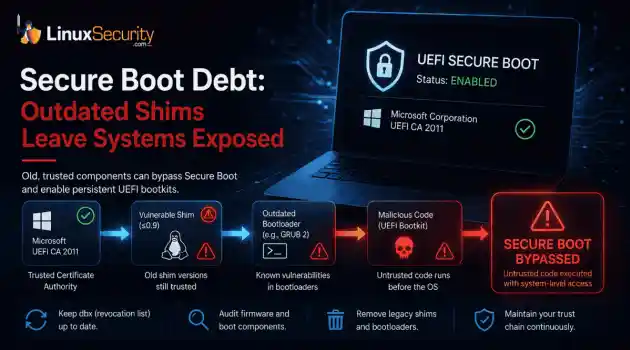
security advisory linux distribution ESET researchers identified 11 old and forgotten Linux UEFI shim bootloaders at versions 0.9 and below that can be used to bypass UEFI Secure Boot on any UEFI-based machine that trusts Microsoft’s Microsoft Corporation UEFI CA 2011 third-party certificate authority, regardless of the installed operating system (OS). Reported shims can be exploited to execute untrusted code during system boot, enabling attackers to deploy malicious UEFI bootkits even on systems with UEFI Secure Boot enabled.....
Jul 16, 2026
 Refine news
X Clear Filters
Get the latest News and Insights
Get the latest Linux and open source security news straight to your inbox.
Community Poll
Is continuous patching actually viable?
Loading...
Explore Latest Linux Security news
We found 5 articles for you...
209
 security toolsthreat mitigationsystem protection
Malware Scanning: Protect Linux Systems from Evolving Threats
As malware continues to evolve , it poses an ever-increasing threat to computing environments of all kinds - Linux systems included. While many may assume Linux is safe due to its robust built-in security features , such a mistaken assumption may open doors for exploitation. . Malware such as viruses, trojans, ransomware botnets, keyloggers, worms, and rootkits pose considerable threats, including data breach risks and potential operational disruption to organizations of any size. Thus, admins must remain vigilant, as even one infection could wreak havoc upon an organization's operations integrity, disrupting service delivery to customers or clients. Linux may seem secure at first glance; however, its inherent security can still be vulnerable. Unpatched software or improper configuration can expose systems to attacks like cryptojacking, where attackers use your resources for cryptocurrency mining without your knowledge, or DDoS attacks that severely disrupt operations. As a result of these vulnerabilities and risks, malware scanners such as ClamAV, Chkrootkit, or RKHunter help ensure a more secure operating environment by providing system administrators the means necessary for malware detection and mitigation so they can maintain stable and secure operating environments. In this article, we investigate practical tools for scanning Linux environments for malware, helping you develop reliable defense mechanisms against an ever-evolving threat landscape. Linux Malware Presents an Increasing Risk for Admins & Organizations Though Linux has historically been known as a highly secure operating system, Linux malware has seen an alarming uptick over recent years, raising significant concern among system administrators. Malware attacks targeting Linux systems have increased in both frequency and complexity. Backdoors and new malware families highlight the growing and evolving Linux malware threat. This trend presents Linux admins with an immense challenge. They must stay vigilant againstsuch complex and dangerous attacks while protecting their systems against newer and more dangerous threats that constantly emerge. Malware scanning is now essential for detecting and mitigating malware attacks before they cause extensive damage. Let's examine some excellent tools Linux admins can use for malware detection and elimination. Essential Tools for Scanning Linux Systems for Malware Admins and organizations need specialized malware scanning tools to mitigate Linux security risks effectively. ClamAV , for instance, is an open-source antivirus engine that detects various forms of malware. Its capabilities cover files, emails, and directories, providing system administrators with the flexibility they require in securing different environments. Its regularly updated virus database ensures maximum protection from newer threats. Chkrootkit is an invaluable tool for detecting rootkits—malware that embeds itself deeply within system processes to evade detection—by scanning for known signatures on system processes. It helps administrators quickly spot potential compromises that otherwise go undetected. Furthermore, its lightweight architecture and simple deployment make Chkrootkit an essential component of any Linux security toolkit. The Role of RKHunter in Vulnerability Assessment RKHunter enhances Linux systems' malware defenses with an integrative vulnerability assessment solution , offering comprehensive rootkit detection, system configuration evaluation, weak password scanning, and suspicious file change detection capabilities. It is invaluable in protecting systems by identifying and addressing vulnerabilities early before attackers can exploit them. It regularly executes to detect any possible malicious activities, helping uphold a robust security posture by effectively addressing vulnerabilities before outside forces can exploit them. Establishing an Effective Security Framework Implementing tools such as ClamAV, Chkrootkit, and RKHunter into any security framework isintegral. Regular scanning using these solutions can significantly lower the risk of malware infections, freeing organizations to focus on core operations without worrying about cyberattacks. However, these tools alone do not serve as sufficient defense. A comprehensive security strategy must incorporate user education, regular software updates , and best practices for secure system configuration to provide extensive protection from emerging threats. Let's examine some of these best practices in more detail. Best Practices for Protecting Against Linux Malware Training users on safe computing practices is vital in protecting Linux systems against malware. Making them aware of common dangers like phishing attacks or social engineering tactics empowers users to identify and avoid potential dangers. Additionally, implementing strict access control policies and creating strong password policies strengthen system defenses further. Regular software updates are also integral to maintaining robust security. By keeping all components current with updates, known vulnerabilities will be patched immediately, decreasing risk. Administrators should conduct routine audits to confirm that security measures are working properly and meet industry standards. Our Final Thoughts on Malware Scanning & Its Importance The increasing prevalence of malware in Linux environments underscores the necessity of employing effective malware scanning mechanisms. As sophisticated threats like cryptojacking and DDoS attacks advance and new attacks emerge, organizations cannot overlook the importance of strong security measures. By including robust tools like ClamAV, Chkrootkit, and RKHunter in their security strategies, system administrators can significantly improve their defenses against potential infections. Staying abreast of new threats and adapting security protocols are integral to maintaining Linux systems' integrity and security. An inclusive approach encompassing user education, software updates, andvigilant monitoring will ensure your systems can withstand emerging cyberattacks and threats. Organizations can protect critical assets while upholding operational continuity amid an ever-more hostile digital landscape by prioritizing security first and maintaining operational continuity over time. . Unix-based environments encounter vulnerabilities from malicious software such as worms, spyware, and backdoors. Discover essential detection utilities and methodologies.. Linux Malware, System Security Tools, Threat Detection Strategies, Anti-Malware Practices, Rootkit Prevention Software. . Anthony Pell
 Oct 10, 2024
•
Oct 10, 2024
• Security Trends
79
 Linux securitybest practicessystem security
Kernel.org Breach: Essential Security Tips for Linux Systems
As most folks know by now, a security breach affecting kernel.org was discovered in September. While that didn't affect kernel sources, it did get Linux kernel developers to thinking about their personal system security--and it might not be a bad idea for others to do the same.. Greg Kroah-Hartman kicked off the discussion with eight tips for doing a reality check on Linux systems. The first suggestion is to start from a clean install--but that's not always an option. Kroah-Hartman shared a few other tips, including using chkrootkit, OSSEC-rootcheck or rkhunter to see if a system has any rootkits. The link for this article located at ServerWatch is no longer available. . In light of a recent incident at kernel.org, Greg Kroah-Hartman discusses vital protective strategies to enhance the security of Linux environments.. Kernel Security, Rootkit Detection, Linux System Security. . LinuxSecurity.com Team
Oct 05, 2011
•
Security Projects

77
cybersecurity techniquessystem securityrootkit detectionRootkit Threats: Detection And Removal Strategies For Linux Systems
There's now a threat to online life that's so potentially potent it requires a new form of defence. Rootkits hide inside the operating system, actively defending themselves and hiding their presence. To arm your system against rootkits, you first need to understand them. So, where have they come from, how have they evolved and how, crucially, can they be stopped?. A rootkit is a program that allows a hacker to come and go as he pleases, unhindered by your computer's defences. No firewall will stop him and no antivirus program will detect his activities. Rootkits subvert the way the operating system works to make it lie about the processes, files, Registry entries and kernel modules that might give away the rootkit's presence to humans and antivirus software. Unlike viruses, rootkits have had a low profile for the past 20 years, but that's changing as their methods merge with those of mainstream malware to produce a threat that requires dedicated software to deal with it. The name 'rootkit' comes from the 'superuser' account in Unix (and Linux). This is called 'root', and logging into it gives the user complete control over the computer, arguably even more so than an administrator account does in Windows. Normally, only a system administrator has access to root because it's so powerful. The link for this article located at techRadar is no longer available. . A rootkit is a program that allows a hacker to come and go as he pleases, unhindered by your compute. there's, threat, online, that's, potentially, potent, requires, defence. . LinuxSecurity.com Team
Mar 25, 2010
•
Server Security
83
security researchrootkit detectionBlack HatBlack Hat Insights on Rootkit Detection Methods by Edgar Barbosa
Security researchers at the Black Hat show in Las Vegas are debating whether rootkits that mimic virtual machines can ever be detected. I have heard about virtual machine rootkits before but I did not think that they were undetectable. What do you think, are these rootkit really invisible? . She returned to Black Hat this year to acknowledge that researcher Edgar Barbosa has come closest to devising a method for detecting Blue Pill. "Congratulations to Edgar," she said, during the highly technical presentation she made with her colleague, researcher Alexander Tereshkin. Rutkowska said they hadn't yet found a way to evade Barbosa's so-called counter-based detection method, which he presented during July's SyScan conference. The link for this article located at TechWorld is no longer available. . She returned to Black Hat this year to acknowledge that researcher Edgar Barbosa has come closest to. security, researchers, black, vegas, debating, whether, rootkits, mimic. . LinuxSecurity.com Team
Aug 04, 2007
•
Hacks/Cracks
83
threat analysissecurity analysisrootkit detectionExploring Kernel Malware and Rootkit Threats: F-Secure Insights
Security analysts have been predicting that kernel rootkits, which cloak their activity by replacing a portion of a program's software kernel with modified code, are expected to continue to grow in frequency in 2007. While rootkit-fighting technologies such as the PatchGuard kernel protection system built into 64-bit versions of Microsoft's new Windows Vista operating system are arriving, most PC users will still be left open to the attacks over the next twelve months, CA has said, and even experienced PC users are vulnerable to their sophisticated techniques. . F-Secure Security Labs has been tracking and dissecting kernel malware for years; this form of attack was first spotted as far back as 1999, in the form of the WinNT/Infis attack. F-Secure researcher Kimmo Kasslin has made the findings available in a paper titled "Kernel Malware: The Attack from Within" (a PDF) as well as in a slide show (also a PDF). The link for this article located at eweek is no longer available. . F-Secure Security Labs has been tracking and dissecting kernel malware for years; this form of attac. security, analysts, predicting, kernel, rootkits, which, cloak, their, activity, replacing. . LinuxSecurity.com Team
Feb 26, 2007
•
Hacks/Cracks
78
security toolsdetection methodssystem securityExplore Six Rootkit Detection Tools For System Protection
In October 2005, Windows expert Mark Russinovich broke the news about a truly underhanded copy-protection technology that had gone horribly wrong. Certain Sony Music CDs came with a program that silently loaded itself onto your PC when you inserted the disc into a CD-ROM drive. Extended Copy Protection (or XCP, as it was called) stymied attempts to rip the disc by injecting a rootkit into Windows . The concept of the rootkit isn't a new one, and dates back to the days of Unix. An intruder could use a kit of common Unix tools, recompiled to allow an intruder to have administrative or root access without leaving traces behind. Rootkits, as we've come to know them today, are programs designed to conceal themselves from both the operating system and the user The link for this article located at InformationWeek is no longer available. . Rootkit development has evolved alongside tech advancements, becoming complex systems that infiltrate OS deeply. This article reviews 6 effective rootkit detection tools. Rootkits Detection,System Integrity Preservation,Unix Security Tools. . LinuxSecurity.com Team
Jan 18, 2007
•
Vendors/Products
79
intrusion detectionlog analysisopen sourceNew Features in OSSEC HIDS v0.9-3 for Enhanced Security Monitoring
OSSEC HIDS is an Open Source Host-based Intrusion Detection System. It performs log analysis, integrity checking, rootkit detection, time-based alerting and active response. It runs on most operating systems, including Linux, OpenBSD, FreeBSD, Solaris and Windows. This new release comes with multiple features, including support for Modsecurity logs, MS exchange, MS FTPD and Windows firewall logs. It also includes a port to HP-UX and numerous bug fixes and new features. . To download the new version: More information at: OSSEC - World's Most Widely Used Host Intrusion Detection System - HIDS The link for this article located at Daniel Cid is no longer available. . To download the new version: More information at: OSSEC - World's Most Widely Used Host Intrusion De. ossec, source, host-based, intrusion, detection, system, performs, analysis, integr. . LinuxSecurity.com Team
Oct 20, 2006
•
Security Projects
78
security technologyrootkit detectionmalware preventionGamma: New Anti-Rootkit Tool for PCs by Government-Funded Startup
A startup funded by the U.S. government's Defense Advanced Research Projects Agency is ready to emerge from stealth mode with hardware and software-based technologies to fight the rapid spread of malicious rootkits. Komoku, of College Park, Md., plans to ship in the summer a beta of Gamma, a new rootkit detection tool that builds on a prototype used by several sensitive U.S. government departments to find operating system abnormalities that may be linked to malicious rootkit activity. Rootkits modify the flow of the kernel to hide the presence of an attack or compromise on a machine. This gives a hacker remote user access to a compromised system while avoiding detection by anti-virus scanners. . The company's Copilot prototype is a high-assurance PCI card capable of monitoring the host's memory and file system at the hardware level. It is specifically geared toward high-security servers and computers. Gamma, meanwhile, is a separate, software-only clone of Copilot that will target businesses interested in a low-assurance tool to protect laptops and PCs. The link for this article located at eWeek is no longer available. . Gamma rootkit detection software, backed by a government initiative, excels at finding and neutralizing evasive malware on PCs and laptops with ease and efficiency. Rootkit Detection, Malware Prevention, Security Technology, Copilot PCI Card, Government Research. . LinuxSecurity.com Team
Apr 27, 2006
•
Vendors/Products

Get the latest News and Insights
Get the latest Linux and open source security news straight to your inbox.
Community Poll
Is continuous patching actually viable?
Search Topics
Powered By

Linux Security - Your source for Top Linux News, Advisories, HOWTOs and Feature Releases
QUICK LINKS
subscribe to newsletters!
Like staying secure? So do we.
Sign up for updates, tips, and alerts!